Follow water from the soil up the xylem and out of the leaf, and sugar from a leaf to a root through the phloem, with the osmosis and potometer practicals.
A giant redwood can stand more than a hundred metres tall, and yet no pump lifts the water to its highest leaves. A strawberry plant can send sugar from its leaves to a fruit that is growing a metre away. A cut flower in a vase drinks water for days without a heart or a muscle in sight. Plants have solved the problem of transport in a quiet and clever way, and the solution is a favourite topic for GCSE examiners.
This guide explains how substances move into, through and out of a plant. We start with the simple physics of osmosis, then follow water from the soil into a root hair, across the root, up the xylem and out of the leaf. We then look at how sugars travel in the phloem, how to measure transpiration with a potometer, and how to answer the most common exam questions.
Why Does a Plant Need a Transport System?
A plant is a multicellular organism, so its parts do different jobs. Leaves make food, roots take in water and minerals, and flowers make seeds. The things that a cell needs are often made in one place and used in another, so they must be moved. Diffusion alone is far too slow to carry substances over the height of a tree, so plants have two transport tissues, xylem and phloem, helped along by osmosis and transpiration.
What is moved
From
To
Why
Water
Roots
Leaves
For photosynthesis and to keep cells firm
Mineral ions
Soil
All parts
For growth, proteins and chlorophyll
Sucrose
Leaves
Roots, fruits and stores
For respiration and storage
Amino acids
Leaves
Growing parts
To build proteins
Four processes drive the movement. Diffusion is the net movement of particles from high to low concentration, and it matters for gas exchange in leaves. Osmosis is the net movement of water across a partially permeable membrane, and it brings water into root hair cells. Active transport moves particles against a gradient using energy, and it takes mineral ions into roots and loads sucrose into the phloem. Transpiration is the evaporation of water from the leaves, and it pulls water up the xylem.
Osmosis and Water Potential
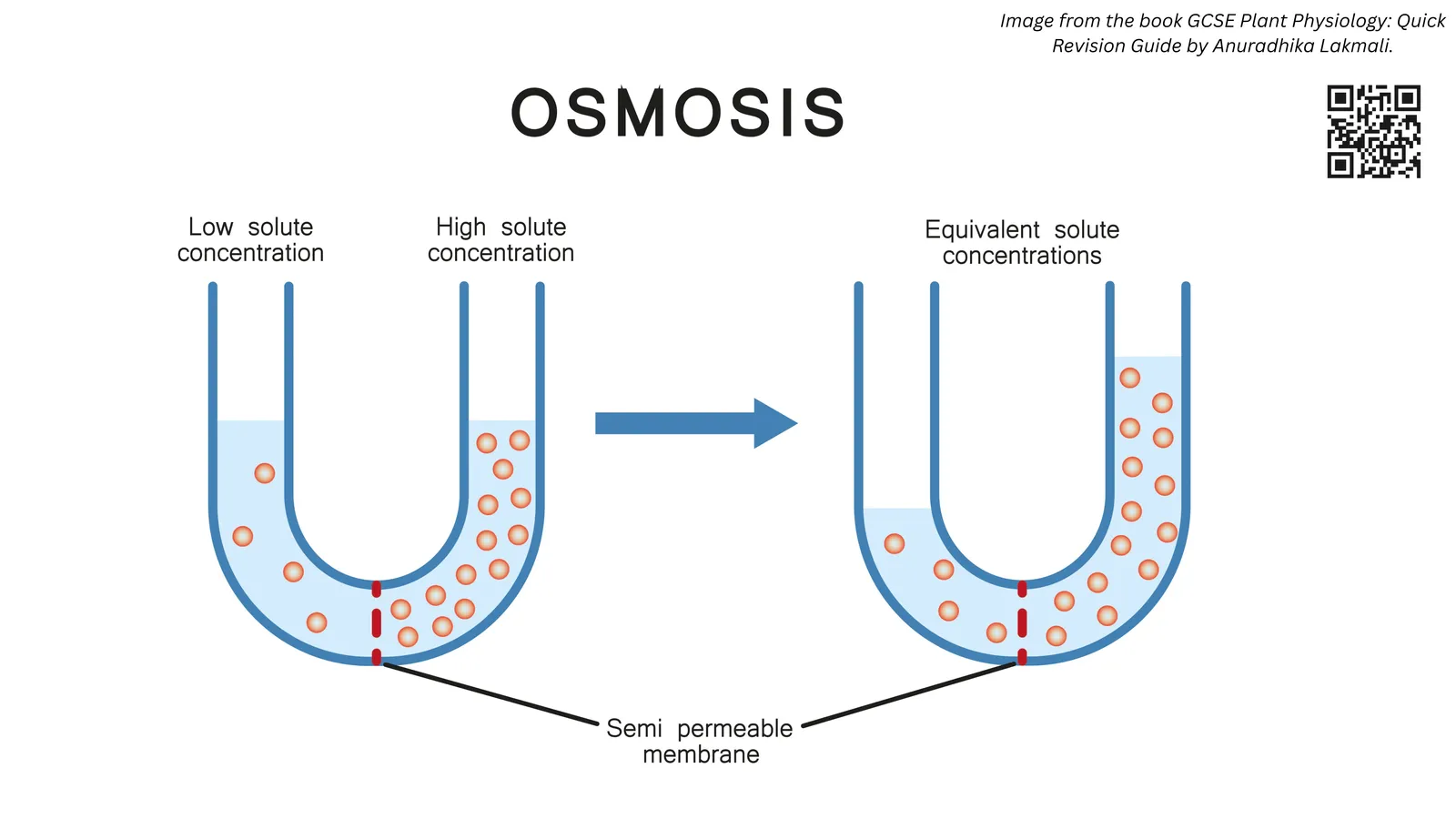
Osmosis is the net movement of water molecules from a region of higher water potential to a region of lower water potential through a partially permeable membrane. Water potential describes how freely water molecules can move. Solute particles hold on to water molecules, so the more solute there is, the lower the water potential. Pure water has the highest water potential of all. Water always moves down the water potential gradient, from high to low.
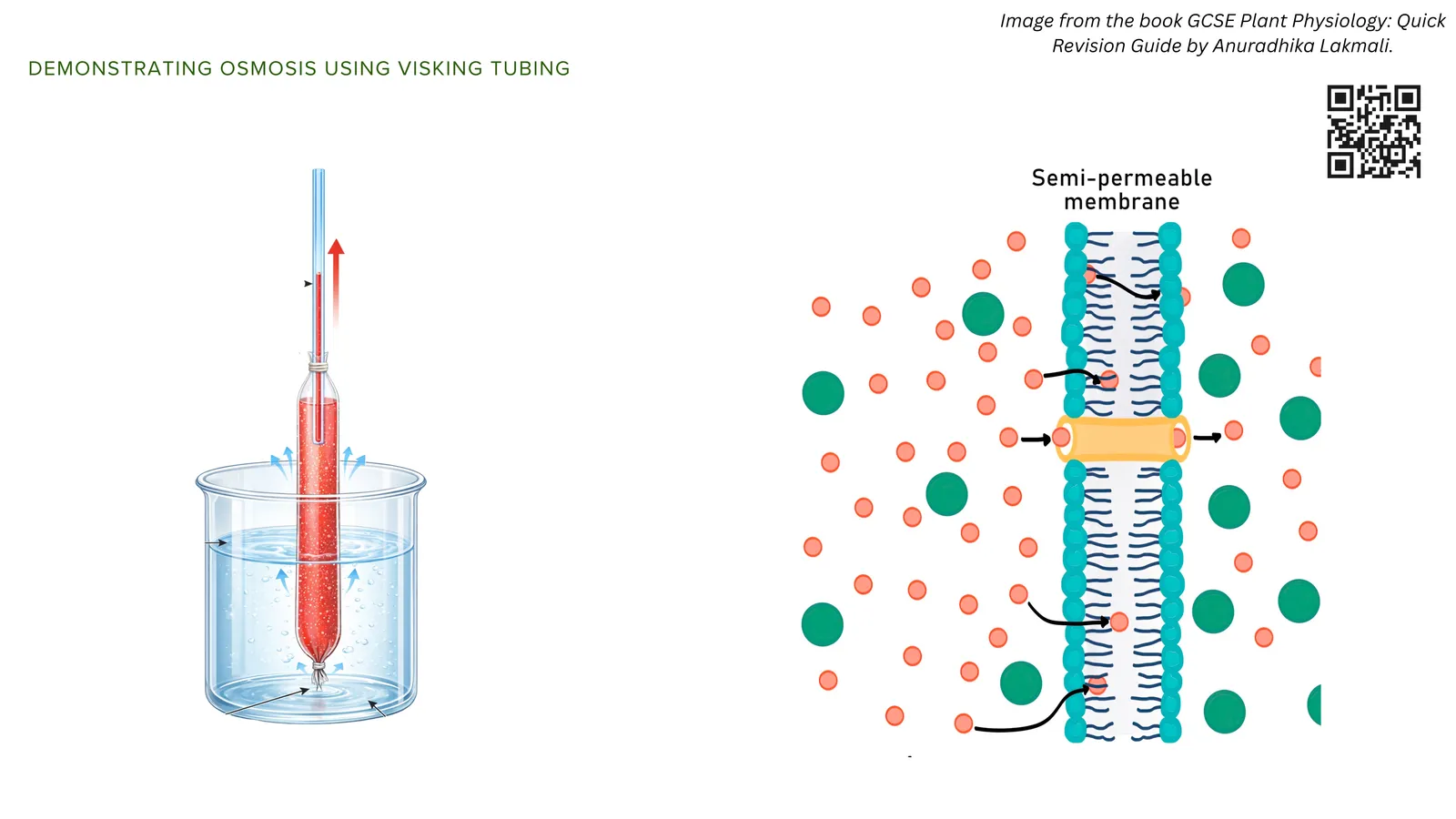
A partially permeable membrane has tiny pores that let small molecules such as water pass through, but stop larger molecules such as sucrose. The cell surface membrane is one example, and Visking tubing is an artificial one. Osmosis is passive, which means it needs no energy from the cell, and only the water moves, not the solute. In exams, always say net movement and always say partially permeable.
A simple demonstration uses Visking tubing. Fill a tube with concentrated sucrose solution, fit a capillary tube in the open end and stand it in a beaker of distilled water. The liquid level in the capillary tube rises, because water moves from the beaker, where the water potential is higher, into the sucrose solution, where it is lower. The sucrose molecules are too large to leave through the pores. Repeat with different sucrose concentrations to compare how far the level rises.
💧
Slides: Osmosis
Water moves through a partially permeable membrane
1/2
Plant Cells in Different Solutions
What happens to a plant cell depends on the water potential of the solution around it. Because plant cells have a strong cellulose wall, they do not burst.
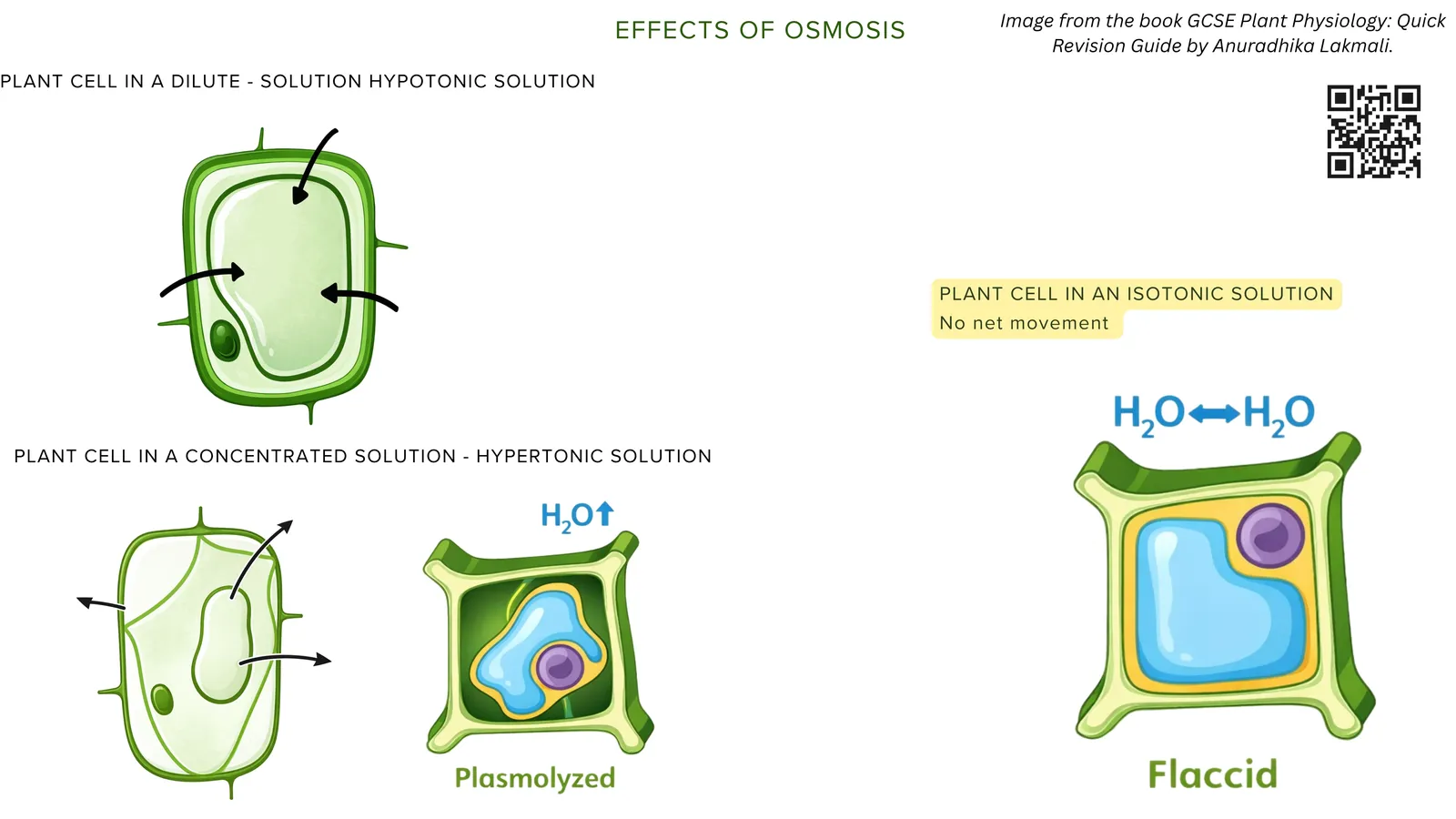
In pure water or a dilute solution, the outside has a higher water potential, so water enters by osmosis. The vacuole swells and pushes the cytoplasm against the wall. Pressure builds up, which is called turgor pressure, and the cell becomes turgid, firm and swollen.
In a concentrated solution, the outside has a lower water potential, so water leaves the cell. The cell shrinks and becomes flaccid, soft and limp.
If water loss continues, the cytoplasm shrinks so much that the membrane pulls away from the wall. The cell is then plasmolysed.
Solution outside
Water potential outside
Water moves
Cell becomes
Pure water or dilute
Higher than the cell
In
Turgid
Same as the cell
Equal
No net movement
Flaccid
Concentrated
Lower than the cell
Out
Flaccid, then plasmolysed
A plasmolysed cell can be put back in water. Water re-enters, the membrane returns to the wall and the cell becomes turgid again.
Animal cells have no cell wall, so they behave differently. A red blood cell placed in pure water swells and bursts. Placed in a concentrated salt solution, it shrinks and becomes crenated, with crinkled edges.
Why turgor matters
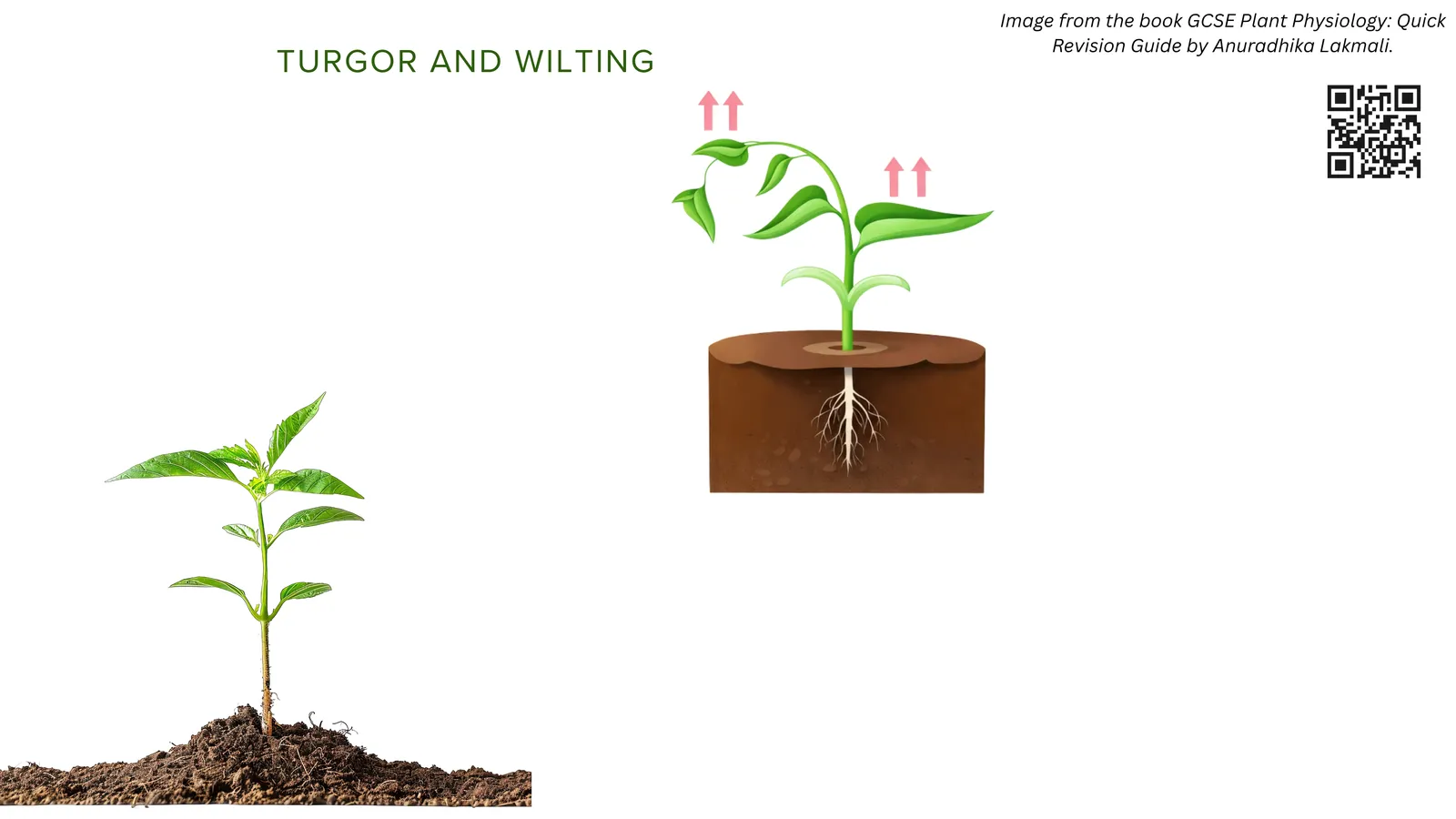
When cells are turgid they press against each other, and this pressure supports non-woody stems and holds leaves out flat to catch light. If a plant loses more water than its roots can take in, its cells become flaccid and the plant wilts. Wilting actually protects the plant for a while, because drooping leaves expose less surface to the Sun and the stomata close. A wilted lettuce becomes crisp again in cold water because its cells take in water and become turgid.
🌱
Slides: Plant cells, turgor and wilting
Turgid, flaccid and plasmolysed cells
1/2
The Two Classic Osmosis Practicals
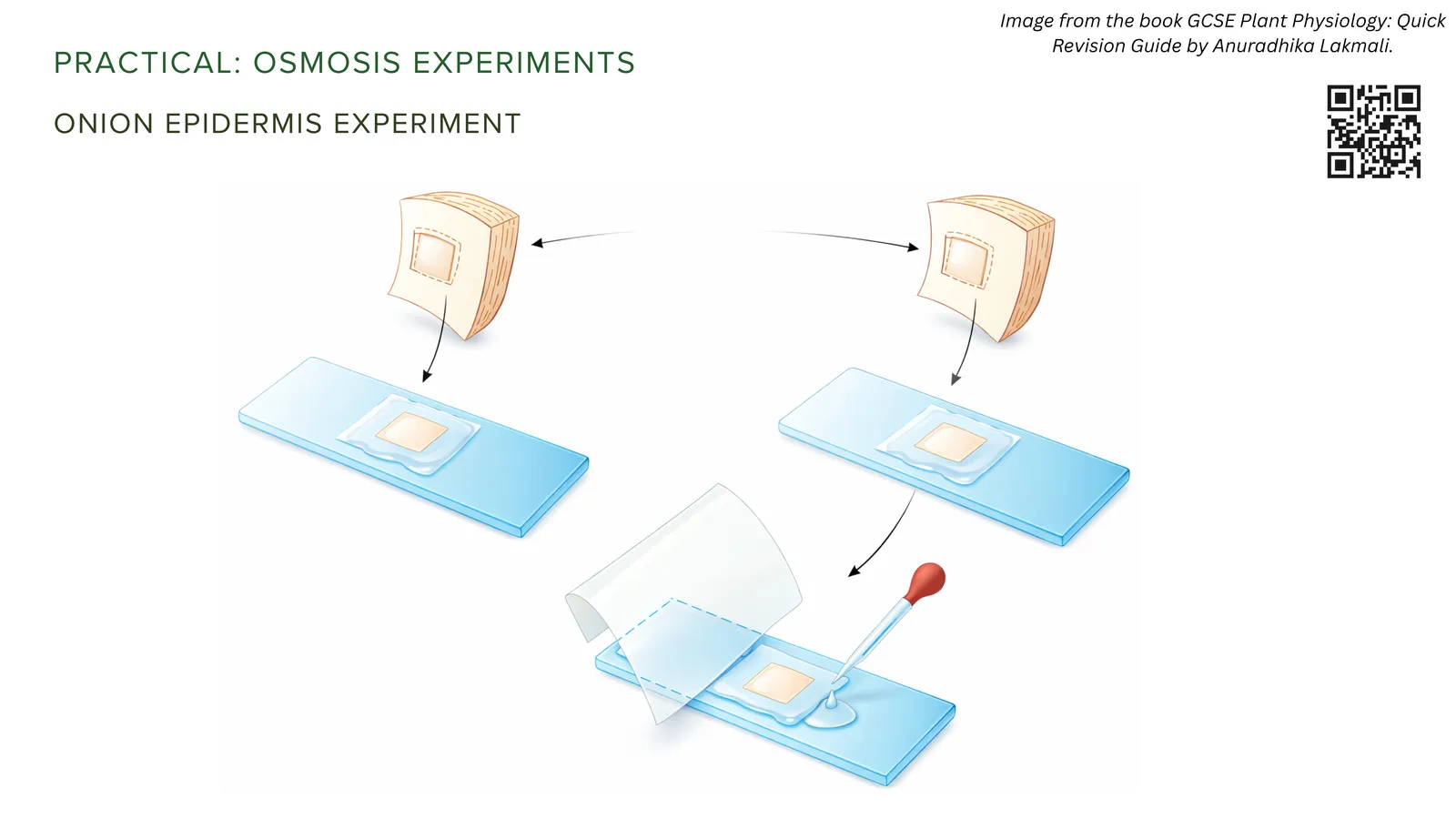
Onion epidermis
Put a drop of concentrated sucrose solution on one slide and a drop of distilled water on another. Peel two small squares of thin onion epidermis, place one in each drop, lower a cover slip at an angle to avoid bubbles, blot the excess liquid and observe under a microscope. In distilled water the cells look full and firm. In concentrated sucrose the cells gradually plasmolyse. Red onion is useful because its cell sap is coloured, so plasmolysis is easier to see. If the sucrose is replaced with distilled water, the cells slowly return to turgid, which shows they were alive and that osmosis caused the change.
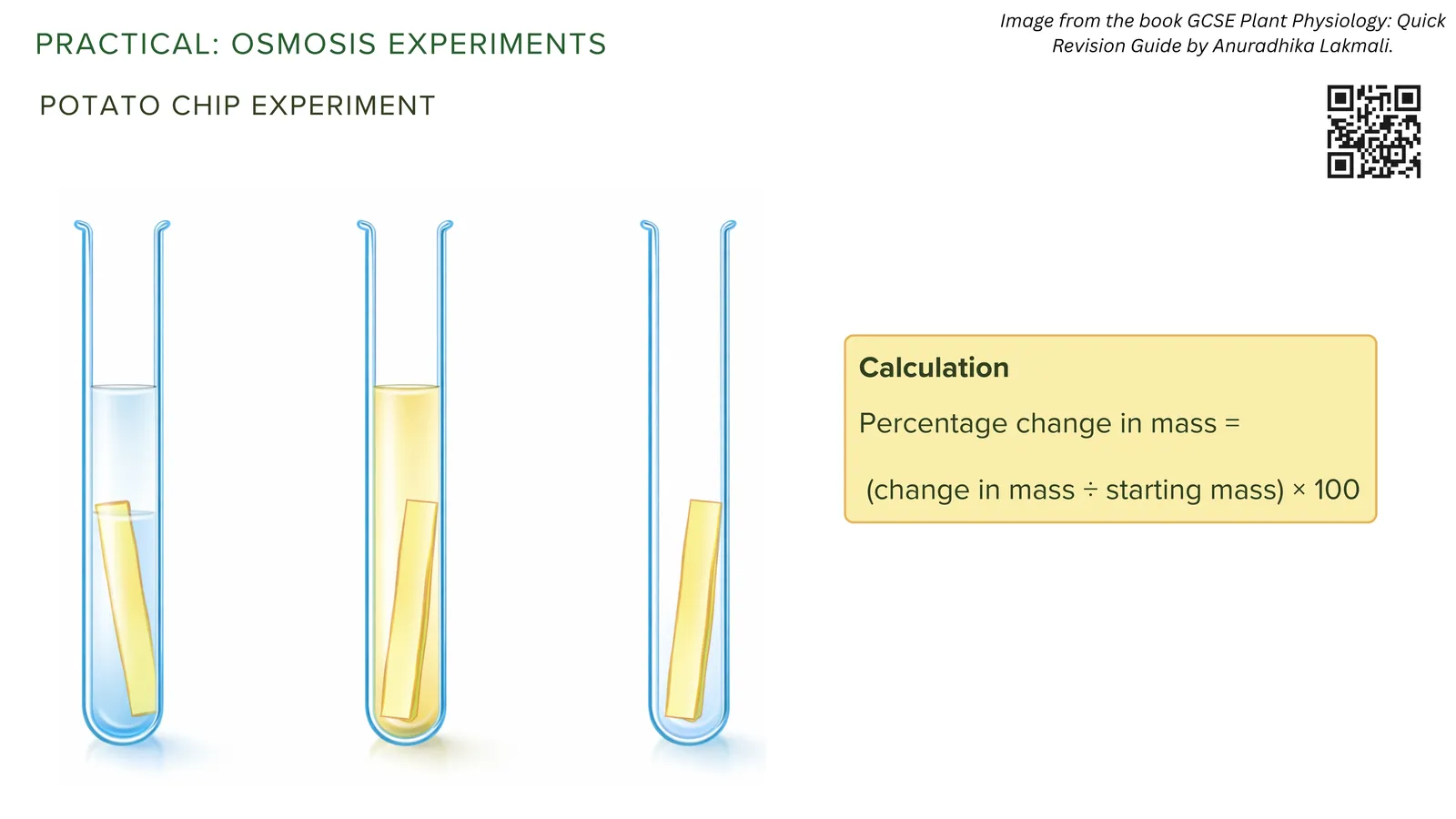
Potato chips
Cut chips of equal size, remove the skin, blot them dry and record the starting mass of each. Place one in distilled water, one in concentrated sucrose and one in an empty tube as a control. After thirty minutes, blot the chips dry and weigh them again. The chip in water gains mass and feels stiff. The chip in sucrose loses mass and feels floppy. The control changes very little.
To compare chips fairly, calculate the percentage change in mass using the formula: change in mass divided by starting mass, multiplied by 100. A chip that rises from 2.0 g to 2.3 g has changed by 0.3 divided by 2.0 times 100, which is plus 15 percent. A fall gives a negative value. Where a graph of percentage change crosses zero, the solution matches the water potential of the potato cells. To improve reliability, use several chips per solution and calculate a mean, and use more concentrations of sucrose.
🔬
Slides: The osmosis practicals
Onion epidermis and potato chips
1/2
How Roots Take in Water and Minerals
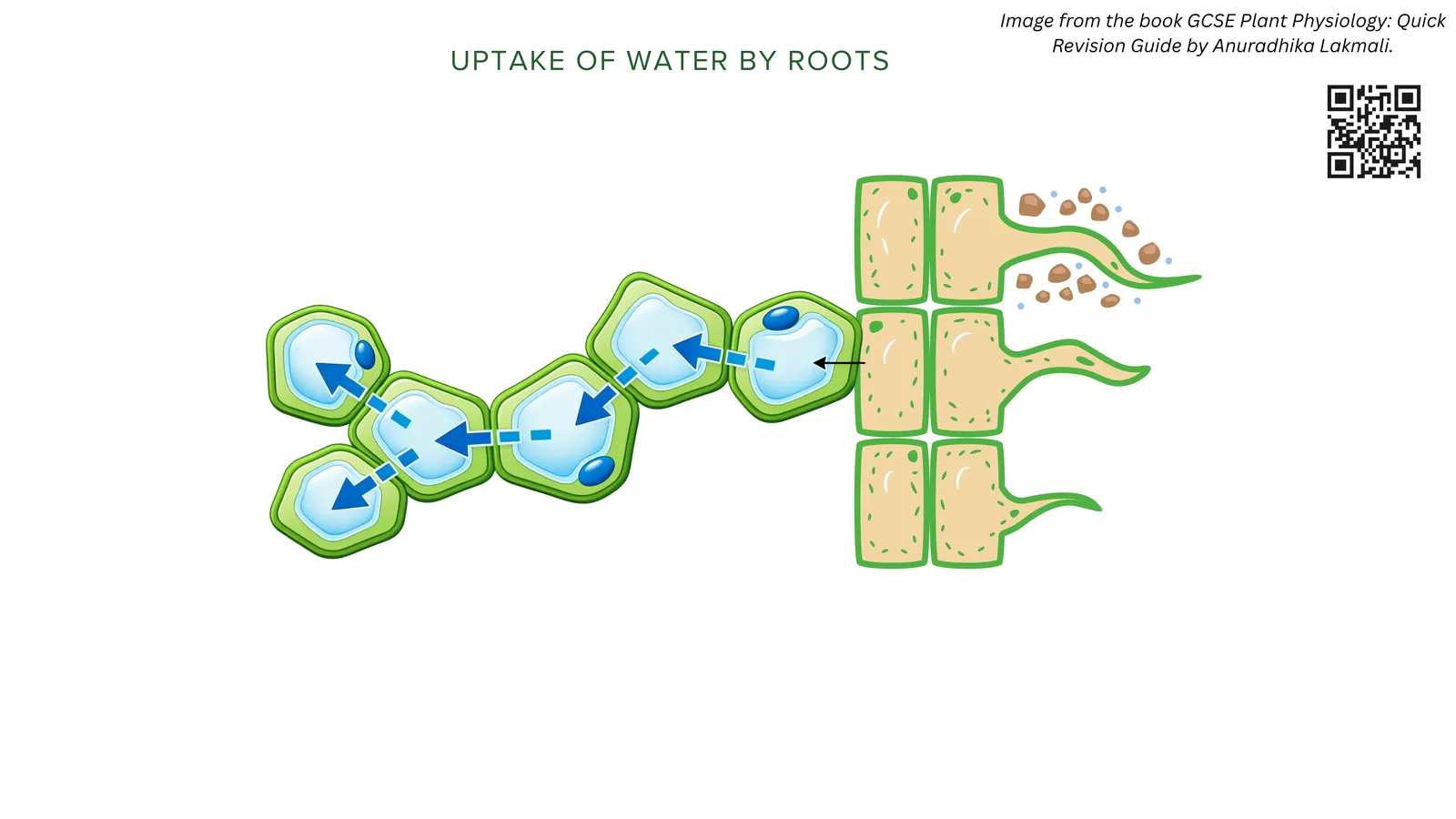
Just behind the growing tip of each root are thousands of root hair cells. Each is a single cell of the root epidermis with a long, thin extension that pushes between soil particles and touches the thin film of water around them.
Feature
Why it helps
Long, thin root hair
Very large surface area for absorption
Thin cell wall
Short distance for water to move into the cell
Many mitochondria
Release energy for active transport of mineral ions
Carrier proteins in the membrane
Pump specific ions into the cell
No chloroplasts
Roots are underground in the dark
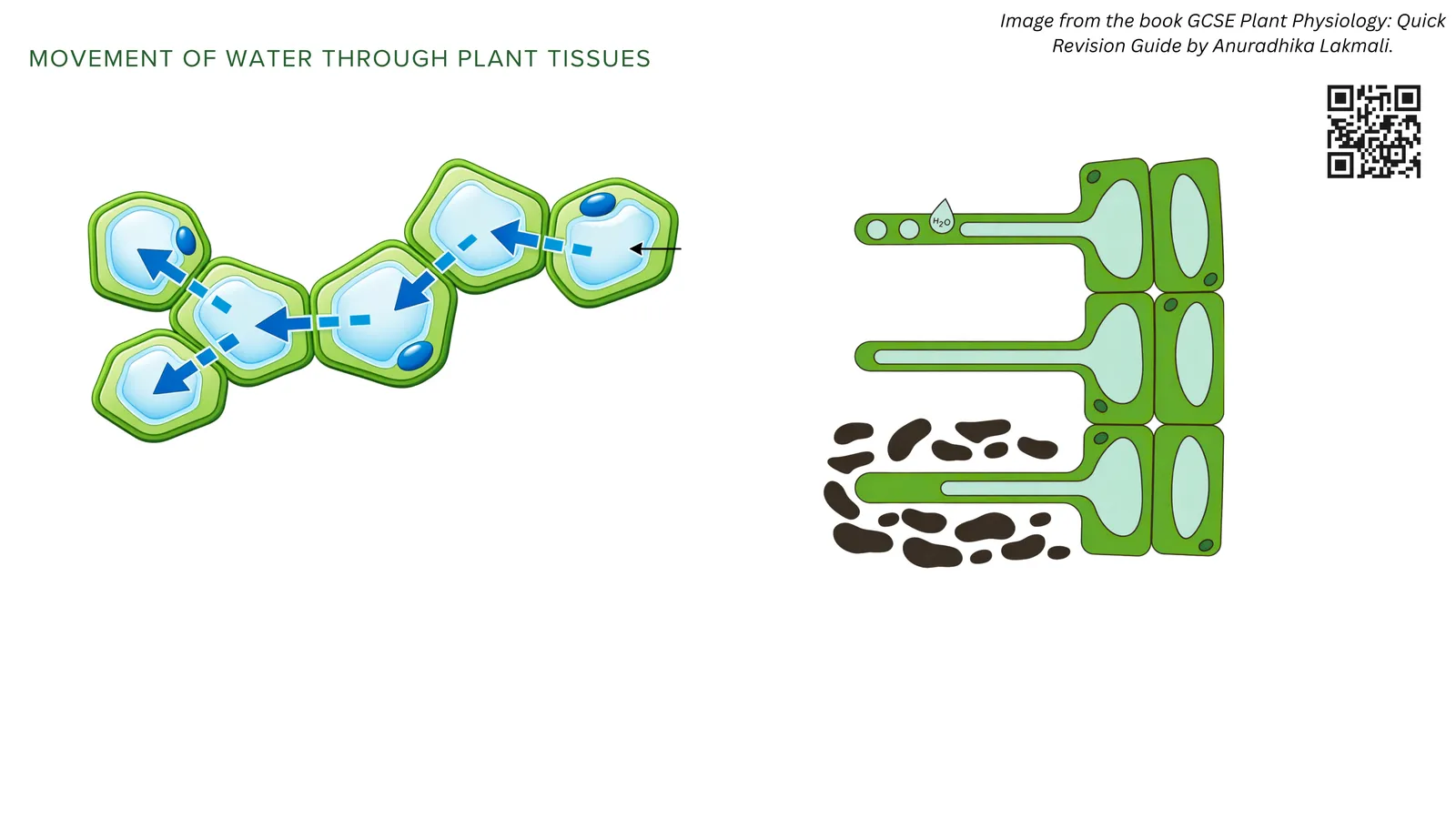
The cell sap of a root hair contains sugars and ions, so it has a lower water potential than the soil water. Water therefore enters by osmosis. The water dilutes the cell, raising its water potential above that of the next cell inward, so water passes from cell to cell across the cortex until it reaches the xylem. The gradient is kept going because water is constantly removed into the xylem.
Mineral ions are usually more concentrated inside the root hair than in the soil, so they cannot enter by diffusion. They are pumped in against the concentration gradient by active transport, which uses energy from respiration. This is why waterlogged soil harms plants. With no air, the roots cannot respire aerobically, so they cannot supply energy for active transport.
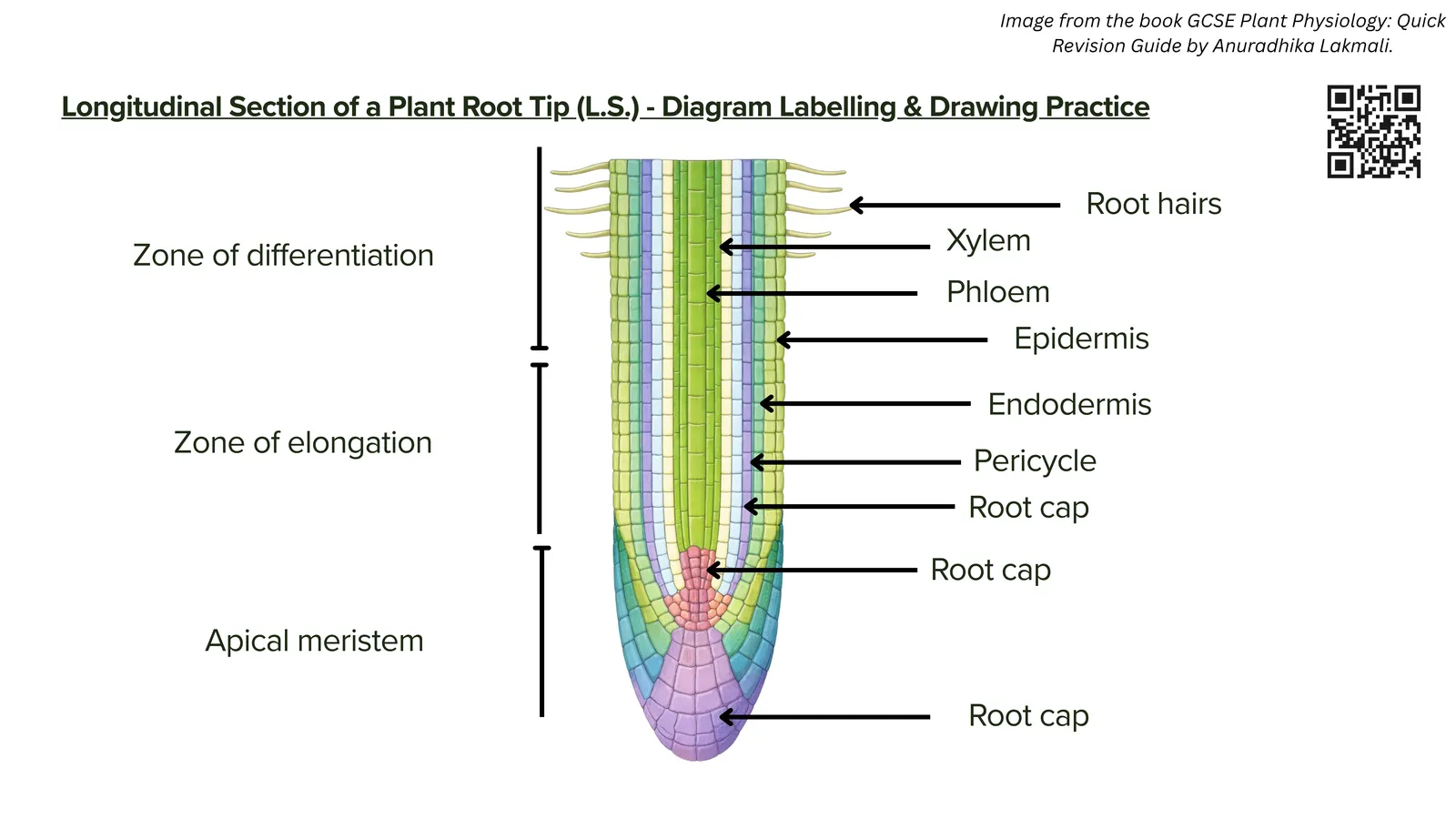
A longitudinal section of a root tip shows three zones. At the apical meristem, cells divide rapidly by mitosis, and a root cap protects the tip. In the zone of elongation, new cells take in water and lengthen. In the zone of differentiation, cells become specialised into root hairs, xylem and phloem.
🌾
Slides: Water uptake by roots
Root hairs, the cortex and the root tip
1/3
Xylem: The Water Pipeline
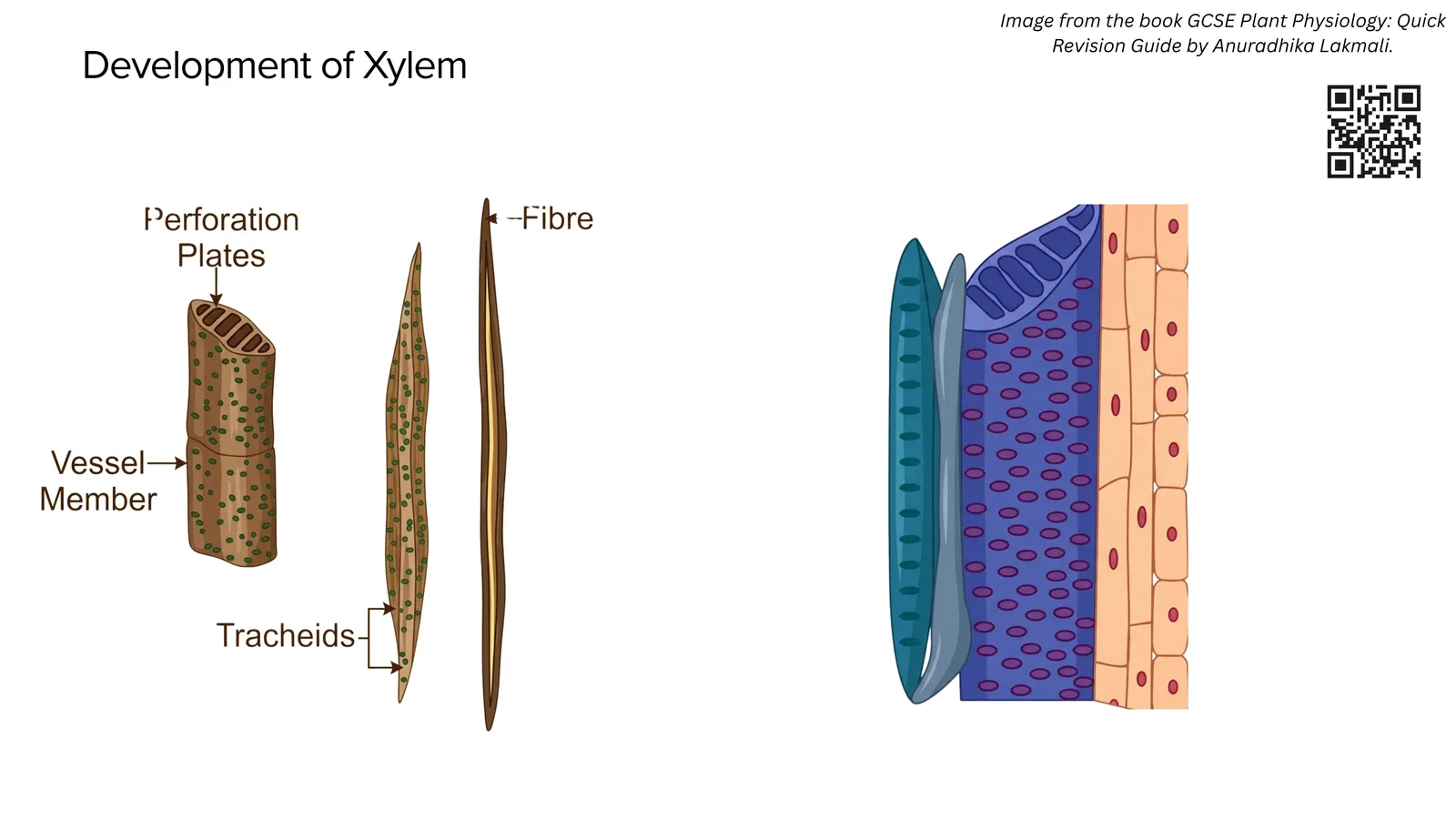
Xylem carries water and mineral ions from the roots to the stem and leaves. It moves them upwards only. A xylem vessel is a long, hollow tube made of dead cells joined end to end.
A vessel forms as a living cell elongates and its wall is thickened with lignin. The cytoplasm and the end walls break down, and the cell dies, leaving a hollow tube called a lumen. Lignin makes the walls strong and waterproof, stops the tube collapsing under the pulling force of transpiration, and helps to support the plant.
Xylem is more than vessels. Tracheids are long, narrow cells with pits that carry water and give support. Xylem fibres are thick-walled cells that give strength. Xylem parenchyma is the only living part of the xylem and stores starch.
🪵
Slide: Xylem tissue
Vessels, tracheids and fibres
1/1
Phloem: The Food Delivery Service
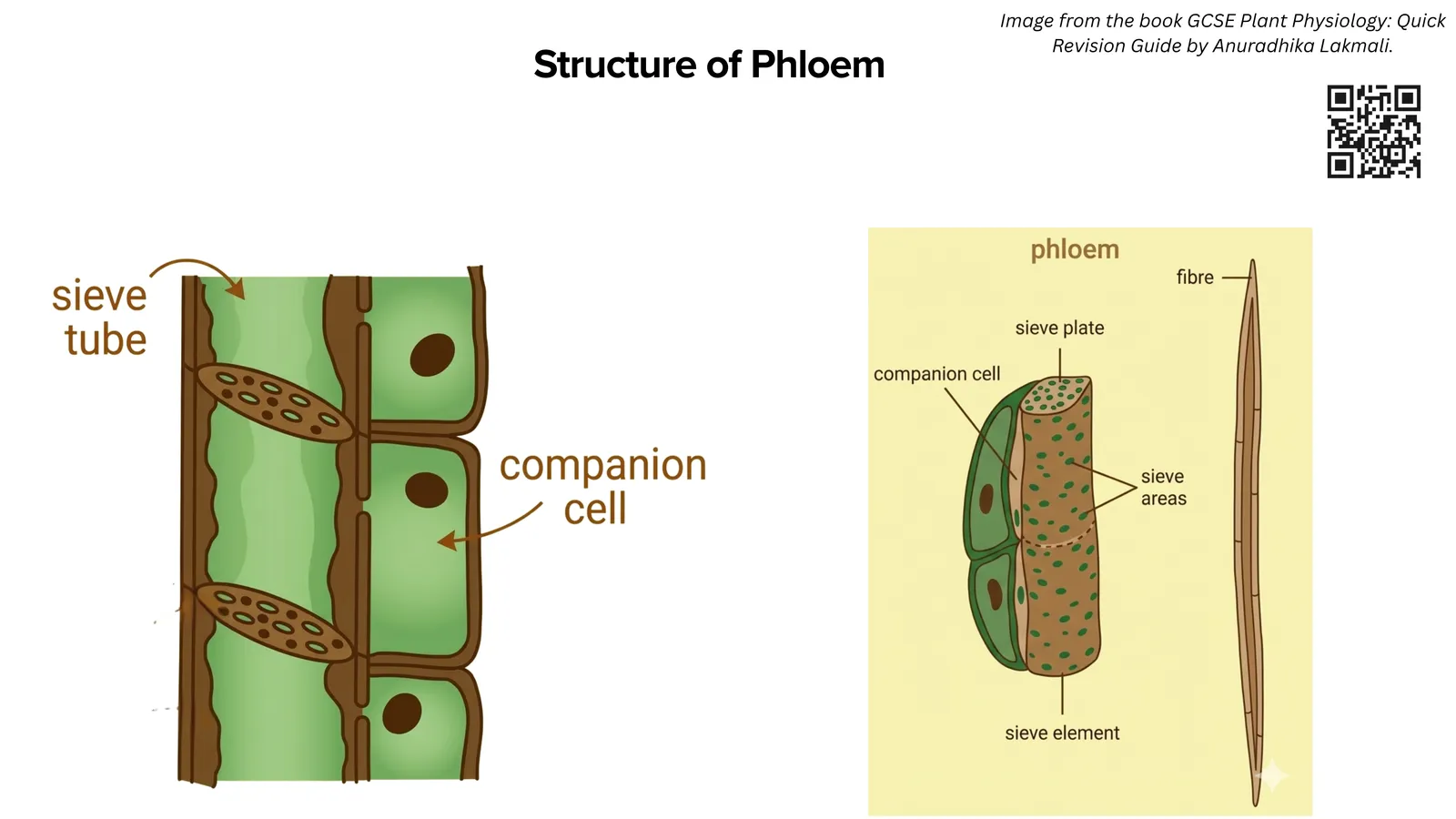
Phloem carries the products of photosynthesis, mainly sucrose and amino acids dissolved in water to form sap. Unlike xylem, phloem moves substances in both directions, up and down, to wherever they are needed. It is made of living cells.
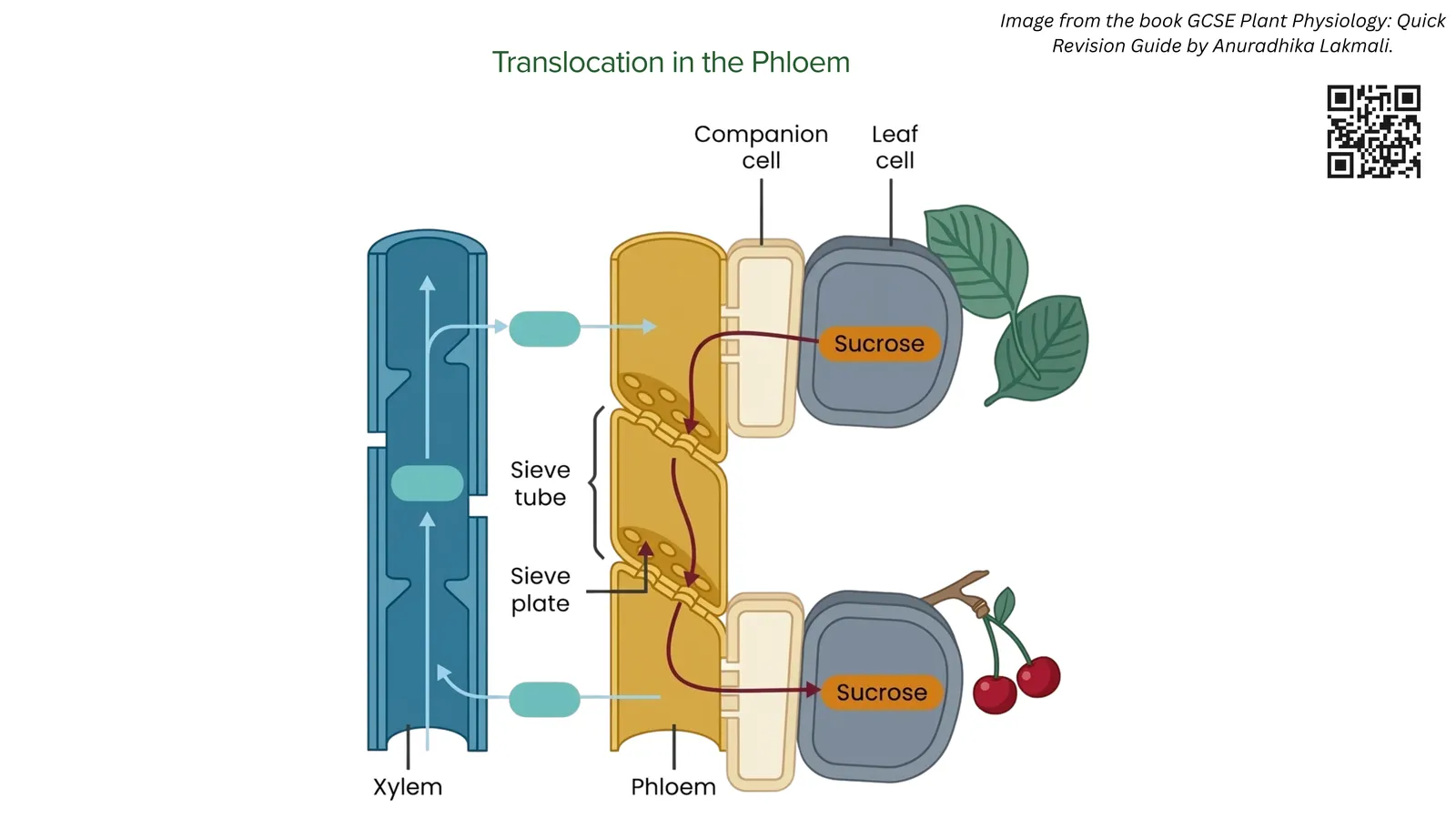
Sieve tube cells are arranged end to end. Their end walls, called sieve plates, have small holes so that cytoplasm passes from one cell to the next. Sieve tubes have no nucleus and few organelles, which leaves more room for sap. Beside each sieve tube is a companion cell. It has a nucleus and many mitochondria, controls the sieve tube cell, and uses energy to load sucrose into the tube.
Feature
Xylem
Phloem
Carries
Water and mineral ions
Sucrose and amino acids
Direction
Upwards only
Up and down
Cells
Dead, hollow, lignified
Living sieve tubes and companion cells
End walls
None or perforated
Sieve plates
Energy needed
No, it is passive
Yes, it is active
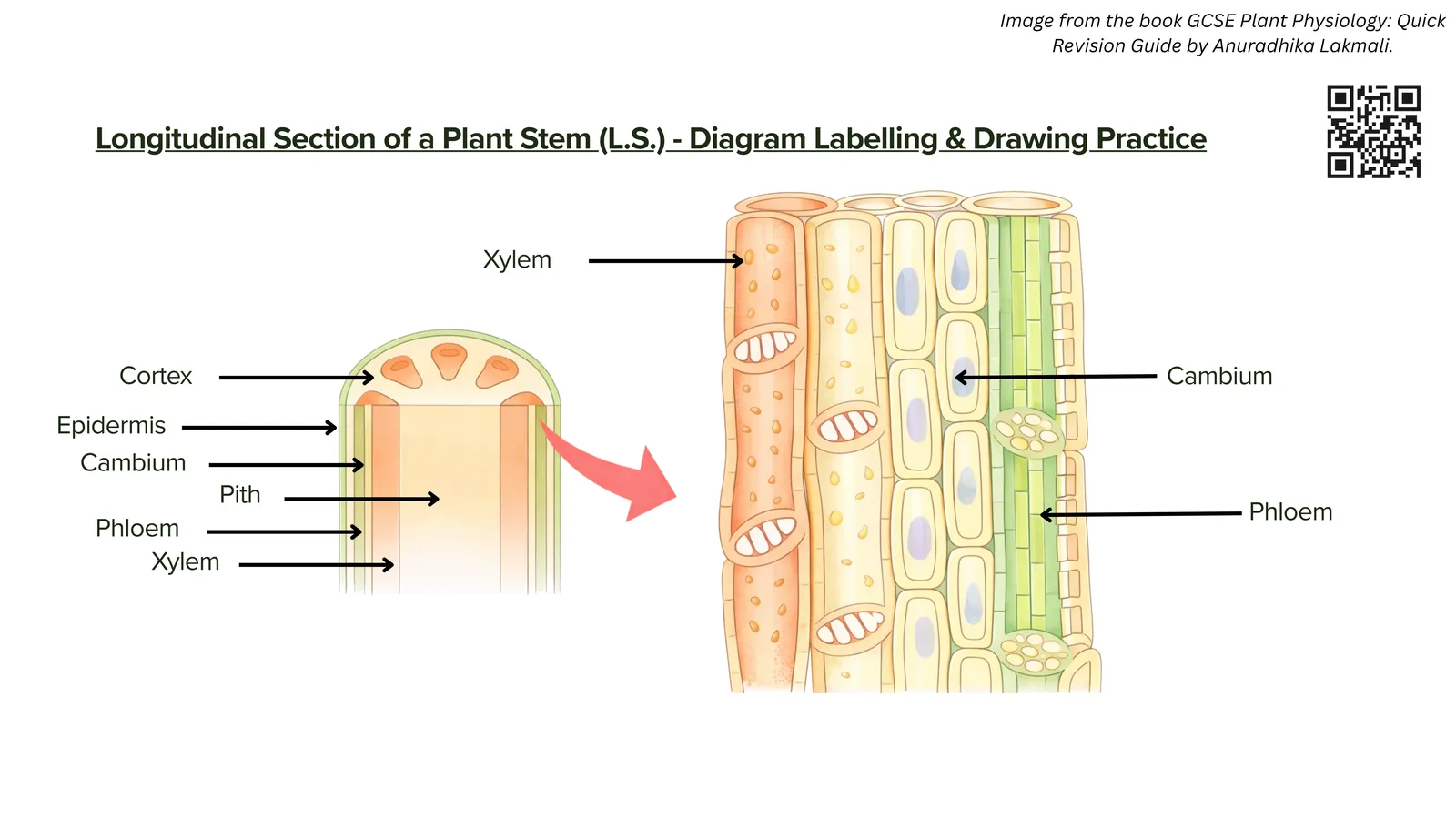
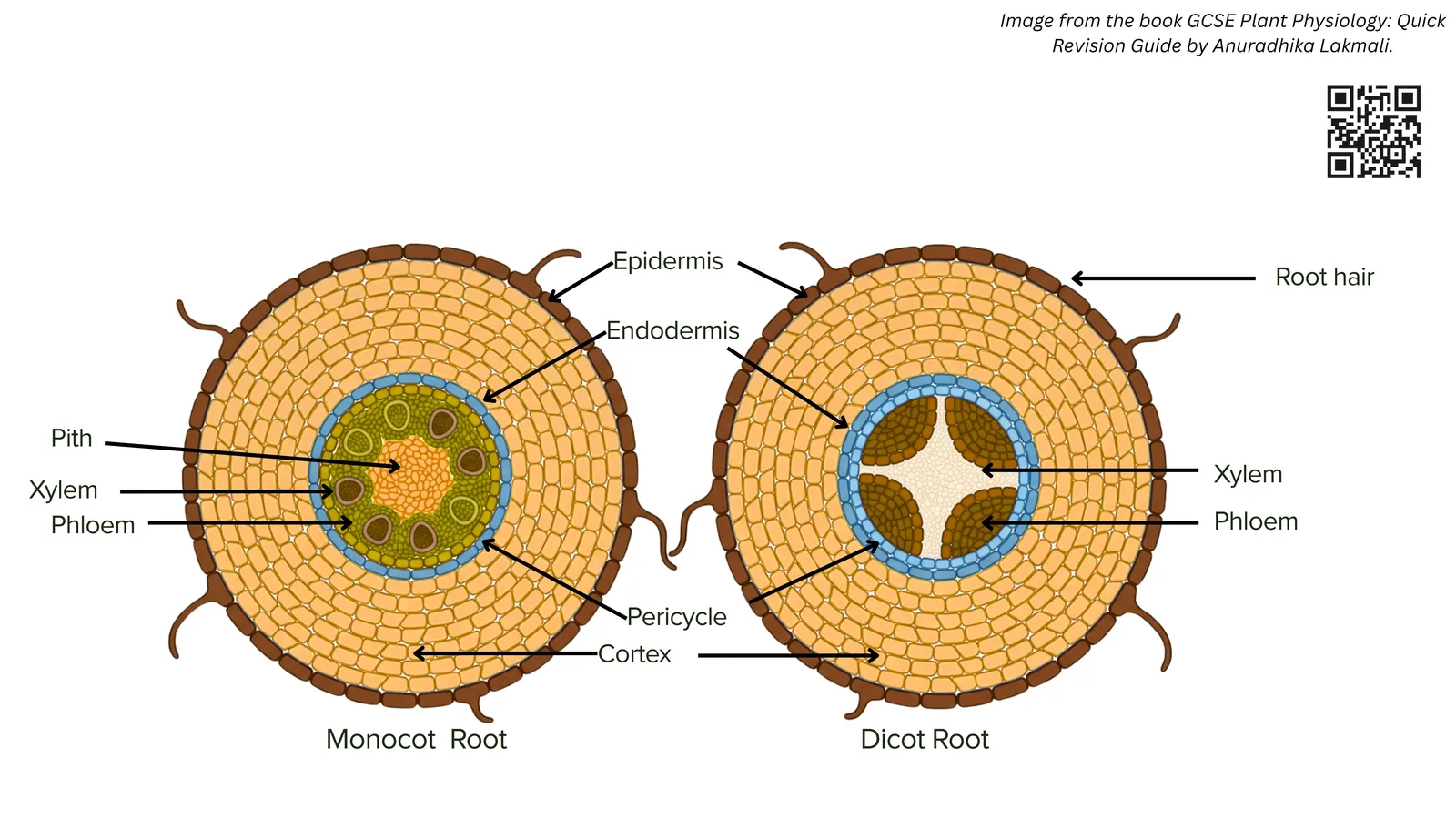
Together, xylem and phloem form vascular bundles. In a dicot stem the bundles form a ring near the edge, with xylem inside and phloem outside, separated by cambium that divides to make new tissue. In a dicot root, xylem forms an X-shaped core in the centre, with phloem between its arms, which resists pulling forces. In a leaf, the bundles form the veins, with xylem on the upper side and phloem on the lower side. A monocot stem has bundles scattered through it instead of in a ring.
🍬
Slides: Phloem and vascular bundles
Sieve tubes, companion cells and where the bundles sit
1/5
Translocation: Moving Sugars From Source to Sink
Translocation is the movement of dissolved organic substances through the phloem from a source to a sink. A source releases sugar into the phloem, such as a photosynthesising leaf, or a storage organ in spring. A sink uses or stores sugar, such as roots, growing buds, flowers, fruits and stores that are filling up. A potato tuber is a sink in summer and a source in spring, which shows how the same organ can switch roles.
Translocation is an active process. Companion cells use energy to load sucrose into the sieve tubes at the source. Water then enters from the xylem by osmosis, which raises the pressure and pushes the sap towards the sink, where unloading lets the water leave again. That idea is called mass flow, and it is a higher tier extension.
Feature
Transpiration stream
Translocation
Tissue
Xylem
Phloem
Carries
Water and mineral ions
Sucrose and amino acids
Direction
Up
Source to sink, in any direction
Energy
Passive, driven by evaporation
Active, needs energy
🔁
Slide: Translocation in the phloem
Sucrose moves from source to sink
1/1
Transpiration: The Water Highway
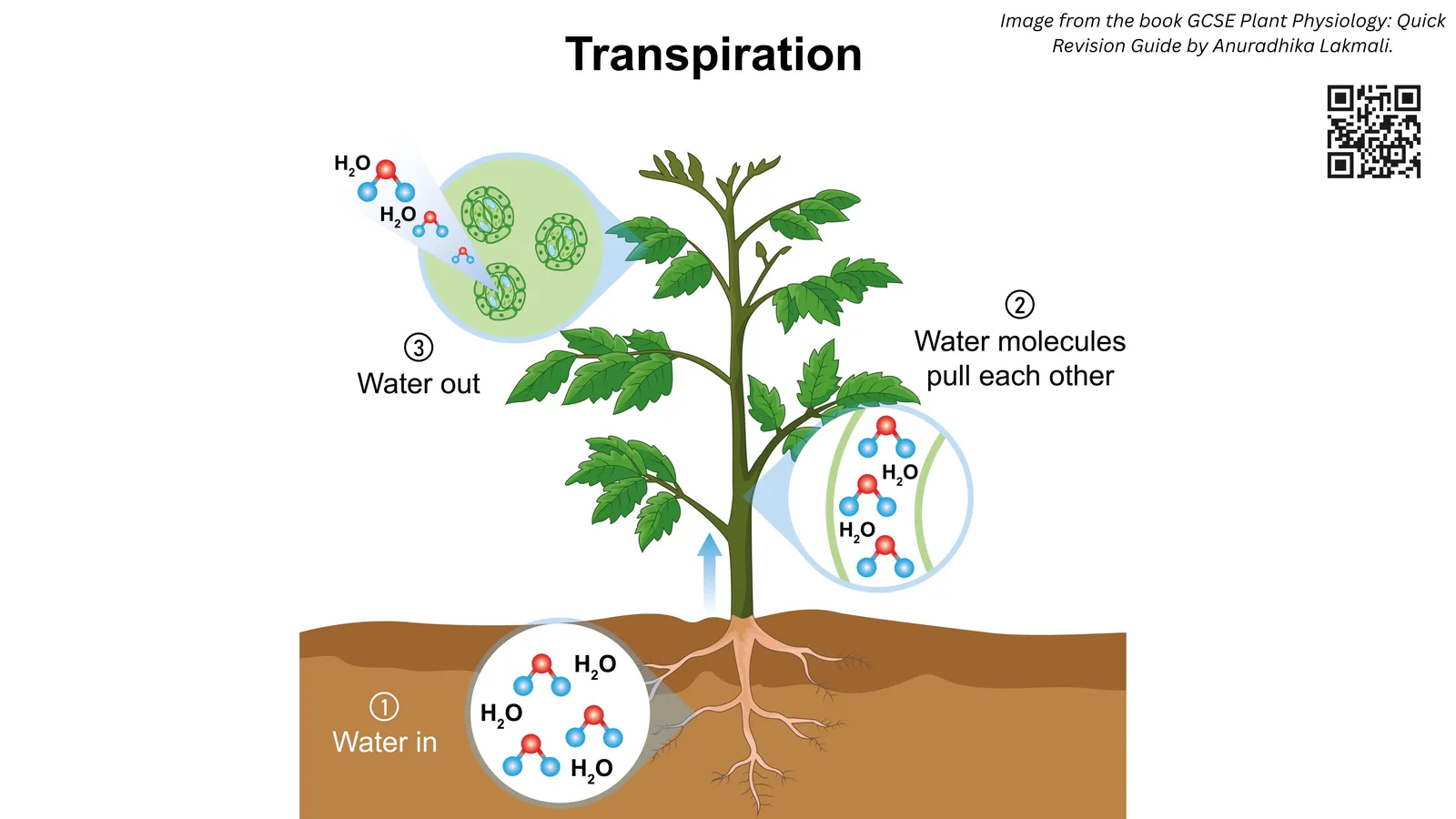
Transpiration is the loss of water vapour from the leaves, mainly through the stomata. Water evaporates from the wet surfaces of the mesophyll cells into the air spaces inside the leaf, then diffuses out through the open stomata. As water leaves, more is pulled up the xylem to replace it. This continuous flow from roots to leaves is the transpiration stream.
Water molecules stick together, a property called cohesion, so the pulling force passes down the whole column like a rope. Evaporation at the top drives the stream, so the plant does not use its own energy to lift the water. The stream is useful because it supplies water for photosynthesis, keeps cells turgid, carries mineral ions to the leaves and cools the leaf, much as sweating cools us.
The journey of a water molecule can be told in six steps. It enters a root hair by osmosis, crosses the cortex cell to cell, enters the xylem, rises up the stem, leaves the xylem in the leaf and evaporates from the mesophyll cells, then diffuses out through a stoma. In exams, use the words evaporation and diffusion in the right order, and remember that transpiration is the loss of water vapour, not liquid water.
🌿
Slide: Transpiration
From root hair to stoma
1/1
Factors That Affect the Rate of Transpiration
Anything that speeds up evaporation, or makes the water vapour gradient between the leaf and the air steeper, increases the rate of transpiration.
Factor
Effect on rate
Explanation
Light intensity
Increases
More stomata open in bright light to let carbon dioxide in
Temperature
Increases
Water molecules have more energy, so they evaporate and diffuse faster
Wind
Increases
Wind blows away water vapour near the leaf, keeping the gradient steep
Humidity
Decreases
Moist air already holds vapour, so the gradient is shallower
For every factor, give the effect and the reason. A good answer reads: humidity increases, so the diffusion gradient is shallower, so transpiration decreases.
Guard cells and stomata
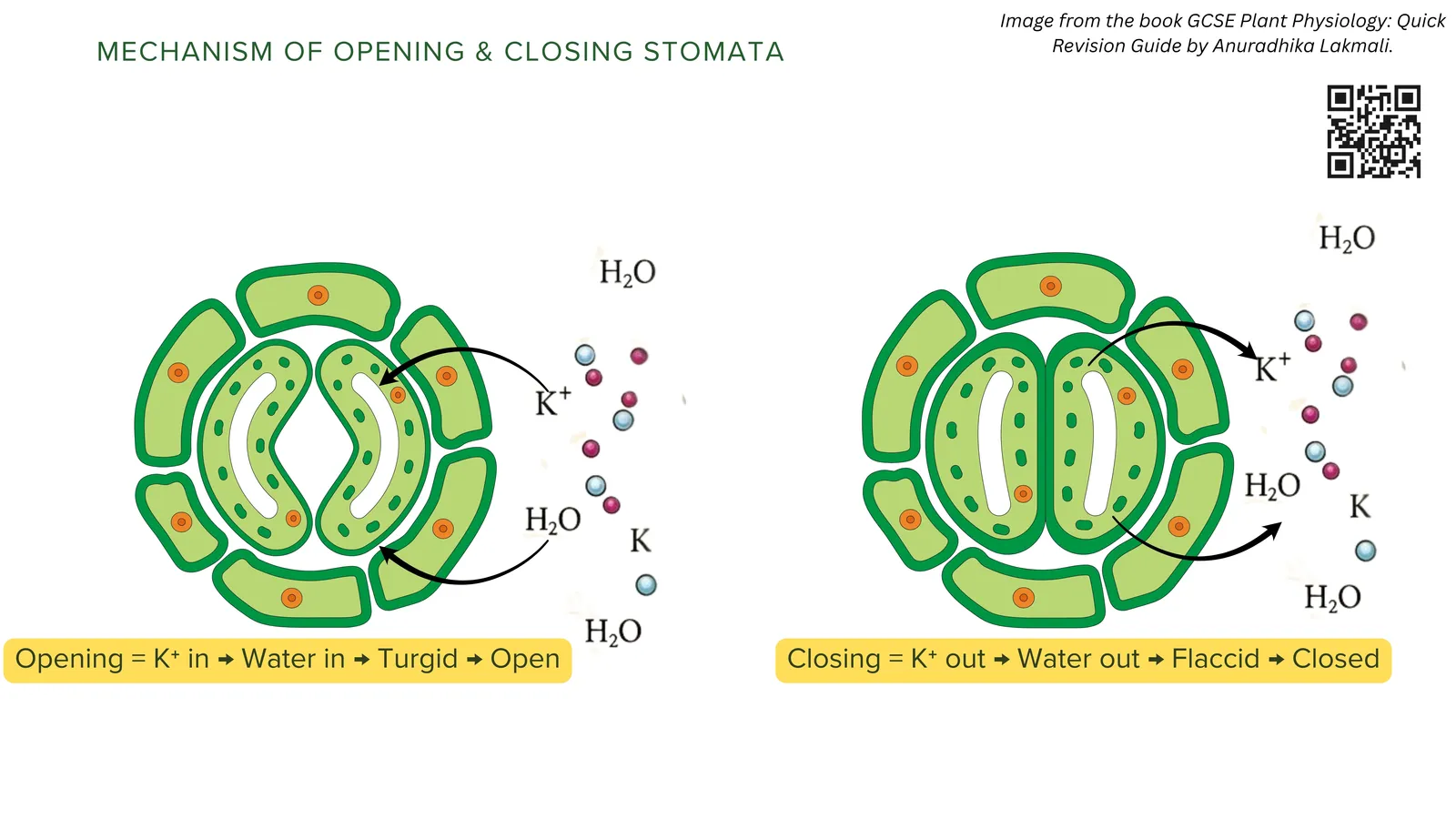
Guard cells open and close stomata. In the light they take in potassium ions, water follows by osmosis, and the cells become turgid. The thicker inner wall stretches less, so the cells curve apart and the pore opens. In the dark, potassium ions leave, water leaves, the cells become flaccid and the pore closes. Closing saves water, but it also stops carbon dioxide entering, so photosynthesis slows.
🚪
Slide: Opening and closing stomata
Potassium ions and water move in or out of guard cells
1/1
Plants of dry habitats
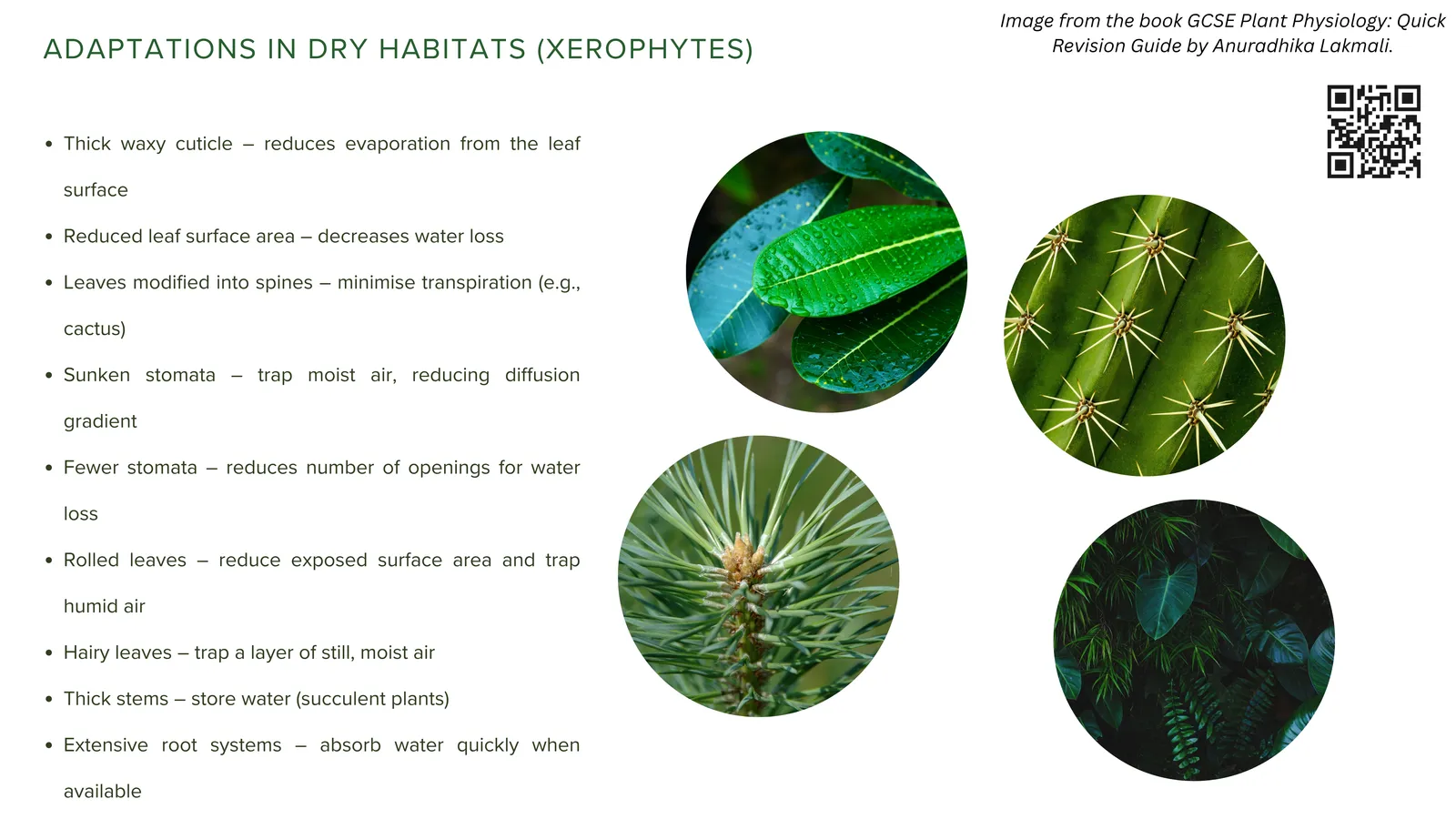
Xerophytes are plants adapted to dry places. A thick waxy cuticle, reduced leaf area, leaves reduced to spines, sunken stomata that trap moist air, fewer stomata, rolled leaves, hairy leaves and fleshy stems that store water all reduce transpiration. Cacti photosynthesise with their green stems, and many open their stomata at night when it is cool. Marram grass rolls its leaves and has sunken stomata. Plants that live in water, called hydrophytes, have the opposite problem, so a water lily has stomata on its upper surface and large air spaces that help it float.
🌵
Slide: Xerophyte adaptations
How plants of dry habitats save water
1/1
Measuring Transpiration With a Potometer
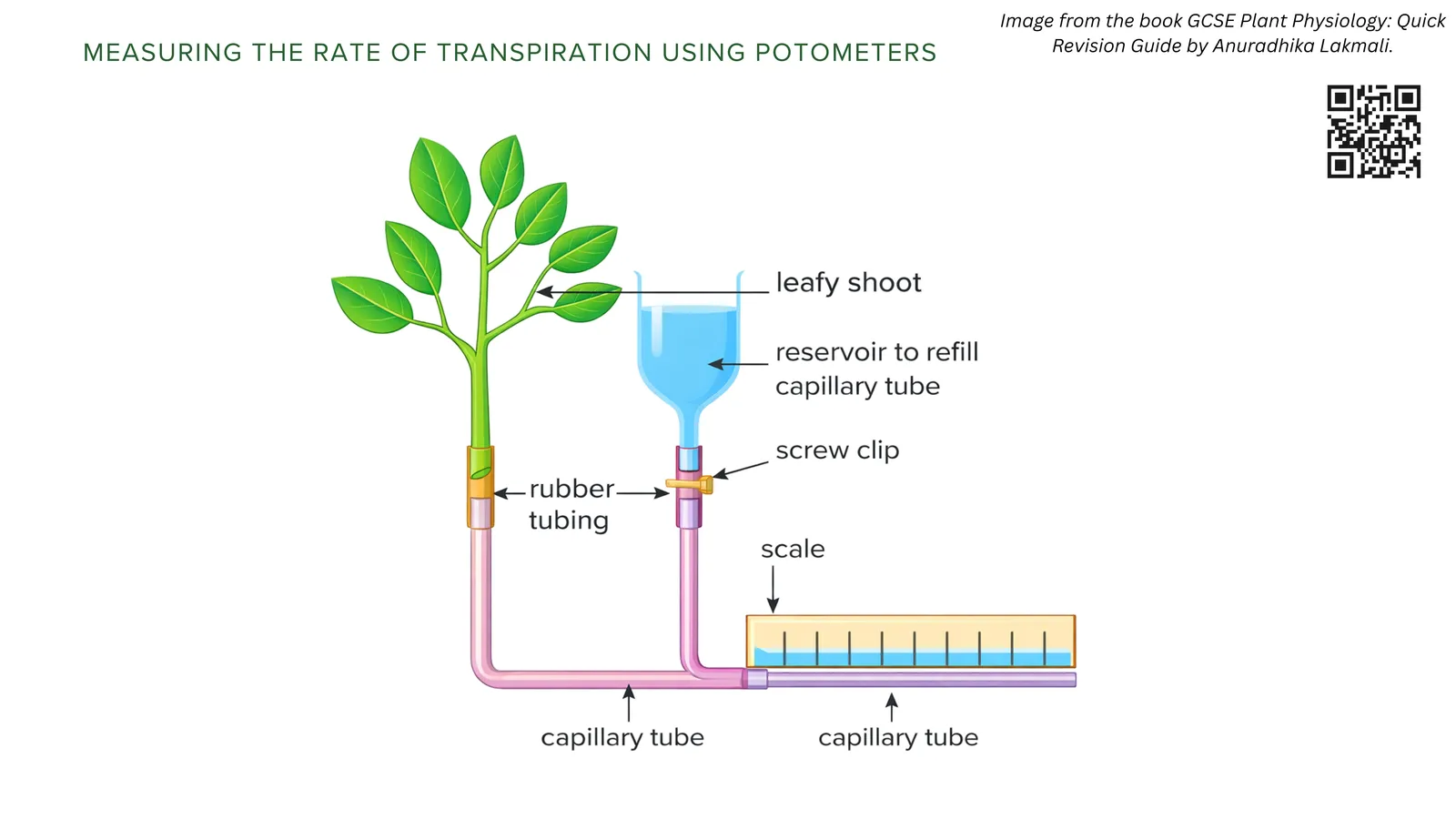
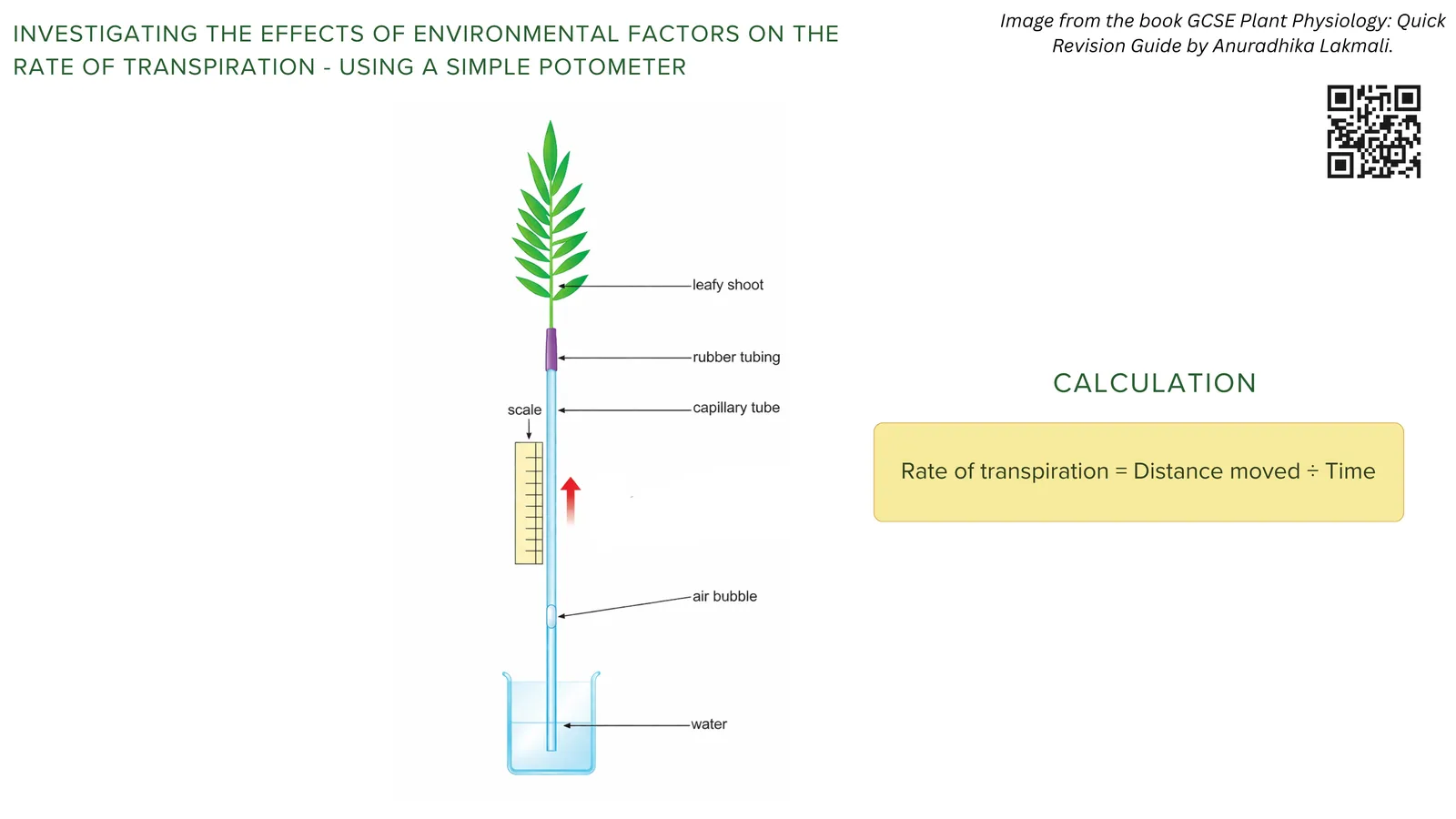
A potometer measures the rate at which a shoot takes up water. Almost all of that water is lost by transpiration, so uptake is a good estimate of the transpiration rate. It is not exact, because a little water is used in photosynthesis and kept in the cells.
1. Fill the apparatus with water and make sure there are no air bubbles.
2. Cut a leafy shoot under water and fix it in the rubber tubing. Cutting under water stops air entering the xylem, which would form a blockage called an air embolism.
3. Make every joint airtight, using petroleum jelly if needed.
4. Clamp the apparatus upright and let it settle.
5. Introduce one air bubble into the capillary tube and note its position.
6. Measure how far the bubble moves in a fixed time.
7. Change one factor only, such as wind from a fan or light from a lamp, let the shoot settle, and repeat.
The rate is distance moved divided by time. If a bubble moves 45 mm in 5 minutes, the rate is 9 mm per minute. To find the volume, multiply the distance by the cross-sectional area of the capillary tube. With an area of 0.8 mm² the volume is 36 mm³, so the rate is 7.2 mm³ per minute. The results should show that wind and bright light increase the rate.
Two other methods are used. A weight potometer measures the mass lost by a potted plant, with the soil covered by a polythene bag so that water cannot evaporate from it. A volume potometer measures water taken up, which shows changes quickly.
🧪
Slides: The potometer
Measuring the rate of water uptake
1/2
Common Exam Mistakes to Avoid
Writing that water moves from a weak solution to a strong solution without mentioning water potential and a partially permeable membrane.
Saying plants get their food from the soil. The soil gives water and minerals only.
Saying xylem carries sugars. Xylem carries water and mineral ions. Phloem carries sucrose.
Forgetting that translocation uses energy while the transpiration stream is passive.
Confusing the cell wall, which is fully permeable and gives strength, with the cell membrane, which controls what enters and leaves.
Saying a potometer measures water loss. It measures water uptake.
Frequently Asked Questions
What is the difference between xylem and phloem?
Xylem carries water and mineral ions upwards in dead, lignified tubes. Phloem carries sucrose and amino acids in both directions in living sieve tubes.
Why does water enter root hair cells?
The cell sap has a lower water potential than the soil water, so water moves in by osmosis down the water potential gradient.
Why do plants wilt?
If water is lost faster than the roots can replace it, the cells lose turgor and become flaccid, so the stems and leaves droop.
Why is lignin important?
Lignin makes xylem walls strong and waterproof, so the vessels do not collapse under the pulling force and the plant stays upright.
Is transpiration useful or harmful?
It is both. It pulls water and minerals up the plant and cools the leaf, but it loses water, which is why plants in dry places have adaptations to reduce it.
Key Takeaways
Osmosis is the net movement of water across a partially permeable membrane from high to low water potential.
Turgid cells support the plant, and flaccid cells cause wilting.
Water enters root hairs by osmosis, and minerals enter by active transport.
Xylem carries water and minerals upwards, and phloem carries sucrose in both directions.
Transpiration is evaporation followed by diffusion, and it drives the transpiration stream.
Light, temperature, wind and humidity change the rate of transpiration, and a potometer measures it.
Translocation moves sugar from sources to sinks and needs energy.
Conclusion
Transport in plants links together some of the biggest ideas in GCSE biology, including diffusion, osmosis, active transport and the structure of specialised cells. If you can follow a water molecule from the soil to the air and a sucrose molecule from a leaf to a root, explaining the process and the tissue at every step, you are ready for almost any question on this topic. Practise the potato and potometer calculations, draw the root, stem and leaf sections from memory, and always finish an answer with the reason.
🗂️ Revision Flashcards
Tap a card to reveal the answer.
🎯 Quick Quiz
8 questions. Pick an answer to check it straight away.
1A plant cell is placed in a concentrated sucrose solution. What happens?
The outside has a lower water potential, so water leaves; continued loss pulls the membrane away from the wall.
2How do mineral ions enter root hair cells?
Ions are more concentrated inside the root hair, so they are pumped in against the gradient by active transport.
3Why does waterlogged soil harm plants?
With no air, roots cannot respire aerobically and cannot supply energy for active transport of ions.
4Which statement about xylem is correct?
Xylem vessels are dead, hollow and lignified, and carry water and minerals upwards only.
5What does a companion cell do?
Companion cells have a nucleus and many mitochondria, control the sieve tube and load sucrose into it.
6A potato tuber in spring is acting as…
A storage organ in spring releases sugar into the phloem, so it is a source; in summer it is a sink.
7Which change DECREASES the rate of transpiration?
Moist air already holds vapour, so the diffusion gradient is shallower and transpiration slows.
8A potometer bubble moves 45 mm in 5 minutes. What is the rate?
Rate = distance ÷ time = 45 mm ÷ 5 min = 9 mm per minute.