Why does a railway line welded with molten aluminium and iron oxide never need touching up, while an unpainted iron gate rusts through in a single wet winter? Both are answered by the same idea: the reactivity series, a ranked list of how readily metals give up electrons. This guide builds the series from scratch using real experimental evidence, explains displacement reactions and redox in both the oxygen-transfer and electron-transfer sense, and shows how the series predicts everything from metal extraction to rust prevention.
📖 Lesson
Build the reactivity series from experiments, then use it to explain displacement, redox, metal extraction and rusting.
What Is the Reactivity Series, and How Is It Built?
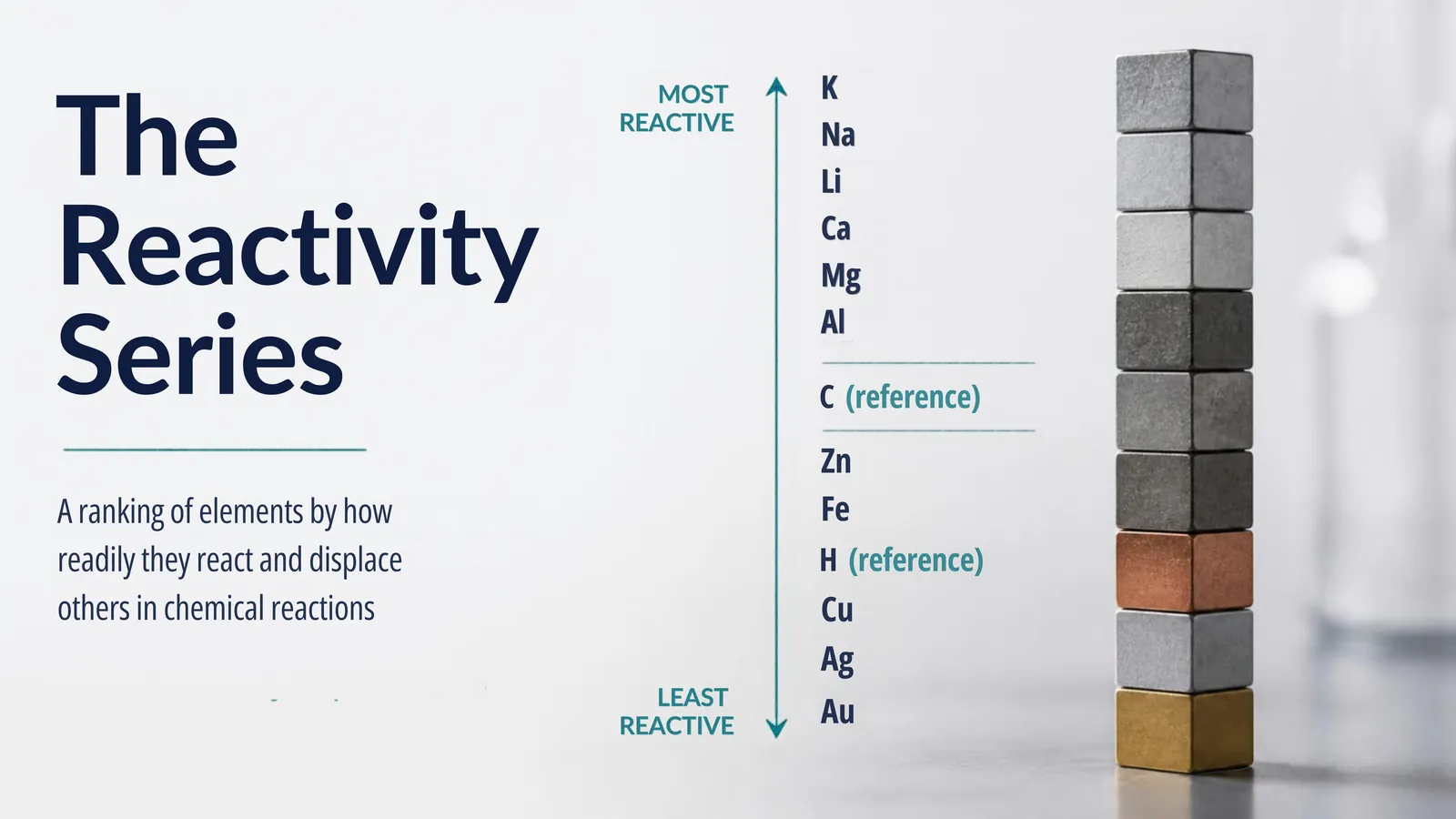
The reactivity series lists metals in order of decreasing reactivity -- how readily each one reacts and loses electrons. The order to learn, from most to least reactive, is: potassium, sodium, lithium, calcium, magnesium, aluminium, zinc, iron, copper, silver, gold. Carbon and hydrogen are not metals, but they are placed in the series too, as useful markers: carbon marks the boundary for extracting metals, and hydrogen marks the boundary for reacting with dilute acid and with water.
Crucially, a metal's position in the series can only ever be found out by experiment -- it cannot be predicted just by looking at it. Three kinds of evidence build the series: reactions with water (and steam), reactions with dilute acid, and displacement reactions, each covered below.
Slide: The reactivity series
Most to least reactive, with carbon and hydrogen as markers
1/1
Reactions with Water and Steam
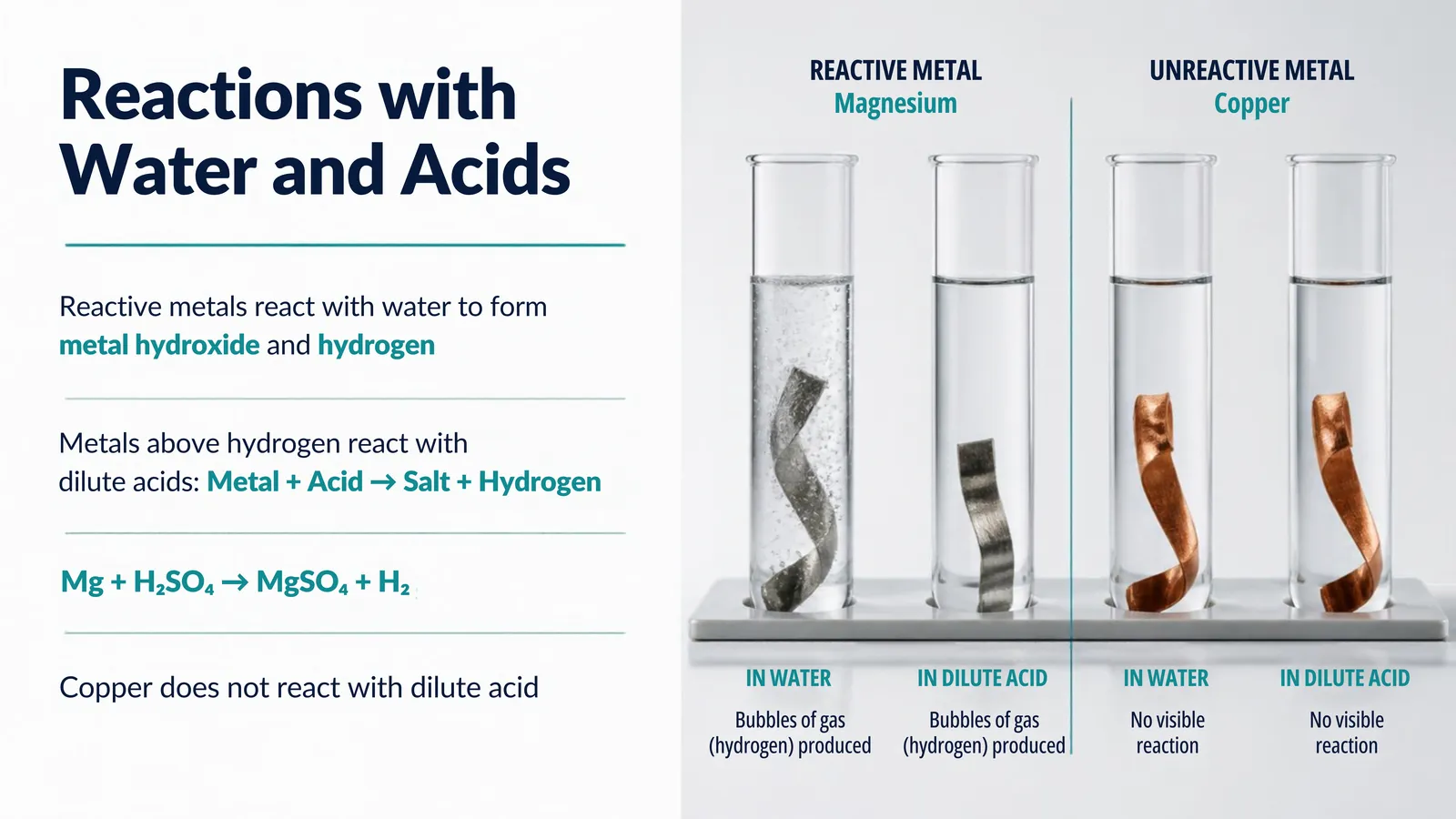
Metals above hydrogen react with cold water or with steam to release hydrogen gas: metal + water → metal hydroxide + hydrogen. Potassium, sodium and lithium all fit this pattern with cold water, but the vigour drops in that order -- potassium and sodium float, melt and fizz rapidly (potassium is fast enough to ignite the hydrogen), while lithium just fizzes steadily. Calcium reacts more gently, forming mostly-insoluble calcium hydroxide. Magnesium shows almost no reaction with cold water -- a protective layer of magnesium hydroxide quickly coats the metal -- but it burns with a bright white flame in steam: Mg(s) + H2O(g) → MgO(s) + H2(g). Zinc and iron react slowly with steam without burning, while copper, silver and gold, all below hydrogen, do not react with water or steam at all -- which is exactly why copper is safe to use for hot and cold water pipes.
Reactions with Dilute Acid (MASH)
The general pattern -- easily remembered with the mnemonic MASH, Metal + Acid → Salt + Hydrogen -- is: metal + acid → salt + hydrogen. Metals above hydrogen react, producing hydrogen gas (confirmed with a lit splint's "squeaky pop"); metals below hydrogen -- copper, silver, gold -- do not react with simple dilute acids at all. The higher a metal sits, the more violent the reaction, which is exactly why potassium, sodium and lithium are never mixed with acid in a school lab.
| Metal | Observation with dilute acid |
|---|---|
| Magnesium | Vigorous fizzing, mixture gets hot, colourless solution: Mg(s) + H2SO4(aq) → MgSO4(aq) + H2(g) |
| Aluminium | Slow when cold; very vigorous once gently warmed (its oxide layer resists the cold acid) |
| Zinc | Steady, slower fizzing than magnesium |
| Iron | Slow fizzing; gives a pale green iron(II) solution, Fe2+ -- never iron(III) |
| Copper | No reaction -- below hydrogen in the series |
Slide: Reactions with water and acids
Metal + acid → salt + hydrogen
1/1
Displacement Reactions: One Metal Pushes Out Another
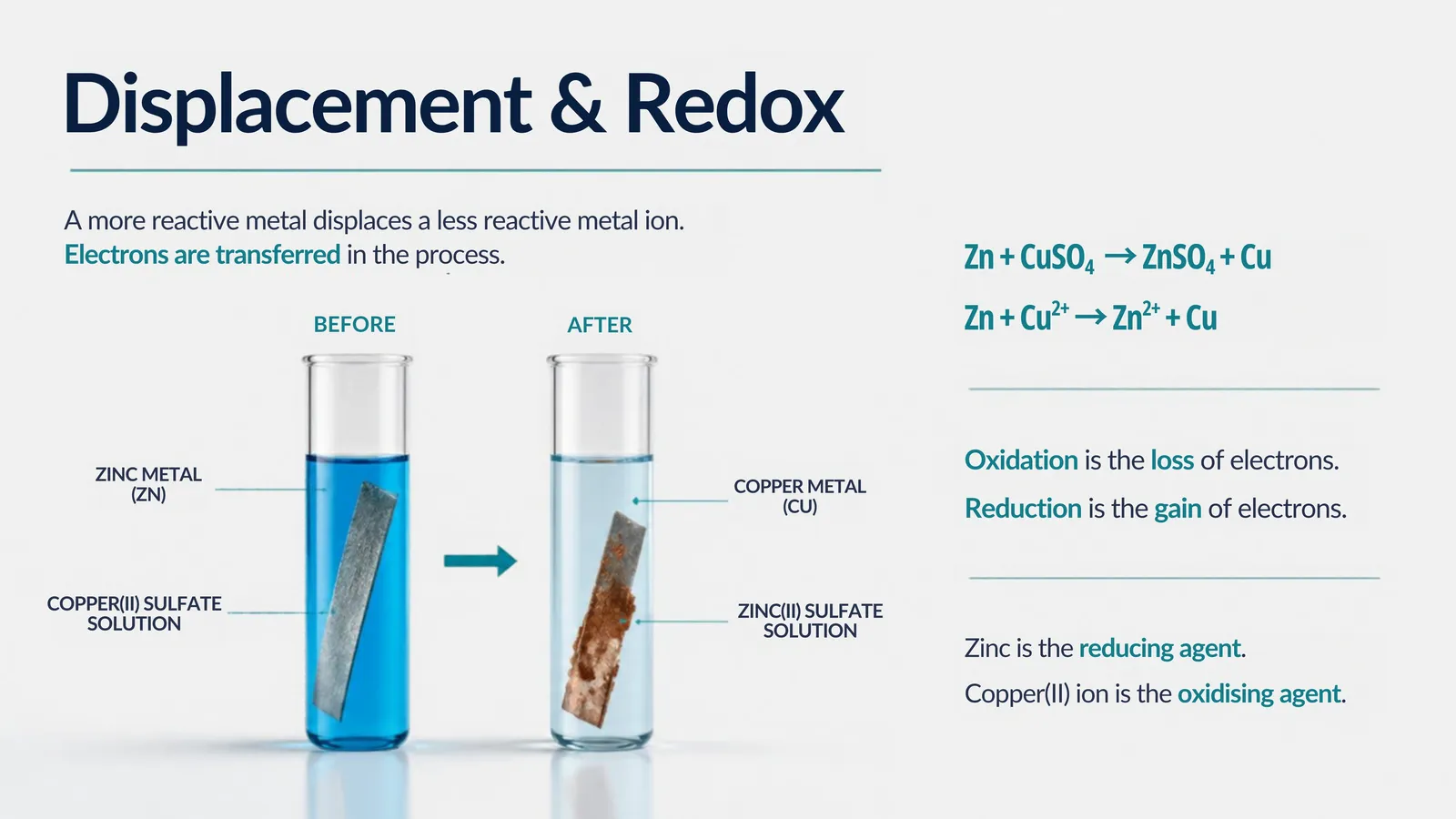
A more reactive metal can push a less reactive metal out of its compound -- a displacement reaction. Heating magnesium powder with black copper(II) oxide produces pink-brown copper metal and white magnesium oxide: Mg(s) + CuO(s) → MgO(s) + Cu(s). Metals can also displace each other from salt solutions: adding zinc to blue copper(II) sulfate solution fades the colour to colourless zinc sulfate as pink-brown copper is deposited, Zn(s) + CuSO4(aq) → ZnSO4(aq) + Cu(s). Rewriting this with every ion present shows that the sulfate ion, SO42-, appears unchanged on both sides -- it is a spectator ion and can be cancelled to give the simplified ionic equation: Zn(s) + Cu2+(aq) → Zn2+(aq) + Cu(s).
Redox Two Ways: Oxygen Transfer and Electron Transfer
Every displacement reaction is also a redox reaction -- both oxidation and reduction happening together -- and IGCSE Chemistry lets you describe this in two equivalent ways.
In terms of oxygen: oxidation is gain of oxygen; reduction is loss of oxygen. In Mg(s) + CuO(s) → MgO(s) + Cu(s), magnesium is oxidised (gains oxygen) and copper(II) oxide is reduced (loses oxygen).
In terms of electrons: oxidation is loss of electrons; reduction is gain of electrons -- remembered with the mnemonic OILRIG (Oxidation Is Loss, Reduction Is Gain). For Zn(s) + Cu2+(aq) → Zn2+(aq) + Cu(s), the two half-equations are Zn(s) → Zn2+(aq) + 2e- (oxidation) and Cu2+(aq) + 2e- → Cu(s) (reduction).
This gives precise definitions for two more key terms. An oxidising agent takes electrons away from something else and is itself reduced -- here, Cu2+ is the oxidising agent. A reducing agent gives electrons away and is itself oxidised -- here, zinc is the reducing agent. These always come as a pair: whichever species loses electrons must hand them to another species that gains them.
Slide: Displacement and redox
Zinc in copper(II) sulfate, step by step
1/1
Extracting Metals Using the Series
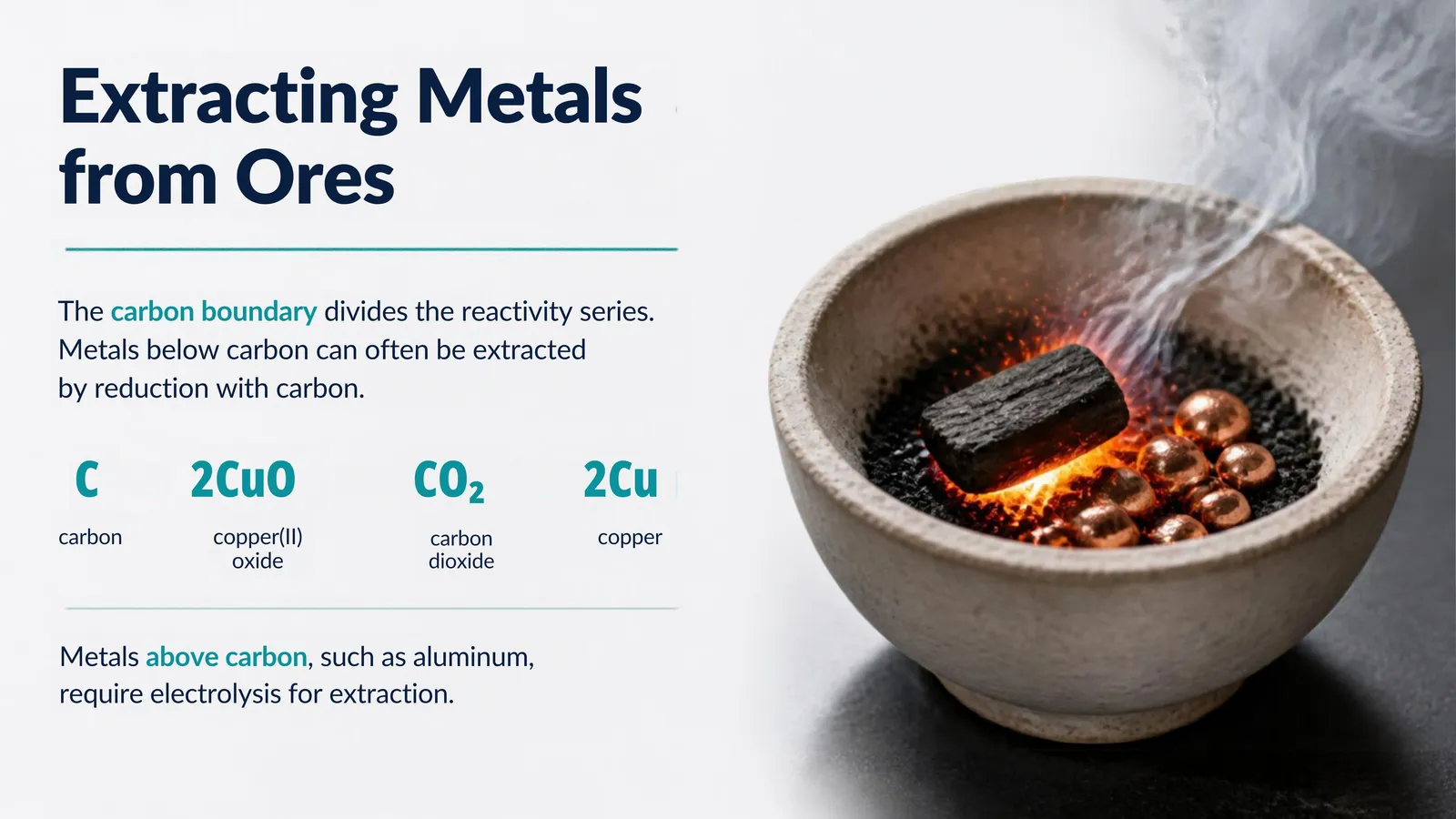
Many metals occur in the ground combined with oxygen, as metal oxides, and the reactivity series tells you exactly how to get the metal back out. A metal oxide below carbon in the series can be reduced simply by heating it with carbon -- C(s) + 2CuO(s) → CO2(g) + 2Cu(s) is the same reaction you met above with magnesium, just using carbon as the reducing agent instead. Metals above carbon, such as aluminium or sodium, hold onto their oxygen far too strongly for carbon to remove it, so a different method (electrolysis) is needed. At the very bottom of the series, gold is so unreactive that it never combines with oxygen or water at all -- it is found in the ground as the native metal, already uncombined, needing no chemical extraction whatsoever.
Slide: Extracting metals from ores
The carbon boundary
1/1
Rusting of Iron and How to Prevent It
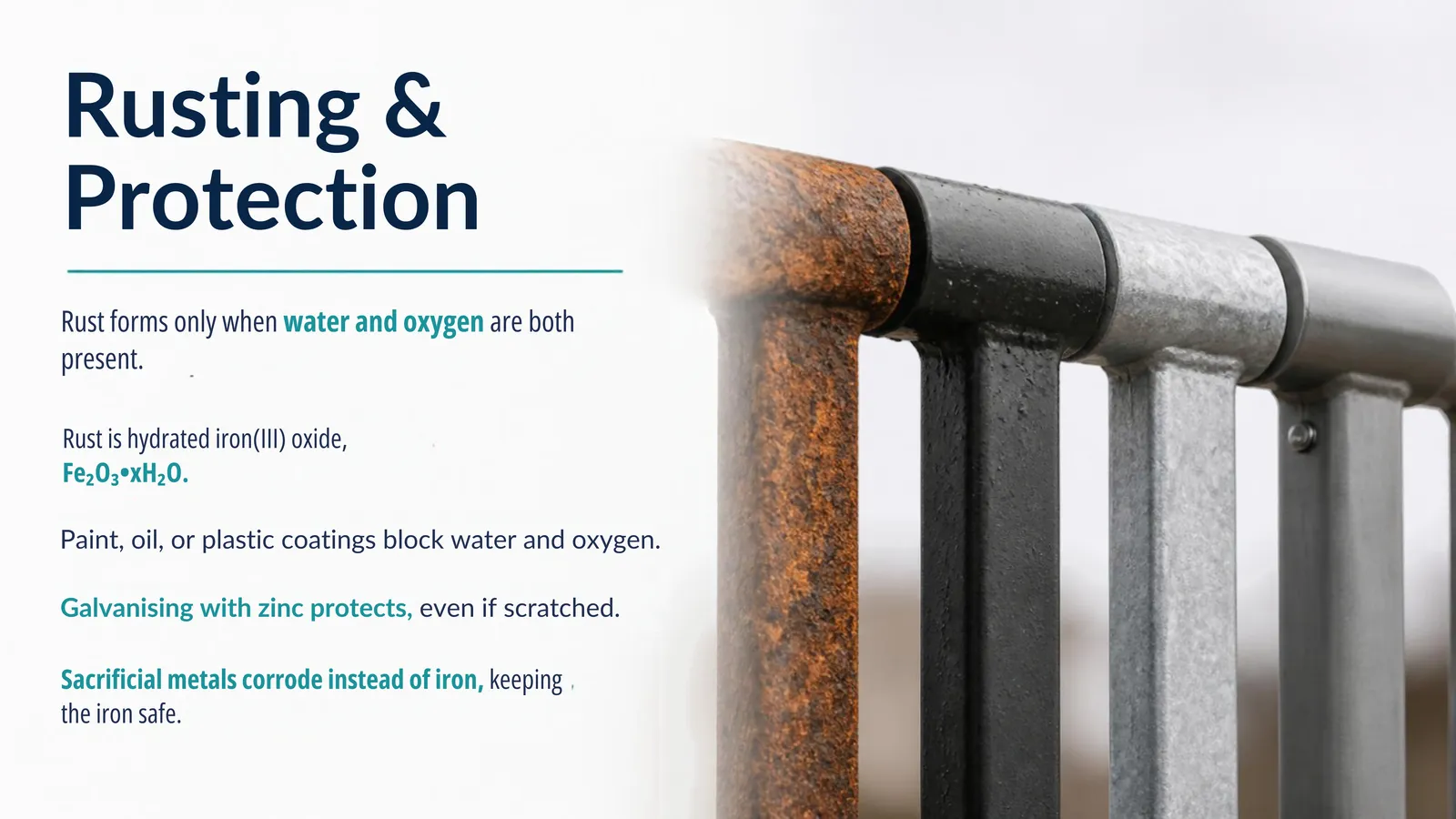
Rusting is specifically the corrosion of iron, and it needs both water and oxygen together -- neither alone is enough. Rust itself is hydrated iron(III) oxide, Fe2O3·xH2O, formed after iron atoms are oxidised first to Fe2+ and then further to Fe3+. Three prevention strategies all follow directly from the reactivity series:
Barrier methods -- paint, oil, grease or plastic coatings physically keep water and oxygen away from the iron. Cheap and simple, but the barrier only works while it stays intact; once scratched, the iron underneath rusts as normal.
Galvanising -- coating iron with zinc. This acts as a barrier, but even where the zinc is scratched away the iron still doesn't rust, because zinc is more reactive than iron and reacts with oxygen and water in its place, releasing electrons that flow into the iron and stop it forming ions.
Sacrificial protection -- blocks of a metal more reactive than iron (zinc, magnesium or aluminium) are attached to a large structure such as a ship's hull or a pipeline. The more reactive metal corrodes instead of the iron, and is simply replaced once used up.
Slide: Rusting and protection
Barriers, galvanising and sacrificial metals
1/1
Reactivity Series: Frequently Asked Questions
What is the order of the reactivity series?
From most to least reactive: potassium, sodium, lithium, calcium, magnesium, aluminium, (carbon), zinc, iron, (hydrogen), copper, silver, gold. Carbon and hydrogen are included as reference markers even though they are not metals.
What is the difference between an oxidising agent and a reducing agent?
An oxidising agent takes electrons away from another substance and is itself reduced. A reducing agent gives electrons to another substance and is itself oxidised. In any redox reaction the two always occur together.
Why does galvanised iron not rust even when scratched?
Zinc is more reactive than iron, so where the zinc coating is scratched, the zinc reacts with water and oxygen in preference to the iron, releasing electrons that flow into the iron and prevent it from forming ions and rusting. This is called sacrificial protection.
Key Takeaways
The reactivity series (K, Na, Li, Ca, Mg, Al, (C), Zn, Fe, (H), Cu, Ag, Au) is built entirely from experiment -- reactions with water, dilute acid, and displacement.
Displacement: a more reactive metal pushes a less reactive one out of its oxide or salt solution.
Redox has two equivalent definitions -- oxidation is gain of oxygen or loss of electrons; reduction is loss of oxygen or gain of electrons (OILRIG).
An oxidising agent is reduced; a reducing agent is oxidised.
Carbon can extract metals below it in the series; very unreactive metals like gold are found native.
Rusting needs both water and oxygen; prevent it with a barrier, galvanising, or sacrificial protection.
Want more practice? Download the Science A Plus Edu Reactivity Series Revision Notebook, with 25 pages of notes, diagrams and revision activities, and read our companion guide to Acids, Bases and Salt Preparations to see how metals, oxides and acids connect across the whole Inorganic Chemistry unit.
🗂️ Revision Flashcards
Tap a card to reveal the answer.
🎯 Quick Quiz
8 questions. Pick an answer to check it straight away.
1Which list is in order of decreasing reactivity?
The series runs K, Na, Li, Ca, Mg, Al, (C), Zn, Fe, (H), Cu, Ag, Au.
2Which metal does NOT react with dilute acid?
Copper is below hydrogen in the series, so it does not react with simple dilute acids.
3What forms when iron reacts with dilute acid?
Iron gives a pale green iron(II) solution, Fe²⁺, never iron(III).
4In Zn + CuSO₄ → ZnSO₄ + Cu, which ion is the spectator ion?
The sulfate ion appears unchanged on both sides, so it is cancelled.
5Which half-equation shows oxidation?
Oxidation Is Loss of electrons: zinc loses two electrons.
6In the reaction of zinc with copper(II) ions, what is the oxidising agent?
Cu²⁺ takes electrons from zinc and is itself reduced.
7Why can aluminium not be extracted by heating its oxide with carbon?
Metals above carbon hold onto oxygen too strongly, so electrolysis is needed.
8Why does galvanised iron not rust even when scratched?
Zinc is more reactive than iron, so it reacts with water and oxygen instead (sacrificial protection).