📖 Lesson: Non-Renewable Energy
Learn about conventional energy sources that power our world
🃏 Flashcards
Click each card to reveal the definition
🎮 Interactive Games
Test your knowledge of non-renewable energy
🏭 Non-Renewable Energy Explained: Fossil Fuels, Nuclear Power and Their Costs
What makes an energy source non-renewable?
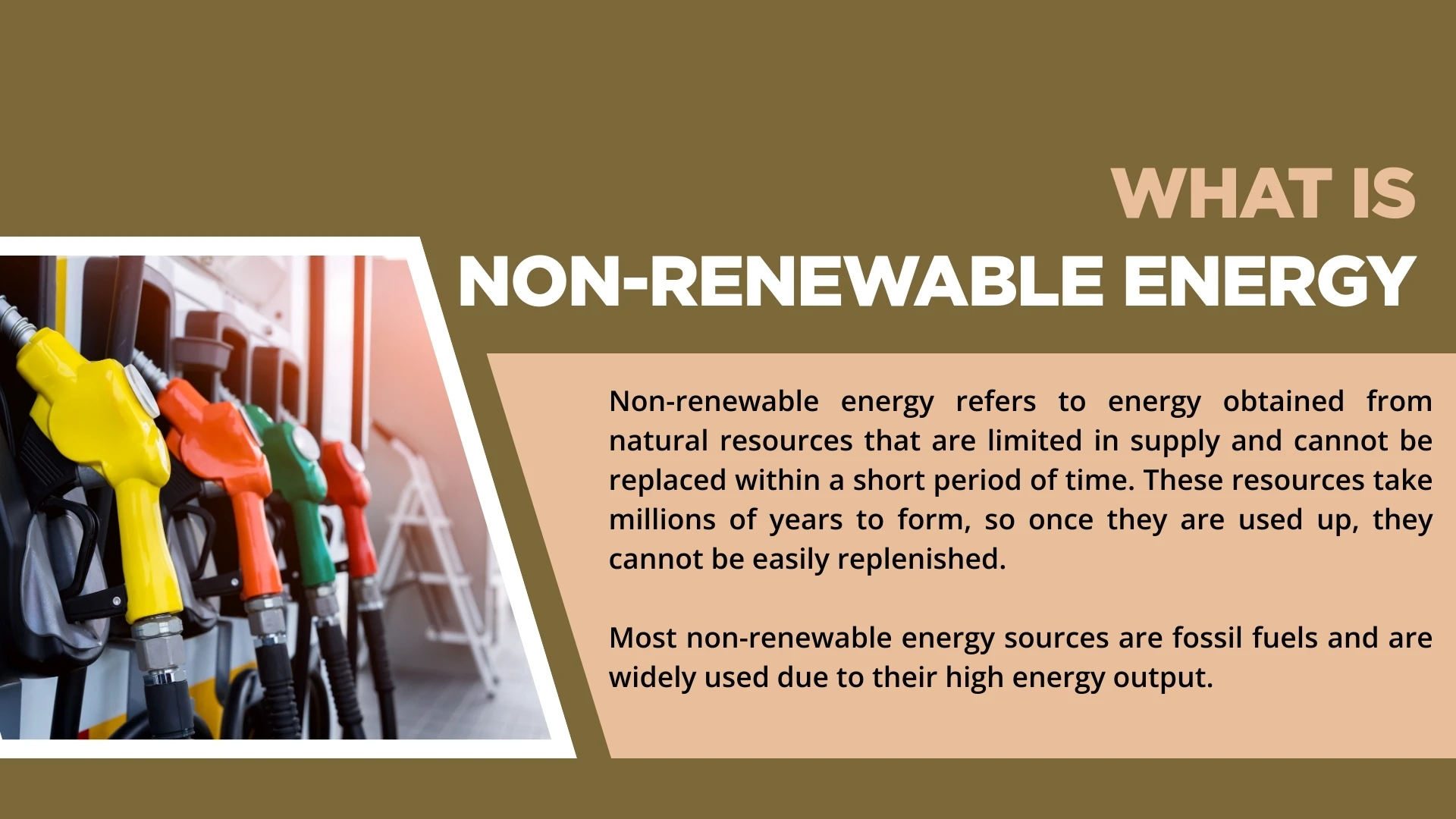
A non-renewable energy source is one that exists in a fixed amount and is used far faster than nature can replace it. Coal, oil and natural gas took millions of years to form, and once they are burned they are gone. Uranium, the fuel for nuclear power, is a metal dug from the ground, so it too is a limited stock. By contrast, the renewable sources described on our renewable energy lesson — sunlight, wind, moving water, tides and heat from inside the Earth — are replaced as fast as they are used.
Non-renewable sources still supply most of the world's energy because they are energy-dense (a small mass of fuel stores a great deal of energy), they can be stored and transported, and a power station burning them can run day and night regardless of the weather. Those strengths are exactly why they are hard to give up, even though their drawbacks are serious.
How fossil fuels formed
Coal, oil and natural gas are called fossil fuels because they are the remains of living things. Their energy was originally sunlight, captured by photosynthesis hundreds of millions of years ago and locked away as chemical energy.
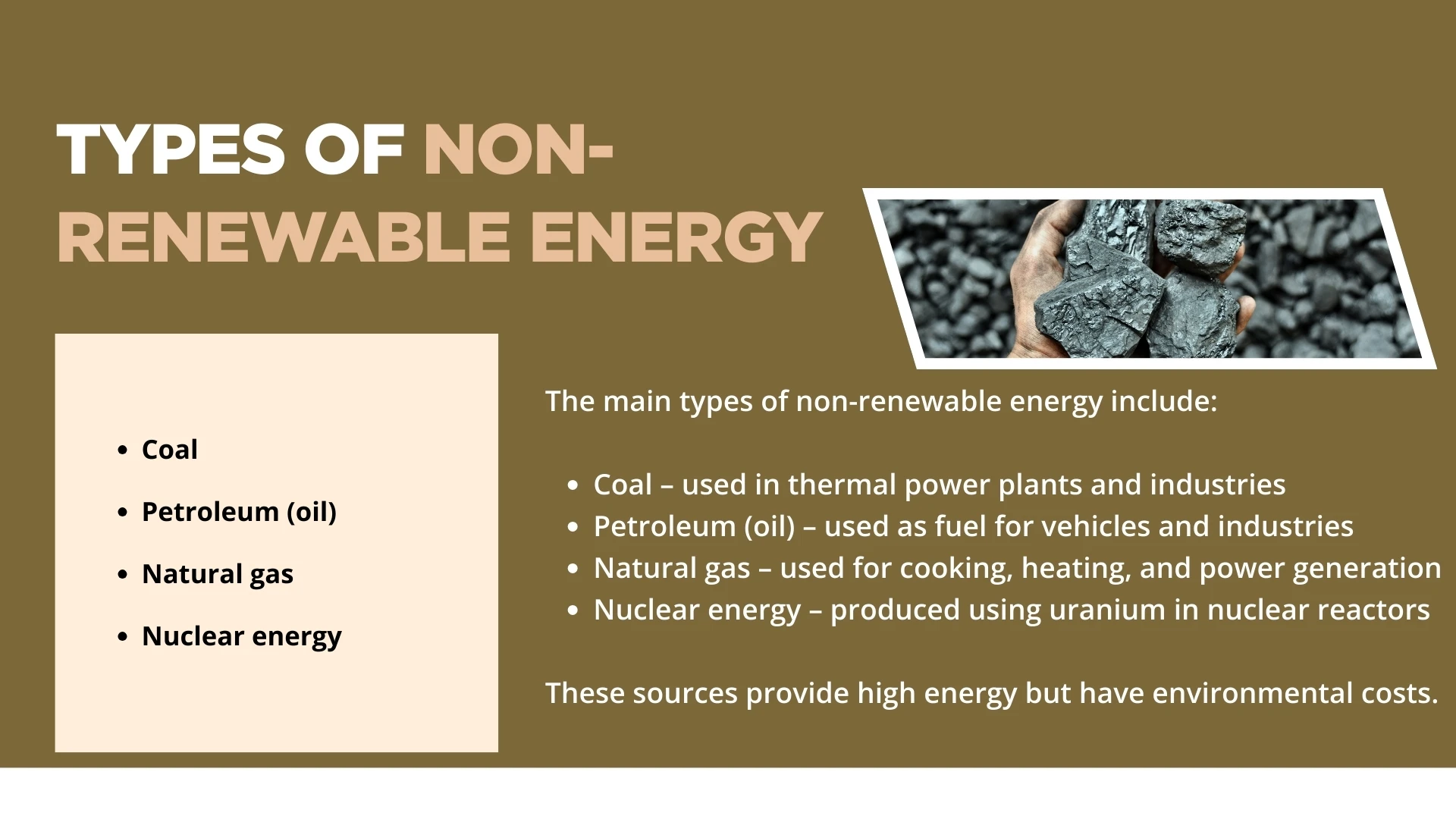
- Coal formed from the trees and ferns of ancient swamp forests. When the plants died they sank into waterlogged, oxygen-poor mud, so they did not fully rot. Layer upon layer of sediment buried them, and over millions of years heat and pressure squeezed the plant matter into peat, then soft brown coal (lignite), then hard black coal (bituminous coal and anthracite). The deeper and older the coal, the more carbon it holds and the more energy it releases per kilogram.
- Oil and natural gas formed in the sea, from microscopic plants and animals (plankton) that died and settled on the seabed. Buried under sand and mud and cooked by the Earth's heat, their remains turned into liquid oil and gaseous methane. Being lighter than water, both moved upwards through porous rock until they were trapped beneath a layer of impermeable rock. Drilling through that cap rock releases them.
1. Coal
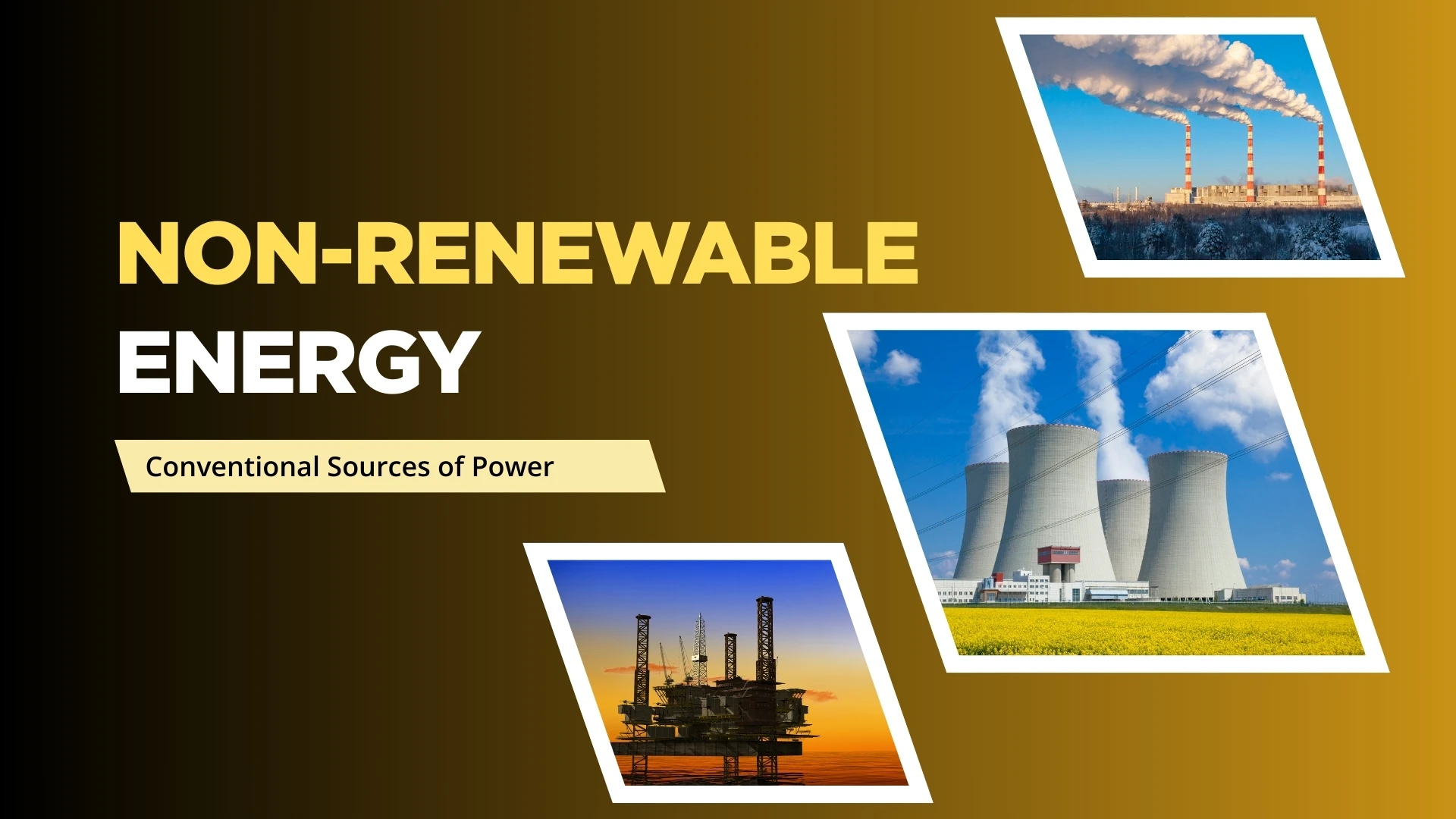
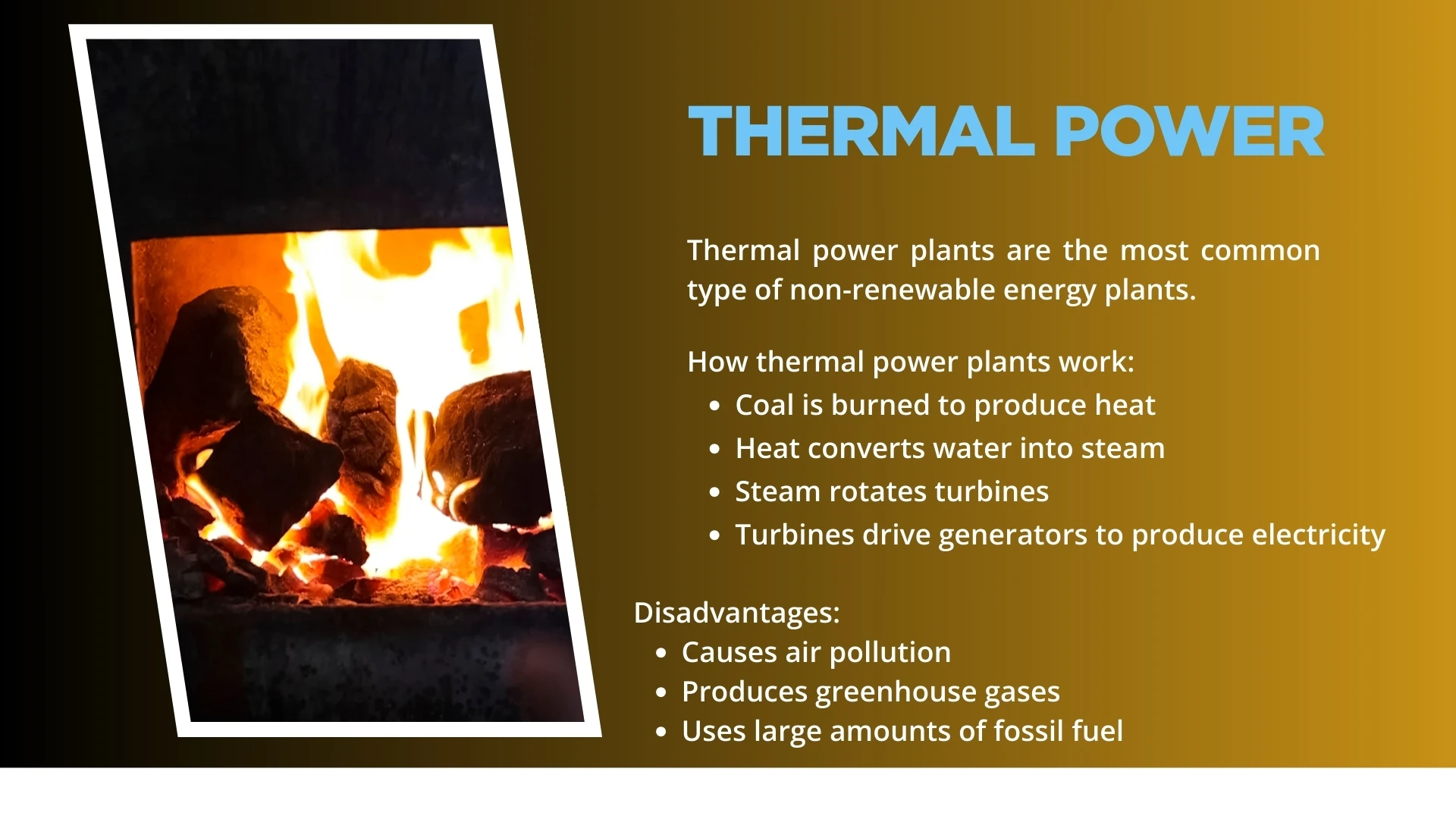
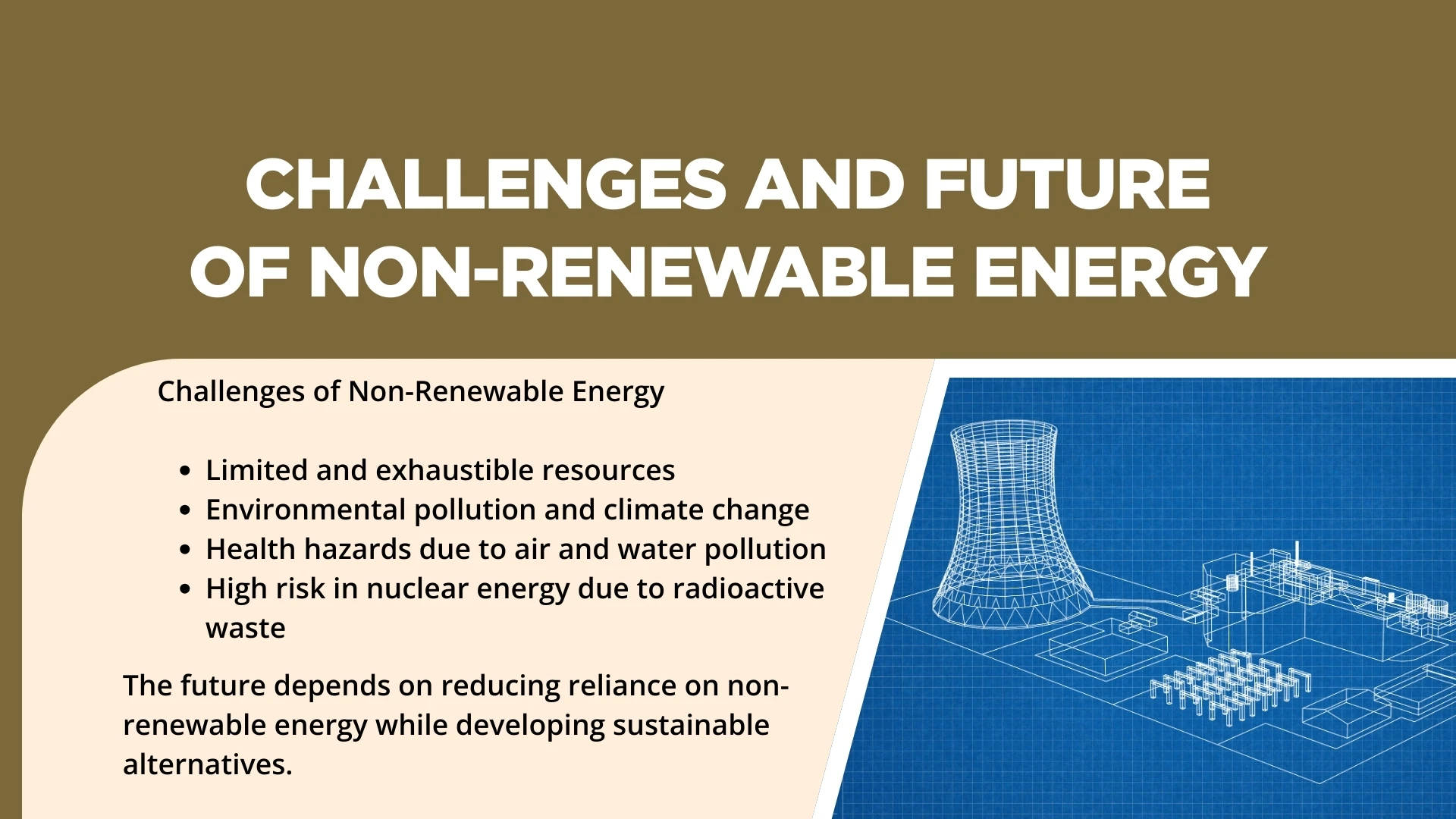
Coal is mainly carbon. It is mined either underground or from open-cast pits, then transported to a thermal power station, where it is ground to a powder and blown into a furnace. The burning coal heats water in a boiler to make high-pressure steam; the steam spins a turbine; the turbine turns a generator, which produces electricity; and the used steam is cooled back to water in the cooling towers and returned to the boiler. Coal is the most polluting fossil fuel: for the same amount of electricity it releases the most carbon dioxide, and it also gives off sulfur dioxide, nitrogen oxides, soot and ash.
2. Oil (petroleum)
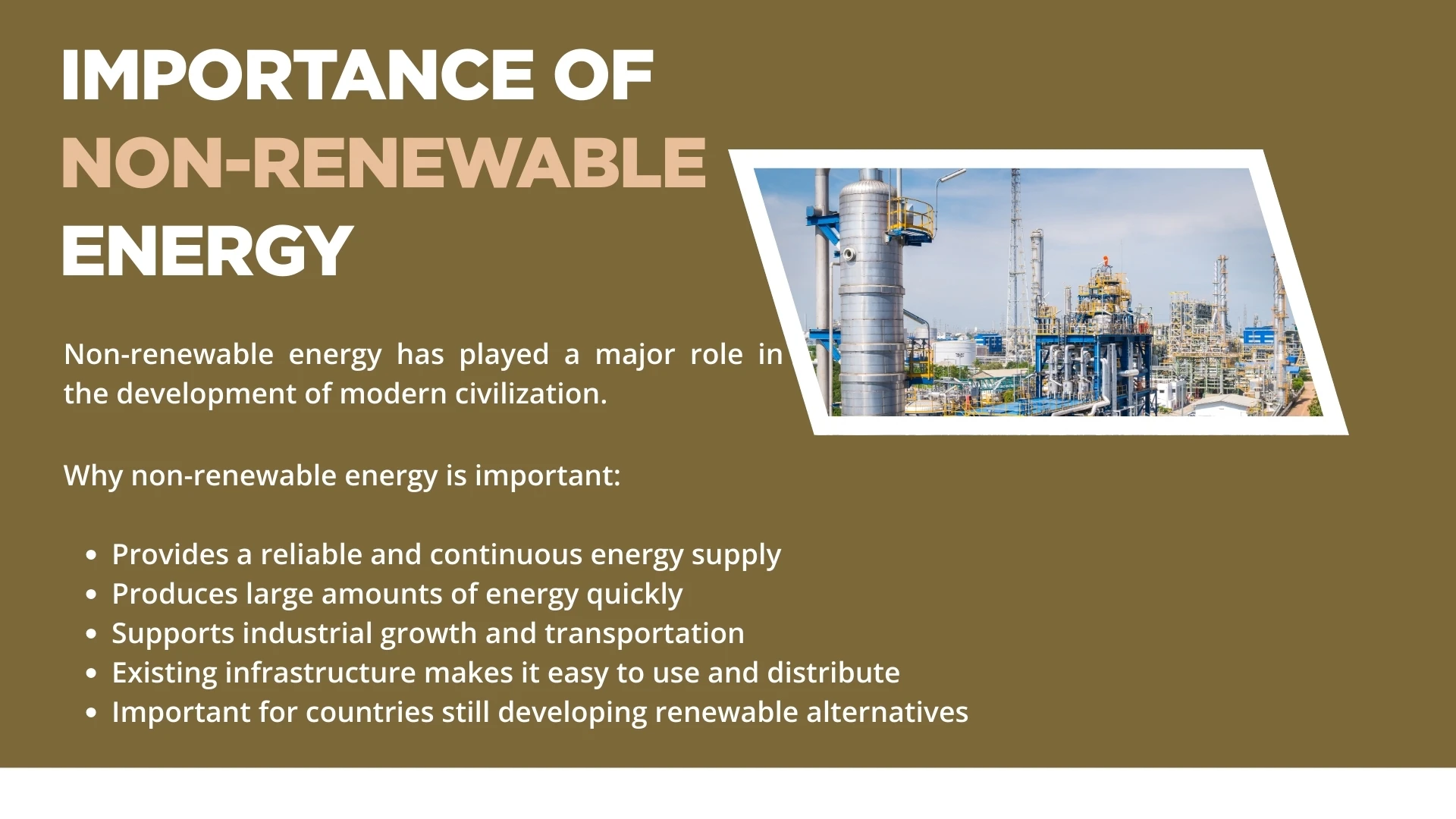
Crude oil is a mixture of hydrocarbons, pumped from wells on land or at sea. At a refinery it is separated by fractional distillation into fuels such as petrol, diesel, kerosene (jet fuel) and fuel oil, and it is also the raw material for plastics. Most oil is burned in vehicle engines rather than power stations, although fuel oil can be burned in a boiler in exactly the same way as coal. Its main environmental risks are carbon dioxide from burning and the damage done by spills during drilling and transport.
3. Natural gas
Natural gas is mostly methane (CH₄). It is piped directly into homes for cooking and heating, and it is the cleanest-burning fossil fuel: it produces roughly half as much carbon dioxide as coal for the same energy and almost no soot or sulfur dioxide. In a modern gas-fired power station the hot exhaust gases from burning spin a gas turbine directly, and the waste heat then raises steam for a second, steam turbine, so less energy is wasted than in a coal station. Gas stations can also be started and stopped quickly, which makes them useful for backing up wind and solar. Methane itself, however, is a powerful greenhouse gas, so leaks from wells and pipelines add to global warming.
4. Nuclear energy: non-renewable, but not a fossil fuel
Nuclear power is the one non-renewable source that does not come from burning. Inside a reactor, nuclei of uranium-235 are struck by neutrons and split into smaller nuclei, a process called nuclear fission. Each fission releases a large amount of energy and more neutrons, which go on to split further nuclei in a chain reaction. Control rods that absorb neutrons keep the reaction at a steady rate. The heat produced turns water into steam, and from that point on the station works like any other thermal power station: steam turbine, generator, cooling towers.
Two points must be stated precisely. First, uranium is not a fossil fuel: it is a metal formed long before the Earth existed, not the remains of living things. Second, a nuclear reactor emits no carbon dioxide while it operates, because nothing is burned. It is still non-renewable because the world's uranium is a finite stock. Its costs are of a different kind: the used fuel is highly radioactive waste that must be stored securely for thousands of years, stations are very expensive to build and to dismantle, and although accidents are rare, the ones at Chernobyl in 1986 and Fukushima in 2011 showed how severe they can be.
The energy transfer chain in a thermal power station
Coal, oil, gas and nuclear stations all end with the same two steps, a turbine and a generator, so they can be described with one chain. Only the first store is different.
Fossil fuel: chemical energy store (fuel) → thermal energy (steam) → kinetic energy (turbine) → electrical energy (generator) Nuclear: nuclear energy store (uranium) → thermal energy (steam) → kinetic energy (turbine) → electrical energy (generator)A large share of the fuel's energy is wasted as heat at each step, most of it carried away by the cooling water. A typical coal-fired station converts only around a third to two-fifths of the energy in its fuel into electricity; the rest warms the air and nearby rivers.
Environmental consequences
- Climate change: burning any fossil fuel releases carbon dioxide, a greenhouse gas that traps heat in the atmosphere. This is the single largest cause of global warming.
- Acid rain: sulfur dioxide and nitrogen oxides from coal and oil dissolve in rain to form acids, which damage forests, lakes and stone buildings.
- Air quality: soot and fine particles from coal and diesel harm the lungs and heart.
- Land and water: open-cast mining strips away habitats, oil spills coat coastlines and kill wildlife, and warm cooling water discharged into rivers lowers the oxygen available to fish.
- Radioactive waste: nuclear power avoids the problems above but leaves waste that stays hazardous for many thousands of years and must be isolated from people and groundwater.
Advantages and disadvantages at a glance
| Source | How it generates electricity | Main advantages | Main disadvantages |
|---|---|---|---|
| Coal | Burned in a boiler to make steam for a turbine | Large reserves; cheap to mine; reliable output | Highest CO₂ per unit of electricity; sulfur dioxide, soot and ash; mining damage |
| Oil | Fuel oil burned in a boiler; mostly used for transport instead | Very energy-dense; easy to transport and store; the basis of transport fuels and plastics | CO₂ emissions; oil spills; reserves concentrated in a few regions |
| Natural gas | Hot combustion gases spin a gas turbine, then waste heat raises steam | Cleanest fossil fuel; efficient; stations start and stop quickly | Still emits CO₂; methane leaks; delivered by pipeline, so supply can be cut |
| Nuclear | Fission of uranium-235 releases heat that makes steam for a turbine | No CO₂ during operation; tiny fuel mass for a huge energy output; runs continuously | Radioactive waste; very high building and decommissioning costs; rare but serious accidents |
Key terms
- Non-renewable energy
- Energy from a source that exists in a fixed amount and cannot be replaced within a human lifetime once used.
- Fossil fuel
- Coal, oil or natural gas: a fuel formed over millions of years from the buried remains of living things.
- Thermal power station
- A power station that uses heat to make steam, which drives a turbine connected to a generator.
- Nuclear fission
- The splitting of a heavy nucleus such as uranium-235 into smaller nuclei, releasing energy and neutrons.
- Greenhouse gas
- A gas such as carbon dioxide or methane that absorbs heat radiated from the Earth's surface and warms the atmosphere.