Why do your fingers go wrinkly in the bath? Why does a wilted lettuce leaf become crisp again when you soak it in cold water? Why do doctors never inject pure water into a patient's vein? The answer to all three questions is the same: osmosis. It is one of the most important ideas in biology, and it appears in almost every school exam from GCSE and IGCSE to A Level. In this guide you will learn exactly what osmosis is, why it happens, what it does to plant and animal cells, and how to investigate it with a simple potato experiment.
📖 Lesson
Water potential, hypotonic and hypertonic solutions, turgid and plasmolysed cells and the potato practical, in exam-ready words.
Osmosis Definition in Simple Words
Osmosis is a special type of diffusion that involves only water. To understand it you need three key terms.
Solvent: the liquid that does the dissolving. In living things the solvent is almost always water.
Solute: the substance that is dissolved, such as sugar or salt.
Solution: the mixture of solvent and solute.
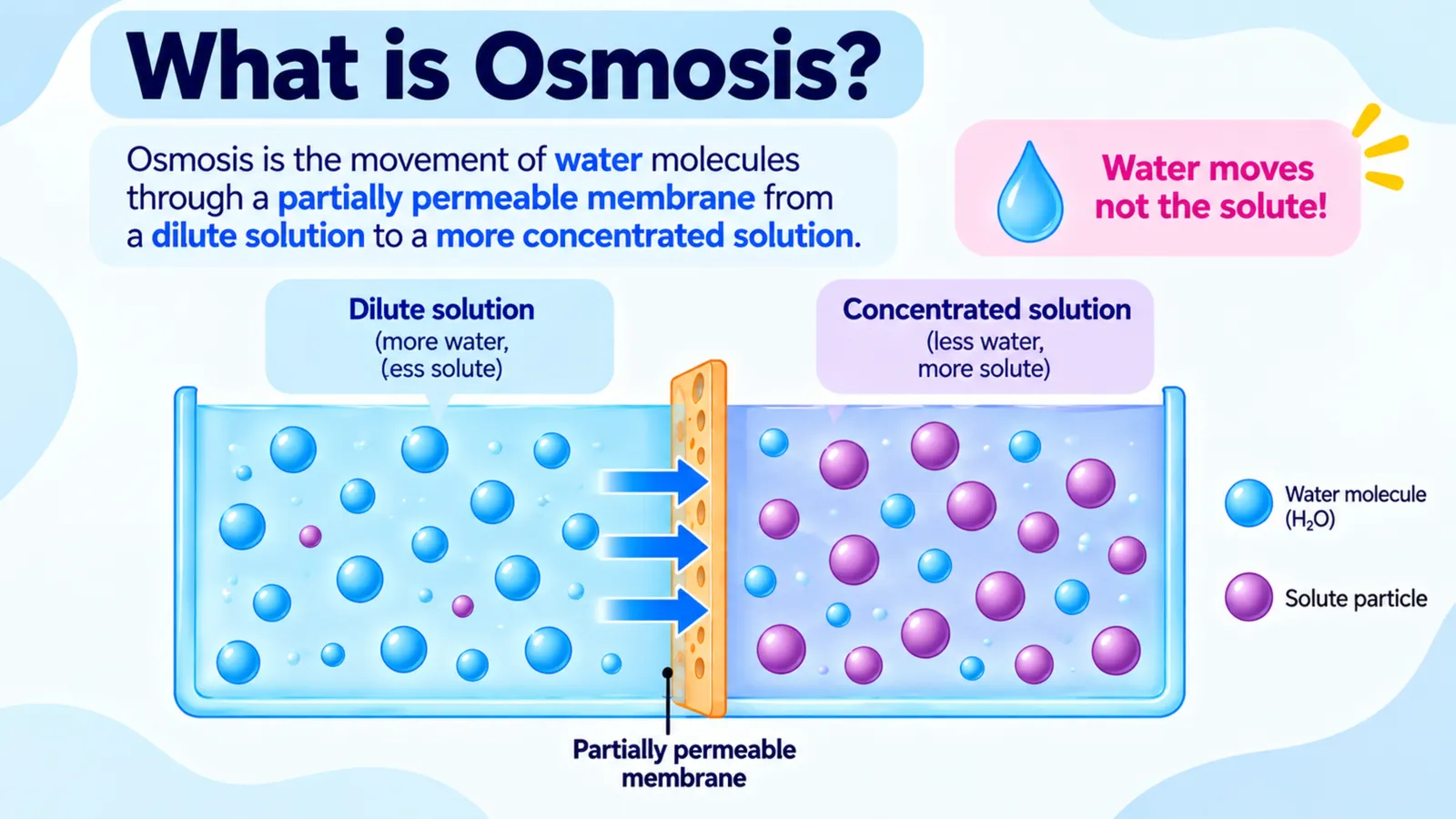
A dilute solution contains a lot of water and only a little solute. A concentrated solution contains less water and more solute. During osmosis, water molecules move from the dilute solution into the concentrated solution, crossing a membrane that lets water through but stops the larger solute molecules.
The exam-ready definition is: osmosis is the net movement of water molecules from a region of higher water potential to a region of lower water potential, through a partially permeable membrane. If your syllabus does not use the phrase water potential, you can say "from a dilute solution to a more concentrated solution".
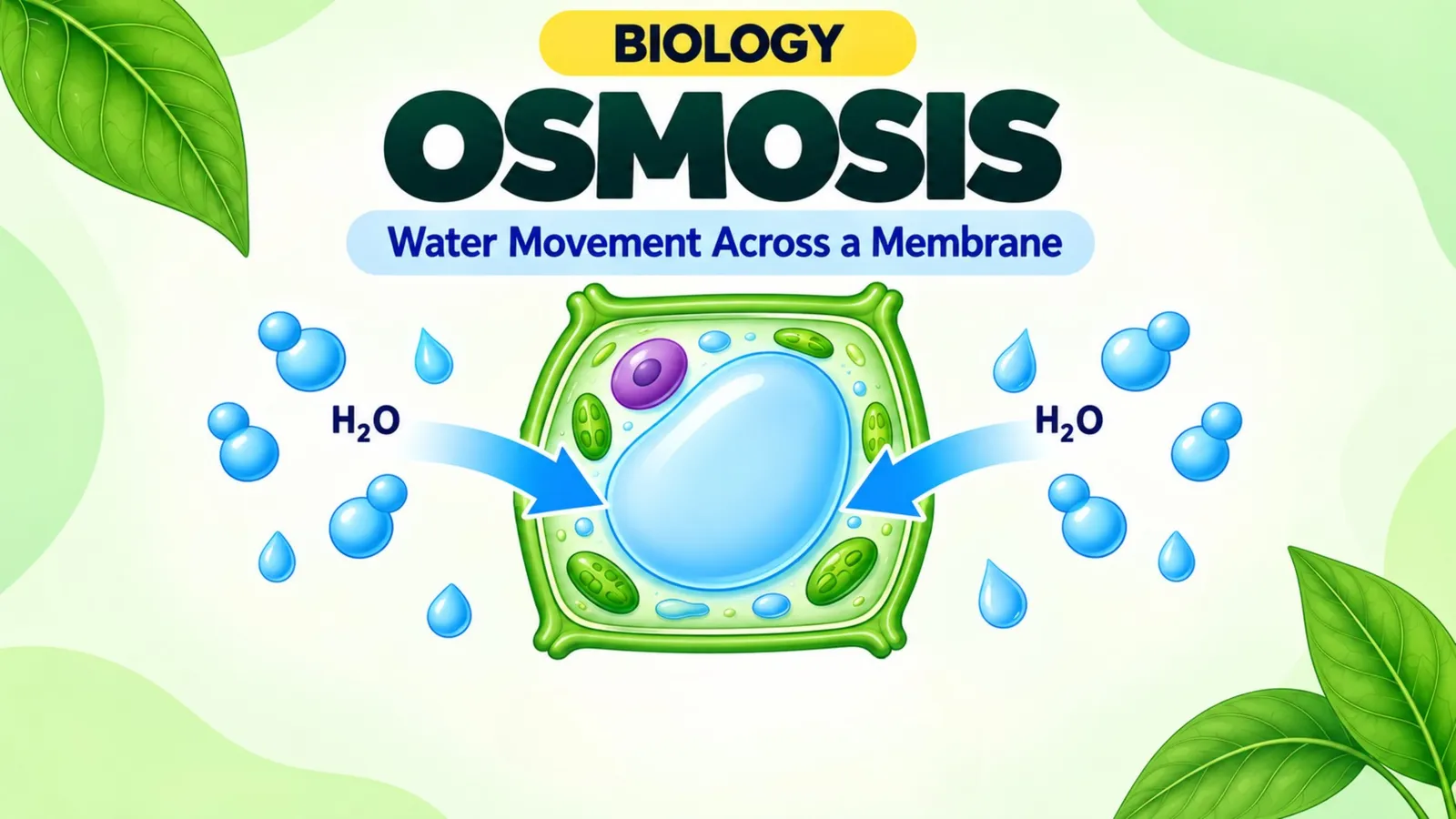
Slides: What is osmosis?
Water crosses a partially permeable membrane
1/2
Why Does Osmosis Happen? The Science Behind It
Water molecules are always moving randomly because they have kinetic energy. When a partially permeable membrane separates two solutions, water molecules bump into the membrane from both sides and some of them pass through the tiny pores.
On the dilute side there are more free water molecules. On the concentrated side, many water molecules are attracted to the solute particles and cluster around them, so fewer are free to move. As a result, more water molecules hit the pores and pass through from the dilute side than from the concentrated side. The overall, or net, movement is therefore towards the concentrated solution. Water keeps moving in both directions, but more moves one way than the other. That is why the word "net" matters in your definition.
Osmosis continues until the two sides have equal water potential, or until something such as a cell wall pushes back hard enough to stop further net movement.
What Is a Partially Permeable Membrane?
A partially permeable membrane (also called a selectively permeable or semi-permeable membrane) allows some molecules to pass through but not others. Small molecules such as water, oxygen and carbon dioxide pass through easily. Larger molecules such as sucrose, starch and proteins cannot.
Every cell is surrounded by a cell membrane, which is partially permeable. That is why osmosis is going on inside your body every second. In the lab, scientists often use Visking tubing (dialysis tubing) as a model membrane, because it behaves in a similar way to a real cell membrane.
Water Potential Made Easy
Water potential is a measure of how freely water molecules can move. It is given the Greek symbol ψ (psi) and is measured in kilopascals (kPa).
Pure water has the highest possible water potential, which is set at zero.
Adding any solute lowers the water potential, so all solutions have a negative water potential.
The more concentrated the solution, the more negative its water potential.
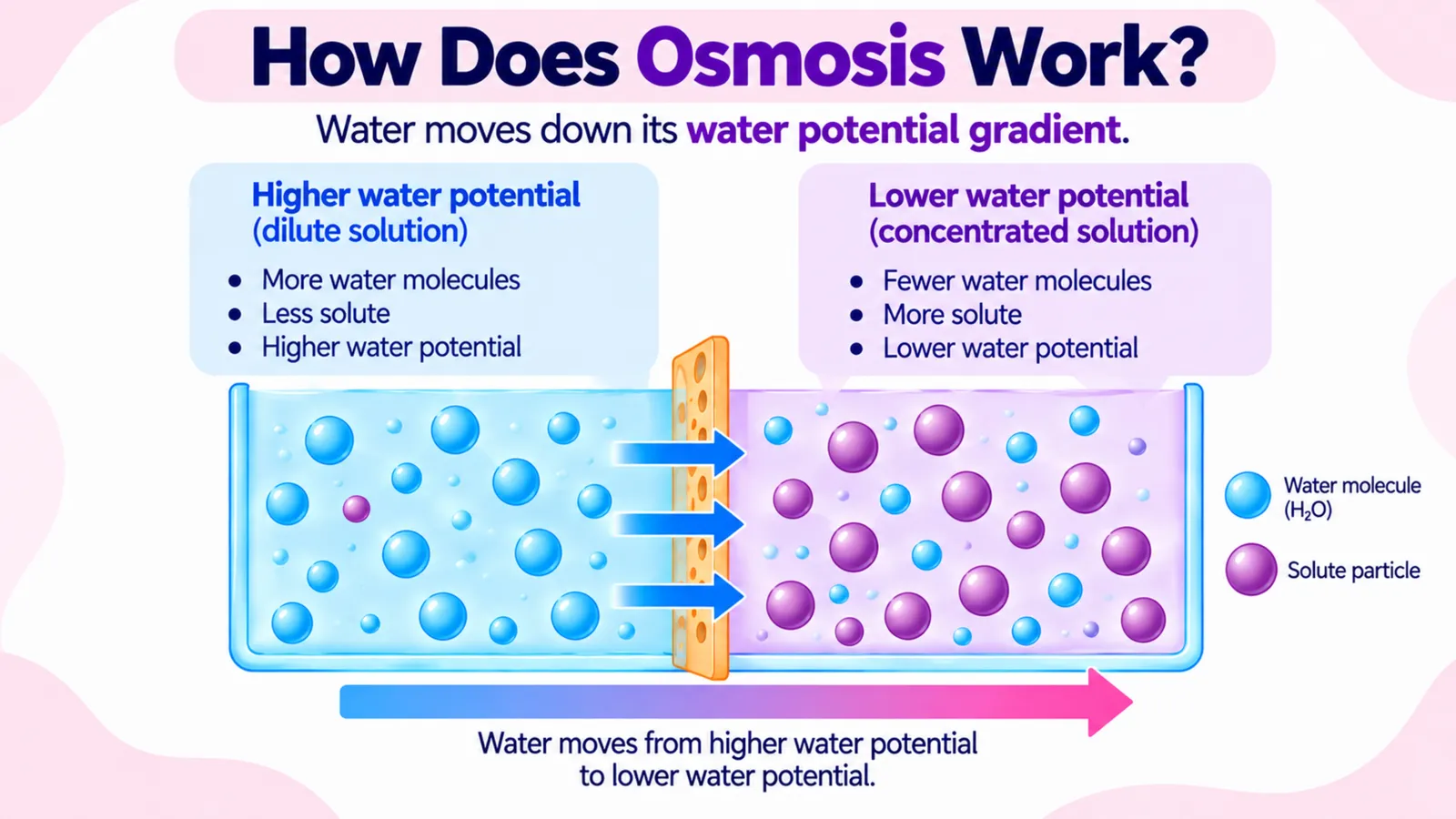
Water always moves down a water potential gradient, from less negative to more negative. For example, water moves from a solution at −200 kPa into one at −800 kPa. Thinking in terms of water potential avoids the common mistake of talking about "water concentration", which examiners do not accept.
Slide: How does osmosis work?
Water moves down its water potential gradient
1/1
Hypotonic, Hypertonic and Isotonic Solutions
These three words describe a solution compared with the inside of a cell. They are among the most searched osmosis terms, so it is worth learning them properly.
| Solution type | What it means | Direction of water movement |
|---|---|---|
| Hypotonic | Lower solute concentration (higher water potential) than the cell | Water moves into the cell |
| Hypertonic | Higher solute concentration (lower water potential) than the cell | Water moves out of the cell |
| Isotonic | Same solute concentration and water potential as the cell | No net movement of water |
A simple memory trick: "hypo" sounds like "hippo", and a cell placed in a hypotonic solution swells up like a hippo. "Hyper" solutions pull water out and make cells shrink.
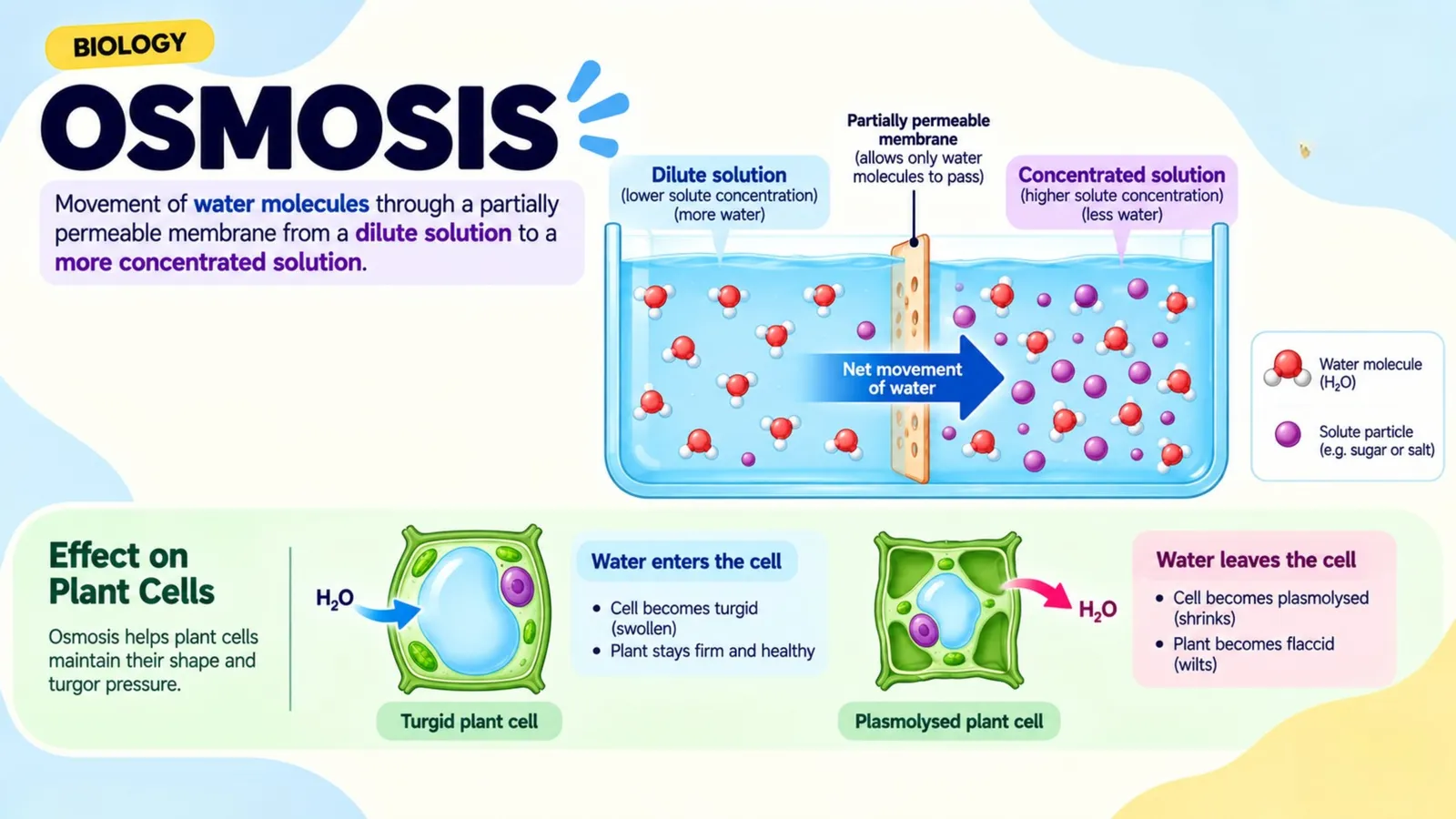
Slide: Osmosis at a glance
Dilute vs concentrated solutions and what happens to plant cells
1/1
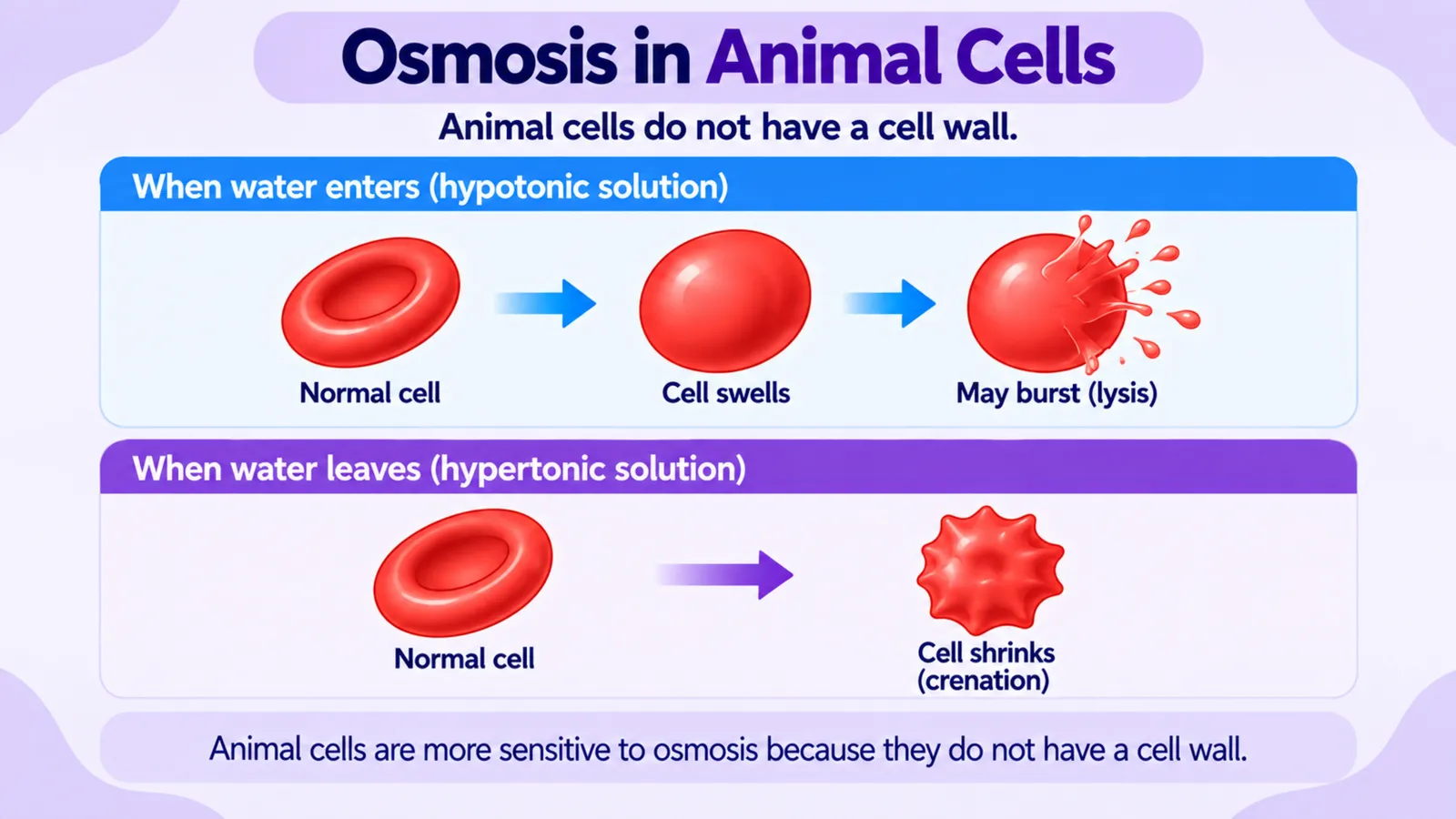
Osmosis in Animal Cells: Why Red Blood Cells Burst
Animal cells have a cell membrane but no cell wall, and that makes them vulnerable to osmosis.
Red blood cells in pure water (hypotonic)
If you place red blood cells in pure water, water moves into them by osmosis. There is no cell wall to resist the swelling, so the cells get bigger and bigger until the membrane tears. This bursting is called haemolysis (or lysis).
Red blood cells in strong salt solution (hypertonic)
In a concentrated salt solution, water moves out of the red blood cells. They shrink and develop a spiky, wrinkled surface. This is called crenation.
Red blood cells in an isotonic solution
In a solution with the same water potential as the cytoplasm, there is no net movement of water, and the cells keep their normal biconcave disc shape. That is why hospital drips use saline at about 0.9 percent salt, which is isotonic with blood plasma. Injecting pure water would cause haemolysis, and a very salty drip would shrink blood cells.
Your body protects its cells by keeping the water potential of blood plasma constant. This is part of homeostasis, and the kidneys do most of the work by adjusting how much water is lost in urine.
Slide: Osmosis in animal cells
Red blood cells swell and burst or shrink
1/1
Osmosis in Plant Cells: Turgor, Flaccidity and Plasmolysis
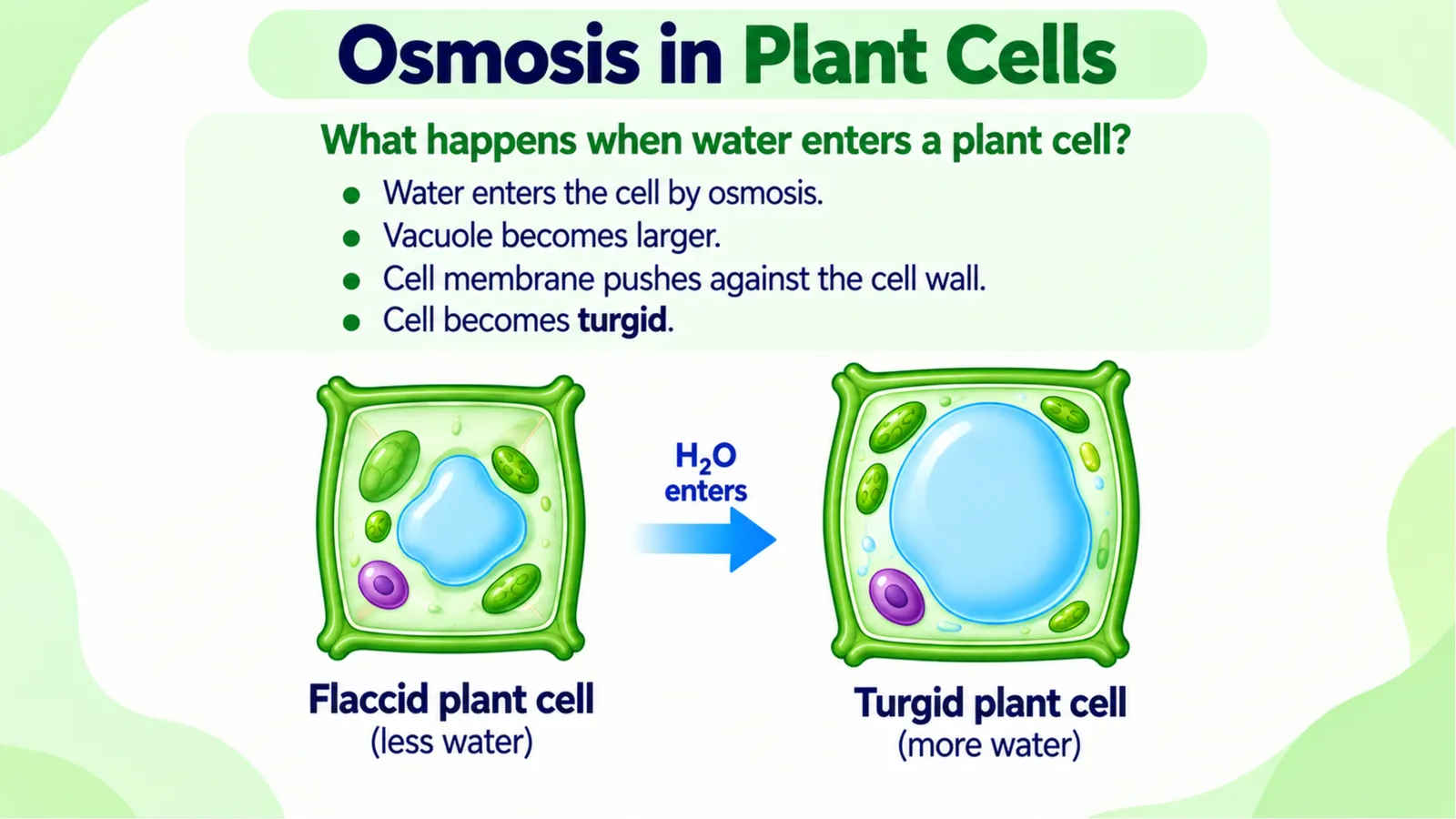
Plant cells behave differently because they are surrounded by a strong, freely permeable cellulose cell wall, and most of the cell is filled with a large vacuole of cell sap.
Turgid cells in a dilute solution
When a plant cell is surrounded by water or a dilute solution, water enters the vacuole by osmosis. The vacuole swells and pushes the cytoplasm against the cell wall. The wall is strong, so it pushes back. This outward push is called turgor pressure, and the firm cell is described as turgid. The cell does not burst because the wall stops it. Turgid cells press against each other and hold up soft plant tissues such as leaves and young stems. This is why well-watered plants stand upright.
Flaccid cells and wilting
When a plant loses more water than it takes in, its cells lose turgor pressure and become flaccid (soft). The leaves droop and the plant wilts. Watering the plant restores the turgor and the leaves stand up again, usually within an hour or two.
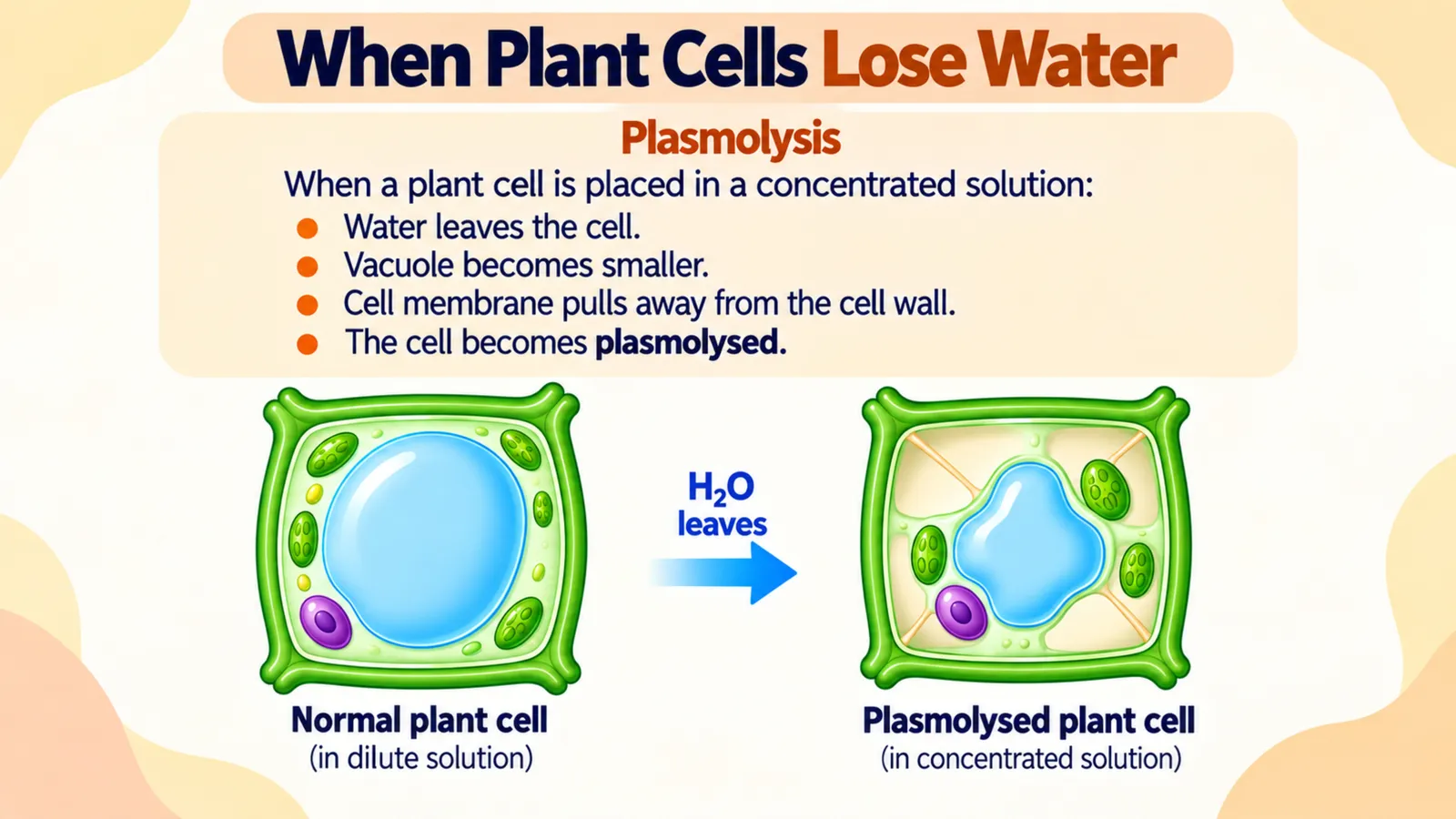
Plasmolysed cells in a concentrated solution
In a strong sugar or salt solution, so much water leaves the vacuole that the cytoplasm and cell membrane pull away from the cell wall. The cell is now plasmolysed. Because the cell wall is freely permeable, the gap between the wall and the membrane fills with the outside solution. Plasmolysis can be seen clearly under a microscope using red onion skin cells, whose coloured vacuoles make the shrinking easy to spot. Severe plasmolysis usually kills the cell.
Slides: Osmosis in plant cells
Turgid, flaccid and plasmolysed cells
1/2
Osmosis vs Diffusion vs Active Transport
Students often mix up the three main ways substances move into and out of cells. This comparison table makes the differences clear.
| Feature | Diffusion | Osmosis | Active transport |
|---|---|---|---|
| What moves | Any particles (gases, solutes) | Water only | Particles such as ions and glucose |
| Direction | High to low concentration | High to low water potential | Low to high concentration (against the gradient) |
| Membrane needed? | No | Yes, partially permeable | Yes, with carrier proteins |
| Energy from respiration? | No (passive) | No (passive) | Yes (ATP needed) |
| Example | Oxygen entering blood in the lungs | Water entering root hair cells | Mineral ions absorbed by root hair cells |
Remember: osmosis is simply the diffusion of water across a partially permeable membrane. All osmosis is diffusion, but not all diffusion is osmosis.
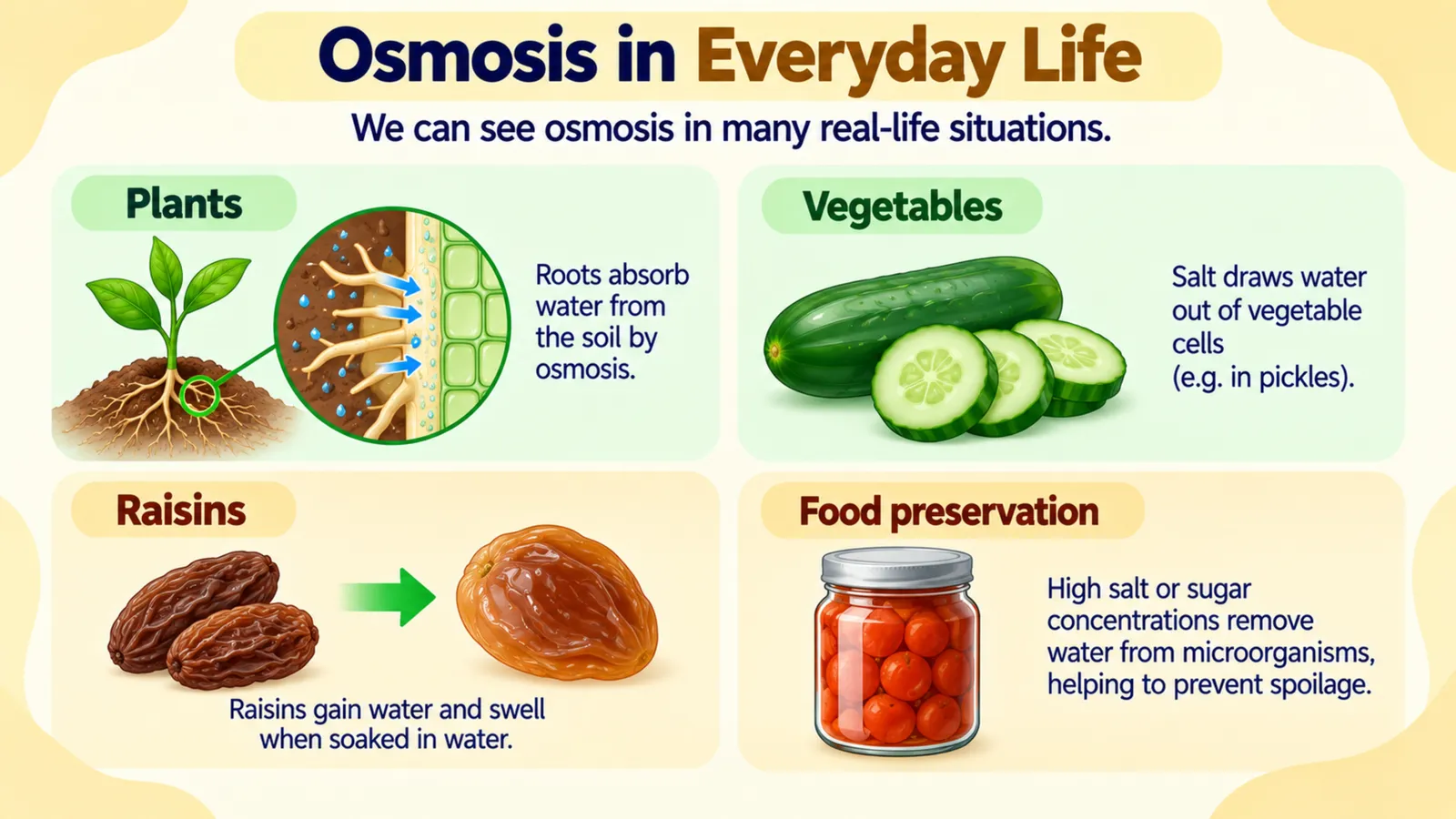
Real-Life Examples of Osmosis You See Every Day
Osmosis is not just an exam topic. It explains many things around you.
Wrinkly fingers: after a long bath, water moves into the outer layers of skin, which swell unevenly and wrinkle. Scientists also think nerves play a role, but osmosis starts the process.
Root hair cells absorbing water: soil water is more dilute than the cell sap, so water enters the root hairs by osmosis. This is the first step of the journey that ends with transpiration from the leaves.
Salting food to preserve it: salt draws water out of bacteria and fungi by osmosis, so they cannot grow. This is why salted fish and meat last longer.
Making jam: very high sugar concentrations do the same job as salt, stopping microbes from spoiling fruit.
Killing slugs with salt: salt on a slug's moist skin pulls water out of its body. This is why gardeners are advised not to do it, because it is cruel.
Crisping vegetables: putting limp celery or lettuce into cold water makes the cells turgid again.
Over-fertilised plants wilting: too much fertiliser makes the soil solution more concentrated than the root cells, so water leaves the roots instead of entering them. This is often called fertiliser burn.
Kidney dialysis: dialysis machines use partially permeable membranes to remove waste from the blood of patients whose kidneys have failed.
Freshwater fish: water constantly enters their bodies by osmosis, so they produce large amounts of dilute urine to get rid of it.
Slide: Osmosis in everyday life
Roots, pickles, raisins and food preservation
1/1
Easy Osmosis Experiment: The Potato Cylinder Practical
The potato osmosis experiment is a required practical in many courses, and it is simple enough to try at home with salt or sugar.
What you need
A large potato and a cork borer (or a sharp knife and ruler)
Sugar or salt solutions of different concentrations, for example 0.0, 0.2, 0.4, 0.6, 0.8 and 1.0 mol/dm³
Test tubes or beakers, a top-pan balance, paper towels and a timer
Method
Cut six potato cylinders of the same length and diameter, and remove any skin.
Gently blot each cylinder dry and record its starting mass.
Place one cylinder in each solution and leave them for at least 30 minutes, ideally overnight.
Remove the cylinders, blot them dry in the same way and record the final mass.
Calculate the percentage change in mass for each cylinder.
The formula is: percentage change = (final mass − initial mass) ÷ initial mass × 100.
Results and conclusion
Cylinders in pure water or dilute solutions gain mass, because water enters the potato cells by osmosis. Cylinders in concentrated solutions lose mass because water leaves the cells. When you plot a graph of percentage change in mass against concentration, the line crosses the x-axis at the concentration where there is no change. At that point the solution is isotonic with the potato cells, so you have estimated the water potential of potato tissue. Using percentage change rather than actual mass means cylinders of slightly different starting mass can be compared fairly.
Tips for a fair test
Keep the temperature, time, cylinder size and potato variety the same. Blot each cylinder with the same technique, because leftover surface water adds mass that did not enter the cells. Repeat each concentration three times and calculate a mean to improve reliability.
What Affects the Rate of Osmosis?
Several factors change how quickly water moves by osmosis:
Water potential gradient: the bigger the difference between the two solutions, the faster the rate.
Temperature: warmer water molecules have more kinetic energy and move faster, so osmosis speeds up.
Surface area: a larger membrane area gives more pores for water to pass through. Root hairs increase surface area for exactly this reason.
Distance: thinner membranes and shorter diffusion paths increase the rate.
Aquaporins: many cells contain special channel proteins called aquaporins that let water cross the membrane much faster. Kidney cells have lots of them.
Common Osmosis Exam Mistakes to Avoid
Do not say "water moves from high concentration to low concentration". Use water potential or dilute-to-concentrated wording instead.
Do not say salt or sugar molecules move by osmosis. Only water moves by osmosis.
Do not say plant cells burst. The cell wall prevents bursting; they become turgid.
Do not forget the word "net" and the phrase "partially permeable membrane" in your definition.
Do not confuse flaccid (soft, no turgor) with plasmolysed (membrane pulled away from the wall).
Frequently Asked Questions About Osmosis
Is osmosis active or passive?
Osmosis is passive. It does not use energy from respiration, because water moves down its water potential gradient naturally.
Can osmosis happen without a membrane?
No. Without a partially permeable membrane, both the water and the solute would diffuse freely and the process would simply be diffusion.
Why don't plant cells burst in pure water?
The strong cellulose cell wall resists the expanding vacuole and creates turgor pressure. When the wall pushes back hard enough, net water entry stops.
What is reverse osmosis?
Reverse osmosis uses high pressure to push water the "wrong" way through a membrane, from a concentrated solution into pure water. It is used to make drinking water from seawater in desalination plants.
Key Takeaways
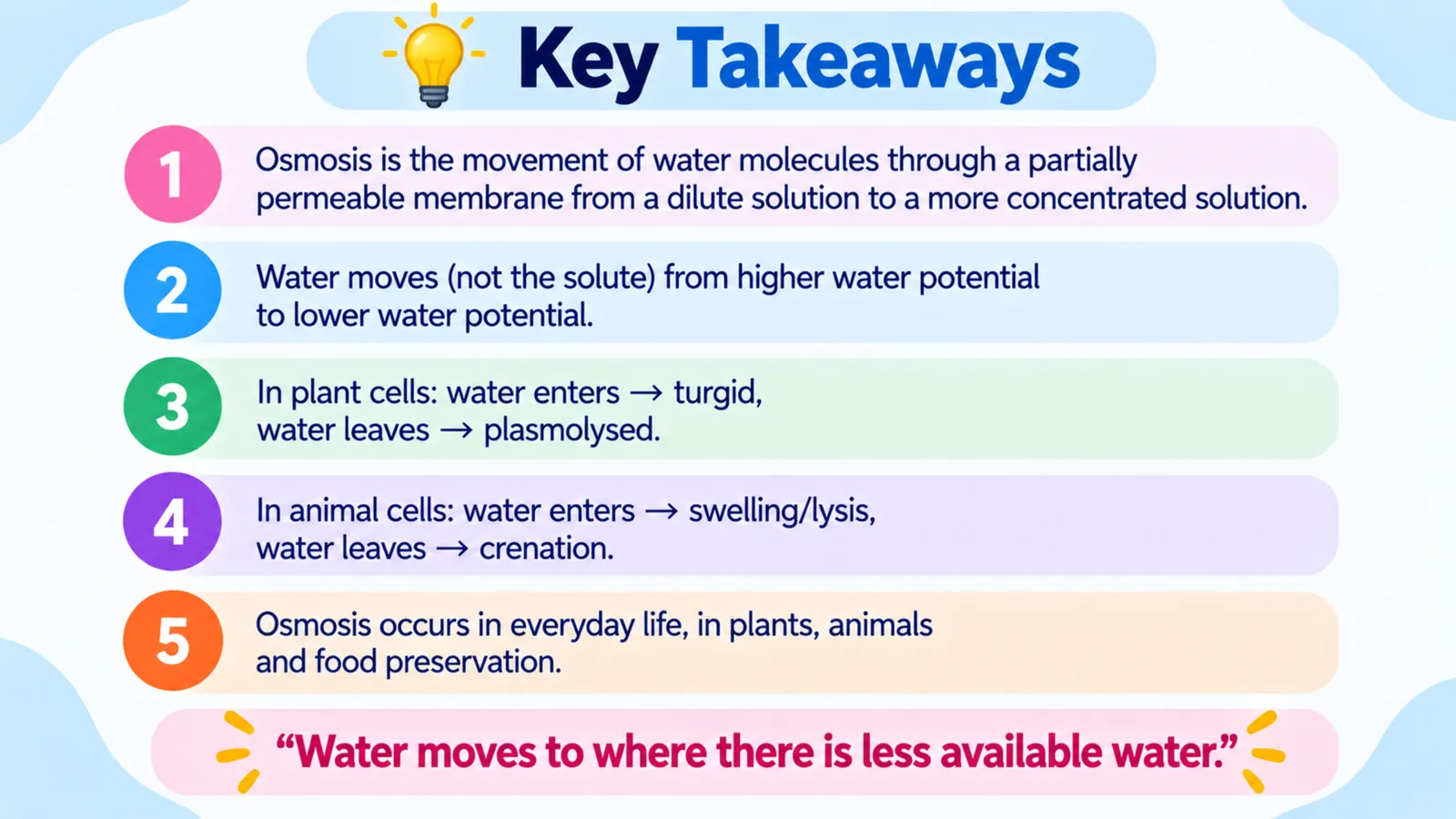
Osmosis is the net movement of water from high to low water potential across a partially permeable membrane.
It is passive and involves water only.
Animal cells burst (haemolysis) in hypotonic solutions and shrink (crenation) in hypertonic solutions.
Plant cells become turgid in dilute solutions and plasmolysed in concentrated ones, but never burst.
The potato cylinder practical lets you estimate the water potential of plant tissue.
Slide: Key takeaways
Osmosis in five points
1/1
Master these ideas and you will be ready for any osmosis question the exam can throw at you. Next, read our guide to transpiration in plants to see how osmosis at the roots powers the movement of water all the way to the top of the tallest trees.
🗂️ Revision Flashcards
Tap a card to reveal the answer.
🎯 Quick Quiz
8 questions. Pick an answer to check it straight away.
1Which statement about osmosis is correct?
Osmosis is passive and only water moves by osmosis, across a partially permeable membrane.
2Water moves from a solution at −200 kPa to one at −800 kPa. Why?
Water always moves from higher (less negative) to lower (more negative) water potential.
3What is the water potential of pure water?
Pure water has the highest possible water potential, which is set at zero.
4Red blood cells are placed in pure water. What happens?
Water enters by osmosis and there is no cell wall, so the membrane tears.
5Why don't plant cells burst in pure water?
The cell wall resists the expanding vacuole; when it pushes back hard enough, net water entry stops.
6Why do hospital drips use saline at about 0.9 percent salt?
An isotonic drip causes no net movement of water, so blood cells keep their shape.
7In the potato cylinder practical, what does the point where the graph crosses the x-axis show?
There is no change in mass there, so it estimates the water potential of potato tissue.
8Which factor speeds up osmosis?
A larger membrane area gives more pores for water to pass through.