Introduction to Microscope Parts
Understanding the Microscope
A microscope is an essential scientific instrument that allows us to observe objects and organisms too small to be seen with the naked eye. Understanding each part of the microscope and its function is crucial for proper use and accurate observations.
The microscope consists of several key components working together. The eyepiece (or ocular lens) is where you look through to view the specimen, typically providing 10x magnification. The objective lenses mounted on the rotating nosepiece provide additional magnification, usually ranging from 4x to 100x. Together, these lenses create the magnified image we observe.
The mechanical components include the body tube, which connects the eyepiece to the objective lenses, and the arm, which supports the tube and provides a handle for carrying. The base provides stability, while the stage holds the specimen slide in place. The diaphragm controls the amount of light reaching the specimen, and the mirror (or light source) directs light upward through the specimen.
Proper focusing is achieved through two adjustment knobs: the coarse adjustment knob for initial focusing and the fine adjustment knob for sharp, detailed focus. Mastering these parts and their functions is the foundation for successful microscopy in biology and other sciences.
Interactive Learning
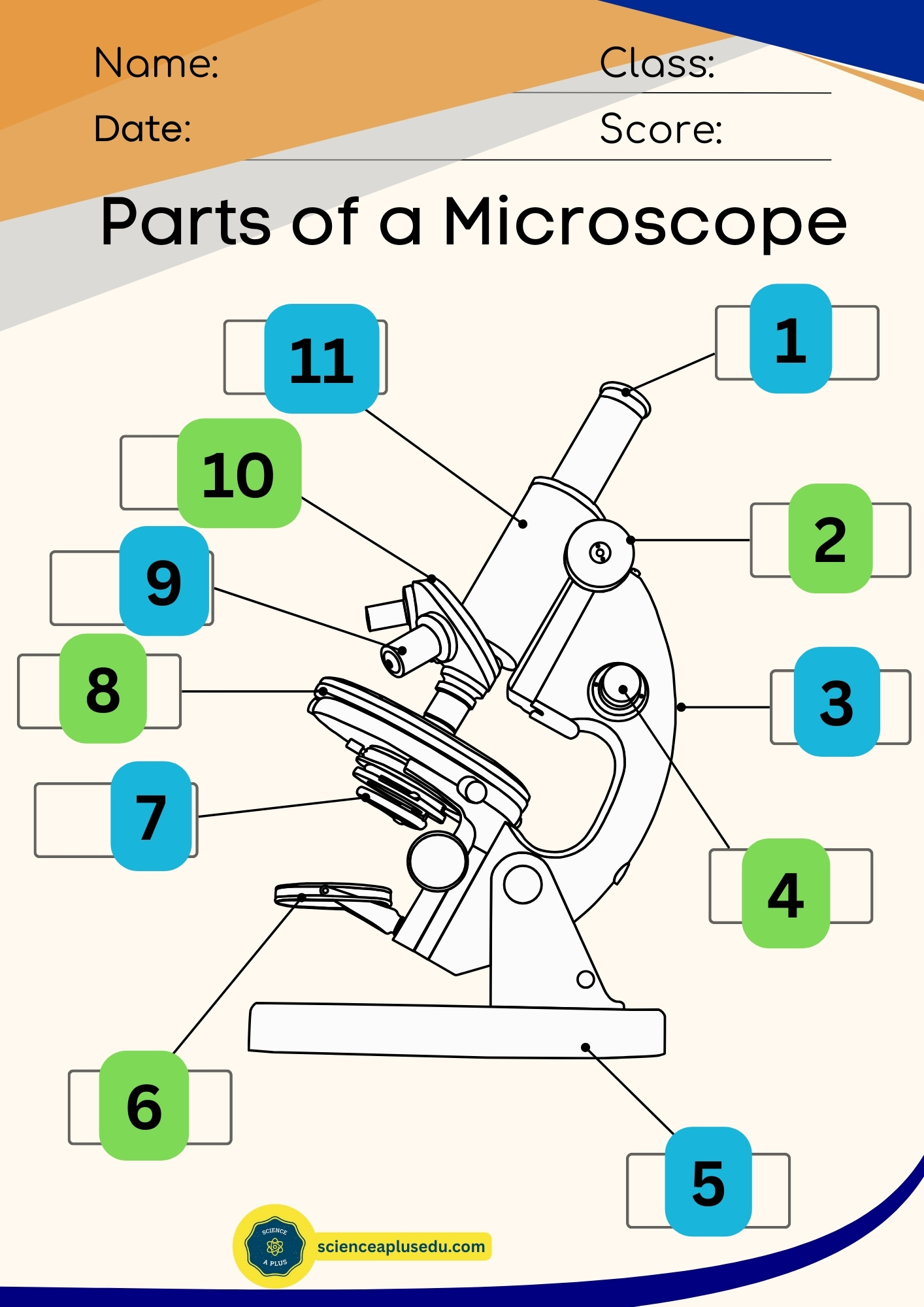
Worksheets
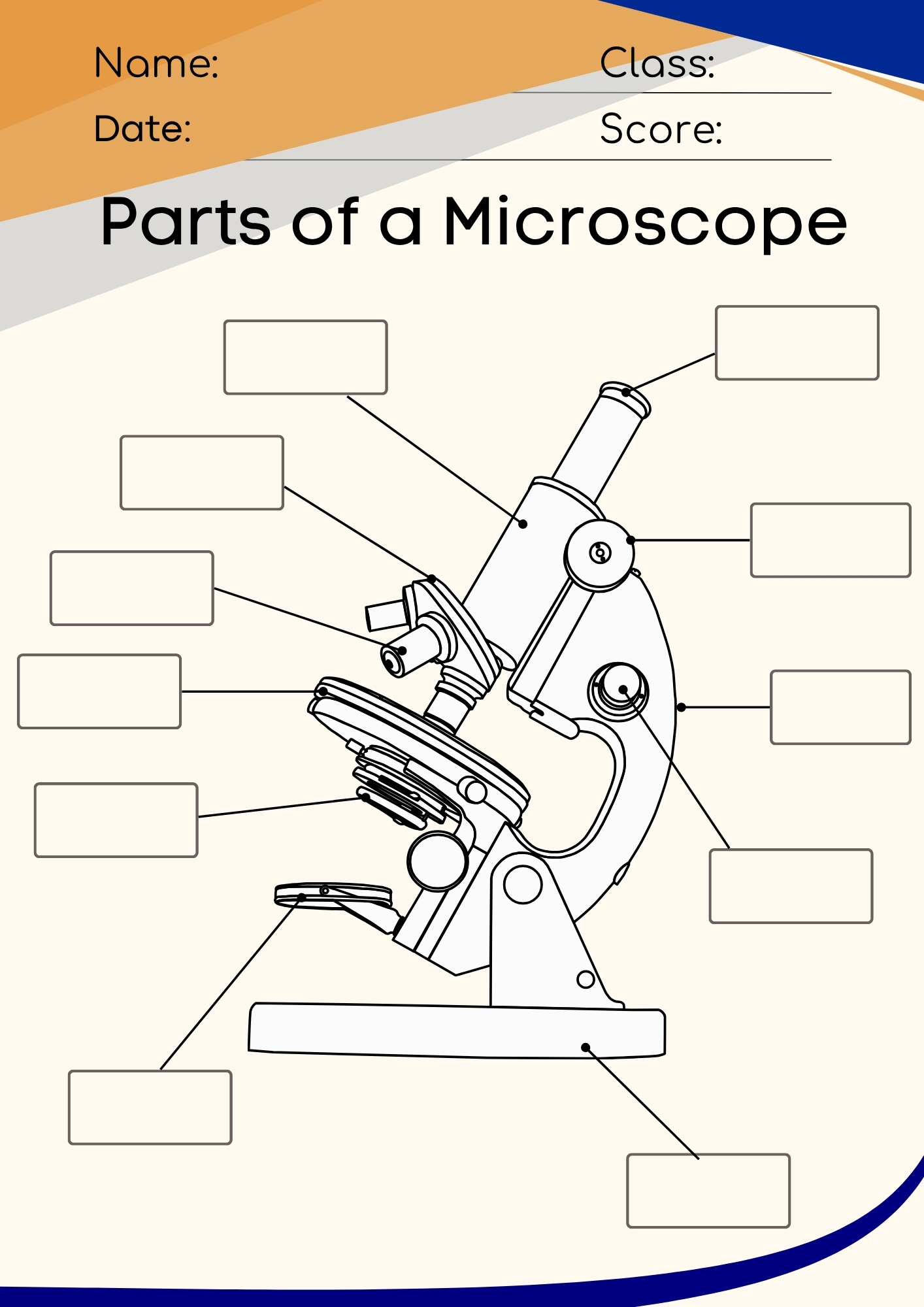
Parts of a Microscope - Practice
Label all the parts of the microscope in this comprehensive worksheet.
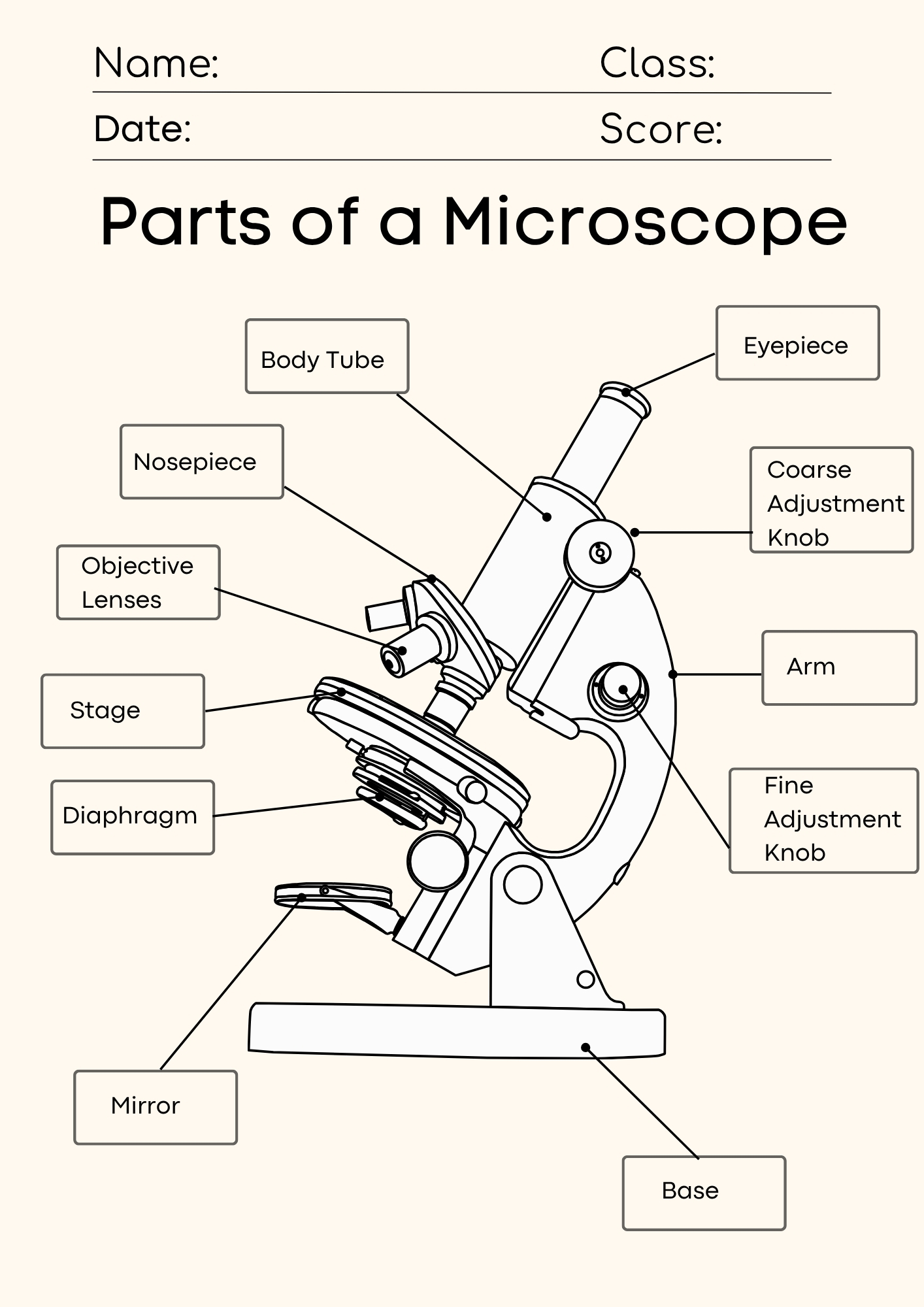
Parts of a Microscope - Answer Key
Complete answer key with all microscope parts labeled correctly.
Light Microscope Parts and Functions
What a light microscope does
A light microscope (also called a compound microscope) uses visible light and two sets of glass lenses to produce an enlarged image of a small, thin specimen. Light passes up through the specimen, into an objective lens that forms a magnified image, and then through the eyepiece lens, which magnifies that image a second time. Because the light must pass through the specimen, whatever you look at has to be thin enough to be nearly transparent, which is why slides of onion skin or cheek cells are only one cell thick.
Every part of the instrument does one of three jobs: it magnifies (the lenses), it controls light (the lamp, diaphragm and condenser), or it holds and moves things (the stage, focus knobs, arm and base). The table below names each part and gives its function.
Parts of a light microscope and their functions
| Part | Function |
|---|---|
| Eyepiece (ocular lens) | The lens you look through. It magnifies the image made by the objective lens, usually by 10×. |
| Body tube | Holds the eyepiece the correct distance above the objective lenses so the image is formed in the right place. |
| Revolving nosepiece | A rotating turret that holds the objective lenses. Turning it clicks a different objective into position over the specimen. |
| Objective lenses | The lenses closest to the specimen. They do the first stage of magnifying. A school microscope usually has 4×, 10× and 40× objectives; some also have a 100× oil-immersion lens. |
| Stage | The flat platform that supports the slide. It has a hole in the centre so light can pass up through the specimen. |
| Stage clips | Spring clips that hold the slide still so it does not slip while you focus. Some microscopes have a mechanical stage with knobs that move the slide instead. |
| Coarse adjustment knob | Moves the stage (or the body tube) up and down by large amounts to bring the specimen roughly into focus. Used only with the low-power objective. |
| Fine adjustment knob | Moves the stage by very small amounts to make the image sharp. This is the only focus knob you should turn when using the high-power objective. |
| Condenser | A lens beneath the stage that gathers light from the lamp and concentrates it onto the specimen so the image is evenly lit. |
| Diaphragm (iris diaphragm) | An adjustable opening under the stage that controls how much light reaches the specimen. Closing it a little increases contrast so pale structures show up. |
| Light source or mirror | Provides the light. Modern microscopes have a built-in lamp in the base; older ones use a mirror to reflect light from a lamp or a window up through the stage. Never point a mirror at direct sunlight. |
| Arm | The curved upright that connects the head and lenses to the base. It is where you hold the microscope when carrying it. |
| Base | The heavy, flat bottom that keeps the microscope steady on the bench. The lamp is usually housed inside it. |
Working out total magnification
The two sets of lenses multiply their effects, so the total magnification is found by multiplying the magnification of the eyepiece by the magnification of the objective lens in use:
Total magnification = eyepiece magnification × objective magnification
Worked example: a microscope has a 10× eyepiece and the 40× objective is clicked into place. Total magnification is 10 × 40 = 400×, so the image you see is four hundred times wider than the real specimen. With the same eyepiece, the 4× objective gives 40×, the 10× objective gives 100×, and a 100× oil-immersion objective gives 1000×.
Two things change as you go up in magnification. The field of view (the circle of specimen you can see) becomes smaller, so you must centre the object before switching to a higher objective or it will vanish from view. The image also becomes dimmer, because the same light is spread over a larger image, so you may need to open the diaphragm.
Magnification is not the same as resolution
Magnification is how many times larger the image is than the object. Resolution is the smallest distance between two points at which they can still be seen as two separate points rather than one blur. A light microscope cannot resolve points closer together than about 0.2 micrometres (200 nanometres), because of the wavelength of visible light. Magnifying beyond roughly 1000× just makes the same blur bigger. That is why structures such as ribosomes and the inside of mitochondria can only be seen with an electron microscope, which uses a beam of electrons with a far shorter wavelength and resolves detail down to a fraction of a nanometre.
How to view a slide: step by step
- Carry the microscope with one hand under the base and the other on the arm. Place it on a flat bench away from the edge and switch on the lamp (or angle the mirror towards a lamp).
- Turn the revolving nosepiece so the lowest-power objective (usually 4×) clicks into place.
- Put the slide on the stage, hold it with the stage clips, and move it so the specimen sits over the hole in the centre of the stage.
- Looking at the microscope from the side, not through the eyepiece, turn the coarse adjustment knob until the objective is close to the slide but not touching it.
- Now look through the eyepiece and slowly turn the coarse knob to move the lens and slide apart until the specimen comes into focus. Moving apart, rather than closer, means you cannot drive the lens into the slide.
- Use the fine adjustment knob to make the image sharp, and adjust the diaphragm until the detail is clear without glare.
- Move the slide so the part you want to study is in the centre of the field of view, then rotate to the 10× and later the 40× objective. Refocus with the fine knob only.
- When you finish, return to the lowest-power objective, remove the slide, switch off the lamp and replace the dust cover.
Remember that the image is inverted: it appears upside down and reversed left to right, so moving the slide to the left makes the image move to the right.
Preparing a simple slide
Place a thin piece of specimen, such as a single layer of onion skin, in the centre of a clean glass slide. Add one drop of water or a stain that makes transparent parts visible: iodine solution for onion cells (it colours starch and the nucleus) or methylene blue for cheek cells. Rest one edge of a coverslip on the slide at about 45 degrees and lower it gently with a mounted needle so that air bubbles are pushed out rather than trapped. Blot away any liquid that squeezes out before putting the slide on the stage.
Key terms
- Specimen
- The object being examined under the microscope, mounted on a glass slide.
- Objective lens
- The lens nearest the specimen that produces the first magnified image.
- Eyepiece (ocular lens)
- The lens nearest your eye that magnifies the objective's image again.
- Total magnification
- Eyepiece magnification multiplied by objective magnification.
- Resolution
- The ability to see two close points as separate; about 0.2 micrometres for a light microscope.
- Field of view
- The circular area of the specimen visible through the eyepiece; it shrinks as magnification rises.
- Coverslip
- A very thin square of glass laid over the specimen to hold it flat and protect the objective lens.