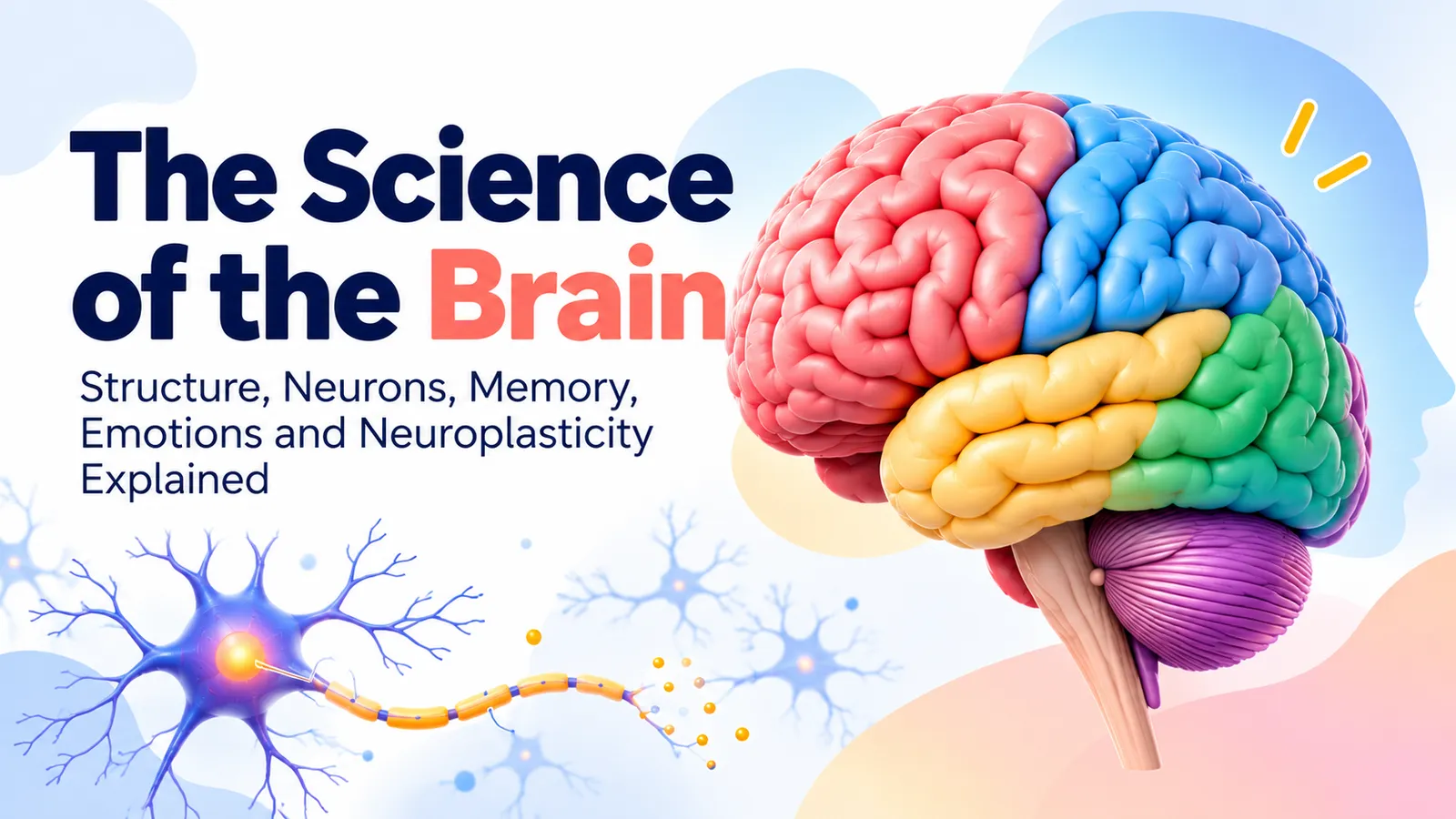
From the skull and meninges to neurons, synapses, lobes, memory, emotion and neuroplasticity, the whole brain in one guide.
Hold up your two fists and press them together. That is roughly the size of the object responsible for everything you have ever thought, felt, remembered or done. It weighs about 1.4 kilograms and has the texture of firm jelly. It has no moving parts and would fit comfortably in your hands. Yet, as far as we know, it is the most complex object in the universe.
Right now your brain is turning marks on a page into meaning. It is keeping your heart beating and your lungs breathing without a single conscious command. It is holding the memory of your name and your childhood home. And it is doing all of this on about 20 watts, less power than a dim light bulb. The ancient Egyptians thought so little of the brain that they threw it away when preparing mummies, believing the heart was the seat of thought. Today scientists can watch a living brain think, yet the deepest question, how the brain produces conscious experience, is still unsolved.
The Structure of the Brain
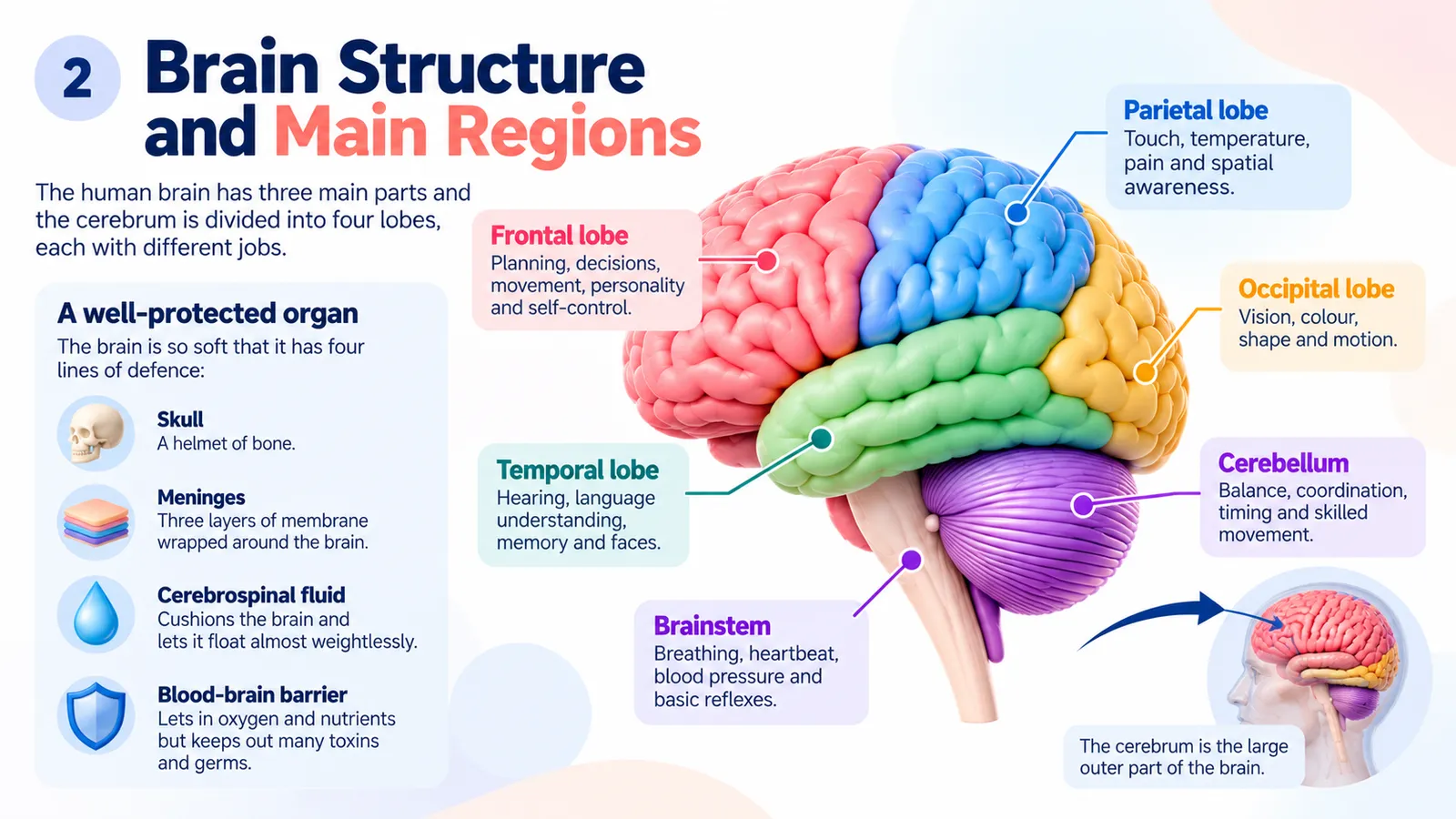
A well-protected organ
The brain is so soft that, out of the body, it cannot hold its own shape. It therefore has four lines of defence:
The skull, a helmet of bone.
The meninges, three layers of membrane wrapped around the brain.
Cerebrospinal fluid, which cushions the brain and lets it float almost weightlessly.
The blood-brain barrier, a tight seal around blood vessels that lets in oxygen and nutrients but keeps out many toxins and germs.
Grey matter and white matter
Grey matter is where the thinking happens, because it is packed with the cell bodies of neurons. White matter is the cabling, made of long fibres wrapped in pale fatty insulation. The outer surface, the cerebral cortex, is a sheet of grey matter only a few millimetres thick, and it is deeply wrinkled. Like scrunching paper to fit in a cup, folding lets a large area of cortex fit inside a small skull. Unfolded, it would cover about 2,000 to 2,400 cm², roughly a large pillowcase.
Thinking, memory, senses, language, emotion, voluntary movement
Two halves, one mind
Seen from above, the brain has left and right hemispheres joined by the corpus callosum, a superhighway of some 200 million fibres. The wiring crosses over, so the left hemisphere controls the right side of the body and the right controls the left.
You may have heard that people are "left-brained" (logical) or "right-brained" (creative). This is largely a myth. The hemispheres do specialise somewhat, with language leaning left for most people, but nearly everything you do uses both halves working together. The idea that we use only 10% of our brains is also a myth. Brain scans show we use virtually all of it over a day, and most of it stays active even during sleep.
🧠
Slides: The science of the brain
Protection, the three main parts and the four lobes
1/2
Neurons and Nerve Impulses
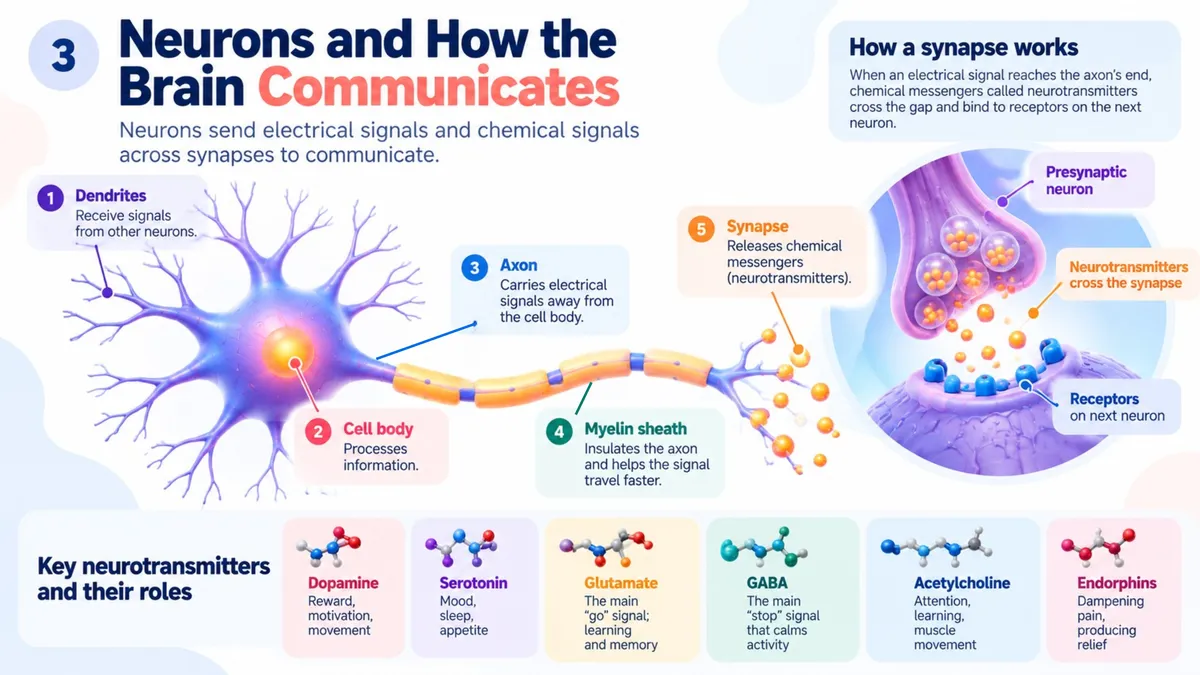
The secret of the brain lies in its cells. The neuron is the basic building block of the nervous system, built to receive, process and pass on information. Most neurons share three parts:
Dendrites, branching extensions that receive incoming signals.
The cell body (soma), which contains the nucleus and gathers the incoming signals.
The axon, a long fibre that carries the outgoing signal to other cells.
Many axons are wrapped in myelin, a fatty insulating sheath like the plastic coating on a wire. Myelin lets signals race along at over 100 metres per second, which is why diseases that damage it are so serious.
The electrical signal
A neuron sends a message as a brief electrical pulse called an action potential. At rest, a neuron holds a small charge across its membrane, like a tiny battery. When enough incoming signals push it past a threshold, gates open, ions rush across the membrane and a wave of electrical change sweeps down the axon. The signal is all-or-nothing: a neuron either fires a full pulse or does not fire. The brain signals strength by firing more often, so a gentle touch produces a slow trickle of pulses and a firm one a rapid burst.
The chemical signal
Neurons do not actually touch. Between them is a microscopic gap called the synapse. When an action potential reaches the axon's end, it triggers the release of chemical messengers called neurotransmitters, which cross the gap and dock onto receptors on the next neuron. That neuron adds up all its incoming signals and decides whether to fire. The brain therefore runs on electrical signals within neurons and chemical signals between them, and this handover is where many medicines act.
Neurotransmitter
Broadly associated with
Dopamine
Reward, motivation, movement
Serotonin
Mood, sleep, appetite
Glutamate
The main "go" signal; learning and memory
GABA
The main "stop" signal that calms activity
Acetylcholine
Attention, learning, muscle movement
Endorphins
Dampening pain, producing relief
Neurons are not alone: the brain also contains support cells called glia, which build myelin, feed and protect neurons, and tidy up synapses. Billions of neurons firing in coordinated patterns produce perception, memory, imagination and self-awareness.
Neurons and how the brain communicates
A Tour of the Brain: Regions and Functions
Each hemisphere of the cerebrum has four lobes, named after the skull bones above them.
Lobe
Location
Main functions
Frontal
Front
Planning, decisions, movement, personality, self-control, speech production
Parietal
Top, toward the back
Touch, temperature, pain, spatial awareness
Temporal
Sides, near the ears
Hearing, language understanding, memory, faces
Occipital
Back
Vision: colour, shape, motion
Deeper inside lie older structures often grouped as the limbic system:
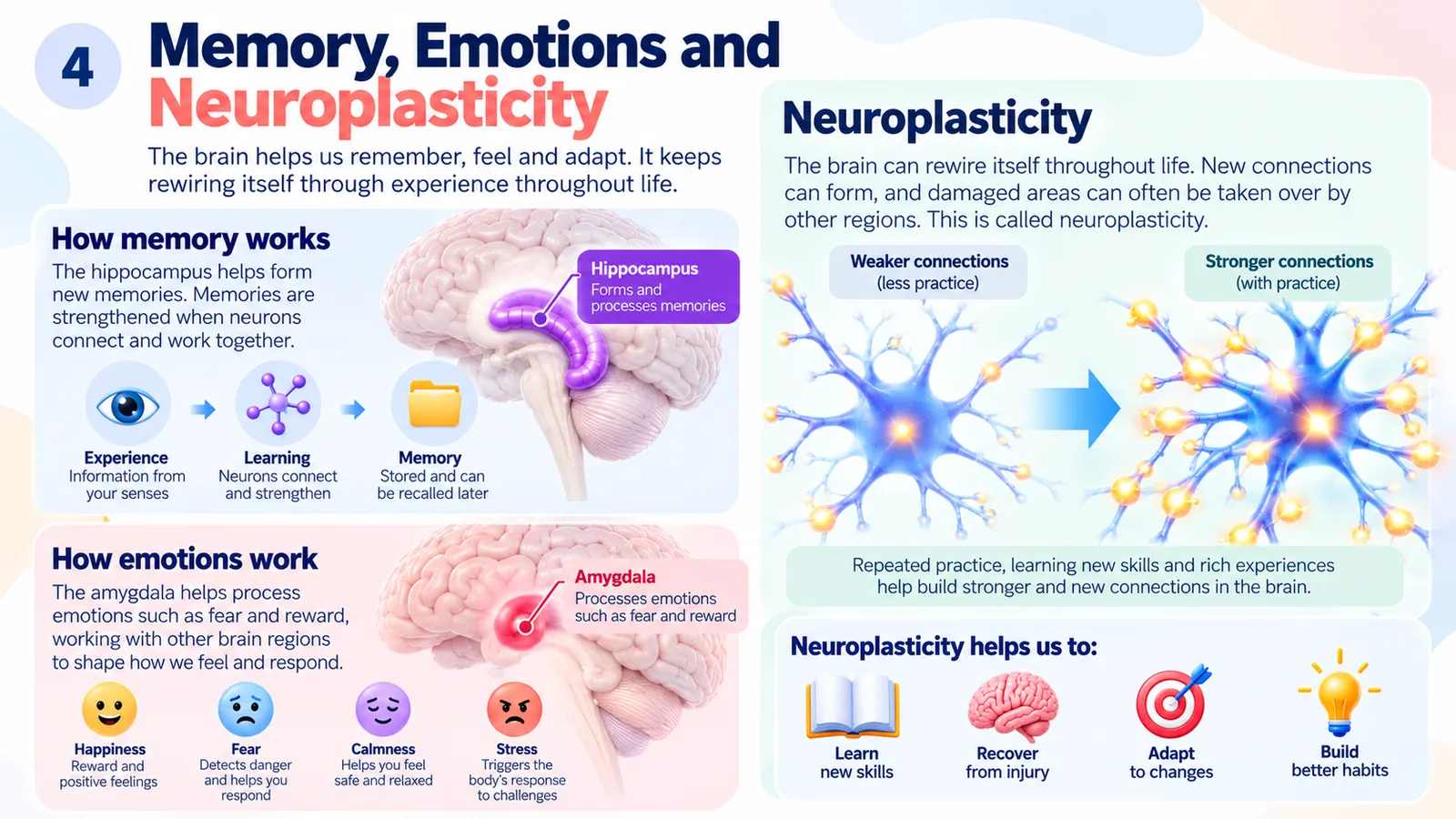
The hippocampus forms new long-term memories, a "save button" for experience.
The amygdala is the brain's alarm system for fear and strong emotion.
The thalamus is the sensory relay station.
The hypothalamus controls hunger, thirst, temperature and hormones.
Two strips of cortex hold maps of the body. The motor cortex sends commands for movement and the somatosensory cortex receives touch. These maps are distorted: the hands and lips take up a huge share while the back gets only a sliver, which is why your fingertips can read Braille but your back cannot.
Brain injuries revealed that functions live in specific places. Damage to Broca's area leaves patients able to understand speech but unable to produce it fluently, and in 1848 the railway worker Phineas Gage survived an iron rod through his frontal lobe, after which friends said he was "no longer Gage". His personality and self-control had changed.
The Senses: How the Brain Builds Reality
It feels as though your eyes simply see the world, but your senses do not show you the world directly. Receptors detect energy such as light, sound waves, chemicals or pressure and convert it into electrical signals, a process called transduction. Your brain then builds the experience you call reality. In a real sense, you do not see with your eyes. You see with your brain.
Sight
Light lands on the retina, where rods (dim light, colour-blind) and cones (bright light and colour) convert it into signals. These travel along the optic nerve to the visual cortex at the back of the brain, which reconstructs shape, colour, depth and motion. Because the brain constructs vision, it can be fooled, and optical illusions catch it making its best guess.
The other senses
Hearing begins when sound vibrates the eardrum and hair cells in the cochlea convert it into signals. Smell and taste are chemical senses, and much of what we call flavour is actually smell, which is why food tastes bland when you have a cold.
Memory and Learning
Memory is not a video recording in a drawer. It is an active, reconstructive process. Making a memory has three steps: encoding (taking in information), storage (holding it) and retrieval (bringing it back). Forgetting can fail at any step.
Type of memory
How long
Example
Sensory memory
Under about 2 seconds
The flash of an image after you blink
Short-term (working)
Seconds to a minute
Holding a phone number to dial it
Long-term: explicit
Days to a lifetime
Your birthday, a holiday
Long-term: implicit
Days to a lifetime
Riding a bike
The hippocampus helps form new explicit memories and files them into the cortex over time, while skill memories rely more on the cerebellum and basal ganglia. The patient known as H.M. had his hippocampus removed in 1953 to treat epilepsy. He could no longer form new long-term memories, yet he could still learn new physical skills without remembering practising them, which showed that different memory systems live in different places.
Memory is also fallible. Every time you recall a memory you partly rebuild it, filling gaps with assumptions. That is why eyewitnesses can be honestly certain yet wrong, and why false memories can be created surprisingly easily.
Science also shows how to study smarter:
Test yourself. Retrieval practice beats re-reading, because the effort of recall strengthens memory.
Space it out. Studying over several days beats cramming.
Connect ideas to what you already know, and sleep on it, because sleep moves fragile memories into long-term storage.
Emotions and the Social Brain
Emotions can feel like interruptions to clear thinking, but they are among the brain's most useful tools. An emotion is a quick assessment of a situation, bundled with changes in the body and a push toward action. Fear prepares you to escape, disgust steers you from poison and joy draws you toward what helps you thrive. Feelings are a form of intelligence honed over millions of years.
Three brain parts work together:
The amygdala raises the alarm, often before you are consciously aware of danger.
The hypothalamus turns emotion into body change, driving the racing heart of fight-or-flight through adrenaline and cortisol.
The prefrontal cortex regulates and interprets emotions, acting as the thoughtful brake.
Humans are also intensely social. We read faces, tone of voice and body language within a fraction of a second, and empathy lets us sense what others feel.
Because the prefrontal cortex can influence the emotional core, we can learn to manage feelings. Naming an emotion ("I'm feeling anxious") can reduce its intensity. Slow breathing calms fight-or-flight, and reframing and seeking support help too. The aim is to understand emotions, not suppress them. Chronic stress, with fight-or-flight switched on for weeks, can harm the brain and even shrink parts of the hippocampus, so managing stress protects your brain.
Intelligence and Decision-Making
The mind runs two systems. Fast thinking is automatic and intuitive, like recognising a friend's face. Slow thinking is deliberate and logical, like solving a hard maths problem. We lean on the fast system far more than we realise, and its shortcuts produce cognitive biases, such as confirmation bias (noticing only evidence that fits what we believe) and anchoring (leaning on the first number we hear).
Intelligence has many forms. Fluid intelligence (reasoning about new problems) peaks in early adulthood, while crystallised intelligence (accumulated knowledge) can keep growing for decades. Intelligence is not fixed at birth. It grows through learning and effort, and students with a growth mindset tend to persist longer and learn more.
Sleep and the Brain
The sleeping brain is far from switched off. It cycles through NREM and REM sleep about every 90 minutes, replays and strengthens the day's memories, and uses the glymphatic system to flush waste from the brain, including proteins linked to Alzheimer's disease. Sleep loss quickly worsens attention, memory and mood. Read our companion guide, The Science of Sleep, for the full story.
The Developing Brain: From Birth to Old Age
A newborn's brain is one of the busiest construction sites in nature. Babies are born with most of their neurons, but connections between them multiply explosively after birth, shaped by sights, sounds, language and loving care. Young children have sensitive periods when skills such as language are learned with remarkable ease.
The developing brain deliberately overproduces connections and then prunes the ones it does not use, a process called synaptic pruning. Connections that are used grow stronger, and unused ones are trimmed. This is the brain's version of "use it or lose it".
In teenagers, the emotional and reward systems mature early, but the prefrontal cortex, the seat of judgement and impulse control, is one of the last regions to finish, often not until the mid-twenties. This is a powerful accelerator with still-developing brakes, which helps explain risk-taking and intense emotion. It is a normal, temporary stage and not a flaw.
In adulthood, processing speed may slow a little with age, but experience and wisdom compensate, and staying mentally, physically and socially active helps protect the brain. Serious memory loss is not normal ageing but a sign of illness worth investigating. Scientists once believed the adult brain could never grow new neurons. We now know the hippocampus can generate some, a process called neurogenesis, although its extent in humans is still debated.
Neuroplasticity: The Brain That Rewires Itself
For most of history, scientists believed the adult brain was fixed. We now know that the brain constantly reshapes itself in response to experience. This is neuroplasticity, perhaps the most hopeful discovery in neuroscience. Every time you learn something, connections between neurons strengthen, weaken or form. The guiding principle is that neurons that fire together, wire together. Repeating a pathway strengthens it, which is exactly why practice makes perfect.
The evidence is striking:
London taxi drivers, who memorise a maze of streets, were found to have an enlarged hippocampus.
Skilled musicians show enlarged brain areas controlling their playing hand.
In many blind people the visual cortex is recruited to process touch and hearing.
Plasticity makes recovery from injury possible. After a stroke, undamaged areas can gradually take over lost functions, especially with rehabilitation based on repeated, targeted practice. It is powerful but not magic. Change takes sustained effort, and there are limits after severe damage. Still, the brain is a living, adaptable organ, and you are to a real degree the sculptor of your own.
🔁
Slide: Memory, emotions and neuroplasticity
The hippocampus, the amygdala and a brain that rewires itself
1/1
When the Brain Struggles
This section informs and aims to reduce stigma. It is not a diagnosis tool. If it resonates, talk to a doctor.
Condition
What goes wrong
Stroke
Blood supply to part of the brain is blocked or bursts
Alzheimer's disease and dementia
Progressive loss of neurons and connections
Parkinson's disease
Loss of dopamine cells that control movement
Epilepsy
Bursts of excessive electrical activity cause seizures
Multiple sclerosis
Immune damage to the myelin insulation
A stroke is an emergency. Remember F.A.S.T.: Face drooping, Arm weakness, Speech slurred, Time to call emergency services immediately.
Mental health conditions such as depression and anxiety are common, real and treatable. They are medical conditions, not weakness or a failure of willpower. Treatments include talking therapies, which harness plasticity, medicines that adjust neurotransmitter balance, and lifestyle changes. Exercise is one of the most powerful and underused supports for brain and mental health. Help exists, treatment works for most people and reaching out is a sign of strength.
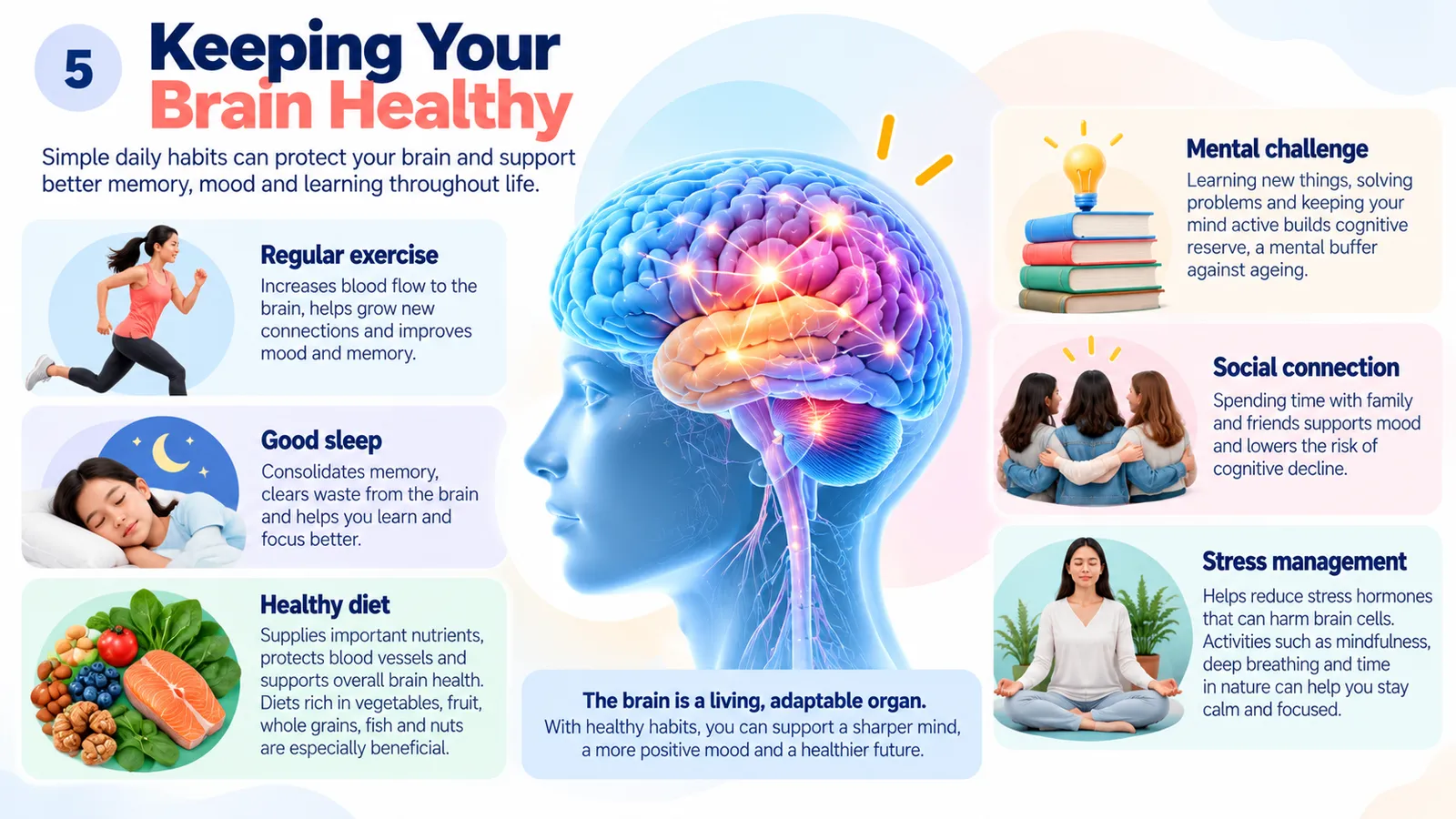
How to Protect Your Brain
You cannot replace your brain, so look after it. The research points to simple habits:
Habit
How it helps the brain
Regular exercise
More blood flow, new connections, better mood and memory
Good sleep
Consolidates memory and clears waste
Healthy diet
Supplies nutrients and protects blood vessels
Mental challenge
Builds cognitive reserve
Social connection
Protects mood and lowers risk of cognitive decline
Stress management
Stops stress hormones harming brain cells
Diets rich in vegetables, fruit, whole grains, fish and nuts, such as the Mediterranean diet, are linked to better brain health. Learning new things builds cognitive reserve, a mental buffer against ageing and disease. Protect your brain physically with helmets and seatbelts, take head injuries seriously, and limit alcohol, smoking and recreational drugs.
🥗
Slide: Keeping your brain healthy
Six everyday habits that protect the brain
1/1
The Frontier of Neuroscience
Modern tools let us watch a living brain without opening the skull. fMRI tracks blood flow to show where activity happens. EEG records electrical waves to show when it happens. Reading a scan is far from reading a mind, though. Brain-computer interfaces decode the brain's signals so that paralysed people can move a robotic arm or write text using only their thoughts.
Artificial intelligence was loosely inspired by brain networks, yet your brain learns from tiny amounts of experience, runs on a dim light bulb's power and produces conscious experience, feats no machine has matched.
The deepest mystery remains: how does a physical brain produce the felt experience of being you? That the universe produced an object able to wonder about its own existence is perhaps the brain's most amazing power.
Frequently Asked Questions About the Brain
Do we really use only 10% of our brain?
No. Brain scans show we use virtually all of it over a day, and most of it stays active even during sleep.
Why do teenagers take more risks?
Their emotional and reward systems mature before the prefrontal cortex, which handles judgement and impulse control and often finishes developing in the mid-twenties.
Key Takeaways
The brain is protected by the skull, meninges, cerebrospinal fluid and the blood-brain barrier.
Neurons send all-or-nothing electrical pulses and pass messages across synapses using neurotransmitters.
The four lobes and deep structures such as the hippocampus and amygdala have specialised jobs.
Your senses are converted into signals, and the brain constructs the reality you experience.
Memory is reconstructive, and testing, spacing and sleep make learning stronger.
Neuroplasticity means the brain rewires itself for life, and exercise, sleep, diet, learning and friendship protect it.
Your brain is the most remarkable object you will ever own. Look after it, challenge it and keep learning. Explore our companion guide, The Science of Sleep, to see what your brain does while you rest.
🗂️ Revision Flashcards
Tap a card to reveal the answer.
🎯 Quick Quiz
8 questions. Pick an answer to check it straight away.
1Roughly how many neurons does the human brain contain?
The brain is a 1.4 kg organ containing about 86 billion neurons.
2Which part of the brain controls breathing, heartbeat and blood pressure?
The brainstem, at the base of the brain, runs breathing, heartbeat, blood pressure and basic reflexes.
3What does 'all-or-nothing' mean for an action potential?
A neuron either fires a full pulse or not; strength is signalled by firing more often.
4How does a signal pass from one neuron to the next?
Neurons do not touch; neurotransmitters cross the synaptic gap and dock onto receptors.
5Which lobe is mainly responsible for vision?
The occipital lobe at the back processes vision: colour, shape and motion.
6Which neurotransmitter is lost in Parkinson's disease?
Parkinson's disease involves loss of dopamine cells that control movement.
7Which study method does the article say beats re-reading?
Retrieval practice beats re-reading because the effort of recall strengthens memory.
8Why do teenagers tend to take more risks?
Emotional and reward systems mature early, but the prefrontal cortex often finishes only in the mid-twenties.