Ice cubes melt in a drink, puddles disappear on a sunny day, and the smell of fresh bread spreads through a whole house. Each of these everyday events can be explained by one simple but powerful idea: everything is made of tiny particles that are always moving. This idea, called the kinetic particle theory, is the foundation of chemistry. In this guide you will learn how particles behave in solids, liquids and gases, what happens during each change of state, how to read heating and cooling curves, and how diffusion experiments prove that particles really do move.
📖 Lesson
Kinetic particle theory, changes of state, heating curves and diffusion, in the words examiners look for.
What Is Matter?
Matter is anything that has mass and takes up space. The air you breathe, the water you drink and the chair you sit on are all matter. All matter is made of extremely small particles, which can be atoms, molecules or ions depending on the substance. They are far too small to see even with the best light microscope; a single drop of water contains around 1.5 × 10²¹ molecules.
The Kinetic Particle Theory
The kinetic particle theory explains the properties of the three states using four key ideas:
All matter is made of tiny particles.
The particles are constantly moving. The word "kinetic" means relating to movement.
There are forces of attraction between the particles.
The higher the temperature, the more kinetic energy the particles have and the faster they move.
The state of a substance depends on the balance between two things: the forces of attraction holding particles together and the kinetic energy of the particles trying to move them apart.
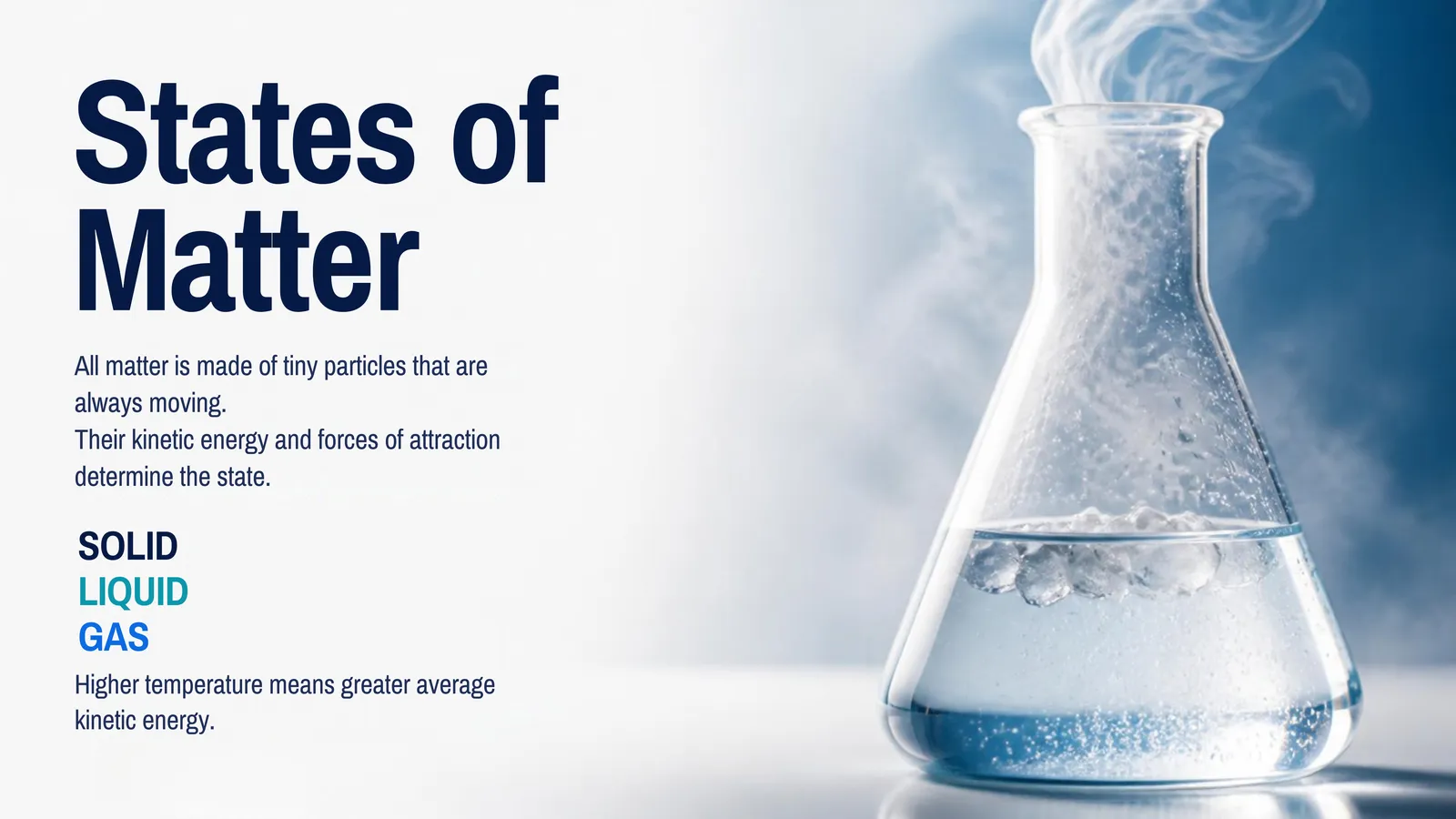
Slide: States of matter
Particles, kinetic energy and the three states
1/1
Solids, Liquids and Gases Compared
| Property | Solid | Liquid | Gas |
|---|---|---|---|
| Arrangement of particles | Regular, closely packed pattern (lattice) | Irregular, particles close together and touching | Random, particles far apart |
| Movement of particles | Vibrate about fixed positions | Move around and slide past each other | Move quickly and randomly in all directions |
| Forces between particles | Very strong | Fairly strong | Very weak |
| Energy of particles | Lowest | Medium | Highest |
| Shape | Fixed shape | Takes the shape of its container | Fills the whole container |
| Volume | Fixed volume | Fixed volume | No fixed volume; expands to fill space |
| Can it be compressed? | No | Hardly at all | Yes, easily |
| Can it flow? | No | Yes | Yes |
Solids
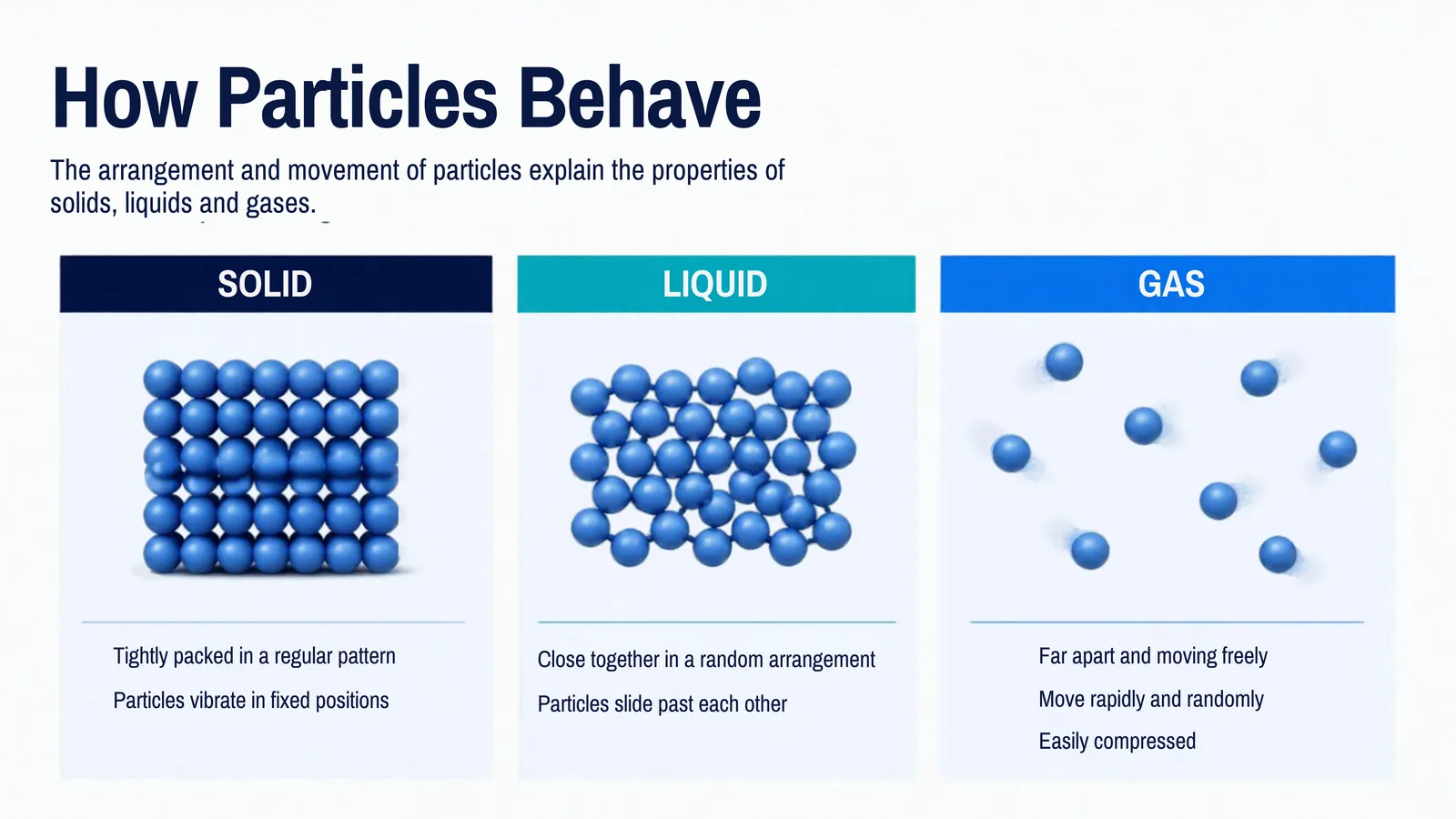
In a solid, the particles are held tightly in fixed positions by strong forces. They cannot move around, but they do vibrate. This explains why solids have a fixed shape and volume and cannot be squashed. As a solid is heated, the particles vibrate more and more strongly, which is why solids expand slightly when warmed. Railway lines have small gaps and bridges have expansion joints for exactly this reason.
Liquids
In a liquid, the particles are still close together, so liquids cannot be compressed much, but they are arranged randomly and can move past one another. This is why liquids flow and take the shape of their container while keeping the same volume. Hydraulic brakes in cars work because liquids are almost incompressible, so pressure applied at the pedal is transmitted through the brake fluid to the wheels.
Gases
In a gas, the particles are far apart, with a lot of empty space between them. The forces between them are very weak, and they move rapidly and randomly in straight lines until they collide with each other or with the walls of the container. These collisions cause gas pressure. Because there is so much space between particles, gases can easily be compressed. This is why gas can be stored under pressure in cylinders and in the air in bicycle tyres.
Slide: How particles behave
Arrangement and movement in solids, liquids and gases
1/1
Changes of State
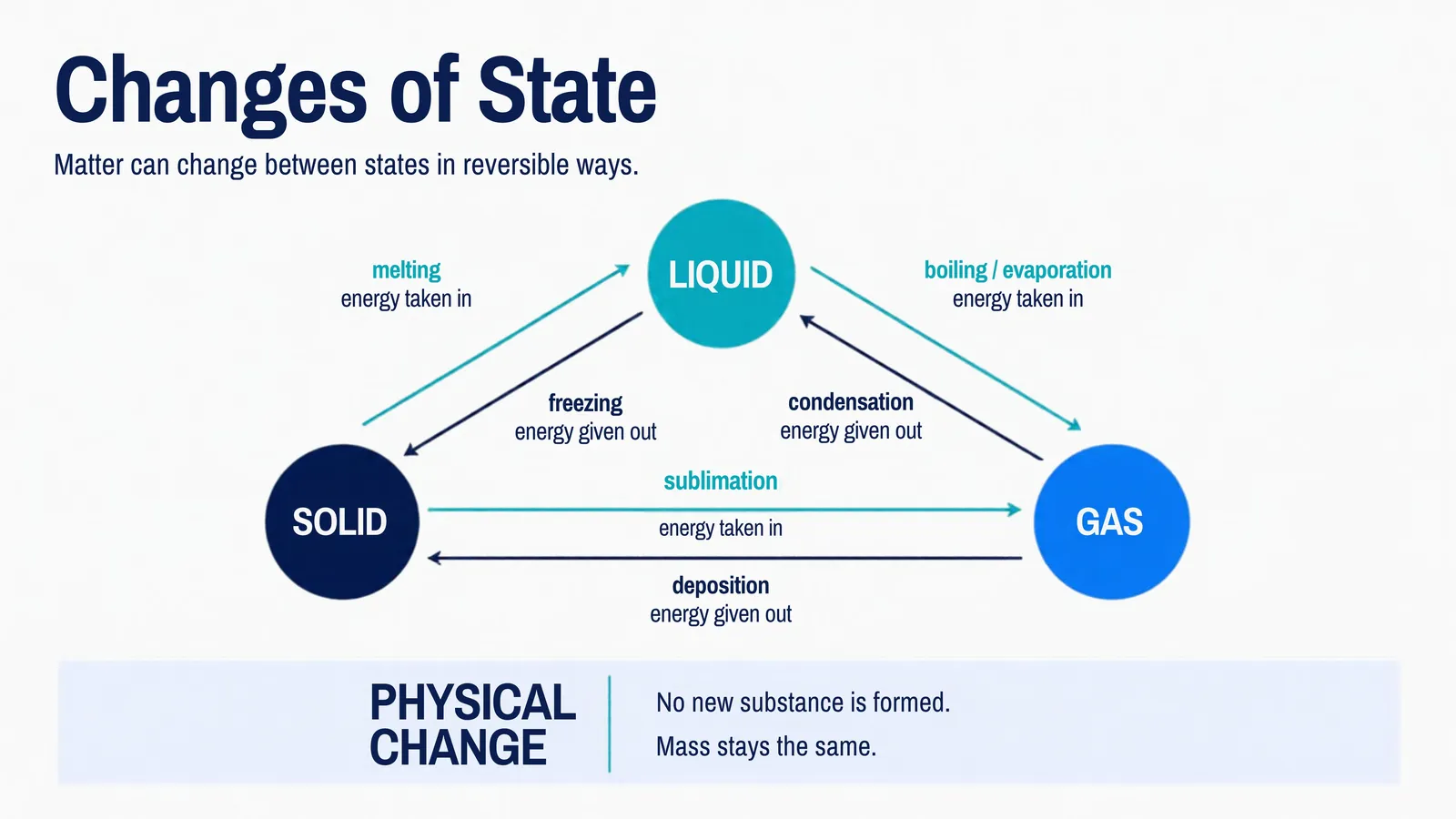
A change of state is a physical change. No new substance is made, and the change can be reversed. The mass stays the same, because the number of particles does not change; only their arrangement and energy change.
| Change of state | From | To | Energy |
|---|---|---|---|
| Melting | Solid | Liquid | Energy taken in |
| Freezing (solidifying) | Liquid | Solid | Energy given out |
| Boiling or evaporation | Liquid | Gas | Energy taken in |
| Condensation | Gas | Liquid | Energy given out |
| Sublimation | Solid | Gas | Energy taken in |
| Deposition | Gas | Solid | Energy given out |
Melting
When a solid is heated, its particles gain energy and vibrate faster. At the melting point, they have enough energy to overcome some of the forces holding them in fixed positions. The regular arrangement breaks down, and the particles can move past each other: the solid has become a liquid. Pure ice melts at 0 °C.
Freezing
Freezing is the reverse of melting. As a liquid cools, its particles lose energy and move more slowly until the forces of attraction pull them into a fixed, regular arrangement. For a pure substance, the freezing point and the melting point are the same temperature.
Boiling
When a liquid is heated to its boiling point, particles throughout the liquid have enough energy to overcome the forces of attraction completely. Bubbles of gas form inside the liquid and rise to the surface. Pure water boils at 100 °C at normal atmospheric pressure. At the top of a high mountain, where the air pressure is lower, water boils at a lower temperature, which is why it takes longer to cook pasta at high altitude.
Evaporation
Evaporation also turns a liquid into a gas, but it is different from boiling.
| Evaporation | Boiling |
|---|---|
| Happens at any temperature | Happens only at the boiling point |
| Takes place only at the surface of the liquid | Takes place throughout the liquid |
| Slow | Fast |
| No bubbles form | Bubbles form |
| Cools the remaining liquid | Temperature stays constant while boiling |
During evaporation, the most energetic particles at the surface escape into the air. The particles left behind have less energy on average, so the liquid cools down. This is why sweating cools your body. Evaporation is faster when the temperature is higher, the surface area is larger, the air is moving (windy) and the air is dry.
Condensation
When a gas cools, its particles lose energy and slow down, and the forces of attraction pull them together into a liquid. You see condensation on a cold window, on the outside of a glass of iced water and when your breath forms a mist on a cold morning.
Sublimation
Some solids turn directly into a gas without melting first. This is called sublimation. Examples include solid carbon dioxide, known as dry ice, which is used to create smoky stage effects, and iodine, which forms a purple vapour on gentle heating. Air fresheners and mothballs also work by slowly subliming. The reverse process, gas to solid, is called deposition, and it is how frost forms on a cold night.
Slide: Changes of state
Melting, freezing, boiling, condensation, sublimation and deposition
1/1
Heating and Cooling Curves
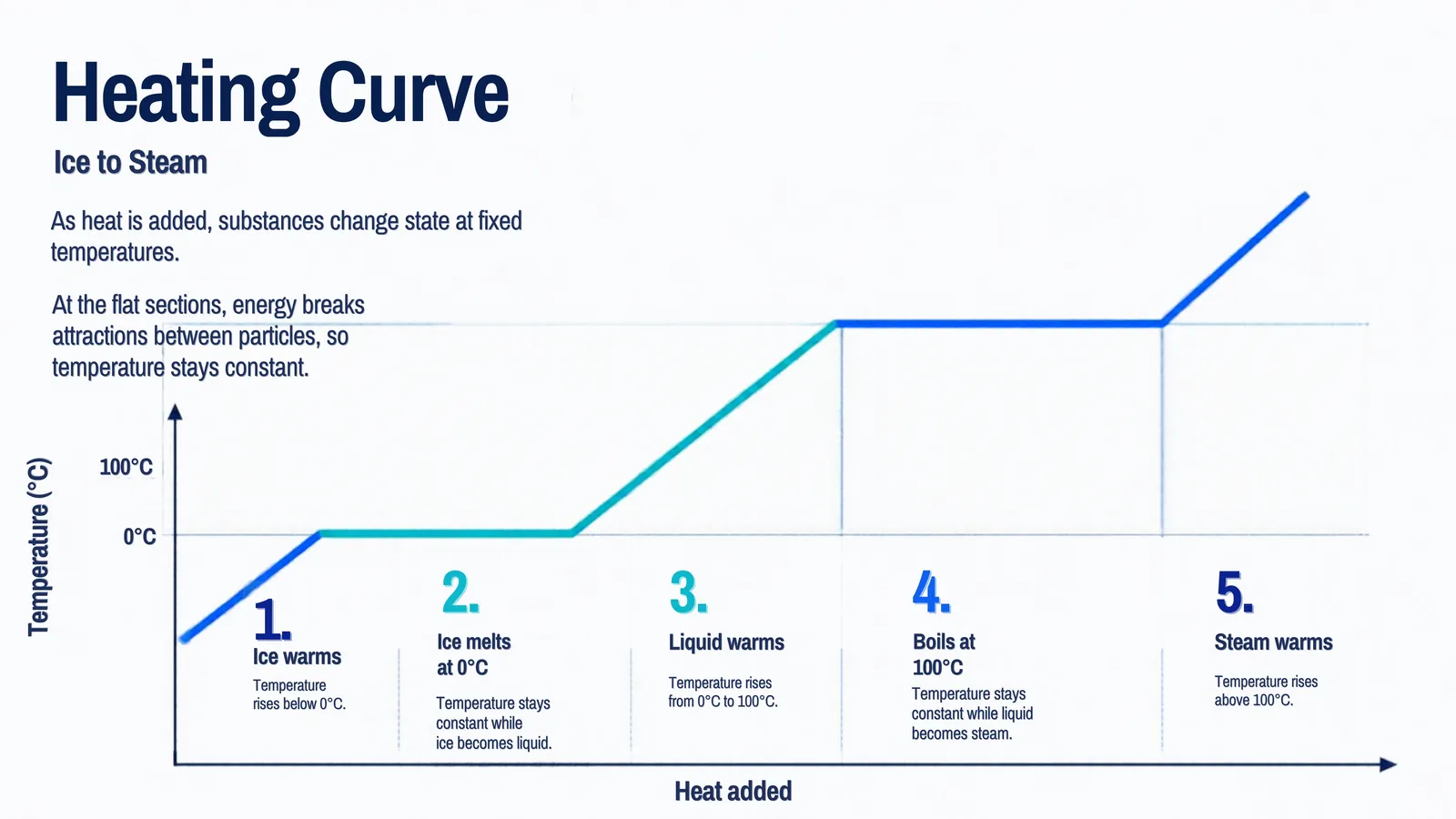
A heating curve shows how the temperature of a substance changes as it is heated steadily. For ice heated to steam, the curve has five parts:
The temperature of the ice rises to 0 °C.
A flat section at 0 °C while the ice melts.
The temperature of the liquid water rises to 100 °C.
A flat section at 100 °C while the water boils.
The temperature of the steam rises.
Why are there flat sections?
During a change of state, the energy supplied is used to overcome the forces of attraction between particles rather than to increase their kinetic energy. So the temperature stays constant until the change of state is complete. This energy is sometimes called latent heat. The boiling section is usually longer than the melting section, because much more energy is needed to separate particles completely than to loosen them.
A cooling curve is the mirror image. When a liquid freezes, the temperature stays constant as energy is released while the particles form bonds and arrange themselves into a solid.
Slide: Heating curve
Ice to steam, with flat sections at each change of state
1/1
Using Melting and Boiling Points to Test Purity
A pure substance melts and boils at a sharp, fixed temperature. An impure substance melts over a range of temperatures and usually melts at a lower temperature and boils at a higher temperature than the pure substance. This is why salt is spread on icy roads: the salt water freezes at a lower temperature than pure water, so the ice melts. Chemists and pharmacists check the purity of medicines by measuring their melting points.
Predicting the State of a Substance
To work out the state of a substance at a given temperature, compare the temperature with its melting and boiling points:
Below the melting point: solid.
Between the melting and boiling points: liquid.
Above the boiling point: gas.
For example, ethanol melts at −114 °C and boils at 78 °C, so at room temperature (25 °C) it is a liquid.
Diffusion: Evidence That Particles Move
Diffusion is the spreading out and mixing of particles from an area of higher concentration to an area of lower concentration, caused by their random movement. It happens in liquids and gases, but not in solids because solid particles cannot move from their positions.
Diffusion in gases: the ammonia and hydrogen chloride experiment
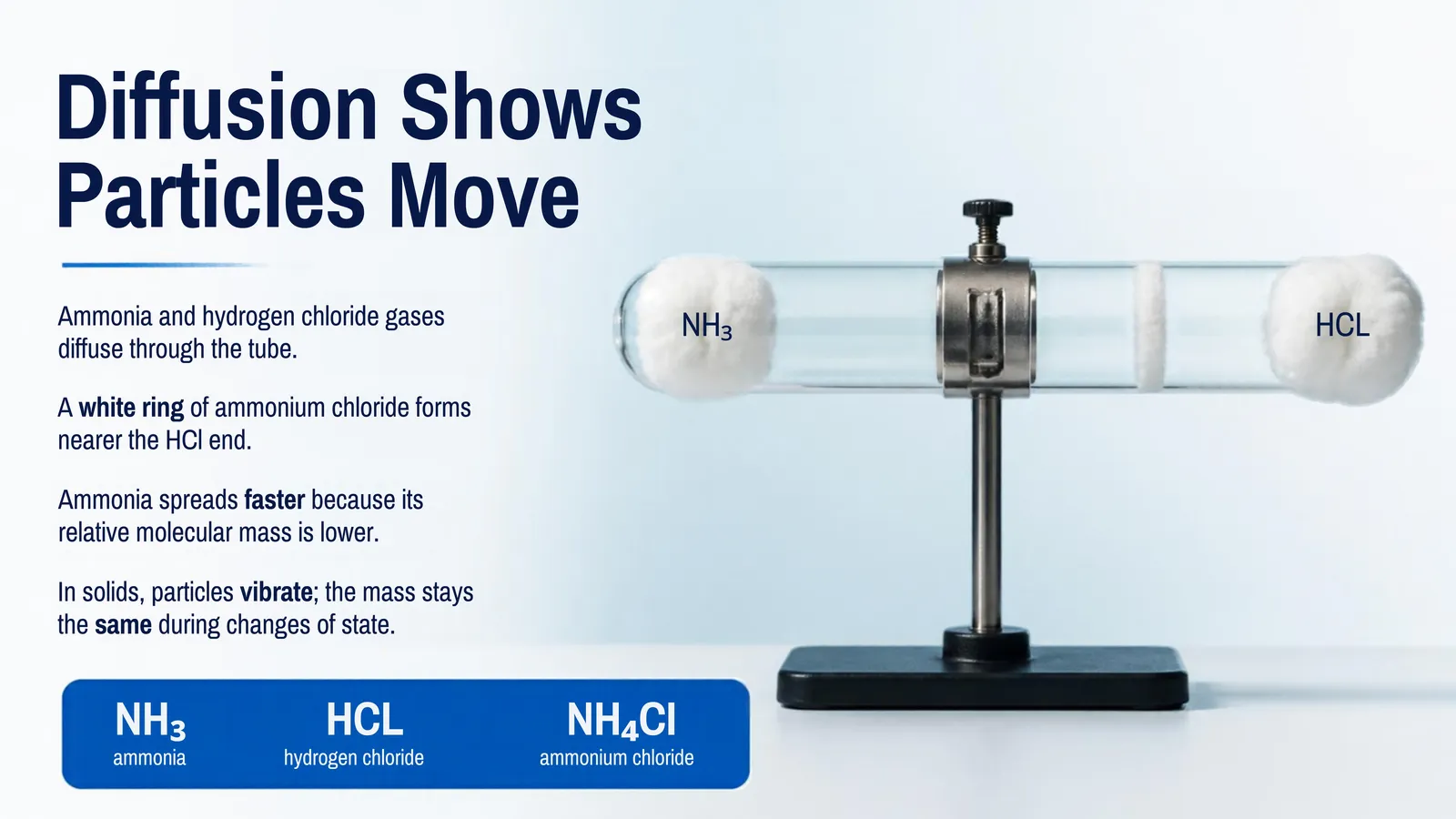
Cotton wool soaked in concentrated ammonia solution is placed at one end of a long glass tube, and cotton wool soaked in concentrated hydrochloric acid at the other. After a few minutes, a white ring of ammonium chloride forms inside the tube where the two gases meet:
NH3 + HCl → NH4Cl
The ring forms closer to the hydrochloric acid end. This shows that ammonia molecules diffuse faster. Ammonia has a lower relative molecular mass (Mr = 17) than hydrogen chloride (Mr = 36.5), and lighter particles diffuse faster at the same temperature.
Diffusion in liquids
If you drop a crystal of purple potassium manganate(VII) into water, the purple colour slowly spreads through the whole beaker without stirring. Diffusion in liquids is much slower than in gases because the particles are closer together and collide more often.
Factors affecting the rate of diffusion
Temperature: higher temperature gives particles more kinetic energy, so diffusion is faster.
Mass of particles: lighter particles diffuse faster.
State: diffusion is fastest in gases and slower in liquids.
Slide: Diffusion shows particles move
Ammonia and hydrogen chloride in a glass tube
1/1
Beyond Three States: Plasma and More
Scientists recognise other states of matter too. Plasma is formed when a gas is heated to such high temperatures that electrons are stripped from the atoms, producing a glowing mixture of ions and electrons. Plasma is the most common state of visible matter in the universe, because stars, including the Sun, are made of it. Lightning and neon signs are examples on Earth. At temperatures close to absolute zero, scientists can even create exotic states such as Bose-Einstein condensates.
Common Exam Mistakes
Saying particles in a solid do not move. They vibrate.
Saying particles themselves expand when heated. The particles stay the same size; the spaces between them increase.
Confusing evaporation with boiling.
Forgetting to explain flat sections on heating curves in terms of overcoming forces of attraction.
Saying mass changes during a change of state. It does not.
Frequently Asked Questions About States of Matter
Is glass a solid or a liquid?
Glass is an amorphous solid. Its particles are arranged randomly like a liquid, but they are held in fixed positions, so it does not flow.
Why does a gas exert pressure?
Gas particles constantly collide with the walls of their container. Each collision pushes on the wall, and together these collisions create pressure.
Why do puddles dry up without boiling?
Water evaporates at any temperature, as the most energetic surface molecules escape into the air.
Key Takeaways
Matter is made of particles that are always moving.
Solids vibrate in fixed positions, liquids slide past each other, and gases move quickly and randomly.
Changes of state are physical changes that involve energy being taken in or given out.
Temperature stays constant during melting and boiling because energy is used to overcome forces between particles.
Diffusion proves particles move, and lighter particles diffuse faster.
Now that you understand how particles behave, read our guide to elements, compounds and mixtures to learn how different particles combine to make every substance around you.
🗂️ Revision Flashcards
Tap a card to reveal the answer.
🎯 Quick Quiz
8 questions. Pick an answer to check it straight away.
1What do particles in a solid do?
Solid particles cannot move around, but they do vibrate.
2Which state has particles with the highest energy?
Gas particles have the highest energy and the weakest forces between them.
3What happens to mass during a change of state?
The number of particles does not change, so mass is unchanged.
4Why is there a flat section on a heating curve?
During a change of state the energy overcomes forces rather than raising kinetic energy.
5Which statement is true of evaporation but not boiling?
Evaporation takes place only at the surface and at any temperature.
6Ethanol melts at -114 °C and boils at 78 °C. What state is it at 25 °C?
25 °C is between the melting and boiling points, so it is a liquid.
7In the ammonia and hydrogen chloride experiment, where does the white ring form?
Lighter ammonia molecules diffuse faster, so the ring forms nearer the HCl end.
8Why does diffusion not happen in solids?
Solid particles only vibrate in fixed positions.