Copper doesn't react with dilute sulfuric acid, so how does anyone make copper(II) sulfate, the brilliant blue crystals you may have grown yourself in a school lab? The trick is to start from a different, insoluble copper compound instead. This guide covers how salts get their names, the solubility rules that decide which route to take, the four reactions that all produce a salt, and the exact excess-solid method used to turn a reaction mixture into pure, dry crystals.
📖 Lesson
Salt names, solubility rules, the four routes to a salt and the excess solid method, from reaction mixture to pure crystals.
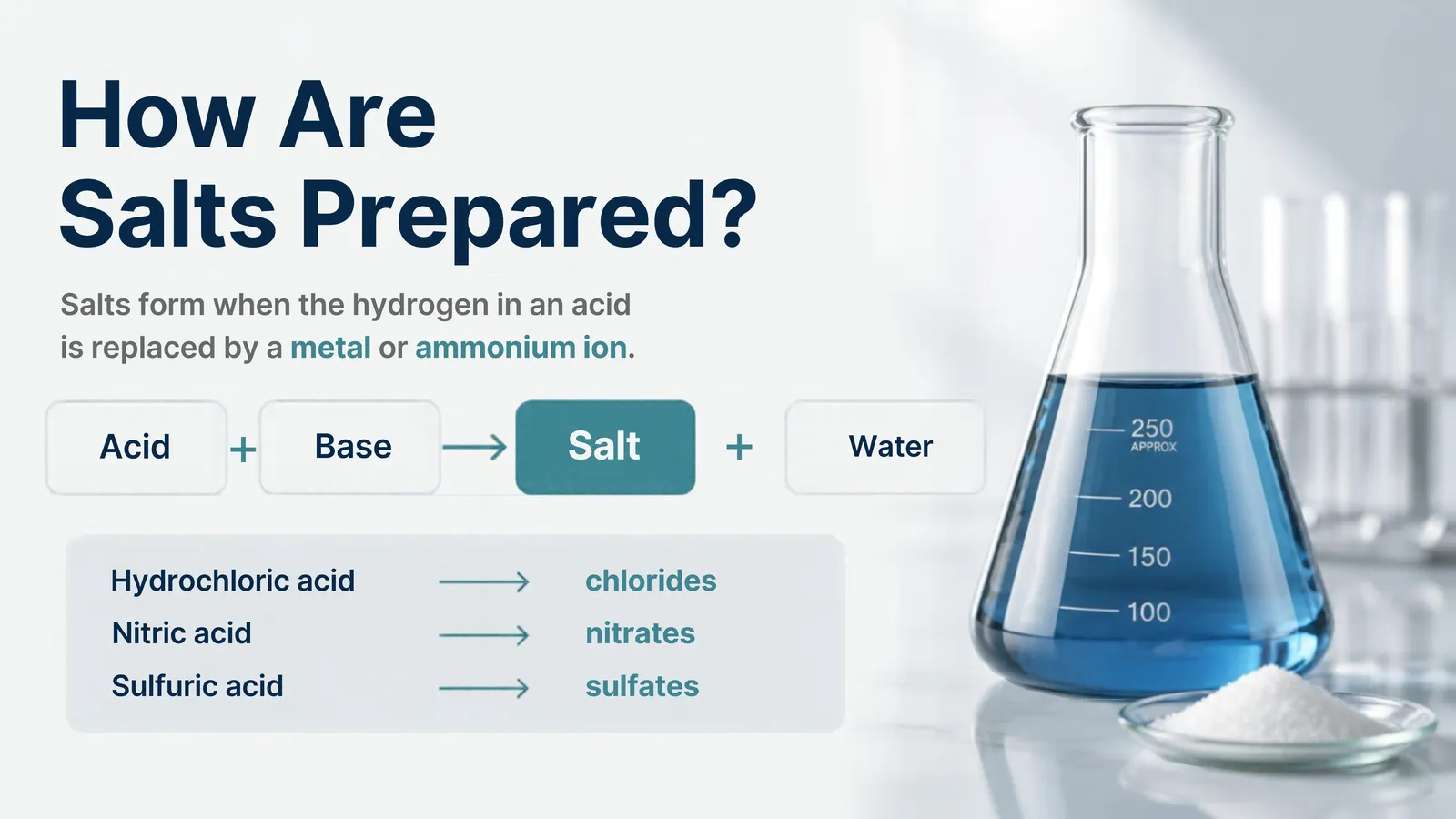
Slide: How are salts prepared?
Acid + base gives a salt
1/1
What Are Salts, and Where Do Their Names Come From?
Every acid contains hydrogen. When that hydrogen is replaced by a metal (or by an ammonium ion, NH4+), the compound formed is a salt. Crucially, a salt's name always comes from its parent acid, never from how it was made.
| Acid | Formula | Salts are called |
|---|---|---|
| Hydrochloric acid | HCl | Chlorides |
| Nitric acid | HNO3 | Nitrates |
| Sulfuric acid | H2SO4 | Sulfates |
| Ethanoic acid | CH3COOH | Ethanoates |
| Phosphoric acid | H3PO4 | Phosphates |
Sulfuric acid is the "parent acid" of all the sulfates -- even copper(II) sulfate, which can never be made directly from copper metal and dilute sulfuric acid (they simply don't react). There is always another route to the same salt, as you'll see below.
The Solubility Rules You Need
Before planning how to make a salt, you need to know whether it dissolves. Sodium, potassium and ammonium compounds are all soluble, with no exceptions -- this single fact underpins most of the rest of the table below.
| Compound type | General rule | Exceptions |
|---|---|---|
| Na, K & NH4+ compounds | All soluble | None |
| Nitrates | All soluble | None |
| Chlorides | Soluble | Silver chloride, lead(II) chloride |
| Sulfates | Soluble | Lead(II), barium, calcium and silver sulfate |
| Carbonates | Insoluble | Sodium, potassium & ammonium carbonates |
| Hydroxides | Insoluble | Na/K/NH4+ hydroxides (soluble); calcium hydroxide is slightly soluble |
Acids and Bases as Proton Transfer
A more general definition than "a source of H+ ions" covers reactions beyond aqueous solution: the Brønsted-Lowry theory defines an acid as a proton (hydrogen ion) donor, and a base as a proton acceptor. When hydrochloric acid dissolves in water, HCl donates a proton to a water molecule: H2O(l) + HCl(aq) → H3O+(aq) + Cl-(aq) -- so HCl is the acid, and water is the base. The H3O+ ion formed here is called the hydroxonium ion, usually written more simply as H+(aq). This framework is also why ammonia counts as a base even though it contains no hydroxide ions of its own: it accepts a proton from an acid, NH3(aq) + HCl(aq) → NH4Cl(aq).
Four Reactions, Four Routes to a Salt
Whichever route you use, every single one of these reactions is a neutralisation reaction, and every one produces a salt.
| React acid with... | General equation | Heat needed? |
|---|---|---|
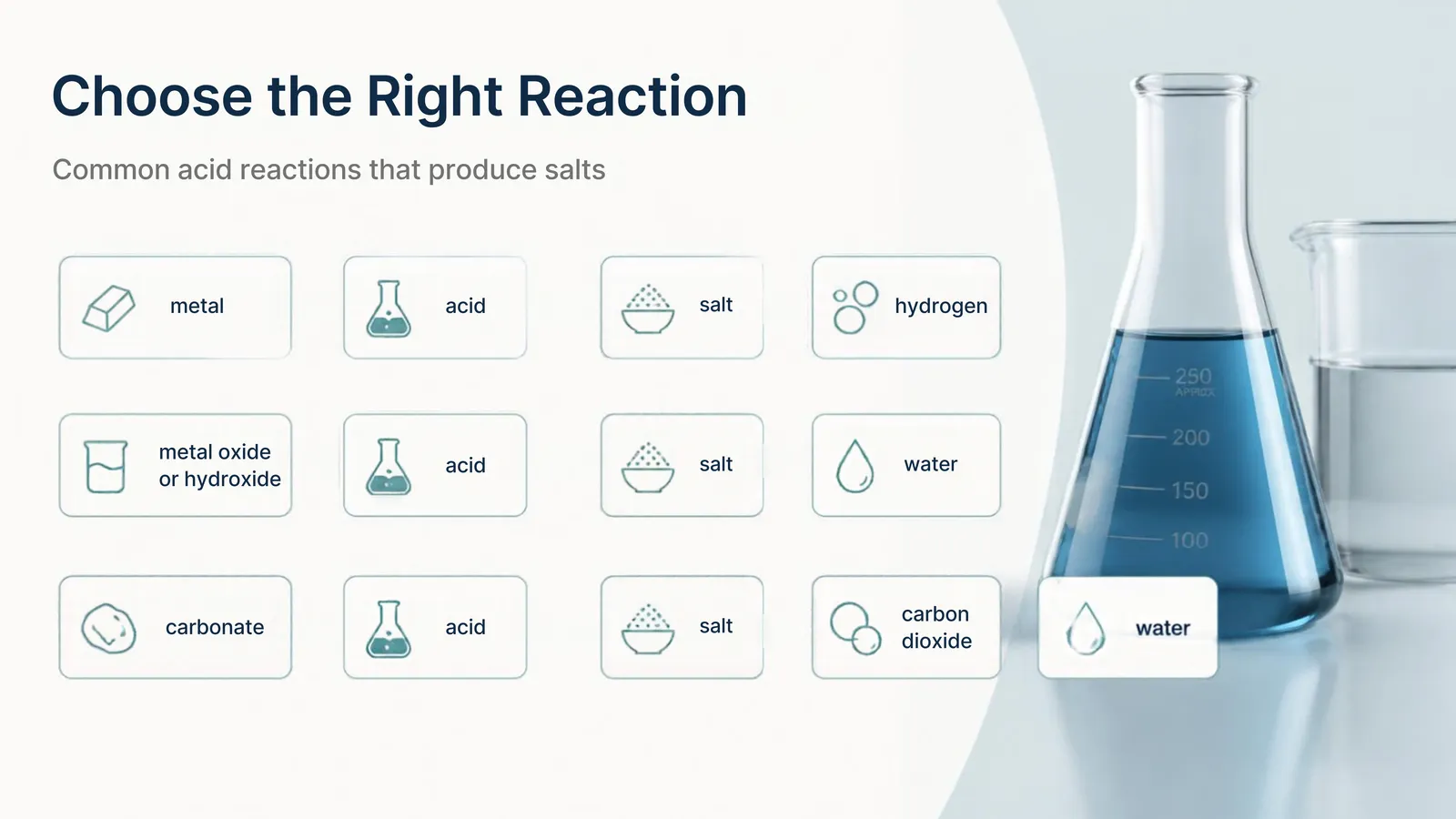
| a reactive metal (Mg to Fe) | metal + acid → salt + hydrogen | Usually cold is enough |
| a metal oxide | metal oxide + acid → salt + water | Usually needs heat |
| a metal hydroxide | metal hydroxide + acid → salt + water | Cold -- already dissolved |
| a metal carbonate | carbonate + acid → salt + CO2 + water | Cold |
Slide: Choose the right reaction
Reactions that produce salts
1/1
The Excess Solid Method, Step by Step
For any soluble salt except a sodium, potassium or ammonium one, the standard preparation is the excess solid method, using a moderately reactive metal, metal oxide, metal hydroxide or carbonate.
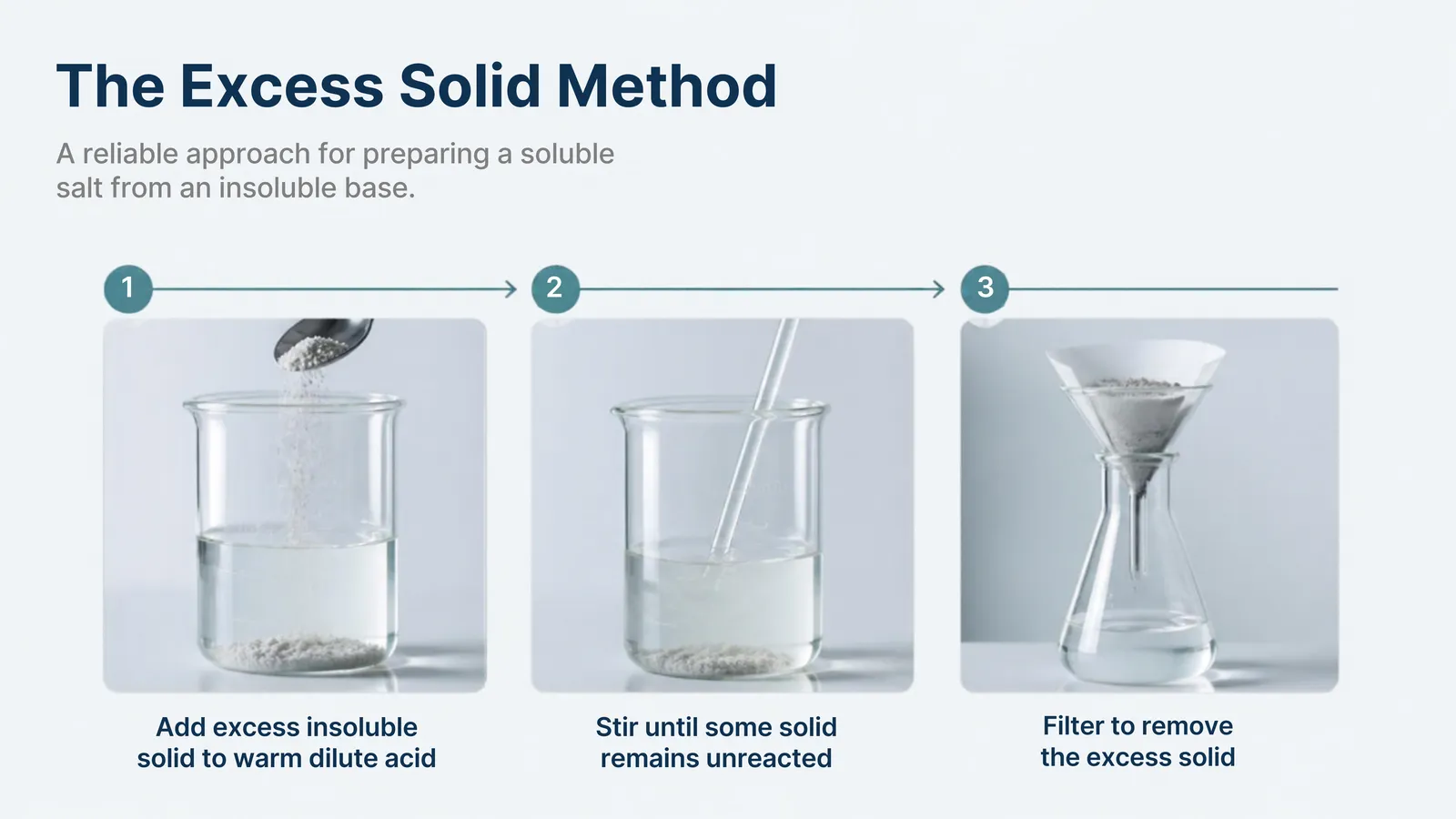
Measure a fixed volume of dilute acid into a beaker, warming gently if using a metal oxide.
Add the insoluble solid a spatula at a time, stirring well after each addition, until no more will react -- some solid is deliberately left over, undissolved.
This leftover solid proves that every trace of acid has been neutralised -- this is exactly why the solid must be in excess, not just "a lot".
Filter the mixture to remove the excess unreacted solid; the filtrate that passes through is a pure solution of the salt.
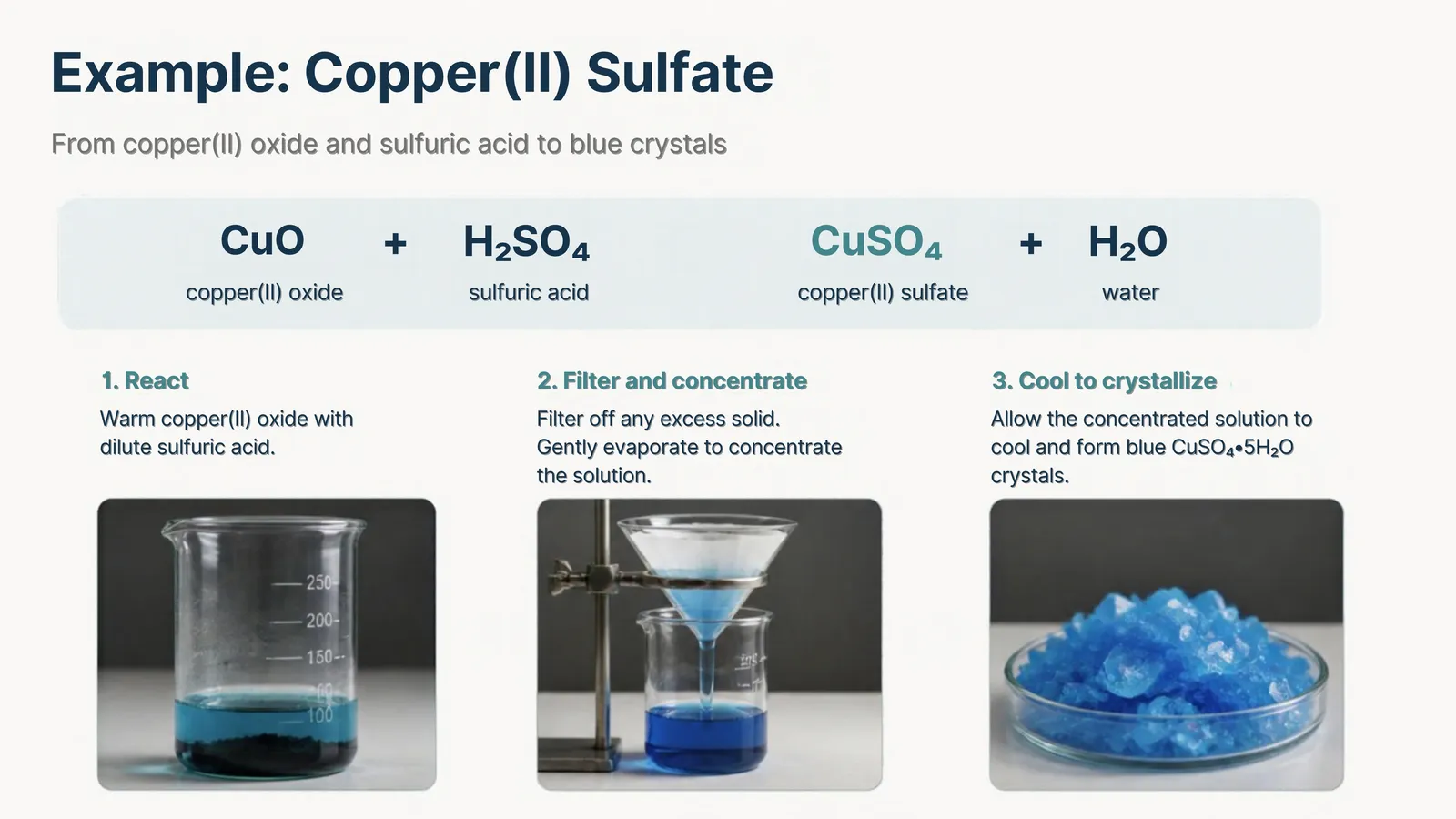
For copper(II) sulfate specifically: CuO(s) + H2SO4(aq) → CuSO4(aq) + H2O(l), adding black copper(II) oxide to hot dilute sulfuric acid until a visible excess remains, then filtering off that excess to leave a clear blue filtrate.
Slides: The excess solid method
Excess solid, then filter, then a worked copper(II) sulfate example
1/2
Filtration, Evaporation and Crystallisation Explained
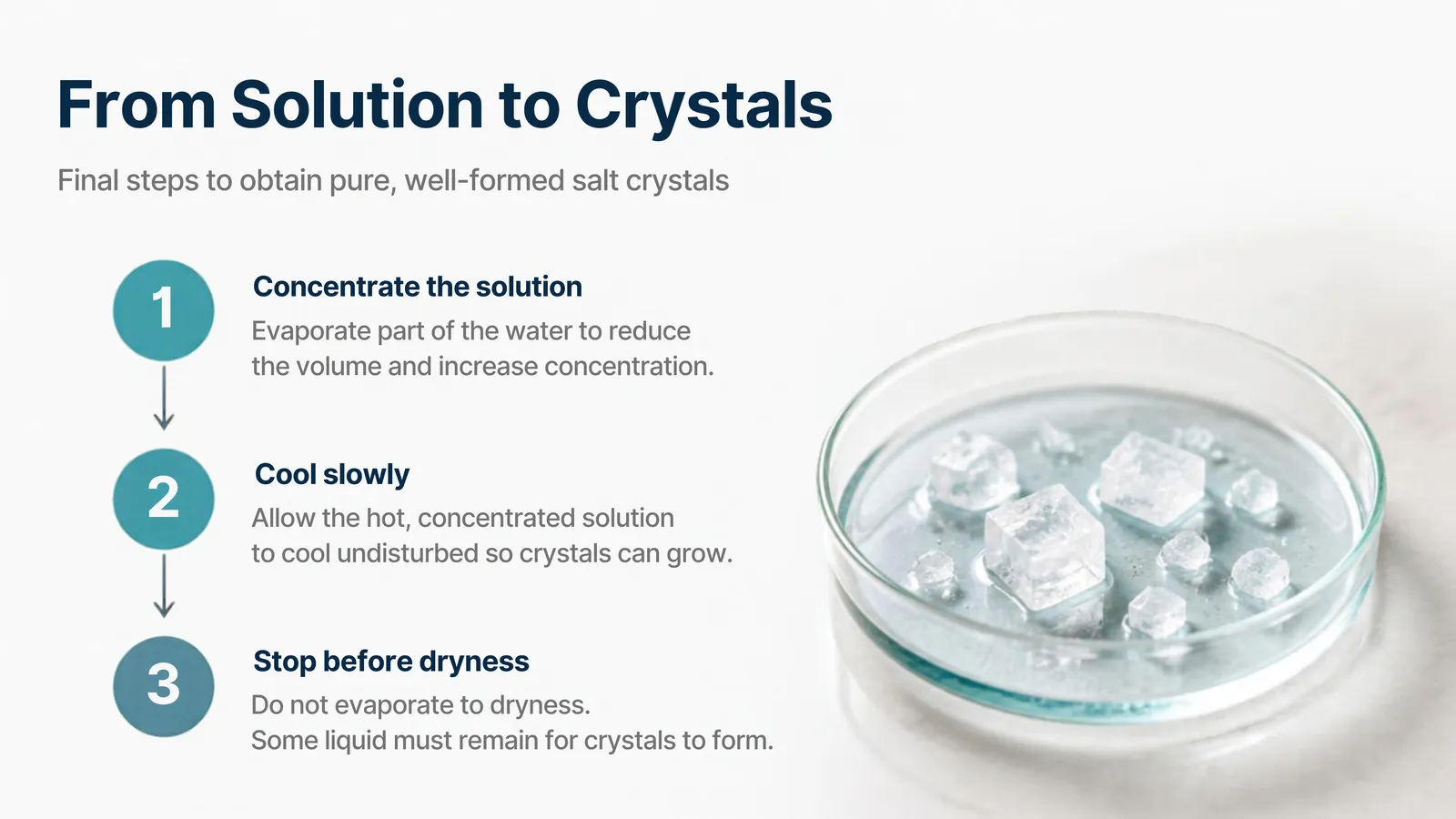
Three separate techniques finish the job. Filtration removes the excess insoluble solid (the residue) from the salt solution (the filtrate). Evaporation then boils off some of the water to concentrate the solution close to saturation -- tested by dipping a glass rod in the solution: if crystals form on the rod as it cools, the solution is ready. Crystallisation is the slow-cooling stage: as the hot saturated solution cools, the salt becomes less soluble and solid crystals grow out of it.
It would seem easier to just boil the whole solution to dryness -- but this is a genuine exam trap. Evaporating copper(II) sulfate solution fully to dryness gives a white powder of anhydrous copper(II) sulfate, not blue crystals, because it drives off the water of crystallisation chemically bound into the crystal: CuSO4(aq) + 5H2O(l) → CuSO4·5H2O(s). A salt containing water of crystallisation is hydrated; one without it is anhydrous.
Slide: From solution to crystals
Concentrate, cool slowly, stop before dryness
1/1
Choosing the Right Reactants for a Target Salt
Given a target salt's name, work backwards: the second part of the name (chloride, nitrate, sulfate...) tells you which acid to use, and the metal part tells you which insoluble compound of that metal to start from -- its oxide, hydroxide, carbonate, or (for a moderately reactive metal) the metal itself. One exception is worth memorising: copper never reacts with dilute acids (it sits below hydrogen in the reactivity series), so copper metal is never a valid choice -- always start from copper(II) oxide or copper(II) carbonate instead.
Salt Preparation: Frequently Asked Questions
Why must the insoluble solid be added in excess?
Adding the solid until some is clearly left over proves that every hydrogen ion from the acid has reacted. If exactly the right amount (or too little) were added, there would be no way to be sure the acid was fully neutralised, and any leftover acid would contaminate the final crystals.
Why can't the excess solid method make sodium sulfate?
All sodium compounds are soluble, so any "excess" sodium compound added would simply dissolve as well -- there would be no visible leftover solid to filter off, and no way to tell when enough had been added to neutralise the acid.
Why does evaporating copper(II) sulfate solution to dryness give the wrong product?
Full evaporation drives off the water of crystallisation as well as the free water, turning the blue hydrated crystals into a white anhydrous powder. Crystals are grown instead by concentrating the solution and then cooling it slowly.
Key Takeaways
A salt's name always comes from its parent acid: hydrochloric → chlorides, nitric → nitrates, sulfuric → sulfates.
Sodium, potassium and ammonium compounds are always soluble; learn the exceptions among chlorides, sulfates, carbonates and hydroxides.
An acid is a proton donor; a base is a proton acceptor (Brønsted-Lowry theory).
Metal + acid, oxide + acid, hydroxide + acid and carbonate + acid all give a salt -- every one is a neutralisation reaction.
Excess solid method: react acid with excess insoluble solid, filter, evaporate to concentrate, then cool slowly to crystallise.
Want more practice? Download the Science A Plus Edu Acids, Bases and Salt Preparations Revision Notebook, with 25 pages of notes, diagrams and revision activities, and read our companion guide to Acids and Alkalis for the pH and indicator chemistry that sits behind every neutralisation reaction here.
🗂️ Revision Flashcards
Tap a card to reveal the answer.
🎯 Quick Quiz
8 questions. Pick an answer to check it straight away.
1Which acid is the parent acid of the sulfates?
A salt's name comes from its parent acid, and sulfuric acid gives sulfates.
2Which of these is always soluble?
Sodium, potassium and ammonium compounds are all soluble, even carbonates.
3In Brønsted-Lowry theory, what is a base?
A base accepts a proton, which is why ammonia counts as a base.
4What are the products of a metal carbonate reacting with an acid?
carbonate + acid → salt + CO₂ + water.
5Why is the insoluble solid added in excess?
Leftover solid shows every hydrogen ion has reacted.
6Why can't the excess solid method make sodium sulfate?
All sodium compounds are soluble, so no leftover solid is visible.
7What do you get if copper(II) sulfate solution is evaporated fully to dryness?
Full evaporation drives off the water of crystallisation.
8Which starting material is a valid choice for making copper(II) sulfate?
Copper never reacts with dilute acids, so use copper(II) oxide or carbonate.