🌿 Introduction to Photosynthesis
Photosynthesis is one of the most important biological processes on Earth, serving as the foundation for nearly all life. This remarkable chemical reaction occurs primarily in the leaves of plants, where specialized organelles called chloroplasts capture light energy from the sun and convert it into chemical energy stored in glucose molecules. The process uses carbon dioxide (CO₂) from the air and water (H₂O) absorbed through the roots, transforming these simple inorganic molecules into energy-rich organic compounds. As a byproduct, plants release oxygen (O₂) into the atmosphere, which is essential for the survival of most living organisms including humans.
The importance of photosynthesis extends far beyond just plant survival—it forms the basis of all food chains and ecosystems on our planet. Every piece of food you eat can be traced back to the energy captured by plants through photosynthesis. Additionally, this process is crucial for regulating Earth's atmosphere by removing carbon dioxide (a greenhouse gas) and producing oxygen. Scientists estimate that photosynthesis produces approximately 100-115 billion tons of carbon in biomass annually. The balanced chemical equation for photosynthesis is: 6CO₂ + 6H₂O → C₆H₁₂O₆ + 6O₂, which shows that six molecules of carbon dioxide and six molecules of water produce one molecule of glucose and six molecules of oxygen when light energy is present.
📄 Worksheets
Click on worksheets to view them in full size, or download as PDF
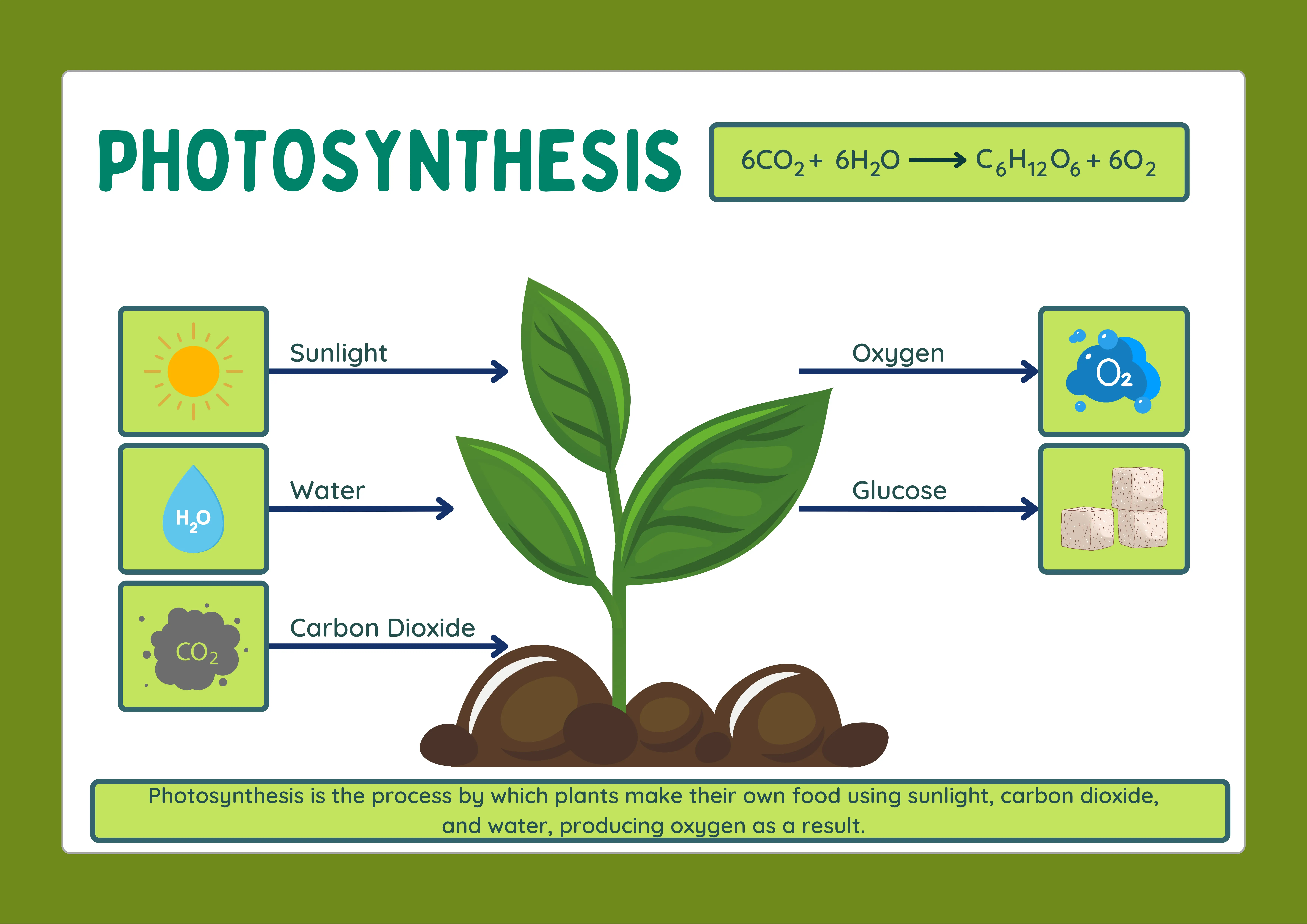
Photosynthesis Overview
Learn the basic components of photosynthesis including inputs (sunlight, water, CO₂) and outputs (oxygen, glucose).
Download PDF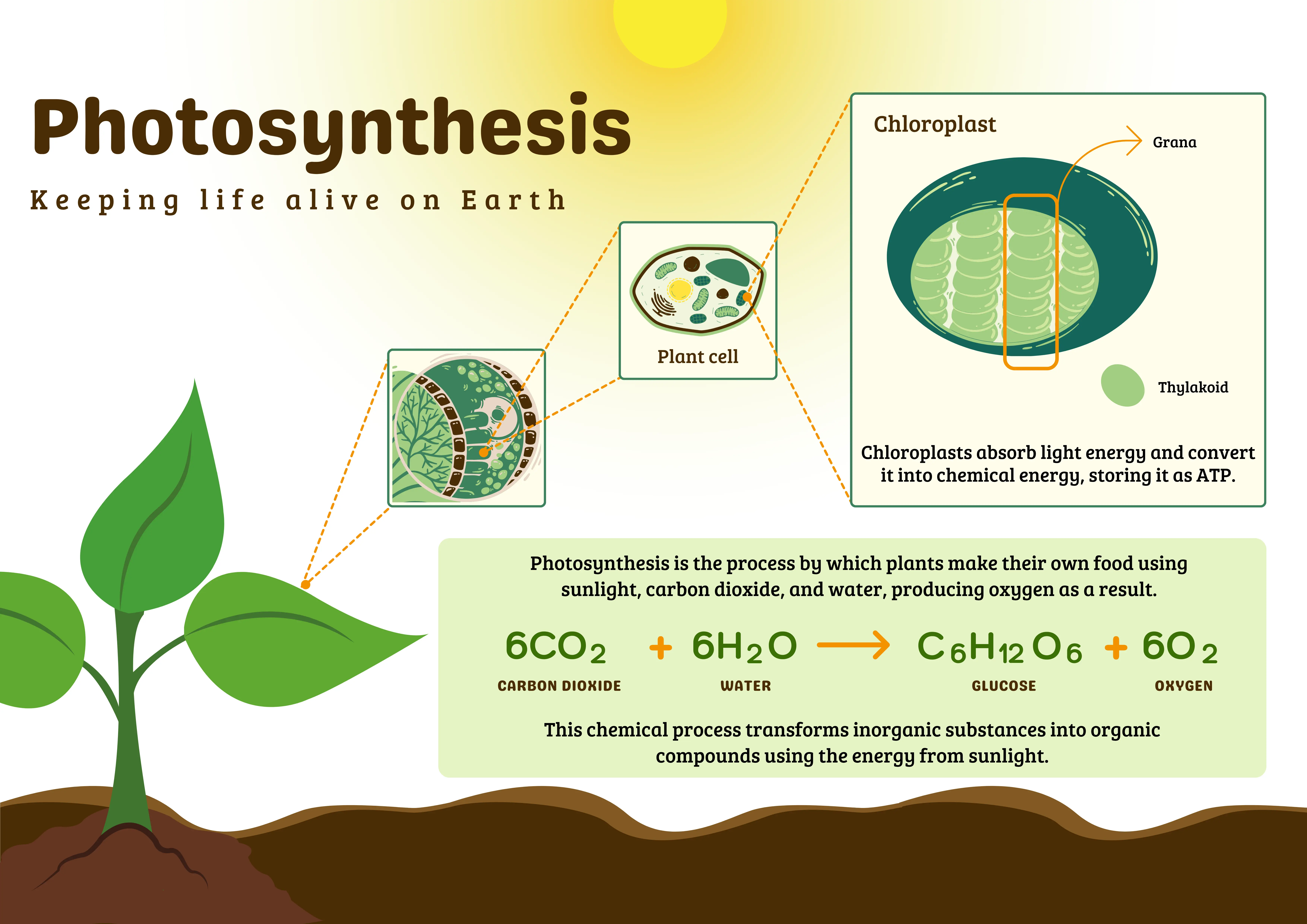
Chloroplast & Cell Structure
Explore the chloroplast structure including grana and thylakoids where photosynthesis takes place.
Download PDF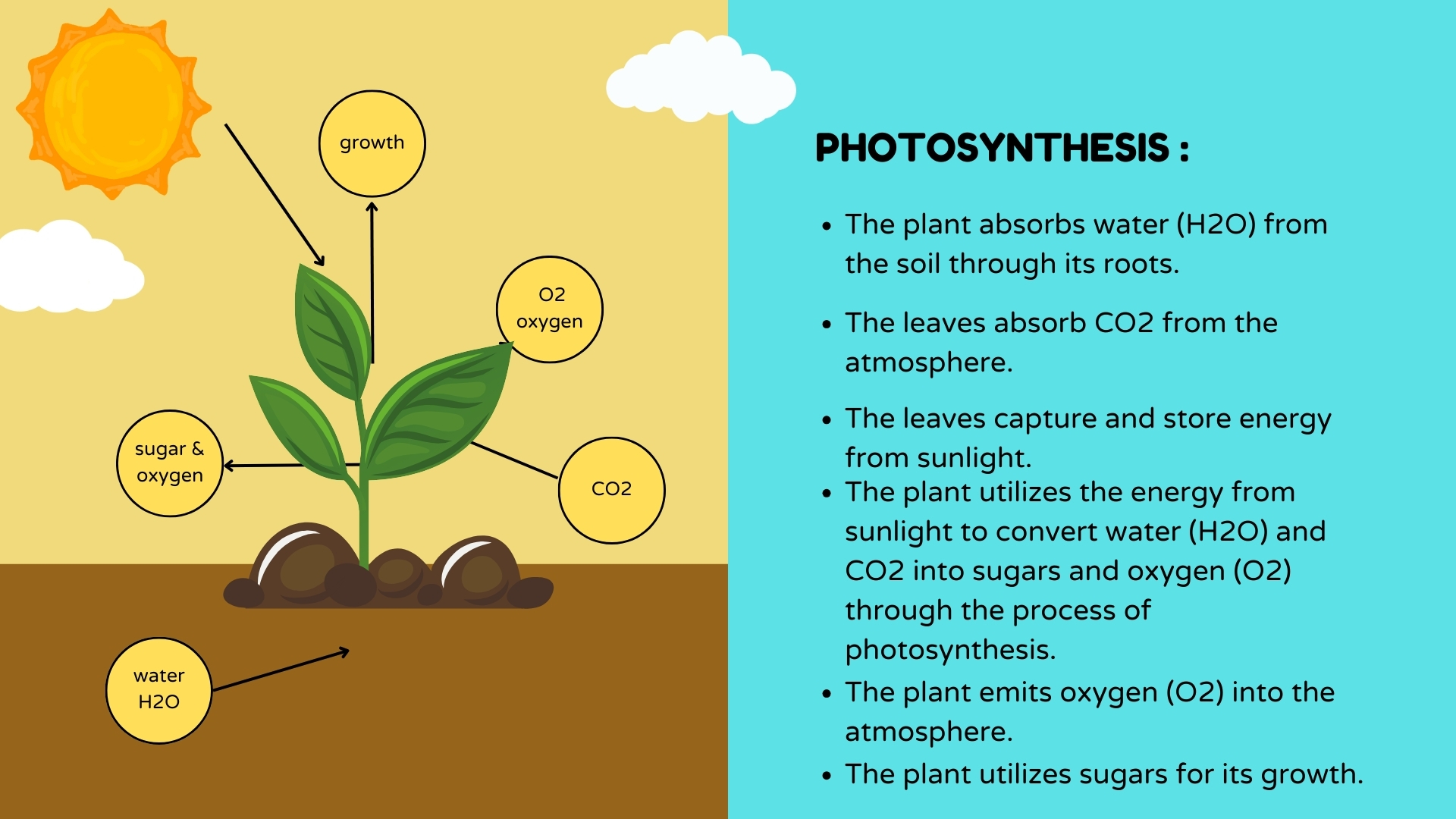
Photosynthesis Process
Learn how plants absorb water and CO2, capture sunlight energy, and convert them into sugars and oxygen.
Download PDF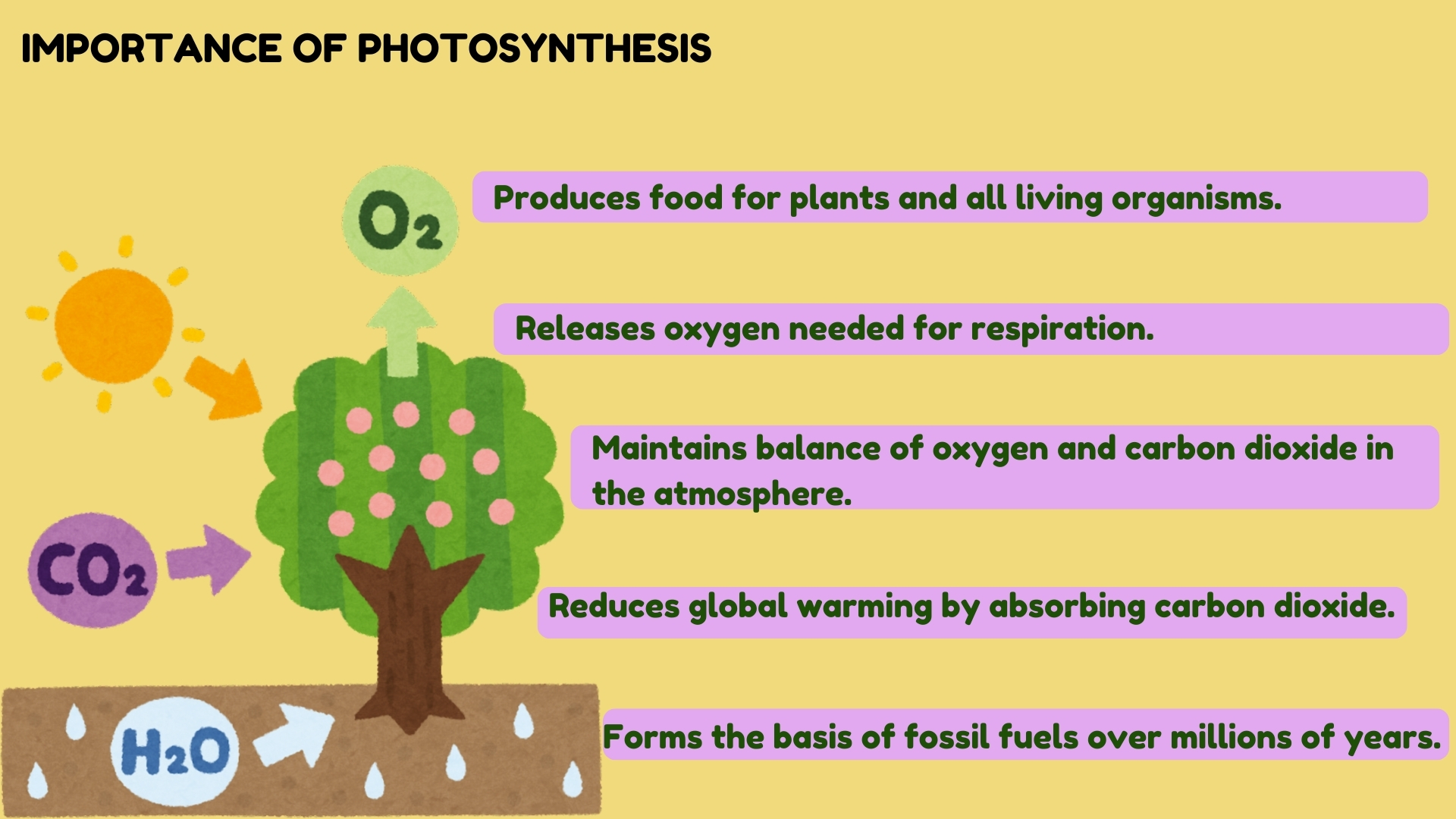
Importance of Photosynthesis
Discover why photosynthesis is vital for food production, oxygen release, atmospheric balance, and reducing global warming.
Download PDF🎮 Interactive Activities
🧪 Activity 1: Sort the Equation
Drag and drop each component to REACTANTS, ENERGY SOURCE, or PRODUCTS
Drag the items below to the correct category:
⚖️ Activity 2: Balance the Equation
Add the correct coefficients to balance the photosynthesis equation
Enter numbers to balance the atoms on both sides:
🌞 Photosynthesis Explained: Equation, Process and Limiting Factors
What is photosynthesis?
Photosynthesis is the process green plants, algae and some bacteria use to build their own food. They take two simple raw materials — carbon dioxide from the air and water from the soil — and use energy from light to join them into glucose, a sugar. Oxygen is released as a by-product. Because plants make their own food rather than eating other organisms, they are called producers, and almost every food chain on Earth starts with them.
Photosynthesis is an endothermic process: it takes in energy from its surroundings, in this case light energy, and stores it as chemical energy in the bonds of the glucose it makes. That stored energy is what an animal eventually gets when it eats a plant, and what you get when you eat the animal.
The photosynthesis equation
The word equation summarises what goes in and what comes out:
carbon dioxide + water → (light energy, chlorophyll) → glucose + oxygen
Light and chlorophyll are written above the arrow rather than beside the reactants because neither is used up. Light supplies the energy; chlorophyll absorbs it and is still there at the end. The balanced symbol equation shows the same reaction with the numbers of atoms on each side matching:
6CO2 + 6H2O → C6H12O6 + 6O2
Count the atoms to check it. On the left there are 6 carbon, 18 oxygen (12 from the carbon dioxide and 6 from the water) and 12 hydrogen. On the right there are 6 carbon, 12 hydrogen and 18 oxygen (6 in the glucose and 12 in the oxygen gas). Nothing is created or destroyed — the atoms are simply rearranged, which is the point the balancing activity above is drilling.
Where it happens: chloroplasts and chlorophyll
Photosynthesis takes place mainly in the leaves, inside organelles called chloroplasts. A chloroplast is the structure; chlorophyll is the green pigment packed inside it. It is easy to mix the two up, and exam papers often test exactly that difference. Chlorophyll absorbs light — mostly the red and blue parts of the spectrum — and reflects green, which is why leaves look green to us.
A leaf is built for the job. It is broad and flat to catch as much light as possible and thin so gases do not have far to travel. The palisade cells near the upper surface are packed with chloroplasts and sit where the light is strongest. Small pores on the underside called stomata, opened and closed by guard cells, let carbon dioxide diffuse in and oxygen and water vapour diffuse out. Water arrives from the roots through tubes called xylem.
The two stages of photosynthesis
Photosynthesis is not one single step. It runs in two linked stages.
- The light-dependent stage happens in the membranes inside the chloroplast and only when light is available. Absorbed light energy splits water molecules — a reaction called photolysis — which releases the oxygen the plant gives off. The energy is also captured in two energy-carrying molecules, ATP and NADPH, which are passed to the second stage.
- The light-independent stage, also known as the Calvin cycle, happens in the fluid part of the chloroplast, the stroma. Here carbon dioxide is joined to existing molecules and, using the ATP and NADPH made in the first stage, built up into sugars. It does not need light directly, but it cannot keep going for long in the dark because it depends on the supply of ATP and NADPH from the light-dependent stage.
What the plant does with the glucose
Glucose is not simply stockpiled. Some is used straight away in respiration to release energy. Some is converted into starch for storage, because starch is insoluble and so does not affect the water balance of the cell. Some becomes cellulose for building cell walls, and some is turned into fats and oils, which is how seeds store energy for germination. Combined with nitrate ions absorbed from the soil, glucose is also used to make amino acids, and from those, proteins.
Limiting factors: what slows photosynthesis down
A limiting factor is the condition in shortest supply — the one currently holding the rate back. Increase it and the rate rises; increase any of the others and nothing happens until the limiting factor is dealt with. Three factors are tested most often.
- Light intensity. In dim conditions the rate climbs steadily as light is increased, because more light means more energy for the light-dependent stage. Eventually the graph levels off: something else has become the limiting factor.
- Carbon dioxide concentration. Carbon dioxide makes up only a small fraction of the air, so it is very often the factor in short supply. Raising it increases the rate until, again, the graph plateaus. Commercial greenhouse growers sometimes add carbon dioxide to the air for this reason.
- Temperature. The reactions are controlled by enzymes, so the rate rises as it warms — but only to a point. If the temperature climbs too high the enzymes are denatured, their shape changes, and the rate falls sharply. That makes temperature different from the other two: too much of it is harmful, not merely unhelpful.
A shortage of chlorophyll, caused by disease or by a lack of magnesium in the soil, will also reduce the rate, since there is less pigment to absorb the light.
How photosynthesis relates to respiration
The two processes are often set side by side, and it is tempting to call respiration "photosynthesis in reverse". Be careful with that phrase. The overall inputs and outputs do swap over — respiration uses glucose and oxygen and gives out carbon dioxide and water — but the two are not the same chemistry run backwards. They happen in different organelles (chloroplast and mitochondrion), use different enzymes, and follow completely different sequences of steps.
There is another important difference. Every living cell in a plant respires, all of the time, day and night. Photosynthesis happens only in cells containing chlorophyll and only when there is light. In bright daylight a plant photosynthesises much faster than it respires, so it releases oxygen overall; in darkness photosynthesis stops while respiration continues, so the plant takes in oxygen and gives out carbon dioxide, like any other living thing.
Key terms
- Photosynthesis
- The process in which plants use light energy to convert carbon dioxide and water into glucose and oxygen.
- Chloroplast
- The organelle in a plant cell where photosynthesis takes place.
- Chlorophyll
- The green pigment inside chloroplasts that absorbs light energy.
- Stomata
- Tiny pores, mostly on the underside of a leaf, that let gases move in and out.
- Photolysis
- The splitting of water molecules using light energy, which releases oxygen.
- Limiting factor
- The factor in shortest supply, which is holding back the rate of a process.
- Endothermic
- Describing a reaction that takes in energy from its surroundings.
- Producer
- An organism that makes its own food and forms the first step of a food chain.