A lighted splint that pops, a glowing splint that relights, a flame that turns lilac -- these are not party tricks, they are precise, examinable evidence for exactly which substance you are looking at. This guide walks through every standard chemical test at IGCSE level: flame tests, the sodium hydroxide tests for cations, the silver nitrate and barium chloride tests for anions, the five gas tests, and the test for water, finishing with how to combine several results to identify a completely unknown compound.
📖 Lesson
Flame colours, precipitate colours, the five gas tests and the water test, then how to combine them to identify an unknown compound.
Why Do We Need Chemical Tests?
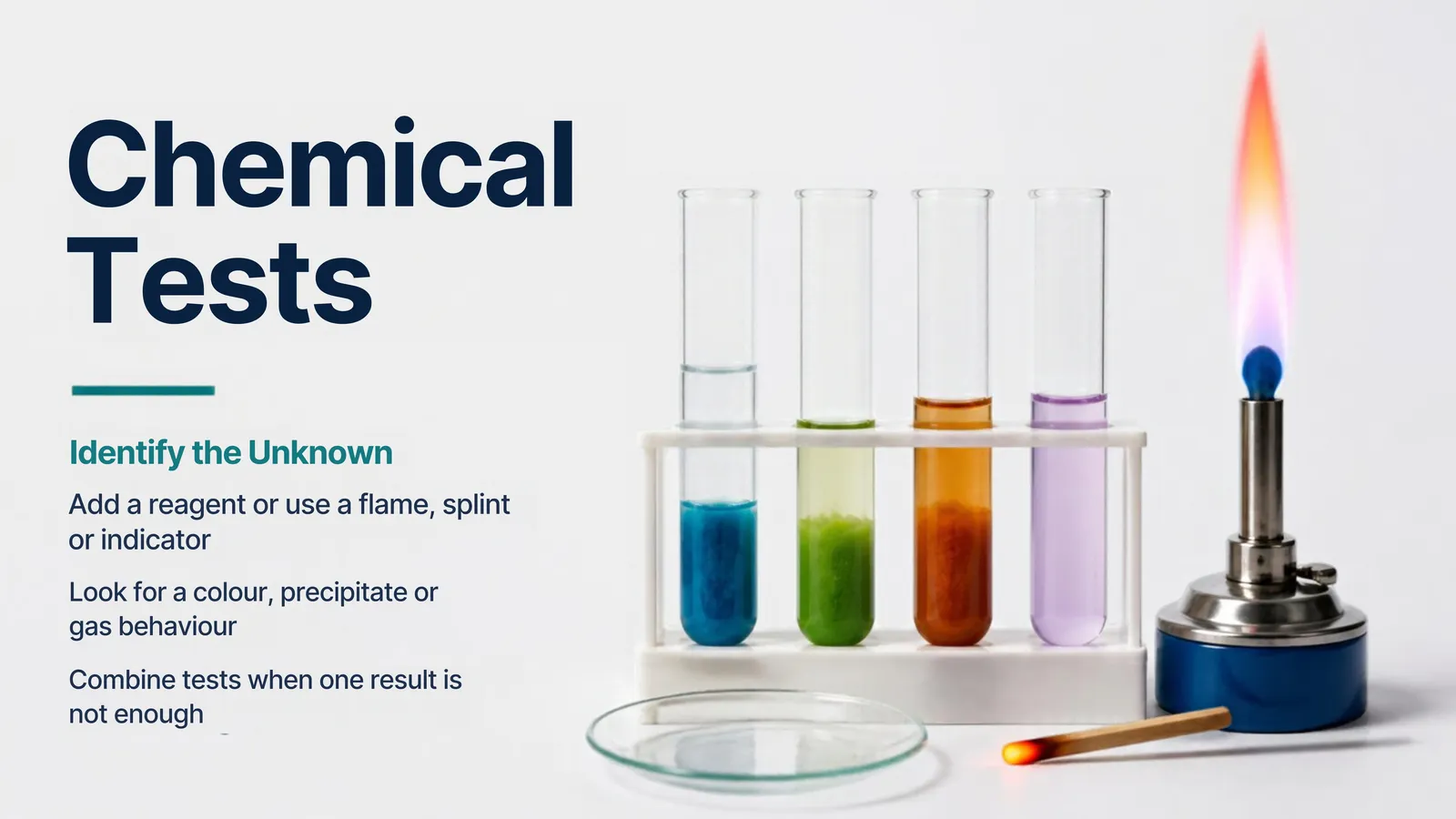
Every test in this chapter follows the same basic idea: add a reagent (or apply a flame, a glowing splint, or a piece of damp indicator paper) to an unknown sample, and look for a positive result -- a colour, a precipitate, or a change that only happens if a particular ion or gas is present. A positive result must be specific: if several different ions could cause the same colour change, that test alone cannot identify the substance, and you may need to combine more than one test, exactly as in the worked example at the end of this guide.
Slide: Chemical tests at a glance
Add a reagent, look for a result, combine tests
1/1
Flame Tests: Five Cations, Five Colours
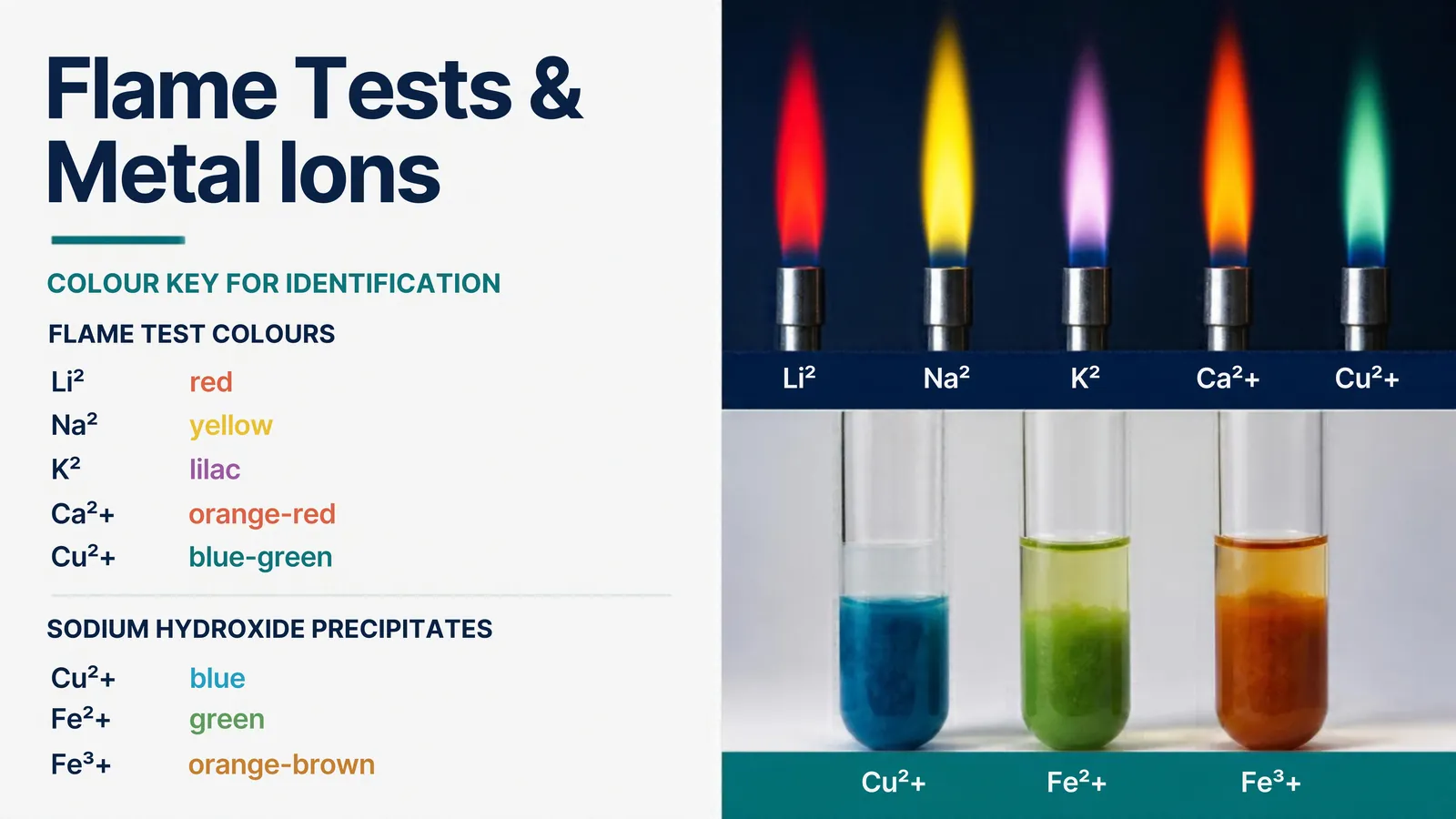
A flame test shows the presence of certain metal ions by the characteristic colour they give a Bunsen flame. A clean platinum or nichrome wire is dipped first into concentrated hydrochloric acid, then into the solid or solution being tested, and held in a roaring (non-luminous) flame.
| Metal ion | Formula | Flame colour |
|---|---|---|
| Lithium | Li+ | Red |
| Sodium | Na+ | Yellow |
| Potassium | K+ | Lilac |
| Calcium | Ca2+ | Orange-red |
| Copper(II) | Cu2+ | Blue-green |
One catch worth knowing: lithium is not the only ion that gives a red flame -- strontium gives a very similar red, so the only reliable way to be sure which one you have is to compare the colour side by side with a known compound.
Testing Cations with Sodium Hydroxide
Most metal hydroxides are insoluble, so adding sodium hydroxide solution to a solution containing a metal ion produces a precipitate of that metal's hydroxide -- and the precipitate's colour identifies the ion. Copper(II) ions give a blue precipitate, Cu2+(aq) + 2OH-(aq) → Cu(OH)2(s). Iron(II) ions give a green precipitate that slowly darkens to orange-brown on standing in air, as it oxidises to iron(III) hydroxide. Iron(III) ions give an orange-brown precipitate directly, Fe3+(aq) + 3OH-(aq) → Fe(OH)3(s). Ammonium ions behave differently -- there is no precipitate at all; instead, sodium hydroxide reacts with the ammonium salt to release ammonia gas, NH4+(aq) + OH-(aq) → NH3(g) + H2O(l), which turns damp red litmus paper blue.
Slide: Flame tests and metal ions
Flame colours and sodium hydroxide precipitates
1/1
Testing Anions: Halides, Sulfates and Carbonates
Negative ions have their own standard tests, and getting the order of reagents right matters -- the wrong acid can add the very ion you're testing for.
| Ion | Test | Positive result |
|---|---|---|
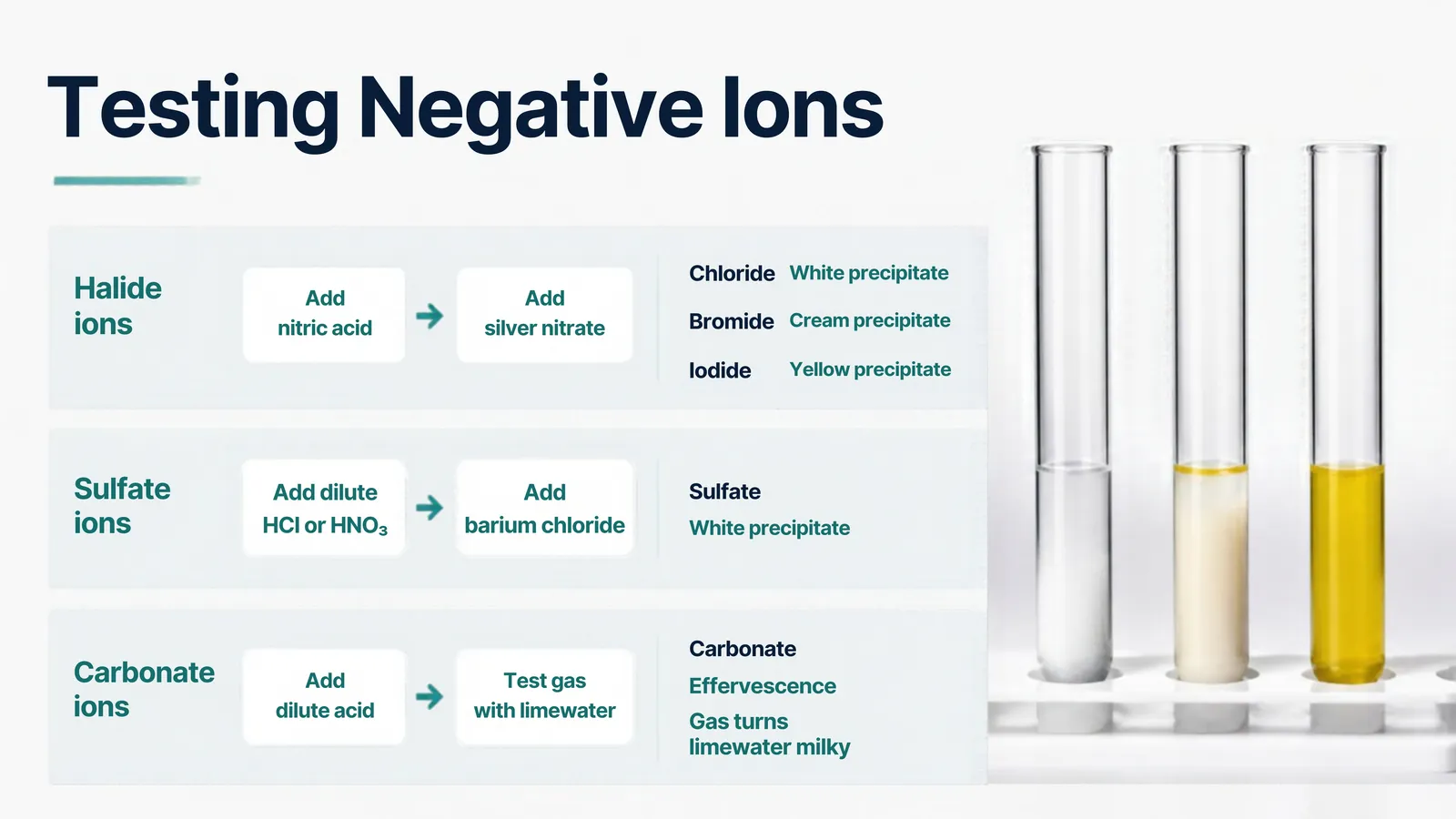
| Chloride, Cl- | Acidify with dilute nitric acid, then add silver nitrate solution | White precipitate, AgCl |
| Bromide, Br- | Same as above | Cream precipitate, AgBr |
| Iodide, I- | Same as above | Yellow precipitate, AgI |
| Sulfate, SO42- | Acidify with dilute HCl or HNO3, then add barium chloride solution | White precipitate, BaSO4 |
| Carbonate, CO32- | Add dilute acid; bubble any gas through limewater | Fizzing; limewater turns milky |
Two golden rules protect against false positives. For sulfate, always acidify with hydrochloric or nitric acid -- never with sulfuric acid, since it already contains the sulfate ion you're testing for. For halides, always acidify with dilute nitric acid -- never with hydrochloric, hydrobromic or hydroiodic acid, since each would add a halide ion of its own.
Slide: Testing negative ions
Halides, sulfate and carbonate
1/1
The Five Gas Tests
Five gases have simple, specific tests you need to know by heart.
| Gas | Test | Positive result |
|---|---|---|
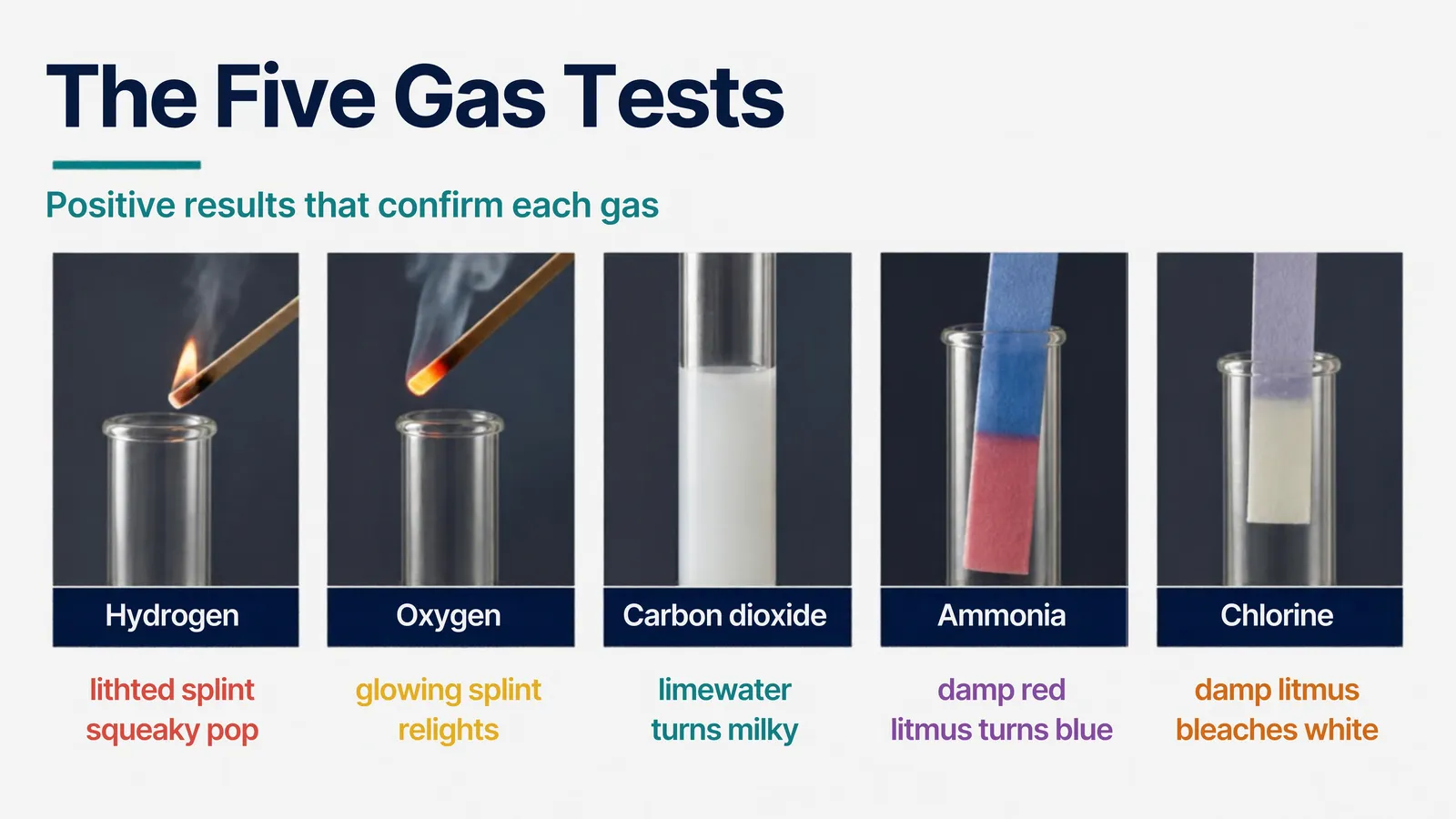
| Hydrogen, H2 | Hold a lighted splint to the mouth of the tube | Squeaky pop |
| Oxygen, O2 | Put a glowing splint into the tube | Splint relights |
| Carbon dioxide, CO2 | Bubble the gas through limewater | Turns milky/cloudy |
| Ammonia, NH3 | Hold damp red litmus paper at the mouth of the tube | Paper turns blue |
| Chlorine, Cl2 | Hold damp litmus paper at the mouth of the tube | Paper bleached white |
A couple of precise wordings are worth locking in: examiners specifically want "squeaky pop" for hydrogen, not "bang" or "explosion", and "relights a glowing splint" for oxygen -- mixing up a lighted splint with a glowing one is one of the most common slip-ups in this whole topic. For chlorine, if blue litmus is used, it briefly turns red first (chlorine dissolving to form an acidic solution) before bleaching white.
Slide: The five gas tests
Positive results that confirm each gas
1/1
Testing for Water
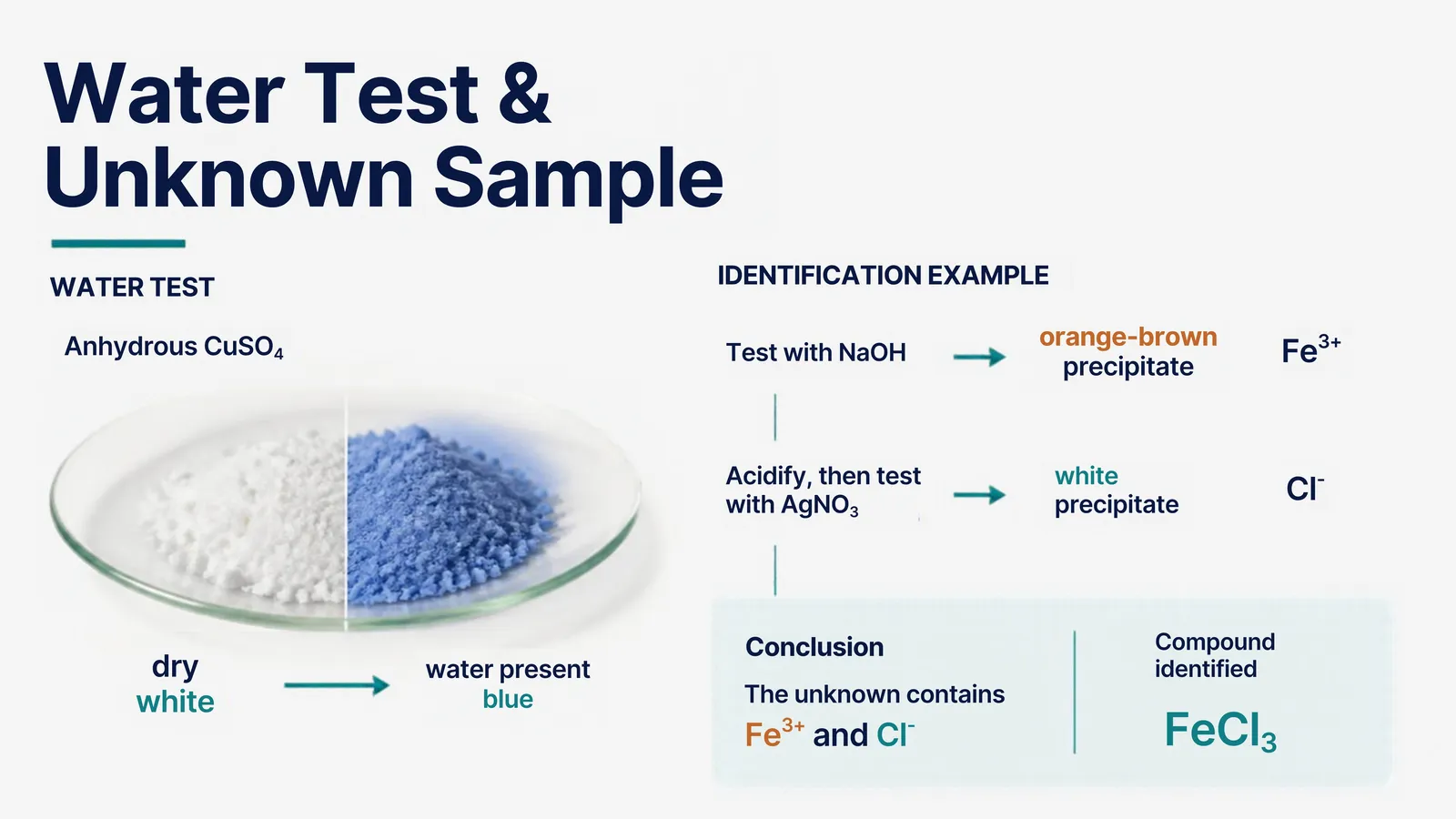
Water turns white anhydrous copper(II) sulfate blue, as it re-forms the hydrated crystal: CuSO4(s) + 5H2O(l) → CuSO4·5H2O(s). This test only proves that water is present, though -- it says nothing about purity. To check whether a sample of water is pure, measure its melting or boiling point instead: pure water freezes at exactly 0°C and boils at exactly 100°C; an impure sample will typically freeze lower and boil higher than these exact values.
Putting It Together: Identifying an Unknown
Exam questions often chain several clues together. For example: A is an orange solid that dissolves to give an orange solution. Adding sodium hydroxide gives an orange-brown precipitate, B; adding dilute nitric acid then silver nitrate gives a white precipitate, C. Working through each clue in turn -- the orange-brown NaOH precipitate identifies Fe3+, so B is iron(III) hydroxide; the white silver nitrate precipitate identifies Cl-, so C is silver chloride -- combining the two ions identifies A as iron(III) chloride, FeCl3. This step-by-step approach, working out the cation and the anion separately before combining them, is the method behind every "identify the unknown" question at this level.
Slide: Water test and identifying an unknown
Anhydrous copper(II) sulfate, then the FeCl₃ worked example
1/1
Chemical Tests: Frequently Asked Questions
What is the difference between the tests for hydrogen and oxygen gas?
Hydrogen is tested with a lighted splint held at the mouth of the tube, giving a squeaky pop. Oxygen is tested with a glowing (not flaming) splint placed into the tube, which relights and bursts back into flame.
How do you tell iron(II) and iron(III) ions apart using sodium hydroxide?
Iron(II) ions give a green precipitate of iron(II) hydroxide, which darkens to orange-brown on standing in air as it oxidises. Iron(III) ions give an orange-brown precipitate of iron(III) hydroxide immediately, with no green stage.
Why must you acidify before testing for sulfate or halide ions?
Acidifying first removes other anions, such as carbonate or hydroxide ions, that could also form a white precipitate with barium chloride or silver nitrate and give a false positive. The specific acid matters too: never use sulfuric acid before a sulfate test, and never use a hydrogen halide acid before a halide test.
Key Takeaways
Flame test colours: Li+ red, Na+ yellow, K+ lilac, Ca2+ orange-red, Cu2+ blue-green.
Sodium hydroxide precipitates: Cu2+ blue, Fe2+ green (darkens to orange-brown), Fe3+ orange-brown; NH4+ releases ammonia gas instead.
Silver nitrate (after nitric acid) gives white/cream/yellow precipitates for Cl-/Br-/I-; barium chloride (after HCl or HNO3) gives a white precipitate for SO42-.
Gas tests: H2 squeaky pop, O2 relights a glowing splint, CO2 turns limewater milky, NH3 turns damp litmus blue, Cl2 bleaches damp litmus white.
Anhydrous copper(II) sulfate turning blue shows water is present, but only melting/boiling point confirms it is pure.
Want more practice? Download the Science A Plus Edu Chemical Tests Revision Notebook, with 25 pages of notes, diagrams and revision activities, and read our companion guide to Acids, Bases and Salt Preparations, since many of the compounds you identify here are exactly the salts you learn to prepare there.
🗂️ Revision Flashcards
Tap a card to reveal the answer.
🎯 Quick Quiz
8 questions. Pick an answer to check it straight away.
1Which metal ion gives a lilac flame?
Potassium ions colour the flame lilac; sodium gives yellow and lithium red.
2Sodium hydroxide is added to a solution and a green precipitate forms that slowly turns orange-brown. Which ion is present?
Iron(II) hydroxide is green and darkens as it oxidises to iron(III) hydroxide in air.
3Which acid should you use before adding silver nitrate to test for halide ions?
Nitric acid adds no halide ion of its own, so it cannot give a false positive.
4What colour precipitate does bromide give with acidified silver nitrate?
Chloride gives white AgCl, bromide cream AgBr and iodide yellow AgI.
5Why must you never acidify with sulfuric acid before the sulfate test?
Sulfuric acid would add the very sulfate ion you are testing for.
6What is the positive test for oxygen?
Oxygen relights a glowing splint; the squeaky pop is the test for hydrogen.
7Which gas turns damp red litmus paper blue?
Ammonia turns damp red litmus blue; chlorine bleaches damp litmus white.
8A solution gives an orange-brown precipitate with NaOH and a white precipitate with nitric acid then silver nitrate. What is it?
Orange-brown hydroxide means Fe³⁺ and the white silver precipitate means Cl⁻, so it is FeCl₃.