🧪 Understanding Ions
Positive Ions (Cations)
Metals lose electrons to form positive ions. Their charge matches their group number on the periodic table.
Sodium (Na)
Na⁺
+1Calcium (Ca)
Ca²⁺
+2Aluminium (Al)
Al³⁺
+3Magnesium (Mg)
Mg²⁺
+2Potassium (K)
K⁺
+1Iron(II) (Fe)
Fe²⁺
+2Iron(III) (Fe)
Fe³⁺
+3Copper(I) (Cu)
Cu⁺
+1Copper(II) (Cu)
Cu²⁺
+2Zinc (Zn)
Zn²⁺
+2Silver (Ag)
Ag⁺
+1Ammonium (NH₄)
NH₄⁺
+1Negative Ions (Anions)
Non-metals gain electrons to form negative ions. Their charge is 18 minus their group number.
Chloride (Cl)
Cl⁻
-1Oxide (O)
O²⁻
-2Sulfate (SO₄)
SO₄²⁻
-2Nitrate (NO₃)
NO₃⁻
-1Carbonate (CO₃)
CO₃²⁻
-2Hydroxide (OH)
OH⁻
-1Phosphate (PO₄)
PO₄³⁻
-3Dichromate (Cr₂O₇)
Cr₂O₇²⁻
-2📝 Interactive Worksheets
Practice Chemical Formula Writing
Click on any worksheet to view it in full size. Work through the exercises to master chemical formula writing!
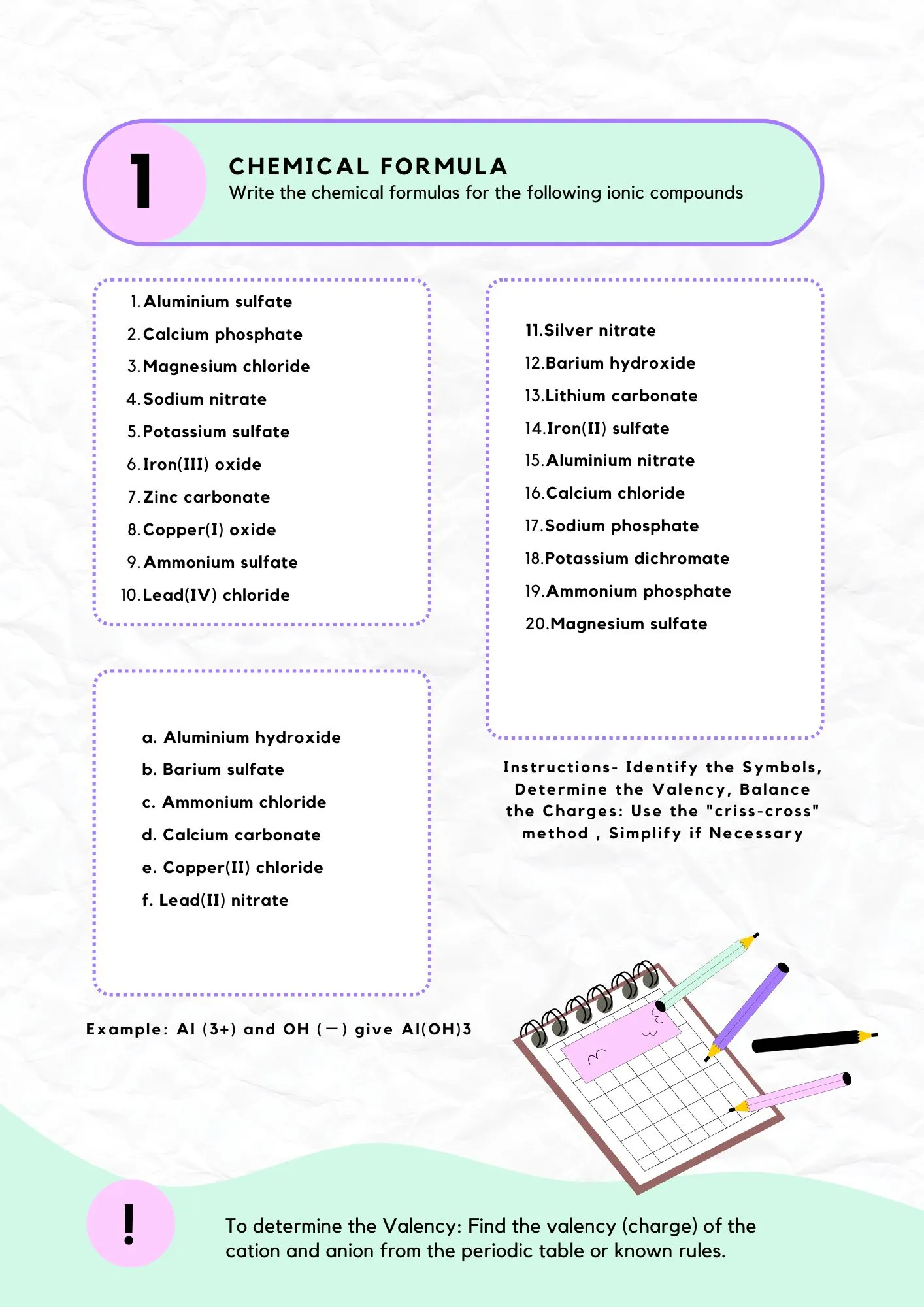
Exercise 1: Formula Writing
Write chemical formulas for ionic compounds
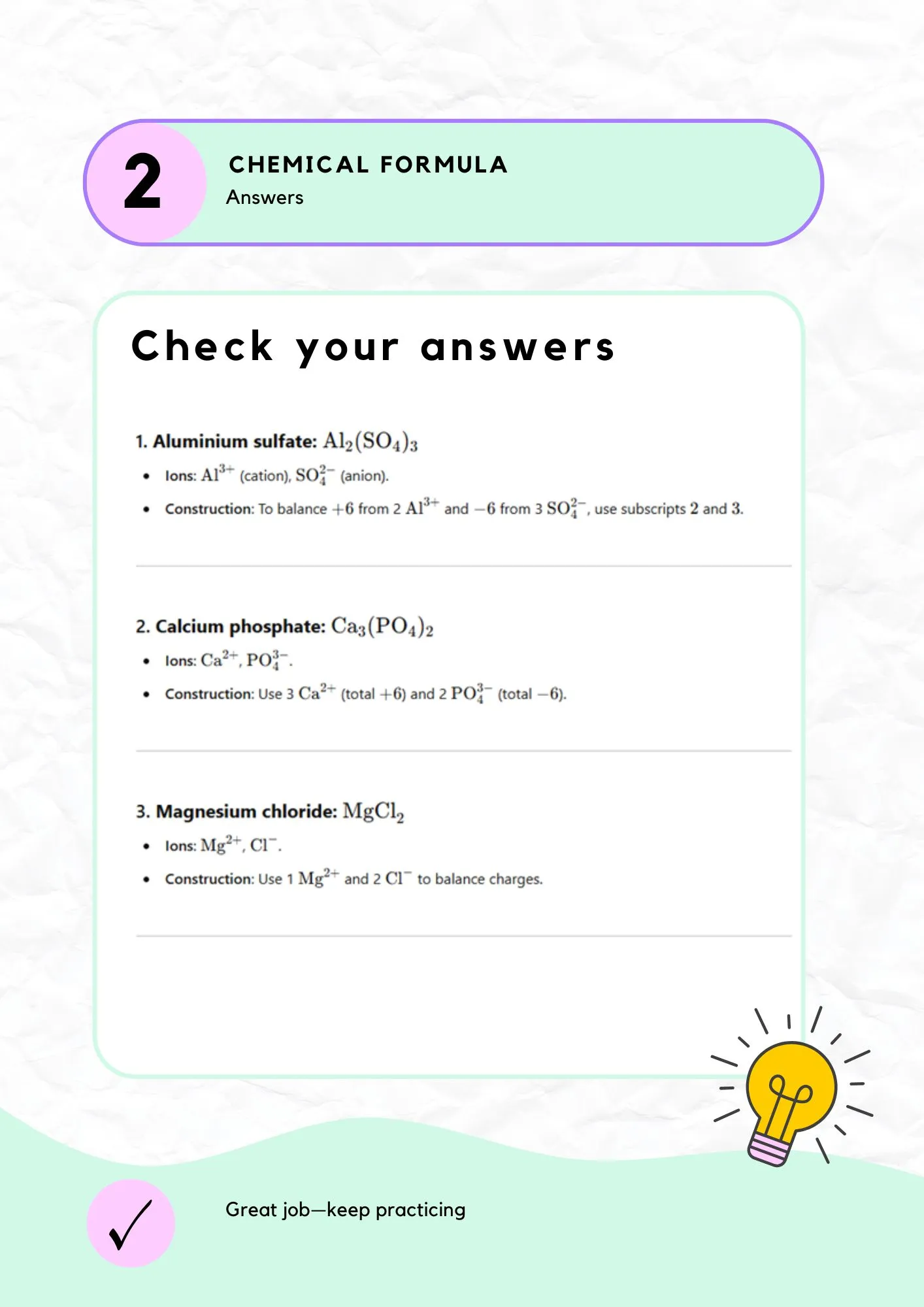
Exercise 1: Answers
Check your answers with detailed explanations
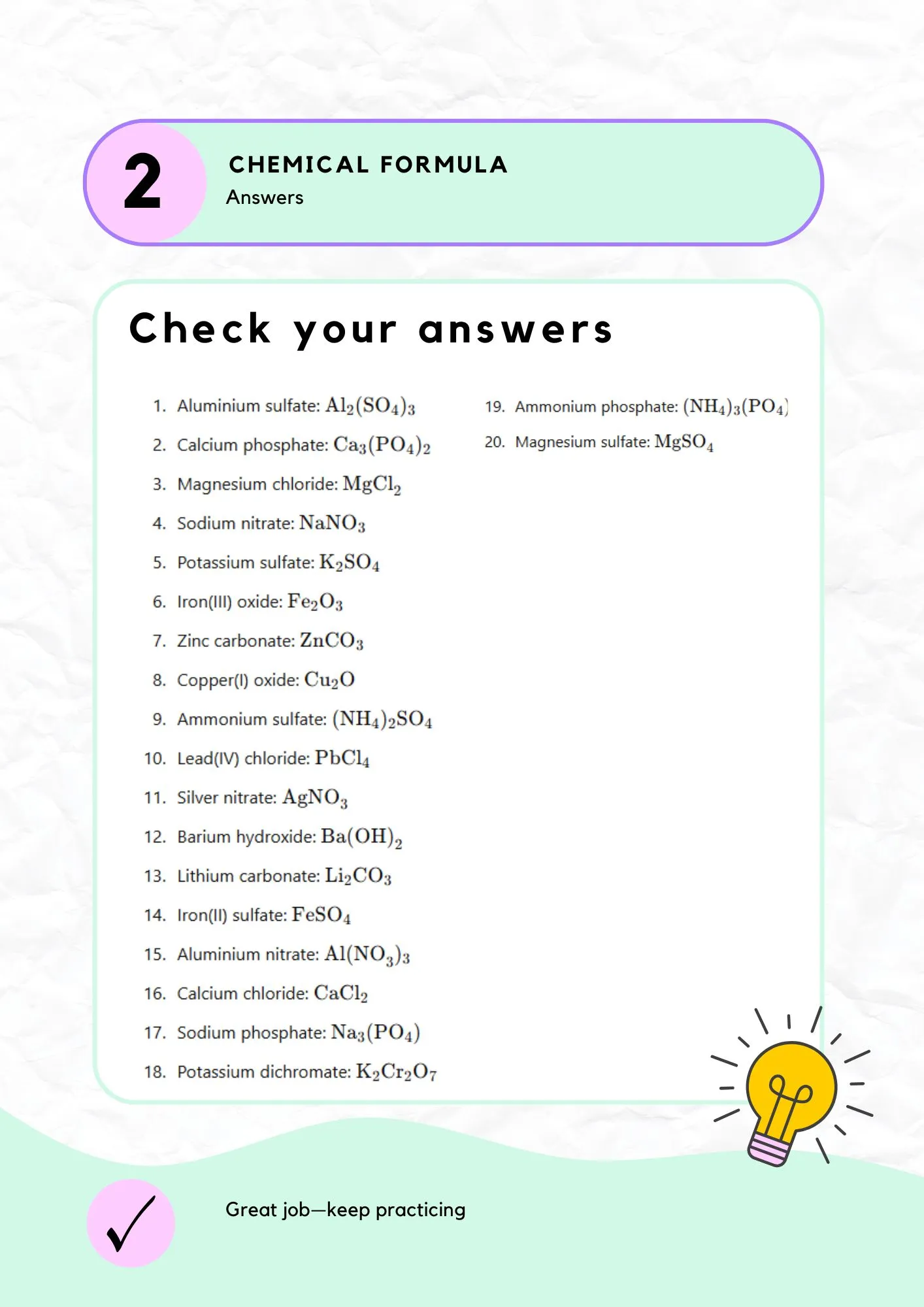
Exercise 1: Full Answer Key
Complete list of all formula answers
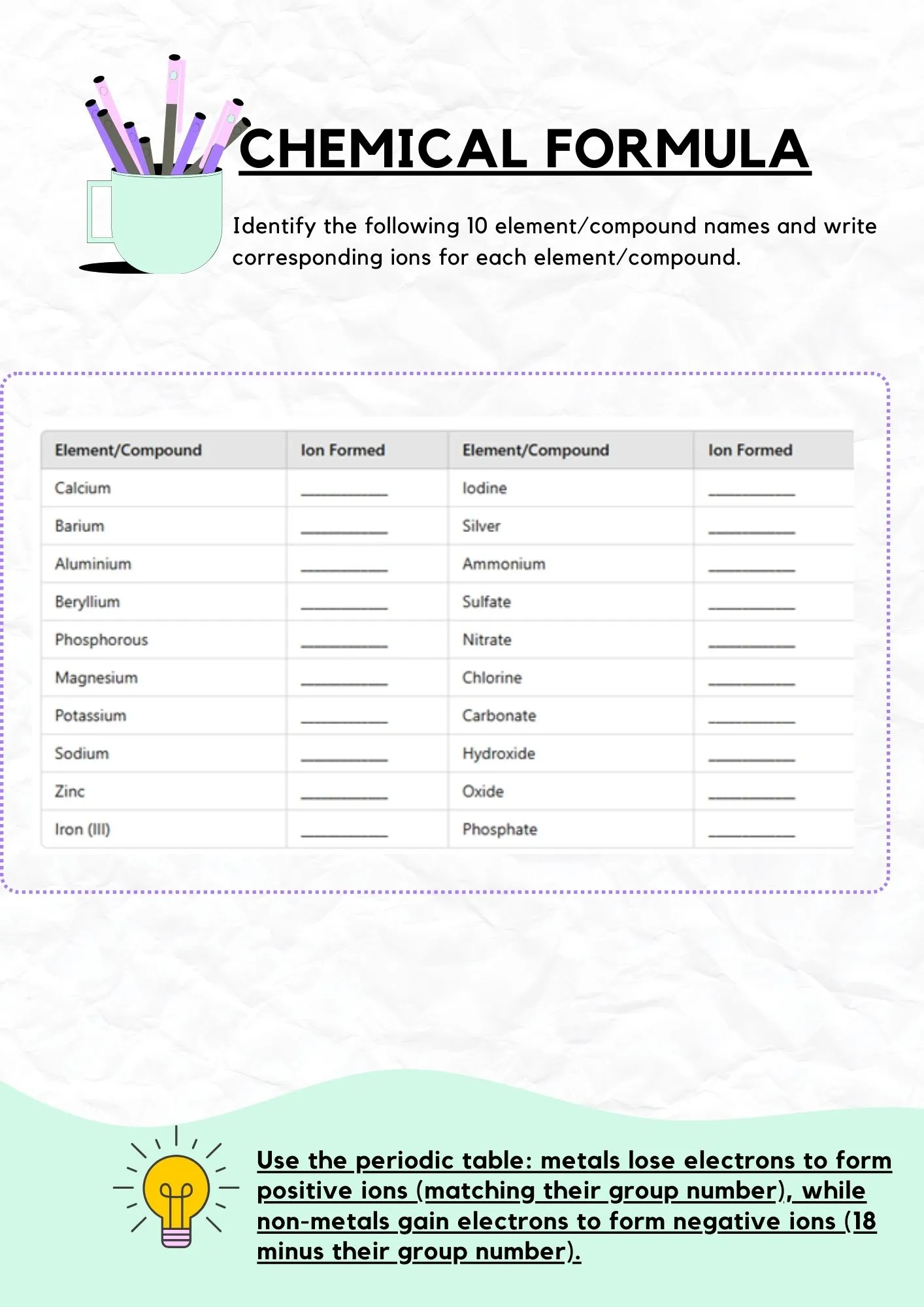
Exercise 2: Ion Formation
Identify ions formed by elements and compounds
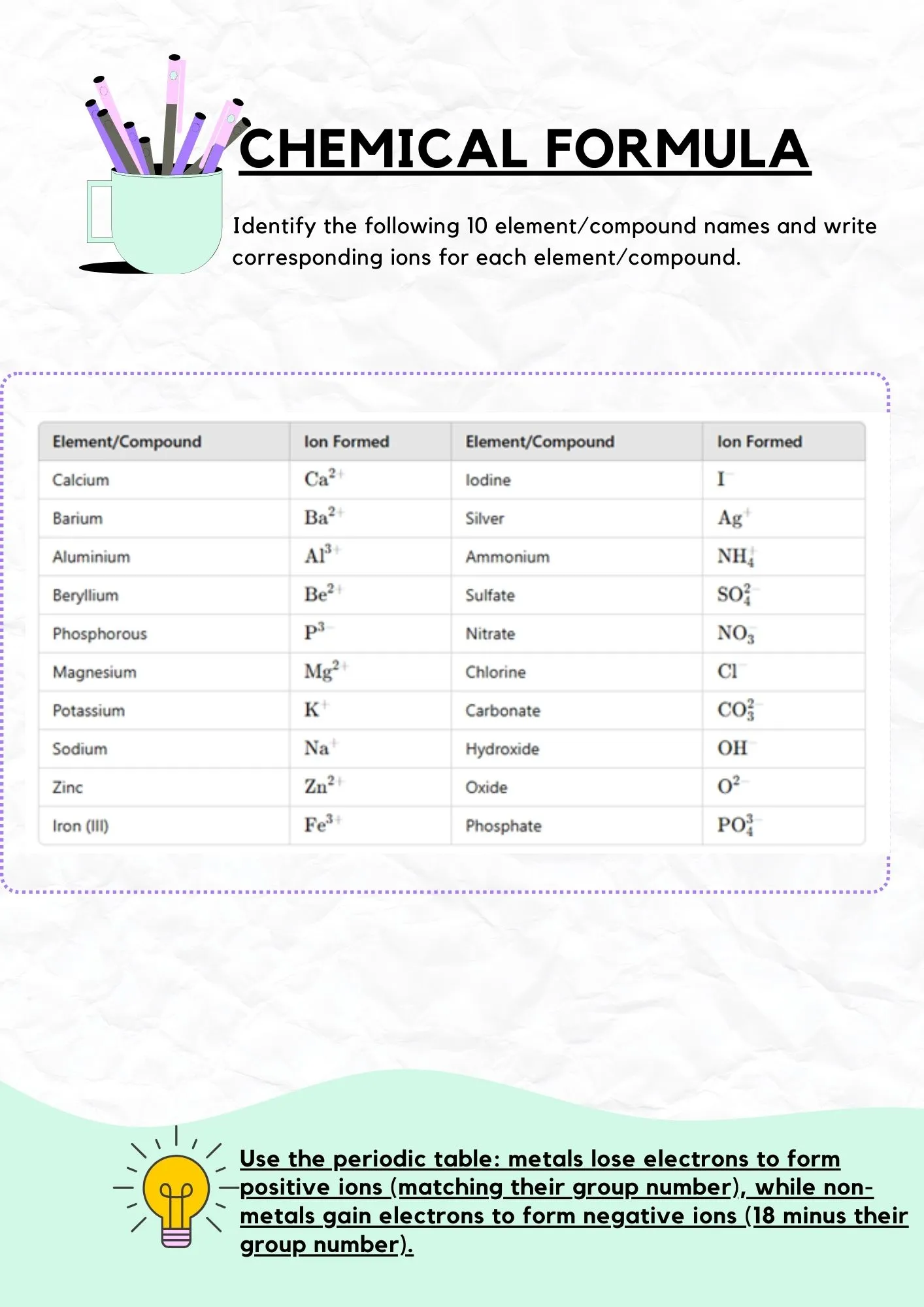
Exercise 2: Answers
Check your ion formation answers
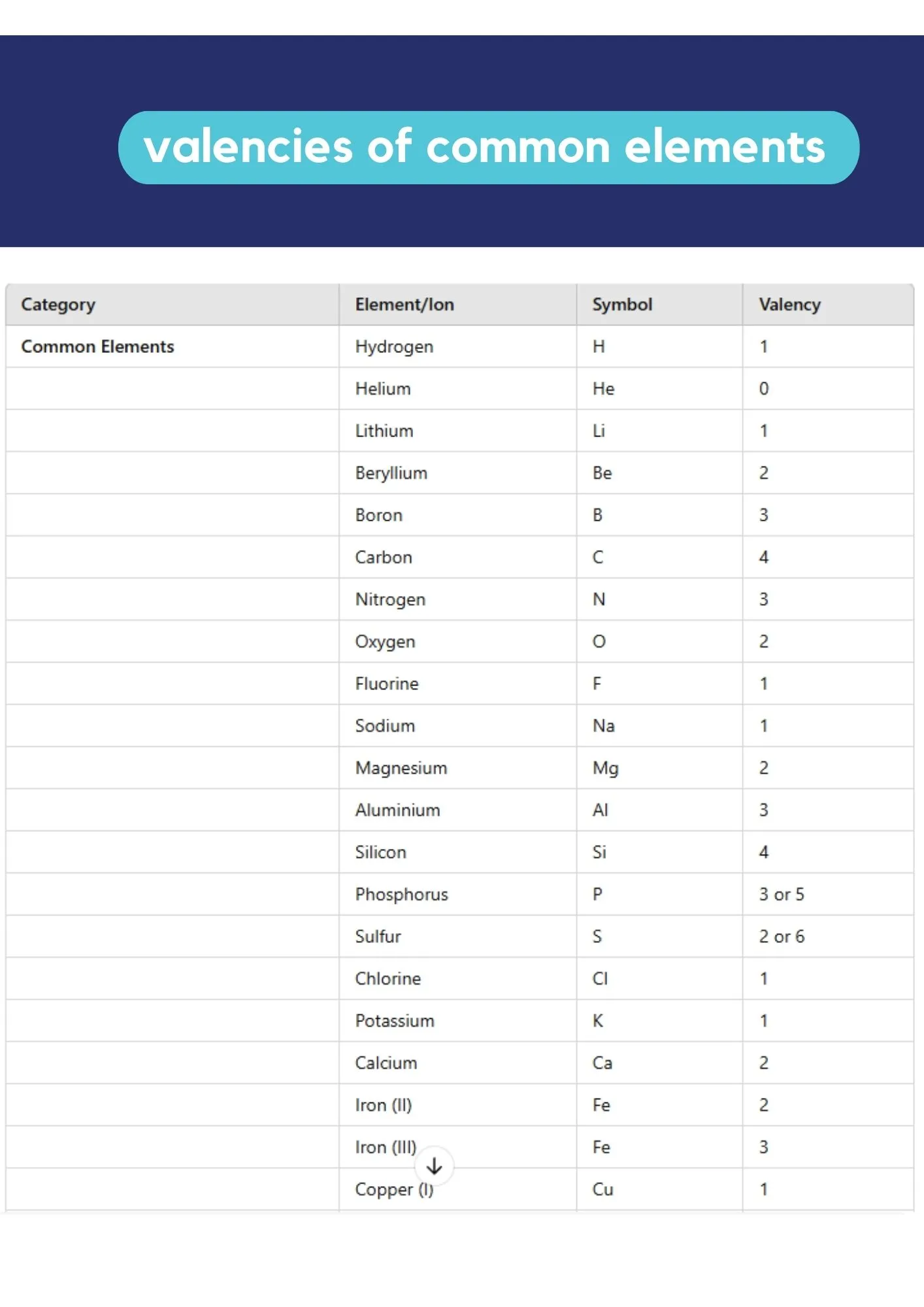
Reference: Valencies of Elements
Quick reference for common element valencies
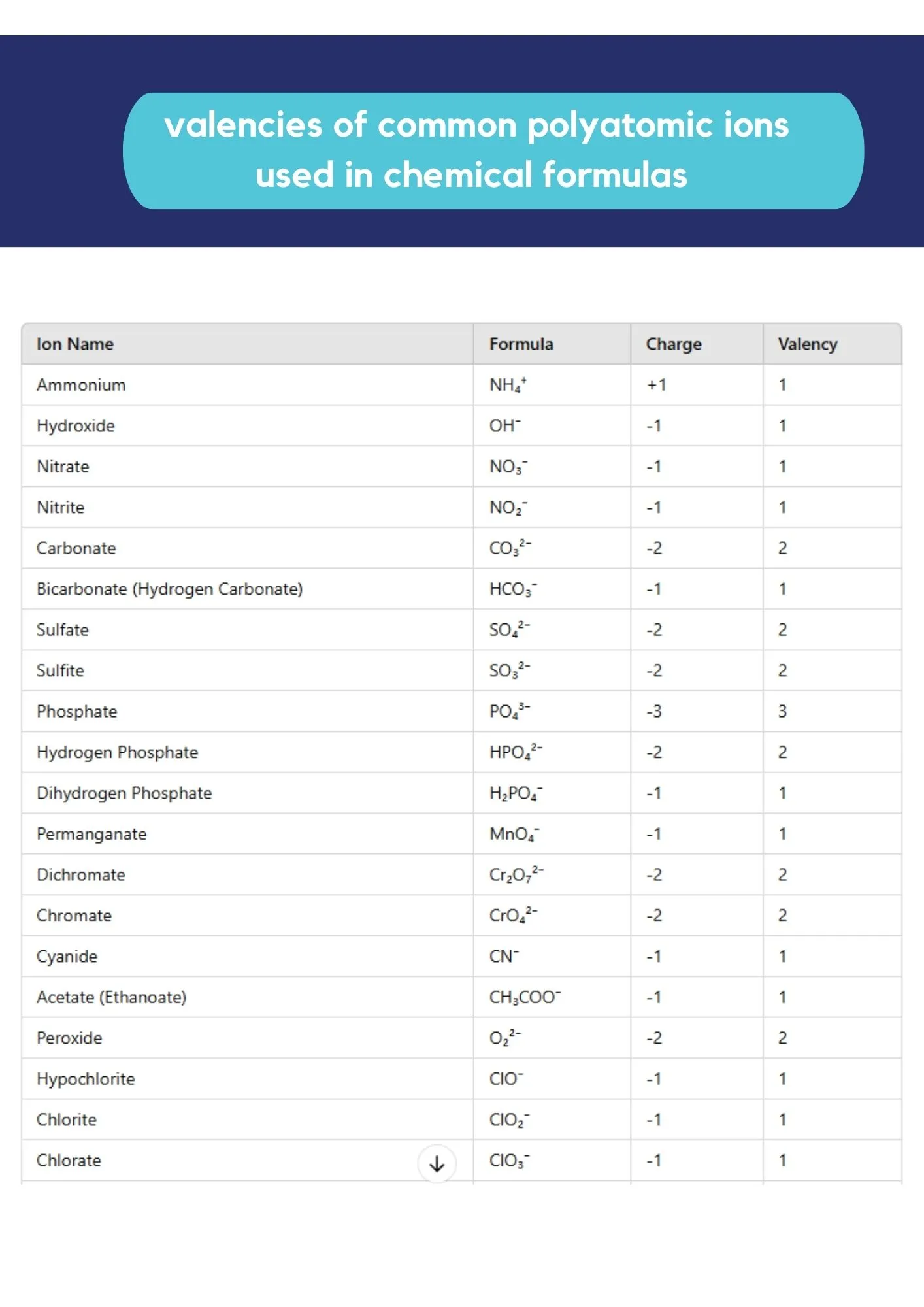
Reference: Polyatomic Ions
Valencies of common polyatomic ions
🎮 Interactive Activities
Coming Soon: Learning Activities
Exciting interactive activities are on the way to help you master chemical formulas!
Formula Builder Game
Build chemical formulas by dragging and dropping ions. Get instant feedback on your answers!
Coming SoonFormula Quiz Challenge
Test your knowledge with timed quizzes and compete with your classmates!
Coming Soon✏️ How to Write Chemical Formulae: A Step-by-Step Guide
Writing a chemical formula is a skill, not a memory test. Once you know the charges of the common ions and one simple rule, you can write the formula of almost any ionic compound you are asked for. Work through the four steps below, then try the practice exercises at the end.
Step 1: Learn the charges of the common ions
An ion is an atom, or a group of atoms, that has gained or lost electrons and so carries a charge. Metals lose electrons and form positive ions; non-metals gain electrons and form negative ions. The size of the charge is also called the valency of the ion: the valency is the number without the sign, so Mg²⁺ has a valency of 2 and PO₄³⁻ has a valency of 3. The table below is the one you need to know.
| Charge | Positive ions (cations) | Negative ions (anions) |
|---|---|---|
| 1 | Lithium Li⁺, sodium Na⁺, potassium K⁺, silver Ag⁺, copper(I) Cu⁺, ammonium NH₄⁺, hydrogen H⁺ | Fluoride F⁻, chloride Cl⁻, bromide Br⁻, iodide I⁻, hydroxide OH⁻, nitrate NO₃⁻, hydrogencarbonate HCO₃⁻ |
| 2 | Magnesium Mg²⁺, calcium Ca²⁺, barium Ba²⁺, zinc Zn²⁺, iron(II) Fe²⁺, copper(II) Cu²⁺, lead(II) Pb²⁺ | Oxide O²⁻, sulfide S²⁻, sulfate SO₄²⁻, carbonate CO₃²⁻, dichromate Cr₂O₇²⁻ |
| 3 | Aluminium Al³⁺, iron(III) Fe³⁺, chromium(III) Cr³⁺ | Nitride N³⁻, phosphate PO₄³⁻ |
Ions made of more than one atom, such as sulfate, nitrate, hydroxide and ammonium, are called polyatomic ions. They behave as a single unit and the group of atoms is never split up.
Step 2: Use the crossover method
An ionic compound has no overall charge, so the positive and negative charges must cancel. The crossover method finds the numbers that make them cancel: write the two ions side by side, then take the size of each charge and cross it over to become the subscript of the other ion. If the two subscripts can be simplified, divide both by the same number, because a formula shows the simplest ratio of ions.
- Sodium chloride: Na⁺ and Cl⁻. Cross over 1 and 1. Formula: NaCl (a subscript of 1 is never written).
- Calcium chloride: Ca²⁺ and Cl⁻. The 2 crosses to the chloride and the 1 to the calcium. Formula: CaCl₂. Check: one +2 and two −1 charges add up to zero.
- Aluminium oxide: Al³⁺ and O²⁻. The 3 crosses to oxygen and the 2 to aluminium. Formula: Al₂O₃. Check: 2 × (+3) = +6 and 3 × (−2) = −6.
- Magnesium oxide: Mg²⁺ and O²⁻. Crossing over gives Mg₂O₂, but the ratio 2 : 2 simplifies to 1 : 1. Formula: MgO.
Step 3: Put brackets around polyatomic ions
When the crossover method gives a polyatomic ion a subscript greater than 1, the ion goes in brackets and the subscript goes outside. Without the brackets the formula would say something different: MgOH₂ would mean one oxygen and two hydrogens, when magnesium hydroxide actually contains two whole hydroxide ions.
- Magnesium hydroxide: Mg²⁺ and OH⁻ gives Mg(OH)₂: one magnesium, two oxygens, two hydrogens.
- Calcium nitrate: Ca²⁺ and NO₃⁻ gives Ca(NO₃)₂.
- Ammonium sulfate: NH₄⁺ and SO₄²⁻ gives (NH₄)₂SO₄. Only the ammonium needs brackets because only the ammonium has a subscript.
- Aluminium sulfate: Al³⁺ and SO₄²⁻ gives Al₂(SO₄)₃.
- No brackets needed: sodium hydroxide is NaOH and sodium carbonate is Na₂CO₃, because there is only one polyatomic ion in each formula unit.
Step 4: Read the Roman numeral for transition metals
Iron, copper, lead and most other transition metals can form ions with different charges, so the name tells you which one to use. The Roman numeral is the charge, not the number of atoms. Iron(II) chloride is FeCl₂ and iron(III) chloride is FeCl₃. Copper(I) oxide is Cu₂O and copper(II) oxide is CuO. Iron(III) oxide, the main compound in rust, is Fe₂O₃. Metals in Groups 1 and 2 and aluminium only ever form one ion, so their names never carry a numeral.
Balancing a chemical equation, step by step
A balanced equation has the same number of atoms of each element on both sides, because atoms are never created or destroyed in a reaction. You balance an equation by writing a large number, called a coefficient, in front of a formula. You must never change a subscript: changing H₂O to H₂O₂ turns water into hydrogen peroxide, a different substance. Also remember that hydrogen, nitrogen, oxygen, fluorine, chlorine, bromine and iodine exist as two-atom molecules, so they are written H₂, N₂, O₂, F₂, Cl₂, Br₂ and I₂.
Worked example 1: magnesium burning in oxygen. Write the correct formulae first, then count each element.
Mg + O₂ → MgO Left: 1 Mg, 2 O. Right: 1 Mg, 1 O. Oxygen is unbalanced. 2Mg + O₂ → 2MgO Put 2 in front of MgO to give 2 O, then 2 in front of Mg to match. Left: 2 Mg, 2 O. Right: 2 Mg, 2 O. Balanced.Worked example 2: methane burning. Balance carbon first, then hydrogen, and leave oxygen until last because it appears in two products.
CH₄ + 2O₂ → CO₂ + 2H₂O C: 1 = 1. H: 4 = 2 × 2 = 4. O: 2 × 2 = 4 on the left; 2 + 2 = 4 on the right. Balanced.Worked example 3: aluminium and oxygen. Aluminium oxide has three oxygens but oxygen comes in twos, so use the lowest common multiple, 6.
4Al + 3O₂ → 2Al₂O₃ Al: 4 = 2 × 2 = 4. O: 3 × 2 = 6 = 2 × 3 = 6. Balanced.Worked example 4: sodium and water. Hydrogen appears in three places, so count it carefully.
2Na + 2H₂O → 2NaOH + H₂ Na: 2 = 2. H: 2 × 2 = 4 on the left; 2 + 2 = 4 on the right. O: 2 = 2. Balanced.Worked example 5: a neutralisation. Treat the sulfate ion as one unit and it balances quickly.
H₂SO₄ + 2NaOH → Na₂SO₄ + 2H₂O H: 2 + 2 = 4 on the left; 2 × 2 = 4 on the right. S: 1 = 1. O: 4 + 2 = 6 on the left; 4 + 2 = 6 on the right. Na: 2 = 2. Balanced.Practice exercises (answers below)
A. Write the formula of each compound.
- Potassium bromide
- Calcium carbonate
- Iron(III) hydroxide
- Ammonium nitrate
- Zinc sulfate
- Copper(II) nitrate
- Magnesium phosphate
- Aluminium chloride
B. Balance each equation.
- Zn + HCl → ZnCl₂ + H₂
- N₂ + H₂ → NH₃
- C₃H₈ + O₂ → CO₂ + H₂O
- Fe + Cl₂ → FeCl₃
Answers A: 1. KBr. 2. CaCO₃. 3. Fe(OH)₃. 4. NH₄NO₃, with no brackets because each ion appears once. 5. ZnSO₄. 6. Cu(NO₃)₂. 7. Mg₃(PO₄)₂, from Mg²⁺ and PO₄³⁻: 3 × (+2) = +6 and 2 × (−3) = −6. 8. AlCl₃.
Answers B: 1. Zn + 2HCl → ZnCl₂ + H₂ (Zn 1 = 1, H 2 = 2, Cl 2 = 2). 2. N₂ + 3H₂ → 2NH₃ (N 2 = 2, H 6 = 6). 3. C₃H₈ + 5O₂ → 3CO₂ + 4H₂O (C 3 = 3, H 8 = 8, O 10 = 6 + 4). 4. 2Fe + 3Cl₂ → 2FeCl₃ (Fe 2 = 2, Cl 6 = 6).
Common mistakes to avoid
- Changing a subscript to balance an equation. Only coefficients may change.
- Leaving out brackets: MgOH₂ and Mg(OH)₂ are not the same thing.
- Forgetting to simplify: magnesium oxide is MgO, not Mg₂O₂.
- Writing oxygen or chlorine as single atoms in an equation instead of O₂ and Cl₂.
- Treating the Roman numeral as a number of atoms. Iron(III) oxide is Fe₂O₃, not Fe₃O.
Key terms
- Ion
- An atom or group of atoms with a positive or negative charge, formed by losing or gaining electrons.
- Valency
- The combining power of an ion or element: the size of its charge, written without a sign.
- Polyatomic ion
- An ion made of two or more atoms bonded together that carries a charge as a single unit, such as SO₄²⁻.
- Subscript
- The small number written after a symbol that shows how many atoms or ions of that kind are in one formula unit. It is never changed when balancing.
- Coefficient
- The large number written in front of a formula that multiplies the whole formula. Coefficients are the only numbers changed when balancing.
- Balanced equation
- An equation with equal numbers of atoms of every element on the reactant side and the product side.