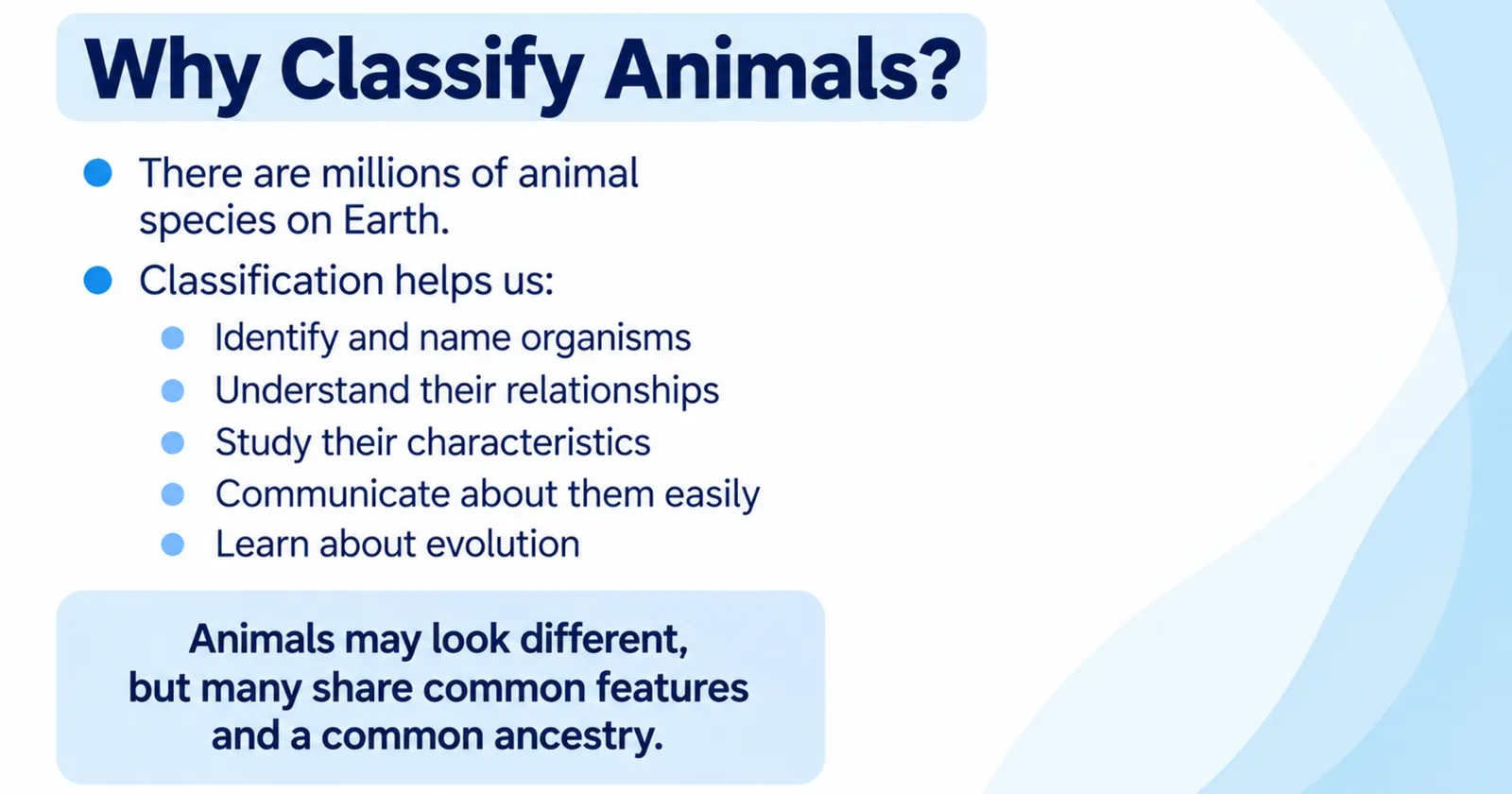
Scientists have described more than 1.5 million species of animals, and millions more may still be waiting to be discovered. They range from sponges that never move to cheetahs that sprint at over 100 kilometres per hour, and from microscopic water bears to the blue whale, the largest animal that has ever lived. Classification brings order to this incredible diversity. In this guide you will learn how the animal kingdom is organised, the key features of each major group and how to tell a reptile from an amphibian or an insect from a spider.
📖 Lesson
How the animal kingdom is organised, the key features of each major group and how to tell tricky animals apart.
What Makes an Animal an Animal?
All members of the kingdom Animalia share these features:
They are multicellular eukaryotes.
Their cells have no cell walls, which allows flexible body shapes and movement.
They are heterotrophs: they cannot make their own food, so they eat other organisms.
Most can move from place to place at some stage of their life.
Most have a nervous system to coordinate their actions.
They store carbohydrate as glycogen.
Most reproduce sexually, developing from a fertilised egg.
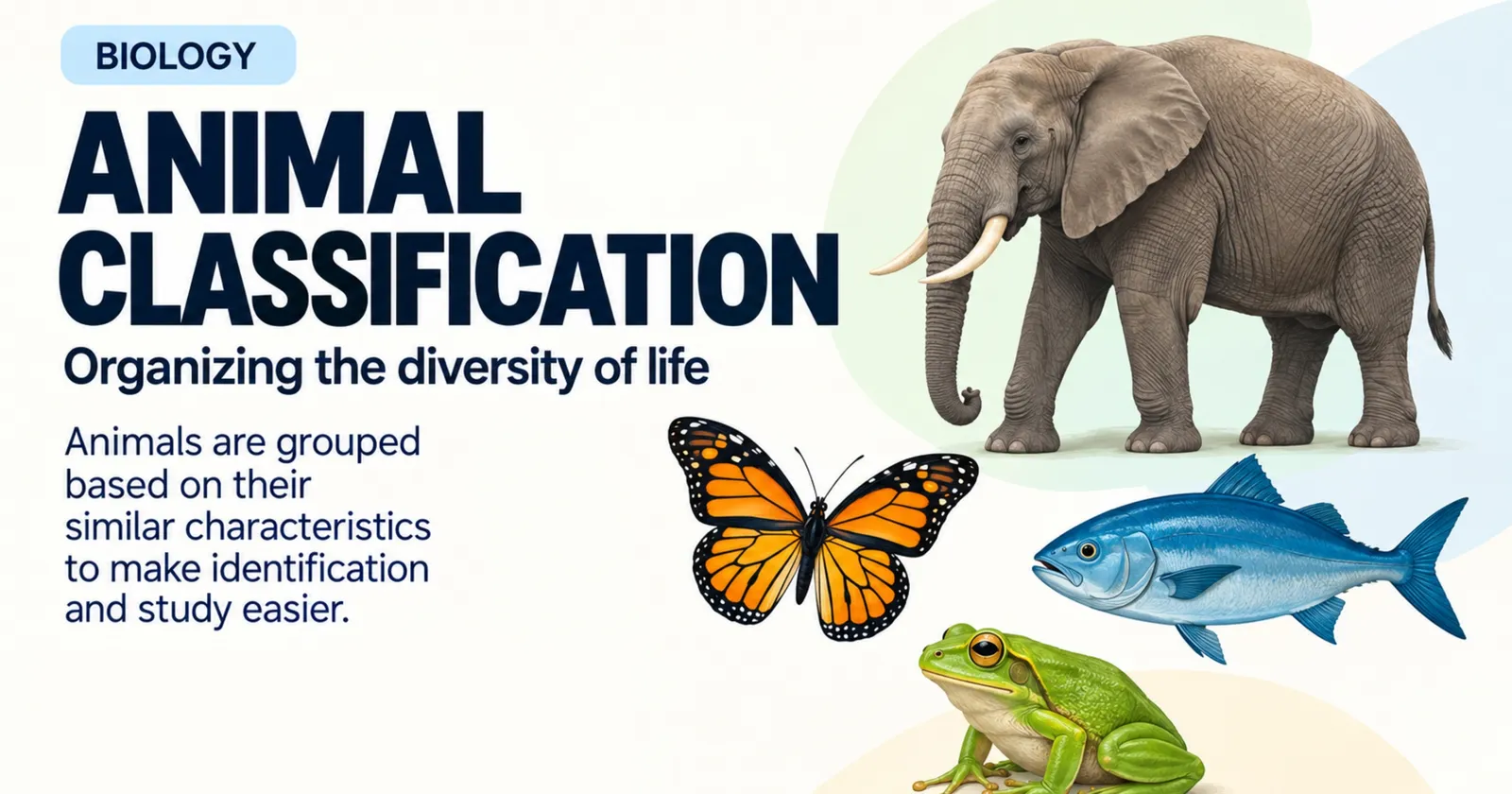
Slides: Animal classification
Why scientists sort the diversity of life into groups
1/2
The Taxonomic Hierarchy for Animals
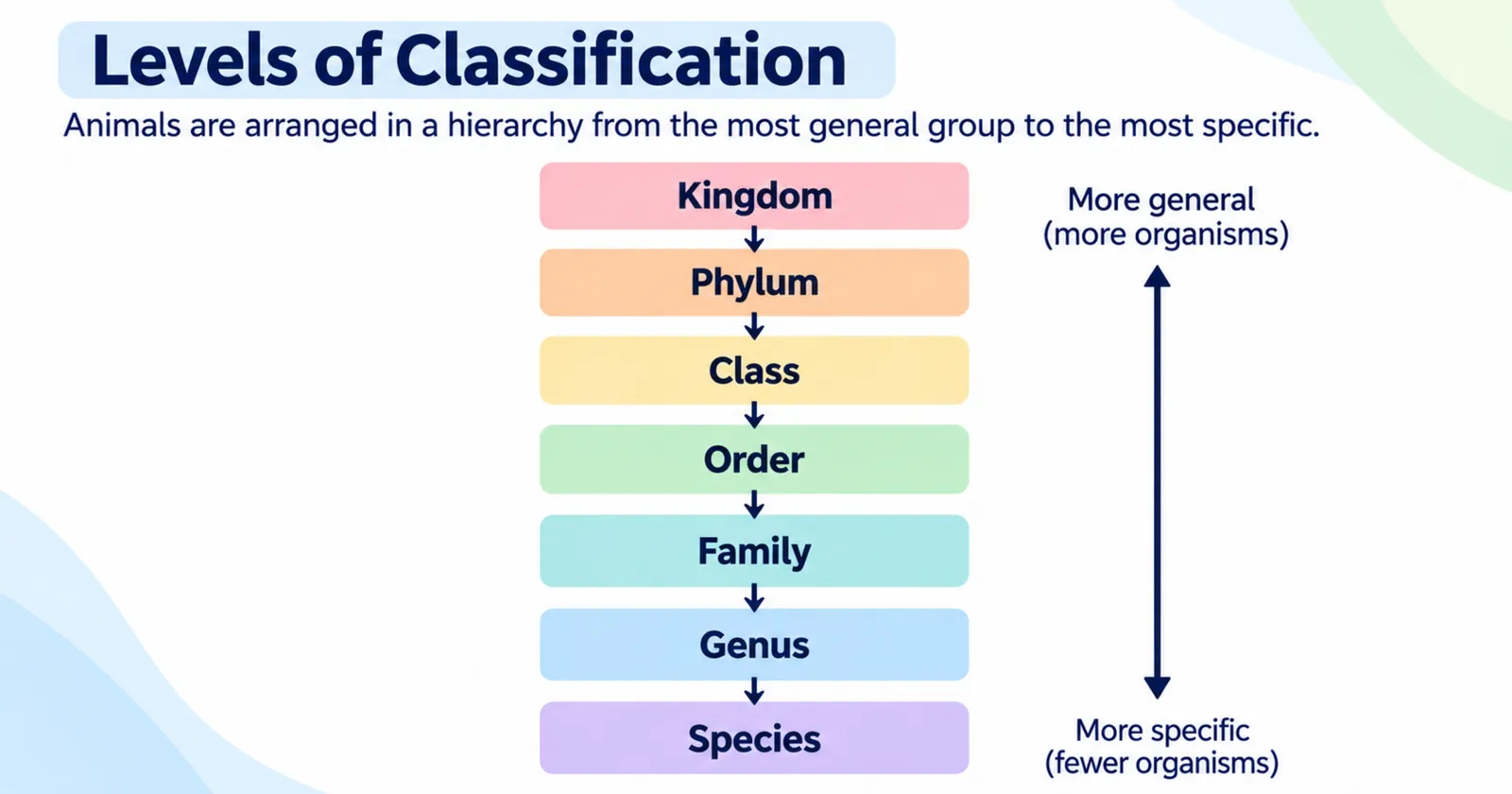
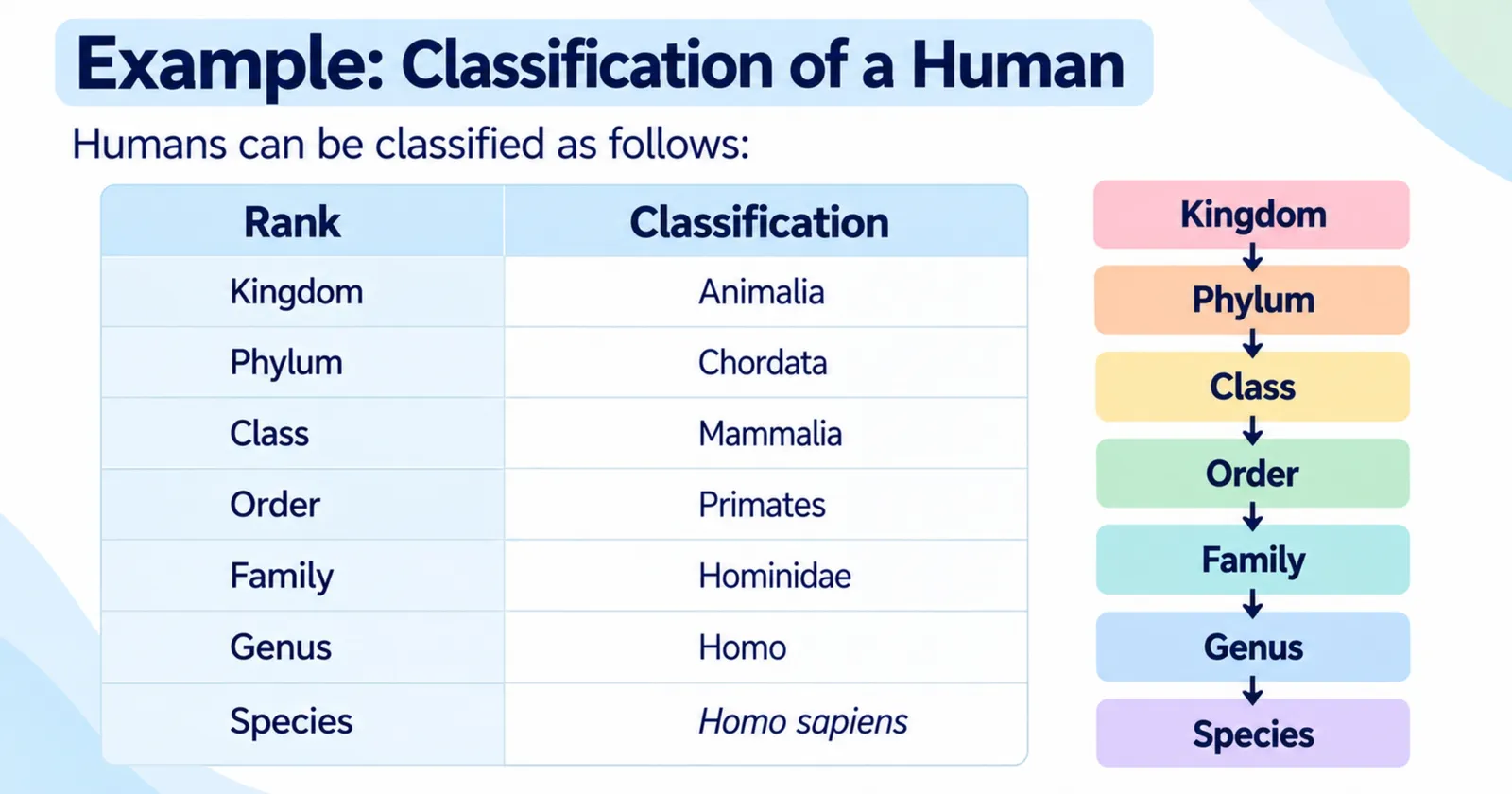
Like plants, animals are placed into a hierarchy of groups: Kingdom, Phylum, Class, Order, Family, Genus and Species. As you move down the levels, the groups get smaller and the members become more similar.
| Level | Human | Lion |
|---|---|---|
| Kingdom | Animalia | Animalia |
| Phylum | Chordata | Chordata |
| Class | Mammalia | Mammalia |
| Order | Primates | Carnivora |
| Family | Hominidae | Felidae |
| Genus | Homo | Panthera |
| Species | Homo sapiens | Panthera leo |
Notice that humans and lions share the same kingdom, phylum and class, because both are mammals, but they separate at the order level.
Slides: Levels of classification
From kingdom down to species
1/2
Binomial names for animals
Each species has a two-part scientific name made of its genus and species, a system created by Carl Linnaeus. The tiger is Panthera tigris, the domestic cat is Felis catus and the Asian elephant is Elephas maximus. Related animals share a genus: the lion (Panthera leo), tiger (Panthera tigris) and leopard (Panthera pardus) are all "big cats" in the genus Panthera.
What is a species?
A species is a group of organisms that can interbreed to produce fertile offspring. A horse and a donkey can breed to produce a mule, but mules are usually infertile, so horses and donkeys are separate species.
How Scientists Decide Which Group an Animal Belongs To
Zoologists use several key features to classify animals:
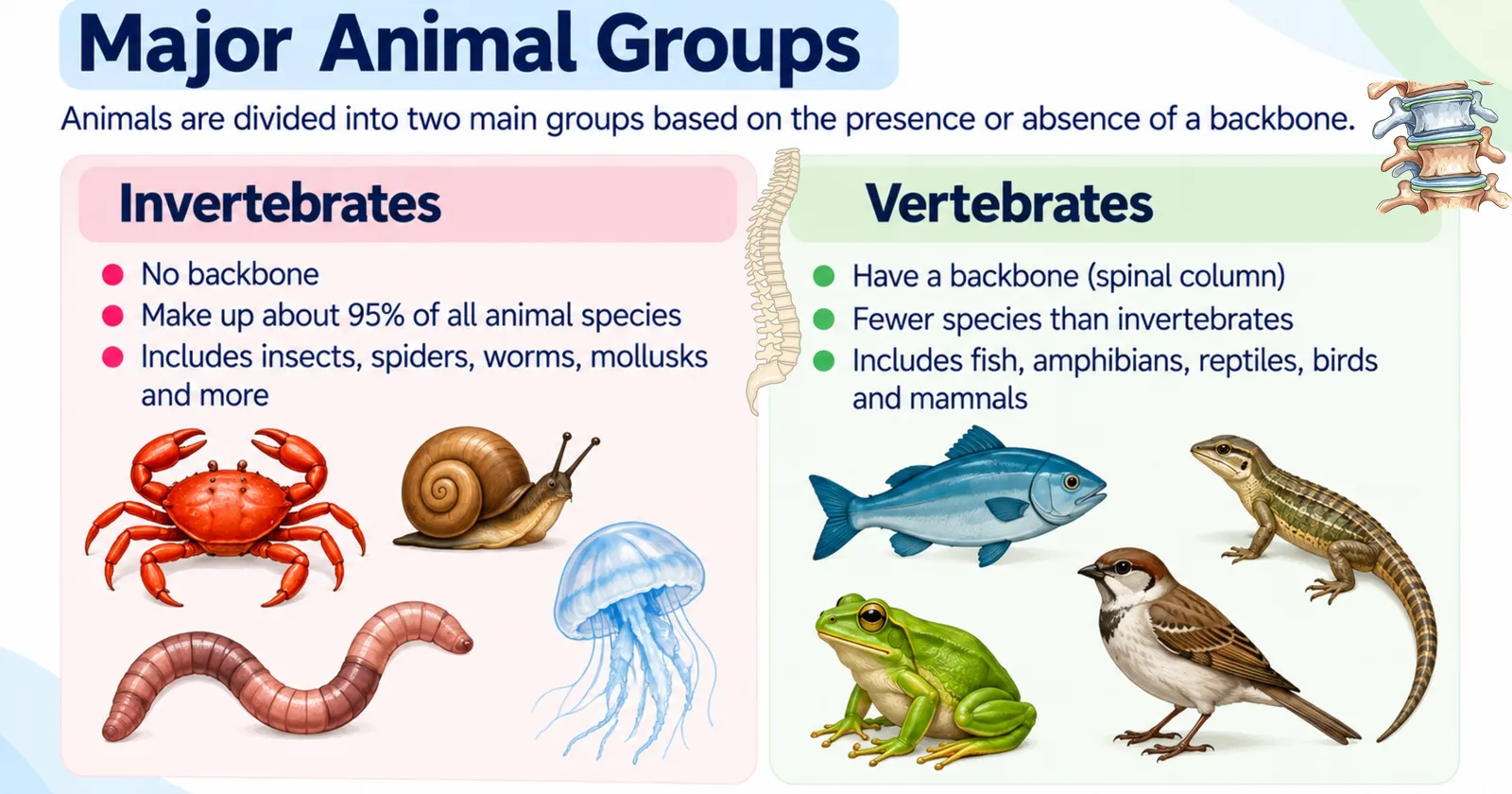
Backbone: vertebrates have one; invertebrates do not.
Body symmetry: radial symmetry (like a wheel, as in jellyfish) or bilateral symmetry (a left and right side that mirror each other, as in humans).
Body layers: two layers of cells (diploblastic) or three (triploblastic).
Body cavity: whether there is a fluid-filled space (coelom) around the organs.
Segmentation: whether the body is divided into repeating segments.
DNA evidence: modern classification compares DNA and protein sequences to reveal true evolutionary relationships. This has moved some animals into new groups.
Slide: Major animal groups
Invertebrates versus vertebrates
1/1
Invertebrates: Animals Without a Backbone
Invertebrates make up about 97 percent of all animal species. Here are the main phyla you need to know.
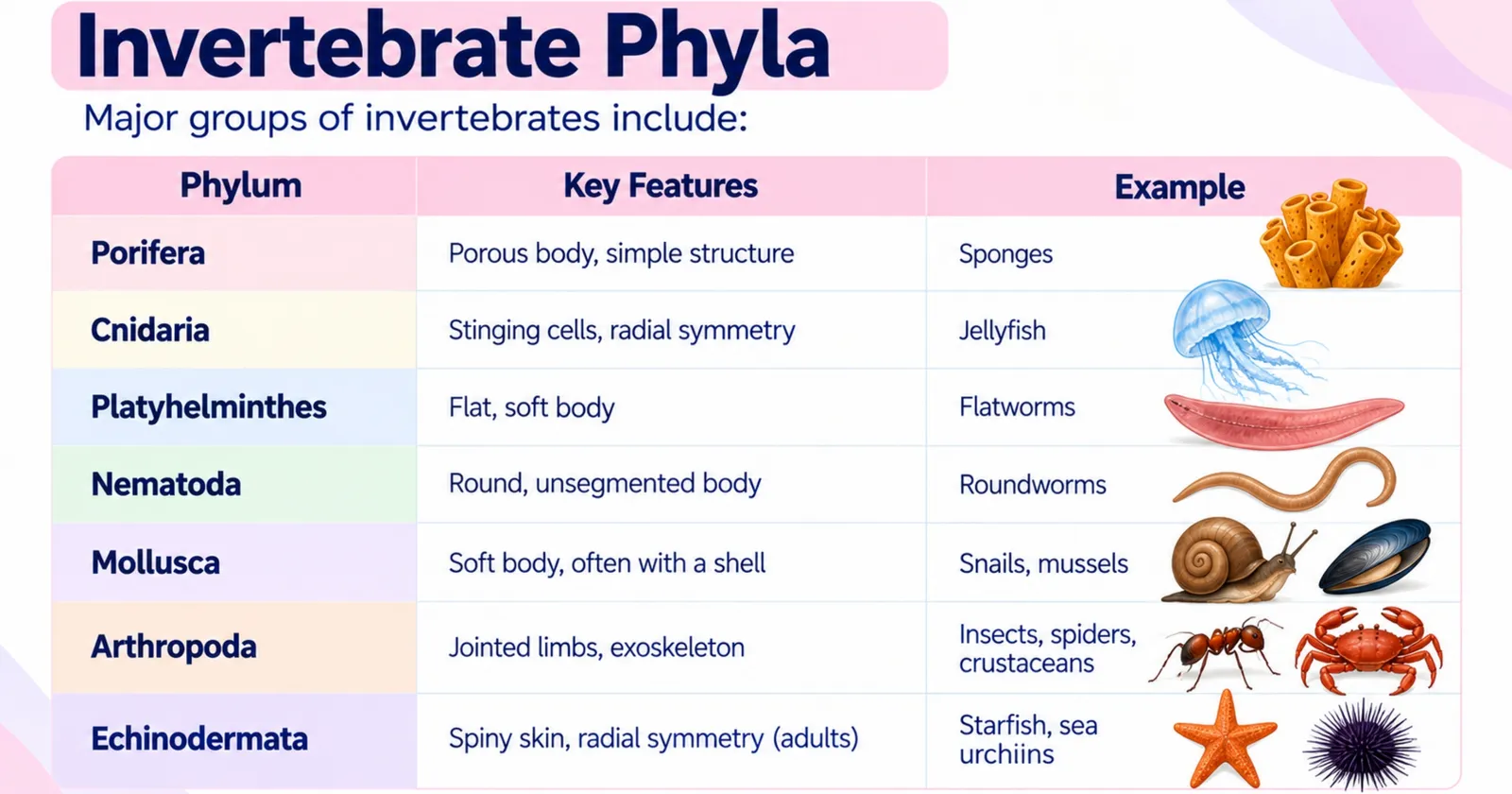
Porifera (sponges)
Sponges are the simplest animals. They have no true tissues, no organs and no symmetry. Their bodies are full of pores through which water flows, and they filter tiny food particles from it. They live attached to rocks, mostly in the sea.
Cnidarians (jellyfish, corals and sea anemones)
Radial symmetry.
Two body layers and a single opening that acts as both mouth and anus.
Tentacles with stinging cells (cnidocytes) for catching prey.
Examples: jellyfish, Hydra, sea anemones and corals. Coral reefs, built by tiny coral animals, are among the most biodiverse habitats on Earth.
Flatworms (Platyhelminthes)
Flat, soft, unsegmented bodies with bilateral symmetry.
Only one body opening.
Many are parasites, such as tapeworms and liver flukes. Free-living planarians can regrow a whole body from a small piece.
Roundworms (Nematodes)
Long, thin, unsegmented, cylindrical bodies tapered at both ends.
A gut with two openings, a mouth and an anus.
Extremely common in soil. Some are parasites, such as Ascaris and hookworms, which infect millions of people.
Annelids (segmented worms)
Long bodies divided into many ring-like segments.
A moist skin used for gas exchange.
Bristles called chaetae on most segments help them move.
Examples: earthworms, leeches and ragworms. Earthworms improve soil by mixing and aerating it.
Molluscs
Soft, unsegmented bodies, usually with a muscular foot for movement.
Most have a hard shell made of calcium carbonate.
A mantle, a fold of tissue that produces the shell.
Examples: snails, slugs, mussels, clams, oysters, squid and octopuses. The octopus is considered one of the most intelligent invertebrates and can solve puzzles.
Echinoderms
Marine animals with spiny skin.
Adults show five-part radial symmetry.
A unique water vascular system that powers tiny tube feet.
Examples: starfish (sea stars), sea urchins, sea cucumbers and brittle stars. Surprisingly, DNA shows that echinoderms are more closely related to vertebrates than to other invertebrates.
Arthropods: the largest animal phylum
Arthropods make up more than 80 percent of all known animal species. They share these features:
A hard exoskeleton made of chitin, which they must shed (moult) to grow.
Segmented bodies.
Jointed legs. The word arthropod means "jointed foot".
Arthropods are divided into four main classes, a favourite exam topic:
| Class | Body parts | Legs | Antennae | Examples |
|---|---|---|---|---|
| Insects | 3 (head, thorax, abdomen) | 6 (3 pairs) | 1 pair | Butterflies, ants, beetles, bees, mosquitoes |
| Arachnids | 2 (cephalothorax, abdomen) | 8 (4 pairs) | None | Spiders, scorpions, ticks, mites |
| Crustaceans | 2 (cephalothorax, abdomen) | 10 or more | 2 pairs | Crabs, lobsters, prawns, woodlice |
| Myriapods | Many segments | Many (1 or 2 pairs per segment) | 1 pair | Centipedes (1 pair per segment), millipedes (2 pairs per segment) |
Many insects also have one or two pairs of wings. There are more species of beetles than of any other animal group.
A common mistake is to call a spider an insect. Spiders have eight legs and two body parts, so they are arachnids.
Slide: Invertebrate phyla
The major groups of invertebrates and their key features
1/1
Chordates and Vertebrates: Animals With a Backbone
Vertebrates belong to the phylum Chordata. All chordates have, at some stage of life, a flexible rod called a notochord, a hollow nerve cord along the back, gill slits and a tail. In vertebrates the notochord is replaced by a backbone (vertebral column) made of vertebrae, which protects the spinal cord.
Vertebrates also have an internal skeleton (endoskeleton) of bone or cartilage, a well-developed brain inside a skull and a closed circulatory system.
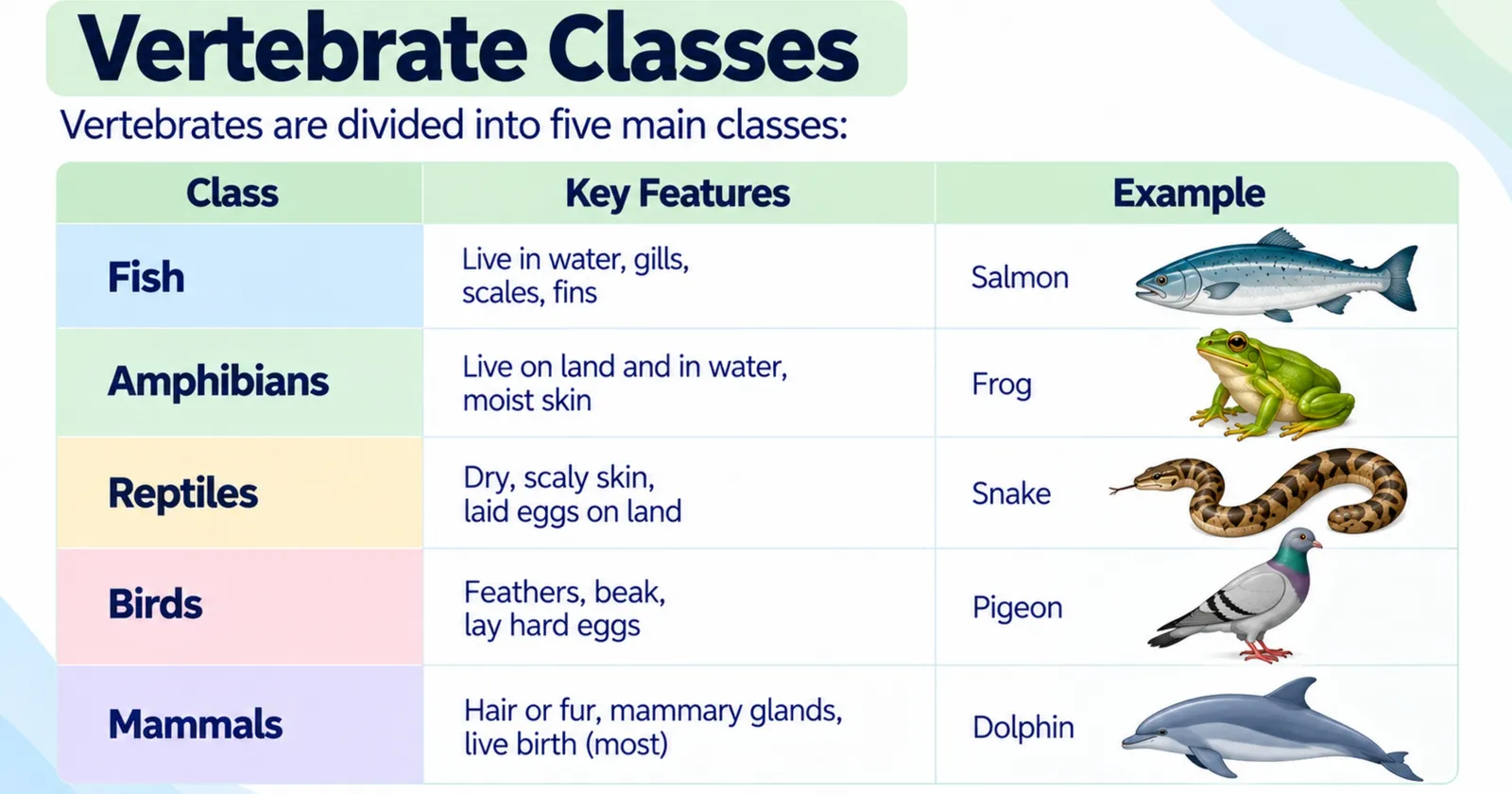
The five classes of vertebrates at a glance
| Feature | Fish | Amphibians | Reptiles | Birds | Mammals |
|---|---|---|---|---|---|
| Body covering | Wet scales | Moist skin, no scales | Dry scales | Feathers | Hair or fur |
| Breathing | Gills | Gills (young), lungs and skin (adults) | Lungs | Lungs | Lungs |
| Body temperature | Ectotherm | Ectotherm | Ectotherm | Endotherm | Endotherm |
| Fertilisation | Usually external | External | Internal | Internal | Internal |
| Eggs | Soft, laid in water | Soft, jelly-coated, in water | Leathery shells, on land | Hard shells | Mostly live young |
| Examples | Shark, salmon, tuna | Frog, toad, salamander | Snake, lizard, crocodile, turtle | Eagle, penguin, parrot | Human, whale, bat, elephant |
Ectotherms (often called cold-blooded) rely on their surroundings to control their body temperature, while endotherms (warm-blooded) generate heat internally to keep a steady temperature.
Fish
Fish live in water, breathe using gills and swim with fins. Most have a streamlined body covered in scales, and many have a swim bladder to control buoyancy. There are two main groups: cartilaginous fish, such as sharks and rays, with skeletons made of cartilage, and bony fish, such as salmon and tuna. Fish are the largest vertebrate group, with over 30,000 species.
Amphibians
The name amphibian means "double life". Most amphibians begin life in water as larvae (such as tadpoles) that breathe with gills, then undergo metamorphosis into adults that live on land and breathe with lungs and through their moist skin. Because their skin must stay moist and their eggs have no shells, most amphibians live near water. Examples include frogs, toads, newts, salamanders and legless caecilians. Amphibians are declining rapidly worldwide because of habitat loss, pollution and a fungal disease called chytridiomycosis.
Reptiles
Reptiles have dry, scaly skin that prevents water loss, allowing them to live in dry places. They breathe with lungs and lay eggs with leathery shells on land. These amniotic eggs contain membranes and fluid that protect the embryo, a key adaptation that freed reptiles from needing water to reproduce. Examples include snakes, lizards, crocodiles, alligators, turtles and tortoises. Dinosaurs were reptiles, and their descendants are the birds.
Birds
Birds are the only animals with feathers. They have wings, a beak with no teeth, hollow lightweight bones and a very efficient breathing system with air sacs. They are endotherms and lay hard-shelled eggs, usually incubated in nests. Not all birds fly: penguins, ostriches, emus and kiwis are flightless. There are around 11,000 bird species.
Mammals
Mammals have hair or fur, and females feed their young with milk from mammary glands. They are endotherms, have a diaphragm for breathing, different types of teeth and the largest brains relative to body size. Mammals are divided into three groups:
Monotremes: egg-laying mammals, such as the platypus and echidna.
Marsupials: give birth to tiny, undeveloped young that continue growing in a pouch, such as kangaroos and koalas.
Placental mammals: the young develop inside the mother, nourished by a placenta. This includes humans, dogs, whales, bats and elephants.
Remember that whales and dolphins are mammals, not fish: they breathe air with lungs, give birth to live young and feed them milk. Bats are the only mammals capable of true flight.
Slide: Vertebrate classes
Fish, amphibians, reptiles, birds and mammals
1/1
Tricky Animals That Confuse Students
Starfish are not fish; they are echinoderms.
Jellyfish are not fish; they are cnidarians.
Spiders are not insects; they are arachnids.
Whales and dolphins are mammals, not fish.
Penguins are birds, even though they cannot fly.
Turtles are reptiles, not amphibians, even though many live in water.
Seahorses are real fish, despite their unusual shape.
Why Animal Classification Matters
Classifying animals correctly helps scientists protect endangered species, track the spread of diseases carried by insects such as mosquitoes and ticks, and discover new medicines from animal venoms.
Using a Dichotomous Key for Animals
1a. Has a backbone: go to 2. 1b. No backbone: invertebrate.
2a. Has feathers: bird. 2b. No feathers: go to 3.
3a. Has hair or fur: mammal. 3b. No hair: go to 4.
4a. Has fins and gills as an adult: fish. 4b. No fins: go to 5.
5a. Dry scaly skin: reptile. 5b. Moist skin without scales: amphibian.
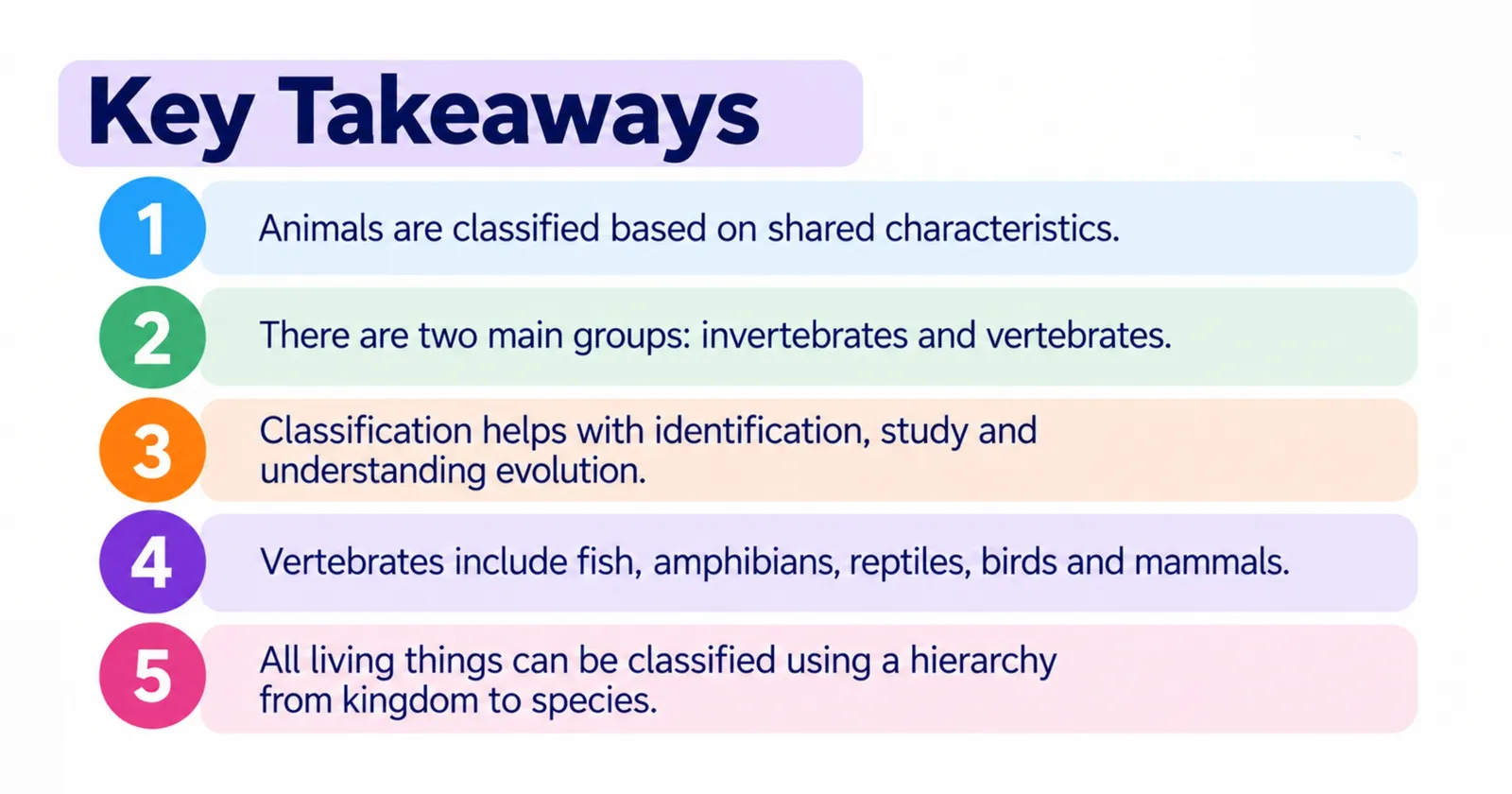
Slide: Key takeaways
1/1
Frequently Asked Questions About Animal Classification
What is the largest group of animals?
Arthropods, and within them, insects. Beetles alone account for around 400,000 described species.
Are humans animals?
Yes. Humans are animals in the phylum Chordata, class Mammalia, order Primates.
Why do scientists reclassify animals?
New evidence, especially from DNA sequencing, reveals relationships that are not obvious from appearance, so classification is updated as knowledge grows.
🗂️ Revision Flashcards
Tap a card to reveal the answer.
🎯 Quick Quiz
8 questions. Pick an answer to check it straight away.
1Which is the correct order of the taxonomic hierarchy, from largest group to smallest?
Kingdom, Phylum, Class, Order, Family, Genus and Species, getting smaller and more similar on the way down.
2At which level do humans and lions separate?
Both are in Animalia, Chordata and Mammalia, but humans are Primates and lions are Carnivora.
3Why are horses and donkeys classed as separate species?
A species interbreeds to produce fertile offspring; mules are usually infertile.
4A spider has eight legs and two body parts. Which group does it belong to?
Arachnids have 2 body parts, 8 legs and no antennae.
5Which phylum contains jellyfish, corals and sea anemones?
Cnidarians have radial symmetry and tentacles with stinging cells (cnidocytes).
6Which vertebrate class has dry scales, breathes with lungs and lays eggs with leathery shells on land?
Reptiles have dry, scaly skin and lay leathery-shelled amniotic eggs on land.
7Why are whales and dolphins classified as mammals, not fish?
Lungs, live young and milk are mammal features.
8Which group of mammals lays eggs?
Monotremes such as the platypus and echidna are egg-laying mammals.