There are more than 390,000 known species of plants on Earth, from tiny mosses no taller than a grain of rice to giant sequoia trees over 90 metres tall. With so much variety, how do scientists keep track of them all? The answer is classification: sorting living things into groups based on the features they share. Understanding plant classification helps you identify plants, understand how they evolved and appreciate how plants conquered the land. In this guide we explain every major plant group with simple descriptions and familiar examples.
📖 Lesson
The taxonomic hierarchy, scientific names and the four main plant groups, from mosses to flowering plants, plus monocots vs dicots.
What Is Classification and Why Does It Matter?
Classification is the process of arranging organisms into groups based on their similarities and differences. The science of classification is called taxonomy.
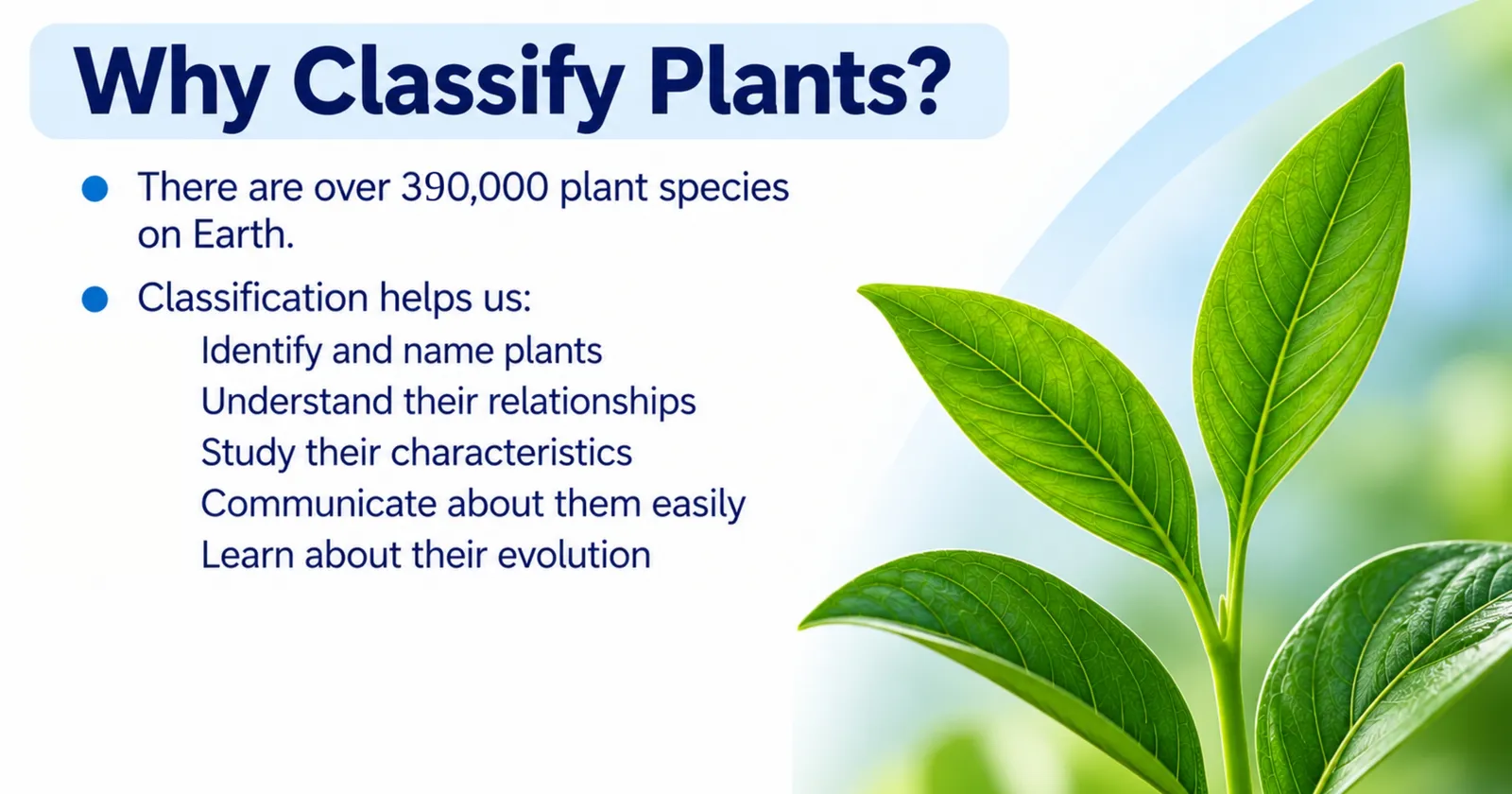
Classification helps us to:
Identify and name organisms accurately, so scientists around the world talk about the same species.
Understand evolutionary relationships, showing which plants share a common ancestor.
Organise the huge diversity of life into manageable groups.
Discover useful plants for food, medicine and materials, because related plants often contain similar chemicals.
Slides: Why classify plants?
Sorting living things by shared features
1/2
The Taxonomic Hierarchy
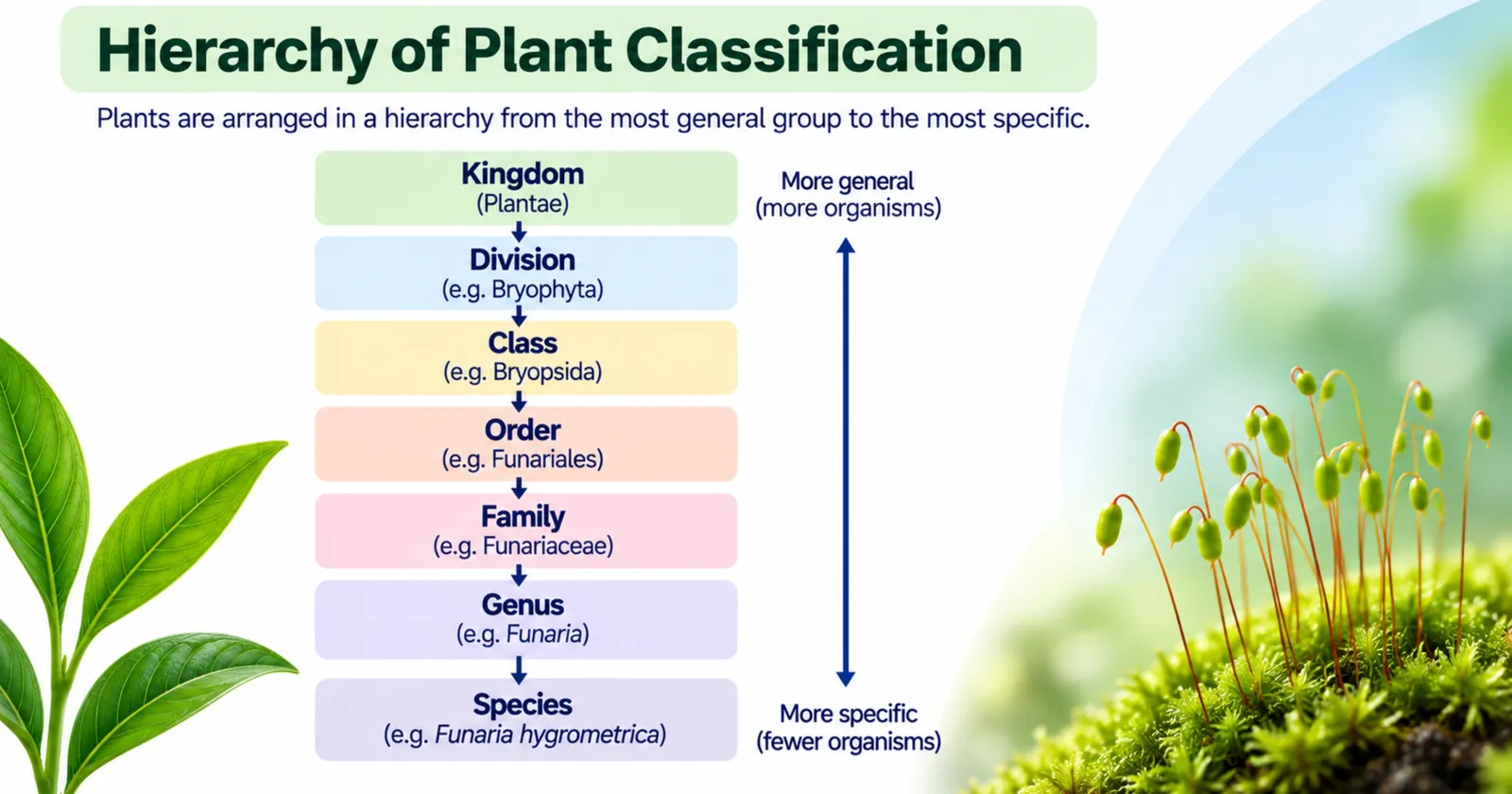
Living things are placed in a series of groups, each one smaller than the one before. The main levels, from largest to smallest, are: Kingdom, Phylum (or Division), Class, Order, Family, Genus and Species. Botanists traditionally use the word "division" instead of phylum for plants.
A popular way to remember the order is the sentence "King Philip Came Over For Good Soup".
Here is how the classification of a sunflower looks:
| Level | Sunflower |
|---|---|
| Kingdom | Plantae |
| Division (Phylum) | Angiosperms (Magnoliophyta) |
| Class | Dicots (Magnoliopsida) |
| Order | Asterales |
| Family | Asteraceae (daisy family) |
| Genus | Helianthus |
| Species | Helianthus annuus |
Slide: The taxonomic hierarchy
From kingdom to species
1/1
Binomial Nomenclature: How Plants Get Scientific Names
Swedish botanist Carl Linnaeus introduced the binomial system in the 1750s. Every species is given a two-part Latin name made of its genus and species. For example, the mango is Mangifera indica, the rose is Rosa rubiginosa (one of many rose species) and rice is Oryza sativa. The genus name starts with a capital letter, the species name is lower case, and the whole name is written in italics or underlined when handwritten.
Scientific names are important because common names vary between countries and languages. A plant called one name in England may have a completely different name in India or Sri Lanka, but its scientific name is the same everywhere.
What Makes a Plant a Plant?
Before we divide plants into groups, it helps to know what all members of the kingdom Plantae have in common:
They are multicellular eukaryotes.
Their cells have cell walls made of cellulose.
They contain chloroplasts with chlorophyll and make their own food by photosynthesis, so they are autotrophs.
They store carbohydrate as starch (and sometimes sucrose).
They have a life cycle with alternating generations, called alternation of generations.
What about algae? Algae such as seaweeds also photosynthesise, and many older textbooks place them in the plant kingdom under a group called Thallophyta. Modern classification usually places most algae in the kingdom Protoctista (or Protista), except green algae, which are close relatives of land plants. Many school syllabuses still mention algae as simple plant-like organisms, so check which system your exam uses.
The Main Groups of the Plant Kingdom
The easiest way to classify plants is with three questions:
Does the plant have vascular tissue (xylem and phloem)?
Does it produce seeds?
Are the seeds enclosed inside a fruit?
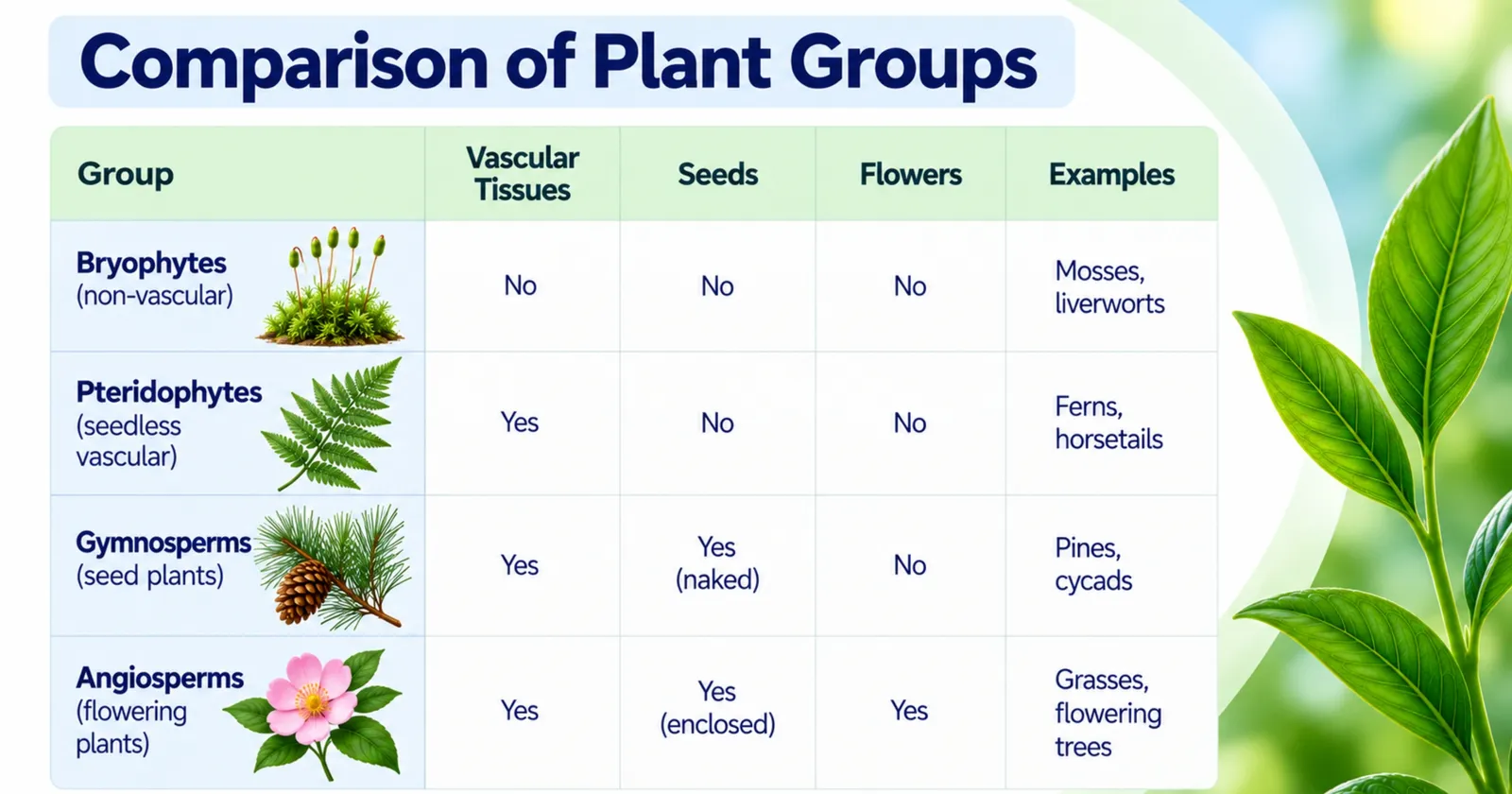
| Group | Vascular tissue? | Seeds? | Flowers and fruit? | Examples |
|---|---|---|---|---|
| Bryophytes | No | No (spores) | No | Mosses, liverworts, hornworts |
| Pteridophytes | Yes | No (spores) | No | Ferns, horsetails, club mosses |
| Gymnosperms | Yes | Yes, naked seeds | No (cones) | Pine, fir, cycads, ginkgo |
| Angiosperms | Yes | Yes, enclosed in fruit | Yes | Mango, grasses, rose, rice, oak |
Slide: Comparing the plant groups
Vascular tissue, seeds, flowers and examples
1/1
1. Bryophytes: Mosses and Liverworts
Bryophytes are the simplest land plants and were among the first plants to colonise land around 470 million years ago.
Key features of bryophytes
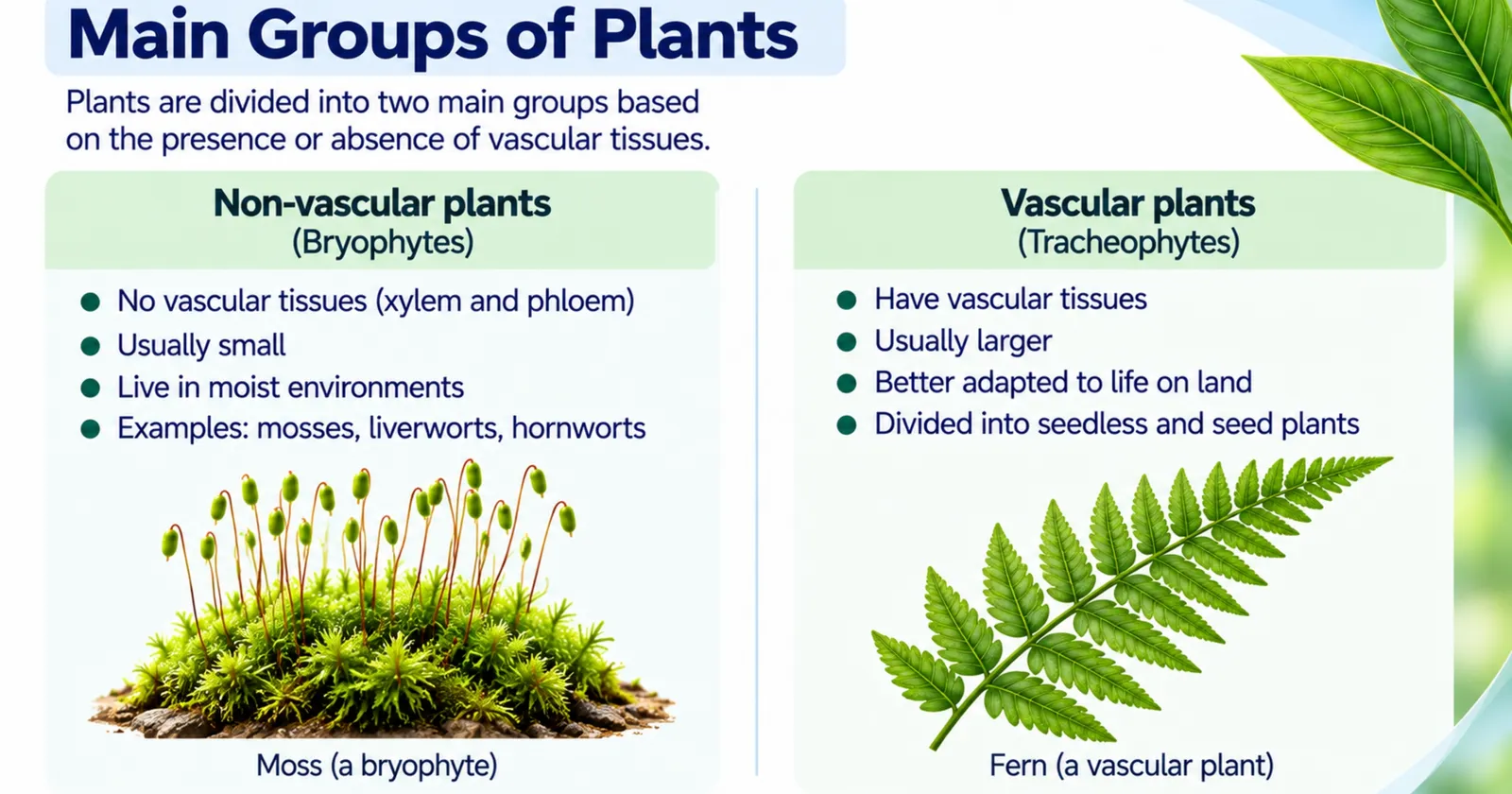
No vascular tissue: they have no xylem or phloem, so water and nutrients move slowly from cell to cell by diffusion and osmosis. This keeps them small, usually only a few centimetres tall.
No true roots, stems or leaves: instead, they have simple leaf-like and stem-like structures, and root-like threads called rhizoids that anchor them.
Reproduce by spores, not seeds, released from a capsule on a stalk.
Need water for reproduction: male sex cells must swim through a film of water to reach the female sex cells, so bryophytes live in damp, shady places.
The main, green plant you see is the gametophyte generation.
Examples include mosses such as Funaria and Sphagnum (peat moss), and liverworts such as Marchantia. Sphagnum moss forms peat bogs that store enormous amounts of carbon.
Slide: Non-vascular vs vascular plants
Bryophytes vs tracheophytes
1/1
2. Pteridophytes: Ferns and Their Relatives
Pteridophytes were the first plants to evolve vascular tissue, which allowed them to grow much taller. Around 350 million years ago, giant tree ferns and horsetails formed vast forests. Their buried remains became the coal we burn today.
Key features of pteridophytes
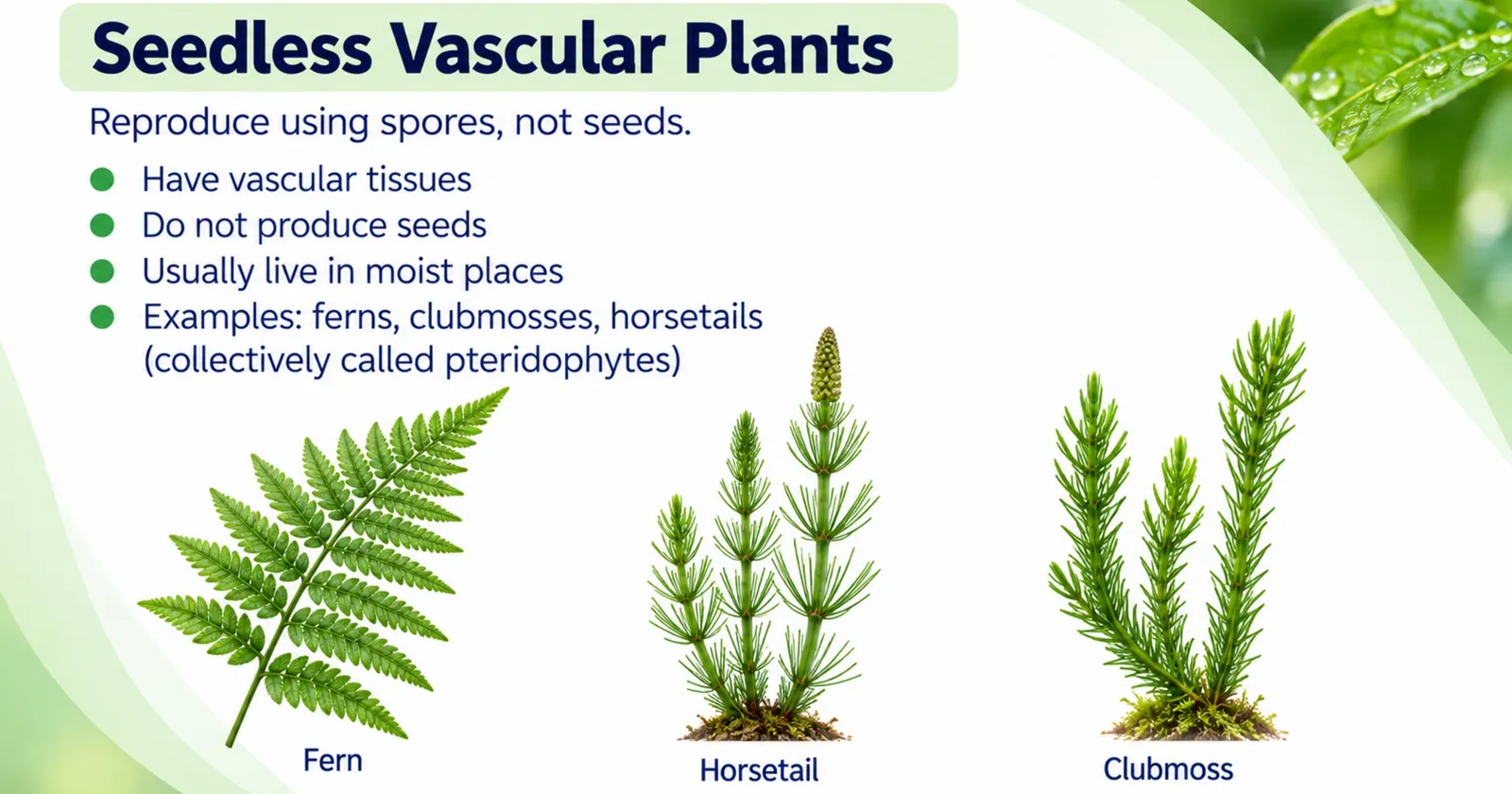
Have vascular tissue (xylem and phloem), so they can transport water efficiently and grow larger.
Have true roots, stems and leaves. Fern leaves are called fronds and unroll from tightly coiled "fiddleheads".
Many have an underground stem called a rhizome.
Reproduce by spores, produced in clusters called sori on the underside of fronds. Look under a fern leaf and you will often see brown dots; these are sori.
Still need water for fertilisation, so most live in damp places.
The main plant you see is the sporophyte generation.
Examples include ferns such as Nephrolepis (Boston fern) and Pteris, horsetails (Equisetum) and club mosses (Lycopodium). The water fern Azolla is used as a natural fertiliser in rice fields because it hosts nitrogen-fixing cyanobacteria.
Slide: Seedless vascular plants
Ferns, horsetails and club mosses
1/1
3. Gymnosperms: Plants With Naked Seeds
The word gymnosperm means "naked seed". Gymnosperms were the first plants to produce seeds, a huge evolutionary advantage because seeds contain a food store and a protective coat, allowing the embryo to survive dry conditions and wait until conditions are right to grow.
Key features of gymnosperms
Vascular plants that produce seeds.
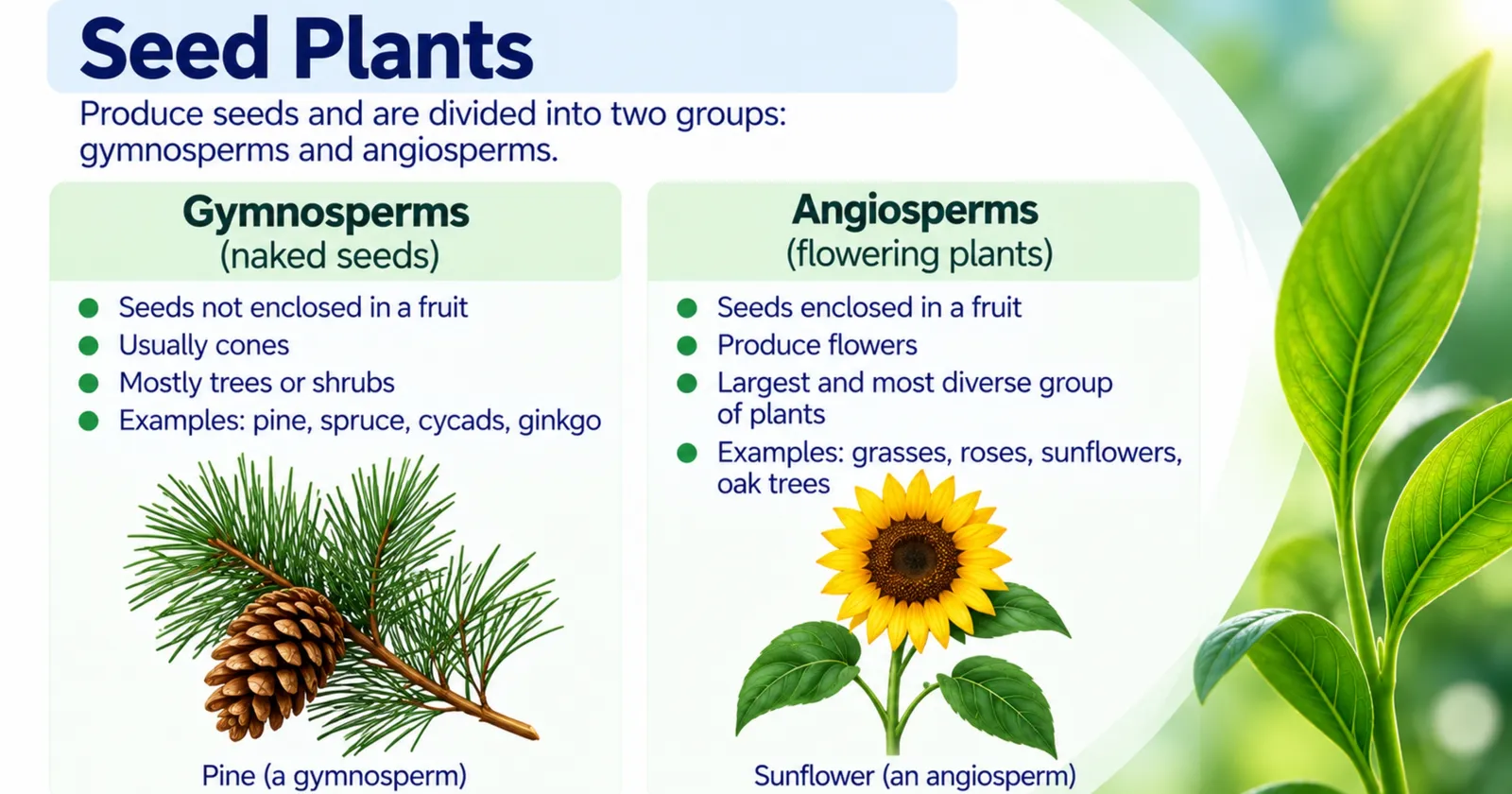
Seeds are not enclosed in a fruit; they sit exposed on the scales of cones.
No flowers. Male cones produce pollen, and female cones contain ovules.
Pollen is usually carried by the wind.
Do not need water for fertilisation, because pollen carries the male sex cells, so gymnosperms can live in dry and cold places.
Most are evergreen trees or shrubs, often with needle-like or scale-like leaves covered in a thick waxy cuticle that reduces water loss.
Examples include pine (Pinus), spruce, fir, cedar, cypress, cycads and Ginkgo biloba. Gymnosperms include some record-breakers: the coast redwood is the tallest tree in the world, and some bristlecone pines are more than 4,800 years old. Pine trees provide timber, paper pulp and resin.
4. Angiosperms: The Flowering Plants
Angiosperms are the largest and most successful plant group, making up around 90 percent of all plant species. The name means "enclosed seed", because their seeds develop inside an ovary that becomes a fruit.
Key features of angiosperms
Vascular plants with true roots, stems and leaves.
Produce flowers, which are the reproductive organs.
Seeds are enclosed in fruits, which help to protect and disperse them.
Pollination by wind, insects, birds or other animals.
Double fertilisation produces both an embryo and a food store called endosperm.
Found in almost every habitat, from deserts to ponds.
Almost all the plants we eat are angiosperms, including rice, wheat, maize, fruits, vegetables, pulses, coffee and tea. They also provide cotton, medicines, spices and hardwood timber.
Monocots vs dicots
Angiosperms are traditionally divided into two classes based on the number of cotyledons (seed leaves) in their seeds. This is a very popular exam question.
| Feature | Monocotyledons (monocots) | Dicotyledons (dicots) |
|---|---|---|
| Cotyledons in seed | One | Two |
| Leaf veins | Parallel | Net-like (reticulate) |
| Flower parts | In multiples of three | In multiples of four or five |
| Root system | Fibrous roots | Tap root with branches |
| Vascular bundles in stem | Scattered | Arranged in a ring |
| Secondary growth (wood) | Usually absent | Often present |
| Examples | Grasses, rice, maize, wheat, bamboo, coconut, banana, lilies, orchids | Mango, beans, peas, roses, sunflower, tomato, oak |
Modern classification based on DNA shows that true dicots, called eudicots, form one group, while a few older lineages such as water lilies and magnolias sit outside both groups. For school exams, the monocot and dicot division is still used.
Slide: Seed plants
Gymnosperms vs angiosperms
1/1
Other Ways to Group Plants
Vascular vs non-vascular plants: bryophytes are non-vascular; all other groups are vascular.
Seedless vs seed plants: bryophytes and pteridophytes reproduce by spores; gymnosperms and angiosperms produce seeds.
Flowering vs non-flowering plants: only angiosperms have flowers.
Cryptogams vs phanerogams: an older system. Cryptogams (algae, bryophytes, pteridophytes) have hidden reproductive organs; phanerogams (gymnosperms and angiosperms) have visible ones and produce seeds.
By life span: annuals complete their life cycle in one year, biennials in two and perennials live for many years.
How Plants Evolved: A Quick Timeline
The major plant groups reflect the story of plants moving from water onto land:
Green algae lived in water.
Bryophytes colonised damp land but stayed small and dependent on water.
Pteridophytes evolved vascular tissue and grew tall.
Gymnosperms evolved seeds and pollen, freeing reproduction from water.
Angiosperms evolved flowers and fruits, allowing partnerships with animals for pollination and seed dispersal, and they spread across the globe.
Why Plant Classification Matters in Everyday Life
Classification is not only for scientists. Farmers use it to identify crops and weeds, doctors and pharmacists use it to find medicinal plants, and conservationists use it to identify endangered species that need protection. Knowing that the potato and the tomato belong to the same family, Solanaceae, helps gardeners understand that they can share the same diseases. Botanical gardens and seed banks, such as the Millennium Seed Bank in the UK, rely on accurate classification to store and protect seeds from thousands of wild plant species.
Using a Dichotomous Key to Identify Plants
A dichotomous key is a tool that identifies organisms using a series of paired questions, each with two choices. For example:
1a. Plant produces flowers: it is an angiosperm, go to 2.
1b. Plant does not produce flowers: go to 3.
2a. Leaves have parallel veins: monocot.
2b. Leaves have net veins: dicot.
3a. Plant produces cones: gymnosperm.
3b. Plant produces spores: go to 4.
4a. Plant has fronds and true roots: fern.
4b. Plant has rhizoids and no true roots: moss.
Try building your own key for plants in your garden or school grounds.
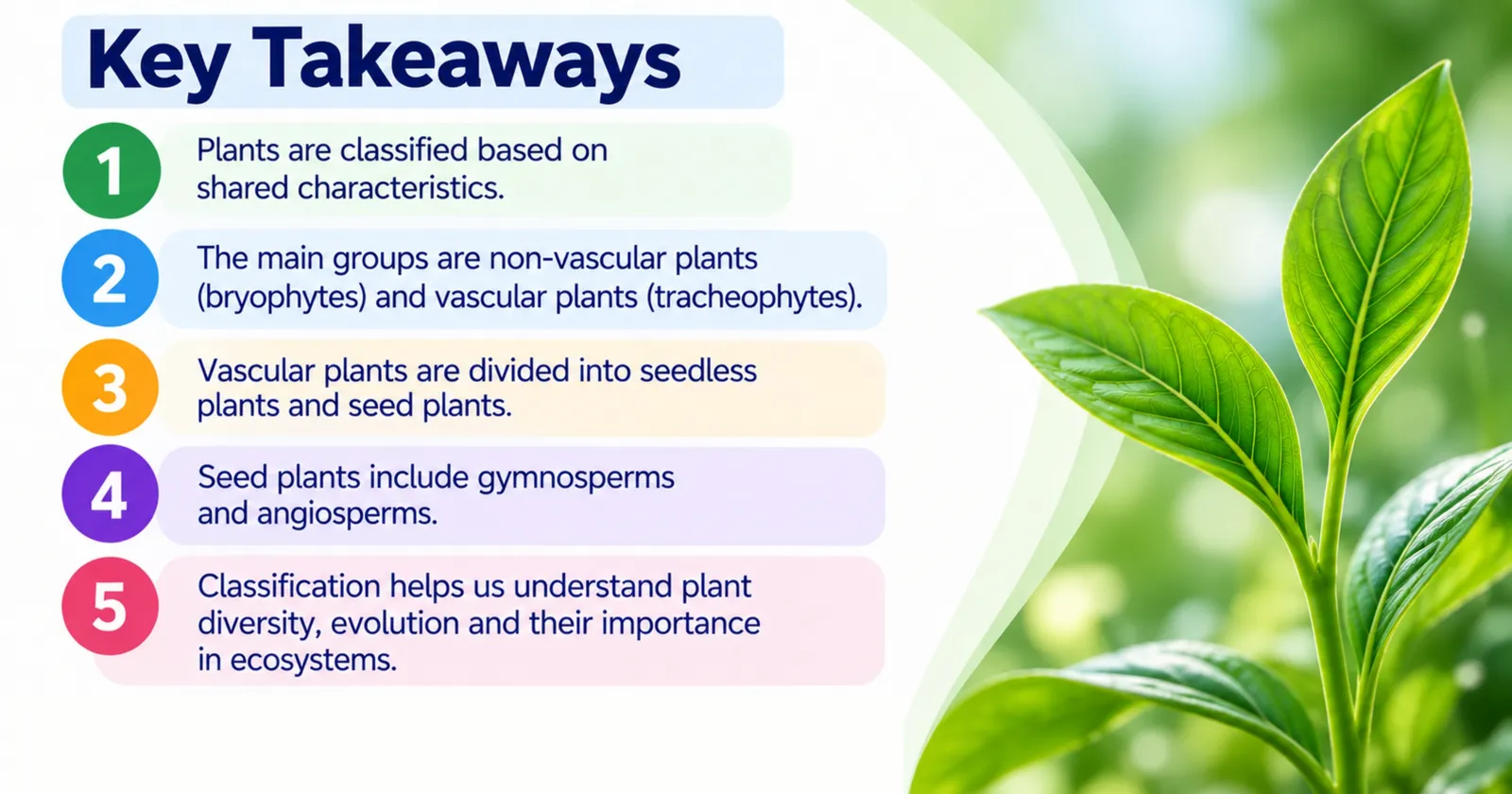
Slide: Key takeaways
1/1
Frequently Asked Questions About Plant Classification
Are fungi plants?
No. Fungi have cell walls made of chitin, cannot photosynthesise and feed by absorbing nutrients. They are placed in their own kingdom, Fungi.
Which is the largest group of plants?
Angiosperms, the flowering plants, with around 300,000 known species.
Is grass a flowering plant?
Yes. Grasses are monocot angiosperms. Their flowers are small, green and wind-pollinated, so people often do not notice them.
🗂️ Revision Flashcards
Tap a card to reveal the answer.
🎯 Quick Quiz
8 questions. Pick an answer to check it straight away.
1Which is the correct order of the taxonomic levels, from largest to smallest?
Kingdom, Phylum (Division), Class, Order, Family, Genus, Species: "King Philip Came Over For Good Soup".
2In the scientific name Mangifera indica, which part is the genus?
The genus comes first and starts with a capital letter; the species name is lower case.
3Why are bryophytes usually only a few centimetres tall?
With no xylem or phloem, water and nutrients move slowly from cell to cell, which keeps them small.
4What are the brown dots often seen on the underside of a fern frond?
Pteridophytes produce spores in clusters called sori on the underside of fronds.
5Why can gymnosperms live in dry and cold places?
Pollen carries the male sex cells, so gymnosperms do not need water for fertilisation.
6A plant has leaves with parallel veins, flower parts in multiples of three and fibrous roots. What is it?
Parallel veins, flower parts in threes and fibrous roots are monocot features.
7Which group makes up around 90 percent of all plant species?
Angiosperms, the flowering plants, are the largest and most successful plant group.
8Why are fungi not placed in the plant kingdom?
Fungi have chitin cell walls, cannot photosynthesise and absorb nutrients, so they have their own kingdom.