Chlorine keeps swimming pools safe, fluoride protects your teeth, iodine disinfects wounds and bromine helps stop furniture catching fire. Yet the same elements can be deadly poisons. The halogens are one of the most dramatic families in chemistry, and they appear in almost every IGCSE and GCSE Chemistry exam. In this guide you will learn what the halogens are, how their properties change down the group, why fluorine is the most reactive non-metal on Earth, how displacement reactions work and how to test for halide ions in the lab.
📖 Lesson
Properties, trends, reactions, displacement and halide ion tests for the Group 7 elements, in the words examiners look for.
What Are the Halogens?
The word halogen comes from Greek and means "salt-former". Halogens react with metals to form salts, the most famous being sodium chloride, common table salt.
The halogens in order down the group are:
| Element | Symbol | Atomic number | Electronic configuration | State at room temperature |
|---|---|---|---|---|
| Fluorine | F | 9 | 2, 7 | Gas |
| Chlorine | Cl | 17 | 2, 8, 7 | Gas |
| Bromine | Br | 35 | 2, 8, 18, 7 | Liquid |
| Iodine | I | 53 | 2, 8, 18, 18, 7 | Solid |
| Astatine | At | 85 | ends in 7 | Solid (radioactive) |
Astatine is extremely rare and radioactive. Scientists estimate there is less than a gram of it in the Earth's crust at any time, so it is rarely studied in schools.
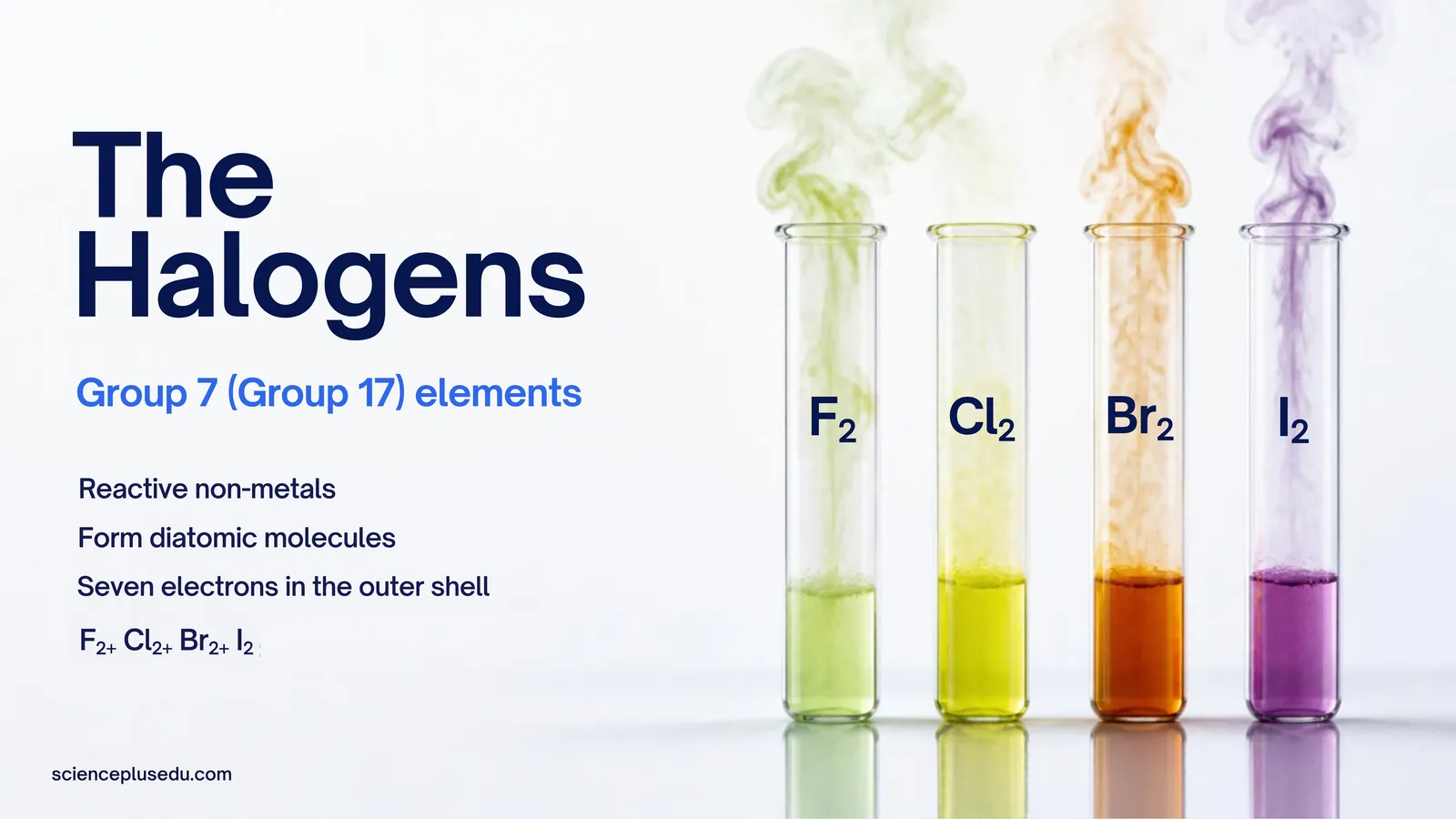
Slide: The halogens
Group 7 at a glance
1/1
Why Are the Halogens in the Same Group?
Every halogen atom has seven electrons in its outer shell. This is why they share such similar chemical properties. To reach a stable full outer shell, a halogen atom needs to gain just one electron. When it does, it forms a halide ion with a charge of 1−:
Fluorine forms fluoride, F−
Chlorine forms chloride, Cl−
Bromine forms bromide, Br−
Iodine forms iodide, I−
Notice how the name changes from "-ine" to "-ide" when the atom becomes an ion. This is a small detail that examiners love to test.
Halogens Are Diatomic Molecules
Halogens do not exist as single atoms. Two atoms share a pair of electrons to form a covalent bond, making a diatomic molecule: F2, Cl2, Br2 and I2. Each atom then has eight electrons in its outer shell. Because the forces between these separate molecules are weak, the halogens have fairly low melting and boiling points compared with metals. Always write chlorine gas as Cl2 in equations, never as Cl.
Physical Properties of the Halogens and Their Trends
| Halogen | Colour and state at room temperature | Colour in aqueous solution | Melting point | Boiling point |
|---|---|---|---|---|
| Fluorine, F2 | Pale yellow gas | Reacts with water | −220 °C | −188 °C |
| Chlorine, Cl2 | Pale yellow-green gas | Pale green | −101 °C | −34 °C |
| Bromine, Br2 | Red-brown liquid (gives orange-brown vapour) | Orange | −7 °C | 59 °C |
| Iodine, I2 | Shiny grey-black solid (gives purple vapour) | Brown | 114 °C | 184 °C |
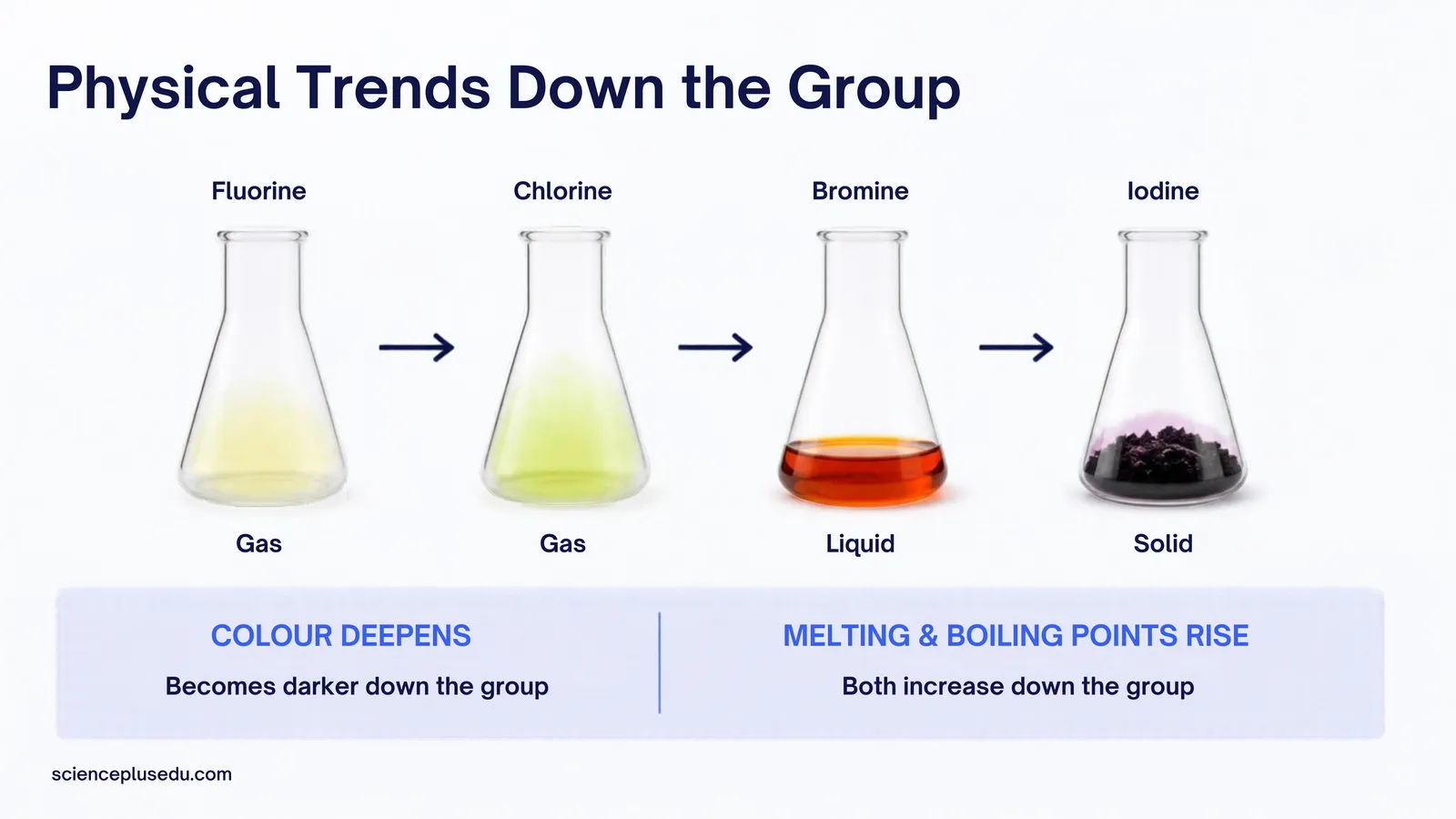
Trend 1: colour gets darker down the group
The colours change from pale yellow to yellow-green to red-brown to grey-black. Iodine is also famous for subliming on gentle heating, turning straight from a solid into a beautiful purple vapour.
Trend 2: melting and boiling points increase down the group
This is because the molecules get larger down the group. Bigger molecules have stronger intermolecular forces between them, so more energy is needed to separate them. That explains why fluorine and chlorine are gases, bromine is a liquid and iodine is a solid at room temperature. Using the trend, you can predict that astatine is a black solid with an even higher melting point.
Trend 3: density increases down the group
Heavier atoms packed together make denser substances.
Slide: Physical trends down the group
Colour, melting point and boiling point
1/1
Chemical Properties: Why Reactivity Decreases Down Group 7
This is the single most important idea in the topic and a guaranteed exam question.
When halogens react, their atoms gain an electron. The easier it is to gain that electron, the more reactive the halogen.
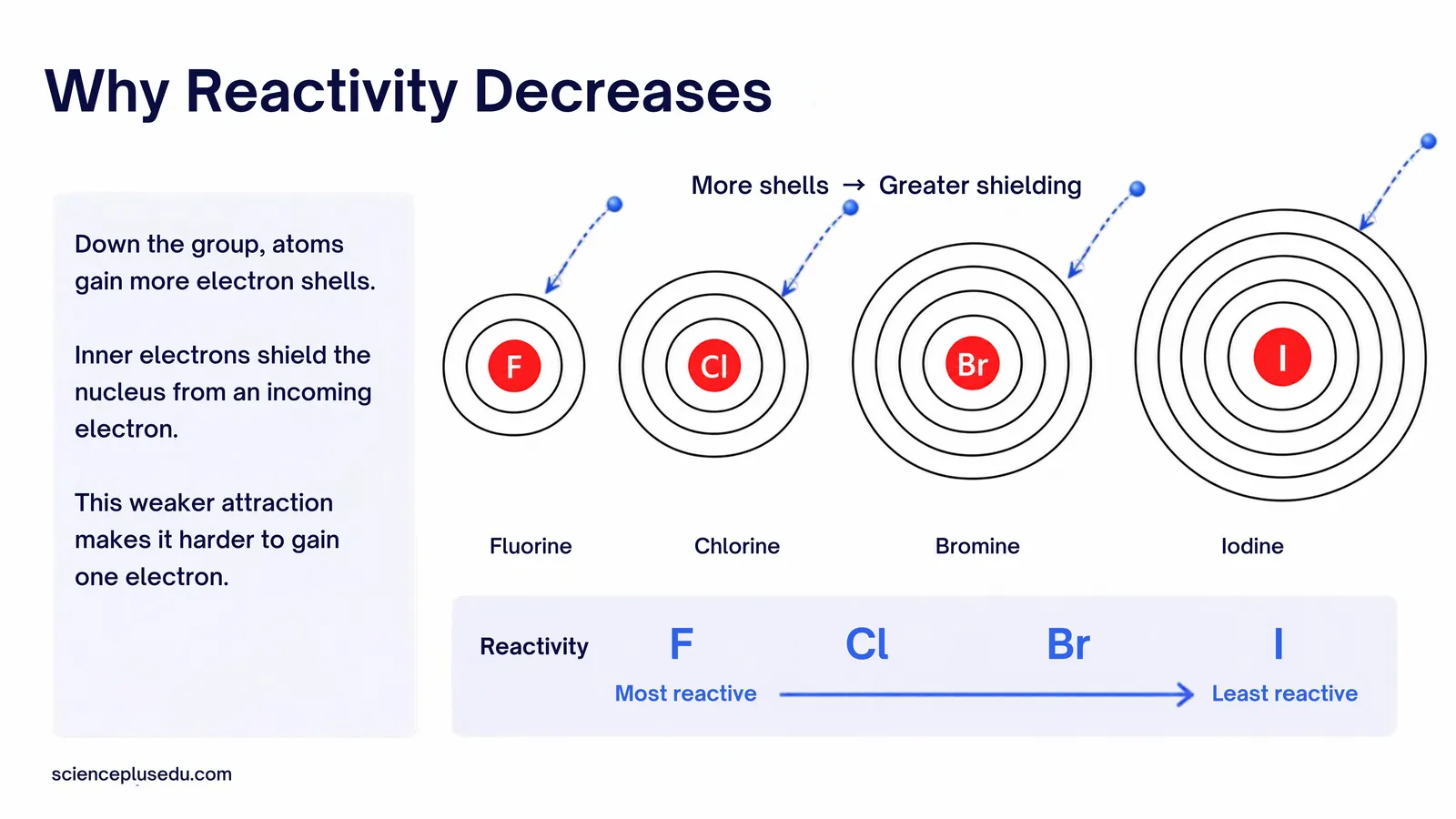
Going down the group, atoms have more electron shells, so the atomic radius increases.
The outer shell is further from the nucleus.
There is more shielding from the inner shells.
So the attraction between the positive nucleus and an incoming electron becomes weaker.
It becomes harder to gain an electron, so reactivity decreases down the group.
Fluorine is therefore the most reactive halogen, and in fact the most reactive non-metal of all. It reacts with almost every element, even glass and some noble gases. Notice that this trend is the opposite of the alkali metals, where reactivity increases down the group because atoms lose electrons more easily.
Slide: Why reactivity decreases
More shells, more shielding, weaker attraction
1/1
Reactions of the Halogens
1. Halogens react with metals to form metal halides
Halogens react with metals to produce ionic salts called metal halides. For example, sodium burns in chlorine with a bright yellow flame to form white sodium chloride:
2Na + Cl2 → 2NaCl
Hot iron wool glows as chlorine passes over it, forming brown iron(III) chloride:
2Fe + 3Cl2 → 2FeCl3
The reactions become less vigorous down the group. Iron reacts with iodine vapour only slowly, forming iron(II) iodide.
2. Halogens react with hydrogen to form hydrogen halides
Halogens react with hydrogen to make hydrogen halides, which are colourless, poisonous gases:
H2 + Cl2 → 2HCl
The trend in reactivity is clear here: fluorine and hydrogen explode even in the dark and cold; chlorine and hydrogen explode in sunlight; bromine needs heating and a catalyst; iodine reacts only partially, even when heated.
Hydrogen halides dissolve very well in water. Hydrogen chloride dissolves to form hydrochloric acid, a strong acid, because it releases H+ ions in water. Interestingly, hydrogen chloride dissolved in methylbenzene, an organic solvent, does not behave as an acid, because it stays as molecules and does not release H+ ions. This is a favourite A-grade exam question.
3. Halogen displacement reactions
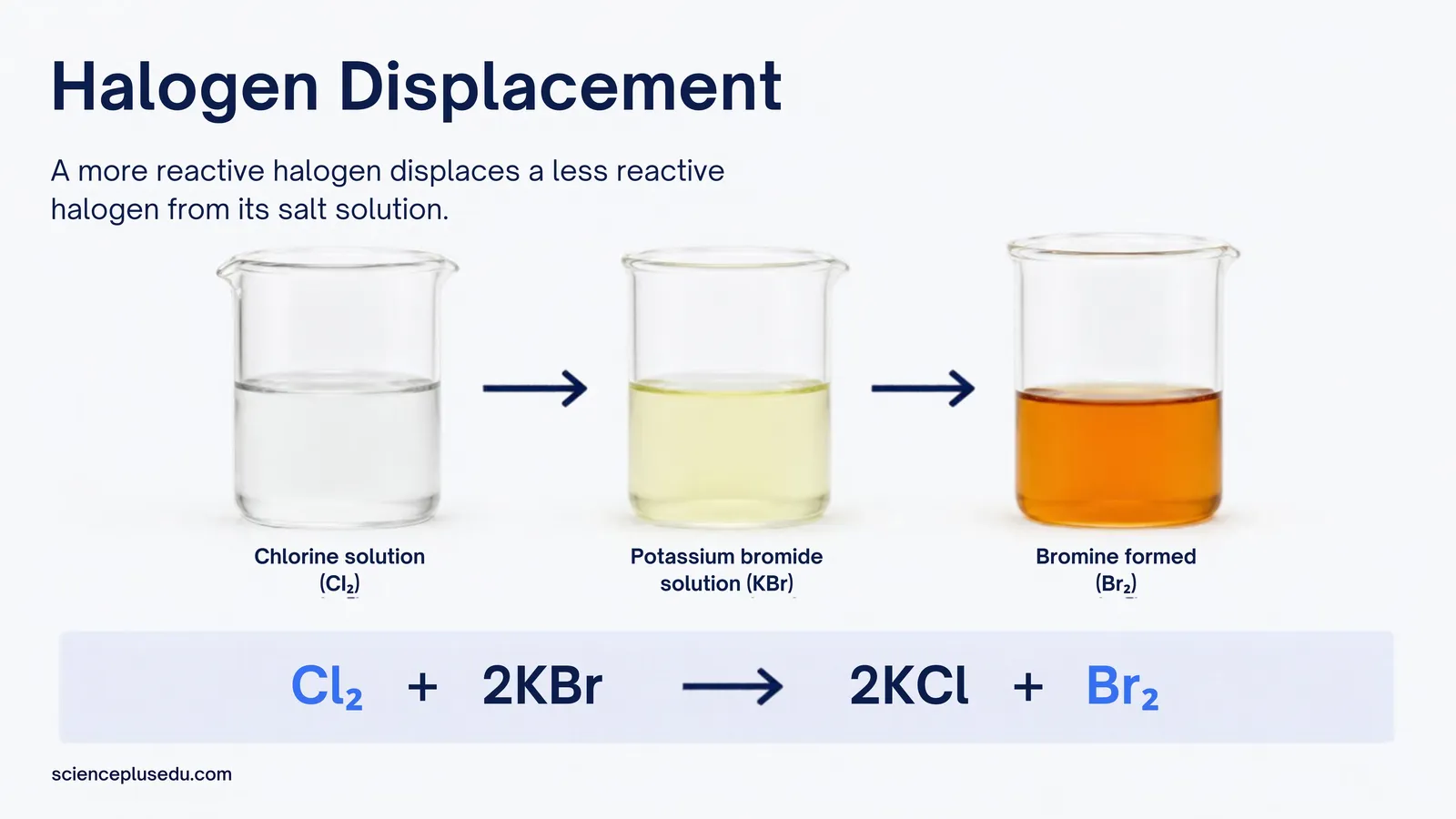
A more reactive halogen displaces a less reactive halogen from a solution of its salt. This is how we prove the order of reactivity experimentally.
For example, when chlorine water is added to potassium bromide solution, the colourless solution turns orange because bromine is produced:
Cl2 + 2KBr → 2KCl + Br2
| Halogen added | Potassium chloride solution | Potassium bromide solution | Potassium iodide solution |
|---|---|---|---|
| Chlorine water | No reaction | Turns orange (bromine formed) | Turns brown (iodine formed) |
| Bromine water | No reaction | No reaction | Turns brown (iodine formed) |
| Iodine solution | No reaction | No reaction | No reaction |
Chlorine displaces both bromine and iodine, bromine displaces only iodine, and iodine displaces nothing. This confirms the reactivity order: chlorine is more reactive than bromine, which is more reactive than iodine.
Displacement reactions are redox reactions
Displacement reactions involve both oxidation and reduction. The ionic equation for chlorine reacting with bromide ions is:
Cl2 + 2Br− → 2Cl− + Br2
Chlorine gains electrons and is reduced to chloride ions.
Bromide ions lose electrons and are oxidised to bromine.
Remember OIL RIG: Oxidation Is Loss, Reduction Is Gain of electrons. Because chlorine causes the bromide ions to be oxidised, chlorine is acting as an oxidising agent. The potassium ions do not change, so they are spectator ions and are left out of the ionic equation.
Slide: Halogen displacement
A more reactive halogen displaces a less reactive one
1/1
How to Test for Chlorine Gas
Hold a piece of damp blue litmus paper in the gas. Chlorine first turns it red, because chlorine water is acidic, and then bleaches it white. Damp universal indicator paper is also bleached. Always do this in a fume cupboard because chlorine is toxic.
How to Test for Halide Ions
To identify which halide ion is in a solution:
Add a few drops of dilute nitric acid. This removes carbonate ions, which would otherwise form a precipitate and give a false result.
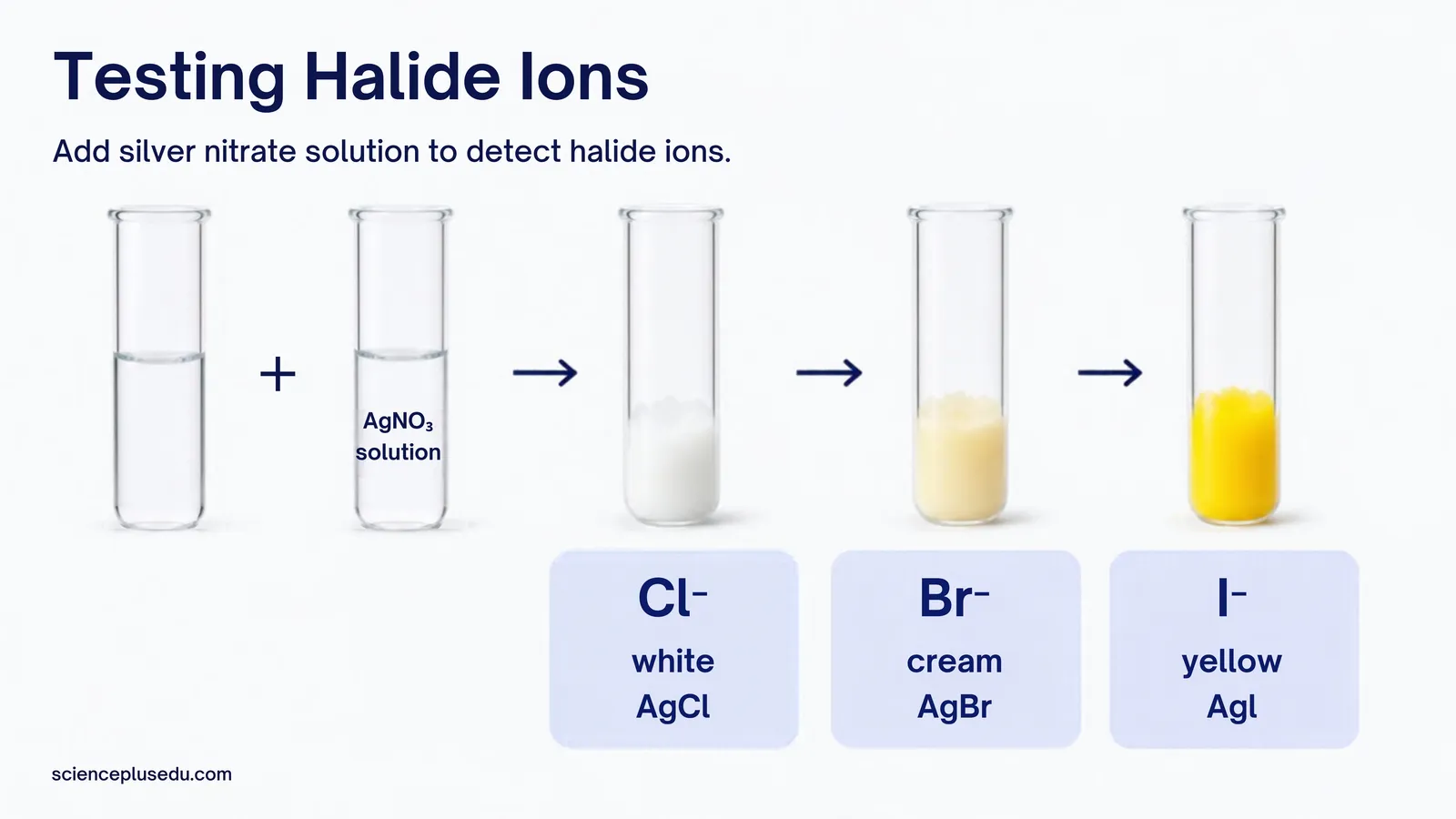
Add a few drops of silver nitrate solution.
Observe the colour of the precipitate formed.
| Halide ion | Precipitate formed | Colour |
|---|---|---|
| Chloride, Cl− | Silver chloride, AgCl | White |
| Bromide, Br− | Silver bromide, AgBr | Cream |
| Iodide, I− | Silver iodide, AgI | Yellow |
The ionic equation for the chloride test is: Ag+ + Cl− → AgCl. Do not use hydrochloric acid to acidify the sample, because it would add chloride ions and ruin the test.
Slide: Testing halide ions
Silver nitrate gives white, cream and yellow precipitates
1/1
Uses of the Halogens in Everyday Life
Fluorine: fluoride compounds are added to toothpaste and, in many places, to drinking water to strengthen tooth enamel. Fluorine is also used to make non-stick PTFE coatings for frying pans and to make refrigerants.
Chlorine: kills bacteria in drinking water and swimming pools, making it one of the most important public health chemicals in history. It is used to make bleach, the plastic PVC, solvents and many medicines.
Bromine: used in flame retardants, some pesticides, pool disinfectants and, historically, photographic film, where silver bromide darkens in light.
Iodine: a dilute solution of iodine is an antiseptic for cleaning wounds. Iodine is also added to table salt, because a lack of iodine in the diet causes goitre, a swelling of the thyroid gland. In the lab, iodine solution is used to test for starch, turning from orange-brown to blue-black.
Hazards and Safety of the Halogens
All halogens are toxic. Chlorine was used as a chemical weapon in the First World War. Bromine is corrosive and causes painful burns, and its vapour damages the lungs. Halogen experiments should always be carried out in a fume cupboard or a well-ventilated lab, using small quantities and wearing eye protection.
Predicting the Properties of Astatine
Exams often ask you to use trends to predict the properties of an unfamiliar element. For astatine you can predict that it:
Is a black solid at room temperature.
Has a higher melting and boiling point than iodine.
Is less reactive than iodine, so it would not displace iodine from iodide solutions.
Forms astatide ions, At−.
Reacts with hydrogen to form hydrogen astatide, HAt.
Common Exam Mistakes About the Halogens
Writing chlorine as Cl instead of Cl2 in equations.
Saying reactivity increases down Group 7. It decreases.
Confusing "chlorine" (the element) with "chloride" (the ion).
Forgetting to explain reactivity using the attraction between the nucleus and the incoming electron.
Saying chlorine "bleaches" blue litmus without mentioning the paper must be damp.
Frequently Asked Questions About the Halogens
Why is fluorine more reactive than chlorine?
Fluorine atoms are smaller, so the incoming electron is closer to the nucleus and more strongly attracted. Fluorine gains an electron more easily.
Are halogens metals or non-metals?
They are non-metals. They are poor conductors of heat and electricity and form negative ions.
Why is bromine a liquid?
Bromine molecules are larger than chlorine molecules, so the intermolecular forces are strong enough to hold them together as a liquid at room temperature, but not strong enough to make a solid.
What is the difference between Group 7 and Group 17?
They are the same group. Older numbering calls it Group 7; the modern IUPAC system, which counts the transition metals, calls it Group 17.
Key Takeaways
The halogens are Group 7 non-metals with seven outer electrons that form diatomic molecules.
Melting point, boiling point and colour intensity increase down the group.
Reactivity decreases down the group because it becomes harder to gain an electron.
A more reactive halogen displaces a less reactive one from its salt solution in a redox reaction.
Silver nitrate gives white, cream and yellow precipitates with chloride, bromide and iodide ions.
The halogens are the chemical opposites of the alkali metals, and the two groups react together to form salts. Read our guide to the alkali metals next to see the other half of the story.
🗂️ Revision Flashcards
Tap a card to reveal the answer.
🎯 Quick Quiz
8 questions. Pick an answer to check it straight away.
1How many electrons are in the outer shell of a halogen atom?
Every halogen atom has seven electrons in its outer shell.
2What happens to reactivity down Group 7?
It becomes harder to gain an electron, so reactivity decreases down the group.
3Which halogen is a red-brown liquid at room temperature?
Bromine is a red-brown liquid; chlorine and fluorine are gases and iodine is a solid.
4Chlorine water is added to potassium bromide solution. What is observed?
Chlorine displaces bromine, which makes the solution orange.
5In Cl₂ + 2Br⁻ → 2Cl⁻ + Br₂, what happens to the bromide ions?
Bromide ions lose electrons and are oxidised to bromine.
6Which colour is the precipitate when silver nitrate is added to a bromide solution?
Silver bromide, AgBr, is cream.
7Why should you not use hydrochloric acid to acidify a halide ion test?
Hydrochloric acid would add chloride ions, so use dilute nitric acid instead.
8What does damp blue litmus paper do in chlorine gas?
Chlorine turns it red first, then bleaches it white.