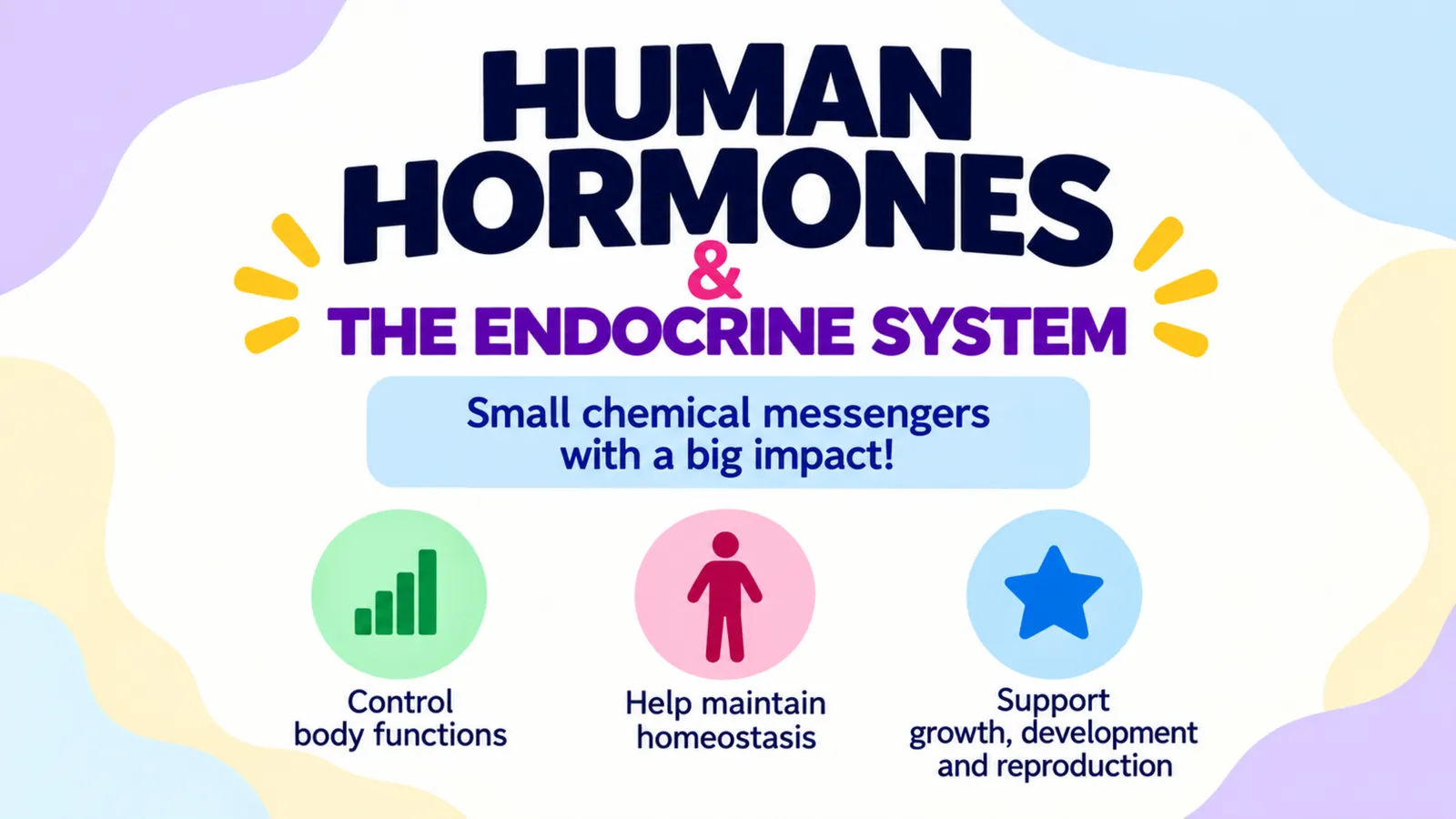
Glands, hormones, target organs and negative feedback, with the pituitary, thyroid, adrenals and pancreas explained simply.
Introduction: The Body's Silent Messaging Service
Imagine a school where the principal needs to send instructions to every classroom. One option is to install a bell system that rings instantly in a chosen room. That is fast, direct and very precise. Another option is to send a general announcement over the loudspeaker that reaches the entire building, where only the classes that are supposed to respond actually act on it. That announcement is slower, but it reaches everyone and its effect lasts much longer.
Your body uses both methods. The fast bell system is the nervous system. The slower loudspeaker system is the endocrine system, and it speaks using chemicals called hormones.
This system explains an enormous amount about you. Why you grew taller between the ages of eleven and sixteen. Why you feel a sudden surge of energy when a dog barks behind you. Why you feel sleepy at night. Why a person with diabetes must watch their sugar intake. All of these are hormone stories.
What Is the Endocrine System?
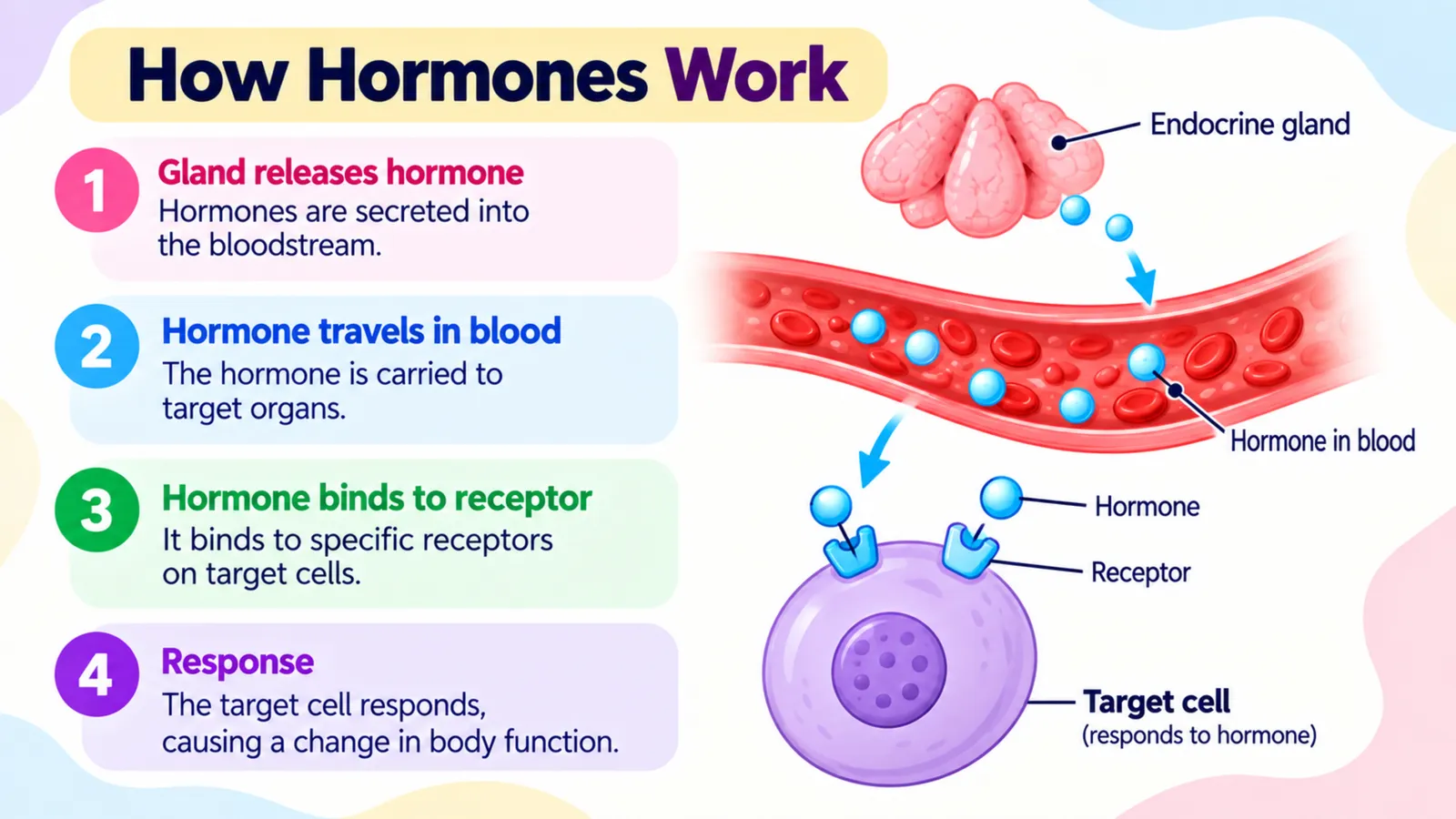
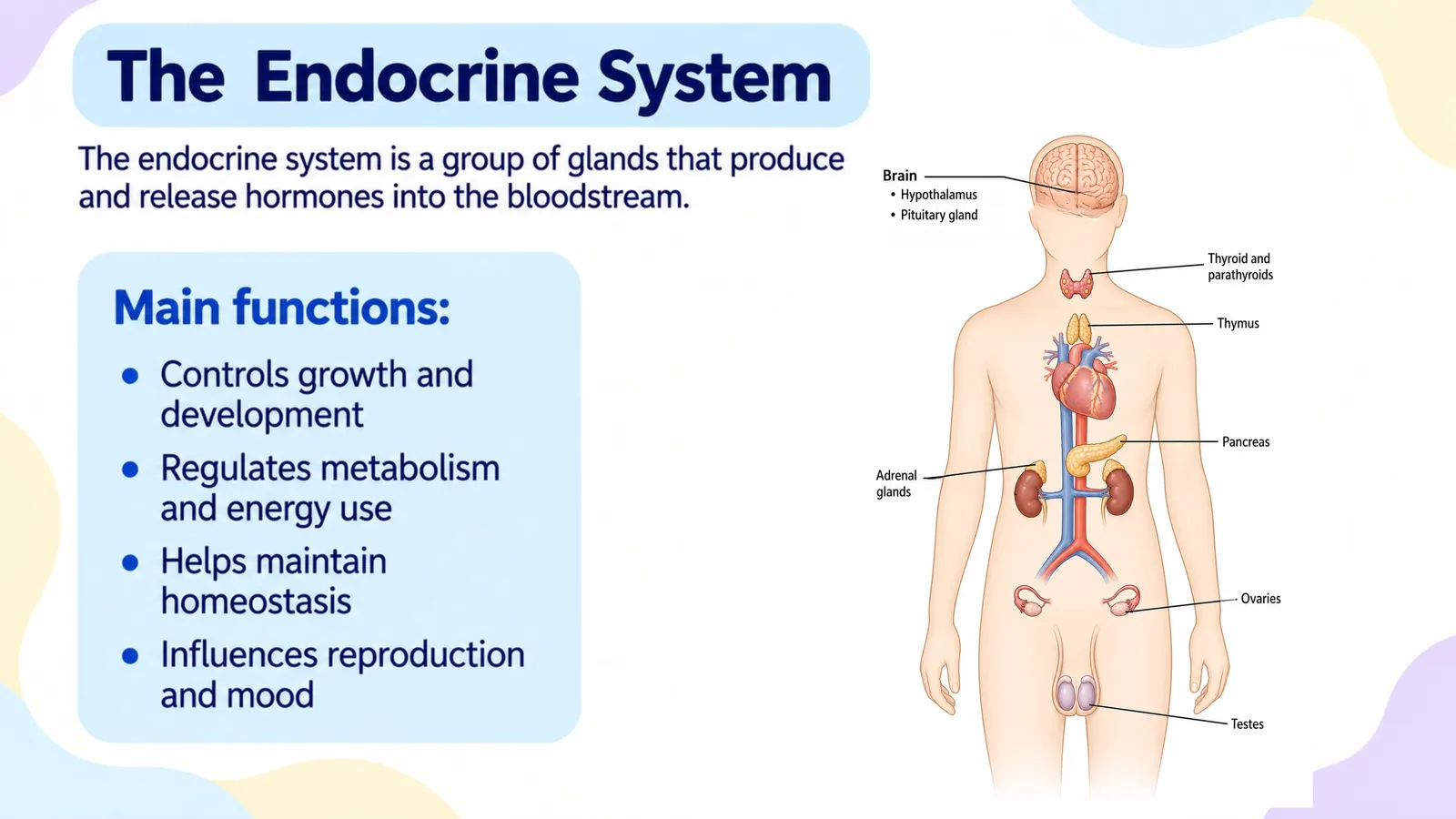
The endocrine system is the collection of glands that produce hormones and release them directly into the bloodstream. Blood then carries these hormones around the whole body until they reach the organs that can respond to them.
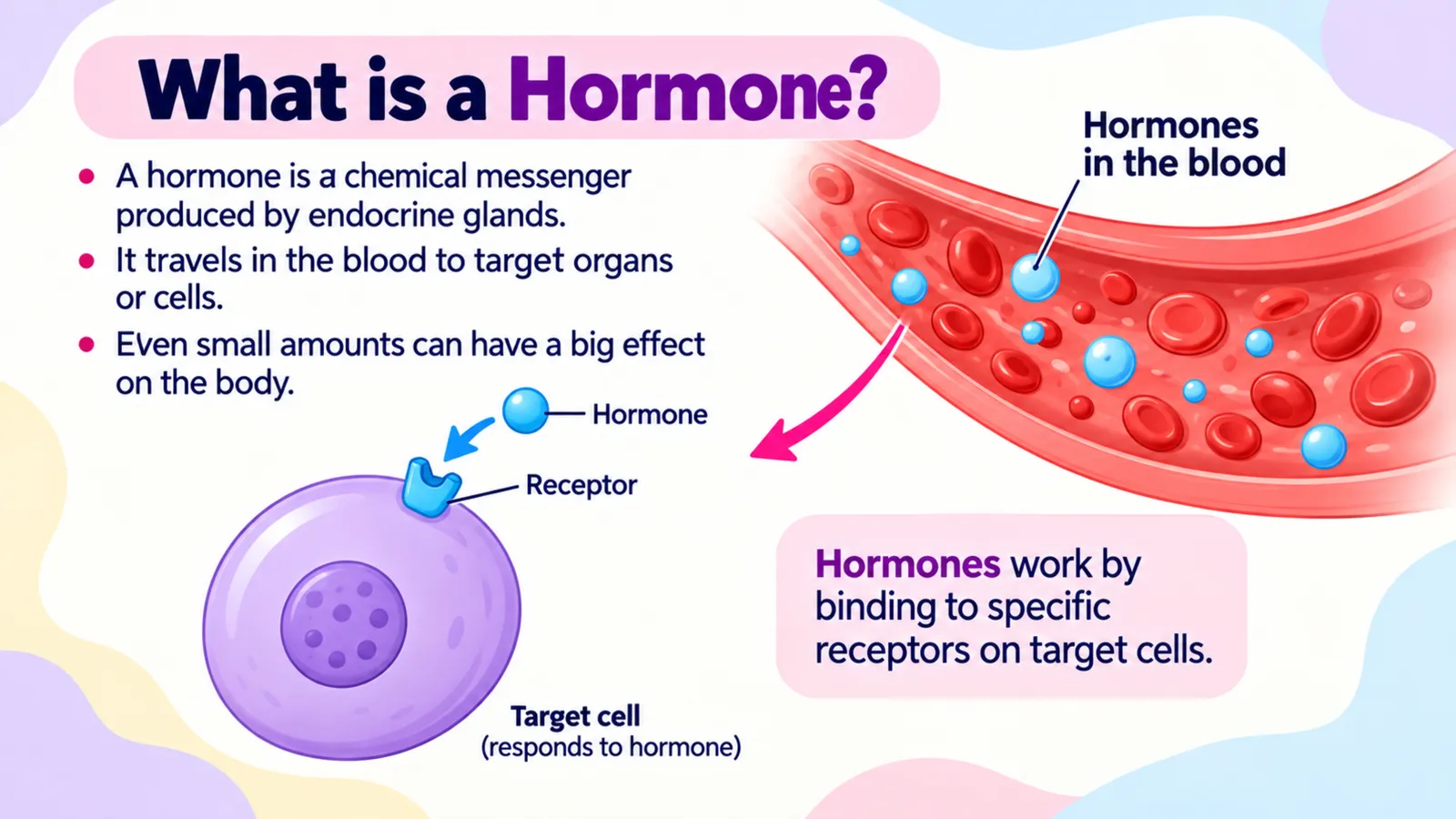
A hormone is a chemical messenger. It is produced in one place, travels in the blood, and produces an effect somewhere else. Hormones are needed only in tiny quantities, yet they control some of the largest changes a human body ever goes through.
The organ or tissue that a hormone acts on is called the target organ. This raises an obvious question. If blood carries a hormone everywhere, why does it only affect certain organs?
The answer is receptors. Cells of the target organ carry special protein receptors on their surface or inside them, and these receptors fit that particular hormone the way a lock fits a key. Cells without the matching receptor simply ignore the hormone as it flows past. This is why thyroxine can circulate through your entire body while producing its main effects in specific tissues.
🧪
Slides: What is a hormone?
Chemical messengers, target cells and receptors
1/3
Endocrine Glands and Exocrine Glands
Students often mix these two up, so it is worth settling the difference clearly.
Endocrine glands are ductless. They have no tube to carry their product away, so they release hormones straight into the surrounding blood capillaries. The thyroid gland and the pituitary gland are examples.
Exocrine glands have ducts. They pour their product through a tube onto a surface or into a cavity. Salivary glands, sweat glands and tear glands are examples. Their products are usually enzymes, mucus or other fluids rather than hormones.
One organ manages to be both. The pancreas releases digestive juice through a duct into the small intestine, which is exocrine behaviour, and it also releases insulin and glucagon directly into the blood, which is endocrine behaviour. Because of this, the pancreas is called a mixed gland or a heterocrine gland.
The Major Endocrine Glands and What They Do
The Pituitary Gland: The Master Gland
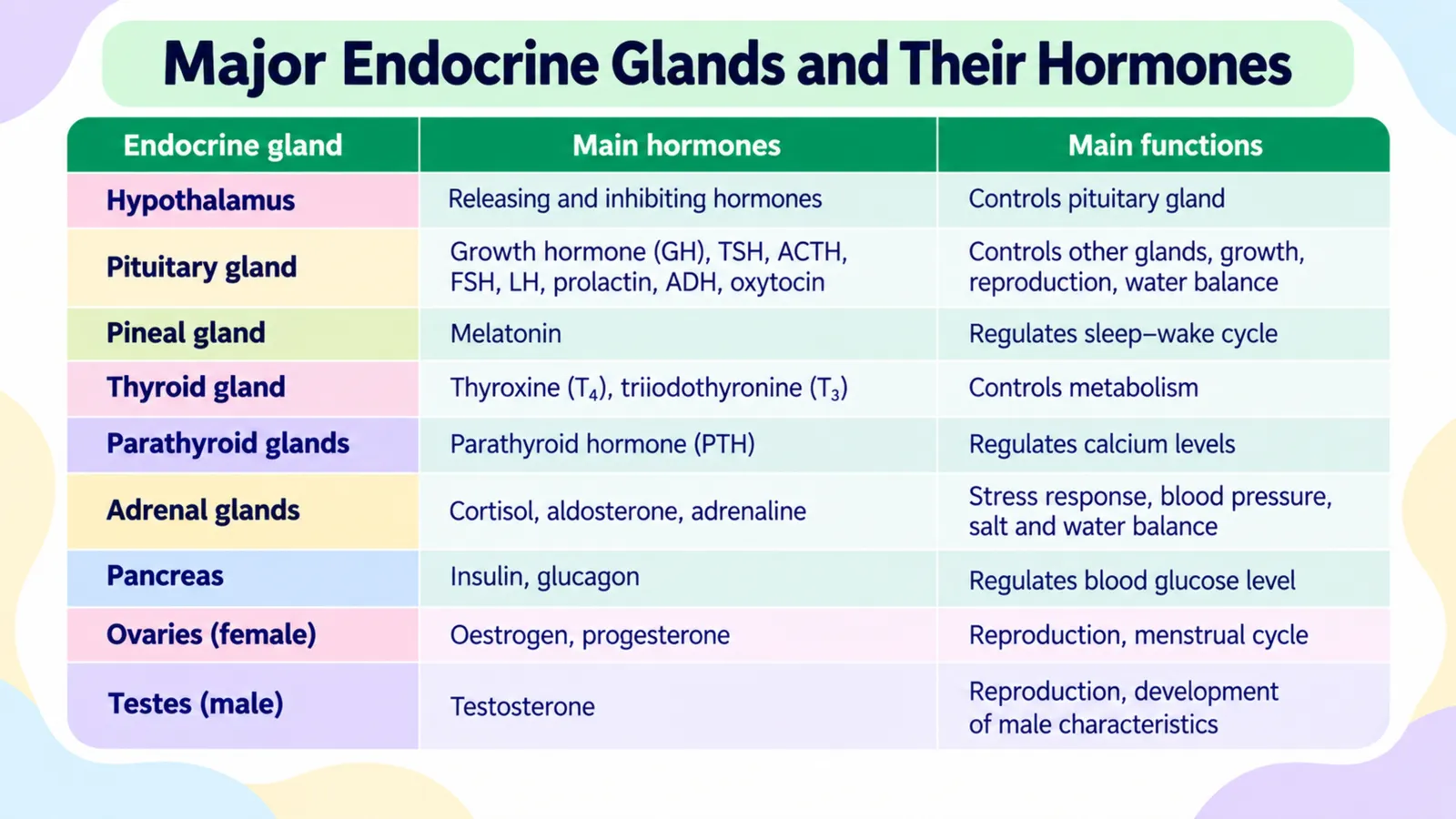
The pituitary is a pea sized gland hanging just below the brain. Despite its small size it is called the master gland, because many of its hormones control other endocrine glands.
The pituitary releases growth hormone, which controls how tall you grow and how tissues repair themselves. It releases thyroid stimulating hormone, which tells the thyroid to get to work. It releases hormones that control the adrenal glands and the reproductive organs. It also releases antidiuretic hormone, which tells the kidneys how much water to keep in the body.
If growth hormone is produced in excess during childhood, the person may grow unusually tall, a condition called gigantism. If too little is produced, growth is limited and the condition is called pituitary dwarfism. Excess growth hormone in adulthood, after the growing bones have sealed, causes acromegaly, where the hands, feet and jaw thicken.
Sitting just above the pituitary is the hypothalamus, a small region of the brain that acts as the true controller. The hypothalamus monitors the body's internal conditions and instructs the pituitary accordingly. It is the bridge where the nervous system and the endocrine system meet and talk to each other.
The Thyroid Gland: The Speed Controller
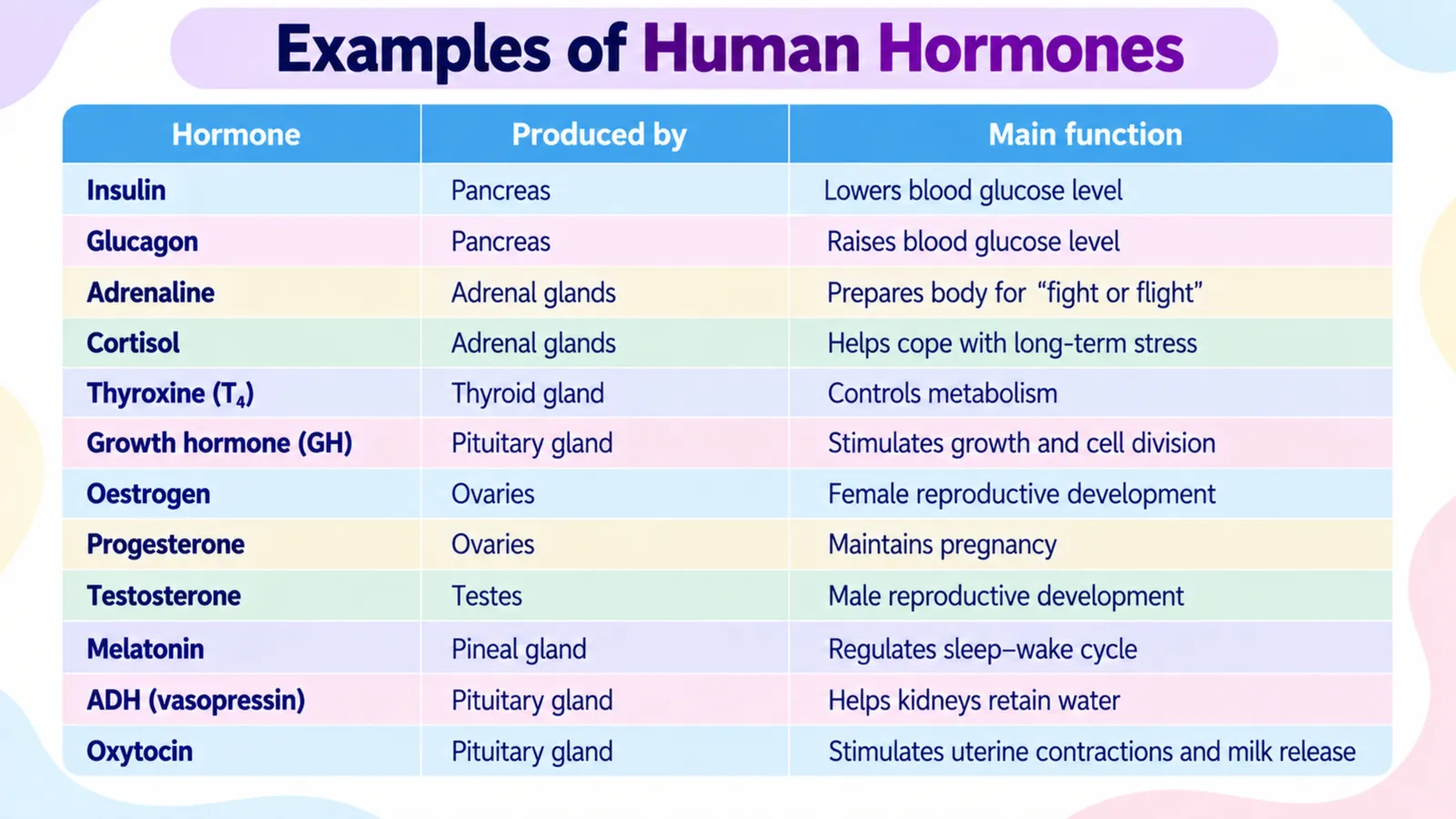
The thyroid is a butterfly shaped gland at the front of the neck, just below the voice box. It produces thyroxine, a hormone that contains iodine and controls the rate of metabolism, meaning how fast your cells release energy from food.
Thyroxine is like the accelerator pedal of the body. When levels are correct, everything runs smoothly. When too much is produced, a condition called hyperthyroidism, metabolism speeds up. The person may lose weight despite eating normally, feel hot, have a racing heartbeat, and feel anxious or restless. When too little is produced, a condition called hypothyroidism, everything slows down. The person may gain weight, feel cold and tired, and think and move more slowly.
Because thyroxine needs iodine, a diet lacking iodine can cause the thyroid to swell into a visible lump in the neck called a goitre. This is exactly why iodised salt is sold in most countries. It is one of the cheapest and most successful public health measures ever introduced.
The thyroid also produces calcitonin, which lowers blood calcium by encouraging calcium to be stored in bones.
The Parathyroid Glands: The Calcium Managers
Four tiny parathyroid glands sit on the back surface of the thyroid. They produce parathyroid hormone, which raises blood calcium levels by releasing calcium from bone and by helping the kidneys hold on to it.
Calcium matters far beyond bones. Muscles cannot contract properly without it and nerves cannot send signals correctly. If blood calcium falls too low, muscles begin to twitch and cramp uncontrollably. Calcitonin and parathyroid hormone work in opposite directions, and this opposing pair keeps blood calcium remarkably steady.
The Adrenal Glands: The Emergency Team
Two adrenal glands sit like small caps on top of the kidneys. Each has an outer region called the cortex and an inner region called the medulla.
The medulla produces adrenaline, often called the fight or flight hormone. Suppose you are walking home and a large dog suddenly rushes at the gate beside you. Before you have finished thinking about it, adrenaline is already in your blood. Your heart beats faster and harder, your breathing quickens, your pupils widen, blood is redirected from the digestive system to the skeletal muscles, and stored glycogen in the liver is converted to glucose for instant fuel. Your body has prepared itself to either fight or run within a couple of seconds.
The cortex produces cortisol, which helps the body handle longer periods of stress and influences how glucose is used, and aldosterone, which controls sodium and water balance through the kidneys.
The Pancreas: The Blood Sugar Regulator
Scattered through the pancreas are small clusters of cells called the islets of Langerhans. These clusters make two hormones with opposite jobs.
Insulin lowers blood glucose. After a meal, glucose floods into the blood. Insulin tells body cells to take glucose in and tells the liver to store the surplus as glycogen. Blood sugar falls back to normal.
Glucagon raises blood glucose. If you have not eaten for several hours, blood sugar starts to drop. Glucagon tells the liver to break stored glycogen back into glucose and release it. Blood sugar rises to normal again.
Together these two hormones keep blood glucose within a narrow safe range all day and all night. This matters enormously, because the brain runs almost entirely on glucose and cannot store any of its own.
When this system fails, the result is diabetes mellitus. In type one diabetes, the cells that make insulin are destroyed, usually by the person's own immune system, so very little insulin is produced. In type two diabetes, insulin is produced but body cells stop responding to it properly, a situation called insulin resistance. In both cases glucose builds up in the blood instead of entering cells, which is why a person can feel weak and constantly hungry even though their blood is full of sugar.
The Reproductive Glands
The testes in males produce testosterone, and the ovaries in females produce oestrogen and progesterone. These hormones control the development of reproductive organs and drive the changes of puberty.
During puberty, hormone levels rise sharply and the body changes over several years. Voice deepening, growth of body hair, widening of the shoulders or hips, growth spurts and the maturing of reproductive organs all happen under hormonal instruction. Understanding that these changes are normal, gradual and controlled by chemistry helps a great deal at an age when the changes themselves can feel confusing.
The Pineal Gland
The pineal gland is a tiny structure deep in the brain that produces melatonin, the hormone linked to sleep. Melatonin production rises in darkness and falls in bright light, which is how your body knows roughly what time it is. This is also why staring at a bright phone screen late at night can delay sleep. The light tells your pineal gland that it is still daytime.
🦋
Slides: The major endocrine glands
Where each gland sits, its hormones and their jobs
1/3
How Hormones Are Controlled: Feedback Loops
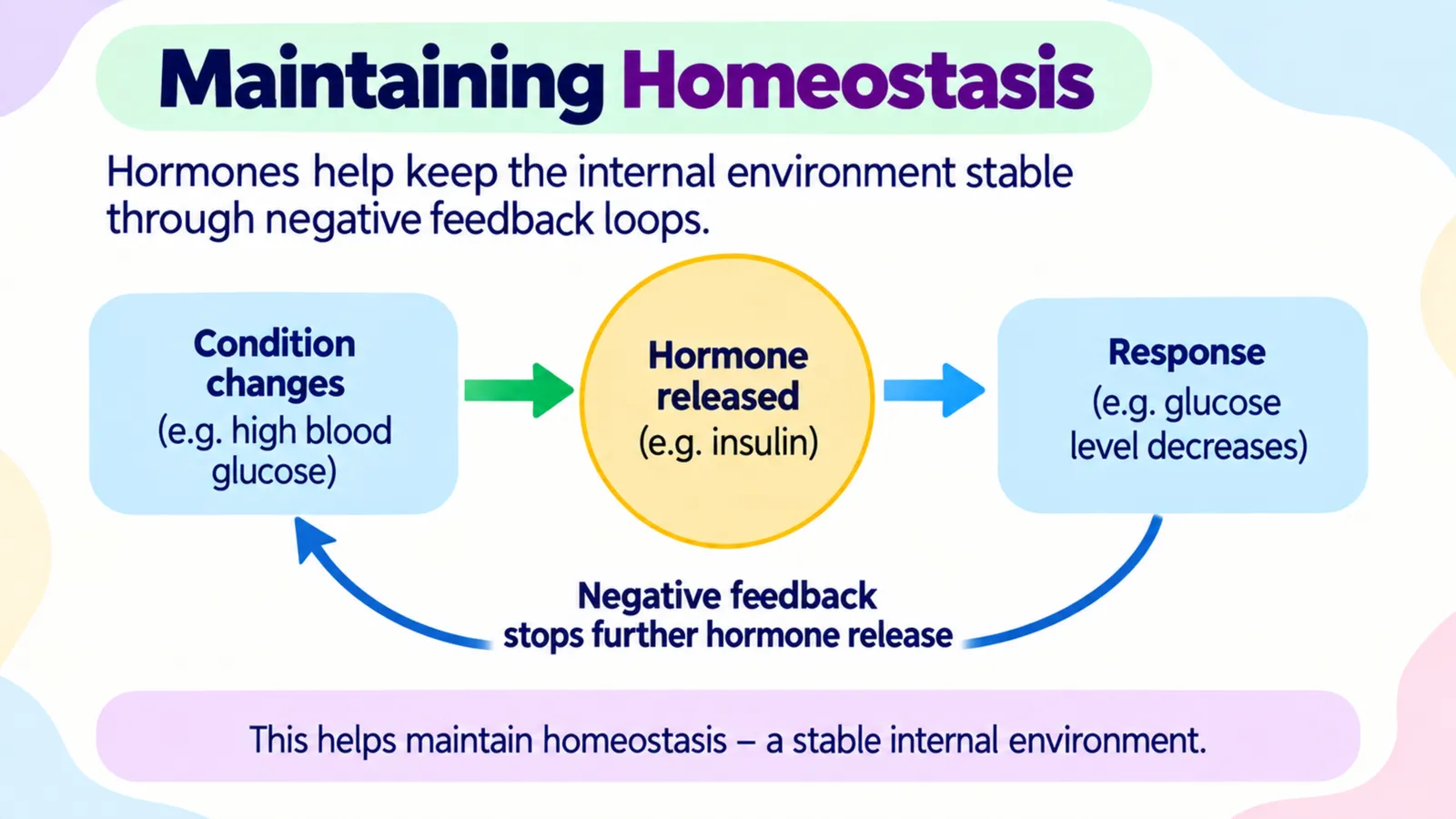
The endocrine system would be dangerous if glands simply released hormones without limit. Control comes from a mechanism called negative feedback, and it is one of the most important ideas in all of biology.
Negative feedback means that the result of a process switches off the process that produced it. A room heater with a thermostat works exactly this way. The heater warms the room, the thermostat detects that the target temperature has been reached, and the heater switches off. When the room cools again, the heater restarts.
Thyroxine control works the same way. The hypothalamus and pituitary detect low thyroxine in the blood and release thyroid stimulating hormone. The thyroid responds by producing thyroxine. Rising thyroxine levels are then detected by the pituitary, which reduces its stimulating hormone. Production slows down. This constant correction keeps hormone levels steady.
There is also positive feedback, which is much rarer because it pushes a process further instead of stopping it. Childbirth is the classic example, where contractions trigger the release of oxytocin, which causes stronger contractions, which triggers still more oxytocin until the baby is born.
🔁
Slide: Maintaining homeostasis
How negative feedback switches hormone release off
1/1
Comparing the Nervous System and the Endocrine System
The nervous system sends electrical impulses along neurons, while the endocrine system sends chemical hormones through blood.
Nervous responses are extremely fast, usually within milliseconds. Hormonal responses take seconds, minutes or even years.
Nervous effects are short lived. Hormonal effects last much longer, sometimes for a lifetime.
Nervous messages travel to a specific target along a fixed pathway. Hormones travel everywhere and act only on cells with matching receptors.
The nervous system controls rapid actions such as pulling your hand off a hot plate. The endocrine system controls slow processes such as growth, metabolism and reproduction.
Both systems are joined at the hypothalamus, so the body treats them as one coordinated control network rather than two separate ones.
Common Hormone Related Disorders
Diabetes mellitus results from insufficient insulin or poor response to insulin, leading to high blood glucose.
Goitre is a swelling of the thyroid gland usually caused by iodine deficiency.
Hyperthyroidism speeds up metabolism, causing weight loss, heat intolerance and a rapid heartbeat.
Hypothyroidism slows metabolism, causing tiredness, weight gain and sensitivity to cold.
Gigantism and dwarfism result from too much or too little growth hormone during childhood.
Addison disease results from an underactive adrenal cortex, causing weakness, low blood pressure and fatigue.
🏁
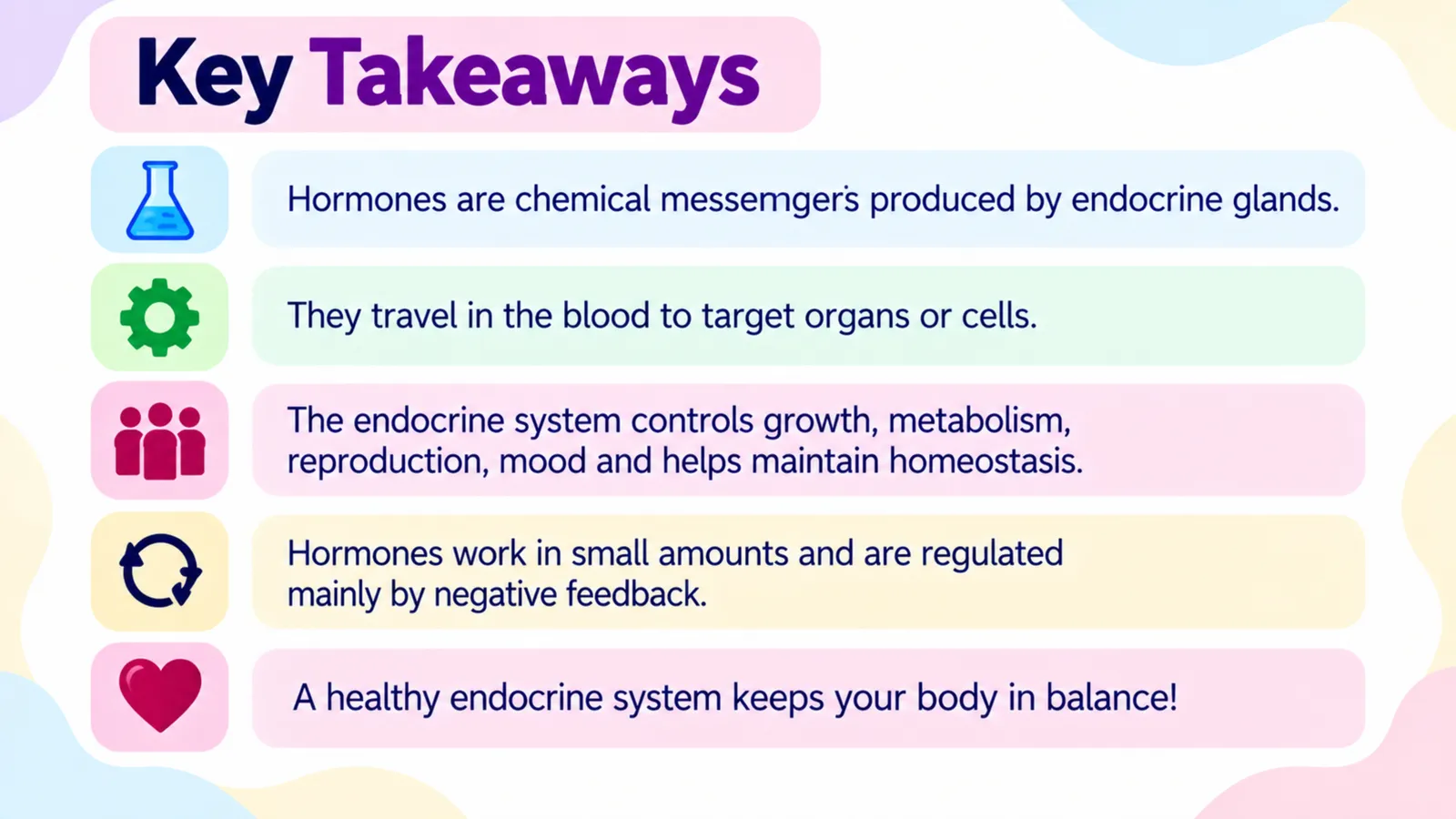
Slide: Key takeaways
1/1
Frequently Asked Questions About the Endocrine System
Why is the pituitary called the master gland?
Because several of its hormones control other endocrine glands, including the thyroid, the adrenal cortex and the reproductive organs. It sets much of the schedule for the rest of the system, although it is itself directed by the hypothalamus.
How do hormones know where to go?
They do not know. They travel everywhere in the blood. Only cells carrying the correct receptor can respond, so the specificity comes from the receiving cell rather than from the hormone's route.
What is the difference between insulin and glucagon?
Insulin lowers blood glucose by moving it into cells and storing it as glycogen. Glucagon raises blood glucose by breaking glycogen back down. They are an opposing pair that keeps blood sugar stable.
Why is iodine important in the diet?
Thyroxine is built using iodine. Without enough dietary iodine the thyroid cannot make enough thyroxine, and it may enlarge into a goitre as it tries to compensate.
Are hormones needed in large amounts?
No. Hormones are effective in extremely small concentrations. A very small change in hormone level can produce a very large change in the body, which is why hormone balance is monitored so carefully in medicine.
Final Thoughts
The endocrine system is easy to overlook because you cannot feel it working. There is no sound, no movement and no obvious sensation. Yet it decides how tall you grow, how fast you burn energy, how you respond to danger, how your body handles sugar, and when you feel sleepy.
The best way to revise this topic is to build a mental map. Place each gland in its position in the body, attach one or two hormones to it, and then attach one clear job to each hormone. After that, practise explaining negative feedback using the thermostat comparison, because examiners ask about control just as often as they ask about names. Once the map and the control idea are both firm in your mind, the endocrine system stops being a list to memorise and becomes a system you actually understand.
📝 Worksheets
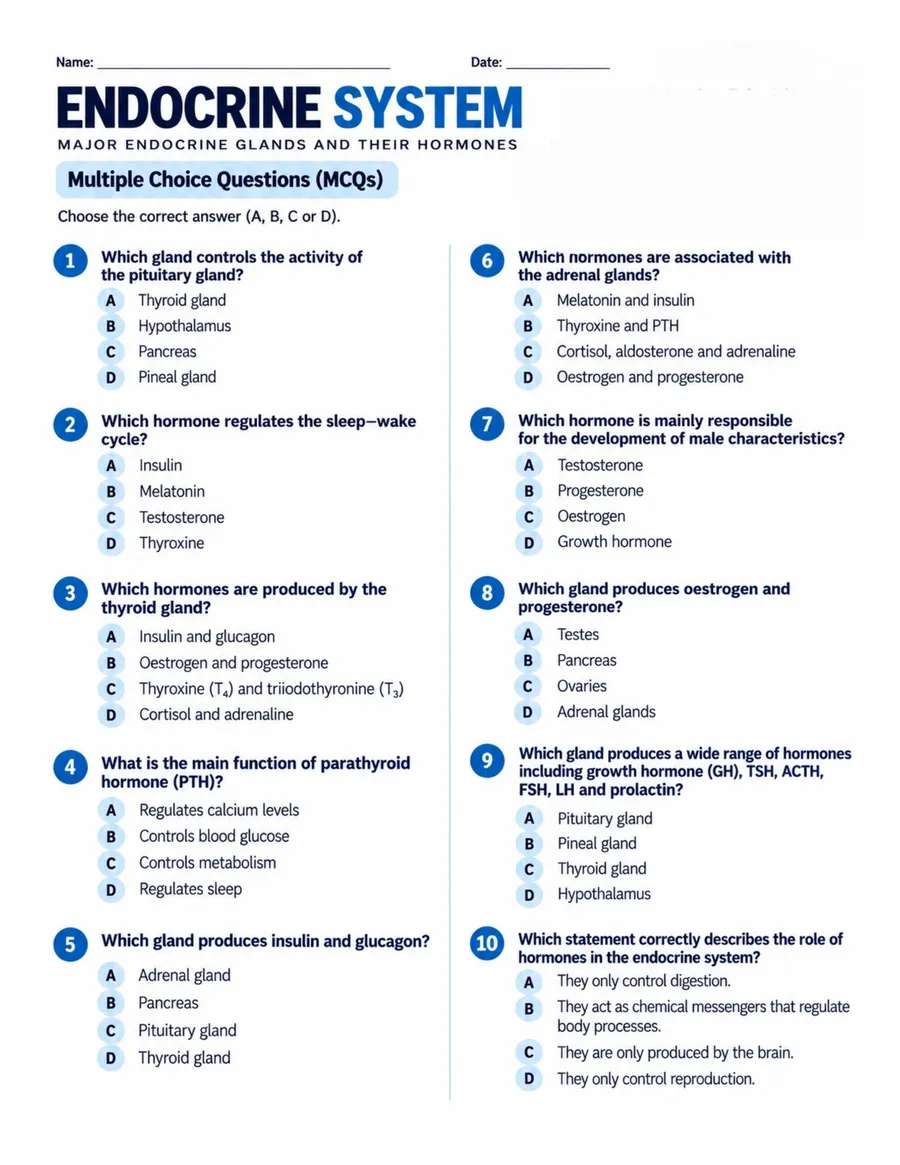
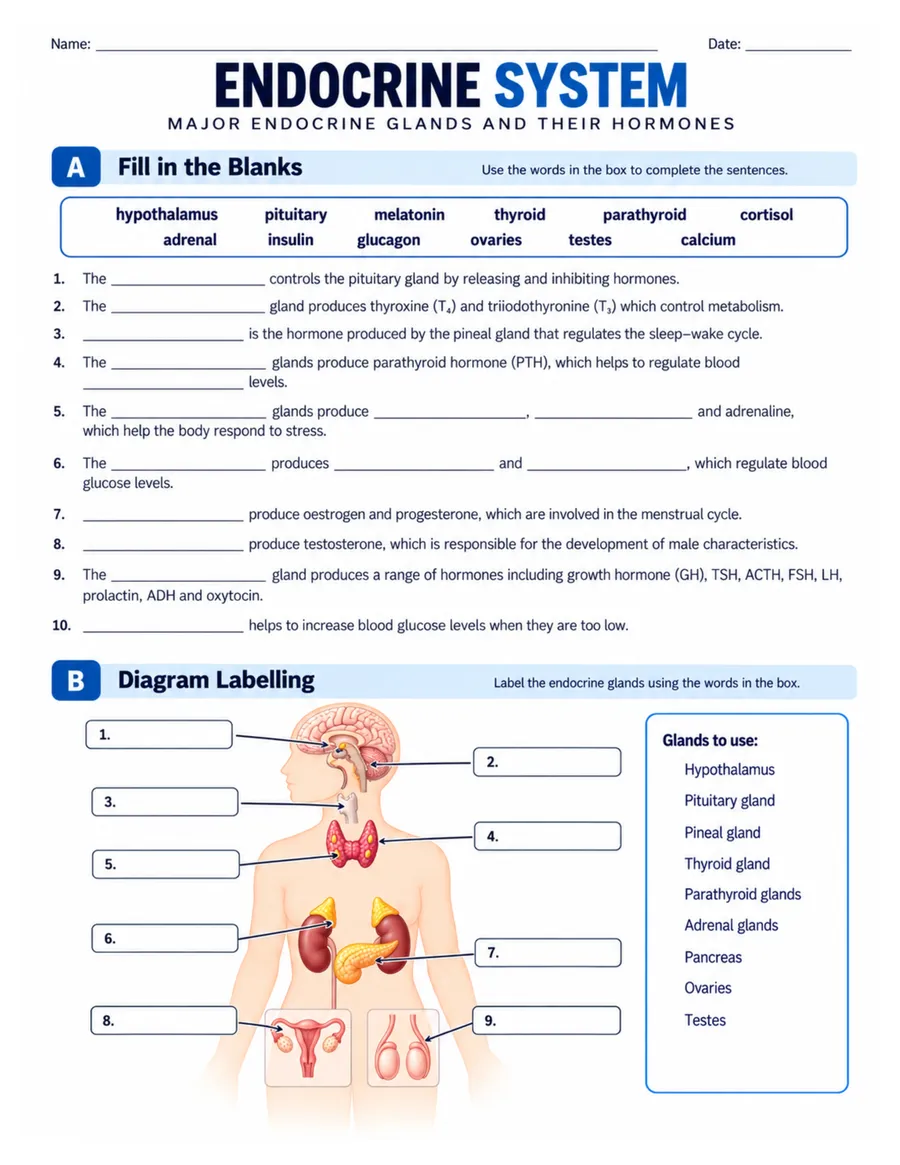
Print-ready practice sheets for this lesson. Sign in to download the PDF.
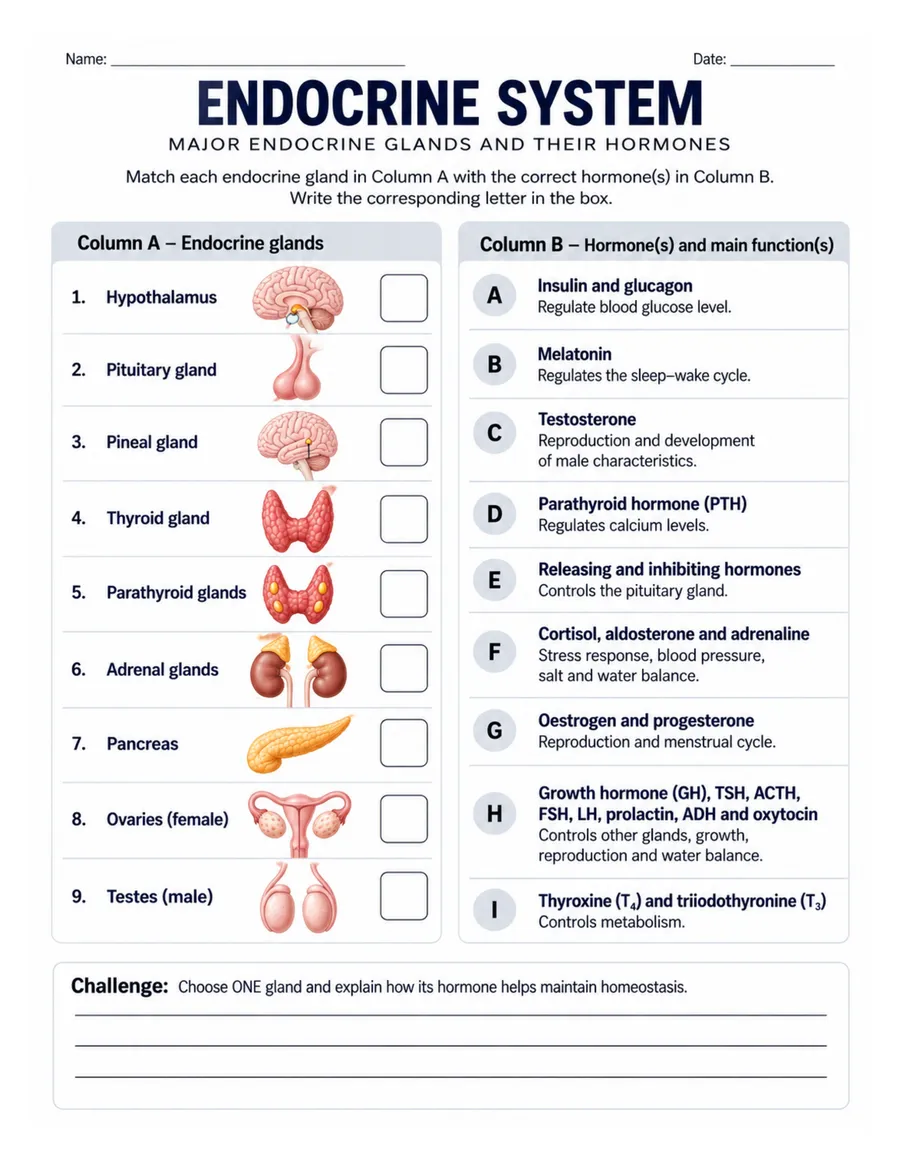
Matching: glands and their hormones
Match each endocrine gland to the hormones it produces and their main job, then try the challenge question.