From flower to seedling: pollination, fertilisation, seeds and germination
Biology · Grade 9-11 · 14 min read
🌸 Parts of a flower🐝 Pollination🧬 Fertilisation🌰 Seeds and fruits🌱 Germination
📖 Lesson
How plants make new plants: cloning, flowers, pollen, seeds and the conditions a seed needs to germinate.
A strawberry plant sends out long runners and, within weeks, a single plant has become a dozen. A bee visits a sunflower, brushes against its pollen and carries a little of it to the next flower. A dandelion seed floats a kilometre on the breeze. A bean seed sits dry in a packet for a year and then, given a drink of water, pushes out a root. These are all pieces of the same story: how plants make new plants.
In GCSE biology, reproduction in plants is a rich topic with many diagrams, comparisons and practical details. This guide takes you through it in order. We start with the two types of reproduction, move through the flower, pollination and fertilisation, and then follow the seed from formation and dispersal to germination. You will find the diagrams you must be able to draw, the tables that examiners love and the mistakes that cost marks.
Why Do Plants Reproduce?
Reproduction is the process by which living things produce new individuals of the same species. It replaces old plants that die, keeps up the population, spreads the species to new places and provides the food that every food chain starts with. Plants cannot walk to find a mate, so they have developed clever strategies that rely on wind, water, animals or simply on growing a new plant from a piece of themselves.
Asexual Reproduction in Plants
Asexual reproduction produces new plants from a single parent, without gametes or fertilisation. A part of the parent plant, such as a stem, a root or a leaf, grows into a new plant. The cells are made by mitosis, which copies cells exactly, so the offspring have the same DNA as the parent and as each other. They are called clones. There is no mixing of genes, so there is no genetic variation.
The characteristics are easy to remember. Only one parent is needed. There are no flowers, seeds or fertilisation. It is a rapid method. The offspring are identical to the parent.
Natural methods
Method
How the new plant grows
Example
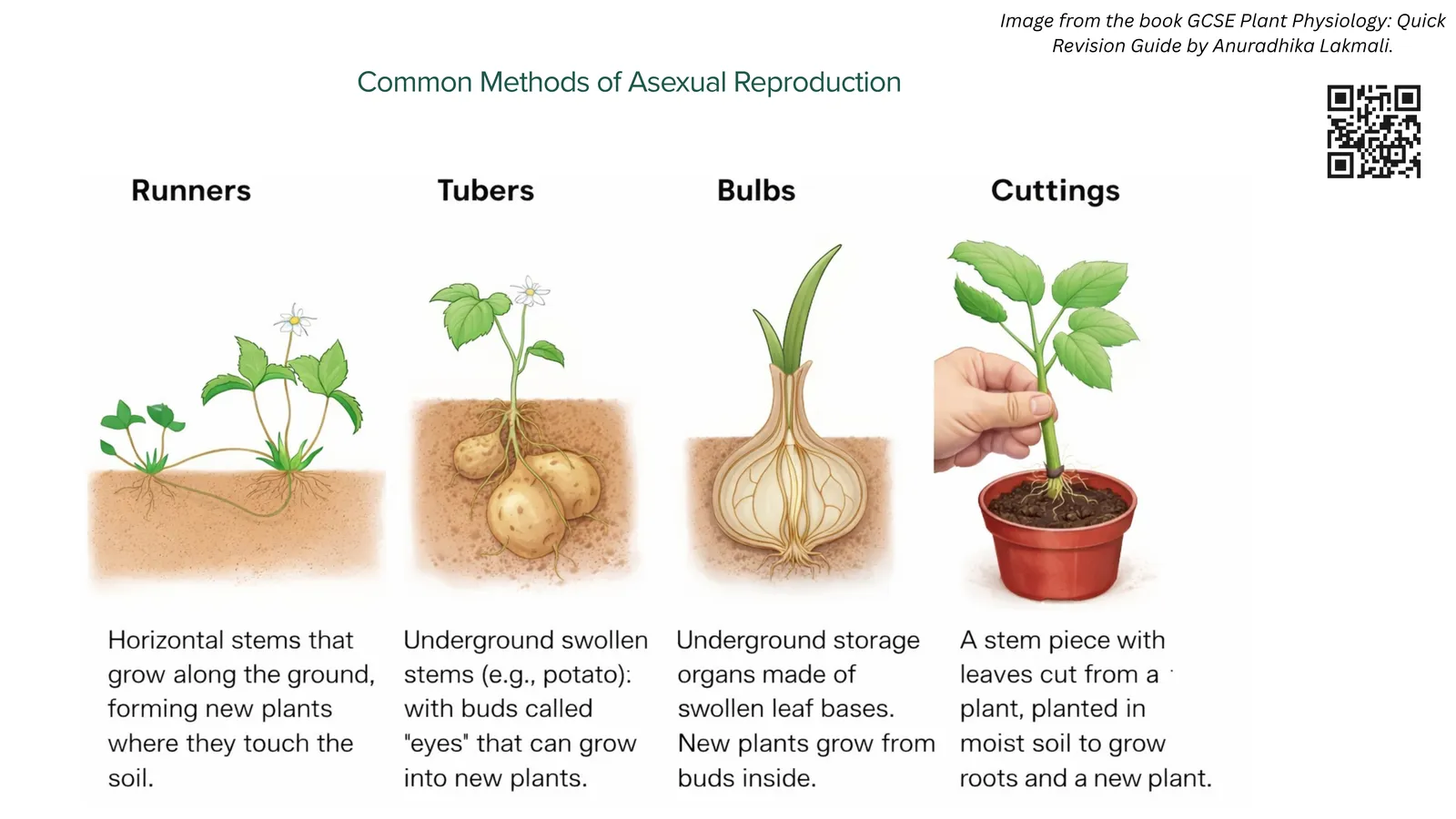
Runners
A horizontal stem grows along the ground and forms roots and a new plant where it touches the soil
Strawberry
Tubers
A swollen underground stem stores food, and buds called eyes grow into new plants
Potato
Bulbs
Swollen leaf bases store food, and new plants grow from buds inside
Onion, daffodil
Cuttings
A stem piece with leaves grows roots in moist soil
Geranium, mint
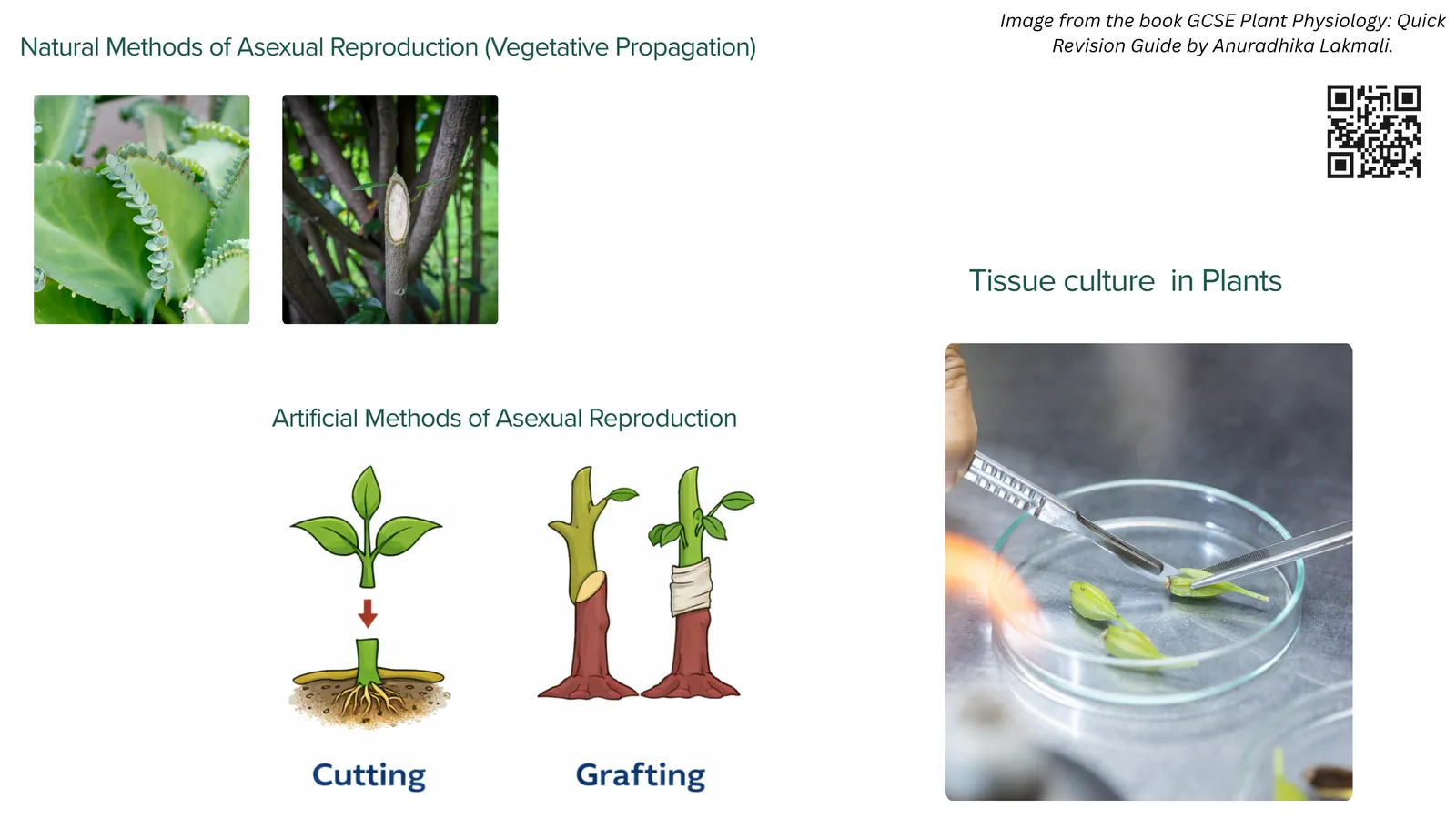
This natural process is called vegetative propagation, and it also happens when plants grow plantlets on leaf edges or send up new shoots from their roots.
🍓
Slide: Natural asexual reproduction
Runners, tubers, bulbs and cuttings
1/1
Artificial methods used by humans
Gardeners and farmers use artificial propagation to make plants with desirable traits such as sweet fruit or disease resistance, and to make many identical plants quickly.
Cuttings. A piece of stem with leaves is planted in moist soil, often after dipping the cut end in rooting powder that contains auxin.
Grafting. A bud or stem of one plant, called the scion, is joined to the roots of another, called the stock, and the two grow together as one plant.
Layering. A low branch is bent down and buried while still attached to the parent. It grows roots and is then cut free.
Micropropagation, or tissue culture. A small piece of tissue from a healthy plant is placed on a sterile nutrient jelly with growth hormones. The cells divide by mitosis into many small plantlets, which are planted out as clones. Everything must be sterile so that bacteria and fungi do not grow on the jelly and kill the plantlets.
🧫
Slide: Artificial propagation
Cuttings, grafting and tissue culture
1/1
Asexual versus sexual reproduction
Feature
Asexual
Sexual
Parents
One
Usually two
Gametes
None
Male and female gametes fuse
Cell division
Mitosis only
Meiosis to make gametes, then fertilisation
Offspring
Identical clones
Genetically different
Speed
Fast
Slower
Spread
Mostly near the parent
Seeds can travel far
The advantages of asexual reproduction are that it needs only one parent, so there is no need for a mate or pollinator, it is fast, good traits are kept in every offspring and new plants flower sooner. Its disadvantages are that there is no variation, so all the plants are equally weak to one disease, and the offspring grow close to the parent and compete with it for light and water.
Sexual reproduction gives variation, so some offspring may survive a new disease or a changing environment, and seeds can be dispersed far from the parent, which allows natural selection to work. Its disadvantages are that it needs pollination and fertilisation, which are uncertain, it is slower and it uses a lot of energy to make flowers. Banana plants are grown from cuttings because they make no viable seeds, breeders use sexual reproduction to create new varieties, and rare orchids are made in large numbers by tissue culture.
The Parts of a Flower
The flower is the organ of sexual reproduction in flowering plants. A typical flower has four whorls, or rings, arranged from the outside to the inside.
Whorl
Parts
Job
Calyx
Sepals
Protect the flower bud
Corolla
Petals
Attract pollinators
Male part
Anther and filament, together called the stamen
Make and release pollen
Female part
Stigma, style and ovary, together called the carpel or pistil
Receive pollen, make seeds and fruit
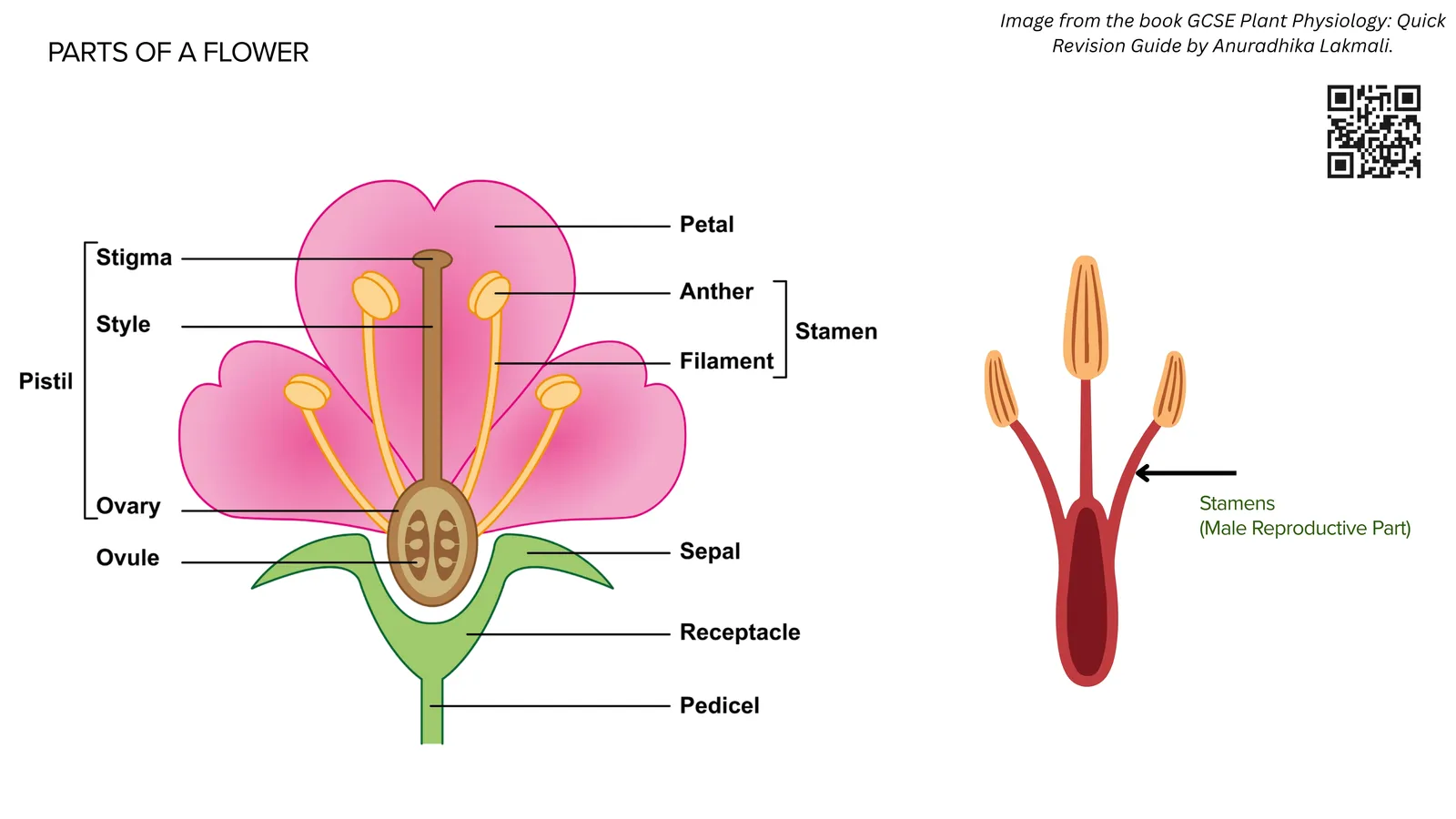
Sepals are usually green and leaf-like. They protect the bud before it opens.
Petals are bright and often scented. They attract insects and birds, give a landing platform, and may have nectar guides that lead pollinators in.
The anther makes pollen grains that contain the male gametes, and the filament is a thin stalk that holds the anther up where wind or insects can pick up pollen.
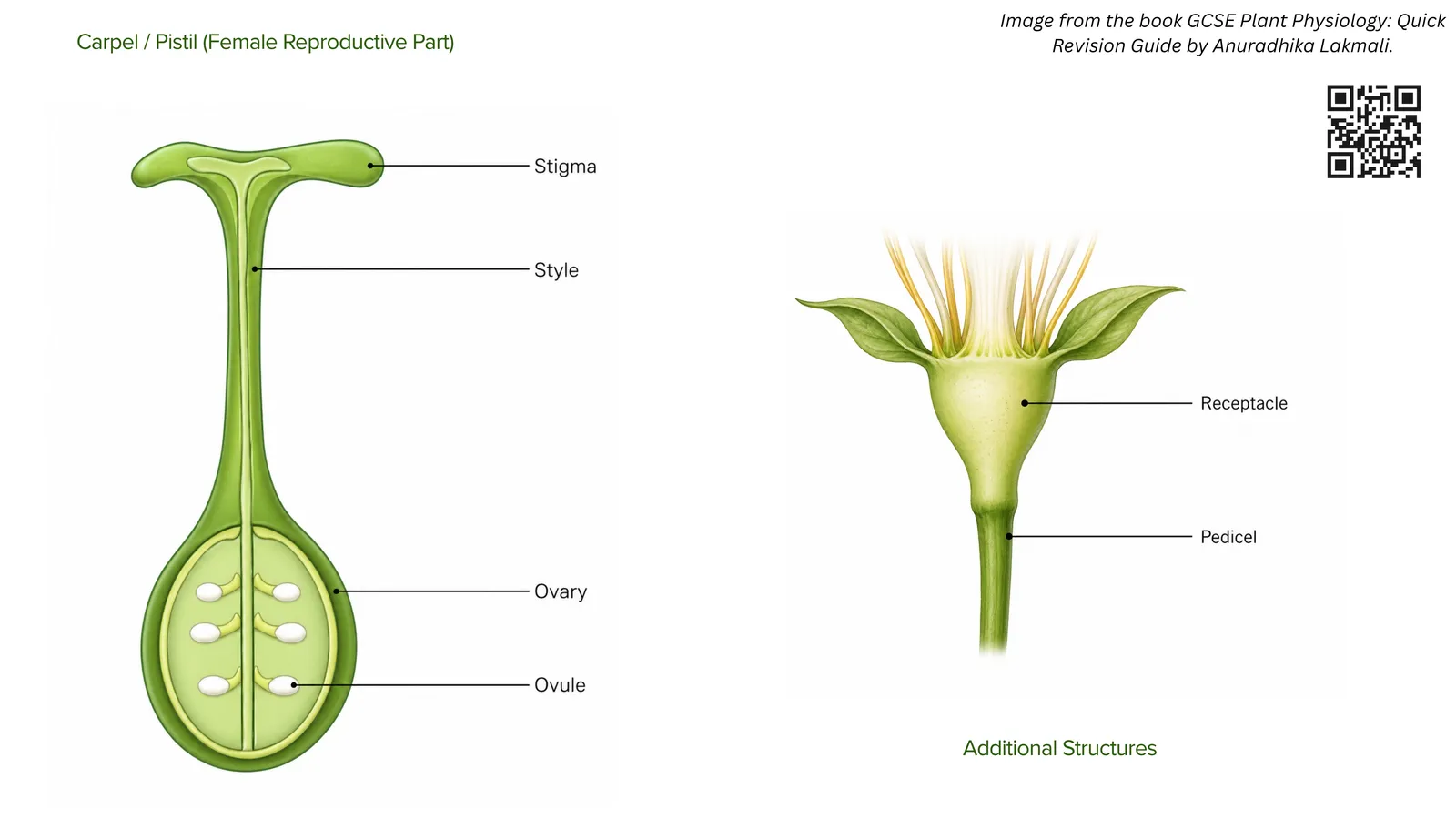
The stigma is the sticky top of the carpel that receives pollen. The style is the tube joining the stigma to the ovary. The ovary is the swollen base that holds the ovules. Each ovule contains an egg cell.
The receptacle is the swollen top of the flower stalk where all the parts attach, and the pedicel is the stalk itself.
Remember the key links: the ovary becomes the fruit and the ovule becomes the seed. Do not mix up the stamen, which is male and makes pollen, with the stigma, which is female and receives pollen. When asked to draw a flower, write the full title, longitudinal section of a typical flower, use a sharp pencil, draw straight label lines that touch the part and avoid shading.
🌸
Slides: Parts of a flower
Labelled diagrams for your exam
1/3
Gametes: Pollen Grains and Ovules
In sexual reproduction, gametes are made by meiosis inside the flower. They are haploid, which means they have half the normal number of chromosomes, so that the zygote has the full number again when they fuse.
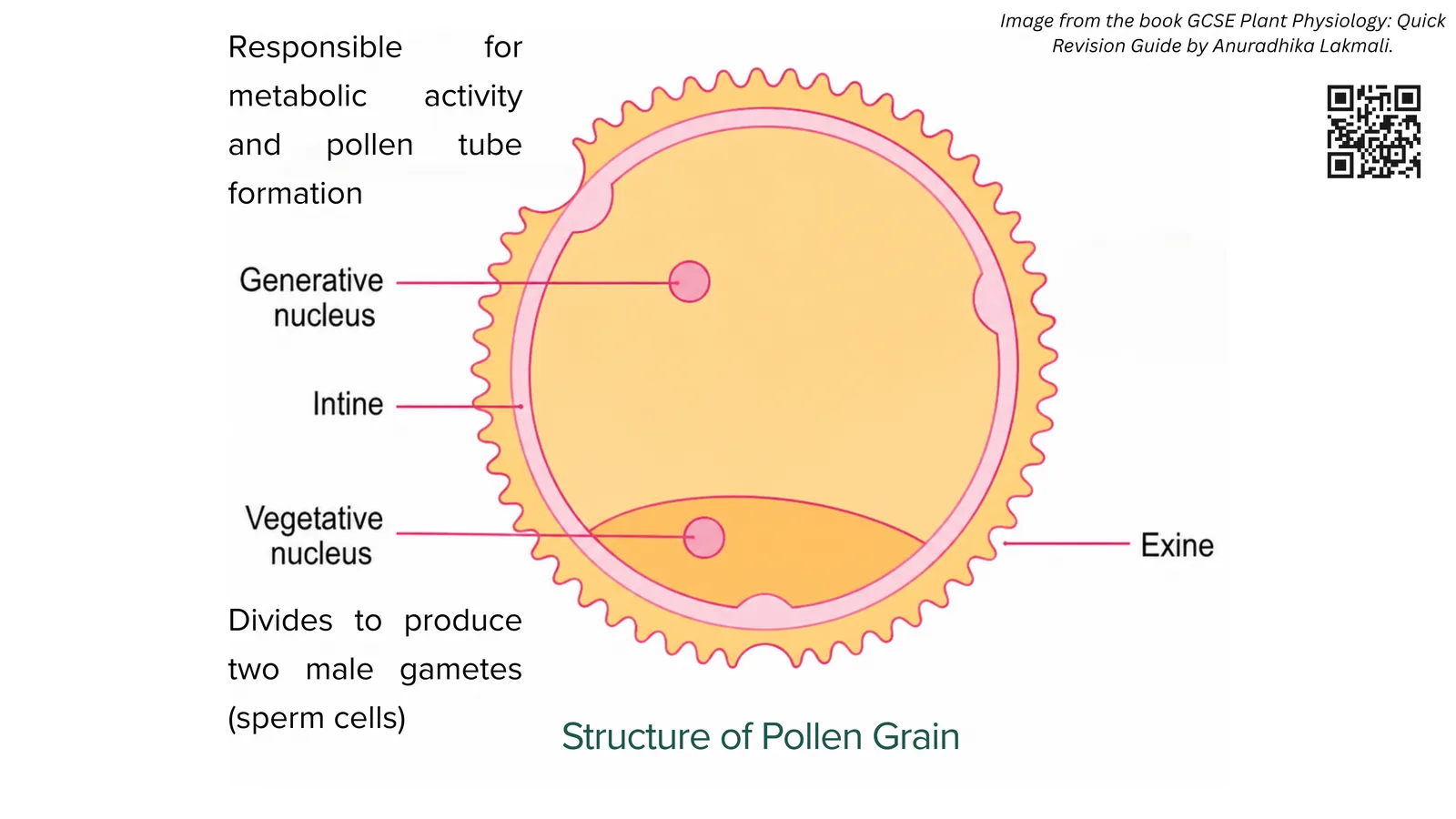
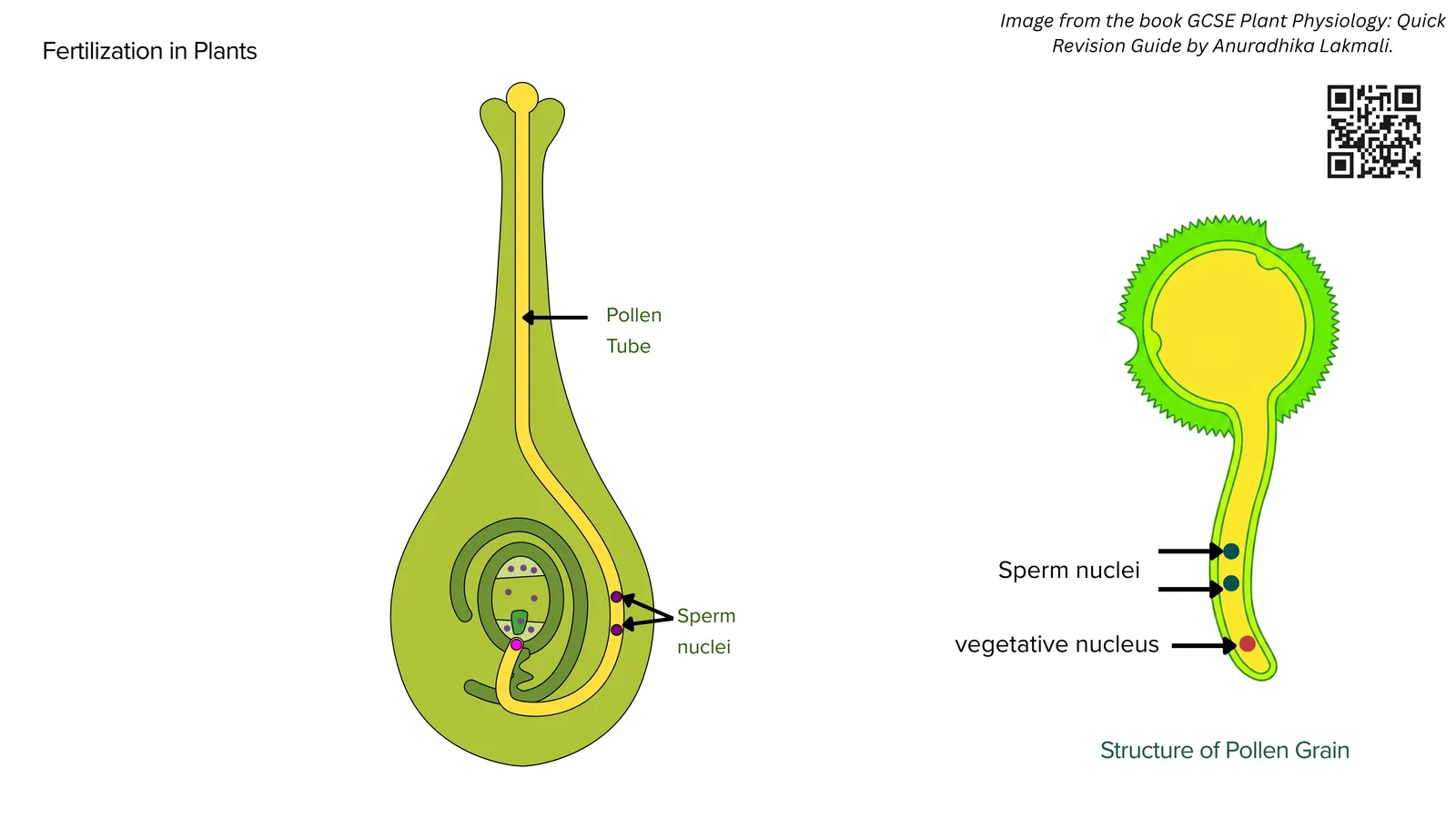
Male gametes are made in the anthers and carried inside pollen grains. A pollen grain has a tough outer wall, the exine, and a thinner inner wall, the intine. Inside are a generative nucleus, which divides to give two male gametes, and a vegetative or tube nucleus, which controls the growth of the pollen tube. Pollen grains contain the male gametes, but they are not themselves gametes.
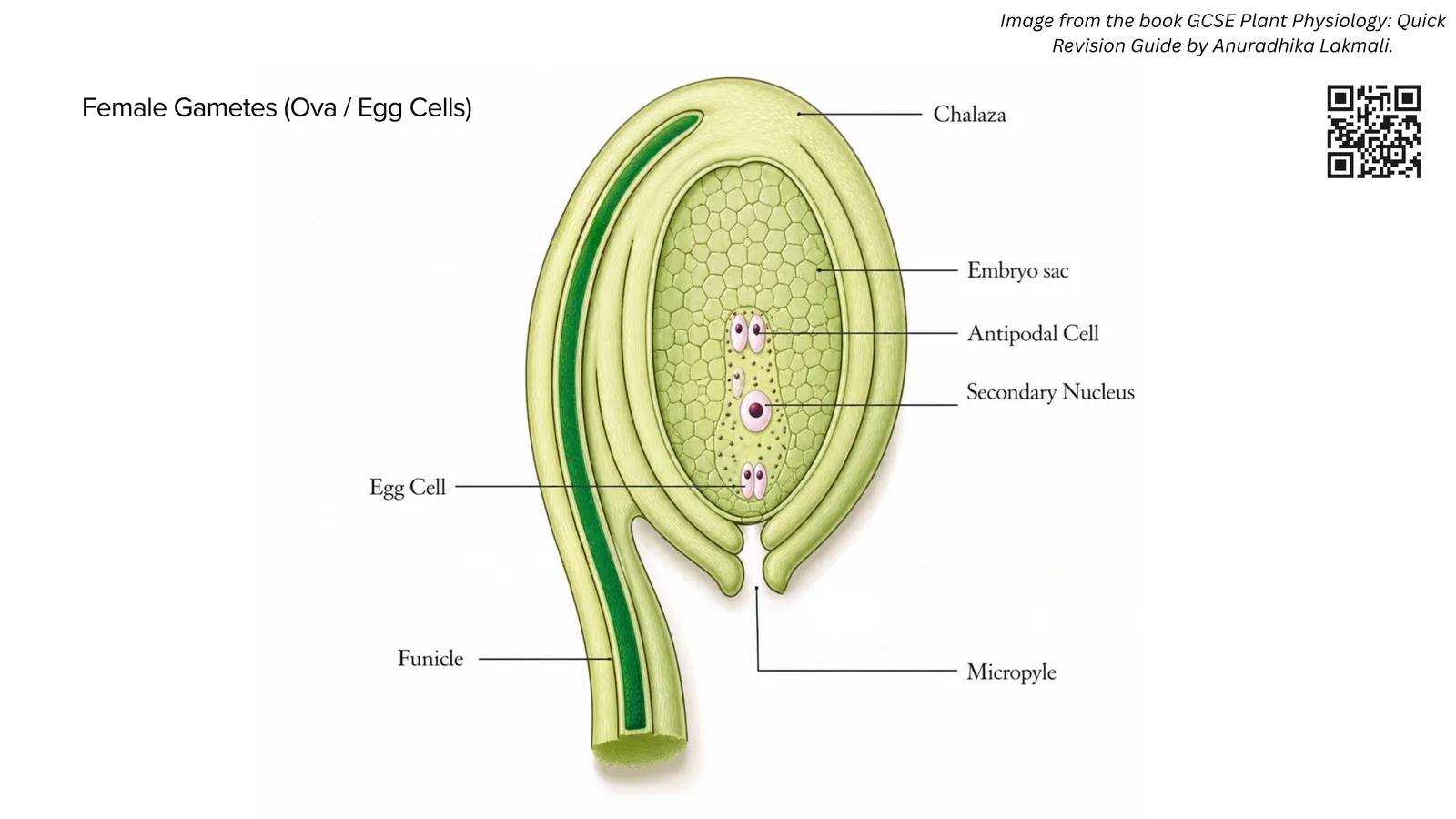
Female gametes are made in the ovules inside the ovary. An ovule is attached to the ovary wall by a stalk called the funicle. It has a tiny opening, the micropyle, where the pollen tube enters. Inside is the embryo sac, which holds the egg cell and the polar nuclei. After fertilisation the ovule becomes the seed.
🔬
Slides: Pollen grains and ovules
Structure of the male and female gametes
1/2
Pollination
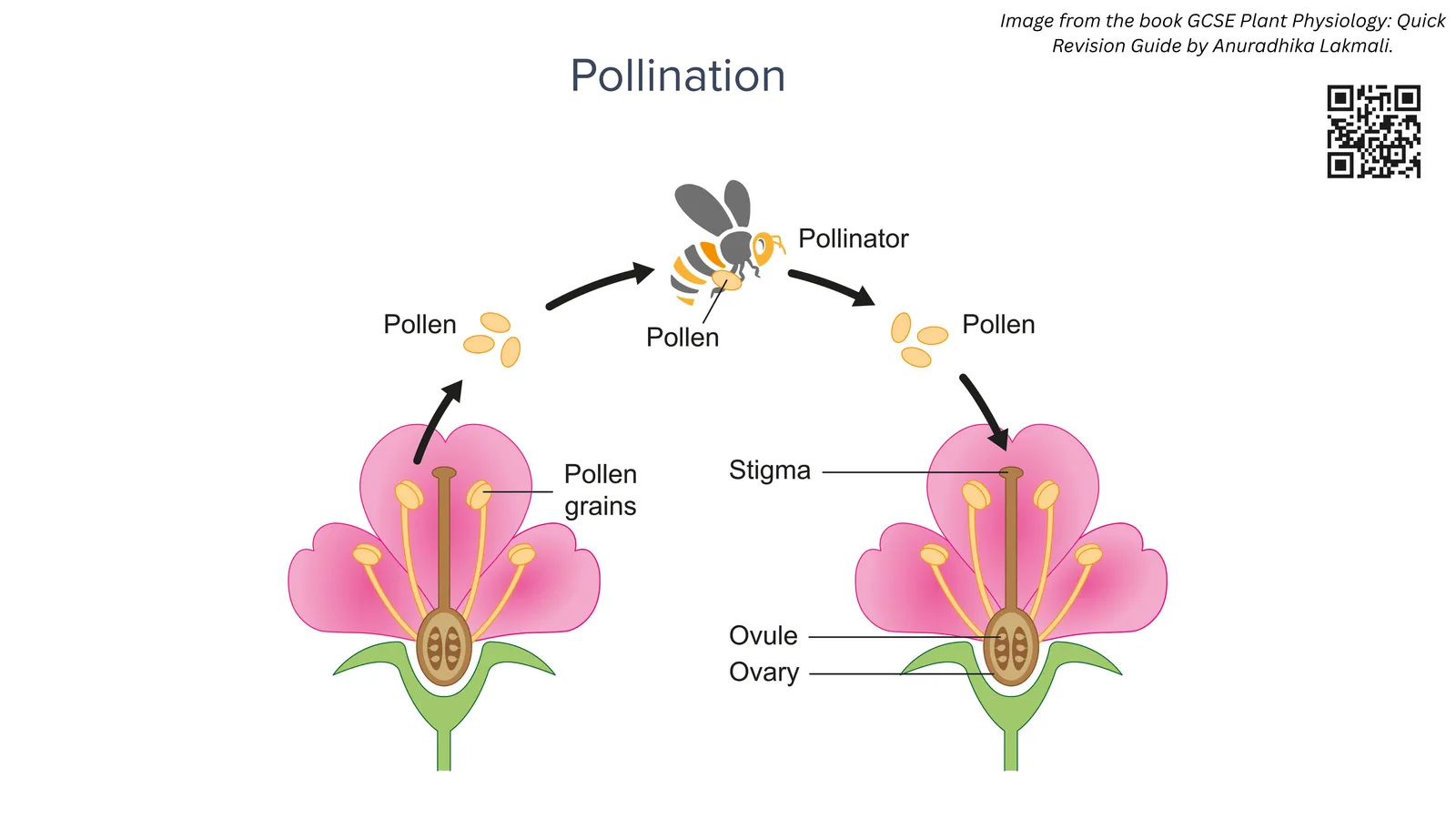
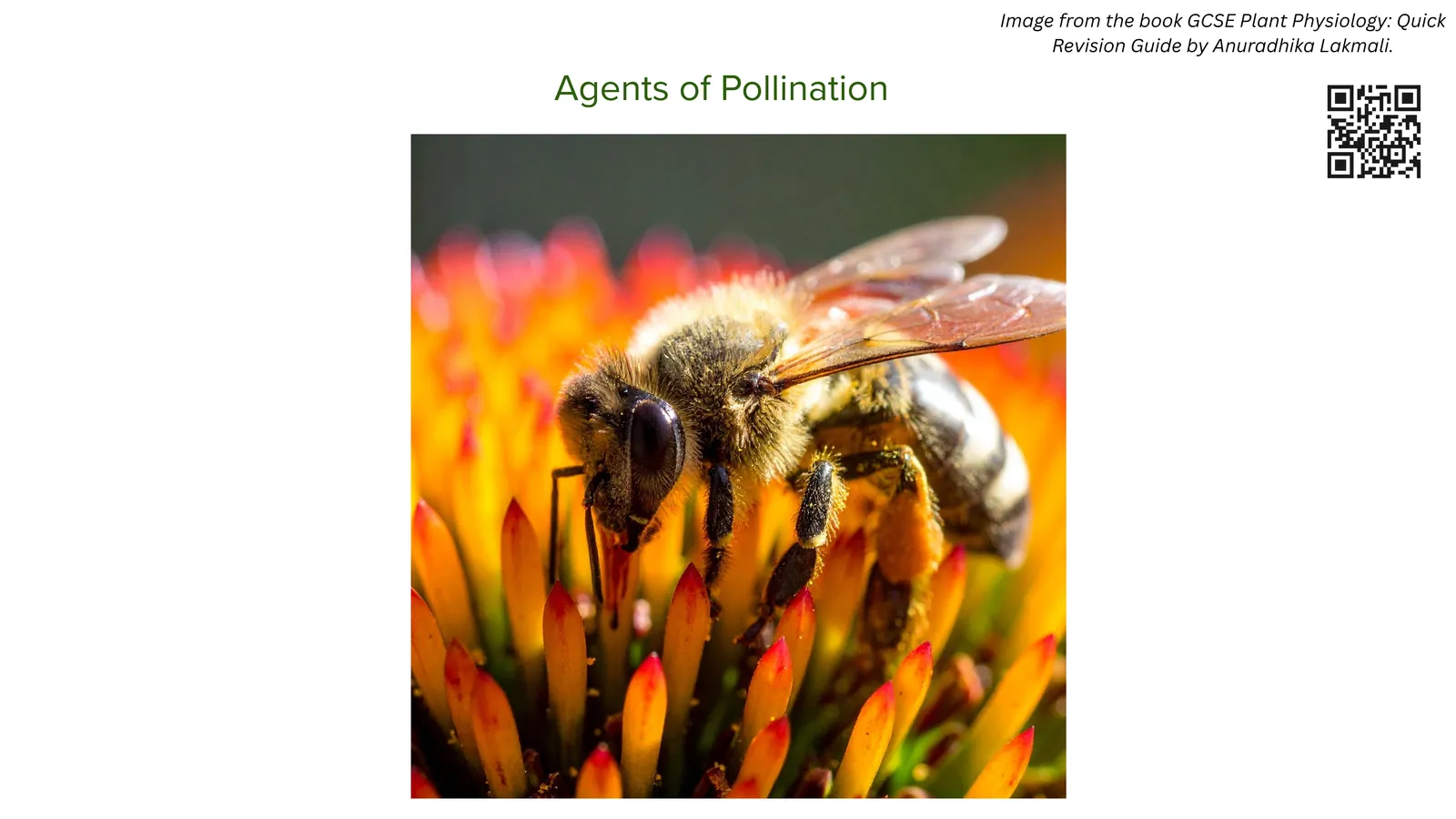
Pollination is the transfer of pollen grains from the anther to the stigma of a flower. It must happen before fertilisation. A pollinator is any animal that moves pollen, usually while feeding on nectar or pollen. When a bee visits a flower it is dusted with pollen, and when it visits another flower of the same species, some of the pollen rubs onto the sticky stigma.
🐝
Slide: Pollination
A pollinator carries pollen to the stigma
1/1
Self-pollination and cross-pollination
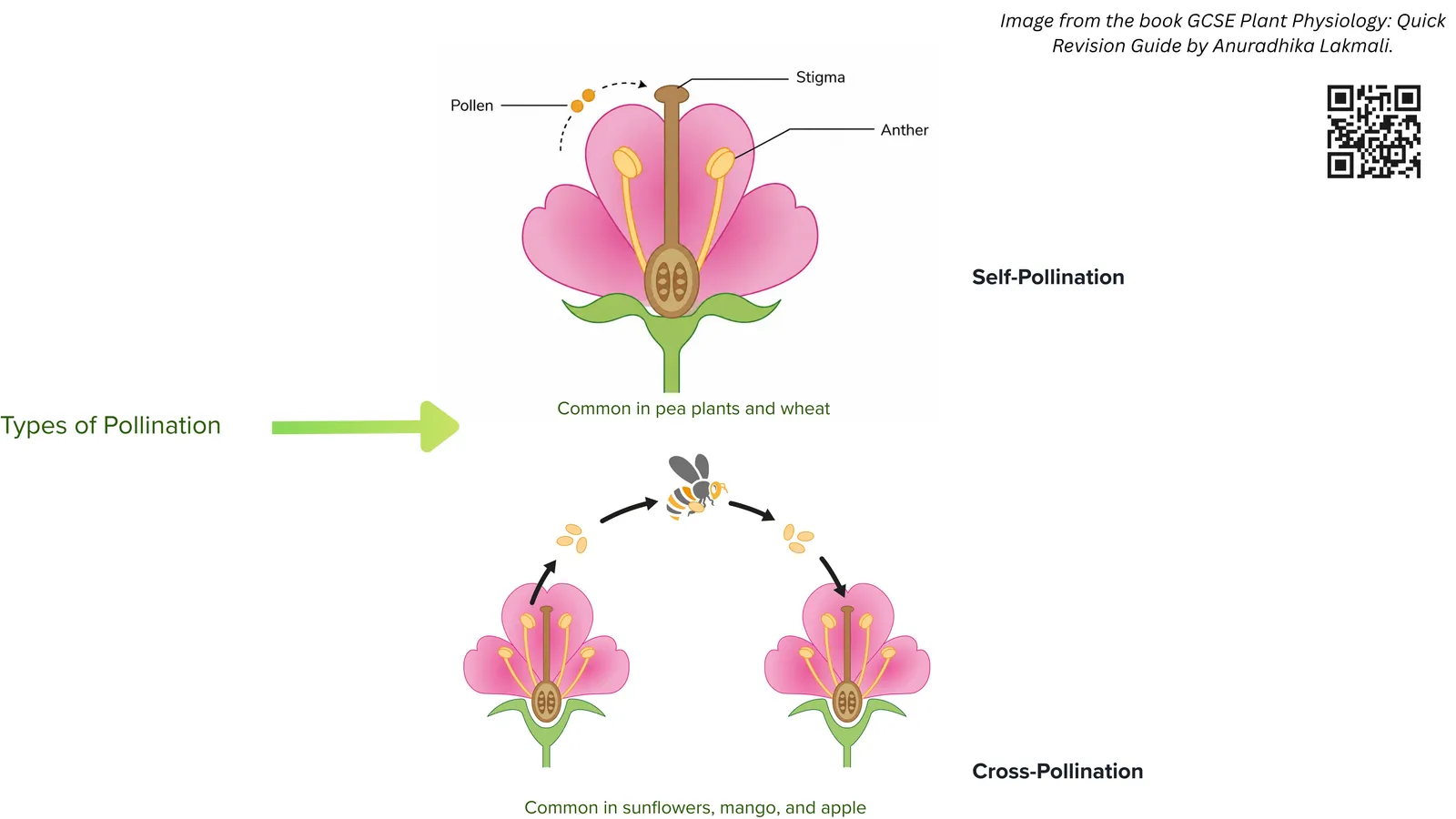
Self-pollination is the transfer of pollen to a stigma on the same flower or the same plant. It works even when pollinators are absent, but it produces little variation. Peas and wheat are examples. Cross-pollination is the transfer of pollen to a flower on a different plant of the same species. It needs wind or animals, but it gives more variation, and so stronger and more adaptable offspring. Sunflowers, apples and mangoes are examples.
🌼
Slide: Self- and cross-pollination
Same flower or a different plant
1/1
Insect-pollinated and wind-pollinated flowers
Feature
Insect-pollinated
Wind-pollinated
Petals
Large, bright and scented to attract insects
Small or absent
Nectar
Present, as a reward
Absent
Pollen
Sticky or spiky, in smaller amounts
Light, smooth and in huge amounts, so it blows far
Anthers
Inside the flower
Hang outside on long filaments to catch the wind
Stigma
Inside, small and sticky
Large and feathery, outside the flower
Examples
Hibiscus, sunflower, mustard
Grasses, wheat, maize, pine
Birds pollinate tubular red or orange flowers with little scent, bats visit large pale night-opening tropical flowers, and a few aquatic plants such as Vallisneria release pollen that floats on water. When answering exam questions, give the reason for each feature, for example a feathery stigma to catch airborne pollen.
🦋
Slide: Agents of pollination
Insects, wind, birds and more
1/1
Fertilisation
Fertilisation is the fusion of a male gamete with a female gamete to form a zygote. It can only happen after pollination.
1. A pollen grain from the same species lands on the stigma and takes in sugary fluid and moisture.
2. The pollen grain grows a pollen tube, controlled by the tube nucleus, down through the style. The tube digests a path and follows chemical signals towards the ovule.
3. The tube enters the ovule through the micropyle.
4. The two male gametes move down the tube into the embryo sac.
5. One male nucleus fuses with the egg cell to form the zygote.
In flowering plants there is a second fusion, called double fertilisation, which is a higher tier idea. The other male nucleus fuses with the polar nuclei to form the endosperm, which is the food store for the embryo.
🧬
Slide: Fertilisation in plants
The pollen tube and the male nuclei
1/1
Feature
Pollination
Fertilisation
What happens
Pollen moves to the stigma
Male and female gametes fuse
Where
Anther to stigma
Inside the ovule
Agent needed
Yes, such as wind or insects
No, the pollen tube does it
Result
Pollen on the stigma
Zygote
The most common mistake is to treat pollination and fertilisation as the same thing. Pollination moves the pollen. Fertilisation is the fusion of nuclei.
Seed and Fruit Formation
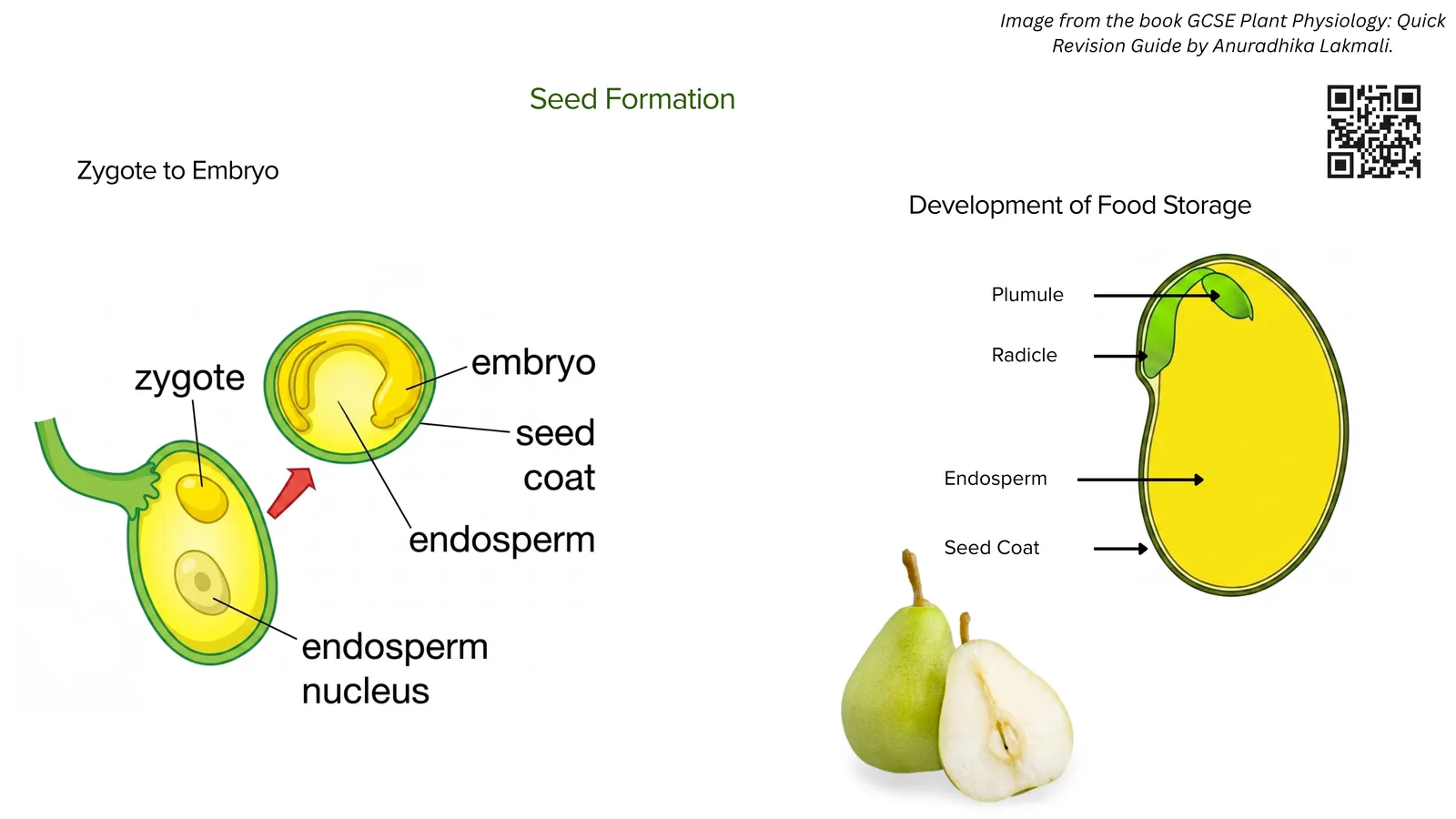
After fertilisation, the ovule develops into a seed and the ovary develops into a fruit. The petals, stamens and style wither and fall away.
1. Zygote to embryo. The zygote divides by mitosis and differentiates into an embryo, with a radicle, which is the embryonic root, and a plumule, which is the embryonic shoot.
2. Food store. Nutrients collect in the endosperm or in the cotyledons. This food gives energy during germination.
3. Seed coat. The outer layers of the ovule, the integuments, harden into the testa, which protects the embryo.
4. Ovary to fruit. The ovary wall swells and ripens into the fruit, which protects the seeds and helps to spread them.
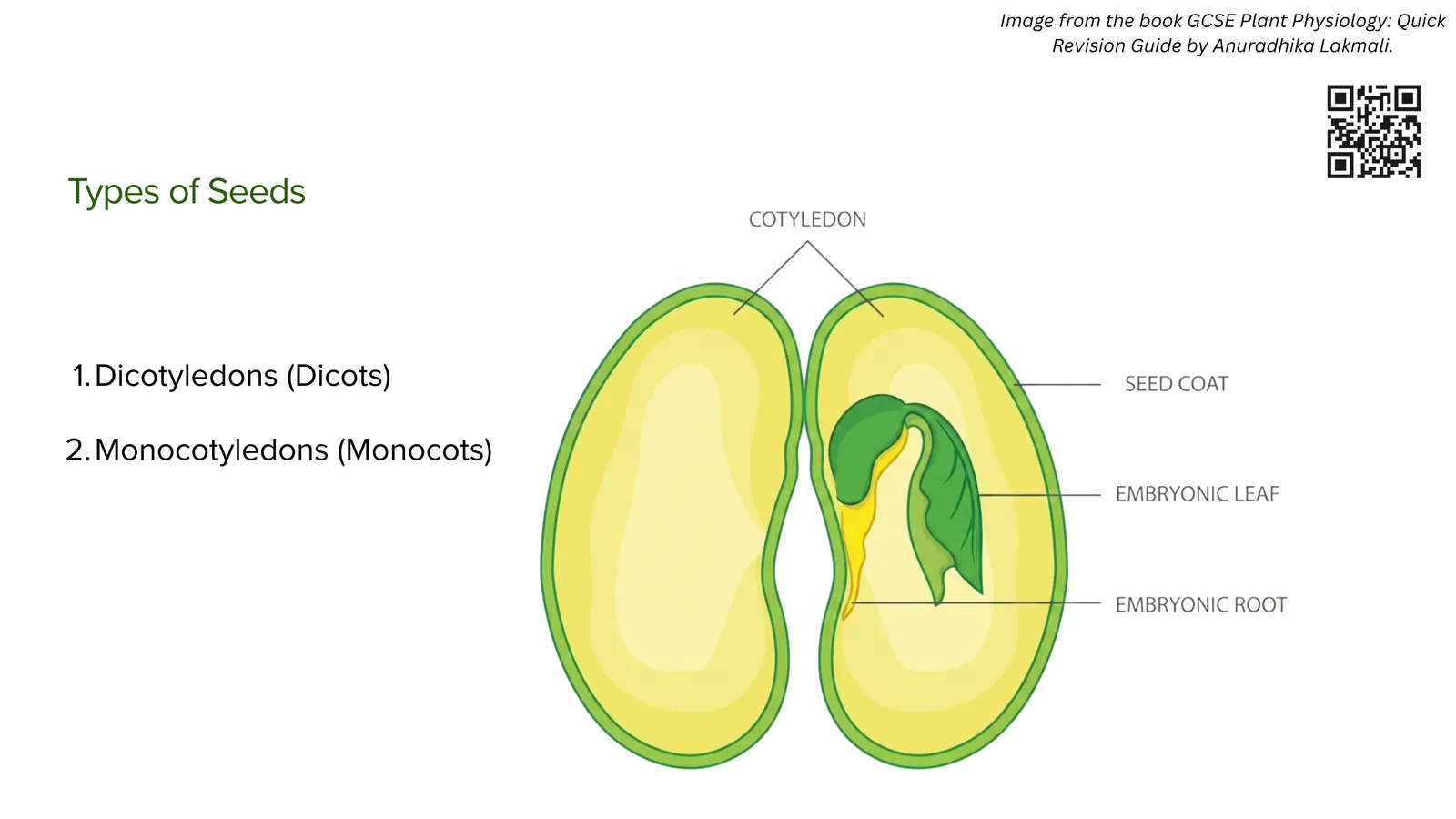
A fleshy fruit such as an apple has three layers in its ovary wall, called the pericarp. They are the exocarp, which is the skin, the mesocarp, which is the fleshy middle, and the endocarp, the inner layer around the seeds. When drawing a longitudinal section of a seed, label the seed coat, plumule, radicle and cotyledon.
🌰
Slide: Seed formation
From zygote to embryo and seed coat
1/1
Dicot and monocot seeds
Feature
Dicotyledon
Monocotyledon
Cotyledons
Two
One
Food store
Mainly in the cotyledons
In a separate endosperm
Leaves
Broad, with a network of veins
Narrow, with parallel veins
Roots
Tap root system
Fibrous root system
Examples
Pea, bean, oak, sunflower
Maize, grass, wheat, orchid
The part of the embryo above the cotyledons is the epicotyl, which grows into the stem and leaves. The part below is the hypocotyl, which becomes the lower stem and joins the root.
🫘
Slide: Types of seeds
Dicotyledons and monocotyledons
1/1
Seed Dispersal
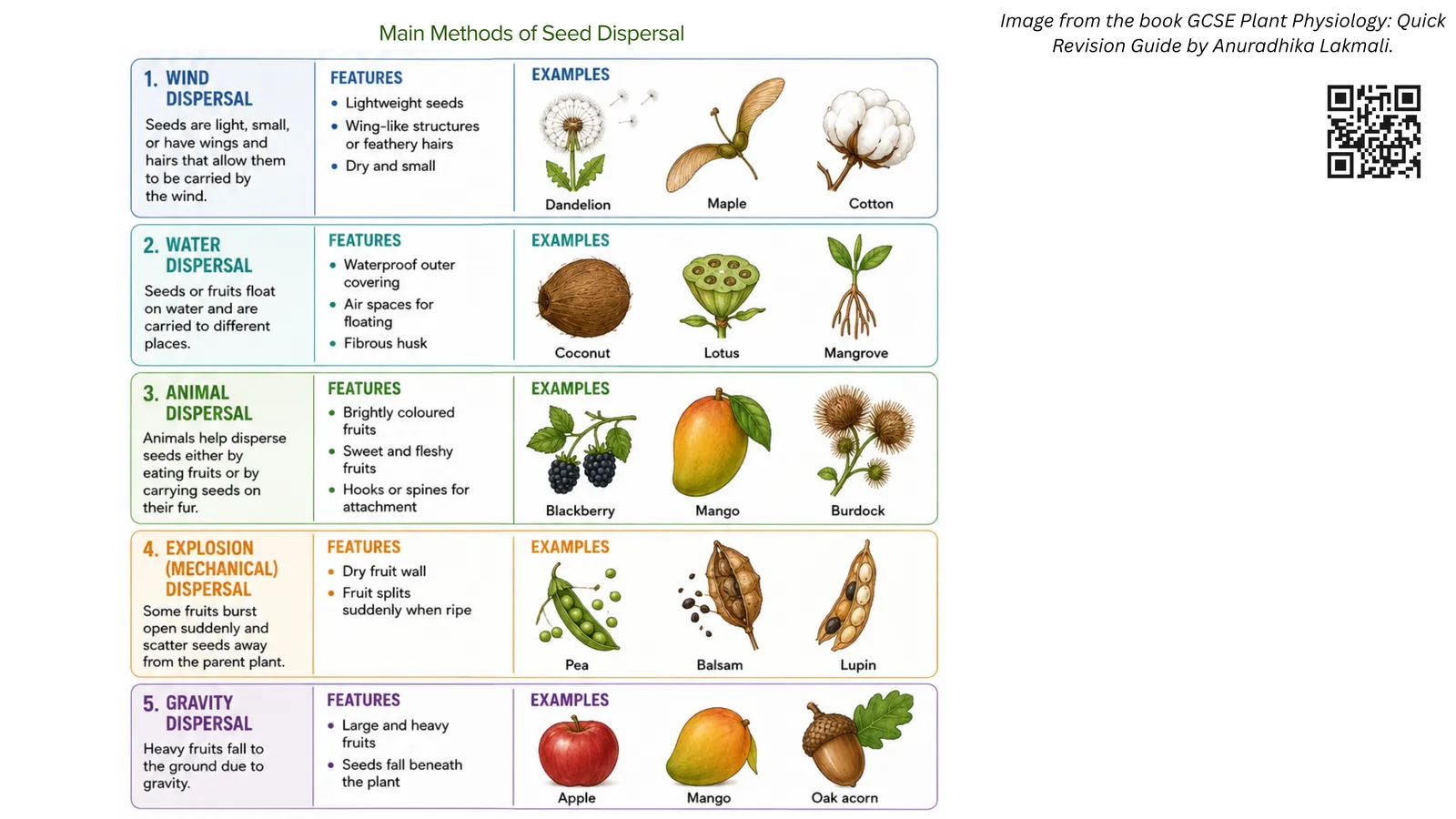
Seed dispersal is the spreading of seeds away from the parent plant. It reduces competition with the parent and with other seedlings for light, water, minerals and space, helps plants colonise new areas and so improves the survival of the species.
Method
Adaptations
Examples
Wind
Light, small, with wings or feathery hairs
Dandelion, sycamore, cotton
Water
Waterproof, with air spaces or a fibrous husk so they float
Coconut, lotus
Animal
Fleshy sweet fruits that are eaten, or hooks that cling to fur
Blackberry, burdock
Explosion
Dry pods that split open and fling seeds away
Pea, balsam, lupin
Gravity
Large, heavy fruits that simply fall
Apple, oak acorn
Link each feature to its method. Wings mean wind, hooks mean animal fur, and a bright sweet fruit means it will be eaten by animals. Squirrels bury acorns and forget some, and those acorns grow into new oak trees far from the parent.
🌬️
Slide: Methods of seed dispersal
Wind, water, animals, explosion and gravity
1/1
Germination
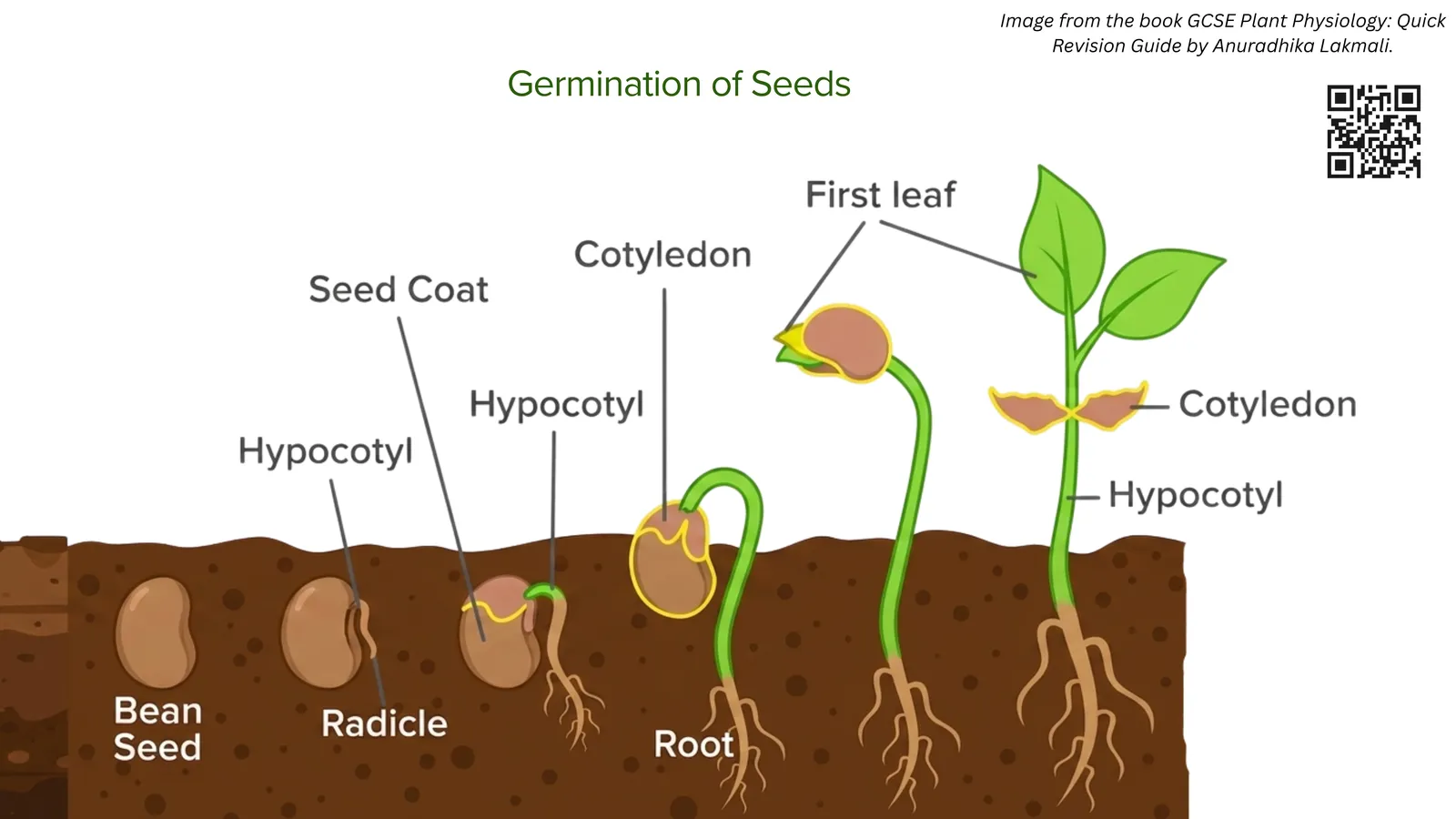
Germination is the growth of a seed into a young plant. A seed is dormant, which means its life processes are almost switched off, until conditions are right.
What a seed needs
Water softens the coat and activates enzymes that digest the stored food.
Oxygen is needed for aerobic respiration, which releases energy for growth.
Warmth gives a suitable temperature for the enzymes to work well.
Seeds do not need light or soil to start germinating, because they use their own food store. Some species do need light or darkness, however.
Stages of germination
1. The seed absorbs water, swells and the seed coat splits.
2. Enzymes break stored starch down into sugars that feed the embryo.
3. The radicle emerges first and grows down to absorb water and minerals.
4. The plumule grows up towards the light.
5. The first leaves open, the seedling begins to photosynthesise and the food store runs out.
🌱
Slide: Germination of seeds
Radicle, plumule and first leaves
1/1
The germination practical
Set up four test tubes containing cotton wool and seeds such as peas. Tube A has wet cotton wool at 20 degrees Celsius and is the control. Tube B has dry cotton wool at 20 degrees Celsius, so it has no water. Tube C has seeds under boiled water with a layer of oil, so it has no oxygen, because boiling removes dissolved oxygen and the oil layer stops oxygen from the air dissolving back in. Tube D has wet cotton wool at 4 degrees Celsius in a refrigerator, so it is too cold.
After several days the seeds in tube A germinate, and none do in tubes B or C. Tube D germinates very slowly, if at all. The conclusion is that seeds need water, oxygen and a suitable temperature. The independent variables are water, oxygen and temperature, the dependent variable is germination, and the controlled variables include seed type and number, the amount of cotton wool and the time. To improve reliability, repeat the experiment, use more seeds and calculate the percentage germination, which is the number of seeds that germinated divided by the total number of seeds, multiplied by 100.
Exam Tips for Reproduction in Plants
For asexual reproduction, use the phrases one parent, mitosis, genetically identical and clones.
For advantage questions, always give a reason, such as sexual reproduction gives variation, so some offspring may survive a new disease.
Learn the links: ovule to seed, ovary to fruit, zygote to embryo, radicle to root and plumule to shoot.
Do not confuse the stigma with the stamen, or pollination with fertilisation.
In practical questions, name the control and the one factor that changes in each tube.
Frequently Asked Questions
What is the difference between pollination and fertilisation?
Pollination is the transfer of pollen from the anther to the stigma. Fertilisation is the fusion of a male gamete with an egg cell inside the ovule.
Why are asexual offspring identical?
Their cells are made by mitosis, which makes exact copies, and there is no fusion of gametes to mix genes.
Why do wind-pollinated flowers have small petals?
They have no need to attract insects, and large petals would block the wind from reaching the anthers and the stigma.
What does a seed need to germinate?
Water, oxygen and a suitable temperature.
Why is tissue culture done in sterile conditions?
Microbes would grow on the nutrient jelly and kill the plantlets.
Key Takeaways
Asexual reproduction needs one parent and makes clones, and sexual reproduction uses gametes and gives variation.
The flower has sepals, petals, stamens and a carpel, and each has a clear job.
Pollination moves pollen to the stigma, and fertilisation is the fusion of gametes in the ovule.
The ovule becomes a seed and the ovary becomes a fruit.
Seeds are dispersed by wind, water, animals, explosion or gravity.
Germination needs water, oxygen and warmth.
Conclusion
Plant reproduction is a story of clever solutions. A plant can copy itself quickly when conditions are good, or mix its genes and send seeds far away when the future is uncertain. If you can name the parts of a flower, follow a pollen grain to the ovule, explain how a seed forms and describe what it needs to grow, you have mastered the topic. Practise the labelled drawings, learn the comparison tables, and always give a reason in your answers.
🗂️ Revision Flashcards
Tap a card to reveal the answer.
🎯 Quick Quiz
8 questions. Pick an answer to check it straight away.
1What does asexual reproduction in plants produce?
Cells are made by mitosis, so the offspring have the same DNA as the parent and are called clones.
2What is pollination?
Pollination is the transfer of pollen grains from the anther to the stigma of a flower.
3After fertilisation, what does the ovary develop into?
The ovule becomes the seed and the ovary becomes the fruit.
4Which feature belongs to a wind-pollinated flower?
Wind-pollinated flowers have a large feathery stigma outside the flower to catch airborne pollen.
5Which part of the embryo is the embryonic root?
The radicle is the embryonic root and the plumule is the embryonic shoot.
6How many cotyledons does a monocotyledon seed have?
Monocotyledons have one cotyledon and dicotyledons have two.
7In the germination practical, why is tube B (dry cotton wool at 20 degrees Celsius) included?
Tube B has no water, so it shows that seeds need water to germinate.
8Which of these is a disadvantage of asexual reproduction?
The offspring are identical, so one disease can affect them all equally.