🧬 Introduction to Cells
Cells are the fundamental building blocks of all living organisms. Every living thing on Earth—from the tiniest bacteria to the largest whale—is made up of cells. While there are many different types of cells, plant and animal cells are the two most commonly studied eukaryotic cells in biology. Both share many similarities because they evolved from a common ancestor, but they also have distinct differences that allow them to perform their unique functions in their respective organisms.
Plant cells and animal cells both contain essential organelles like the nucleus (which houses DNA and controls cell activities), mitochondria (the powerhouses that generate energy through cellular respiration), ribosomes (protein-making factories), endoplasmic reticulum (for protein and lipid synthesis), and the Golgi apparatus (for packaging and shipping proteins). Both cell types are also surrounded by a cell membrane that controls what enters and exits the cell. These shared features reflect their common ancestry and the universal requirements for life.
However, plant cells have several unique structures that animal cells lack. The most prominent is the cell wall—a rigid outer layer made of cellulose that provides structural support and protection. Plant cells also contain chloroplasts, green organelles filled with chlorophyll that enable photosynthesis, allowing plants to convert sunlight, water, and carbon dioxide into glucose and oxygen. Additionally, plant cells typically have a large central vacuole that can occupy up to 90% of the cell's volume, storing water, nutrients, and waste products while helping maintain cell structure (turgor pressure). Animal cells, on the other hand, have centrioles (which help organize cell division), lysosomes (digestive organelles that break down waste), and multiple small vacuoles rather than one large one. Understanding these differences helps us appreciate how cells are adapted to their specific roles in plants and animals.
📄 Worksheets
Click on worksheets to view them in full size, or download as PDF
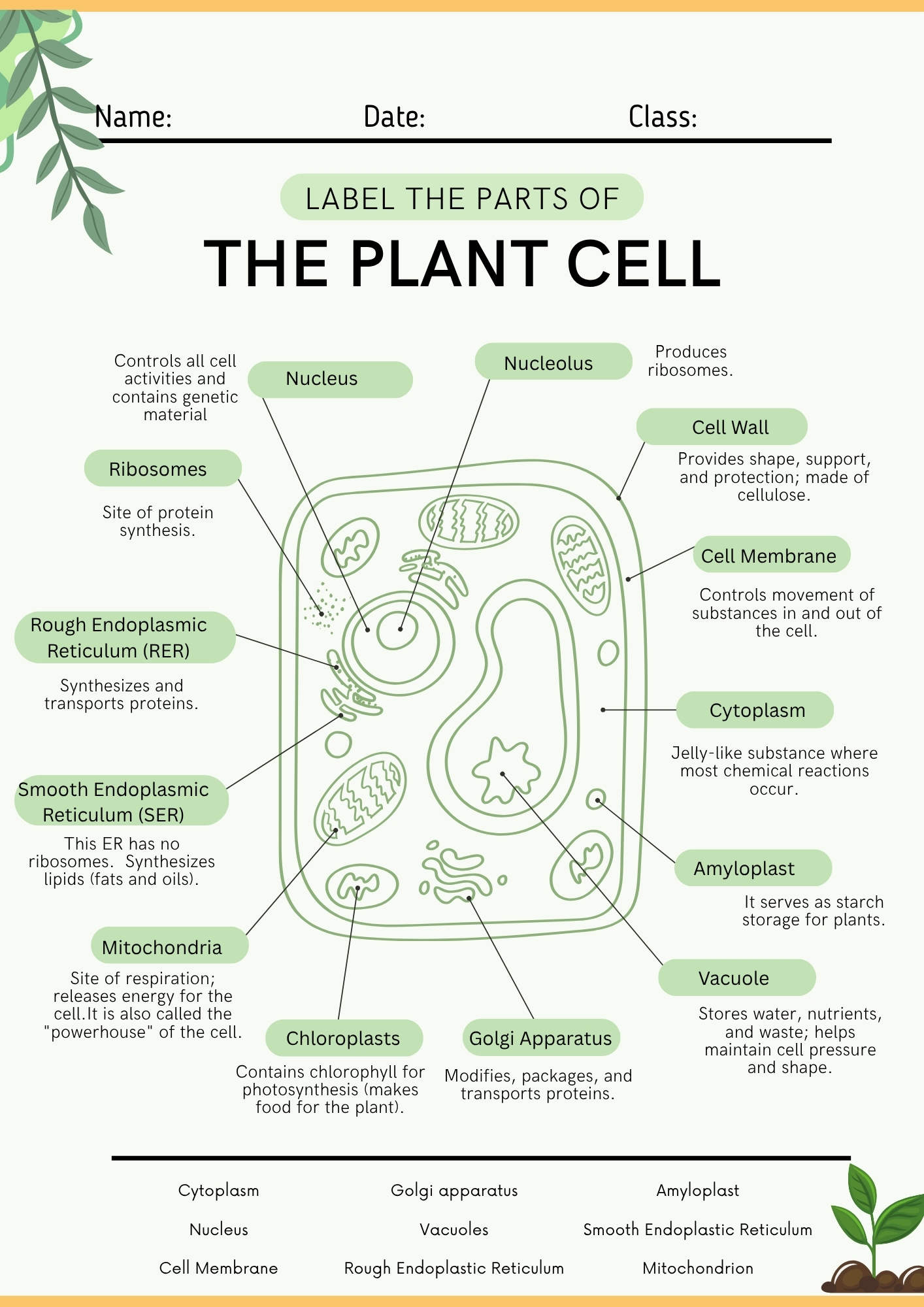
Parts of a Plant Cell
Learn to identify and label all the key organelles found in a plant cell, including the cell wall, chloroplasts, and large central vacuole.
Download PDF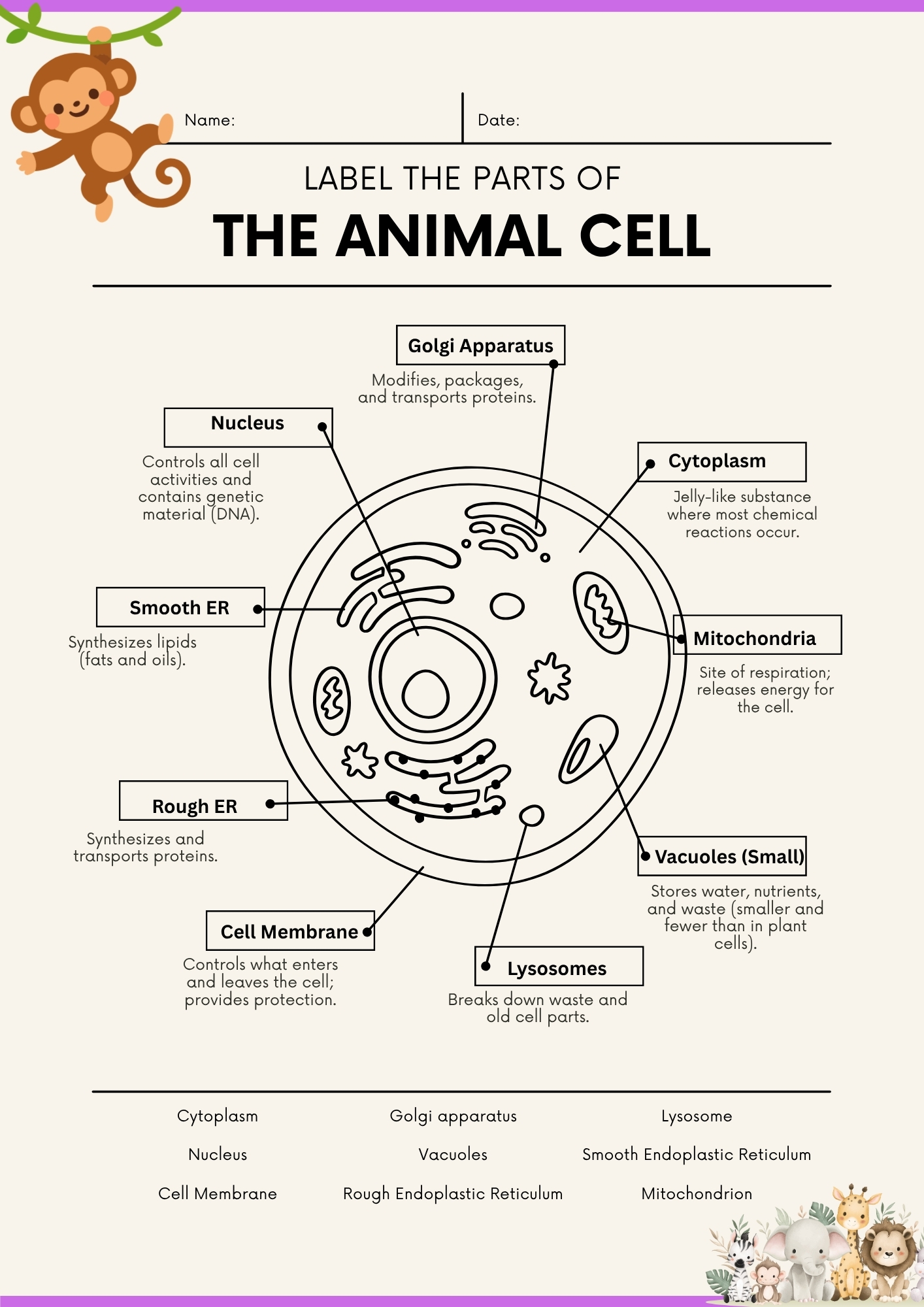
Parts of an Animal Cell
Explore and label the structures unique to animal cells, such as centrioles and lysosomes, plus the organelles shared with plant cells.
Download PDF🎮 Interactive Activity
🔬 Cell Venn Diagram Challenge
Drag each organelle to the correct category: Plant Only, Both Cells, or Animal Only
🧬 Organelle Cards
📊 Plant Cell vs Animal Cell: Differences and Similarities
Two kinds of eukaryotic cell
Plant cells and animal cells are both eukaryotic: each has a true nucleus enclosed in a membrane and a set of membrane-bound organelles floating in the cytoplasm. That shared plan is why the two look so alike in a textbook diagram. The differences come from the different ways plants and animals live. A plant stands still, makes its own food from sunlight and holds itself up without a skeleton; an animal moves, eats other organisms and supports itself with bones or a shell. Every difference in the table below can be traced back to one of those facts.
Comparison table: plant cell vs animal cell
| Feature | Plant cell | Animal cell |
|---|---|---|
| Cell wall | Present; a rigid outer layer made of cellulose | Absent; the cell membrane is the outer boundary |
| Cell membrane | Present, just inside the cell wall | Present, forms the outside of the cell |
| Chloroplasts | Present in green parts (leaves, stems); contain chlorophyll for photosynthesis | Absent; animals cannot photosynthesise |
| Vacuole | One large, permanent central vacuole filled with cell sap; can fill most of the cell | Small, temporary vacuoles, or none at all |
| Shape | Regular and fixed, often box-like or rectangular, because of the wall | Irregular and rounded; can change shape |
| Storage carbohydrate | Starch, stored as grains | Glycogen, stored mainly in liver and muscle cells |
| Centrioles | Not normally present | Present; help organise the spindle during cell division |
| Lysosomes | Rare; the vacuole does much of the breaking-down work | Common; contain digestive enzymes |
| Position of nucleus | Usually pushed to one side by the large vacuole | Usually near the centre of the cell |
| Nucleus, mitochondria, ribosomes, cytoplasm | Present | Present |
| Typical size | Generally larger, roughly 10 to 100 micrometres | Generally smaller, roughly 10 to 30 micrometres |
What plant cells have that animal cells do not
Three structures are found in plant cells but never in animal cells, and they are the ones to learn first. The cell wall is a tough layer of cellulose fibres outside the membrane. It is fully permeable, so it does not control what enters the cell; its job is support. When the cell is full of water the contents press outward against the wall, making the cell firm, or turgid, and millions of turgid cells packed together hold a leaf flat and a stem upright with no bones at all. A wilting plant is one whose cells have lost that pressure.
Chloroplasts are where photosynthesis happens. They contain the green pigment chlorophyll, which absorbs light energy so the cell can build glucose from carbon dioxide and water. Not every plant cell has them: root cells and the cells of an onion bulb grow underground in the dark, so they contain none. The large permanent vacuole stores water, sugars and mineral ions as cell sap and, by pressing the cytoplasm against the wall, provides the turgor pressure that keeps the cell rigid.
What animal cells have that plant cells do not
Animal cells have centrioles, a pair of tiny cylinders near the nucleus that organise the spindle fibres which pull chromosomes apart during cell division. Plant cells divide successfully without them. Animal cells also usually contain many lysosomes, small sacs of digestive enzymes that break down worn-out organelles and, in white blood cells, destroy engulfed bacteria. Most importantly, the absence of a cell wall lets animal cells take on almost any shape: a nerve cell can extend a fibre a metre long, a muscle cell can shorten, and a white blood cell can flow around a microbe and swallow it. None of that is possible for a cell boxed in by cellulose.
Starch or glycogen?
Both cell types run on glucose, and both store spare glucose by linking many molecules into a long chain. Plants join them into starch, which is why iodine turns a potato slice blue-black. Animals join them into glycogen, a more branched molecule that can be broken down quickly when muscles need energy. The other big difference is where the glucose comes from in the first place: a plant cell with chloroplasts makes its own, while an animal cell must be supplied with glucose from digested food carried in the blood.
How the two cells behave in water
The cell wall makes a visible difference when cells are placed in solutions of different concentration. In pure water, water moves into both cells by osmosis. A plant cell swells until the wall stops it, becoming turgid but unharmed. An animal cell such as a red blood cell has nothing to stop it, so it keeps swelling until it bursts. In a concentrated salt or sugar solution water leaves both cells. The plant cell's membrane and cytoplasm shrink away from the wall, a state called plasmolysis, while the whole animal cell shrivels. Because plant cells cannot pinch in half, they also divide differently: a new wall, the cell plate, is built across the middle of the parent cell, whereas an animal cell simply pinches its membrane inward.
Telling them apart under the microscope
In a school laboratory the classic specimens are onion epidermis and human cheek cells. Onion cells appear as neat, brick-like blocks with clear straight walls, a nucleus near the edge and no green colour. Cheek cells are scattered, rounded and irregular, with a nucleus near the centre and no visible wall. If you see green discs inside regular block-shaped cells, as in a leaf of pondweed, you are looking at plant cells with chloroplasts. If the cells have no walls and no fixed shape, they are animal cells.
What the two cells share
- A cell membrane that controls which substances enter and leave.
- Cytoplasm, the jelly-like fluid in which chemical reactions take place.
- A nucleus containing DNA in chromosomes, which controls the cell's activities.
- Mitochondria, where aerobic respiration releases energy from glucose. Plant cells need them too: chloroplasts make glucose, but mitochondria release the energy from it.
- Ribosomes, where proteins are assembled.
- Endoplasmic reticulum and Golgi apparatus for making, modifying and transporting proteins and lipids.
For a full tour of each organelle, see the separate lessons on the parts of a plant cell and the parts of an animal cell.
Key terms
- Eukaryotic cell
- A cell with a nucleus and membrane-bound organelles; plant, animal, fungal and protist cells are all eukaryotic.
- Cellulose
- The carbohydrate that forms the fibres of the plant cell wall (fungal walls use chitin instead).
- Turgid
- Describes a plant cell that is full of water and pressing firmly against its wall.
- Plasmolysis
- The shrinking of a plant cell's cytoplasm away from the wall after water loss.
- Starch
- The storage carbohydrate of plants.
- Glycogen
- The storage carbohydrate of animals.
- Centrioles
- Paired structures in animal cells that organise spindle fibres during division.