Every sound you have ever heard, from your favourite song to a friend whispering your name, has travelled on an incredible journey through your ear. In a fraction of a second, air vibrations are collected, amplified, turned into fluid waves and finally converted into electrical signals your brain understands. At the same time, other parts of your ear are quietly keeping you upright. In this guide we take you through every part of the human ear, explain exactly how hearing and balance work and look at how to protect your hearing for life.
📖 Lesson
Follow sound from the pinna to the brain, see how the inner ear keeps you balanced, and learn how to protect your hearing.
The Three Main Parts of the Human Ear
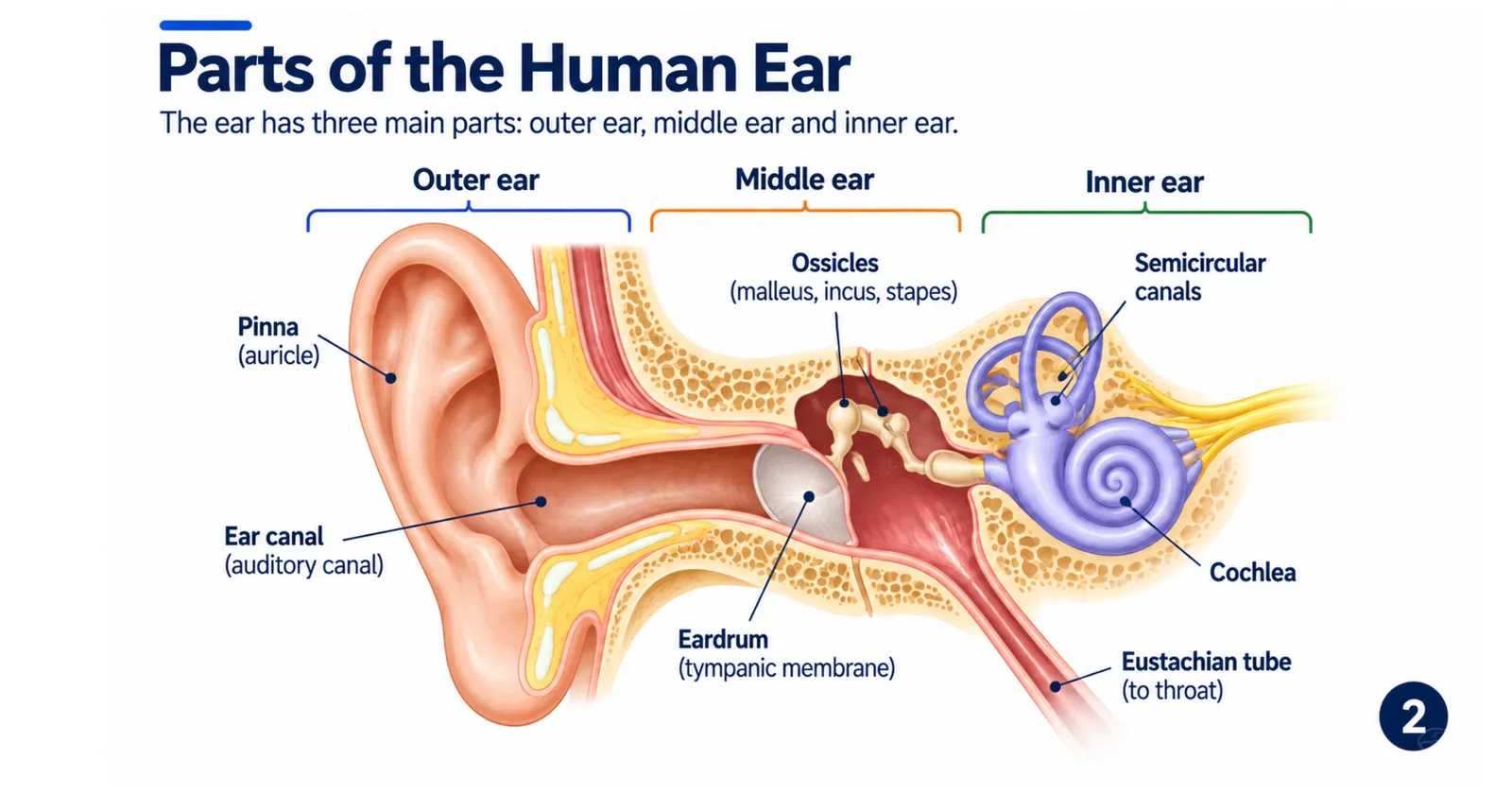
| Part of the ear | Main structures | Main function |
|---|---|---|
| Outer ear | Pinna, ear canal, eardrum (boundary) | Collects sound waves and directs them to the eardrum |
| Middle ear | Malleus, incus, stapes, Eustachian tube | Amplifies vibrations and passes them to the inner ear |
| Inner ear | Cochlea, semicircular canals, vestibule, auditory nerve | Converts vibrations into nerve impulses and detects balance |
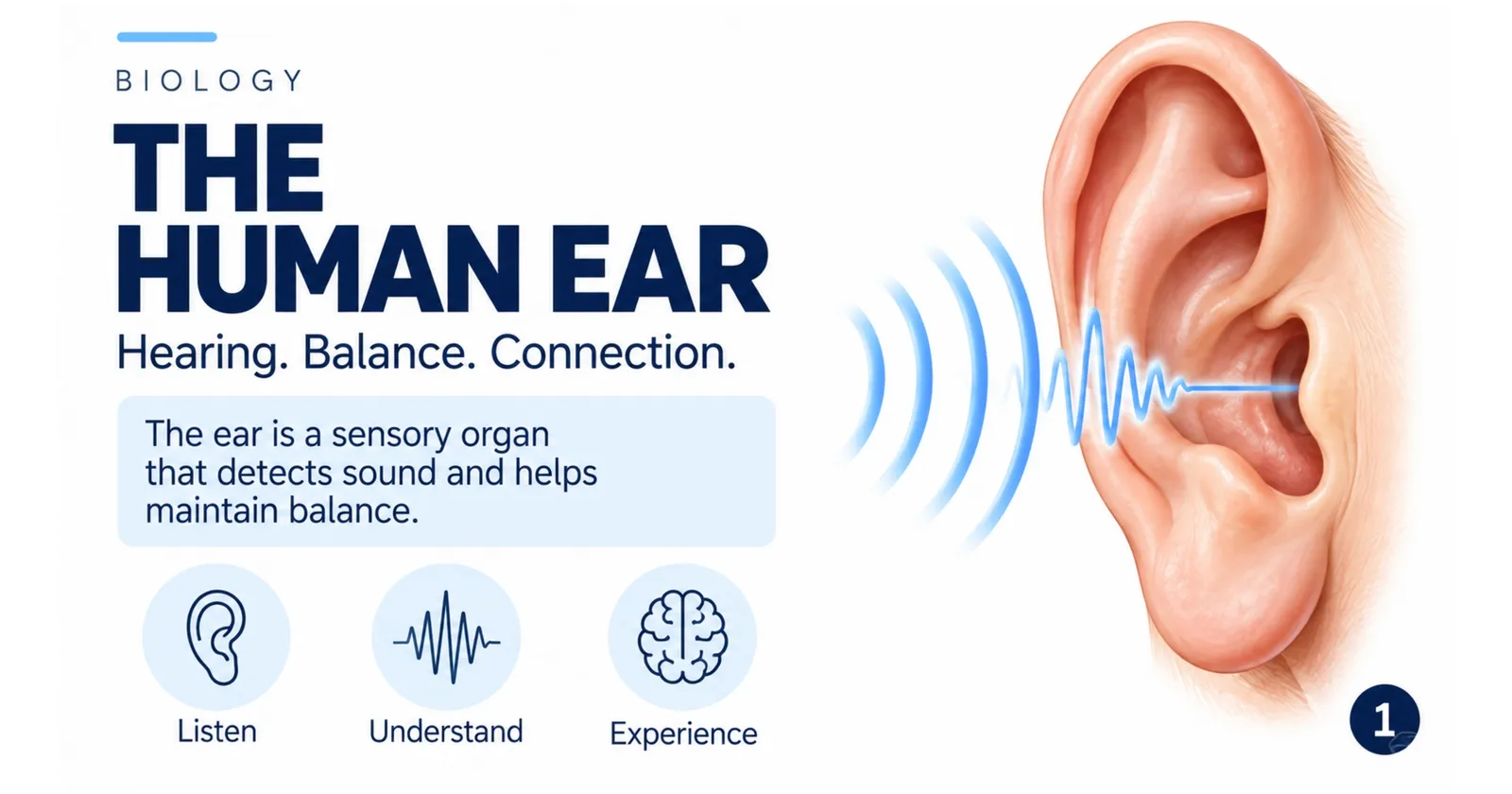
Slides: The human ear and its three parts
Outer, middle and inner ear at a glance
1/2
The Outer Ear: Collecting Sound
The pinna (auricle)
The pinna is the visible part of your ear, made of skin-covered elastic cartilage. Its curves and folds act like a funnel, collecting sound waves and directing them into the ear canal. The shape of the pinna also slightly changes sounds depending on where they come from, which helps the brain work out whether a sound is in front, behind, above or below you. Some animals, such as cats and horses, can swivel their pinnae towards sounds, but humans have mostly lost this ability.
The ear canal (external auditory canal)
The ear canal is a tube about 2.5 centimetres long that leads to the eardrum. Its lining contains fine hairs and special glands that produce earwax (cerumen). Earwax traps dust and microbes, keeps the canal moist and has mild antibacterial properties. The ear canal is self-cleaning: jaw movements slowly push old wax outwards. This is why doctors advise against using cotton buds, which can push wax deeper and even damage the eardrum.
The eardrum (tympanic membrane)
The eardrum is a thin, tightly stretched membrane about 1 centimetre across that separates the outer ear from the middle ear. When sound waves reach it, it vibrates at the same frequency as the sound.
The Middle Ear: Amplifying Vibrations
The middle ear is a small air-filled space inside the temporal bone of the skull.
The ossicles: the smallest bones in the body
Three tiny bones, called the ossicles, form a chain across the middle ear:
Malleus (hammer): attached to the eardrum.
Incus (anvil): the middle bone.
Stapes (stirrup): the smallest bone in the human body, only about 3 millimetres long. Its footplate fits into the oval window of the inner ear.
When the eardrum vibrates, the ossicles move like a system of levers, passing the vibrations to the oval window. Because the eardrum is about 20 times larger than the oval window, and the ossicles act as levers, the pressure of the vibrations is increased roughly 20 times. This amplification is essential because the inner ear is filled with fluid, and it takes much more force to make fluid vibrate than air.
Protecting your ears from loud sounds
Two tiny muscles in the middle ear contract when you hear a very loud sound, stiffening the ossicles and reducing the vibrations reaching the inner ear. This is called the acoustic reflex. However, it takes a fraction of a second to work, so it cannot protect you from sudden bangs such as gunshots or fireworks.
The Eustachian tube
The Eustachian tube connects the middle ear to the back of the nose and throat. It opens when you swallow or yawn, letting air in or out so that the air pressure is the same on both sides of the eardrum. When you fly in a plane or drive up a mountain, the outside air pressure changes and your ears feel blocked until the tube opens with a satisfying "pop". In children the tube is shorter and more horizontal, which is why middle ear infections are so common in young children.
The Inner Ear: Where Hearing Really Happens
The inner ear is a complex set of fluid-filled tubes deep in the skull, sometimes called the labyrinth.
The cochlea: the organ of hearing
The cochlea is a spiral tube shaped like a snail shell, about the size of a pea. If unrolled, it would be about 3.5 centimetres long. Inside, it is divided into fluid-filled channels and contains the organ of Corti, which holds around 15,000 to 20,000 specialised hair cells. Each hair cell has a bundle of tiny projections called stereocilia on its top.
How the cochlea detects different pitches
The basilar membrane that runs along the cochlea is narrow and stiff at the base and wide and floppy at the tip. High-pitched sounds make the base vibrate most, while low-pitched sounds make the tip vibrate most. The brain works out the pitch of a sound from which hair cells are stimulated, and works out the loudness from how strongly they are stimulated. Healthy young humans can hear frequencies from about 20 hertz to 20,000 hertz.
The auditory nerve
The hair cells connect to the auditory nerve (cochlear nerve), which carries nerve impulses to the auditory cortex in the temporal lobe of the brain, where the signals are interpreted as sound.
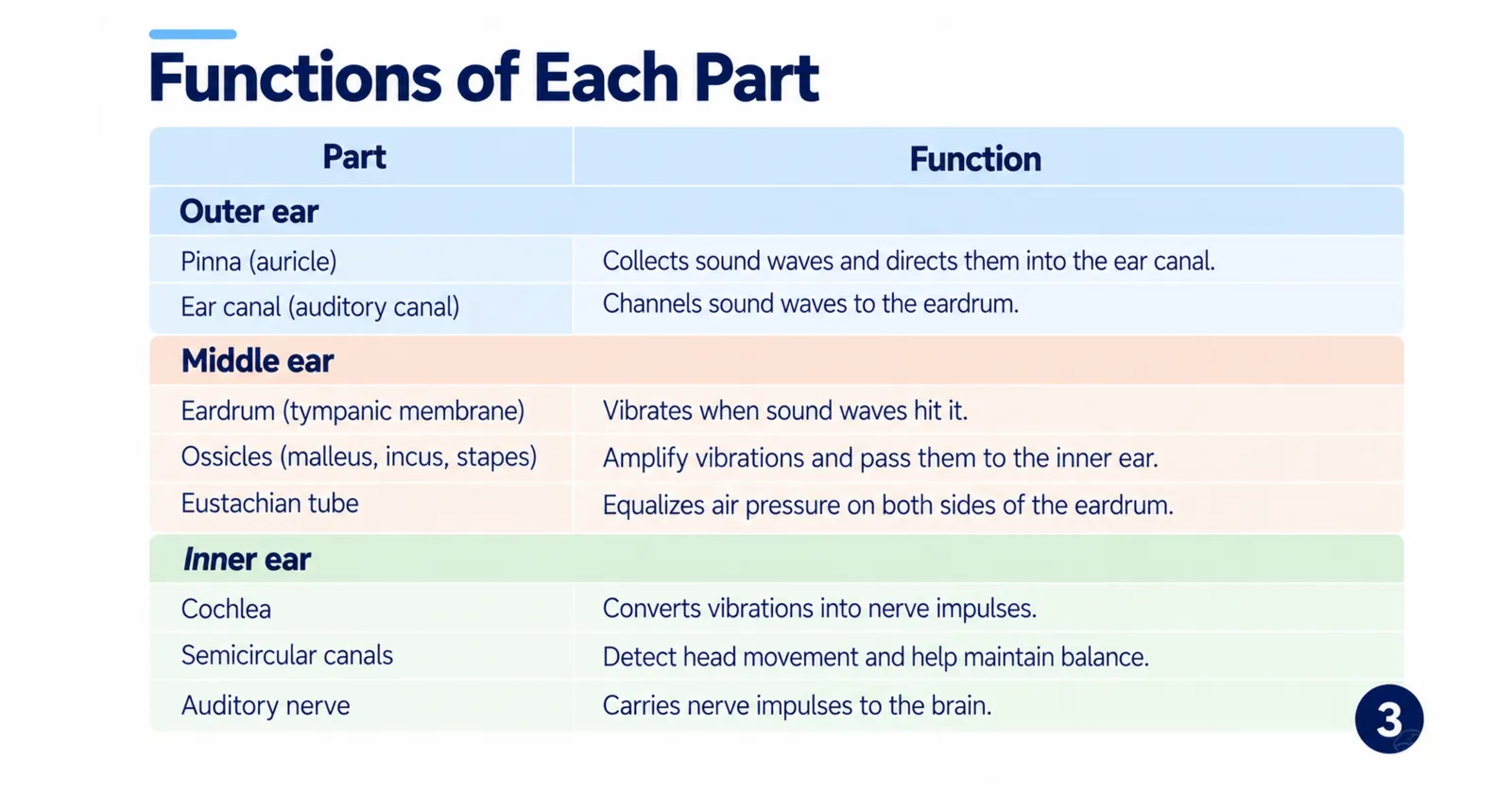
Slide: Functions of each part
What every structure of the ear does
1/1
How We Hear: The Hearing Process Step by Step
This sequence is a favourite exam question, so learn the order carefully.
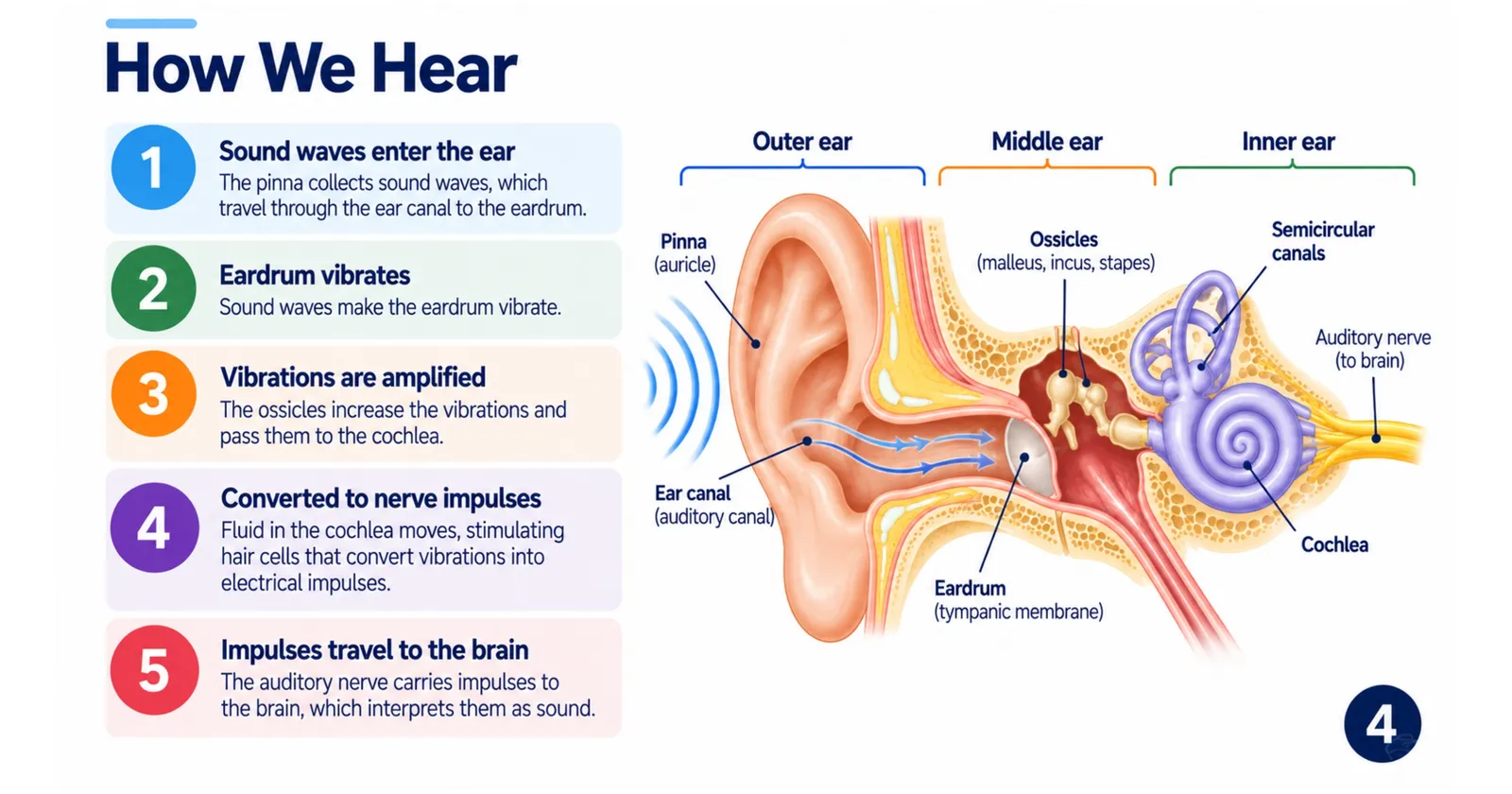
Sound waves are collected by the pinna and travel down the ear canal.
The sound waves make the eardrum vibrate.
The vibrations pass to the malleus, incus and stapes, which amplify them.
The stapes pushes on the oval window, making the fluid inside the cochlea vibrate.
The moving fluid makes the basilar membrane vibrate, bending the stereocilia on the hair cells.
Bending the stereocilia opens ion channels, generating electrical nerve impulses.
Impulses travel along the auditory nerve to the brain.
The brain interprets the impulses as sound.
The round window, a second membrane-covered opening below the oval window, bulges outwards as the fluid moves, allowing the fluid to vibrate freely.
Slide: How we hear
The hearing pathway in five steps
1/1
Why two ears are better than one
Having two ears lets you locate sounds. A sound coming from your left reaches your left ear a tiny fraction of a second earlier and slightly louder than your right ear. Your brain uses these tiny differences to work out the direction of the sound.
How the Ear Controls Balance
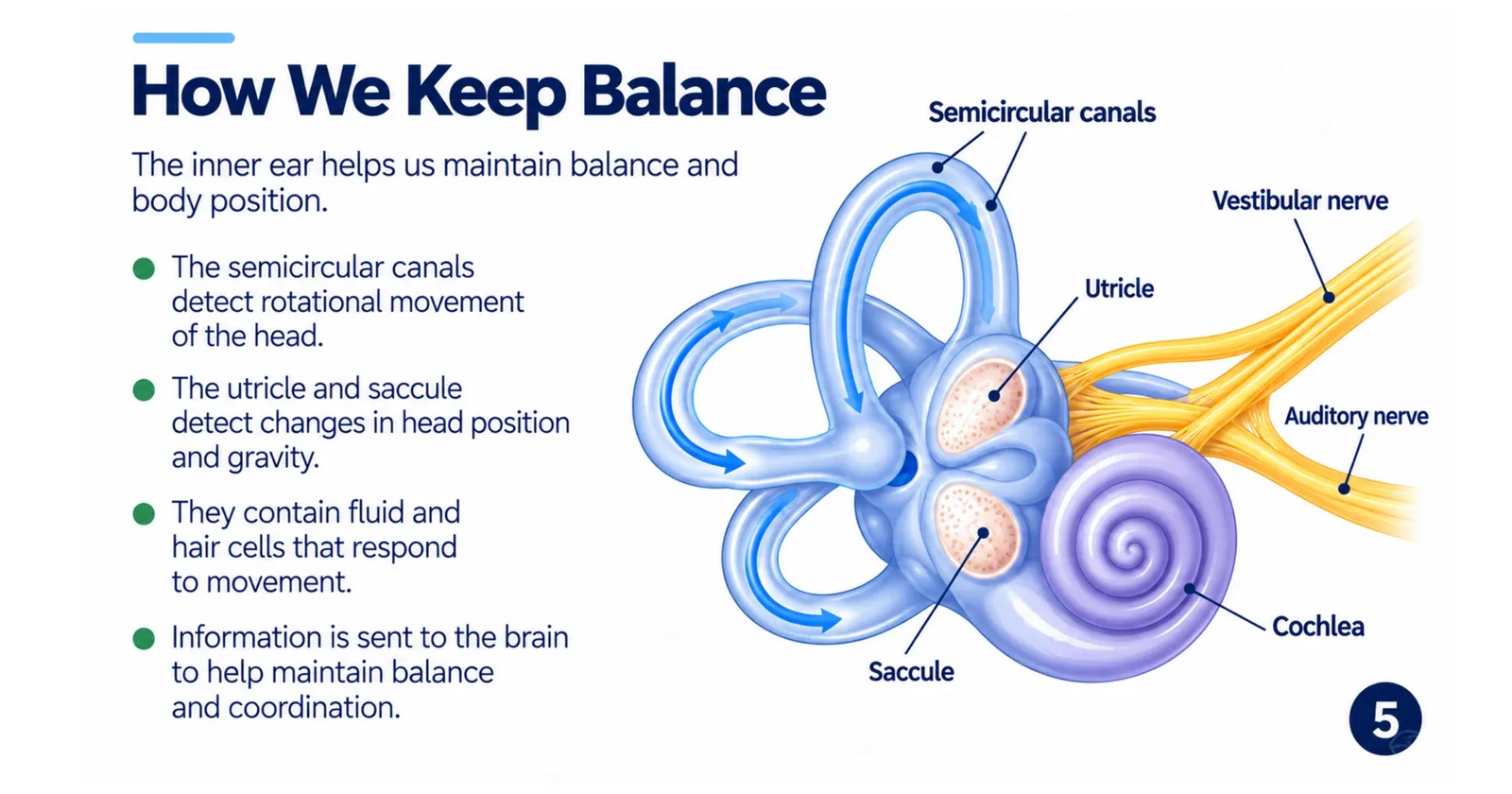
Your inner ear does more than hear. The vestibular system detects movement and the position of your head.
The semicircular canals
There are three semicircular canals in each ear, arranged at right angles to one another like the three sides of a box corner. Each one detects rotation in a different direction: nodding up and down, shaking side to side and tilting towards your shoulders. The canals are filled with fluid. When you turn your head, the fluid lags behind and bends a jelly-like structure called the cupula, which stimulates hair cells and sends signals to the brain.
The vestibule (utricle and saccule)
The utricle and saccule detect gravity and straight-line movement, such as speeding up in a car or going up in a lift. They contain tiny crystals of calcium carbonate called otoliths, which move when you tilt your head, pulling on hair cells.
Why spinning makes you dizzy
When you spin round and suddenly stop, the fluid in your semicircular canals keeps moving for a few seconds. Your ears tell your brain you are still turning, but your eyes say you have stopped. This mismatch makes you dizzy. Travel sickness is caused by a similar conflict between signals from your eyes and your inner ear.
Slide: How we keep balance
Semicircular canals, utricle and saccule
1/1
Common Ear Problems and Hearing Loss
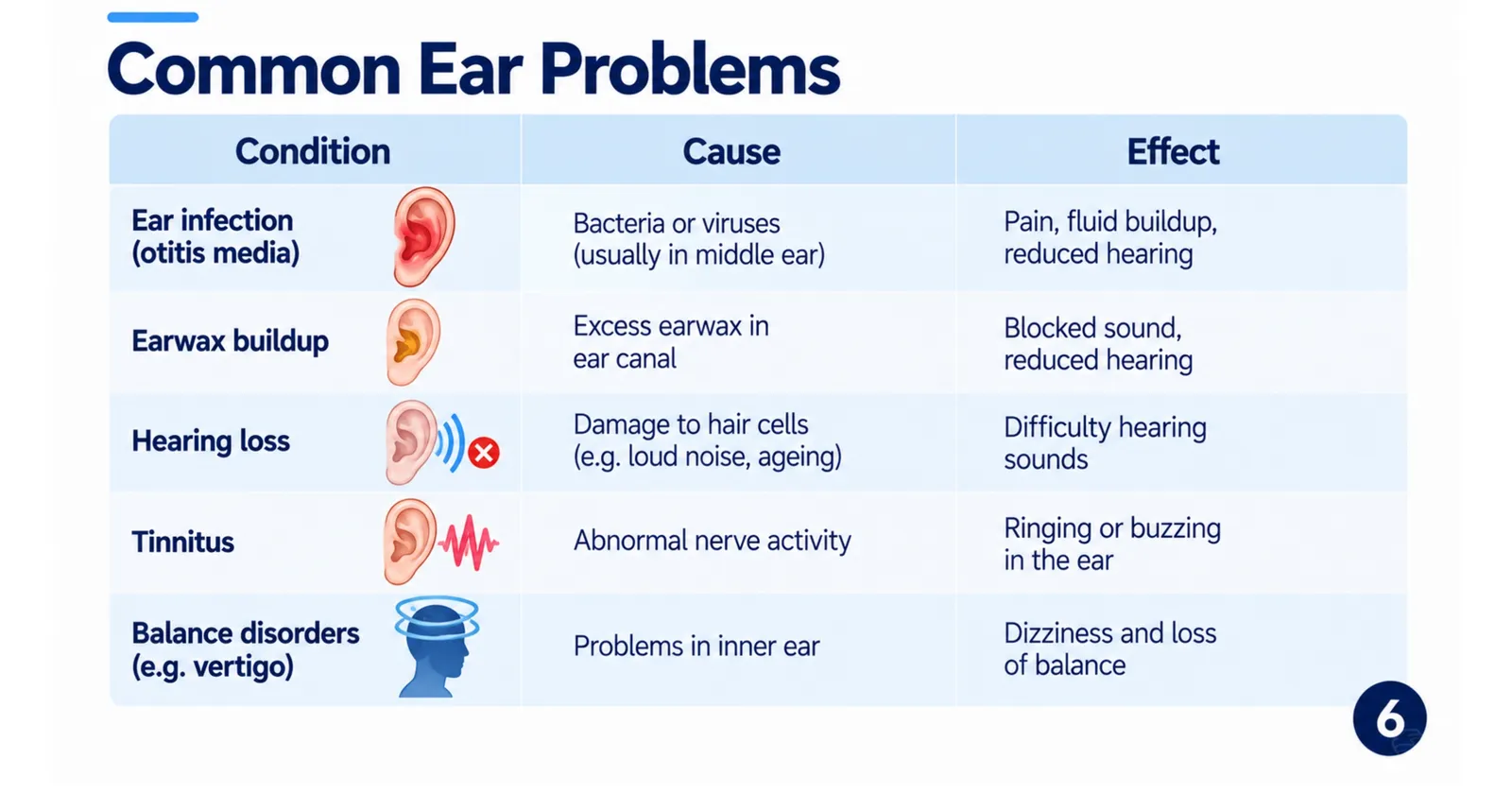
Ear infections (otitis media): infections of the middle ear, common in children, causing pain, fever and temporary hearing loss.
Swimmer's ear (otitis externa): infection of the ear canal, often after water gets trapped inside.
Earwax build-up: can block the canal and muffle hearing.
Perforated eardrum: a hole in the eardrum caused by infection, loud noise or injury. Most heal on their own.
Tinnitus: ringing, buzzing or hissing in the ears without an outside sound, often linked to noise damage.
Vertigo: a spinning sensation caused by problems in the vestibular system.
Conductive hearing loss: sound cannot pass properly through the outer or middle ear, for example because of wax, fluid or damaged ossicles.
Sensorineural hearing loss: damage to the hair cells or the auditory nerve. Hair cells in humans do not grow back, so this type is usually permanent.
Age-related hearing loss (presbycusis): gradual loss of high-frequency hearing as we age.
Hearing aids amplify sound, and cochlear implants can bypass damaged hair cells by stimulating the auditory nerve directly with electrical signals, allowing many profoundly deaf people to hear.
Slide: Common ear problems
Condition, cause and effect
1/1
Hearing in Other Animals
Humans hear a fairly narrow range of sounds compared with many animals. Dogs can hear up to around 45,000 hertz, which is why dog whistles seem silent to us. Bats and dolphins produce and detect ultrasound up to 100,000 hertz or more and use the echoes to find prey, a skill called echolocation. Elephants communicate using very low-pitched infrasound that travels many kilometres. Owls have ears at slightly different heights on their heads, which lets them pinpoint a mouse moving under snow in complete darkness.
How to Protect Your Hearing
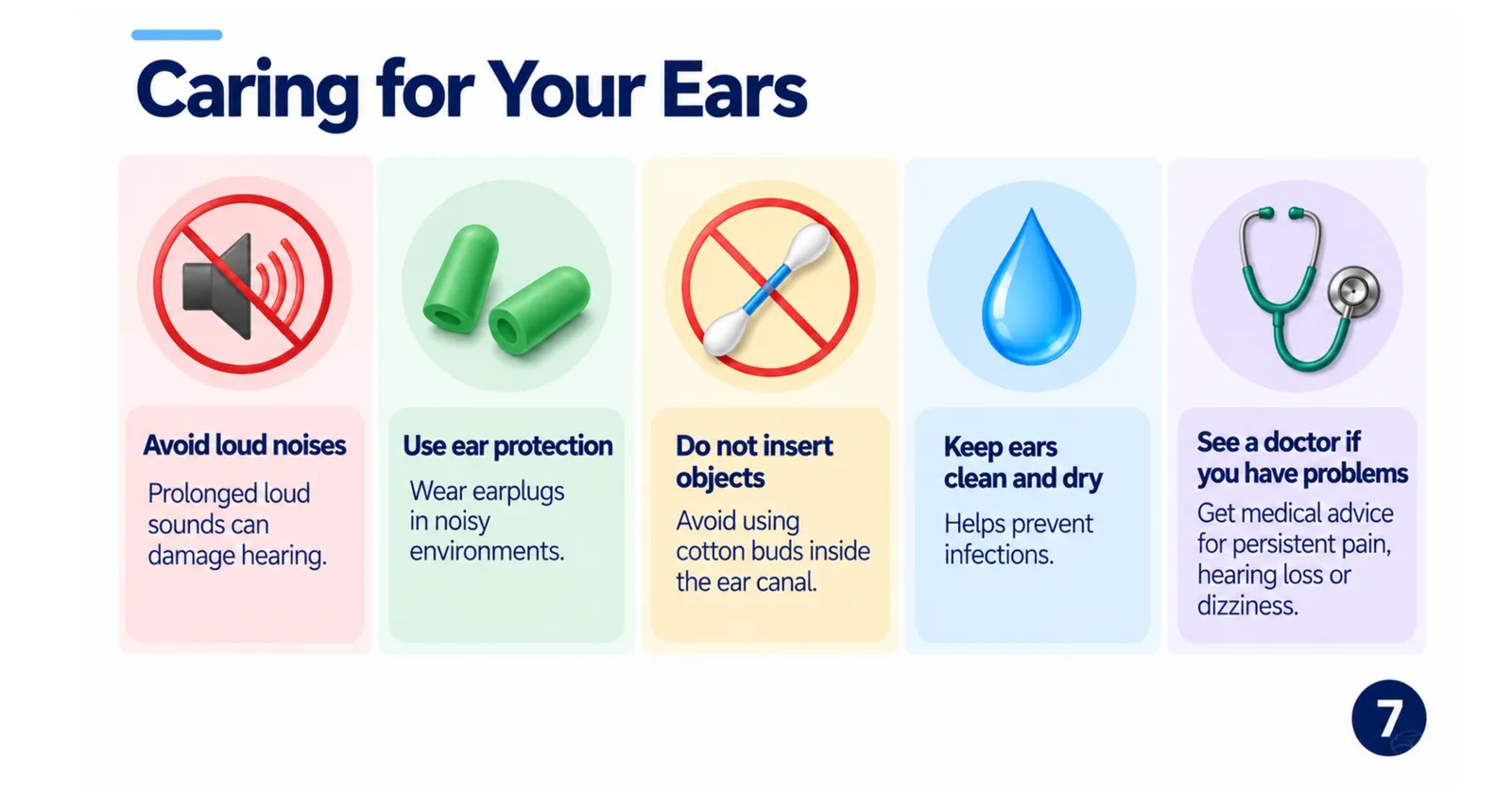
Sound level is measured in decibels (dB). Long exposure to sounds above about 85 dB, roughly the level of heavy traffic, can damage hair cells. A rock concert can reach 110 dB, and every 10 dB increase is about 10 times more intense.
Follow the 60/60 rule: listen with headphones at no more than 60 percent volume for no more than 60 minutes at a time.
Wear ear protection at concerts, on building sites and near loud machinery.
Give your ears quiet time to recover after noisy events.
Never put objects such as cotton buds into your ear canal.
Get your hearing tested if sounds seem muffled or you hear ringing.
Slide: Caring for your ears
Five habits that protect your hearing
1/1
Amazing Facts About the Human Ear
Your ears never stop hearing, even while you sleep; your brain simply ignores most sounds.
The stapes is the smallest named bone in the body.
The cochlea is fully formed and adult-sized at birth.
Babies can hear sounds from inside the womb from about 18 weeks of pregnancy.
Ears and noses continue to appear larger as we age because cartilage changes and skin stretches.
Frequently Asked Questions About the Human Ear
Why do my ears pop on an aeroplane?
Air pressure changes during take-off and landing. Swallowing opens the Eustachian tube and equalises the pressure on both sides of the eardrum.
Can damaged hearing be repaired?
Conductive hearing loss can often be treated. Damage to hair cells is usually permanent, though hearing aids and cochlear implants can help.
Why does my own voice sound strange on a recording?
When you speak, you hear your voice through the air and through vibrations in your skull bones, which makes it sound deeper. A recording captures only the airborne sound.
Key Takeaways
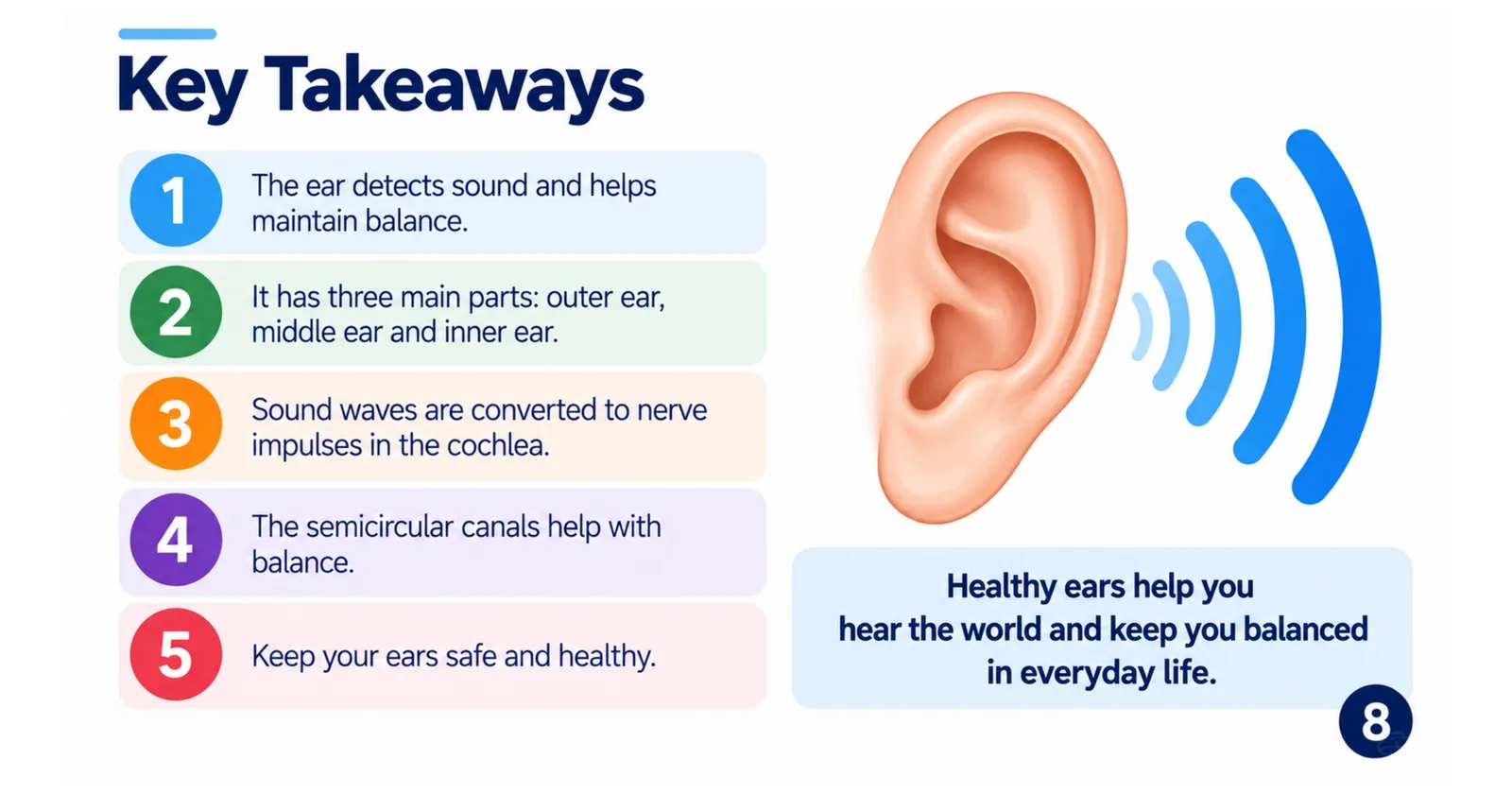
The ear has three parts: the outer, middle and inner ear.
The eardrum and ossicles pass on and amplify sound vibrations.
Hair cells in the cochlea turn vibrations into nerve impulses for the brain.
The semicircular canals and vestibule detect movement and help us balance.
Loud noise permanently damages hair cells, so protecting your hearing matters.
Slide: Key takeaways
1/1
Hearing is only one of your amazing senses. Continue with our guide to the human eye to discover how you see the world in colour and detail.
🗂️ Revision Flashcards
Tap a card to reveal the answer.
🎯 Quick Quiz
8 questions. Pick an answer to check it straight away.
1Which part of the ear amplifies vibrations using three tiny bones?
The middle ear uses the ossicles (malleus, incus and stapes) to amplify vibrations.
2Which is the smallest bone in the human body?
The stapes (stirrup) is only about 3 millimetres long.
3Roughly how many times do the eardrum and ossicles increase the pressure of the vibrations?
The eardrum is about 20 times larger than the oval window, and the ossicles act as levers, so pressure rises roughly 20 times.
4What is the job of the Eustachian tube?
It opens when you swallow or yawn so the air pressure is the same on both sides of the eardrum.
5In the hearing process, what happens straight after the stapes pushes on the oval window?
The stapes pushing on the oval window makes the fluid inside the cochlea vibrate.
6What range of frequencies can healthy young humans hear?
Healthy young humans hear from about 20 hertz to 20,000 hertz.
7Which structures detect gravity and straight-line movement?
The utricle and saccule in the vestibule contain otoliths that detect gravity and straight-line movement.
8Why is sensorineural hearing loss usually permanent?
It is damage to the hair cells or auditory nerve, and human hair cells do not grow back.