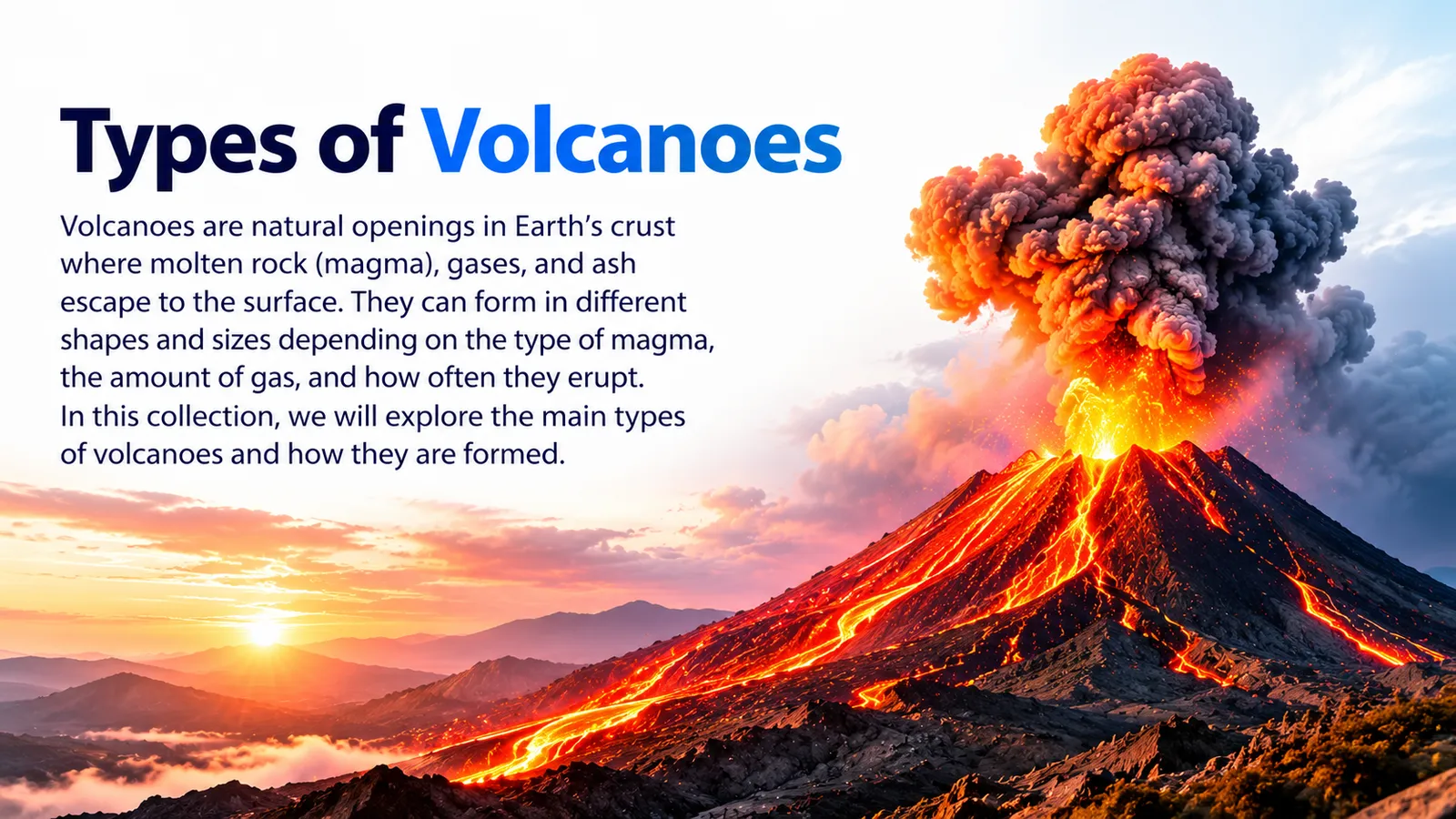
How volcanoes form, the parts of a volcano and every main type, from Mauna Loa to Toba, with what decides how each one erupts.
What Is a Volcano?
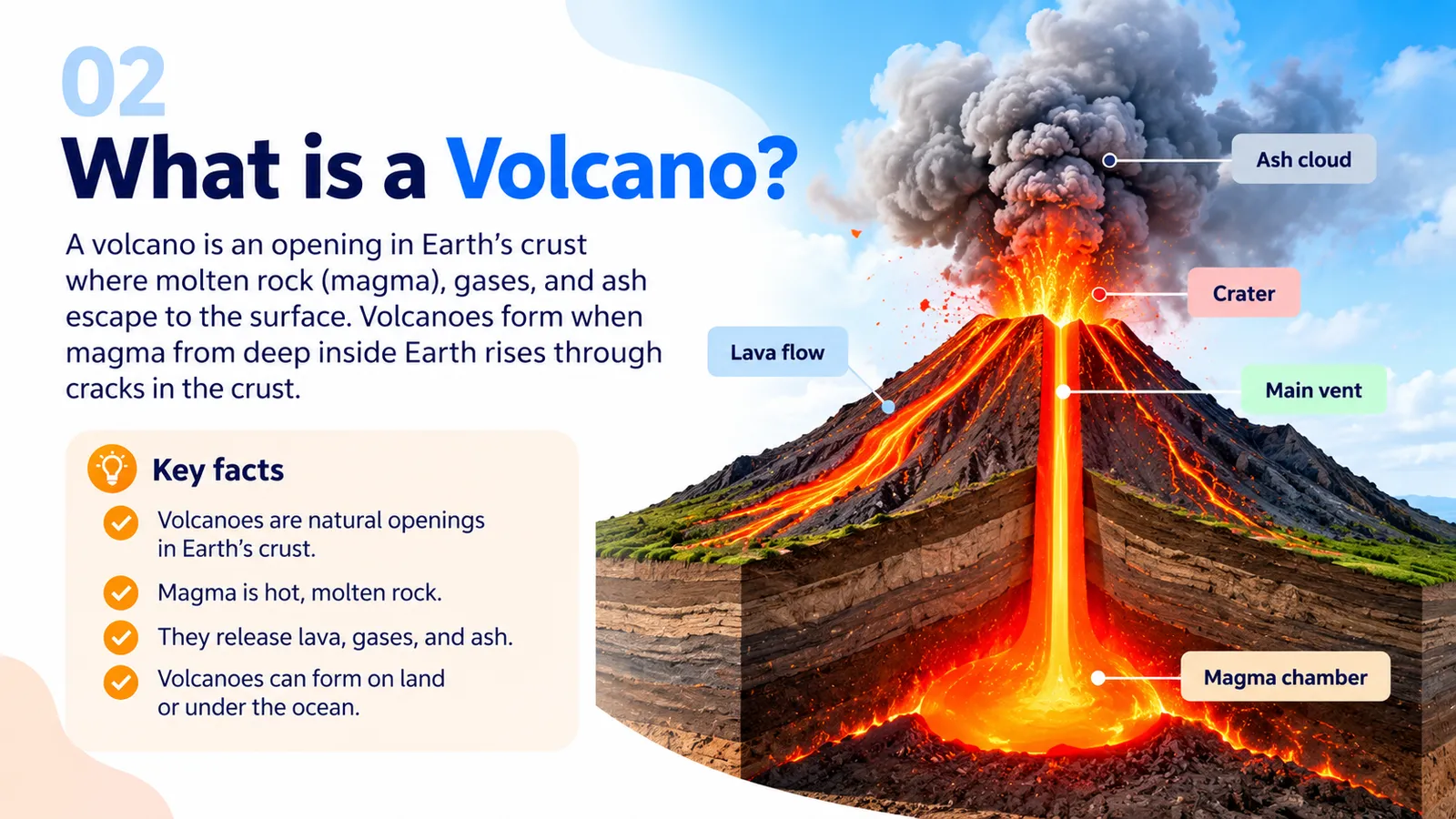
A volcano is an opening in the Earth's crust through which magma, ash and gases escape from deep underground. Once magma reaches the surface it is called lava. Over time, repeated eruptions pile up layers of lava, ash and rock around the opening and build the familiar mountain shape. The word itself comes from Vulcan, the Roman god of fire.
Volcanoes are one of the most powerful forces on the planet. They create new land, enrich soils, shape climates and, at times, threaten the people who live near them. There are about 1,300 potentially active volcanoes on land, and many more beneath the oceans. Roughly 50 to 70 erupt in any given year.
🌋
Slides: What is a volcano?
Magma, lava and the volcano's basic anatomy
1/2
How Volcanoes Form
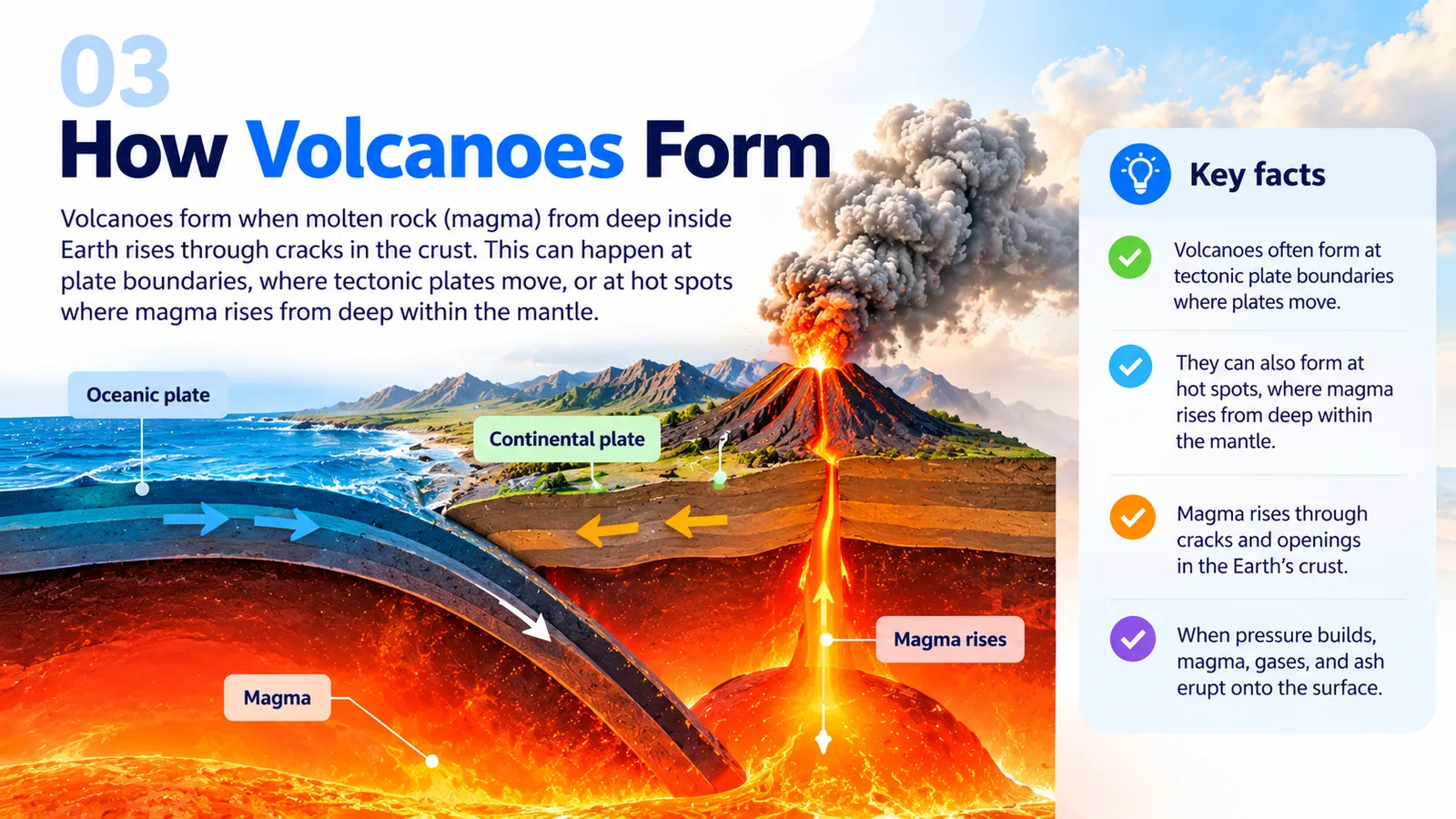
Deep inside the Earth, rock is hot enough to melt in some places. This molten rock, or magma, is less dense than the rock around it, so it rises and collects in a space called a magma chamber. When pressure builds enough, the magma forces its way upward through cracks and vents and erupts at the surface. Most volcanoes form in one of three settings, all linked to plate tectonics.
Where plates collide
When an oceanic plate meets a continental plate, the denser oceanic plate sinks beneath the other in a process called subduction. As it sinks, water trapped in the plate is released into the hot mantle above, which lowers the melting point of the rock and creates magma. The magma rises and builds a chain of volcanoes. The famous Ring of Fire around the Pacific Ocean is made mostly of volcanoes formed this way.
Where plates pull apart
At divergent boundaries, such as the Mid-Atlantic Ridge, plates move away from each other. Magma rises to fill the gap, creating new crust. Iceland sits on one of these boundaries, which is why it is covered in volcanoes and fissures.
Over hotspots
Some volcanoes sit in the middle of plates, far from any boundary. These form over hotspots, where a plume of unusually hot rock rises from deep in the mantle. As the plate slowly moves over the hotspot, a line of volcanoes is formed. The Hawaiian Islands are the classic example.
🧭
Slide: How volcanoes form
Magma rises where plates meet, pull apart or sit over hotspots
1/1
Parts of a Volcano
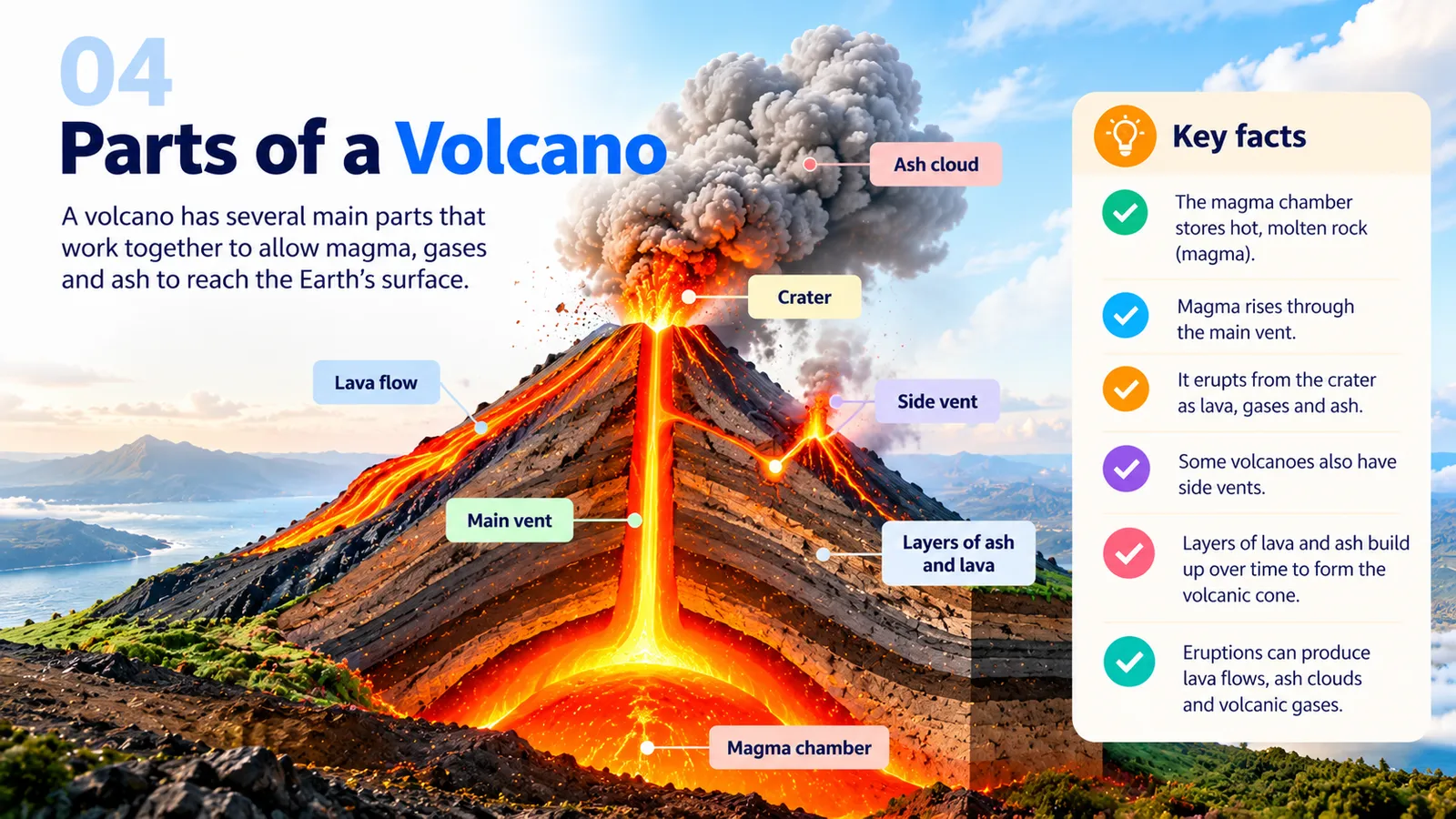
Whatever its type, most volcanoes share the same basic parts.
Magma chamber: the underground pool of molten rock that feeds the volcano.
Main vent: the central pipe through which magma travels to the surface.
Crater: the bowl-shaped depression at the top around the vent.
Side vent: a smaller opening on the flank of the volcano.
Layers of lava and ash: the material from past eruptions that builds up the cone.
Ash cloud: the plume of ash and gas thrown into the air during an eruption.
🔎
Slide: Parts of a volcano
1/1
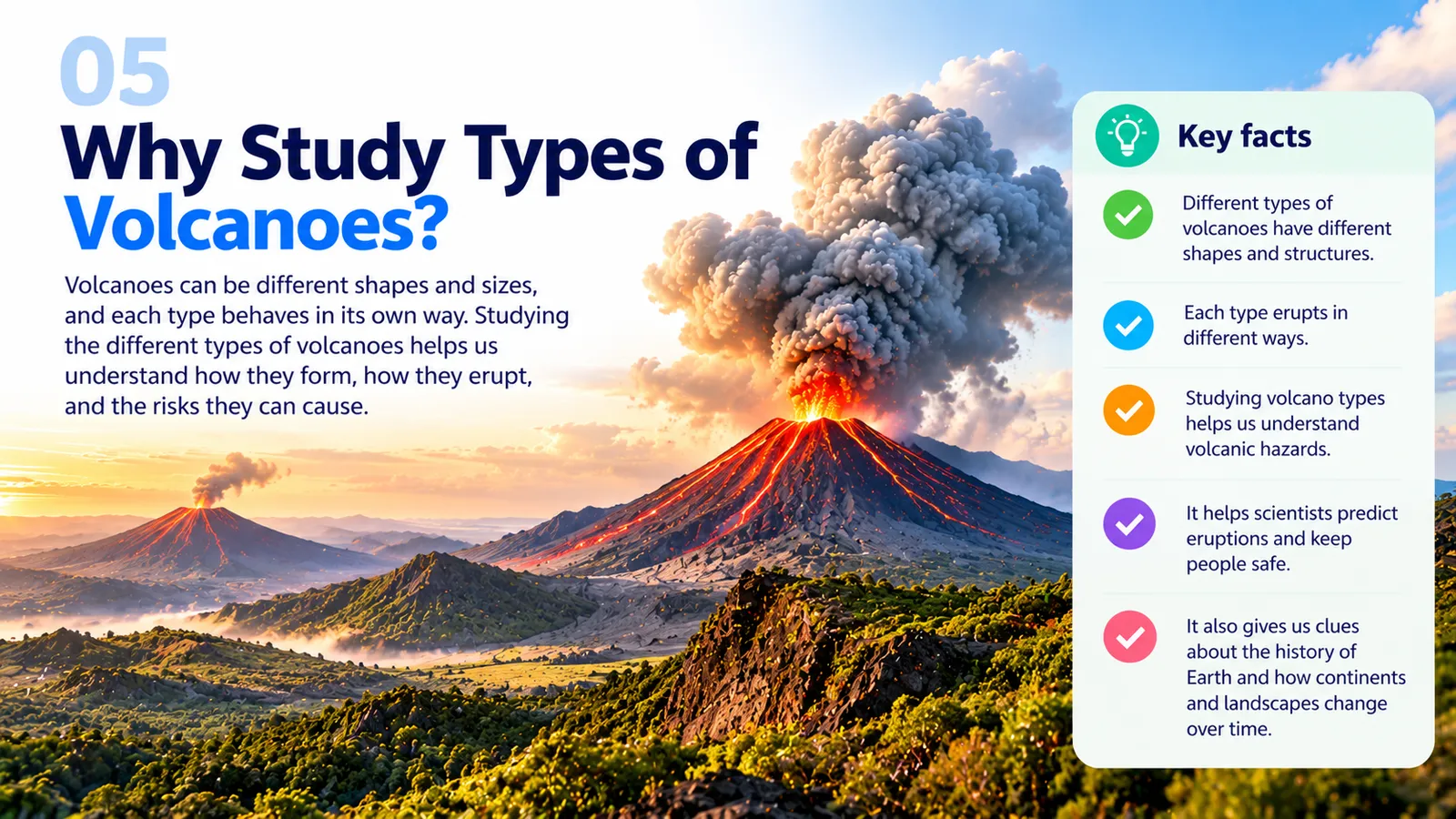
Why Study Types of Volcanoes?
Not all volcanoes are alike, and treating them as if they were can be dangerous. A gentle Hawaiian lava flow can usually be outrun on foot. A violent eruption of a steep composite volcano can send a cloud of burning gas and ash down a slope faster than a car. Knowing the type of volcano helps scientists predict what will happen, helps governments plan evacuations and helps communities decide where it is safe to build.
It also helps us understand Earth's history. Volcanoes released the gases that formed our early atmosphere and oceans. Large eruptions have changed climate and even contributed to mass extinctions. Studying them is a way of reading the planet's autobiography.
Key facts
Volcanoes are different in shape, size and eruption style.
Lava thickness and gas content control how an eruption behaves.
Knowing the type helps scientists forecast hazards.
❓
Slide: Why study types of volcanoes?
1/1
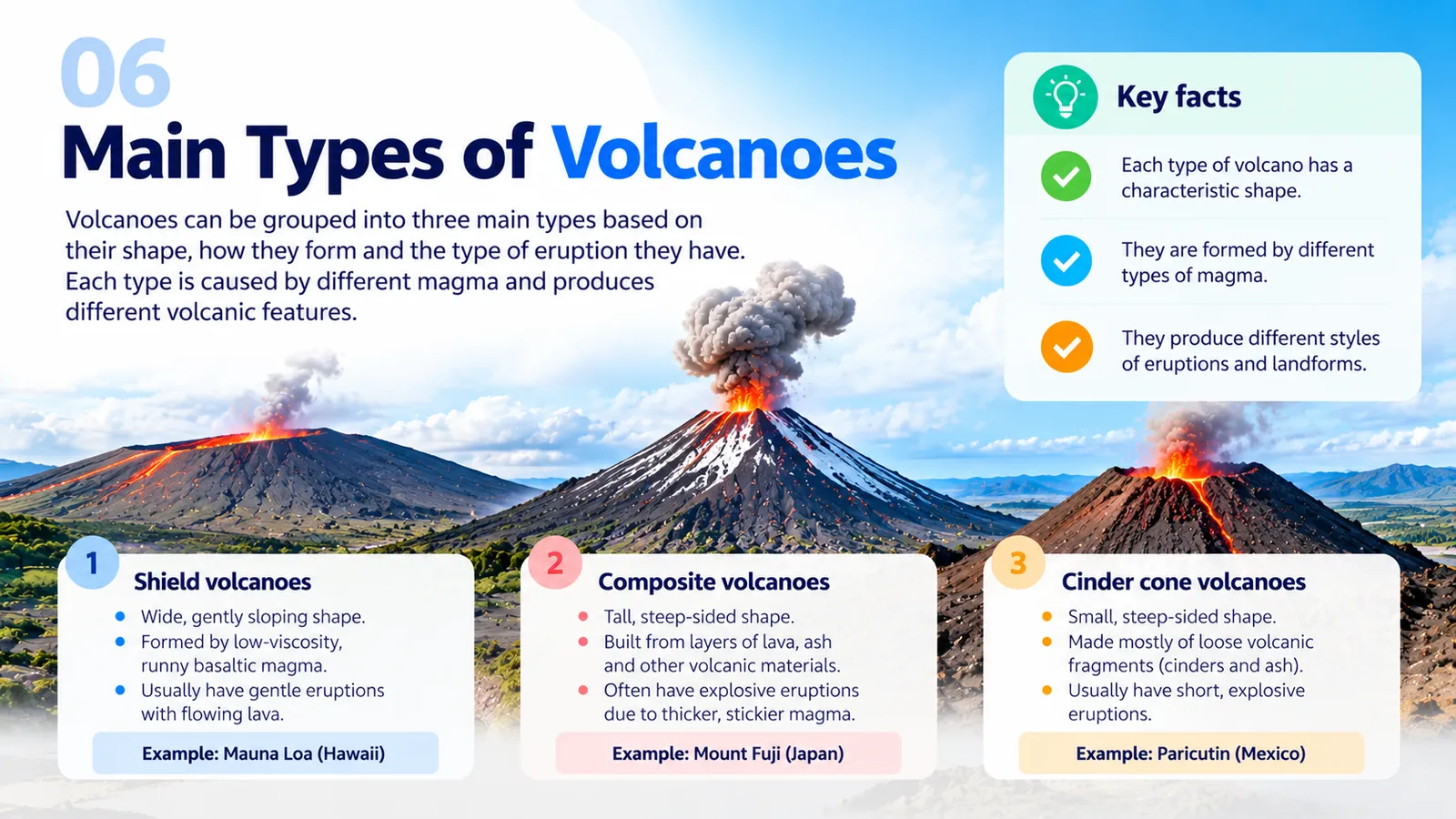
The Main Types of Volcanoes
Volcanologists group volcanoes by their shape and how they erupt. The three classic types are shield volcanoes, composite volcanoes (also called stratovolcanoes) and cinder cones. Other important features include lava domes, calderas, fissure volcanoes, submarine volcanoes and supervolcanoes. The key idea behind all of them is the magma. Runny magma lets gas escape easily and produces gentle eruptions. Thick, sticky magma traps gas and builds pressure like a shaken soda bottle, producing explosions.
🗂️
Slide: The main types of volcanoes
Shield, composite and cinder cone side by side
1/1
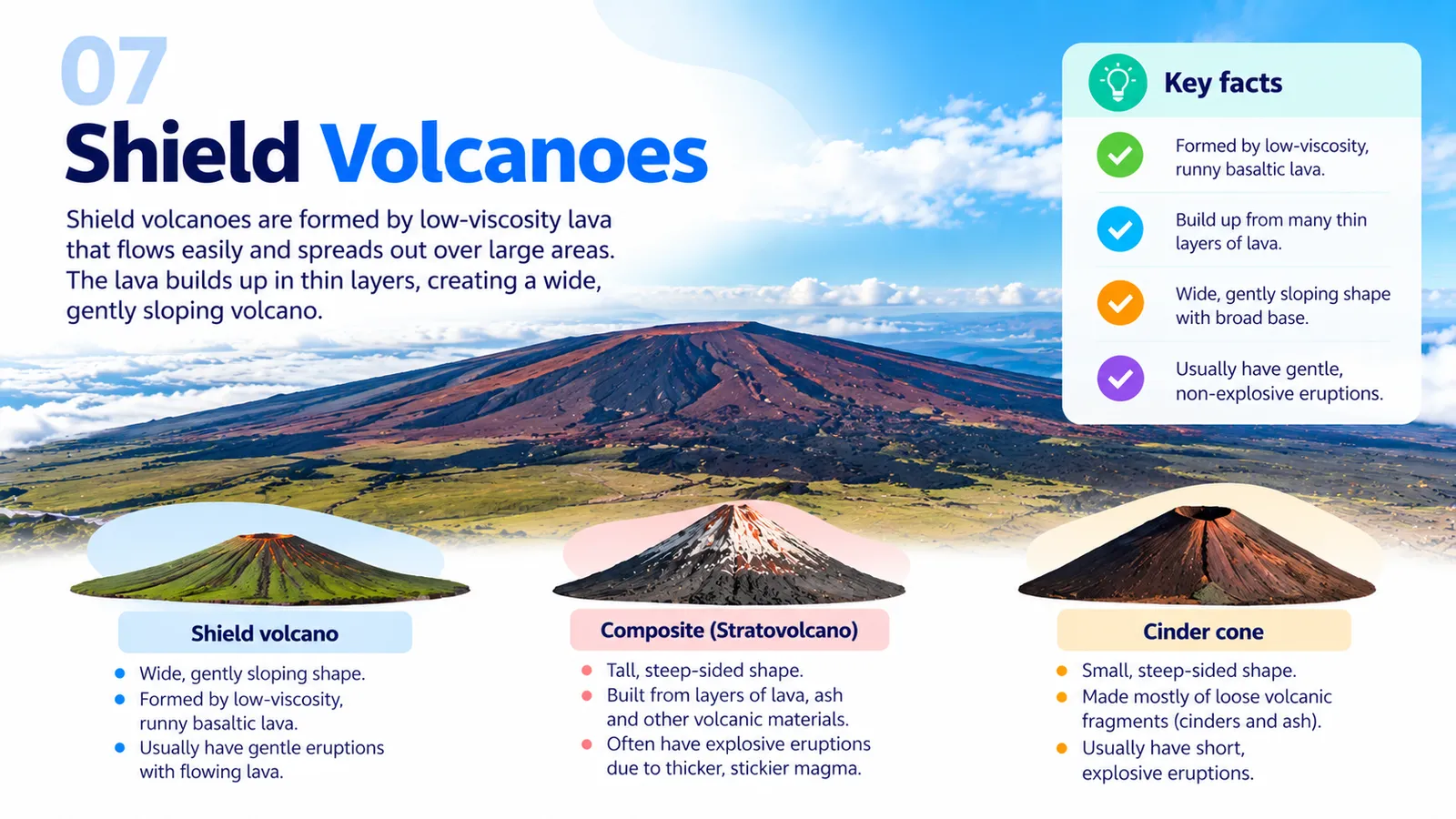
Shield Volcanoes
Shield volcanoes are broad and gently sloping, shaped like a warrior's shield lying on the ground. They are built from fluid lava that flows long distances before it cools, so the eruptions pour out instead of blasting. Layer after layer of thin lava flows build a massive but low profile mountain.
Because the lava is runny, gas escapes easily and eruptions are usually gentle. They are rarely explosive, though they can produce spectacular lava fountains and long lava rivers. This makes them relatively safe to study, and many are visited by scientists and tourists.
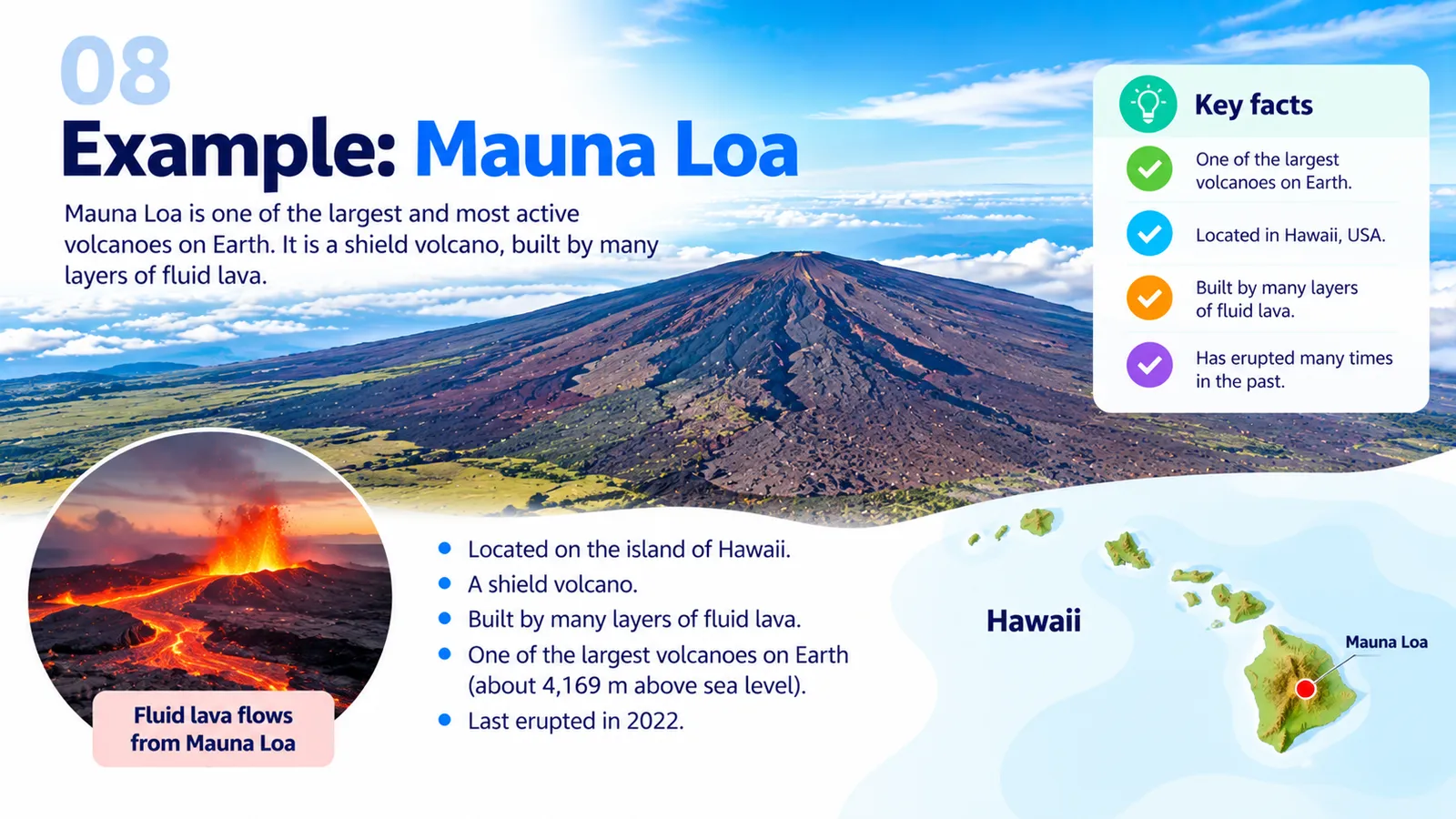
Example: Mauna Loa, Hawaii
Mauna Loa on the Big Island of Hawaii is the largest active volcano on Earth by volume. Its name means "long mountain," and the name fits. Built from many layers of fluid lava, it rises about 4,170 meters above sea level, but measured from the sea floor where it begins, it is taller than Mount Everest. It has erupted dozens of times in recorded history, most recently in 2022. Its slopes are so gentle that from a distance it looks like a long, low hill.
Key facts: Shield volcanoes
Broad shape with gentle slopes.
Fluid, runny lava.
Usually gentle eruptions.
Built from many overlapping lava flows.
🛡️
Slides: Shield volcanoes and Mauna Loa
Runny lava, gentle slopes, gentle eruptions
1/2
Composite Volcanoes (Stratovolcanoes)
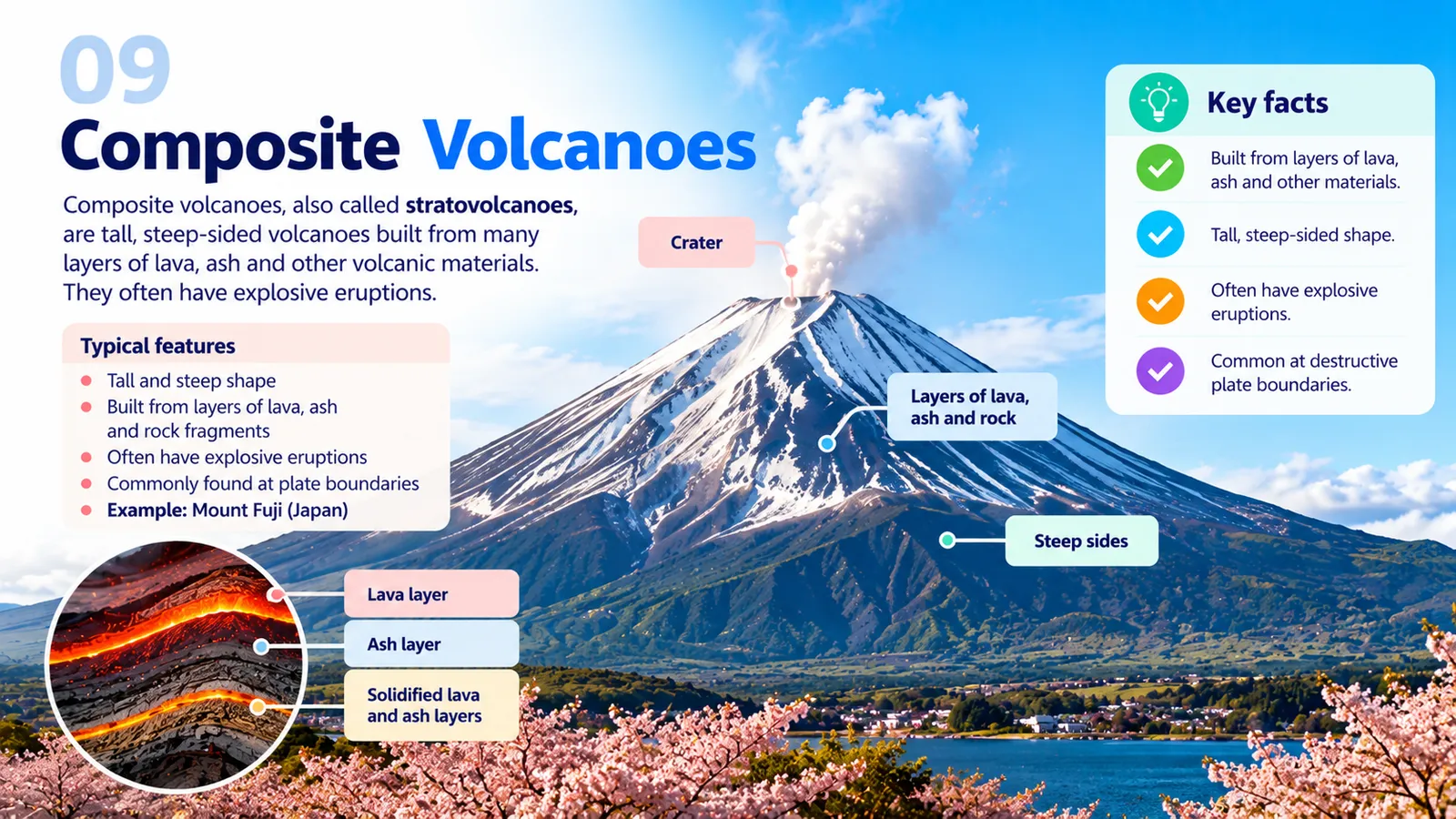
Composite volcanoes are the classic cone-shaped mountains most people picture when they hear the word "volcano." They are tall and steep and are built from alternating layers of lava, ash and rock fragments. The word "composite" means made of many parts, and "strato" refers to the layers.
The magma feeding these volcanoes is thick and sticky and full of dissolved gas. It tends to plug the vent, so pressure builds for years or centuries. When the plug finally breaks, the result is often a violent eruption, with ash clouds, hot gas, rock fragments and fast-moving flows called pyroclastic flows. These are among the most dangerous volcanoes on Earth. Vesuvius, which buried Pompeii in 79 CE, and Mount St. Helens, which erupted in 1980, are both composite volcanoes.
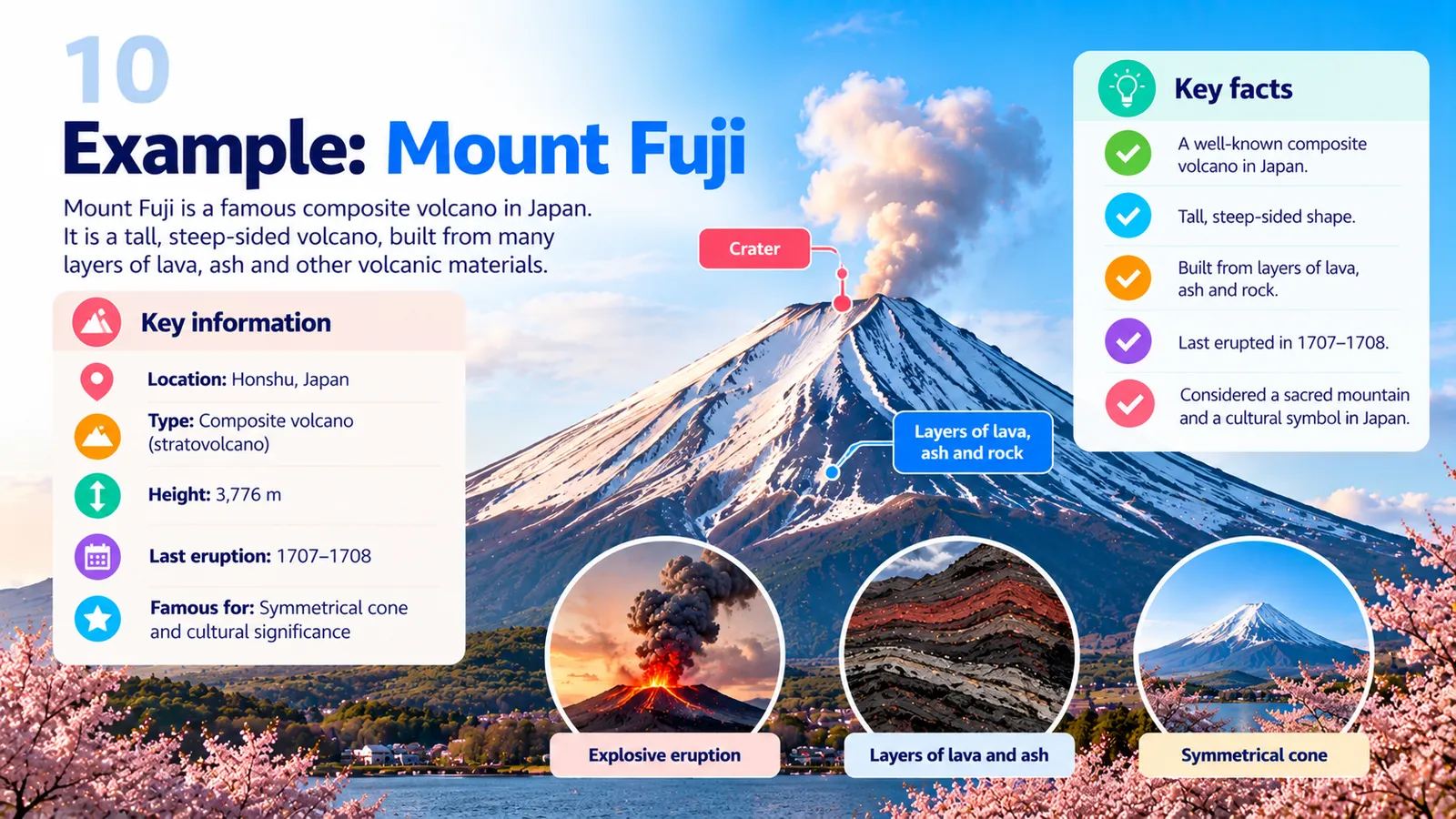
Example: Mount Fuji, Japan
Mount Fuji is a famous composite volcano and Japan's tallest mountain, at 3,776 meters. Its beautifully symmetrical shape has inspired artists for centuries and appears in countless paintings and prints. Fuji last erupted in 1707, and although it has been quiet since, it is still considered an active volcano. Millions of people live within reach of its possible eruptions, so it is carefully monitored.
Key facts: Composite volcanoes
Tall and steep.
Built from layers of lava, ash and rock fragments.
Often violent eruptions.
🏔️
Slides: Composite volcanoes and Mount Fuji
Tall, steep, layered and explosive
1/2
Cinder Cone Volcanoes
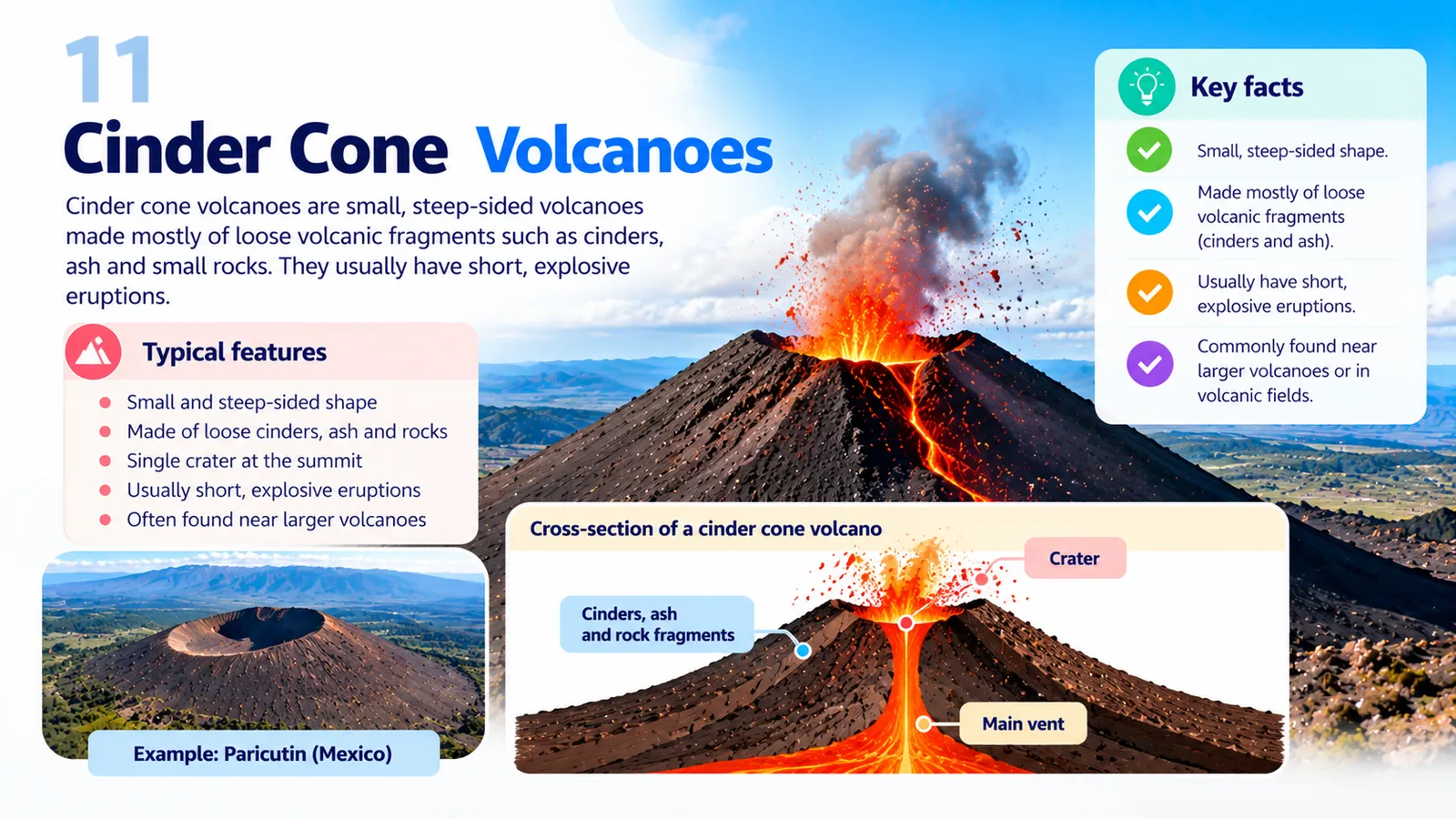
Cinder cones are the simplest and smallest of the main volcano types. They form when gas-rich magma is blasted into the air and breaks into small fragments called cinders, or scoria. The fragments fall back around the vent and pile up into a small, steep, cone-shaped hill, usually less than 300 meters high.
Cinder cone eruptions are typically short-lived, lasting from a few weeks to a few years. Because the loose cinders are not cemented together, the cone is weak, and erosion can wear it down quickly. Cinder cones are often found on the sides of larger volcanoes or in volcanic fields where many small vents erupt.
Example: Parícutin, Mexico
Parícutin is the most famous cinder cone because humans saw it being born. In 1943, a farmer in Michoacán, Mexico, noticed smoke rising from a crack in his cornfield. Within a day a small mound formed, and within a week it was several stories high. The volcano kept growing for nine years, reaching about 424 meters, and buried two nearby villages in lava and ash. It is now one of the best-known examples of a cinder cone and was once named one of the natural wonders of the world.
Key facts: Cinder cones
Small and steep.
Built from loose volcanic fragments (cinders).
Short-lived eruptions.
🪨
Slide: Cinder cone volcanoes
Small, steep cones of loose cinders
1/1
Lava Domes
Lava domes are steep-sided, rounded mounds that form when lava is so thick and sticky that it cannot flow far. Instead, it piles up over the vent like toothpaste squeezed from a tube. The lava is usually rich in silica, which is what makes it so viscous.
Domes may grow slowly over months or years, but they can be dangerous. A growing dome can collapse and release avalanches of hot rock, and the trapped gas inside a dome can cause sudden explosions. Domes often form inside the craters of composite volcanoes, as happened at Mount St. Helens after its 1980 eruption.
Example: Lassen Peak, California, USA
Lassen Peak in northern California is one of the largest lava domes in the world. It formed about 27,000 years ago, and it erupted explosively between 1914 and 1917, the most recent activity in the Cascade Range before Mount St. Helens. Today it is part of Lassen Volcanic National Park, where visitors can hike to the summit and see steaming vents and bubbling mud pots nearby.
Key facts: Lava domes
Steep-sided, rounded dome.
Formed by very thick, sticky lava.
Lava does not flow far.
Can be very explosive.
Calderas
A caldera is a huge, bowl-shaped depression, much larger than an ordinary crater. Calderas form after a massive eruption empties the magma chamber below. With nothing to hold it up, the ground above collapses into the empty space, leaving a giant hole that can be many kilometers wide. Over time the caldera may fill with water to form a lake, such as Crater Lake in Oregon.
Some calderas are quiet for thousands of years, and others remain restless, with hot springs, geysers, ground swelling and earthquakes showing that magma still lives below.
Example: Yellowstone, USA
The Yellowstone caldera in Wyoming is one of the largest volcanic systems in the world. It formed after massive eruptions, the largest about 640,000 years ago. Today the region is famous for its geysers, such as Old Faithful, and its brilliant hot springs like Grand Prismatic Spring. These features are powered by heat from the magma system beneath. Scientists monitor Yellowstone constantly, and although the chance of a giant eruption in any given year is very small, it remains an active volcanic system.
Key facts: Calderas
Large, wide depressions.
Formed after a huge eruption and collapse.
Can be many kilometers wide.
Fissure Volcanoes
Not every volcano is a mountain. Fissure volcanoes erupt from long cracks, or fissures, in the Earth's crust, sometimes many kilometers long. Instead of building a cone, they release lava along the entire length of the crack, often in a curtain of fire. The lava is usually fluid and spreads out across large areas, forming vast lava plains.
Fissure eruptions are common on divergent plate boundaries and hotspots. Some of the biggest volcanic events in history, including those that created enormous lava plateaus like the Deccan Traps in India, were fissure eruptions.
Example: Laki, Iceland
The Laki fissure erupted from 1783 to 1784 along a crack about 25 kilometers long. Fluid lava flowed over huge areas, and the eruption released vast amounts of poisonous gas, including sulfur dioxide. The gas created a haze across Europe, caused crop failures and killed about a fifth of Iceland's people and much of its livestock. The effects were felt worldwide, and the following winters were unusually harsh. It is a powerful reminder that even eruptions without explosions can alter the climate.
Key facts: Fissure volcanoes
Erupt from long cracks in the Earth's crust.
Lava flows out over large areas.
Usually produce fluid, runny lava.
Submarine Volcanoes
Most of the Earth's volcanic activity takes place where nobody sees it: on the ocean floor. Submarine volcanoes erupt underwater, and they are far more numerous than those on land. Most of the planet's new crust forms along mid-ocean ridges, where lava erupts and cools into pillow-shaped lumps called pillow basalt.
The weight of the water above reduces explosions, so many submarine eruptions are gentle. But if a volcano grows tall enough to near the surface, seawater can mix with hot magma and trigger steam explosions. Over time, some submarine volcanoes grow until they break the surface and form new islands. Surtsey, off the coast of Iceland, appeared in 1963 in exactly this way.
Example: Loihi, Hawaii
Loihi, also called Kamaʻehuakanaloa, is an active underwater volcano southeast of the Big Island of Hawaii. It rises more than 3,000 meters from the sea floor but its summit is still about 975 meters below the surface. Scientists expect that, in tens of thousands of years, it could become the next island in the Hawaiian chain. It is a living example of how islands are born.
Key facts: Submarine volcanoes
Erupt on the ocean floor.
Often form new land (islands).
Mostly shield-type volcanoes.
Supervolcanoes
Supervolcanoes are the giants of the volcanic world. The term is used for volcanoes that have produced eruptions of the highest magnitude, ejecting more than 1,000 cubic kilometers of material. These eruptions are thousands of times larger than something like Mount St. Helens. They are extremely rare, happening perhaps once every tens of thousands of years or less often, but their effects would be global.
A supervolcanic eruption would blanket whole regions in ash and push huge clouds of sulfur gas into the upper atmosphere. The gas forms tiny droplets that reflect sunlight, cooling the planet for years. Such an event could disrupt agriculture and affect billions of people. Supervolcanoes usually leave behind enormous calderas.
Example: Toba, Indonesia
About 74,000 years ago, the Toba volcano on the island of Sumatra erupted in one of the largest eruptions of the last two million years. It left behind a huge caldera that is now Lake Toba, the world's largest volcanic lake, about 100 kilometers long. Some scientists suggest that the eruption cooled the climate for several years and may have reduced early human populations, though this is still debated.
Key facts: Supervolcanoes
Extremely large volcanoes.
Produce massive eruptions.
Can affect global climate.
Examples: Toba (Indonesia), Yellowstone (USA).
Volcanoes on Other Planets
Volcanoes are not only found on Earth. They are found all over the solar system, which shows that volcanism is a common planetary process. Venus is covered with thousands of volcanic features. Jupiter's moon Io is the most volcanically active body known, with eruptions that throw plumes hundreds of kilometers high. Some icy moons even have cryovolcanoes, which erupt water and ammonia instead of molten rock.
The best-known example is Olympus Mons on Mars. It is a giant shield volcano, the largest volcano in the solar system, standing about 22 kilometers high, nearly three times the height of Mount Everest, and about as wide as the state of Arizona. It grew so large because Mars has no moving tectonic plates, so a hotspot could keep feeding the same spot for billions of years.
Comparing the Types
Type
Shape
Lava type
Eruption style
Example
Shield
Wide and gentle
Fluid
Usually gentle
Mauna Loa
Composite
Tall and steep
Thick, mixed
Often explosive
Mount Fuji
Cinder cone
Small and steep
Fragmented
Short and explosive
Parícutin
Lava dome
Rounded dome
Very thick
Explosive
Lassen Peak
Caldera
Wide depression
Varies
Massive eruption
Yellowstone
Fissure
Long crack
Fluid
Gentle
Laki
Submarine
Underwater
Fluid
Gentle
Loihi
Supervolcano
Very large
Varies
Extremely explosive
Toba
Staying Safe Around Volcanoes
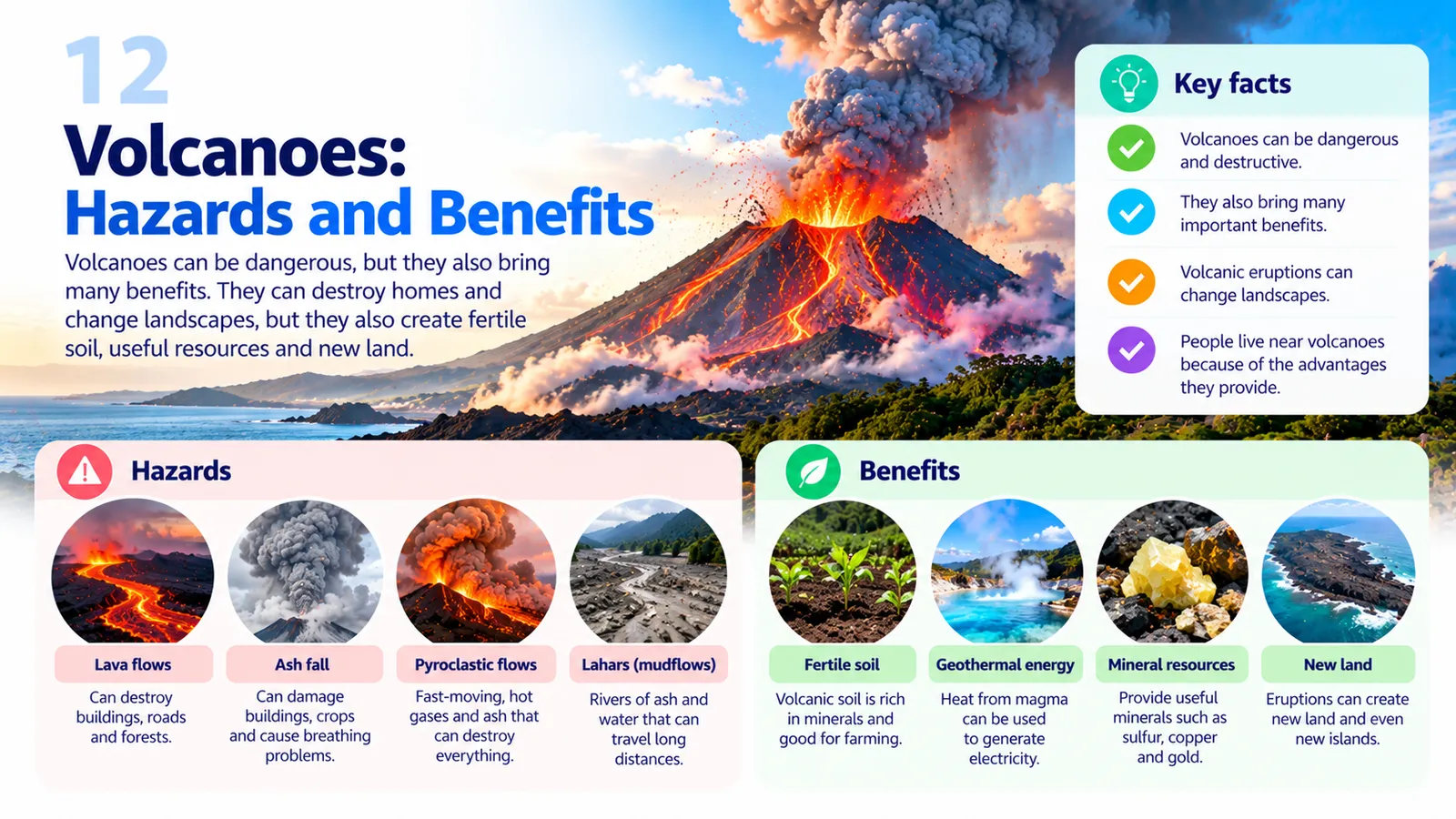
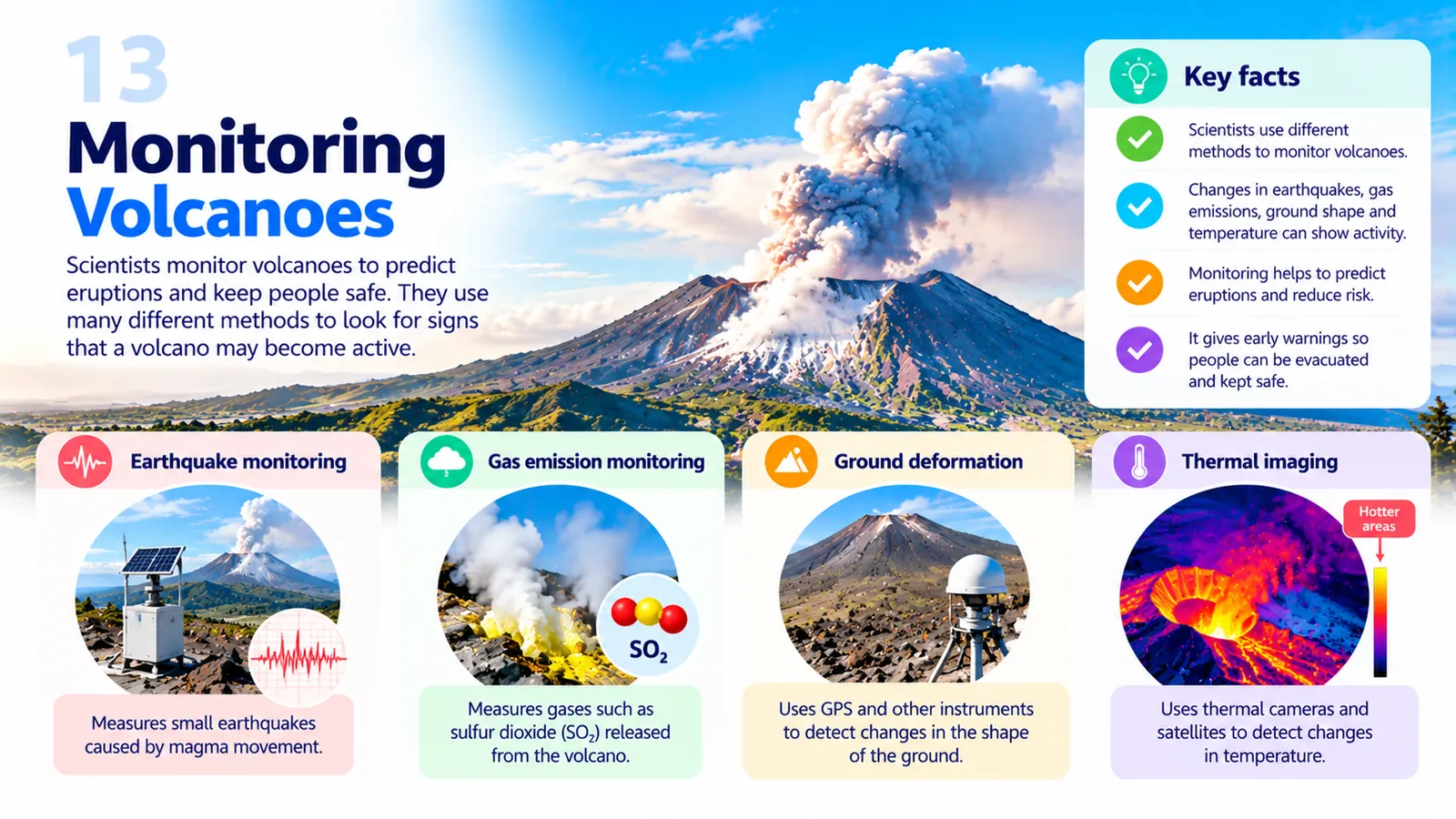
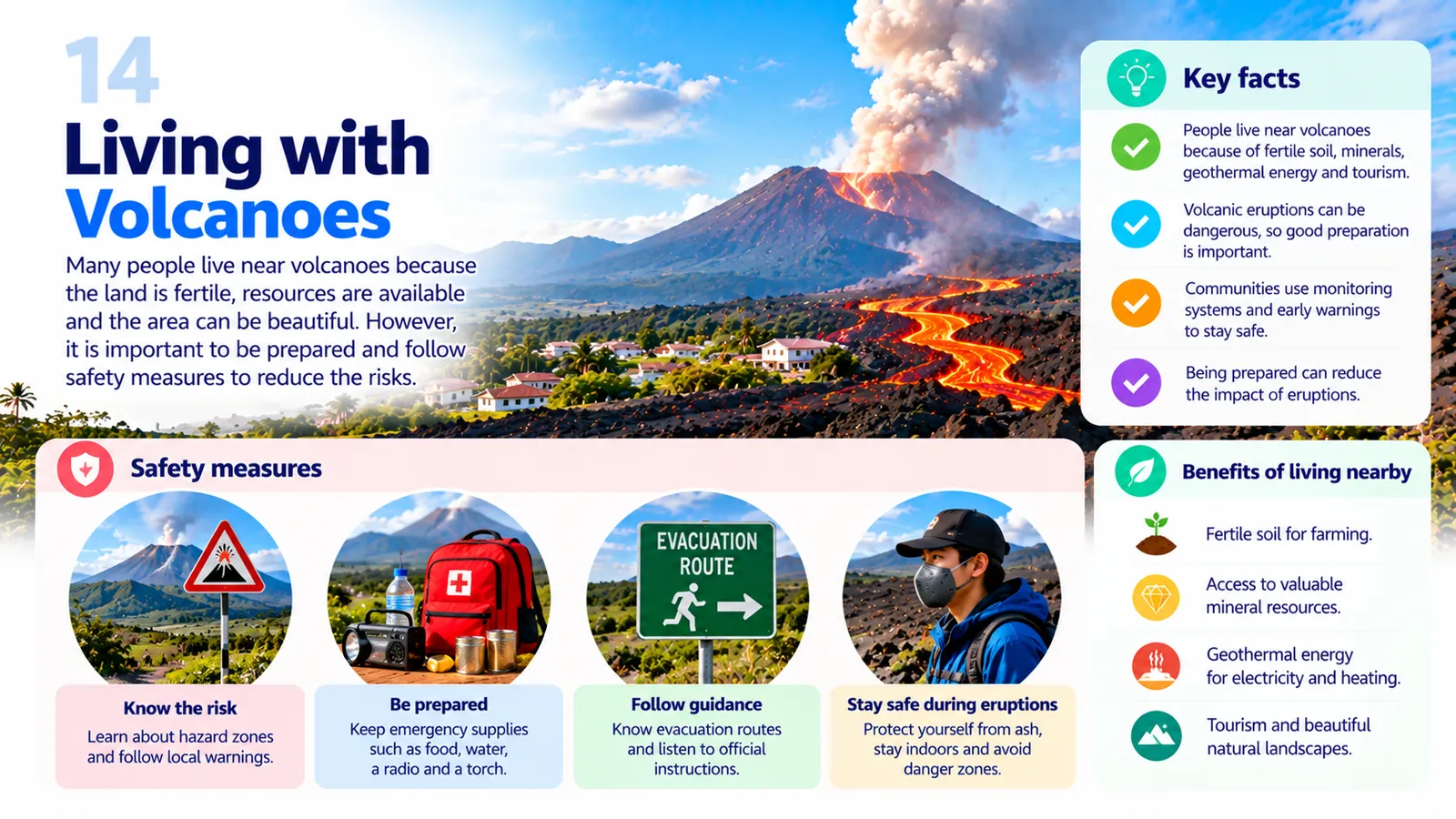
People have always lived near volcanoes, because volcanic soil is rich in nutrients and perfect for farming. Living near one means respecting it. Scientists use seismometers, gas sensors, satellites and ground-tilt instruments to watch for warning signs such as small earthquakes, swelling ground and rising gas levels. When these signs appear, authorities may issue alerts and plan evacuations.
If you ever live in or visit a volcanic region, follow local advice, know the evacuation routes and keep a mask and goggles to protect against ash. Never approach an erupting volcano for a better view.
⚠️
Slides: Hazards, monitoring and living with volcanoes
Why people live near volcanoes and how scientists watch them
1/3
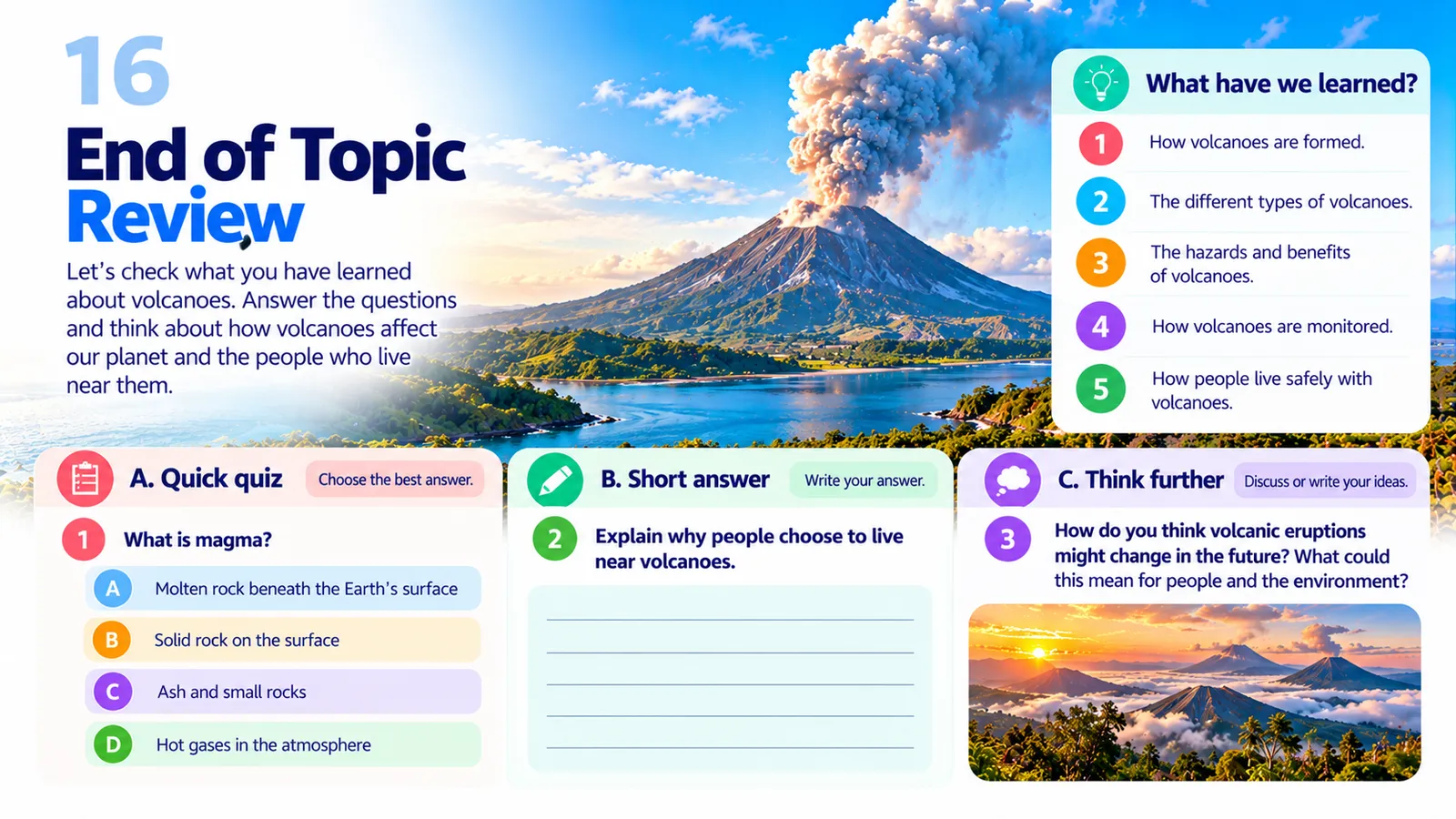
Quick Check
Name the three main types of volcanoes.
Which type has gentle slopes and fluid lava?
Why are composite volcanoes more explosive?
What is a caldera?
Give one example of a submarine volcano.
Answers: (1) Shield, composite and cinder cone. (2) Shield volcanoes. (3) Their thick, sticky magma traps gas and builds pressure. (4) A large bowl-shaped depression formed when the ground collapses after a huge eruption. (5) Loihi near Hawaii.
✅
Slide: End-of-topic review
Test yourself before you read on
1/1
Conclusion
From the wide, gentle slopes of Mauna Loa to the symmetrical cone of Mount Fuji, from a cornfield that grew a mountain to a caldera that holds a geyser basin, volcanoes show the many ways our planet releases its inner heat. Their differences come down to a few simple ideas: how thick the magma is, how much gas it holds and where it breaks through the crust.
Frequently Asked Questions
What is the difference between magma and lava?
Magma is molten rock beneath the surface, while lava is molten rock that has reached the surface and erupted.
Which type of volcano is the most dangerous?
Composite volcanoes are usually the most dangerous because their thick, gas-rich magma causes explosions, ash clouds and pyroclastic flows. Supervolcanoes are far larger, but they erupt extremely rarely.
Can a volcano form in the middle of a tectonic plate?
Yes. Hotspot volcanoes, such as those that built the Hawaiian Islands, form over plumes of hot rock rising from deep in the mantle, far from any plate boundary.
Is a dormant volcano safe?
Not necessarily. Dormant means the volcano is quiet for now, not that it is extinct. Mount Fuji has been quiet since 1707 but is still considered active and is carefully monitored.
Key Takeaways
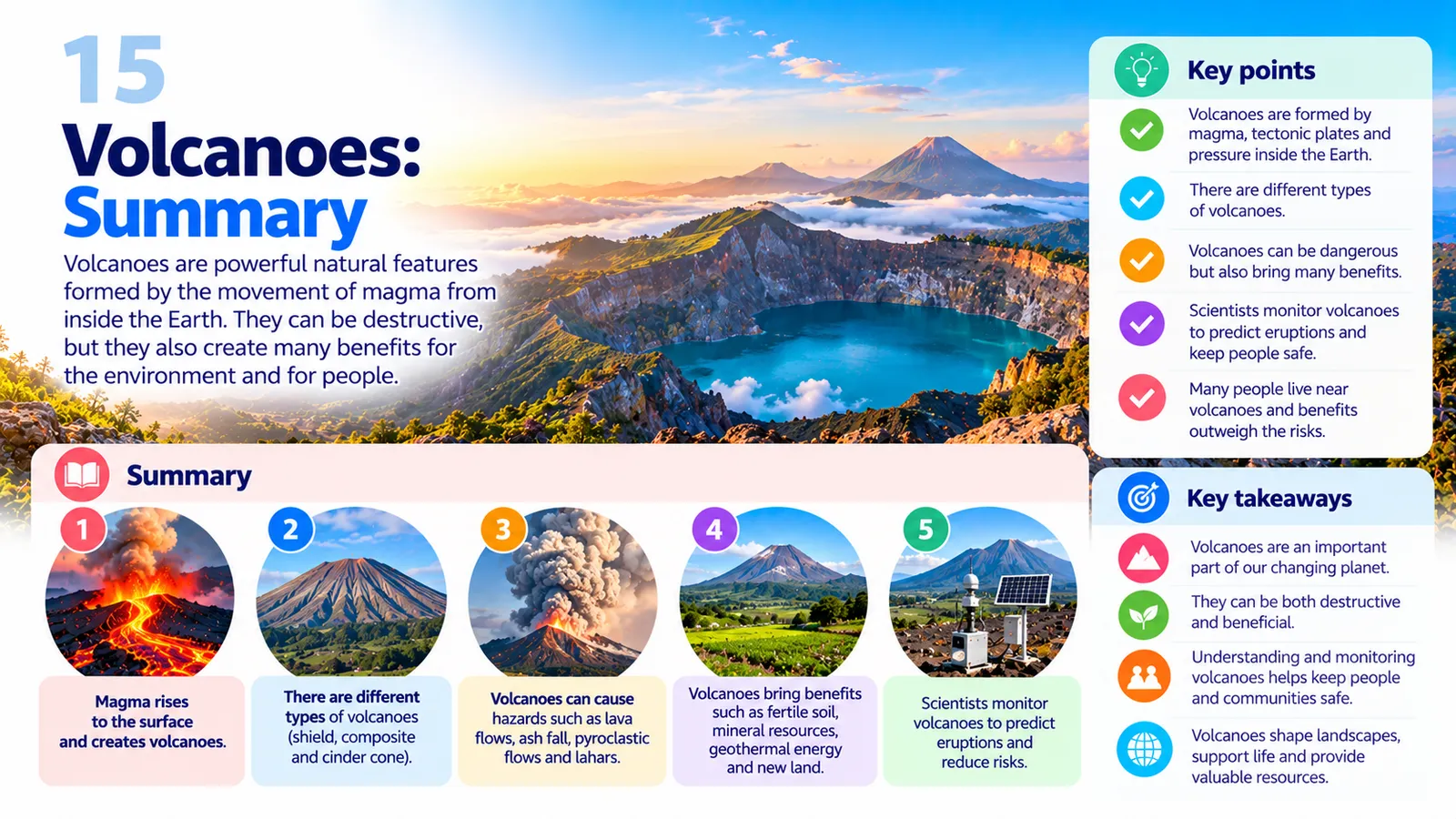
Volcanoes are classified by shape, lava type and eruption style.
Shield volcanoes are broad and gentle, composite volcanoes are tall and explosive, and cinder cones are small and short-lived.
Lava domes, calderas, fissure volcanoes, submarine volcanoes and supervolcanoes show how varied volcanic activity can be.
Thick, gas-rich magma causes explosive eruptions, while runny magma flows gently.
Volcanoes are shaped by plate tectonics and hotspots, and they also exist on other planets, such as Mars.
🏁
Slide: Volcanoes summary
1/1
Understanding these types is more than a school topic. It helps keep people safe, explains how islands and continents grow and gives us a window into the forces that have shaped Earth for billions of years. To keep exploring, find more illustrated slides and lessons at scienceaplusedu.com.
🗂️ Revision Flashcards
Tap a card to reveal the answer.
🎯 Quick Quiz
8 questions. Pick an answer to check it straight away.
1What mainly decides whether an eruption is gentle or explosive?
Runny magma lets gas escape gently; thick, sticky magma traps gas and builds pressure.
2Which type of volcano has broad, gentle slopes and fluid lava?
Shield volcanoes are built from runny lava that flows long distances before it cools.
3Mount Fuji is an example of which type of volcano?
Fuji is a tall, steep, symmetrical composite volcano, 3,776 meters high.
4How does a caldera form?
With nothing to hold it up, the ground above the empty chamber collapses into a huge bowl.
5Where do volcanoes form at divergent boundaries such as the Mid-Atlantic Ridge?
Plates move away from each other and rising magma creates new crust, as in Iceland.
6Which volcano formed in a Mexican cornfield in 1943?
Parícutin is the cinder cone that humans saw being born; it grew for nine years.
7The Laki eruption of 1783 to 1784 changed the climate mainly by releasing…
Laki's gas made a haze across Europe and caused crop failures, even without explosions.
8Why could Olympus Mons on Mars grow so large?
With no moving plates, the volcano stayed over the same hotspot and kept growing.