Follow food from mouth to anus: organs, enzymes, absorption and common disorders
Biology · Grade 9-11 · 14 min read
🍞 Mechanical & chemical🧪 Enzymes🫃 Stomach acid🌿 Villi & absorption🟢 Bile & liver💧 Large intestine
📖 Lesson
Follow a piece of food through the gut, organ by organ: what happens physically, what happens chemically, and which organ helped.
Introduction: Why Your Breakfast Is a Chemistry Lesson
Think about the last thing you ate. Maybe it was a slice of bread, a bowl of rice, or a banana grabbed on the way to class. That food was a solid lump of matter that had nothing to do with you. A few hours later, parts of it were quietly rebuilding your muscles, powering your brain during a maths problem, and keeping your heart beating. Something had to turn that lump into you.
That something is the digestive system. It is one of the busiest systems in the human body, and it works every single day without you giving it a single conscious instruction. You decide to chew. After that, your body takes over completely.
Many students find digestion confusing because textbooks throw a long list of organs and enzymes at them all at once. This guide takes a different route. We will follow food on its journey from the moment it enters your mouth to the moment the waste leaves your body, and we will stop at every organ along the way to understand what it does and why it matters.
What Is the Digestive System?
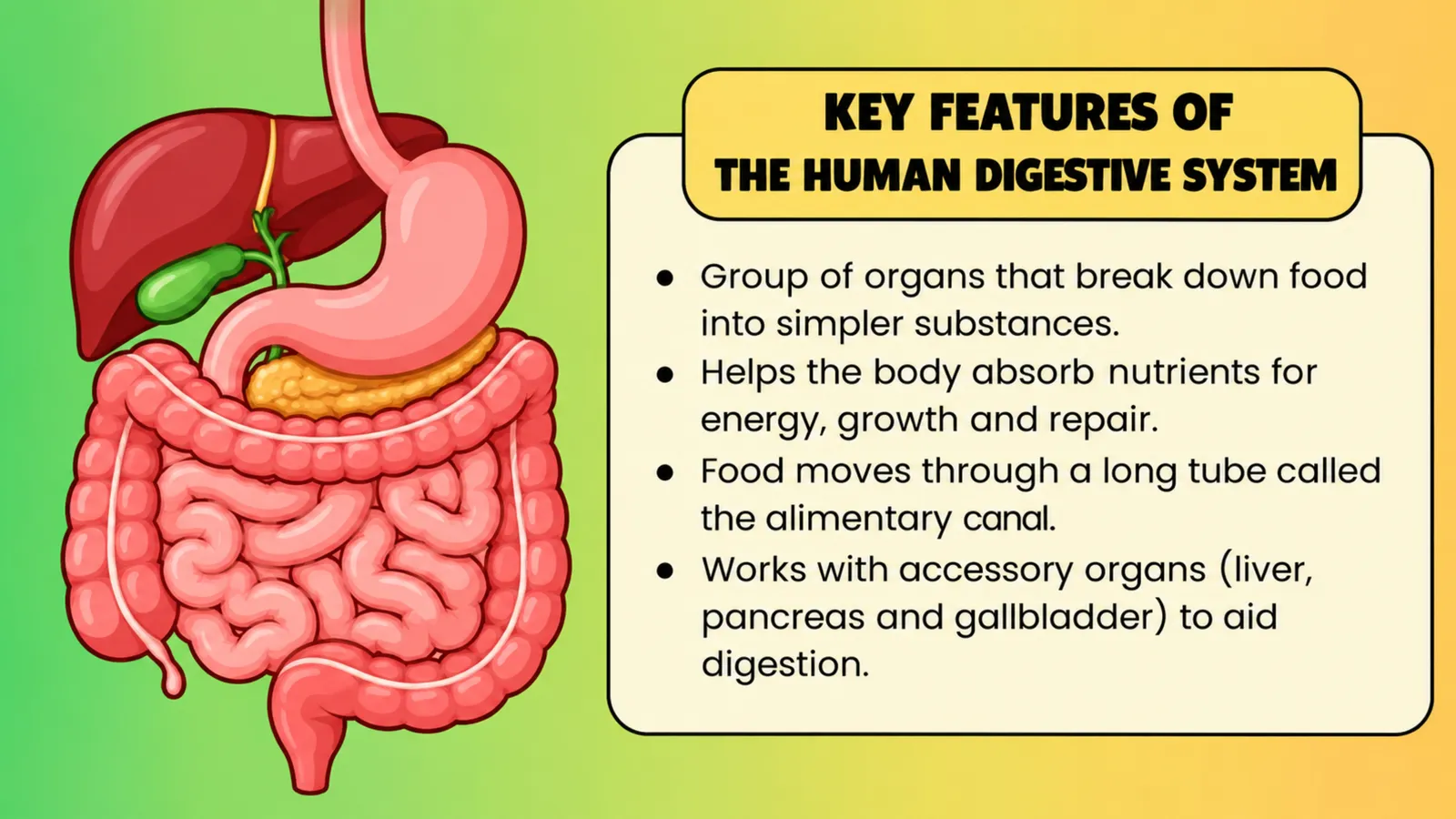
The digestive system is the group of organs that breaks food down into tiny particles that are small enough to pass into your blood. Once those particles are in the blood, they can travel to every cell in the body and be used for energy, growth and repair.
The system has two parts. The first part is the alimentary canal, which is also called the digestive tract or the gut. This is one long muscular tube that starts at the mouth and ends at the anus. Food actually travels through this tube. In an adult human, this tube is roughly nine metres long, which is longer than a school bus, but it is folded neatly inside the abdomen.
The second part is made of the accessory organs. Food never passes through these organs. Instead, they sit beside the canal and pour helpful juices into it. The salivary glands, liver, gallbladder and pancreas belong to this group. Think of the alimentary canal as a factory conveyor belt and the accessory organs as the workers standing beside the belt, adding chemicals as items pass by.
🍽️
Slides: What is the digestive system?
The organ team that turns food into you
1/2
Why Digestion Is Necessary in the First Place
A very fair question is this. If food already contains protein, starch and fat, why can the body not simply absorb it as it is?
The answer is size. The molecules in food are enormous. A single starch molecule is a long chain built from hundreds of sugar units linked together. The wall of your intestine is made of living cells, and those cells only allow very small molecules to cross. A giant starch chain simply cannot fit through.
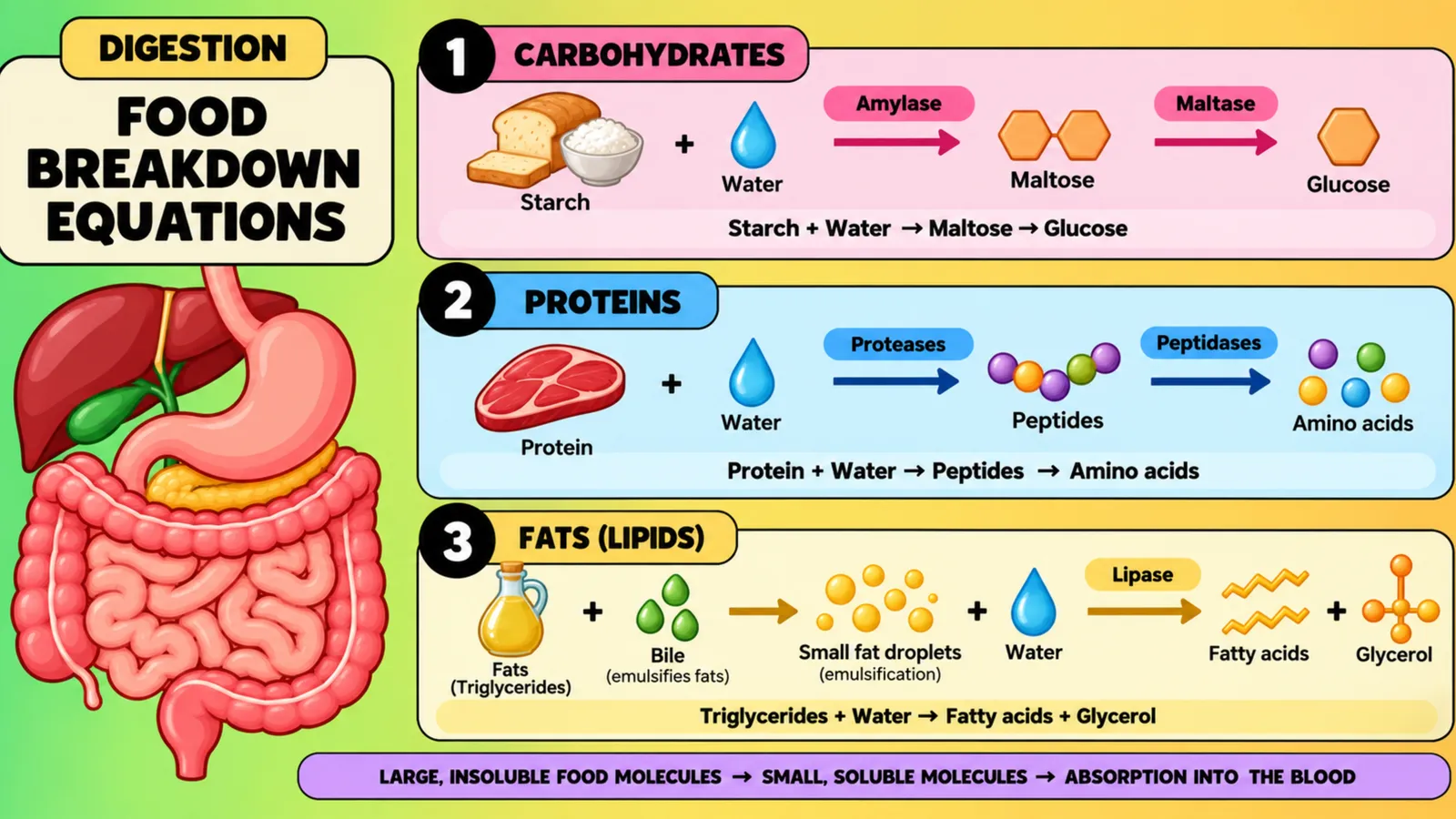
So the body does two things. It cuts food into smaller and smaller pieces, and it changes the chemical shape of the large molecules into simple ones. Starch becomes glucose. Proteins become amino acids. Fats become fatty acids and glycerol. These small units slip through the intestinal wall easily and enter the bloodstream.
There is a second reason too. The proteins in a chicken leg are chicken proteins. They are not human proteins. Your body must take them apart into individual amino acids and then rebuild them into human proteins that suit your own body. Digestion is therefore a demolition job followed by a construction job.
The Two Types of Digestion
Digestion happens in two different ways at the same time, and exam questions love asking students to compare them.
Mechanical Digestion
Mechanical digestion is physical. Nothing new is created chemically. Food is simply broken into smaller pieces so that there is more surface area for chemicals to attack.
Chewing is the most obvious example. Your teeth cut and grind food into a soft ball. The churning action of the stomach muscles is another example, and so is the way bile breaks large fat droplets into a fine spray of tiny droplets.
Here is a useful comparison. If you drop one large sugar cube into water, it takes a long time to dissolve. If you crush the same cube into powder first, it dissolves in seconds. The amount of sugar has not changed at all, but the surface area exposed to water has increased hugely. Mechanical digestion does exactly this favour for the enzymes that come next.
Chemical Digestion
Chemical digestion actually changes the food molecules. It is carried out by enzymes, which are special proteins that speed up chemical reactions.
Enzymes are extremely fussy workers. Each enzyme only acts on one type of molecule, in the same way that one key opens only one lock. The enzyme amylase will break down starch and completely ignore protein sitting right next to it. Enzymes also care about temperature and acidity. An enzyme that works beautifully in the acidic stomach will stop working in the alkaline small intestine, and the reverse is also true.
The Organs of the Alimentary Canal
Now let us walk through the tube itself, organ by organ.
The Mouth: Where Digestion Begins
Digestion starts before you even swallow. The moment you smell food, or sometimes just think about it, your salivary glands begin producing saliva. That is why your mouth waters when you walk past a bakery.
Inside the mouth, three jobs happen together. The teeth carry out mechanical digestion. The incisors at the front cut, the canines tear, and the flat molars at the back grind. The tongue rolls the food around, mixes it with saliva, and shapes it into a soft rounded lump called a bolus.
Meanwhile, saliva does the chemical work. It contains an enzyme called salivary amylase, which begins breaking starch into a simpler sugar called maltose. This is why a plain piece of bread starts tasting slightly sweet if you hold it in your mouth for a minute without swallowing. You are literally tasting the first step of digestion. Saliva also lubricates the food so that it slides down easily, and it contains substances that fight bacteria.
The Pharynx and Oesophagus: The Delivery Pipe
When you swallow, the bolus passes into the pharynx, which is the shared space at the back of the throat. This area is a busy crossroads, because both air and food pass through it. A small flap of cartilage called the epiglottis folds down over the windpipe during swallowing, so food is directed into the food pipe instead of the lungs. When this flap is late, food goes the wrong way and you cough violently.
The oesophagus is a muscular tube roughly twenty five centimetres long. It does not simply drop food into the stomach using gravity. Instead, rings of muscle contract behind the bolus and relax in front of it, squeezing the food along in a wave. This wave is called peristalsis, and it is the reason astronauts can eat in space and you can swallow while lying down or standing on your head.
The Stomach: The Muscular Mixing Bag
The stomach is a J shaped bag with thick muscular walls. It can stretch to hold about one and a half litres of food, which is why a large meal makes you feel full.
Three things happen here. First, the stomach walls churn powerfully, mixing food into a thick soupy liquid called chyme. Second, the stomach lining releases gastric juice, which contains hydrochloric acid. This acid makes the stomach strongly acidic with a pH of around two, which kills most harmful bacteria you swallowed with your food. Third, the acid activates an enzyme called pepsin, which begins breaking proteins into shorter chains called peptides.
Students often ask an excellent question here. If the acid is strong enough to damage tissue, why does the stomach not digest itself? The answer is a thick layer of mucus produced by the stomach lining. This slippery coating forms a protective barrier between the acid and the living cells. The lining cells are also replaced very quickly, roughly every few days. When this mucus layer breaks down, an ulcer can form.
Food usually stays in the stomach for two to four hours. Fatty meals stay longest, which is one reason a heavy oily meal makes you feel full for hours.
The Small Intestine: Where Most of the Work Happens
The small intestine is the star of the whole system. Despite its name, it is around six metres long. It is called small only because it is narrow.
It has three sections. The duodenum is the short first part where most chemical digestion happens. The jejunum is the middle section. The ileum is the final section where most absorption takes place.
When acidic chyme leaves the stomach and enters the duodenum, two important juices arrive. Bile from the liver neutralises the acid and breaks fat droplets apart. Pancreatic juice arrives with a full set of enzymes that work on starch, protein and fat together. The intestinal wall itself adds more enzymes to finish the job.
By the end of this process, starch has become glucose, proteins have become amino acids, and fats have become fatty acids and glycerol. Digestion is essentially complete. Now the nutrients must be absorbed.
The Large Intestine: The Water Recovery Unit
Whatever the small intestine could not digest or absorb passes into the large intestine. This includes fibre, dead cells and a large amount of water.
The large intestine is about one and a half metres long and much wider than the small intestine. Its main job is to reabsorb water and mineral salts, turning the watery leftover material into semi solid faeces. This water recovery is vital. Without it, you would lose litres of fluid every day and become dangerously dehydrated.
The large intestine is also home to trillions of helpful bacteria known as the gut flora or gut microbiome. These bacteria feed on fibre, produce certain vitamins such as vitamin K and some B vitamins, and help keep harmful microbes from settling in.
Finally, the faeces are stored in the rectum and released through the anus during egestion. It is worth remembering that egestion is not the same as excretion. Egestion removes undigested food that never entered your cells. Excretion removes waste produced by your cells.
The Accessory Organs and Their Juices
The Salivary Glands
There are three pairs of salivary glands around the mouth. Together they produce roughly one litre of saliva every day. Saliva moistens food, begins starch digestion, and protects the teeth.
The Liver
The liver is the largest internal organ in the body and easily the busiest. For digestion, its key product is bile, a greenish yellow fluid that contains no enzymes at all.
Bile does two things. It neutralises stomach acid so that intestinal enzymes can work in an alkaline environment, and it emulsifies fat. Emulsification means breaking one big fat droplet into thousands of tiny droplets. This is mechanical digestion, not chemical digestion, and it is the same thing that happens when dish soap attacks oil on a plate. Since enzymes can only work on the surface of a droplet, thousands of small droplets give lipase a vastly larger working area.
The liver also stores glucose as glycogen, stores vitamins, and detoxifies harmful substances including alcohol and medicines.
The Gallbladder
The gallbladder is a small green sac tucked under the liver. It does not make bile. It stores and concentrates the bile the liver produces and squeezes it into the duodenum when a fatty meal arrives. People who have had their gallbladder removed can still digest fat, but the bile arrives in a steady trickle instead of a well timed release.
The Pancreas
The pancreas is a leaf shaped gland sitting behind the stomach, and it has two completely different jobs. As part of the digestive system it produces pancreatic juice, which contains amylase for starch, trypsin for protein, and lipase for fat, along with sodium bicarbonate to neutralise acid. As part of the endocrine system it produces insulin and glucagon to control blood sugar. This double role makes the pancreas a favourite topic for examiners.
🫁
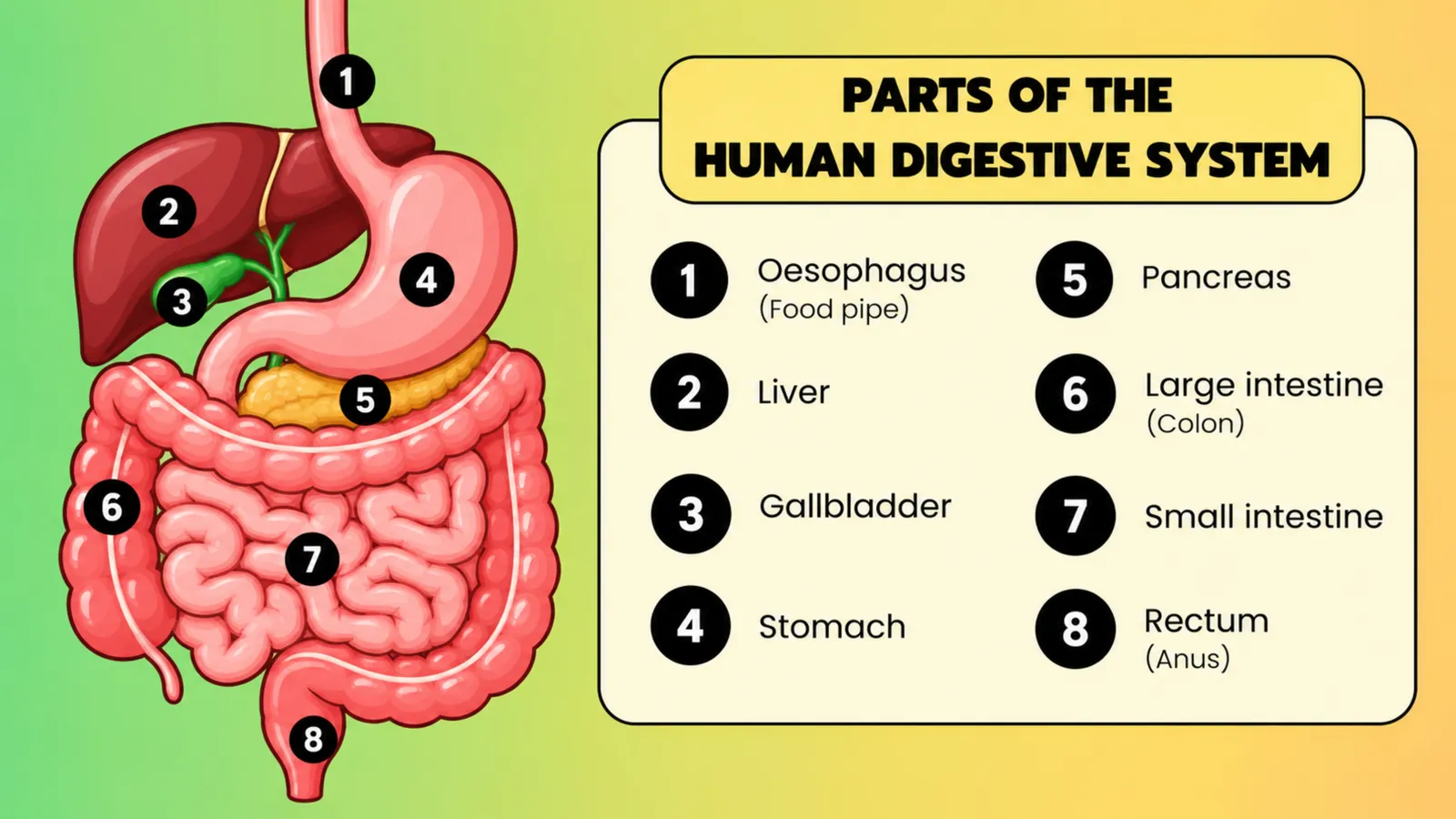
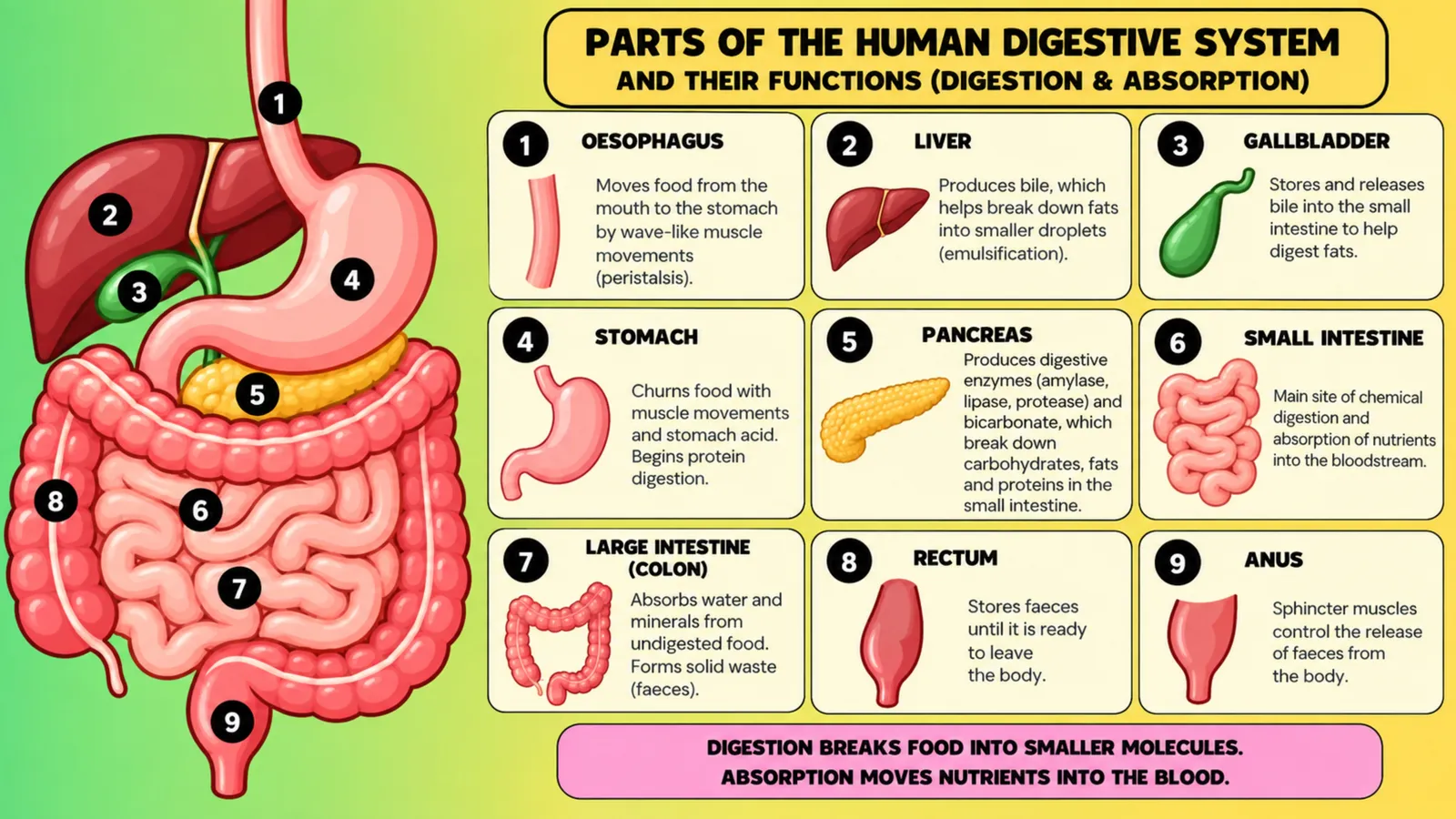
Slides: Parts of the digestive system
Every organ and its job, from oesophagus to anus
1/2
Digestive Enzymes at a Glance
Salivary amylase works in the mouth and turns starch into maltose.
Pepsin works in the acidic stomach and turns proteins into peptides.
Pancreatic amylase works in the small intestine and turns remaining starch into maltose.
Trypsin works in the small intestine and turns proteins and peptides into smaller peptides.
Lipase works in the small intestine and turns fats into fatty acids and glycerol.
Maltase, sucrase and lactase work in the small intestine wall and turn double sugars into single sugars such as glucose.
🧪
Slide: Food breakdown equations
Starch, protein and fat broken into small soluble molecules
1/1
Absorption: How Nutrients Enter the Blood
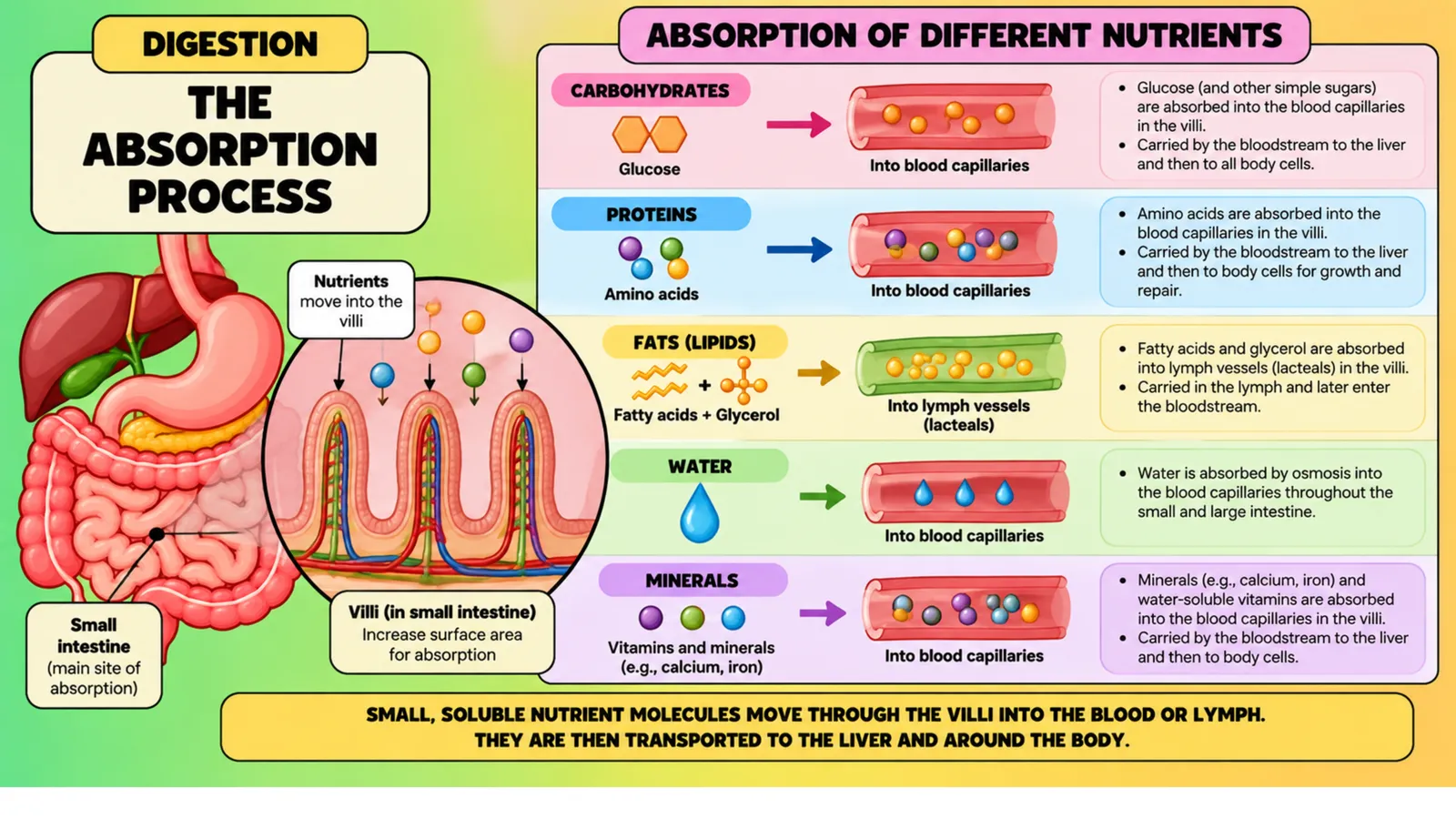
Digestion is useless unless the products actually get into the body. That transfer is called absorption, and it happens mainly in the small intestine.
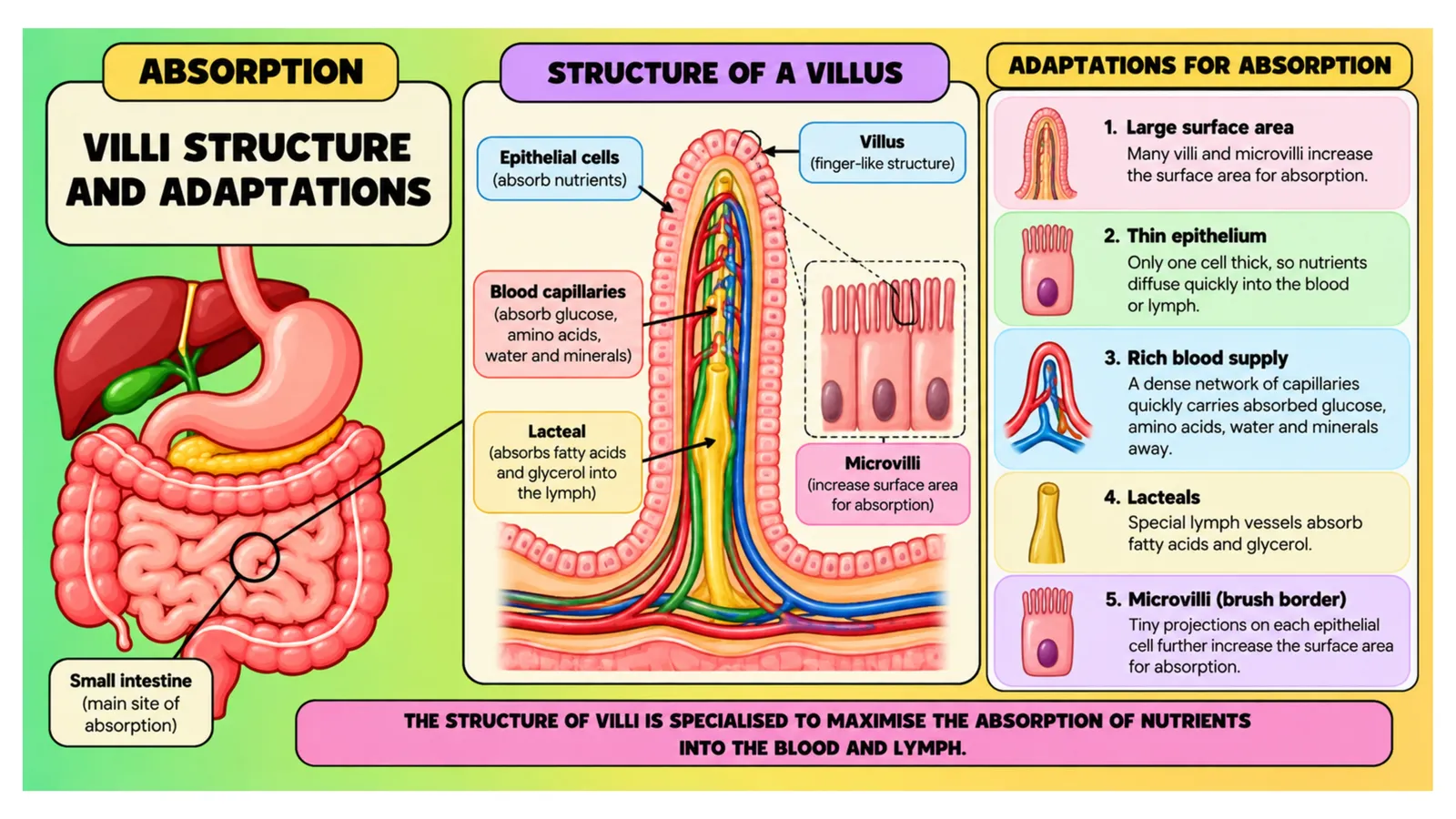
The inner surface of the small intestine is not smooth. It is covered with millions of tiny finger like projections called villi, and each villus is covered with even smaller projections called microvilli. This folding increases the absorbing surface enormously. If you flattened out the inner lining of the small intestine, it would cover an area comparable to a badminton court, all packed inside your abdomen.
Each villus is beautifully designed for its job. Its wall is only one cell thick, so nutrients have a very short distance to travel. It contains a dense network of blood capillaries that carry glucose and amino acids away to the liver. It also contains a lymph vessel called a lacteal that absorbs the products of fat digestion. Because blood is constantly flowing past, the concentration inside the capillary stays low, and this keeps the nutrients moving in by diffusion.
🧬
Slides: Absorption and villi
How digested nutrients get into the blood and lymph
1/2
Common Digestive Problems Students Should Know
Acidity and heartburn happen when stomach acid flows back up into the oesophagus, which has no protective mucus layer, causing a burning feeling in the chest.
Constipation happens when faeces move too slowly and too much water is reabsorbed, usually because of low fibre intake or not drinking enough water.
Diarrhoea is the opposite situation, where material passes too quickly and water is not reabsorbed properly, often due to infection.
Ulcers are open sores in the stomach or duodenum lining, frequently linked to a bacterium called Helicobacter pylori.
Lactose intolerance occurs when a person produces too little lactase, so the milk sugar lactose is not digested and gut bacteria ferment it instead, causing gas and discomfort.
How to Keep Your Digestive System Healthy
Chew your food properly, because good mechanical digestion makes the enzymes work faster.
Eat plenty of fibre from fruits, vegetables and whole grains so that material moves smoothly through the gut.
Drink enough water throughout the day to support both digestion and water balance.
Eat at fairly regular times, since the stomach releases acid in anticipation of meals.
Stay physically active, because movement encourages peristalsis.
Avoid eating very late at night, as lying down soon after a heavy meal makes acid reflux more likely.
Frequently Asked Questions About the Digestive System
How long does digestion take from start to finish?
Food usually spends a few minutes in the mouth and oesophagus, two to four hours in the stomach, three to five hours in the small intestine, and up to a day or more in the large intestine. The complete journey commonly takes somewhere between twenty four and seventy two hours.
Which organ absorbs the most nutrients?
The small intestine, and specifically the ileum, absorbs the vast majority of nutrients thanks to its villi and enormous surface area.
Is bile an enzyme?
No. Bile contains no enzymes. It neutralises acid and emulsifies fat, which is a physical change rather than a chemical breakdown.
What is the difference between egestion and excretion?
Egestion removes undigested food that never entered your body cells. Excretion removes metabolic waste such as urea that was produced inside cells.
Why does the stomach not digest itself?
A thick mucus layer protects the lining from acid, and the lining cells are replaced very quickly.
Final Thoughts
The digestive system is a wonderful example of teamwork inside the body. No single organ can do the job alone. The mouth prepares, the stomach softens and sterilises, the liver and pancreas supply chemicals, the small intestine finishes the work and collects the reward, and the large intestine tidies up.
When you revise this topic, do not memorise a random list of organs. Follow the food. Picture a piece of bread moving through the tube and ask yourself at each stop what happens to it physically, what happens to it chemically, and which organ helped. If you can tell that story clearly in your own words, you understand the digestive system properly, and any exam question on the topic becomes much easier to answer.
📝 Worksheets
Print-ready practice sheets for this lesson. Sign in to download the PDF.
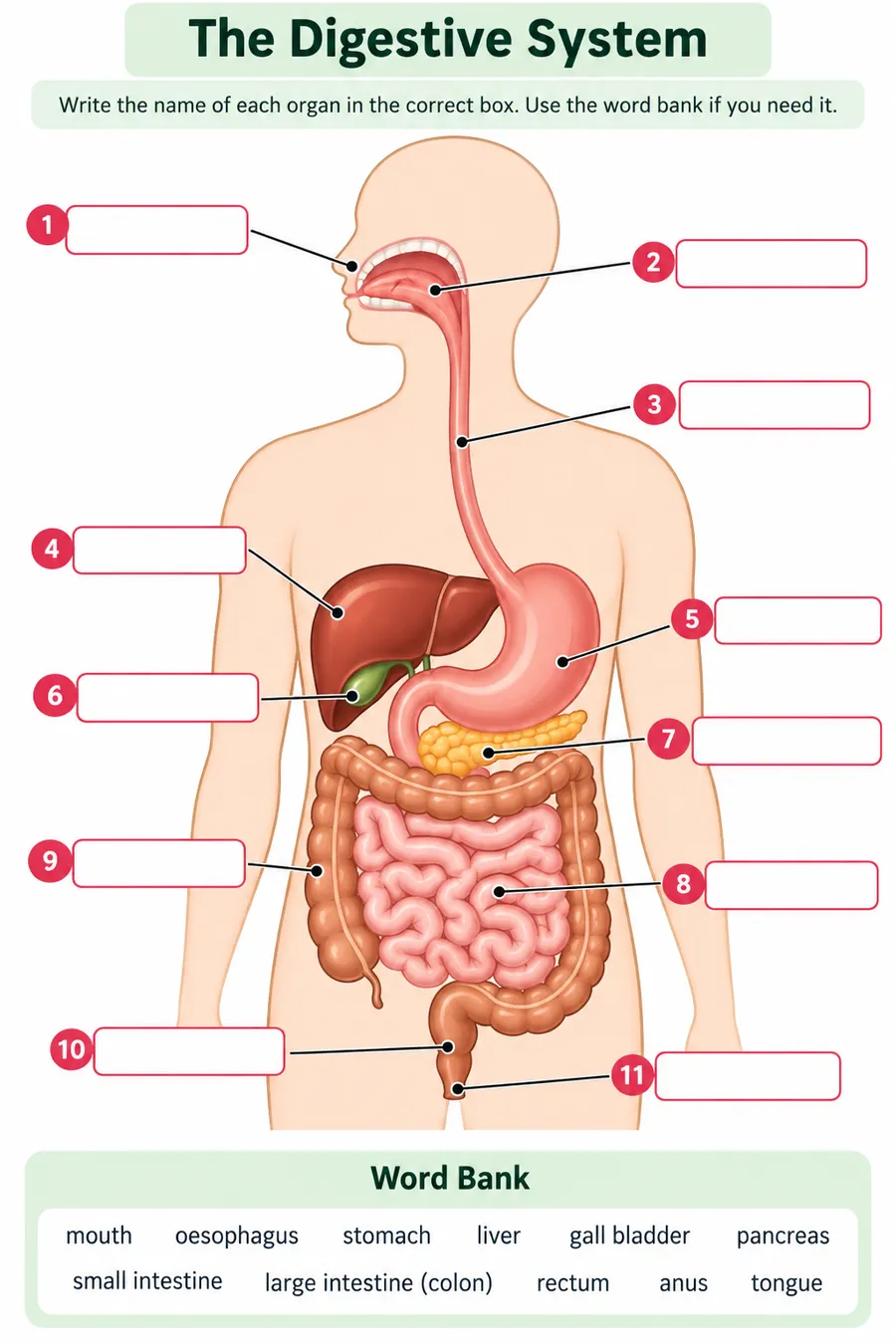
Label the Digestive System
Write the name of each of the 11 numbered organs, from mouth to anus, using the word bank.