📖 Lesson: Electric Current and Voltage
Learn about the flow of electric charges and potential difference

🃏 Flashcards
Click each card to reveal the definition
🎮 Interactive Games
Test your knowledge about electric current and voltage
⚡ Electric Current and Voltage Explained: The Ideas Behind the Circuit
Two true-or-false statements that catch students out
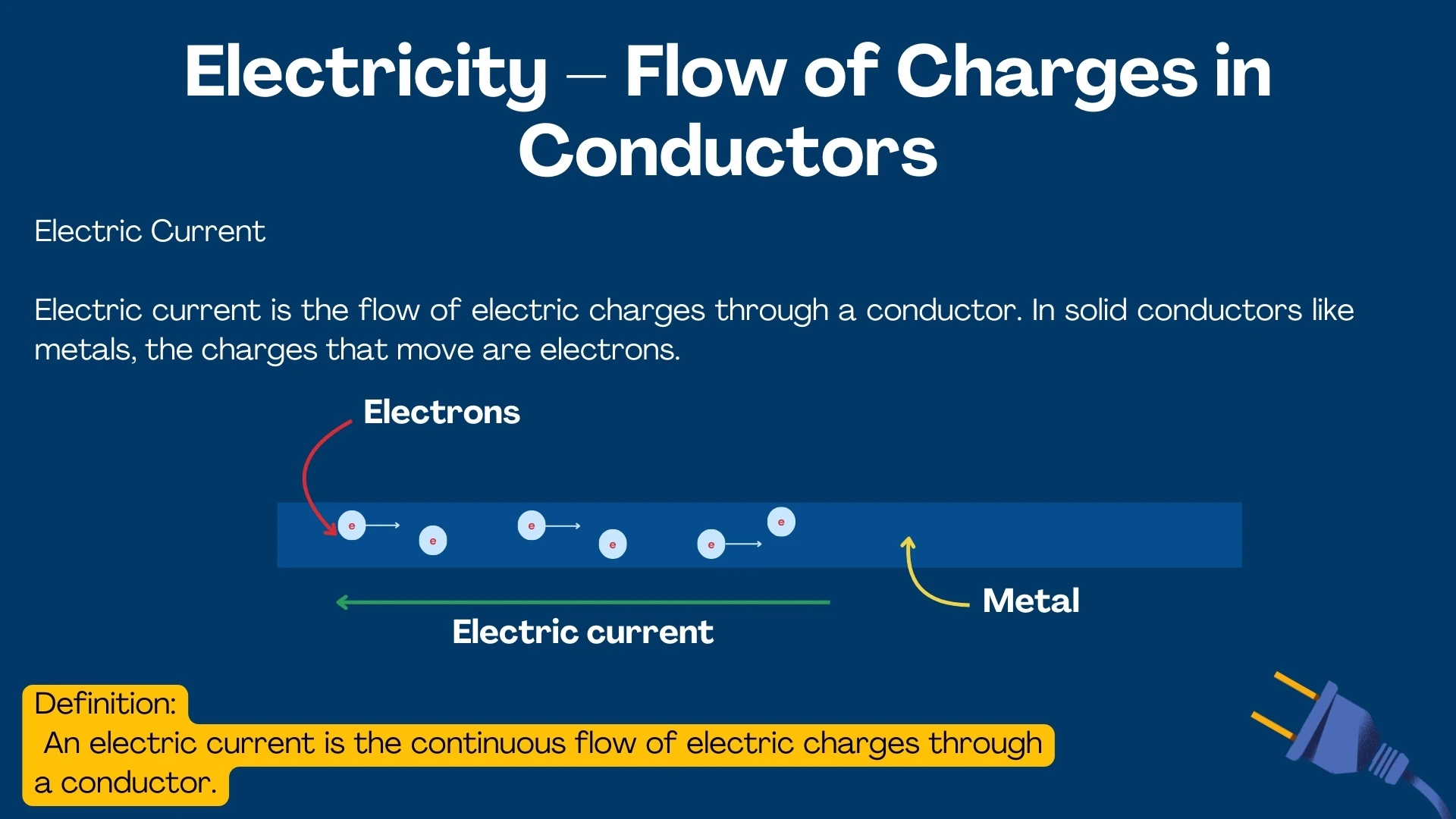
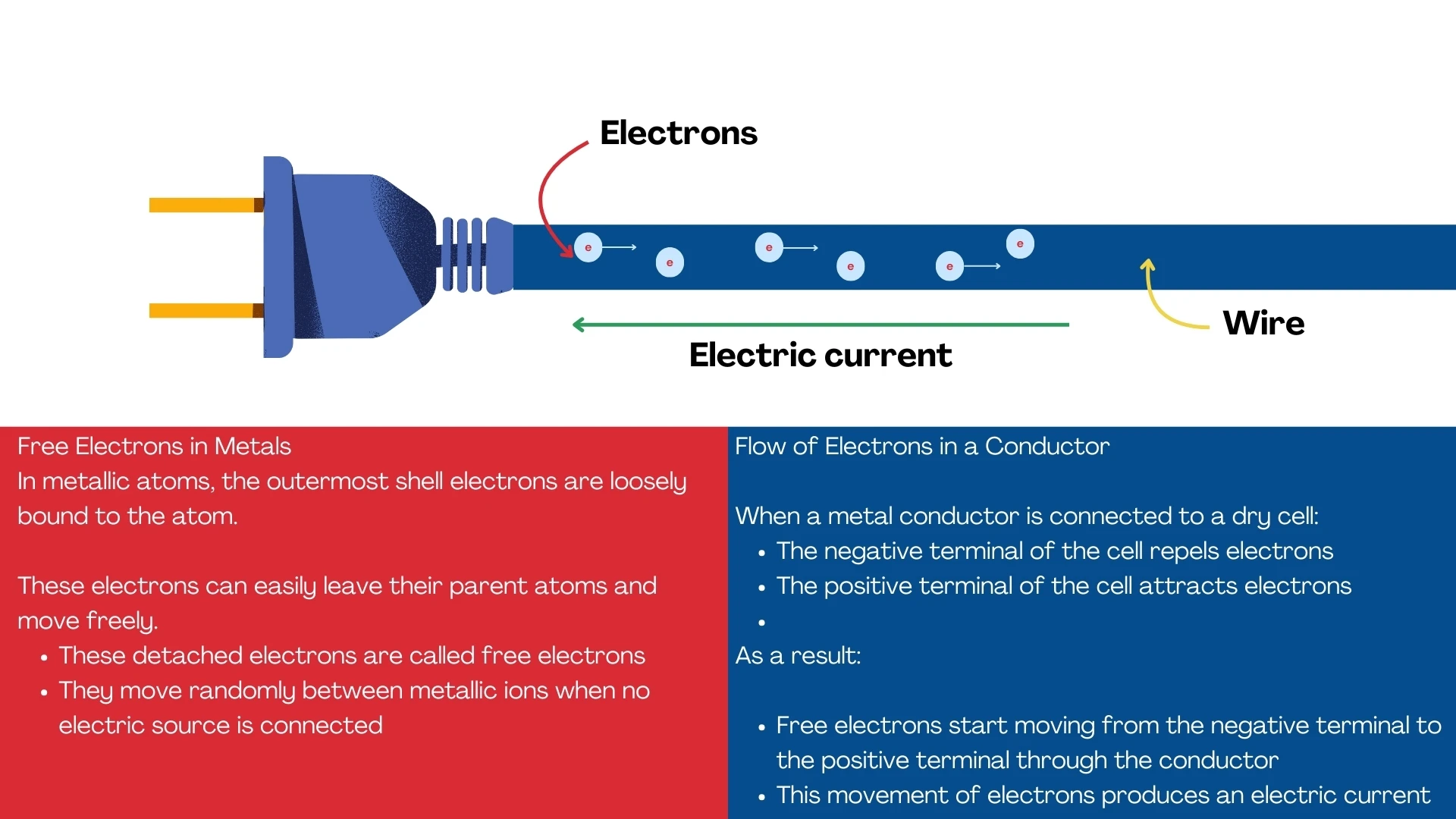
"Electric current is the continuous flow of atoms in a conductor." FALSE. The atoms in a copper wire stay where they are, vibrating about fixed positions. What flows is electric charge, carried in a metal by electrons that are free to move between the atoms. Current is the flow of charge, not of atoms. "Metals have tightly bound outer electrons." FALSE. It is the other way round. In a metal the outer electron of each atom is delocalised: it is not tied to any one atom and drifts freely through the whole piece of metal. Those free electrons are exactly why metals conduct. In an insulator such as rubber or glass the outer electrons are tightly bound, so there is nothing free to carry charge.What electric current is
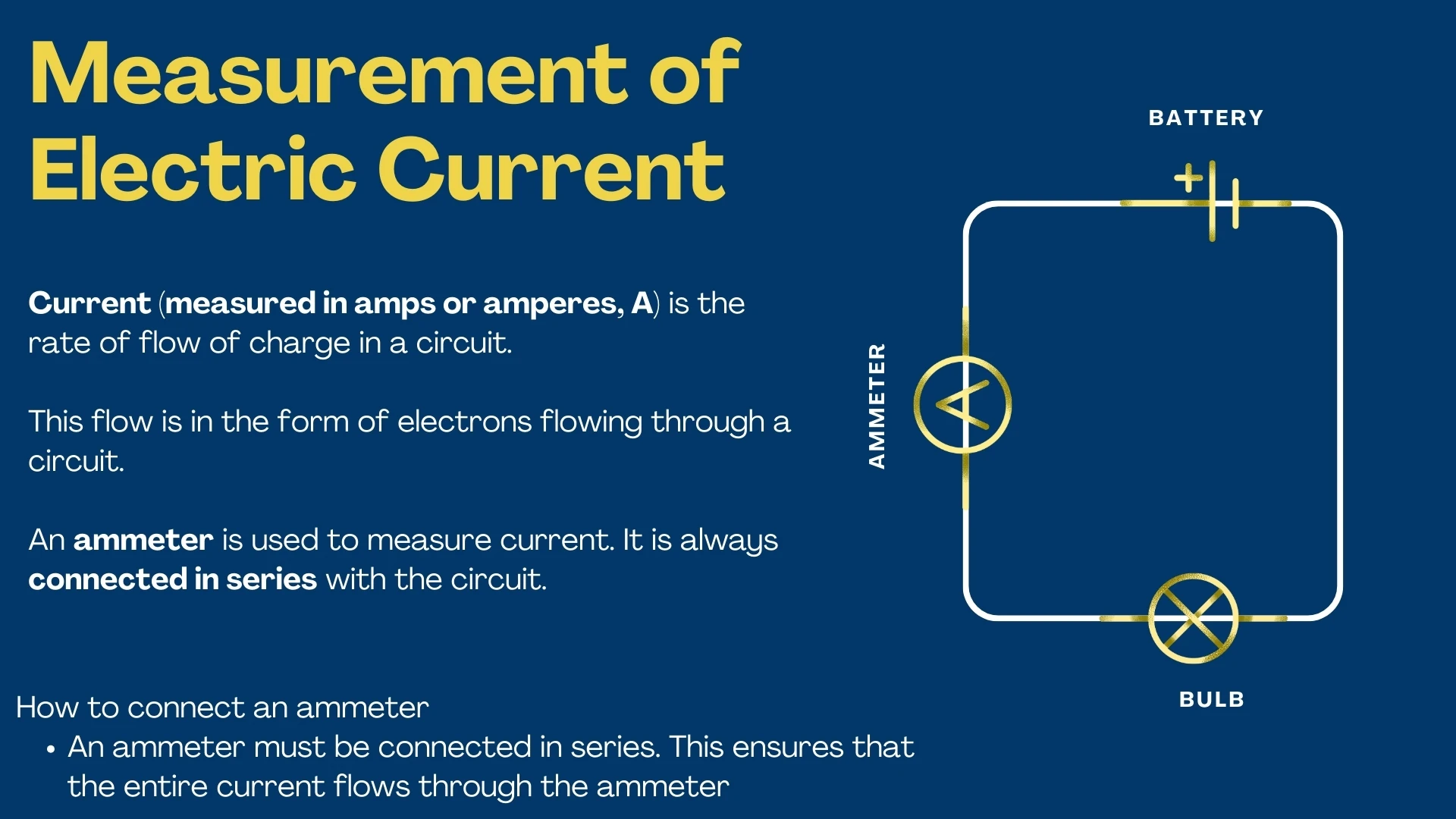
Electric current is the rate of flow of electric charge: how much charge passes a point in a circuit each second. Its unit is the ampere (A), and one ampere means one coulomb of charge passing every second. Current is given the symbol I and is measured with an ammeter. (Working out charge, current and time from each other is the subject of our separate I = Q/t calculations lesson.)
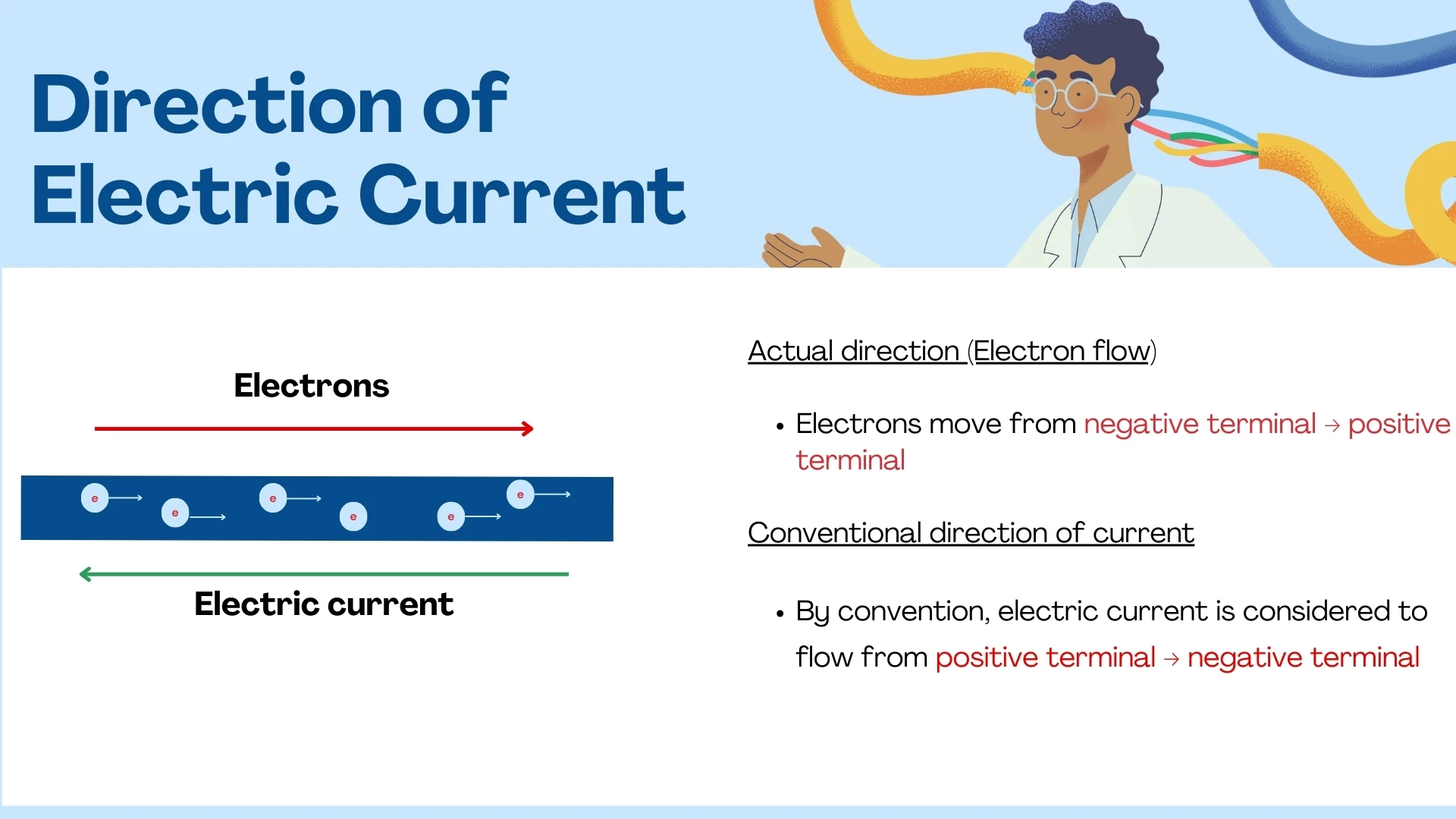
Two directions are used when talking about current, and it helps to keep them apart. Conventional current is drawn from the positive terminal of the cell, round the circuit, to the negative terminal; this is the direction used in all circuit diagrams and rules. Electron flow is the opposite way, from negative to positive, because electrons are negatively charged and are repelled by the negative terminal. Both descriptions are correct; they simply describe the same current from different points of view.
One surprise: the electrons themselves drift very slowly, typically less than a millimetre per second. A lamp still lights the instant a switch is closed because the wire is already full of free electrons, and the push that starts them all moving spreads through the wire almost at the speed of light.
What potential difference (voltage) is
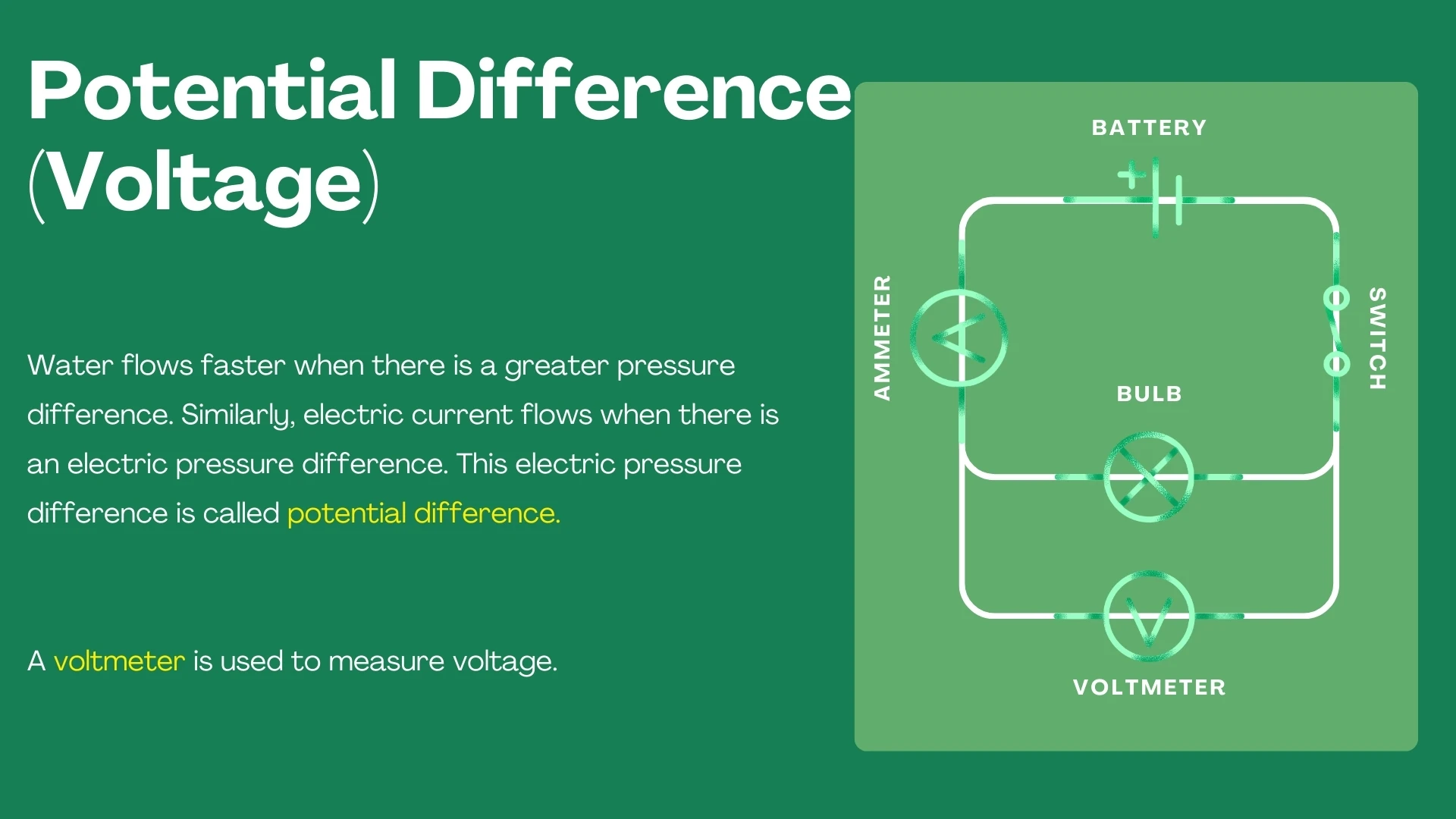
A current will not flow on its own. Something has to push the charge around the circuit and give it energy to transfer to the lamps, motors and resistors it passes through. That something is the potential difference (p.d.), usually called voltage. The potential difference between two points is the energy transferred per unit of charge that passes between them. Its unit is the volt (V), and one volt means one joule of energy transferred by each coulomb of charge. It is given the symbol V and measured with a voltmeter.
So a 1.5 V cell gives each coulomb of charge 1.5 joules of energy as it passes through, and a lamp with 1.5 V across it takes 1.5 joules from every coulomb that flows through its filament, releasing it as light and heat. A 9 V battery gives each coulomb six times as much energy.
Current and voltage: the difference in one table
Students often treat the two words as interchangeable. They are not. Current is something that flows through a component; potential difference is a measurement across a component, between two points. A cell on the shelf has a voltage between its terminals but no current, because there is no complete circuit for charge to flow round.
| Feature | Electric current | Potential difference (voltage) |
|---|---|---|
| Definition | Rate of flow of electric charge | Energy transferred per unit charge between two points |
| Symbol and unit | I, measured in amperes (A) | V, measured in volts (V) |
| Measured with | Ammeter | Voltmeter |
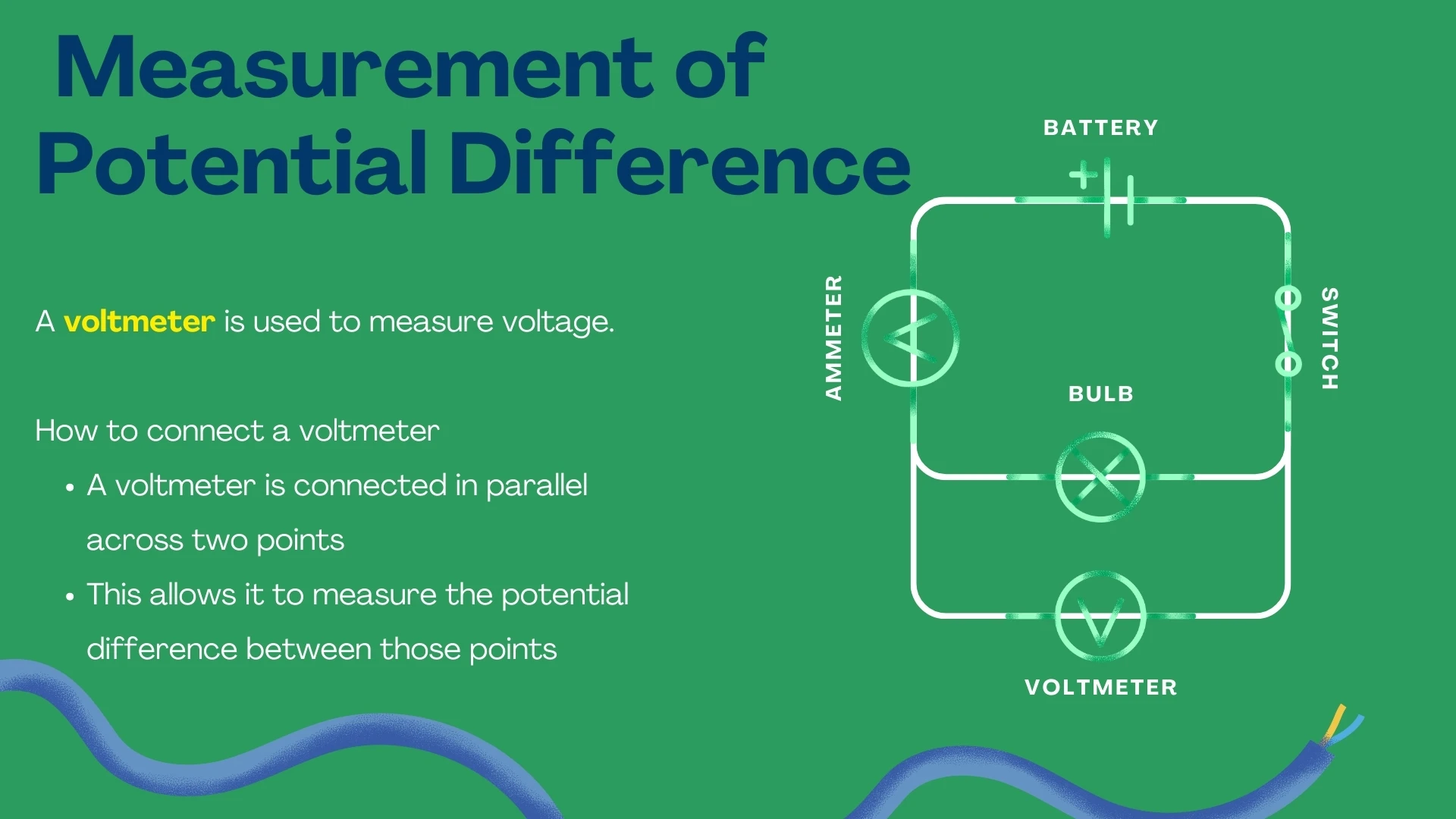
| Meter connected | In series, so the same current flows through the meter | In parallel, across the two points being compared |
| Think of it as | What flows through a component | What pushes the flow, measured across a component |
Connecting ammeters and voltmeters
An ammeter is connected in series with the component, so that every bit of charge going through the component also goes through the meter. To avoid changing the current it is measuring, an ammeter is built with a very low resistance. A voltmeter is connected in parallel, with one lead on each side of the component, so that it compares the energy of the charge going in with the energy coming out. To avoid stealing current from the component, a voltmeter is built with a very high resistance. Connect them the wrong way round and the readings are meaningless: an ammeter in parallel acts almost like a short circuit, and a voltmeter in series almost stops the current altogether.
How current and voltage behave in series and parallel circuits
- Series circuit (one loop): the current is the same at every point, because there is only one path and charge cannot pile up anywhere. The potential difference of the supply is shared between the components, and the p.d.s across them add up to the supply voltage. Two identical lamps on a 6 V battery get 3 V each; if one lamp breaks, the loop is broken and both go out.
- Parallel circuit (branches): each branch is connected directly across the supply, so the potential difference is the same across every branch and equals the supply voltage. The current from the supply is shared between the branches, and the branch currents add up to the total. Each branch works independently, which is why the lights in a house are wired in parallel: one bulb can fail and the rest stay on.
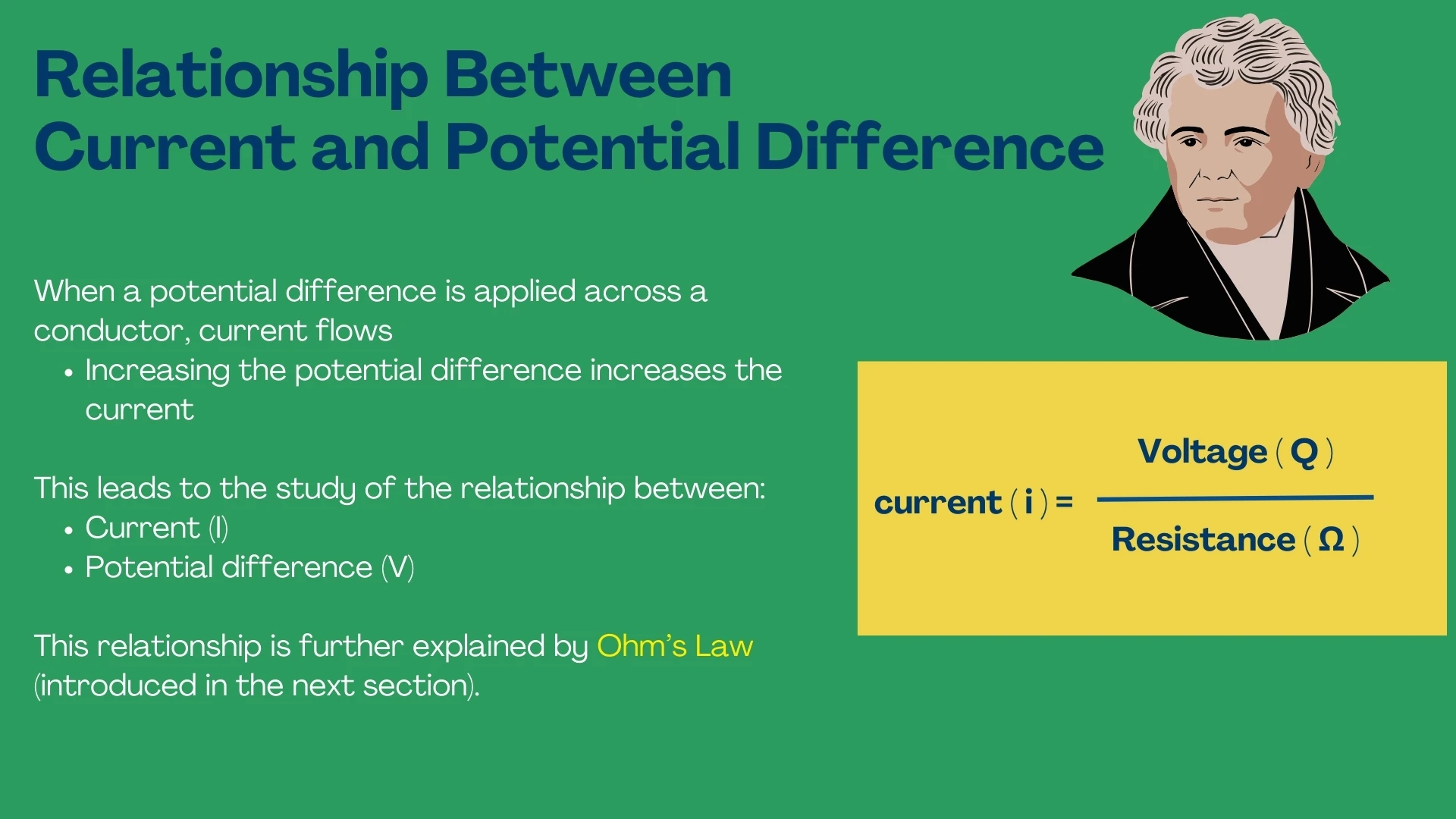
The size of the current that a given voltage produces depends on the resistance of the circuit; that relationship, V = IR, is explained with worked examples on our Ohm's law lesson.
EMF and terminal voltage
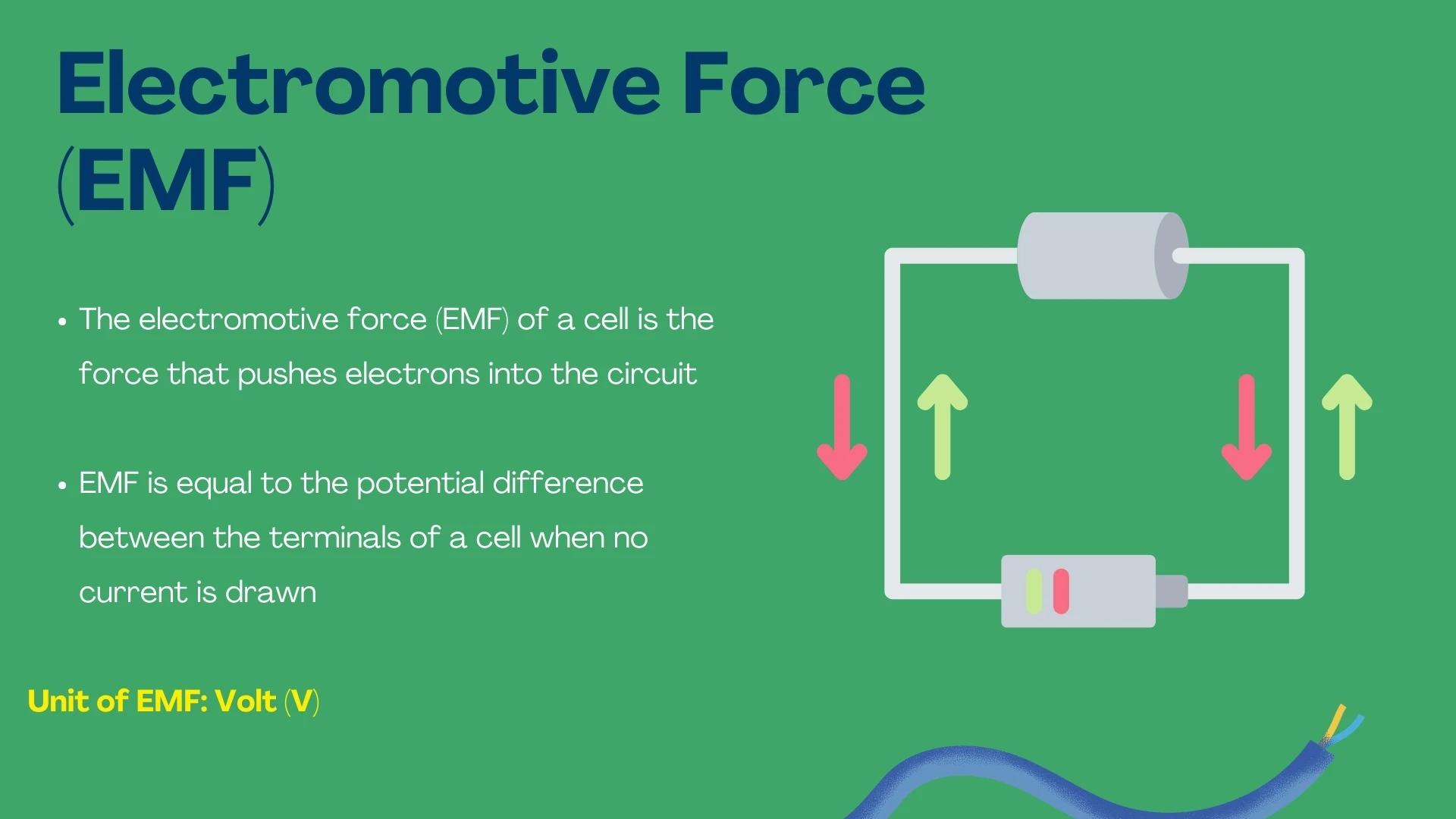
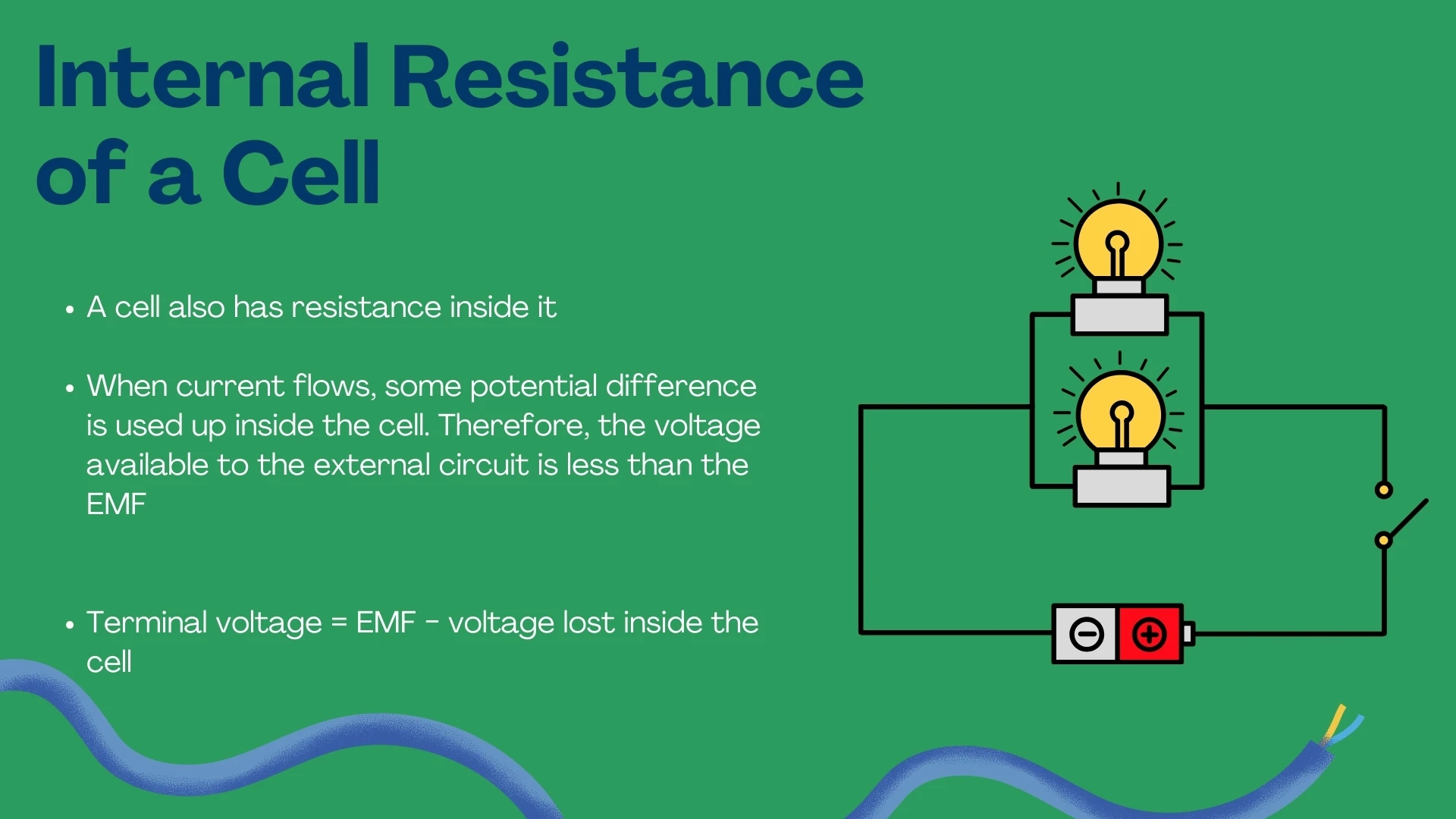
The voltage printed on a cell is its electromotive force (EMF): the energy it gives to each coulomb of charge, measured in volts. A real cell also has a small resistance of its own, its internal resistance, and some of the EMF is used up pushing charge through the cell itself. The voltage actually available at the terminals, the terminal voltage, is therefore slightly less than the EMF whenever a current flows, and the gap grows as the current increases. Only when no current is drawn does the terminal voltage equal the EMF.
Key terms
- Electric current
- The rate of flow of electric charge, measured in amperes (A). One ampere is one coulomb per second.
- Potential difference
- The energy transferred per unit charge between two points, measured in volts (V). One volt is one joule per coulomb.
- Delocalised electron
- An outer electron in a metal that is free to move through the whole structure rather than staying with one atom; the charge carrier in metal conductors.
- Conventional current
- The direction of current used in circuit diagrams, from the positive terminal to the negative terminal; opposite to the direction electrons move.
- Electromotive force (EMF)
- The energy a source gives to each coulomb of charge, in volts; equal to the terminal voltage only when no current flows.