📖 Lesson: Natural Selection & Populations
Explore how natural selection drives evolution and shapes populations over time
🎮 Interactive Games
Test your knowledge with fun interactive activities
Interactive Simulation
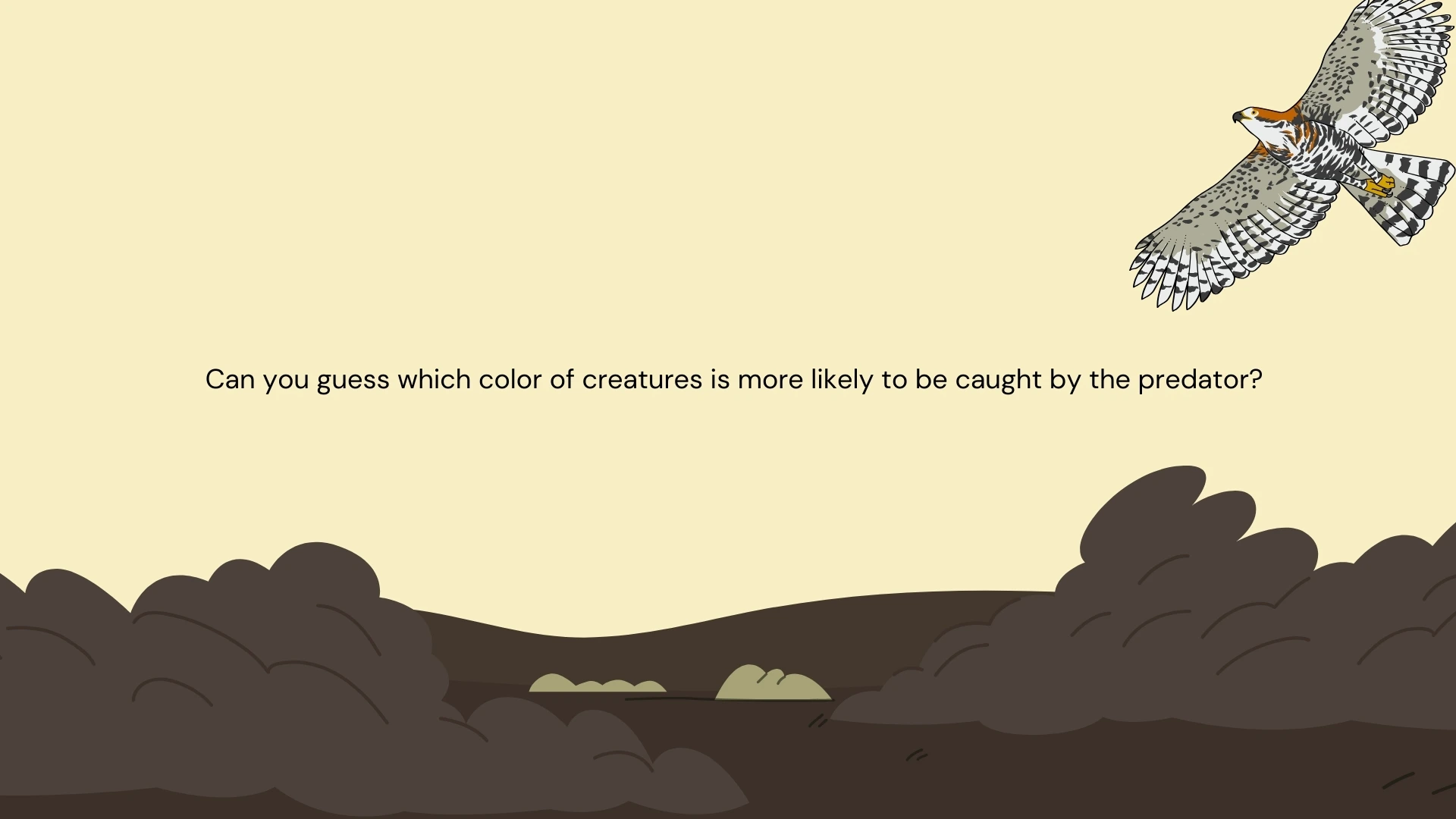
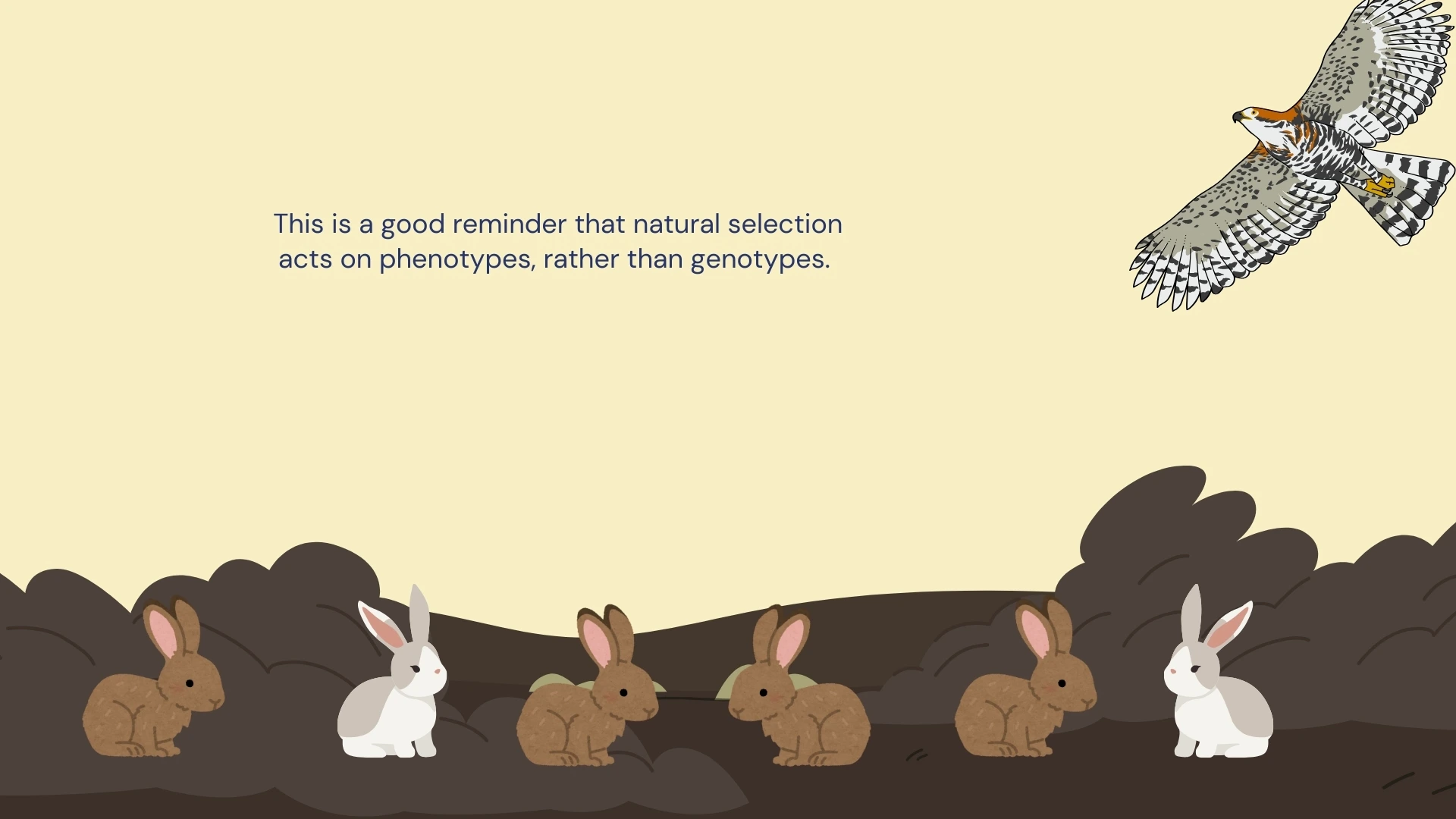
Watch how predator-prey relationships drive natural selection. See which traits help organisms survive and reproduce in different environments.
Coming Soon📚 Natural Selection Explained: How It Works
What is natural selection?
Natural selection is the process by which individuals with characteristics better suited to their environment are more likely to survive and reproduce, so those characteristics become more common in the population over many generations. It is the main mechanism of evolution, the gradual change in the inherited features of a population over time. Natural selection has no plan and no goal. It is simply the outcome of three facts: individuals vary, more offspring are produced than can survive, and some variations are inherited.
How natural selection works, step by step
- Variation. Individuals in a population are not all the same. Some of this variation is genetic, caused by random mutations in DNA and by the shuffling of alleles during sexual reproduction. Only genetic variation matters for natural selection, because only genetic variation can be passed on.
- Selection pressure. Something in the environment makes survival difficult: predators, disease, cold, drought, a shortage of food, or competition for mates. Populations produce far more young than the environment can support, so not every individual will live to breed.
- Differential survival. Individuals whose characteristics happen to suit the conditions are more likely to survive the selection pressure. A faster gazelle escapes the cheetah; a better-camouflaged moth is missed by the bird.
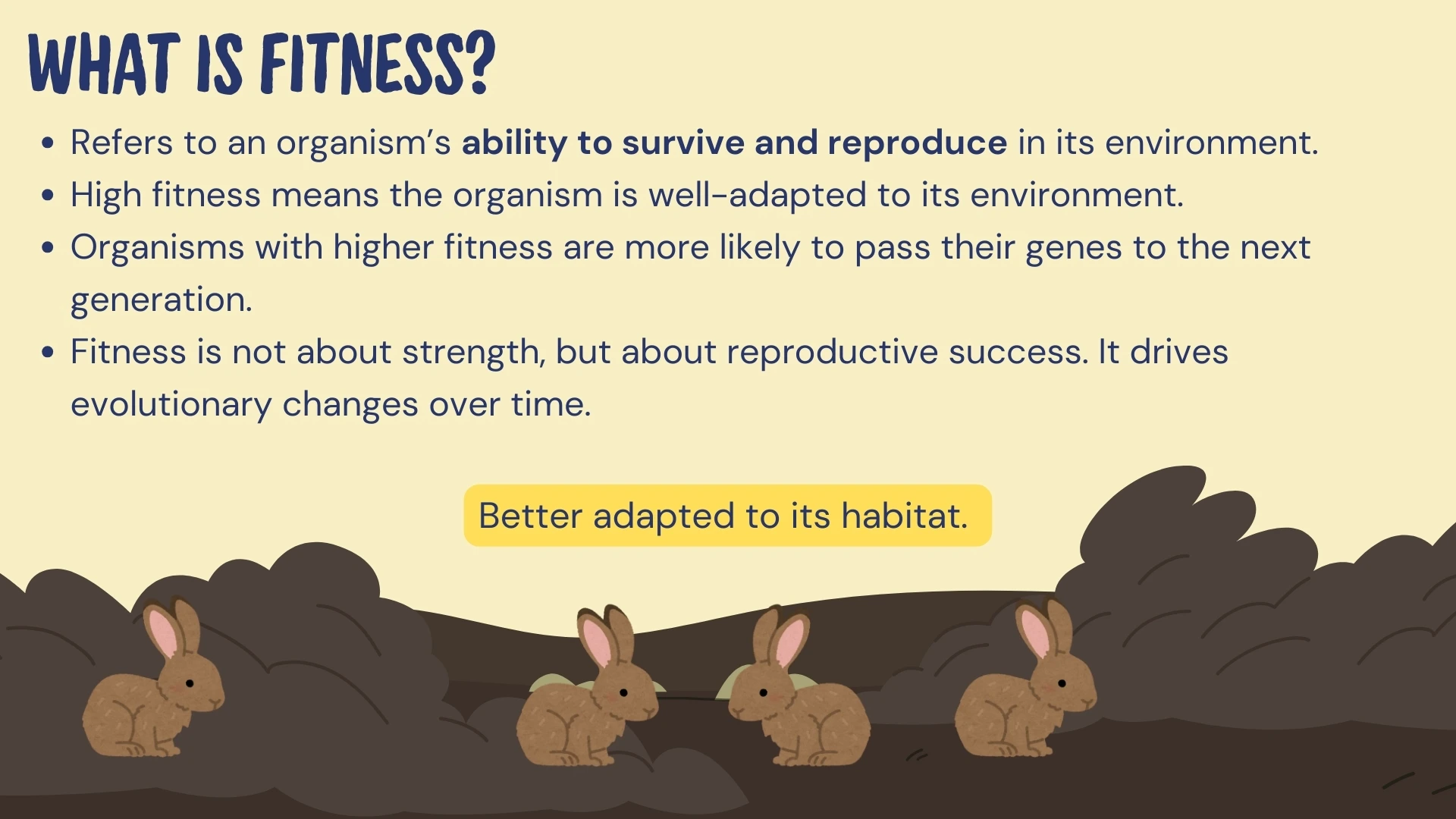
- Reproduction. The survivors breed and pass their alleles to their offspring. Biologists call this reproductive success fitness. Fitness has nothing to do with being strong or healthy in the everyday sense; the fittest individual is the one that leaves the most surviving offspring.
- Inheritance over generations. Because the advantageous alleles are inherited, they become more common in each generation, and the disadvantageous ones become rarer. Over many generations the whole population becomes better suited, or adapted, to its environment. If two populations of the same species are separated and selected in different directions for long enough, they may become so different that they can no longer interbreed, and a new species has formed.
A worked example: the peppered moth
The peppered moth rests on tree trunks during the day and is hunted by birds. Before the Industrial Revolution almost all peppered moths in Britain were pale and speckled, which hid them against lichen-covered bark. A dark, almost black form also existed, produced by a single mutation, but it was very rare because birds spotted it easily. The first dark peppered moth was recorded in Manchester in 1848. As factories spread, soot blackened the tree trunks and killed the lichens. Now the pale moths stood out and were eaten, while the dark moths were hidden and survived to breed. By 1895 about 98 per cent of the peppered moths around Manchester were dark. When clean-air laws reduced the soot in the second half of the twentieth century, the trees became pale again and the pale form recovered. Notice what did not happen: no moth changed colour during its life. The dark allele already existed; the changing environment changed which moths survived to pass it on.
The same process explains antibiotic resistance. In any large population of bacteria a few carry a random mutation that lets them survive a particular antibiotic. When the antibiotic is used, the non-resistant bacteria die, the resistant few multiply, and within days the population is mostly resistant. The bacteria did not "learn" to resist the drug; the drug acted as a selection pressure on variation that was already there.
Common misconceptions
- Individuals do not adapt and pass it on. A giraffe that stretches for high leaves does not produce longer-necked calves. This idea, proposed by Jean-Baptiste Lamarck before Darwin, is wrong because changes to an animal's body during its life do not alter the alleles in its sex cells. Natural selection works only on variation that is already inherited.
- Organisms do not evolve "in order to" do something. Moths did not turn dark so that they could hide. Random variation came first; the environment then favoured some variants over others.
- Evolution happens to populations, not individuals. An individual is born with its alleles and dies with them. It is the proportion of alleles in the population that changes from one generation to the next.
Darwin, Wallace and the theory of evolution
Charles Darwin developed the theory of natural selection after his five-year voyage on HMS Beagle (1831 to 1836), during which he collected fossils and living specimens from South America and the Galápagos Islands. The Galápagos finches, whose beaks differ from island to island to suit the local food, became a famous example. Darwin worked on the idea for more than twenty years. In 1858 he received a letter from Alfred Russel Wallace, a naturalist working in what is now Indonesia, who had reached the same explanation independently. Their ideas were presented together to the Linnean Society of London that year, and Darwin published his full account, On the Origin of Species, in 1859. Neither man knew about genes; the mechanism of inheritance was only understood after Gregor Mendel's work was rediscovered in 1900 and DNA's structure was described in 1953, and both findings supported the theory.
Three forms of natural selection
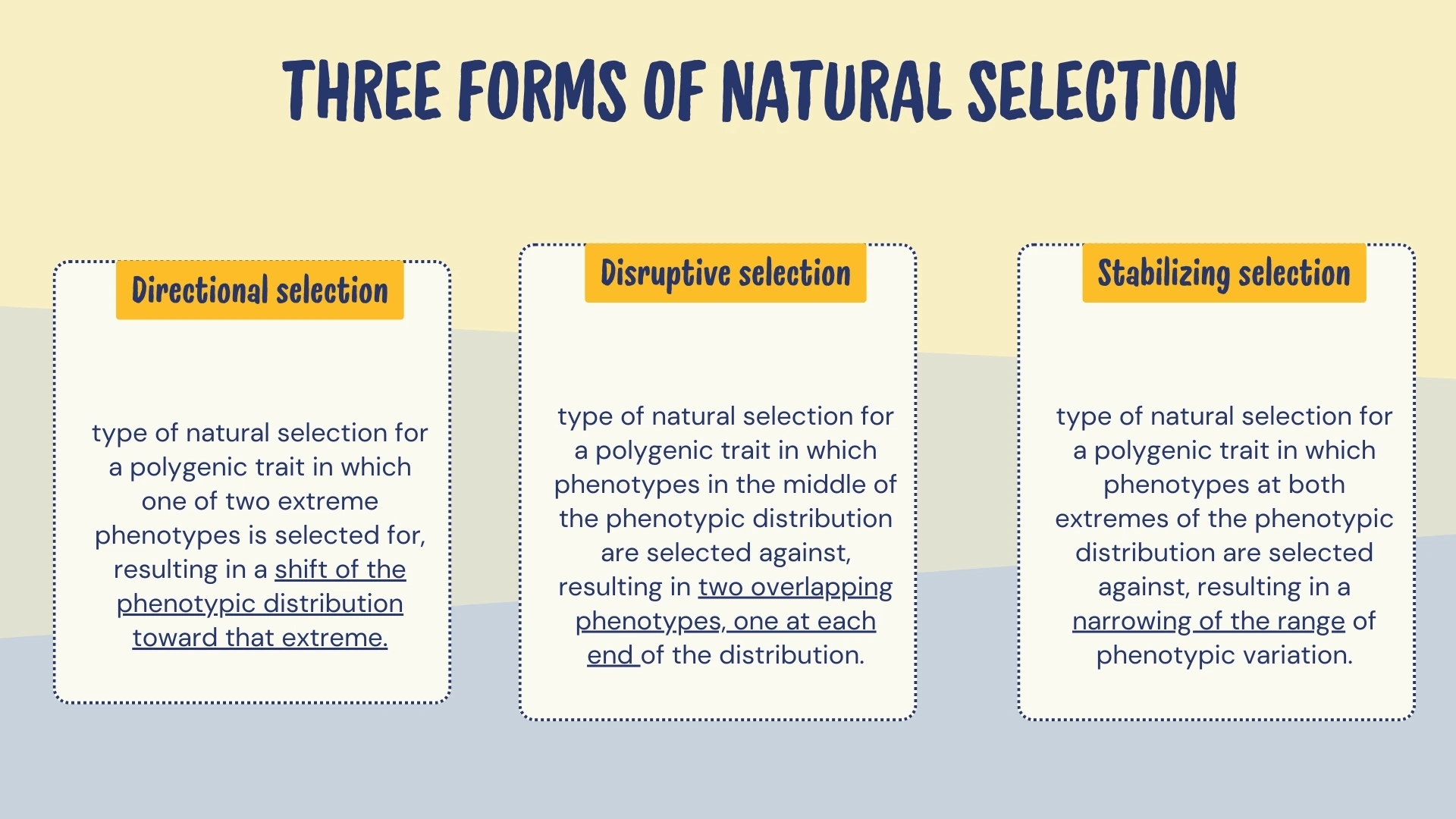
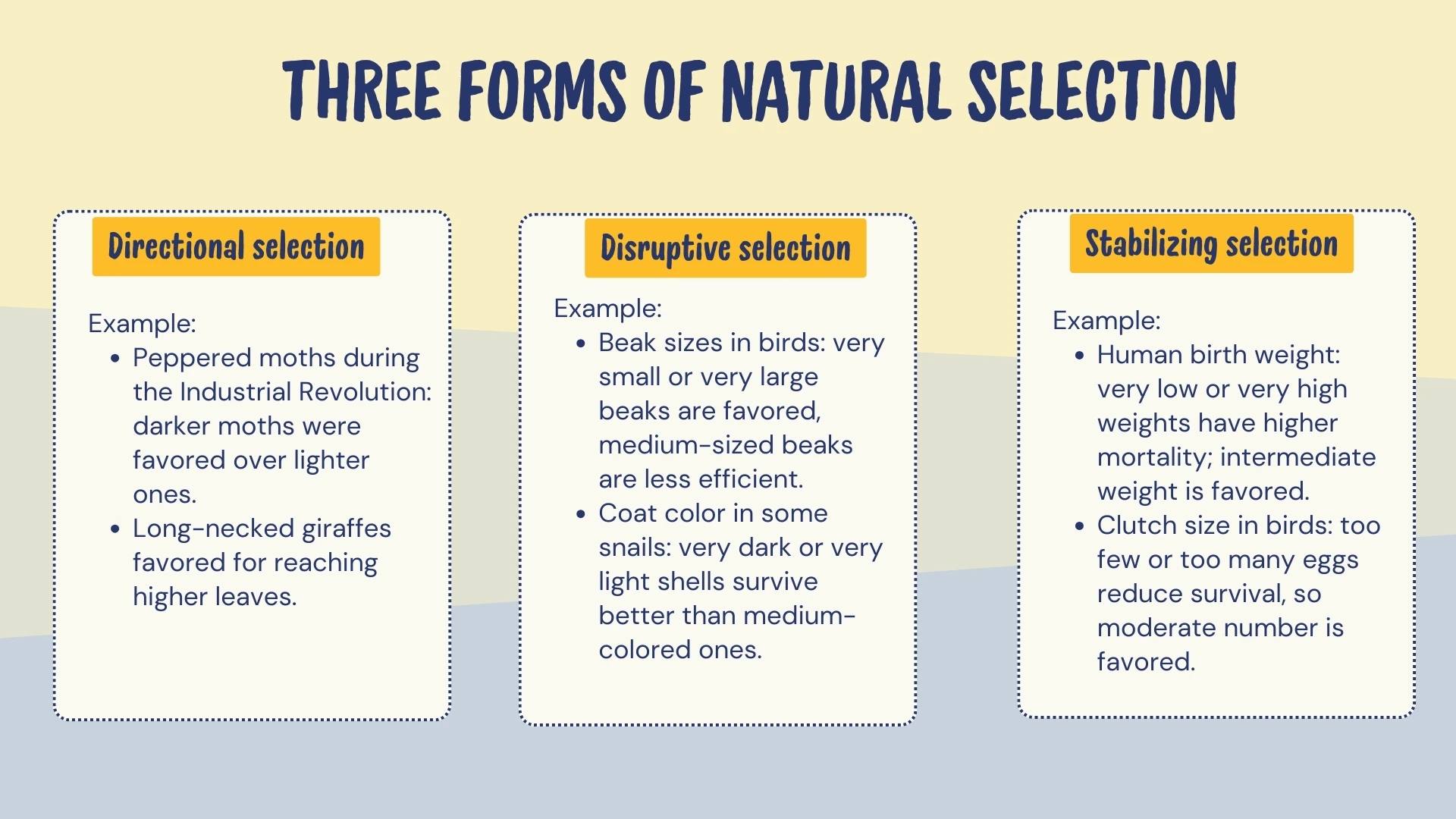
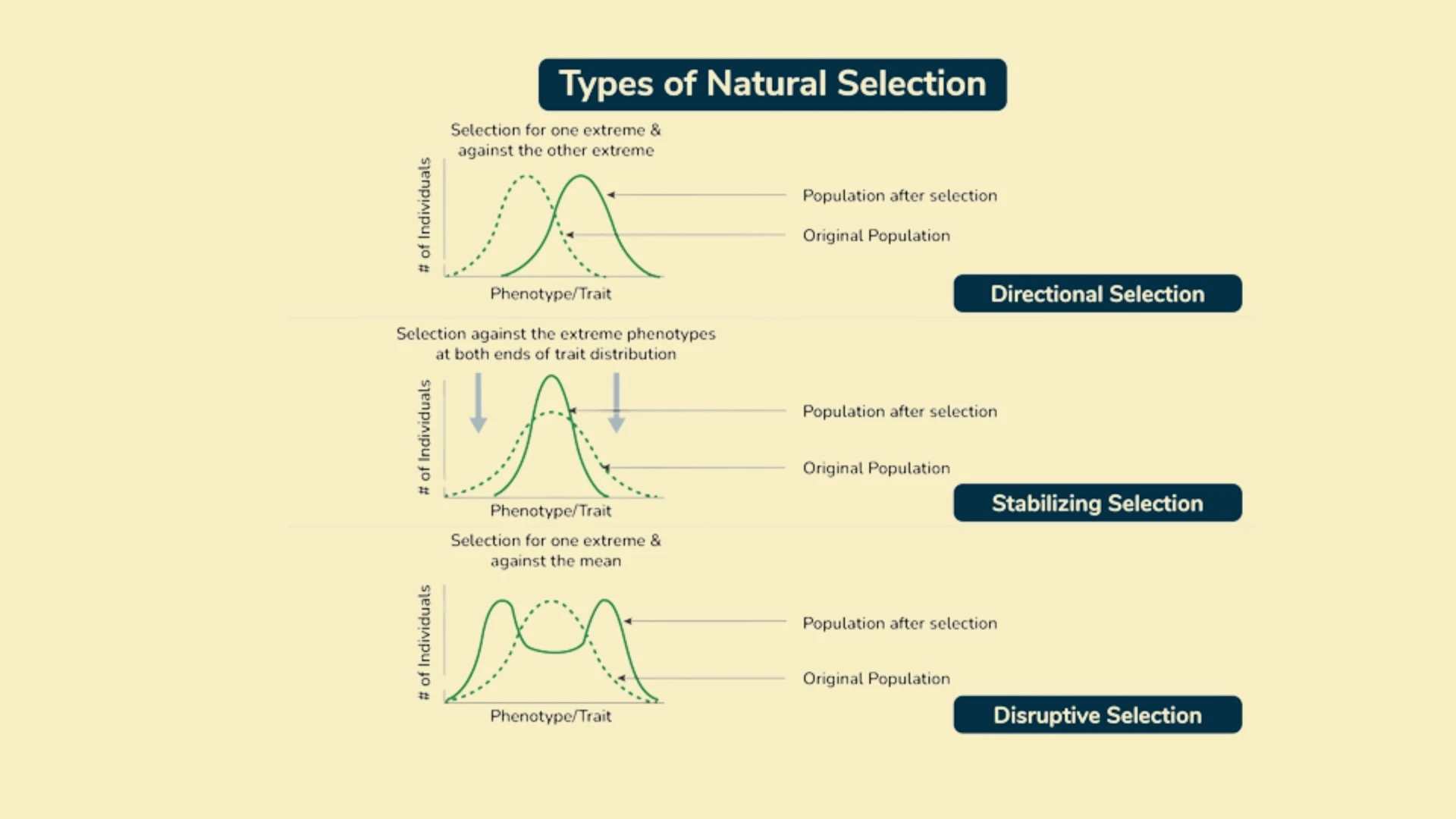
Selection can push a characteristic in different ways, and the carousel above shows the three patterns as graphs. Directional selection favours one extreme, so the average shifts over time, as it did for moth colour in polluted areas. Stabilising selection favours the middle and removes both extremes; human birth weight is the classic example, because very small and very large babies have historically had lower survival. Disruptive selection favours both extremes at the expense of the middle, as when small-beaked and large-beaked finches each have a food source but medium-beaked birds handle neither well; this can split a population in two.
Natural selection versus selective breeding
Selective breeding (also called artificial selection) is what happens when humans choose which individuals are allowed to reproduce. Farmers who breed only from the cows that give the most milk, or dog owners who breed only the smallest dogs, are applying a selection pressure of their own. Darwin used pigeon breeding as evidence that selection can transform a species. The two processes rely on the same ingredients, variation and inheritance, but they differ in who does the choosing and what is chosen.
| Feature | Natural selection | Selective breeding |
|---|---|---|
| Who selects | The environment: predators, climate, disease, competition | Humans choose the parents |
| What is favoured | Traits that improve survival and reproduction in the wild | Traits useful or attractive to people, such as milk yield, crop size or coat colour |
| Speed | Usually slow, over many generations | Can be fast, because only chosen individuals breed |
| Effect on variation | Maintains variation suited to changing conditions | Reduces variation, which can lead to inherited disorders and vulnerability to new diseases |
| Examples | Peppered moth colour, antibiotic-resistant bacteria, finch beaks | Dog breeds, dairy cattle, seedless fruit, disease-resistant wheat |
Key terms
- Adaptation
- An inherited feature that makes an organism better suited to survive and reproduce in its environment.
- Allele
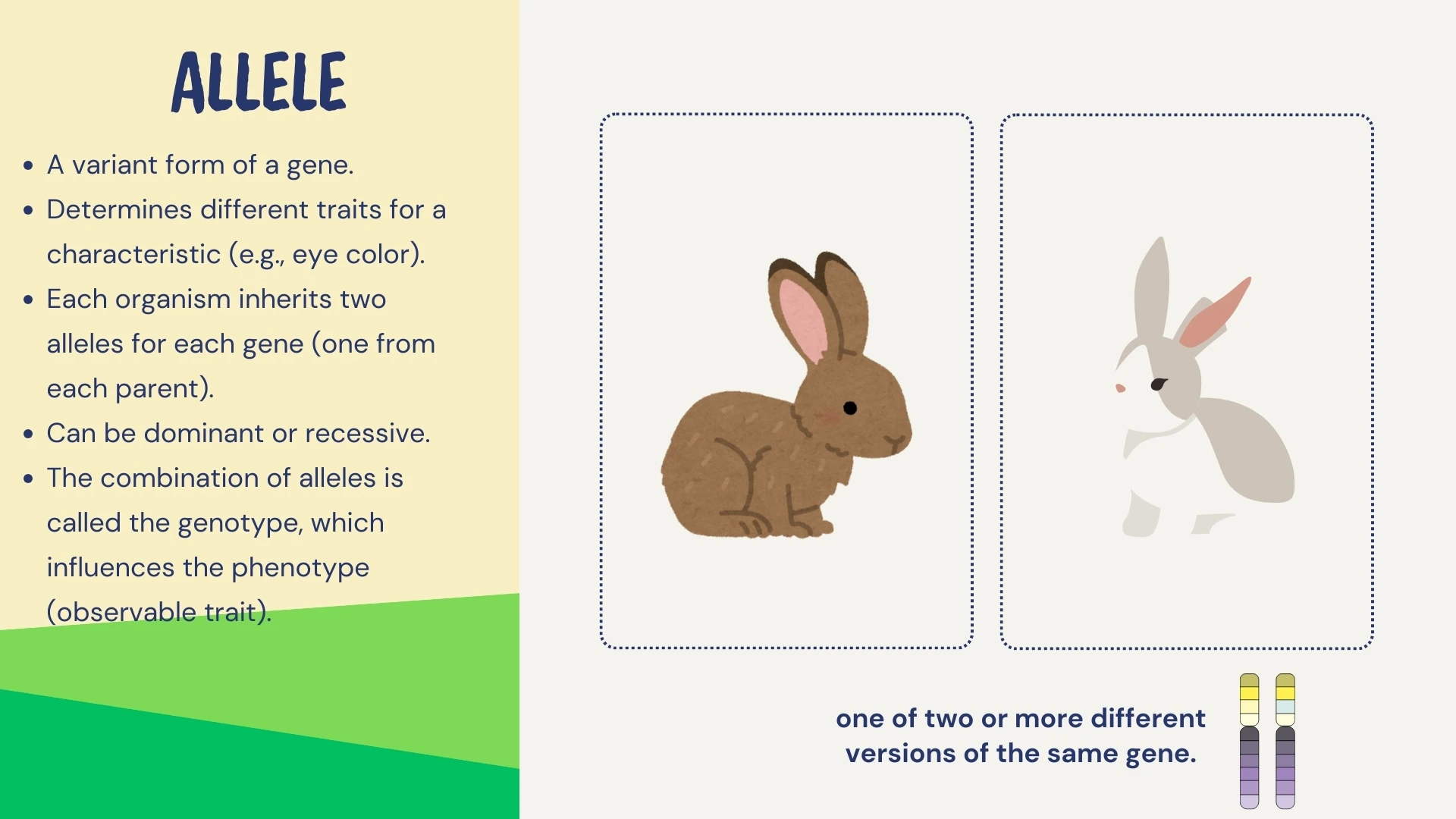
- One version of a gene; different alleles produce different forms of a characteristic.
- Mutation
- A random change in DNA that can create a new allele and so new variation.
- Selection pressure
- Any factor in the environment that affects which individuals survive and reproduce.
- Fitness
- How successful an individual is at leaving offspring that survive.
- Speciation
- The formation of a new species when separated populations become unable to interbreed.
- Selective breeding
- Humans choosing which organisms breed so that desired traits are passed on.