Sleep stages, the body clock, the chemistry of sleepiness, dreams and the health benefits of a good night's sleep.
Right now, somewhere in the world, a student is nodding off over a textbook. A newborn is drifting to sleep for the fourteenth time today. And a dolphin is sleeping with only half of its brain, keeping the other half awake to breathe. Sleep is everywhere in the living world, yet it is one of the strangest things biology does.
Every night you willingly switch off your awareness of the world. You stop eating, stop moving and stop watching for danger. From a survival point of view this looks like a terrible idea, so why did evolution keep it? In this guide you will discover what your brain does while you are unconscious, how your internal clock works, why you dream, how sleep protects your health and which evidence-based habits help you sleep better.
🌙
Slide: The science of sleep
What really happens in your brain and body at night
1/1
Why Do We Sleep?
Almost every animal that has been carefully studied sleeps, or does something very much like it. Even tiny fruit flies and worms have periods of stillness that behave exactly like sleep. If you disturb a sleeping fruit fly all night, it sleeps longer and more deeply the next day, just as a tired human would. This sleep rebound is one of the signatures scientists use to tell true sleep from ordinary rest. A behaviour this old and this widespread is not an accident.
Sleep is also dangerous. An antelope asleep on the savannah is an easy meal. Yet nature kept sleep in almost every species, which is strong evidence that its benefits outweigh the risk. Dolphins and some whales practise unihemispheric sleep, sleeping with one half of the brain at a time while the other half stays alert to surface for air. Rather than skip sleep, these animals evolved a way to sleep and stay partly alert at once.
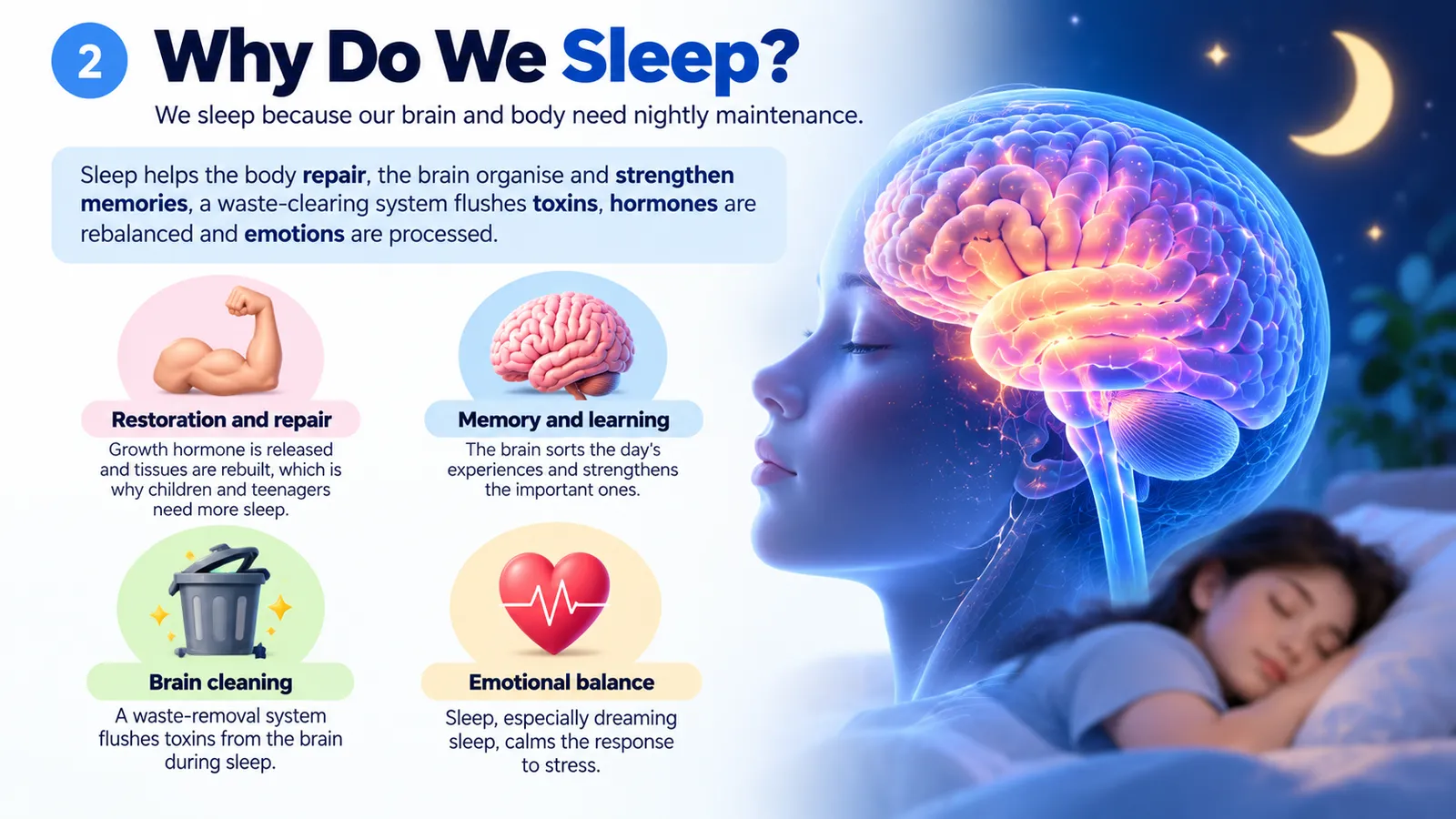
Modern research points to four broad functions of sleep:
Restoration and repair. During deep sleep, growth hormone is released and tissues are rebuilt, which is why growing children and teenagers need more sleep than adults.
Memory and learning. The brain sorts the day's experiences and strengthens the important ones.
Brain cleaning. The brain has a waste-removal system that works hardest during sleep.
Emotional balance. Sleep, especially dreaming sleep, calms the response to stress. It is overnight therapy for the emotional brain.
What happens without sleep? In 1964, 17-year-old Randy Gardner stayed awake for about 11 days, the longest documented deliberate sleep deprivation. By the end he struggled to think clearly and showed memory problems and mood changes. Please never try this, because severe sleep loss is dangerous. Even one poor night slows reaction times, and drowsy driving causes thousands of crashes every year. Over the long term, short sleep is linked to weakened immunity, weight gain, heart disease, type 2 diabetes and poorer mental health. Sleep is a biological necessity, as fundamental as food and water.
💤
Slide: Why do we sleep?
Four jobs sleep does every night
1/1
The Stages of Sleep
For thousands of years people assumed sleep was one uniform state. The truth is more interesting. Sleep is a journey through several distinct stages, repeated in cycles all night.
The breakthrough came from the electroencephalogram (EEG), which records the electrical signals of billions of brain cells firing together. In a sleep laboratory, a study called polysomnography records brain waves, eye movements, muscle activity, heart rate and breathing at once. As you fall asleep, brain waves slow down and grow larger:
Brain wave
Speed
When it appears
Beta
Fast and small
The alert, awake brain
Alpha
A little slower
Relaxed and drowsy, eyes closed
Theta
Slower still
Light sleep
Delta
Very slow and large
The deepest sleep
NREM sleep: deep and restorative
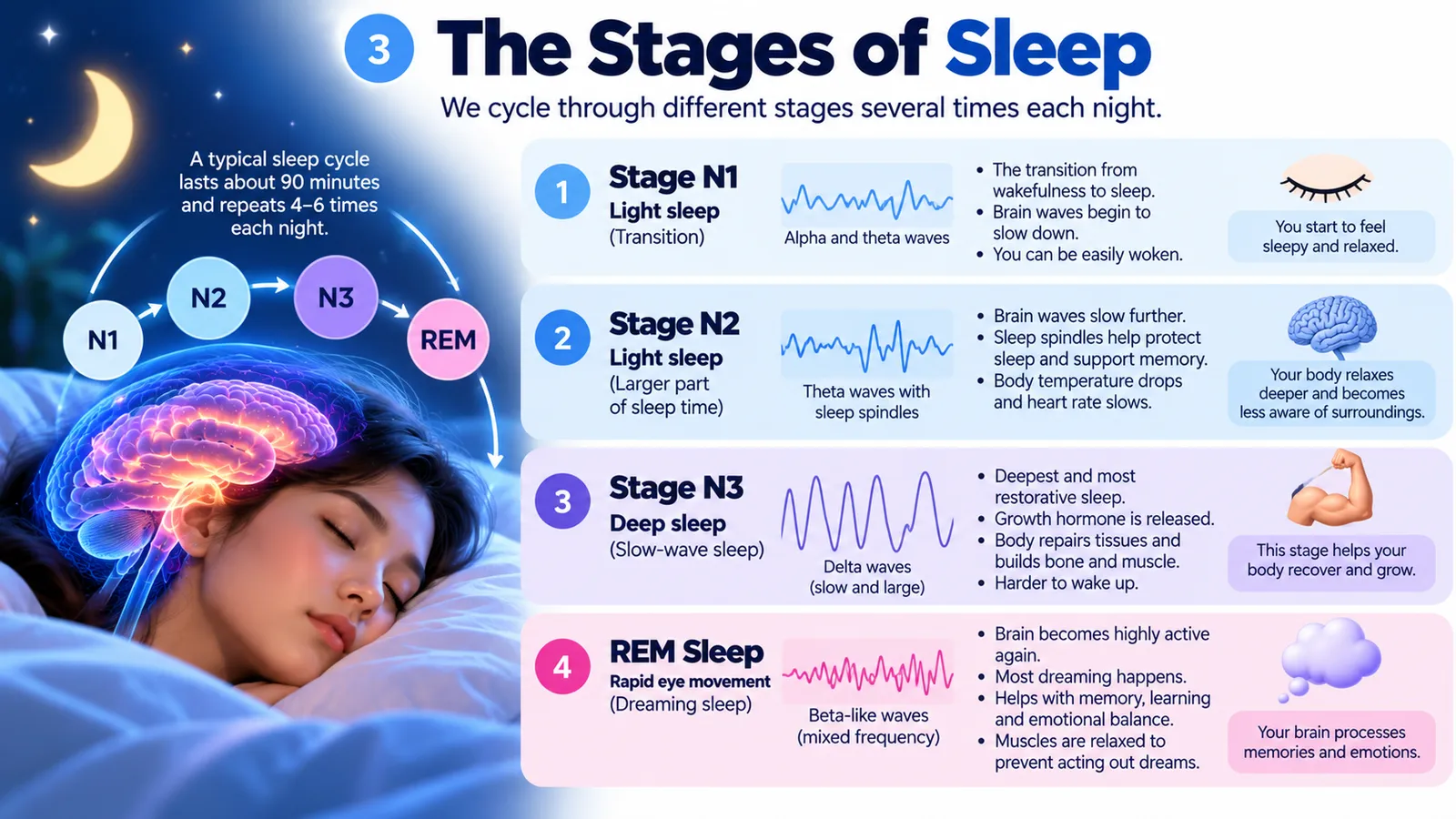
NREM sleep (Non-Rapid Eye Movement) has three stages.
Stage N1 is the featherlight doorway into sleep, lasting only minutes. This is where you may feel a sudden falling sensation and a jerk of the body, a harmless hypnic jerk.
Stage N2 takes up nearly half the night. The brain produces quick bursts called sleep spindles, which help protect sleep and lock in new memories.
Stage N3 is the deepest sleep, dominated by slow delta waves. It is the hardest stage to wake from, and being roused from it causes groggy sleep inertia. Growth hormone surges and most of it happens in the first half of the night.
REM sleep: the dreaming phase
In REM sleep (Rapid Eye Movement) the eyes dart beneath closed lids and the brain is almost as active as when awake. Vivid dreaming is most common here. At the same time the major muscles are switched off, a safety feature called REM atonia that stops you acting out your dreams. An active mind inside a paralysed body is so unusual that REM is also called paradoxical sleep.
The 90-minute cycle
You loop through N1, N2, N3 and REM about every 90 minutes, four to six times a night. Early cycles are rich in deep sleep, so the first half of the night is when most physical restoration happens. Later cycles contain more REM, so the second half is when most dreaming happens. If you wake after only four or five hours, you lose almost all the late, REM-rich cycles, one reason a short night leaves you emotionally frayed.
This also explains napping. A power nap of 10 to 20 minutes keeps you in light sleep and leaves you refreshed. A longer nap risks dropping you into N3, so you wake groggy.
📉
Slide: The stages of sleep
N1, N2, N3 and REM in a 90-minute cycle
1/1
Your Internal Clock: Circadian Rhythms
Have you ever woken moments before your alarm? Deep in your brain sits a biological clock that tracks time across roughly 24 hours. The word circadian comes from the Latin circa (around) and diem (day). In classic experiments, volunteers lived for weeks in caves with no clocks or daylight, yet their bodies kept to a cycle close to 24 hours. The clock is generated from within.
The master clock is a cluster of about 20,000 nerve cells called the suprachiasmatic nucleus (SCN), in the hypothalamus just above where the nerves from your eyes cross. It keeps the clocks in almost every tissue in step and helps regulate alertness, body temperature, hormones such as melatonin and cortisol, and digestion. The 2017 Nobel Prize in Physiology or Medicine went to Jeffrey Hall, Michael Rosbash and Michael Young for discovering the molecular clockwork inside cells.
Light and melatonin
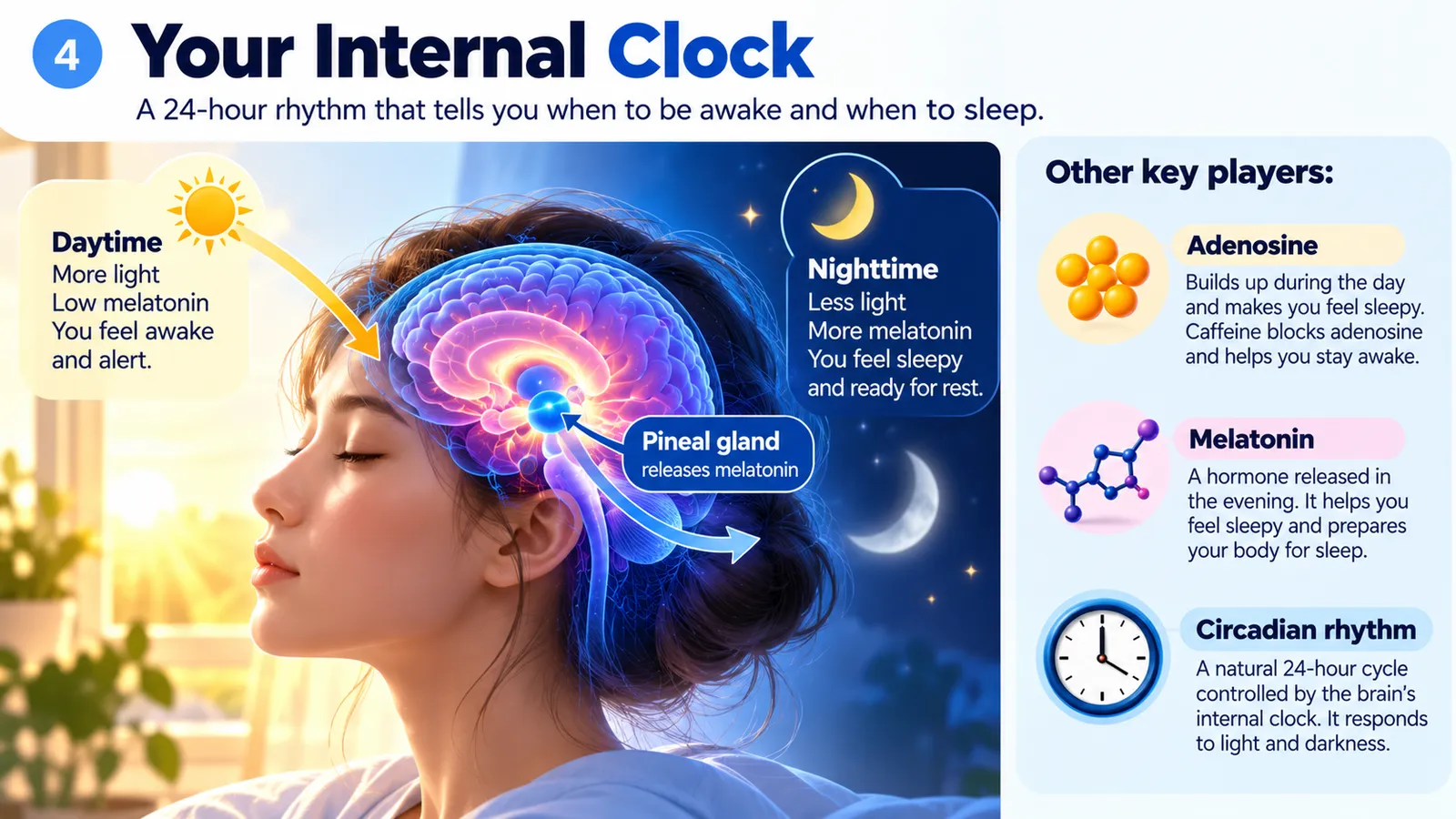
The clock runs slightly off 24 hours, so light resets it each day. Special cells in the retina detect brightness, especially blue light, and signal the SCN. Morning light nudges the clock earlier and boosts alertness. As light fades, the SCN tells the pineal gland to release melatonin, the body's "it is night-time" messenger. Melatonin is not a sedative. It is a timing signal.
This is why bright screens late at night are a problem. To your ancient body clock, the blue-white glow of a phone at midnight looks like daylight, so it suppresses melatonin and delays sleepiness.
When the clock is out of step
Jet lag happens when you cross time zones faster than your clock can adjust. It takes about a day per zone to reset, and travelling east is harder than west.
Shift work forces people to be alert when the clock says sleep, and is linked to poorer sleep and health risks.
Teenagers experience a clock that naturally shifts later. They do not release melatonin until later at night, so they are not lazy when they cannot sleep at 10 p.m. or wake at 6 a.m. This is a major reason many scientists argue for later school start times.
🕰️
Slide: Your internal clock
Light, melatonin and the daily rhythm
1/1
The Chemistry of Sleep
Adenosine and sleep pressure
As brain cells work through the day, a by-product called adenosine gradually builds up. It makes you drowsy, and the more it accumulates, the stronger the pull toward sleep. Think of adenosine as sand filling an hourglass all day. Only sleep turns the hourglass over and clears it away.
Why caffeine works
Caffeine blocks the receptors adenosine normally attaches to. The brain cannot read how much adenosine has built up, so you feel alert even though the adenosine is still there. Caffeine does not remove tiredness. It hides the signal. When it wears off, the accumulated adenosine floods in and you get a caffeine crash. Caffeine's half-life is about 5 to 6 hours, so a 4 p.m. coffee can leave a quarter of its caffeine active around midnight, quietly disrupting deep sleep.
The brain's flip-flop switch
Falling asleep is less like a dimmer and more like a switch flipping between two teams of chemicals. Wake-promoting messengers such as histamine and orexin hold wakefulness in place. GABA, the brain's main calming messenger, quiets them so sleep can take over. This explains why some allergy medicines cause drowsiness (they block histamine), and why loss of orexin-producing cells causes narcolepsy, where people fall asleep suddenly in the day.
The two-process model
Scientists combine two forces. Process S is sleep pressure from adenosine. Process C is the circadian clock. You fall asleep most easily when high sleep pressure meets the downward slope of your clock at night. The afternoon slump happens when pressure has built up while the clock's alerting signal briefly dips. The second wind after an all-nighter happens because by dawn your clock signals morning despite huge sleep pressure.
Why Do We Dream?
A dream is a sequence of images, thoughts and emotions generated by the mind during sleep. The most vivid dreams happen in REM sleep. Everyone dreams every night, roughly two hours in total, but most dreams are forgotten within about five minutes of waking.
Science has no single answer yet, and that is part of the fascination. Four leading theories are:
Memory and learning. Dreaming reflects the brain replaying and reorganising memories.
Emotional processing. In REM sleep the brain reprocesses emotional experiences while stress chemicals are turned down, so a difficult memory loses its sting.
Threat rehearsal. Dreams act as a built-in simulator for dealing with danger, which fits how common chase dreams are.
Activation-synthesis. Random bursts of brain activity are woven by the thinking brain into a story, which is why dreams are so bizarre.
Sleep, memory and learning
One benefit is beyond doubt: sleep strengthens memory. Sleep before learning prepares the brain to absorb information. Sleep after learning locks memories in through consolidation. Sleep also helps the brain make creative connections, which is why answers can appear overnight. Mendeleev said the periodic table came together in his mind around a dream.
For students the lesson is clear. An all-nighter damages both the intake and the storage of information. Spacing study over several days with good sleep beats cramming. Sleep is not time stolen from studying. Sleep is part of studying.
Not every dream is gentle. Nightmares occur in REM sleep. Night terrors arise from deep NREM sleep in young children, who remember nothing. Lucid dreams occur when you realise you are dreaming. Sleep paralysis is waking while the REM muscle switch is still off, so you cannot move for a few seconds. It is frightening but harmless.
Sleep and Your Health
The brain's overnight power-wash
The brain has no ordinary lymphatic vessels, which long puzzled scientists. Around 2013, researchers described the glymphatic system. During deep sleep, spaces between brain cells widen and cerebrospinal fluid flushes through like a tide, washing away waste, including beta-amyloid, a protein linked to Alzheimer's disease when it builds up over years. This is one reason chronic poor sleep is studied as a risk factor for long-term brain health.
Immunity, appetite and the heart
Immune system. Sleep releases cytokines that fight infection, and people who sleep too little are more likely to catch colds. Good sleep around a vaccination can strengthen the response.
Appetite. When you are short on sleep, leptin (the fullness hormone) falls and ghrelin (the hunger hormone) rises, so you crave sugary food. Poor sleep also makes cells less responsive to insulin, nudging the body toward patterns seen in type 2 diabetes.
Heart. In deep sleep, heart rate and blood pressure fall, giving the cardiovascular system a rest. Years of short or fragmented sleep raise the risk of high blood pressure, heart disease and stroke.
Growth and repair. Growth hormone peaks in deep sleep, supporting teenagers and athletes. Training breaks the body down, but sleep builds it back up.
Mental health. Poor sleep worsens anxiety and depression, and those conditions disrupt sleep. Improving sleep is a powerful support for wellbeing.
Sleep Across the Lifespan
Age group
Typical sleep needed
Newborns (0 to 3 months)
14 to 17 hours a day
Toddlers (1 to 2 years)
11 to 14 hours
School age (6 to 13 years)
9 to 11 hours
Teenagers (14 to 17 years)
8 to 10 hours
Adults (18 to 64 years)
7 to 9 hours
Older adults (65 and over)
7 to 8 hours
Babies sleep in scattered bursts because their circadian clock is not yet set, and spend about half their sleep in REM, which helps wire the developing brain. Children are deep sleepers. Teenagers have a delayed clock, and when some schools started 30 to 60 minutes later, researchers reported more sleep and, in some cases, better attendance. Adults often carry a hidden sleep debt, because people adapt to feeling tired long before their performance recovers. Older adults get lighter sleep and feel sleepy earlier, which is normal ageing, but severe insomnia is not inevitable.
Common Sleep Disorders
This section informs but does not diagnose. If you recognise yourself here, speak to a doctor.
Insomnia is difficulty falling or staying asleep despite the chance to sleep. Worrying about sleep keeps the brain alert, creating a loop. CBT-I (Cognitive Behavioural Therapy for Insomnia) is the recommended first treatment, with lasting benefits and no risk of dependence.
Obstructive sleep apnea occurs when the airway collapses and breathing repeatedly stops, causing loud snoring and severe daytime sleepiness. It is very treatable, often with a CPAP machine.
Narcolepsy brings overwhelming daytime sleepiness, sometimes with cataplexy, a sudden loss of muscle strength triggered by emotion.
Parasomnias include sleepwalking, night terrors and REM sleep behaviour disorder, where REM paralysis fails and dreams are acted out.
Sleep disorders are medical conditions, not personal failings, and most can be helped.
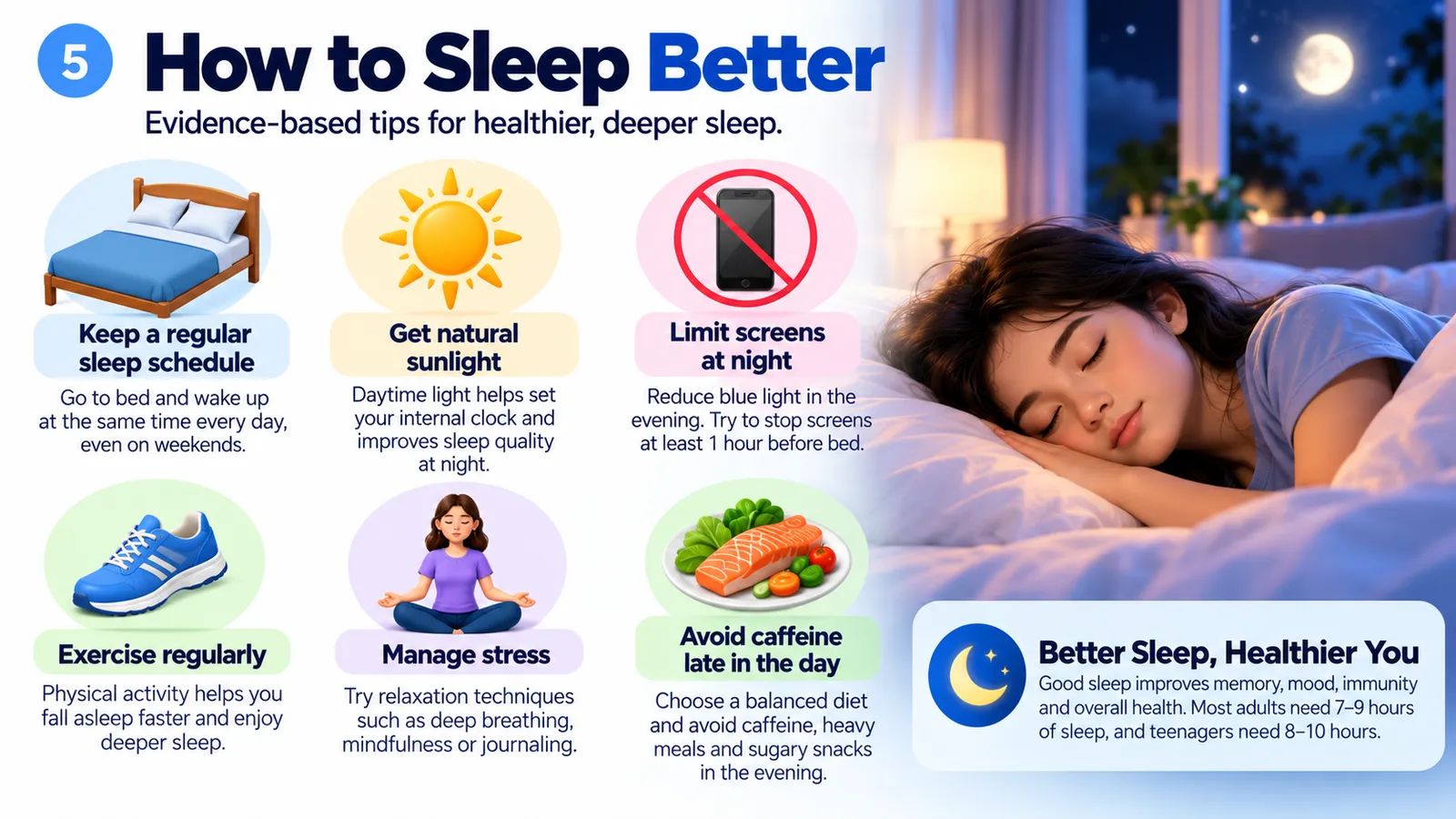
How to Sleep Better: Evidence-Based Habits
These habits are often called sleep hygiene.
1. Keep a consistent schedule
This may be the most powerful advice. Waking at the same time every day, including weekends, keeps your clock steady. Very different wake times cause a mini jet lag, called social jet lag, every Monday.
2. Get light right
Seek bright morning light to anchor your clock. In the evening, dim the lights and reduce blue-rich screen light for an hour before bed so melatonin can rise on time.
3. Build a cool, dark, quiet cave
Falling asleep depends on a small drop in core body temperature, so a slightly cool room helps. Use blackout curtains or an eye mask, and earplugs or steady background sound to mask noise.
4. Mind what you consume
Avoid caffeine from the early afternoon if you are sensitive. Treat alcohol as a sleep disruptor, not a sleep aid, because it fragments sleep and suppresses REM.
5. Wind down and calm your mind
Spend the last 30 to 60 minutes reading, stretching or taking a warm shower. Warm skin widens blood vessels, which release heat, so your core temperature falls afterwards and nudges you toward sleep. Writing tomorrow's worries on paper parks them outside your head. Slow breathing also helps: inhale for four counts and exhale for six. If you lie awake for a long time, get up, do something calm and dim, and return when sleepy, so your brain keeps linking bed with sleep.
Keep naps to 10 to 20 minutes, exercise regularly, and keep your expectations kind. Perfect sleep is not the goal. Consistently good enough sleep is.
🛏️
Slide: How to sleep better
Evidence-based habits at a glance
1/1
Frequently Asked Questions About Sleep
Does everyone dream?
Yes. Everyone dreams every night, but dream memories fade within minutes, so many people do not remember them.
Why do I feel groggy after a long nap?
You probably woke from deep N3 sleep, which causes sleep inertia. Keep naps to 10 to 20 minutes, or sleep a full 90-minute cycle.
Is it bad to use my phone before bed?
Bright, blue-rich evening light can delay melatonin and shift your clock later. Dim the lights and put screens down an hour before bed if you can.
When should I see a doctor about sleep?
Speak to a doctor about persistent trouble sleeping, loud snoring with gasping, or heavy daytime sleepiness. This guide is for education only and is not medical advice.
Key Takeaways
Sleep is ancient and essential. It repairs the body, strengthens memory, cleans the brain, balances hormones and steadies emotions.
Sleep cycles through NREM and REM stages about every 90 minutes, with deep sleep early and REM later.
The circadian clock, reset by light, and sleep pressure from adenosine decide when you sleep.
Caffeine hides tiredness by blocking adenosine receptors. It does not remove it.
Teenagers' clocks naturally run later, and most sleep disorders are treatable.
A consistent schedule, morning light, a cool dark bedroom and a calming wind-down are the foundations of better sleep.
In a busy world, sleep is often the first thing sacrificed and the last thing respected. The science points the other way. Tonight, when you feel that familiar drowsiness, see it as your brain and body beginning their essential nightly work. Continue your journey with our companion guide, The Science of the Brain.
🗂️ Revision Flashcards
Tap a card to reveal the answer.
🎯 Quick Quiz
8 questions. Pick an answer to check it straight away.
1Which brain waves dominate the deepest stage of sleep?
Stage N3 is dominated by very slow, large delta waves.
2What is REM atonia?
REM atonia is the safety feature that stops you acting out your dreams.
3About how long is one sleep cycle?
You loop through N1, N2, N3 and REM about every 90 minutes.
4Where is the body's master clock, the SCN?
The SCN sits in the hypothalamus, just above where the nerves from the eyes cross.
5How does caffeine make you feel alert?
Caffeine hides the adenosine signal; the adenosine is still there.
6Loss of orexin-producing cells causes which condition?
Orexin holds wakefulness in place; losing it causes narcolepsy.
7In the two-process model, what is Process S?
Process S is sleep pressure from adenosine; Process C is the circadian clock.
8What happens to appetite hormones when you are short on sleep?
Leptin (fullness) falls and ghrelin (hunger) rises, so you crave sugary food.