How plants coordinate growth without nerves: auxin, tropisms, the experiments behind them and the other four plant hormones.
Put a pot plant on a windowsill and, within a few days, the stem leans towards the glass. Turn a seedling on its side and its shoot curves upwards while its root curves down. A sunflower bud follows the Sun across the sky from morning to evening. No plant has a brain, a nerve or a muscle, so how does it do this? The answer is hormones, and the discovery of how they work is one of the most beautiful stories in biology.
This guide explains plant coordination from the beginning. We look at what a tropism is, follow the experiments that led scientists from Darwin to the discovery of auxin, and then see exactly how auxin steers shoots and roots. We then meet the other plant hormones and the practical that uses a clinostat, finishing with how farmers use hormones and how to answer the exam questions.
Chemical Coordination in Plants
Animals use nerves for fast responses. Plants have no nerves, so they coordinate their growth and development with plant hormones. A hormone is a chemical messenger made in small amounts in one part of the plant and carried to another part, where it changes how cells behave. Plant responses are usually slow and based on growth. They take hours or days and involve changes in the rate of cell elongation rather than quick movement.
Feature
Plant hormones
Nerves in animals
Messenger
Chemicals
Electrical impulses
Speed
Slow, over hours or days
Fast, in milliseconds
Travel by
Diffusion, phloem and xylem
Neurones
Response
Usually growth
Movement or gland secretion
A few plants do respond quickly. The Venus flytrap snaps shut and the sensitive plant, Mimosa pudica, folds its leaves when touched. This is not growth. It is caused by sudden changes in turgor pressure in certain cells.
What Is a Tropism?
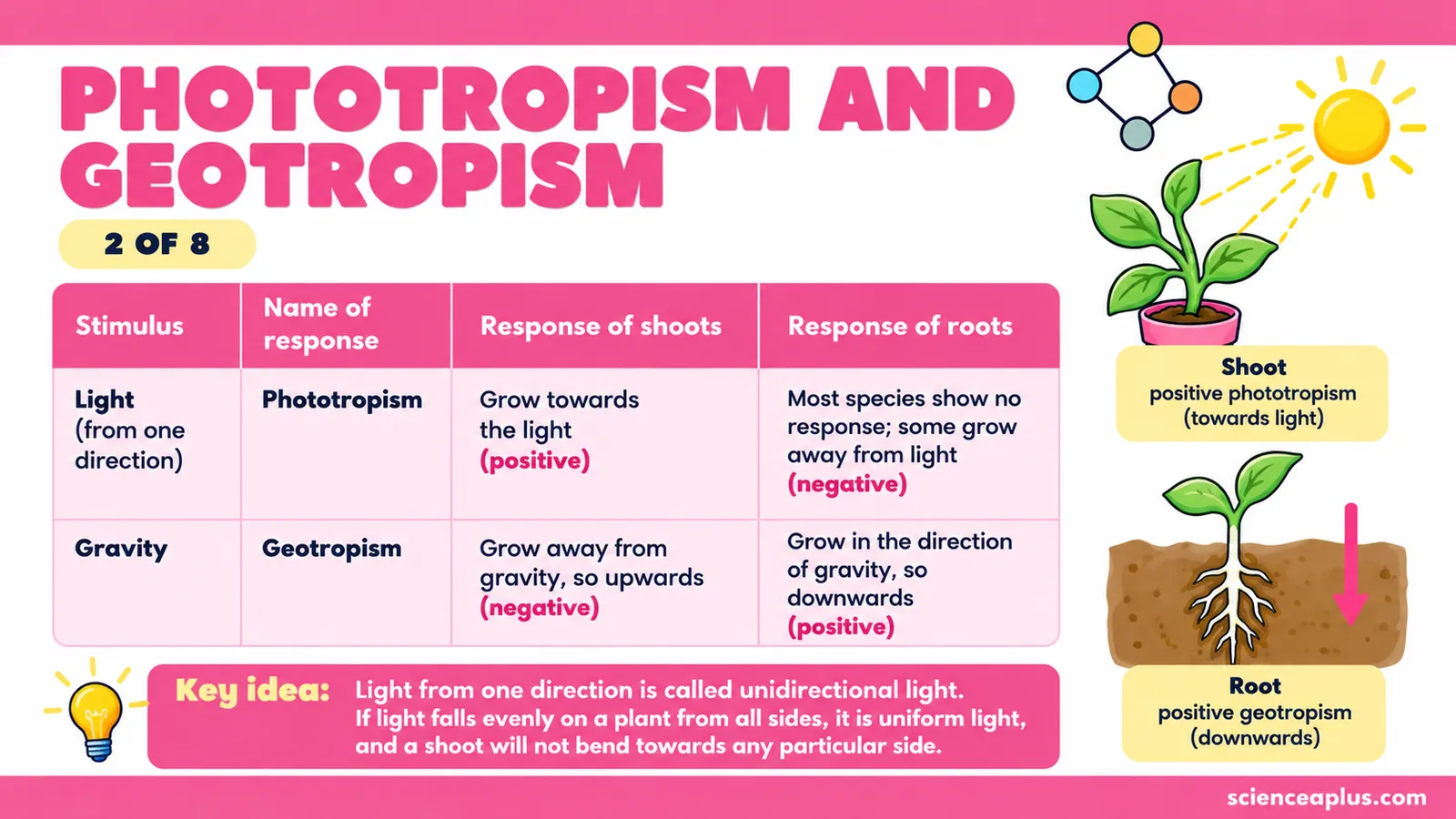
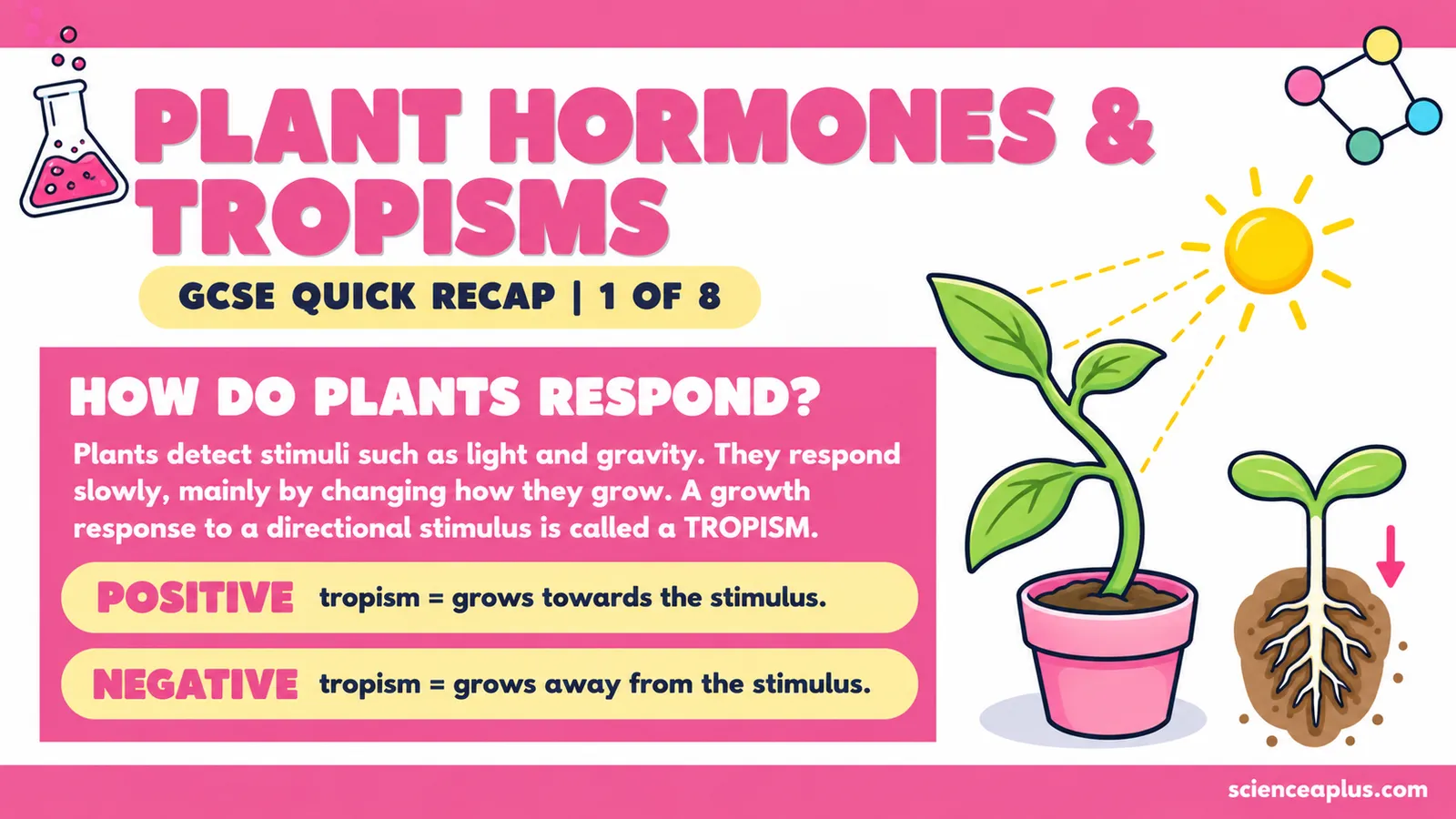
A tropism is a growth response of a plant to a stimulus that comes from one direction. Different sides of the organ grow at different rates, so the organ curves or bends. A response towards the stimulus is a positive tropism, and a response away from it is a negative tropism.
Phototropism is a response to light. Shoots grow towards light, so they show positive phototropism. Most roots show little or no response.
Geotropism, also called gravitropism, is a response to gravity. Roots grow downwards, which is positive geotropism. Shoots grow upwards, which is negative geotropism.
Tropisms matter because they help the plant survive. Phototropism holds leaves in the best position to catch light for photosynthesis. Geotropism sends roots into the soil to anchor the plant and to absorb water and mineral ions. Even when a plant is knocked over in the dark, its shoot curves up and its roots curve down, because gravity is the stimulus, not light. Always name the stimulus in an exam answer, for example shoots show positive phototropism and negative geotropism.
🌞
Slide: Light and gravity
Phototropism and geotropism
1/1
Darwin's Coleoptile Experiments
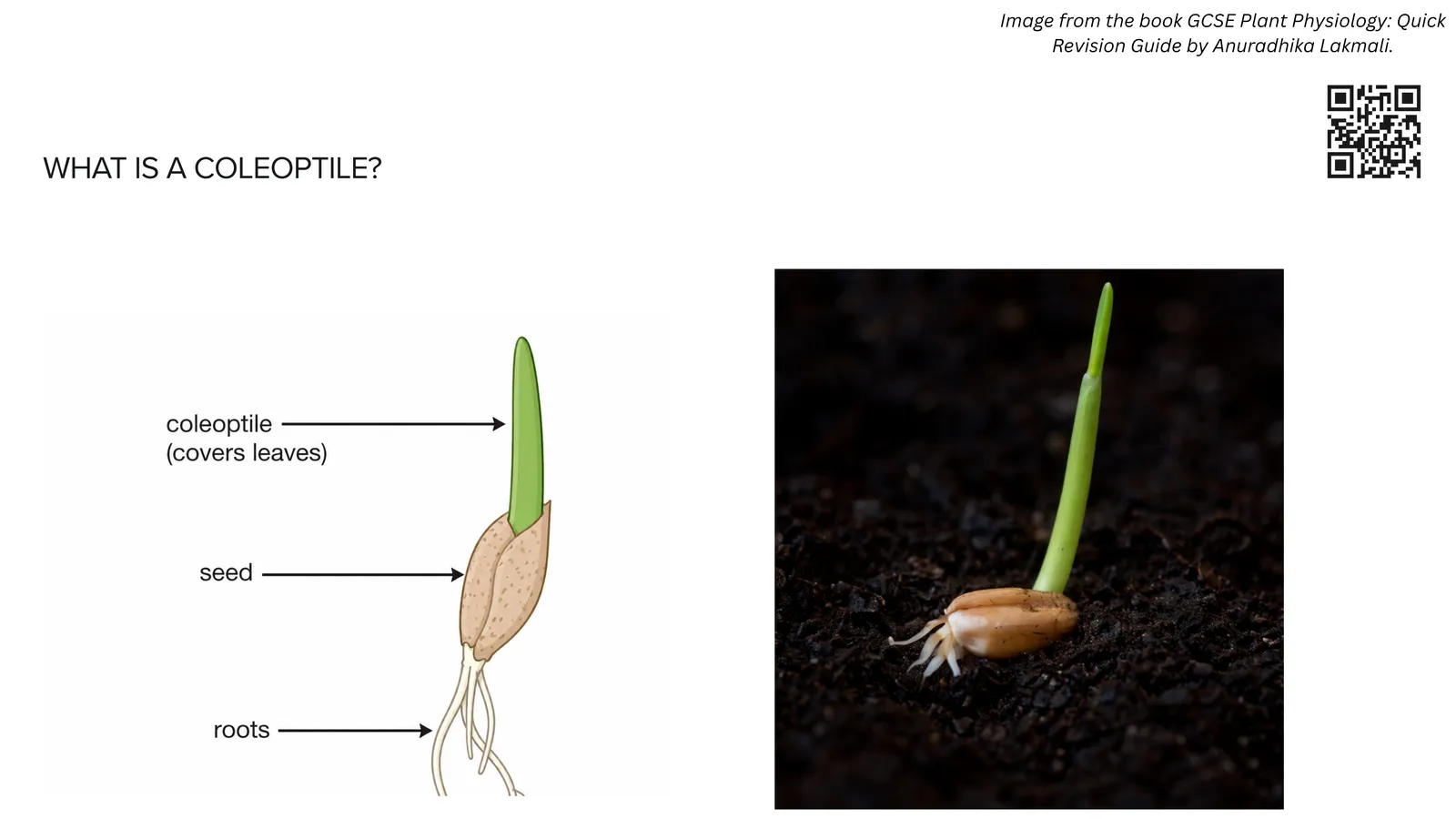
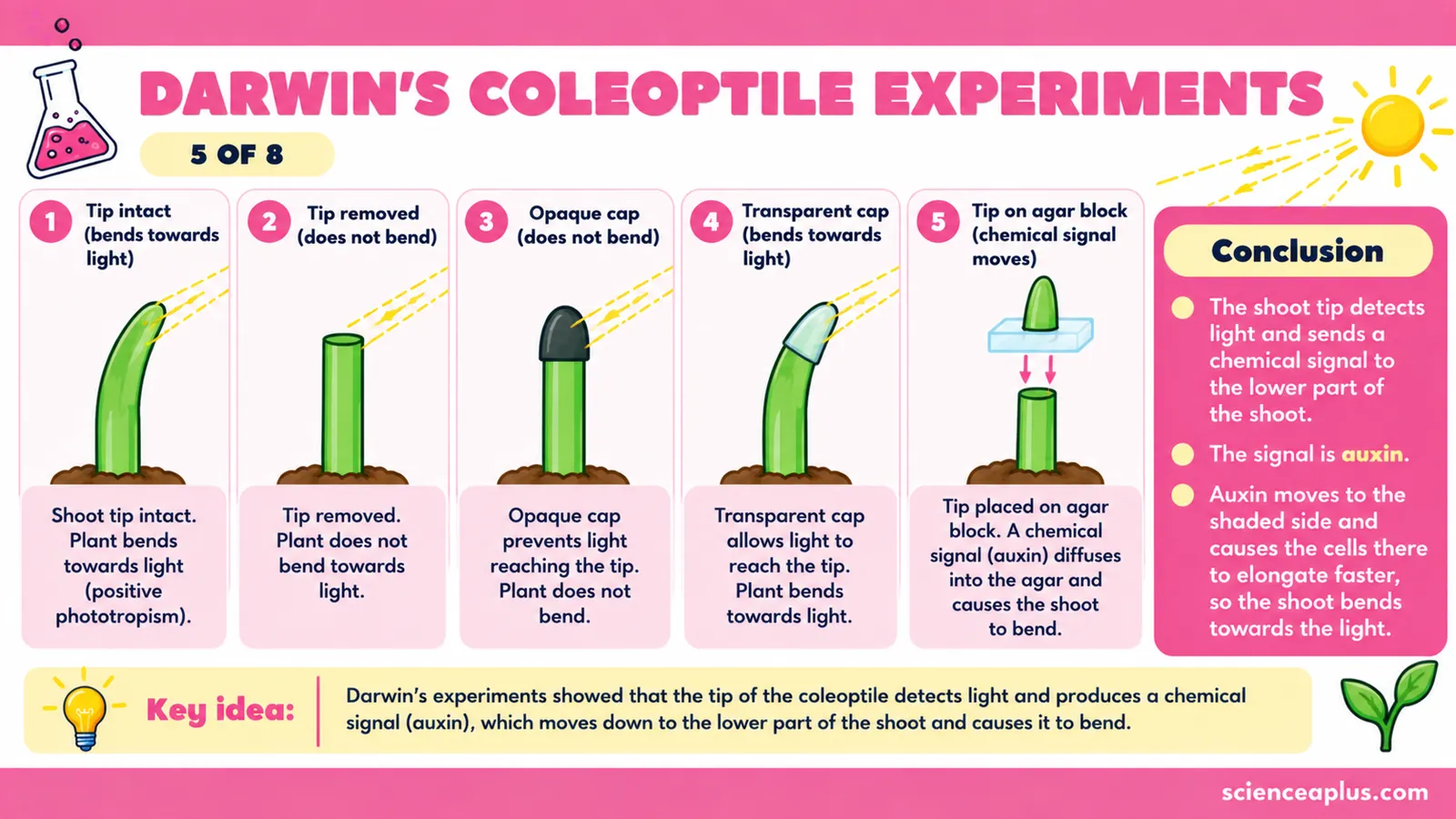
Charles Darwin and his son Francis wanted to know which part of a shoot detects light and which part bends. They used coleoptiles, the protective sheaths that cover the first leaf of a cereal seedling such as oats or wheat. Coleoptiles are ideal because they have a simple structure, grow quickly and respond clearly to light.
Treatment
Result
Control: intact coleoptile, no one-sided light
Grows straight up
Intact tip, light from one side
Bends towards the light
Tip removed, light from one side
No growth and no bending
Tip covered with an opaque cap, light from one side
Grows but does not bend
Darwin concluded that the tip detects the light, because covering it stopped the bending. The bending happens below the tip, in the growth zone. So some kind of signal must travel from the tip down to the cells that bend. Note the difference between the last two rows. Removing the tip stops growth as well as bending, but the cap stops only the bending. The tip is needed for both. Unidirectional light means light from one side only, while uniform light falls equally from all sides.
🧪
Slides: Darwin's coleoptile experiments
What a coleoptile is and what Darwin found
1/2
Finding the Chemical Signal
Later scientists looked for what the signal actually was. Was it a chemical? Could it travel through living tissue? Could it pass through solid barriers?
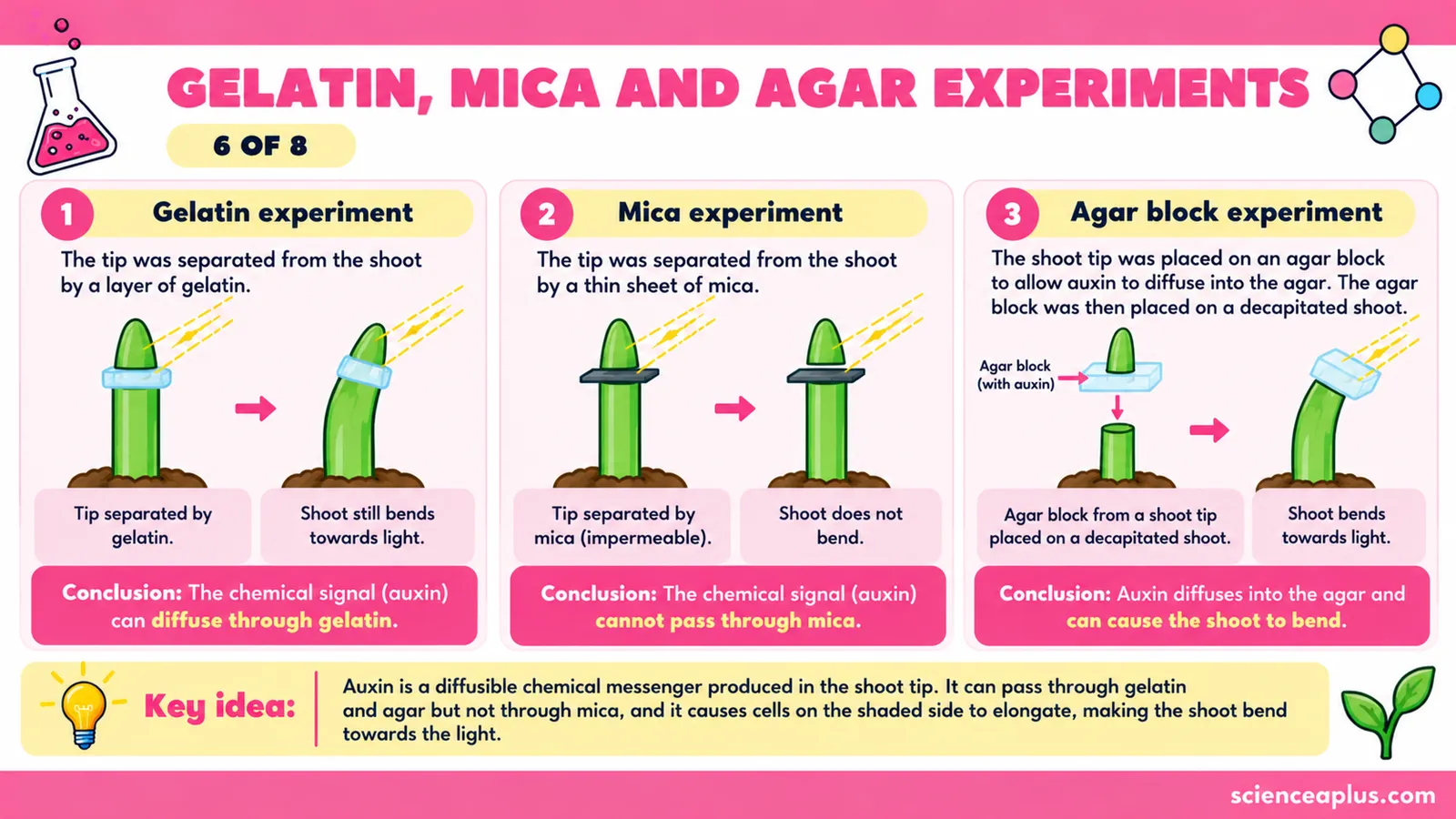
Experiment 1: mica and gelatin
In the first experiment, the tip was cut off and replaced, with a thin sheet of mica between the tip and the stalk. Light from one side caused no bending. Mica is impermeable to water, so it blocked the signal. When the tip was replaced on a block of gelatin instead, the coleoptile bent normally towards the light. Gelatin lets water-soluble chemicals diffuse through. The conclusion is that the growth signal is a water-soluble chemical.
Experiment 2: bending without light
In the second experiment, the tip was removed and replaced on one side only of the cut stalk, and the seedling was kept in darkness. The stalk bent away from the side with the tip, even though there was no light. This showed that the tip makes a chemical that moves down into the stalk and makes the cells on that side grow more. Light only changes where the chemical goes. It does not create it. The side under the tip receives more chemical, so it elongates more, and the longer side makes the stalk curve towards the shorter side.
Experiment 3: agar jelly
In the third experiment, the tip was placed on a block of agar jelly for several hours. The hormone diffused into the agar, and the tip was discarded. When the agar block was placed on one side of a decapitated coleoptile in the dark, the stalk bent away from the block. A diffusible chemical caused the growth, with no tip and no light. The chemical was named auxin.
Experiment
Observation
What it shows
Mica sheet
No bending
The signal cannot pass a waterproof barrier
Gelatin block
Normal bending
The signal is water-soluble
Tip on one side, in the dark
Bending without light
The chemical acts without light
Agar block
Bending without the tip
The chemical is diffusible
🧫
Slide: Gelatin, mica and agar experiments
Showing the signal is a diffusible chemical
1/1
Auxin: The Growth Hormone
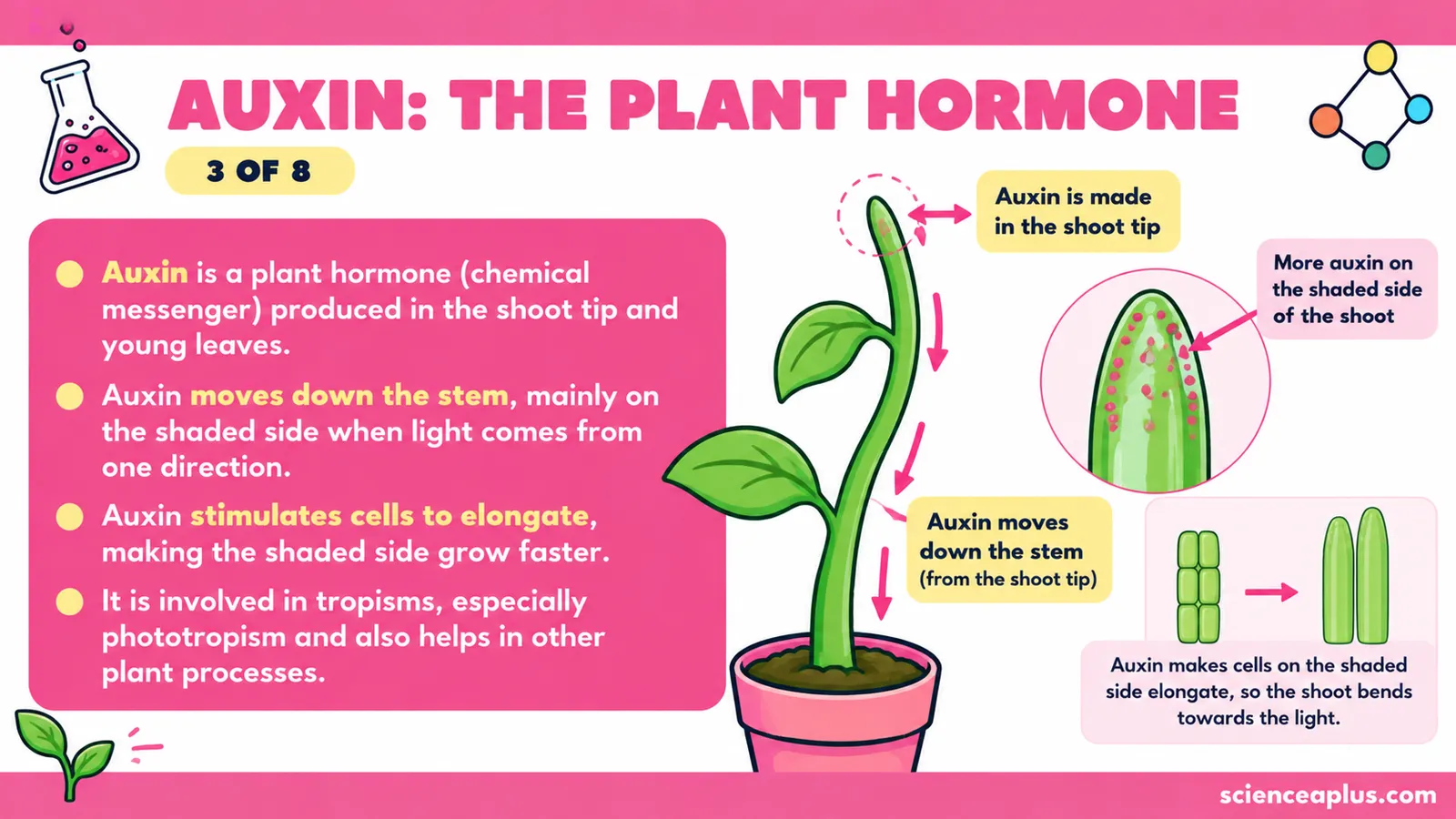
Auxin is a group of plant hormones. The main natural one is IAA, indole-3-acetic acid. It is made at the growing tip of the shoot and transported downwards. It controls growth by stimulating cell elongation. It makes cell walls more flexible, so water can enter the vacuole and push the cell longer. Auxin makes cells longer, not more numerous.
🌱
Slide: Auxin, the plant hormone
Where auxin is made and what it does
1/1
How auxin causes phototropism
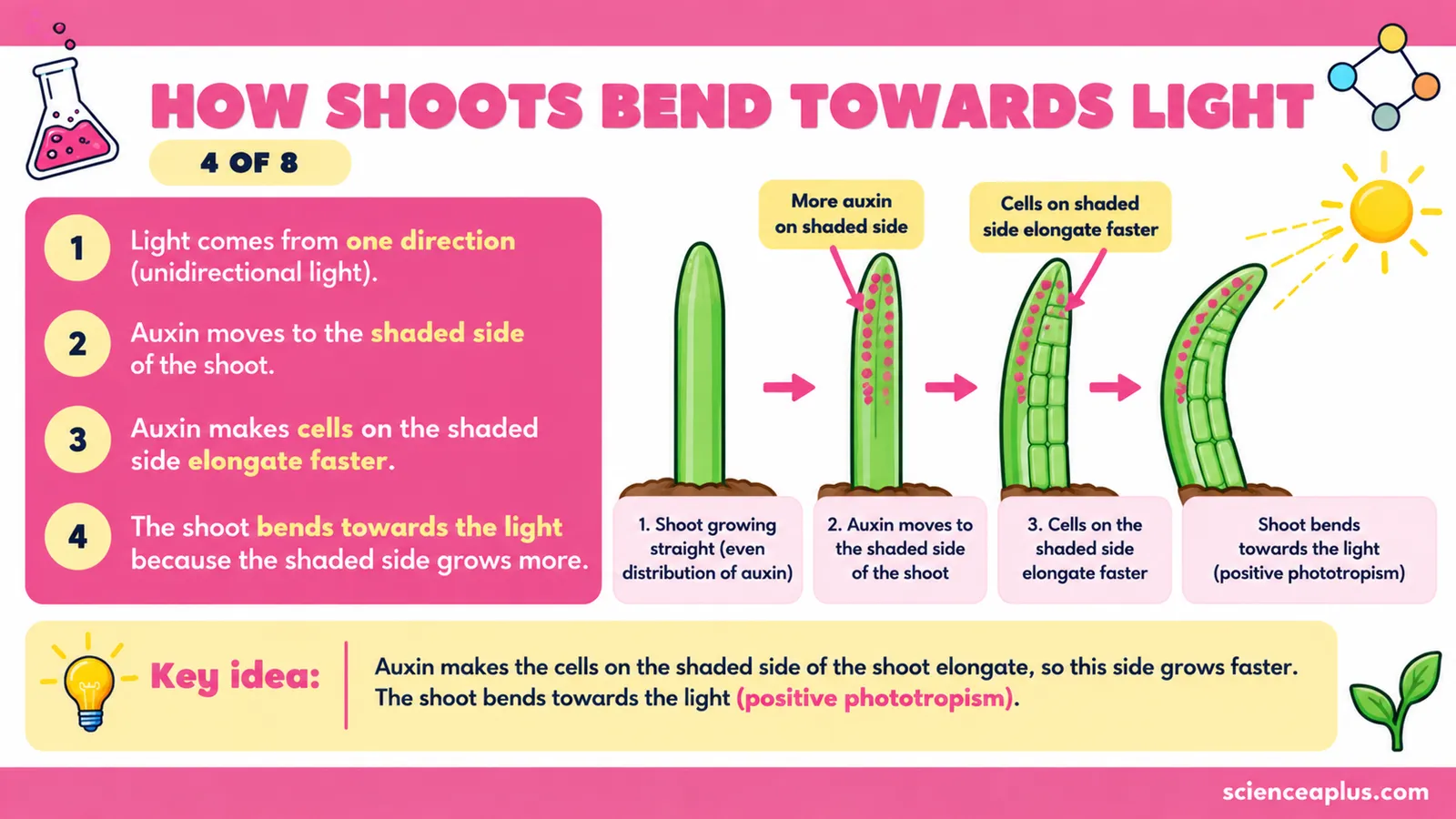
1. Auxin is made at the growing tip of the shoot.
2. One-sided light makes auxin move across to the shaded side.
3. Auxin then moves down, so the shaded side has more of it.
4. More auxin means more cell elongation on the shaded side.
5. The shaded side is longer, so the shoot curves towards the light.
A very common mistake is to say that auxin moves to the lit side. It moves to the shaded side.
💡
Slide: How shoots bend towards light
Auxin on the shaded side
1/1
Why shoots and roots respond differently
Shoots and roots respond to the same hormone in opposite ways, because roots are far more sensitive to auxin. In shoots, low to moderate concentrations of auxin stimulate elongation, so the side with more auxin grows faster. In roots, the same concentration inhibits growth. Roots are stimulated only by very low concentrations, and higher concentrations slow them down. A graph of growth against auxin concentration shows both curves, with the root curve peaking at a much lower concentration than the shoot curve.
This explains geotropism. When a root is placed horizontally, gravity makes auxin collect on its lower side. The extra auxin there slows cell elongation. The upper side, with less auxin, grows more, so the root bends downwards. In a horizontal shoot, auxin also collects on the lower side, but it stimulates growth there, so the lower side grows faster and the shoot bends upwards.
Feature
Root (horizontal)
Shoot (horizontal)
Stimulus
Gravity
Gravity
Auxin collects on
The lower side
The lower side
Effect of extra auxin
Inhibits elongation
Stimulates elongation
Faster-growing side
Upper
Lower
Result
Bends down, positive geotropism
Bends up, negative geotropism
Types of Auxin and Their Uses
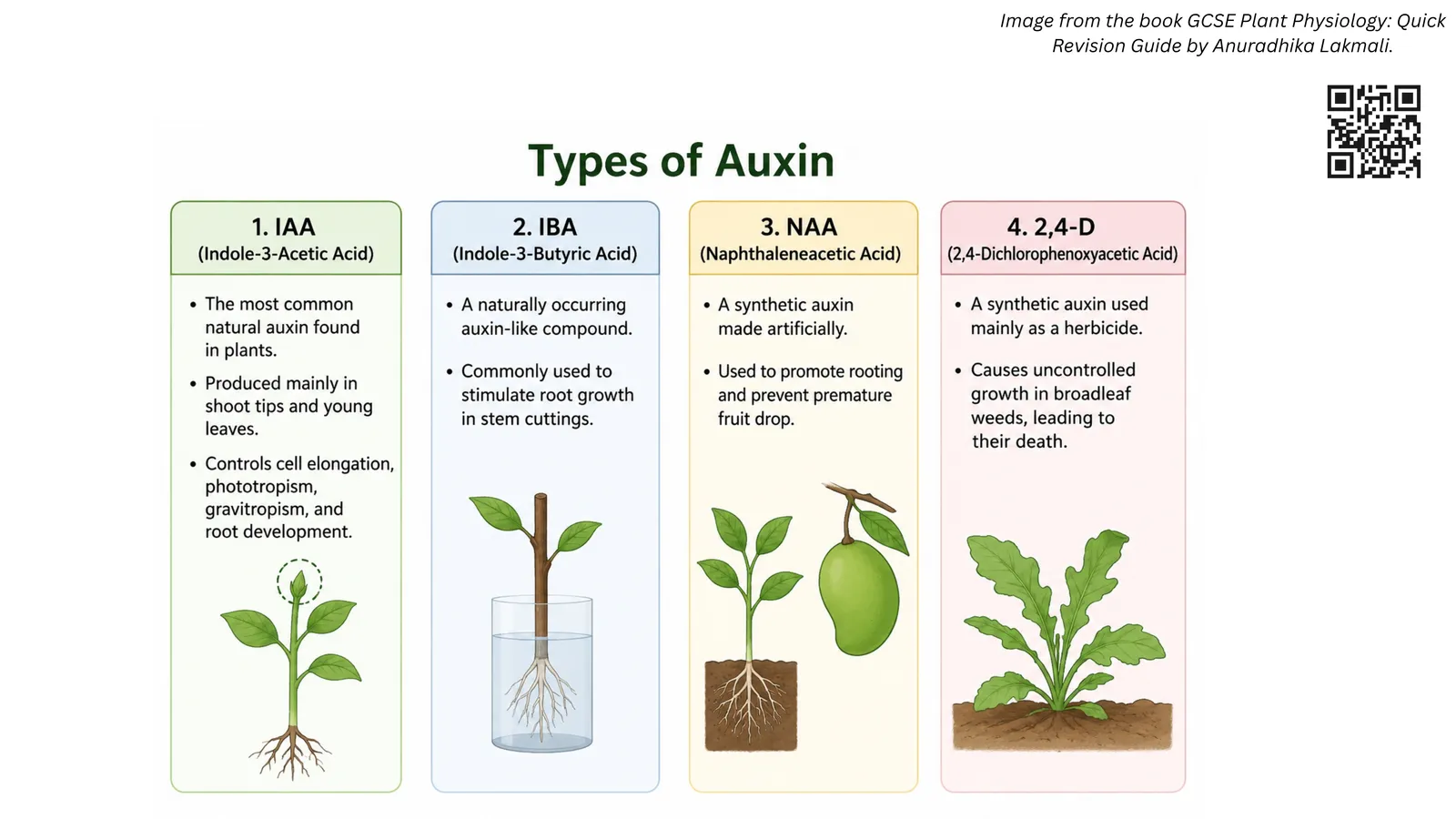
Auxin is not a single chemical. Some are natural, and others are synthetic and made in a laboratory.
Auxin
Type
Main use
IAA
Natural
The main auxin in plants, made in shoot tips and young leaves
IBA
Natural-like
Stimulates root growth in stem cuttings, used in rooting powder
NAA
Synthetic
Helps rooting and prevents premature fruit drop
2,4-D
Synthetic
Selective weedkiller
Gardeners dip the cut end of a stem in rooting powder that contains auxin, so that roots grow quickly and many identical plants can be made. The synthetic auxin 2,4-D is a selective weedkiller. Broad-leaved weeds take in a lot of it and grow so fast and unevenly that they die, while narrow-leaved crops such as wheat are not harmed. Spraying unpollinated flowers with auxin can make the ovary grow into a fruit with no seeds.
🧬
Slide: Types of auxin
IAA, IBA, NAA and 2,4-D
1/1
The Other Plant Hormones
Auxin is not the only hormone. Four others regulate growth, development, ripening and responses to the environment. Each hormone usually has several effects, and hormones often work together.
Gibberellins
Gibberellins stimulate stem elongation, break dormancy in seeds and buds, promote seed germination and help fruit grow larger. During germination, water enters the seed and gibberellin is released. It switches on enzymes such as amylase that break down stored starch into sugars to feed the embryo. Gibberellins are sprayed on seedless grapes to make bigger fruit, and they are used in the malting of barley to speed germination.
Cytokinins
Cytokinins stimulate cell division, promote the growth of side buds and delay the ageing of leaves, so that they stay green for longer. Auxin from the shoot tip stops the side buds growing, and cytokinin does the opposite. Cutting off the tip lets the plant grow bushy, which is why gardeners pinch out the tips of young plants.
Ethylene
Ethylene is a gas, so it can drift from one plant or fruit to another. It promotes fruit ripening, causes leaf and fruit fall and helps plants respond to stress. Ripe fruit releases ethylene, which speeds up the ripening of nearby fruit, which is why one ripe banana ripens a whole bunch. Growers pick bananas and tomatoes while they are green, because firm fruit travels without damage, and then use ethylene to ripen them in time for sale.
Abscisic acid
Abscisic acid, or ABA, inhibits growth, causes seed and bud dormancy and closes stomata in dry conditions. It is called the stress hormone. In drought, a water-stressed leaf makes more ABA, which tells the guard cells to lose water and become flaccid, so the stomata close and less water is lost by transpiration. It also helps explain why many seeds stay dormant through winter until conditions improve.
Hormone
Main effects
A memory hook
Auxin
Cell elongation, tropisms, rooting
Makes cells longer
Gibberellin
Stem elongation, germination, ends dormancy
G for growing tall
Cytokinin
Cell division, side buds, delays leaf ageing
C for cell division
Ethylene
Fruit ripening, leaf and fruit fall
A ripening gas
Abscisic acid
Dormancy, closes stomata
The stress hormone
Abscisic acid works against growth and gibberellin. A simple summary is that ABA means dormancy and gibberellin means germination.
Plant Hormones in Farming and Gardening
Use
Hormone
Benefit
Rooting powder
Auxin
Many identical plants from cuttings
Selective weedkiller
Synthetic auxin, 2,4-D
Kills broad-leaved weeds, not cereals
Seedless fruit
Auxin or gibberellin
Fruit grows without pollination or seeds
Ripening bananas and tomatoes
Ethylene
Fruit travels unripe and ripens on time
Delaying fruit drop
NAA
Fruit stays on the tree until harvest
Larger fruit
Gibberellin
Bigger grapes and other fruit
The Clinostat Practical
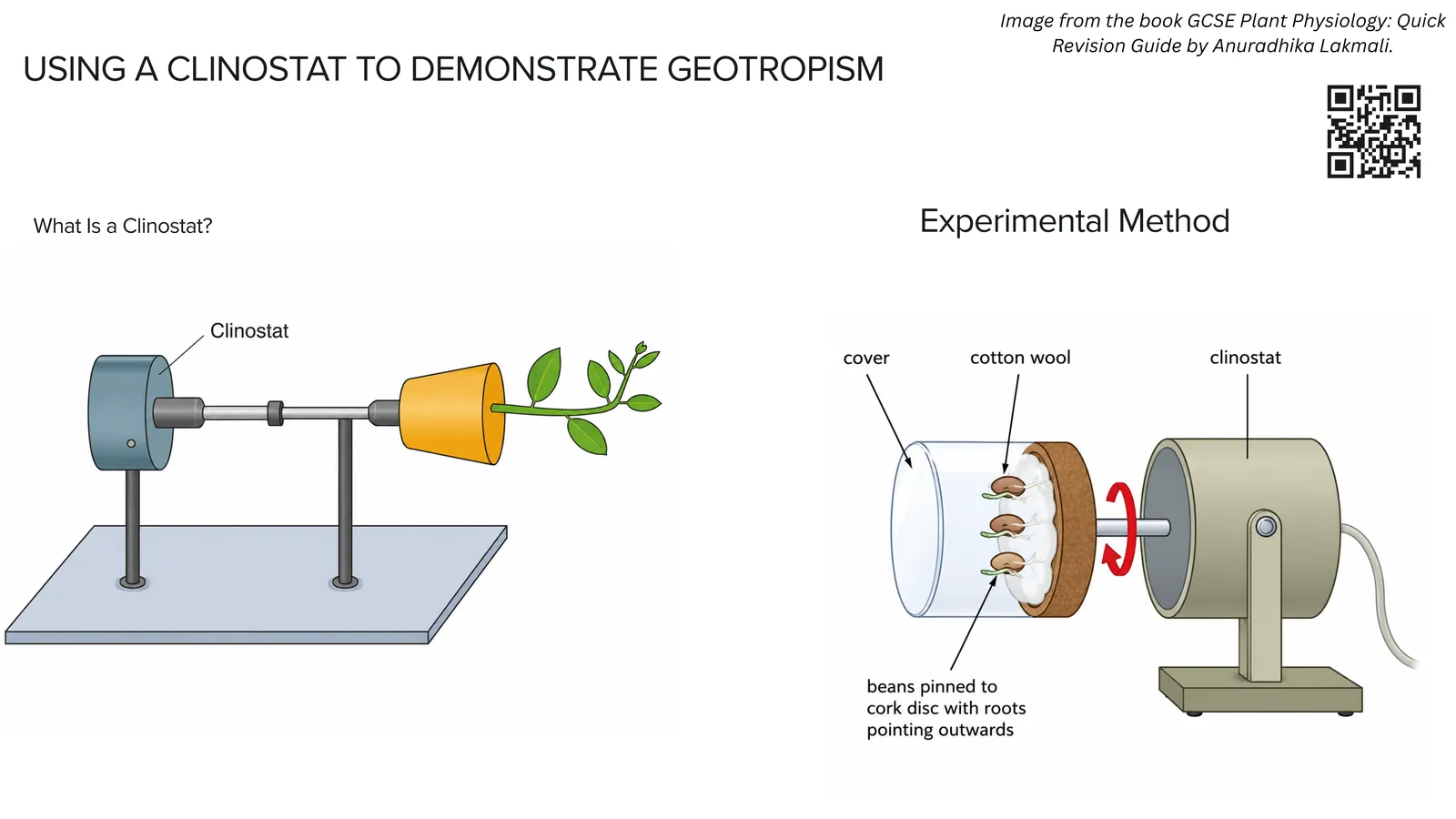
A clinostat is a piece of laboratory apparatus with an electric motor that turns a disc very slowly. Germinating seeds are pinned to the disc, which is placed on its side, so gravity acts on the seeds from every direction in turn. Because the direction of gravity keeps changing, no single direction lasts long enough to cause a tropism. The effect of gravity is cancelled out, while the seeds still grow normally. A clinostat does not remove gravity. It evens out its effect over time.
⚙️
Slide: The clinostat
Apparatus and method
1/1
Method
1. Soak bean seeds overnight and let the radicles grow to about 2 cm.
2. Fix wet cotton wool to the cork discs of two clinostats.
3. Pin three or four seeds to each disc with the radicles pointing outwards.
4. Put a cover over the seeds to keep the air moist.
5. Lay both clinostats on their sides. Clinostat A is switched off and is the control. Clinostat B has the motor on and rotates slowly.
6. Keep the cotton wool damp, and after four or five days record the direction of root growth.
Results and explanation
On the stationary clinostat A, the radicles grew downwards, in the direction of gravity. Gravity always pulls the same way, so auxin collected on the lower side of each root and slowed its elongation. The upper side grew more and the root curved down, which is positive geotropism. On the rotating clinostat B, the radicles grew horizontally outwards. Slow rotation continuously changed the direction of gravity, so auxin could not collect on one side long enough, growth was equal on all sides and the roots grew straight out.
The conclusion is that gravity is the directional stimulus for geotropism. Growth itself does not need gravity, only the direction of growth does. To improve the investigation, use more seeds, repeat it, measure the angle of the roots with a protractor, and keep both discs in the same light. The independent variable is rotation, the dependent variable is the direction of root growth, and the controlled variables include seed type, age, moisture, temperature and time.
The Phototropism Practical
A typical investigation grows five groups of oat coleoptiles for three days under identical conditions and then gives each group a different treatment for 24 hours.
Group
Treatment
Expected result and reason
A
Intact tip, light from the left
Bends towards the light, because auxin moves to the shaded side
B
Tip removed, light from the left
No bending, because no auxin is made
C
Tip covered with an opaque cap, light from the left
Grows but does not bend, because the tip cannot detect light
D
Intact tip, light from all sides
Grows straight, because auxin is spread evenly
E
Tip replaced on one side, in darkness
Bends away from the tip side, because auxin diffuses into one side only
Control the age and species of the seedlings, the temperature, the light intensity and the time. Use several coleoptiles per group and calculate a mean bending angle. Link each result to auxin, saying where it is made, where it moves and what it does.
Exam Tips
Define a tropism as a growth response to a directional stimulus, and use the words positive and negative correctly.
Remember that the tip makes auxin and detects light, while the growth zone below the tip bends.
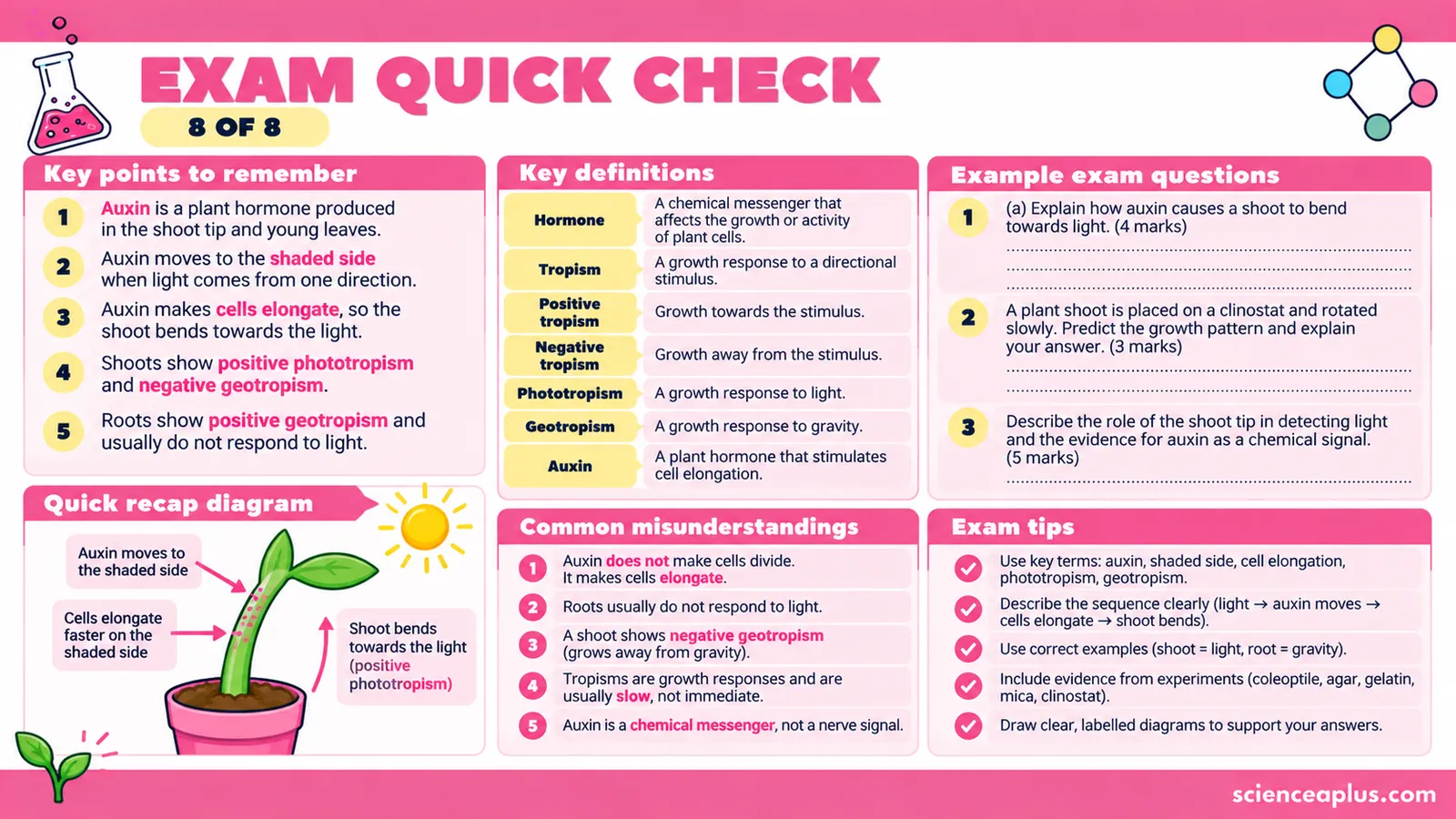
Say that auxin moves to the shaded side and makes cells longer.
Always say whether you are talking about a shoot or a root, because the same auxin concentration can speed up a shoot and slow down a root.
If a question says explain, include every step: stimulus, where auxin is made, how it moves, what it does and the result.
Learn one function and one use for every hormone, since many questions ask why a farmer would use it.
📝
Slides: Exam quick check and recap
Key points, definitions and exam tips
1/2
Frequently Asked Questions
What is the difference between a hormone and a nerve impulse?
A hormone is a slow chemical message that travels in the plant, while a nerve impulse is a fast electrical signal. Plants use hormones.
Why does a shoot bend towards the light?
Auxin moves to the shaded side, where it makes the cells elongate more, so the shaded side is longer and the shoot curves towards the light.
Why do roots grow downwards?
Auxin collects on the lower side of a horizontal root, where it slows elongation. The upper side grows faster, so the root bends down.
Why did mica stop the bending?
Mica is impermeable, so it blocks a water-soluble chemical signal. Gelatin lets the chemical diffuse through.
Which hormone ripens fruit?
Ethylene, a gas that ripe fruit releases.
Why do plants close their stomata in a drought?
Abscisic acid makes the guard cells lose water and become flaccid, which closes the stomata and reduces water loss.
Key Takeaways
Plants coordinate their growth with hormones, which are slow chemical messengers.
A tropism is a directional growth response, and it can be positive or negative.
Darwin showed that the tip detects light, and later experiments with mica, gelatin and agar showed that the signal is a diffusible, water-soluble chemical, auxin.
Auxin moves to the shaded side and causes cell elongation, so shoots bend towards light.
Roots are more sensitive to auxin, so extra auxin on the lower side slows their growth and they bend down.
Gibberellins, cytokinins, ethylene and abscisic acid control germination, cell division, ripening and dormancy.
A clinostat cancels the one-way effect of gravity, so the roots grow straight out.
Conclusion
Plant hormones show how much can be achieved with a few chemical messengers and a lot of cleverness. From Darwin's simple coleoptile experiments to the modern use of rooting powder, selective weedkillers and ripening gas, the same ideas run through the topic: a signal is made, it moves, and it changes how cells grow. If you can tell that story for a shoot bending to the light and a root growing down, and name what the other four hormones do, you will be well prepared for your exam.
🗂️ Revision Flashcards
Tap a card to reveal the answer.
🎯 Quick Quiz
8 questions. Pick an answer to check it straight away.
1Which side of a shoot does auxin move to when light comes from one side?
Auxin moves to the shaded side, where it makes cells elongate more, so the shoot bends towards the light.
2What did Darwin's experiments show about the coleoptile tip?
Covering the tip stopped the bending, so the tip detects the light.
3Why did mica stop the bending while gelatin did not?
Mica is impermeable to water, so it blocked the signal. Gelatin lets water-soluble chemicals diffuse through.
4Why does a horizontal root bend downwards?
Auxin collects on the lower side, where it inhibits elongation, so the upper side grows more and the root bends down.
5Which hormone ripens fruit?
Ethylene is a gas released by ripe fruit that speeds up the ripening of nearby fruit.
6Which hormone closes stomata in a drought?
Abscisic acid tells the guard cells to lose water and become flaccid, so the stomata close.
7Why is 2,4-D used as a selective weedkiller?
Broad-leaved weeds take in a lot of 2,4-D and die, while narrow-leaved crops are not harmed.
8What does a clinostat do?
A clinostat does not remove gravity. It keeps changing its direction so no single direction lasts long enough to cause a tropism.