Right now, millions of chemical reactions are happening inside your body. You are breaking down food, building new proteins, copying DNA and releasing energy from glucose. Without help, most of these reactions would be so slow that you could not survive. A meal that takes a few hours to digest would take years. The heroes that make life possible are enzymes. In this guide you will learn what enzymes are, how they work, why they stop working when they get too hot, and how we use them in everything from washing powder to cheese making.
📖 Lesson
What enzymes are, how the active site works, why heat and pH denature them, and the experiments and uses examiners ask about.
What Are Enzymes? A Simple Definition
An enzyme is a protein that acts as a biological catalyst. A catalyst is a substance that speeds up a chemical reaction without being changed or used up at the end of it. Because enzymes are not used up, one enzyme molecule can be used again and again, sometimes thousands of times every second.
Here are the key words you need to know:
Substrate: the molecule an enzyme acts on. For example, starch is the substrate of the enzyme amylase.
Product: the molecule or molecules produced by the reaction. Amylase breaks starch down into the product maltose, a sugar.
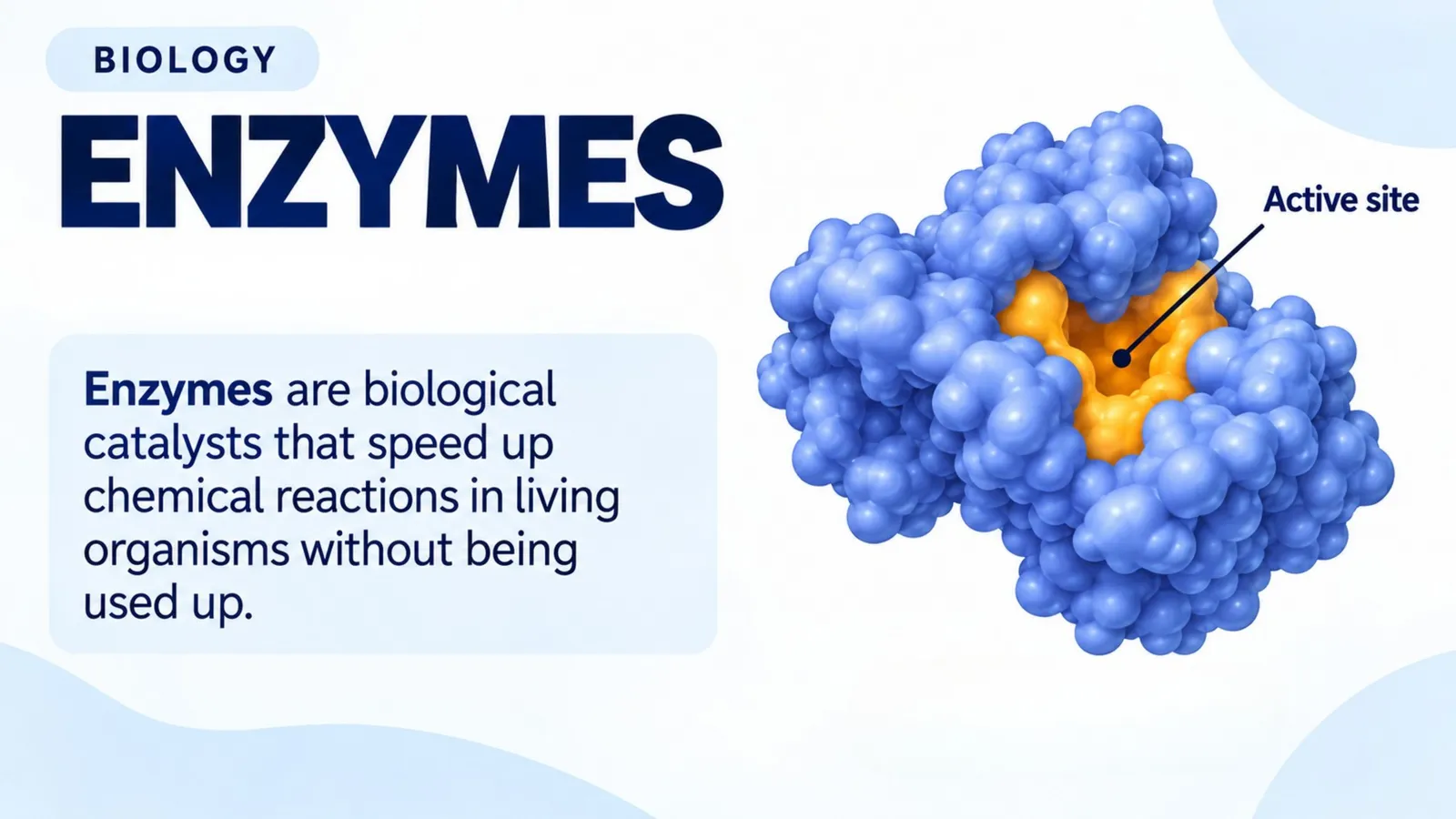
Active site: the small region of the enzyme where the substrate binds and the reaction takes place.
Enzyme-substrate complex: the temporary structure formed when a substrate is bound in the active site.
Enzymes can break large molecules into smaller ones (like digestive enzymes) or join small molecules together to make bigger ones (like the enzymes that build proteins and DNA).
Slide: What are enzymes?
Biological catalysts with an active site
1/1
How Do Enzymes Speed Up Reactions?
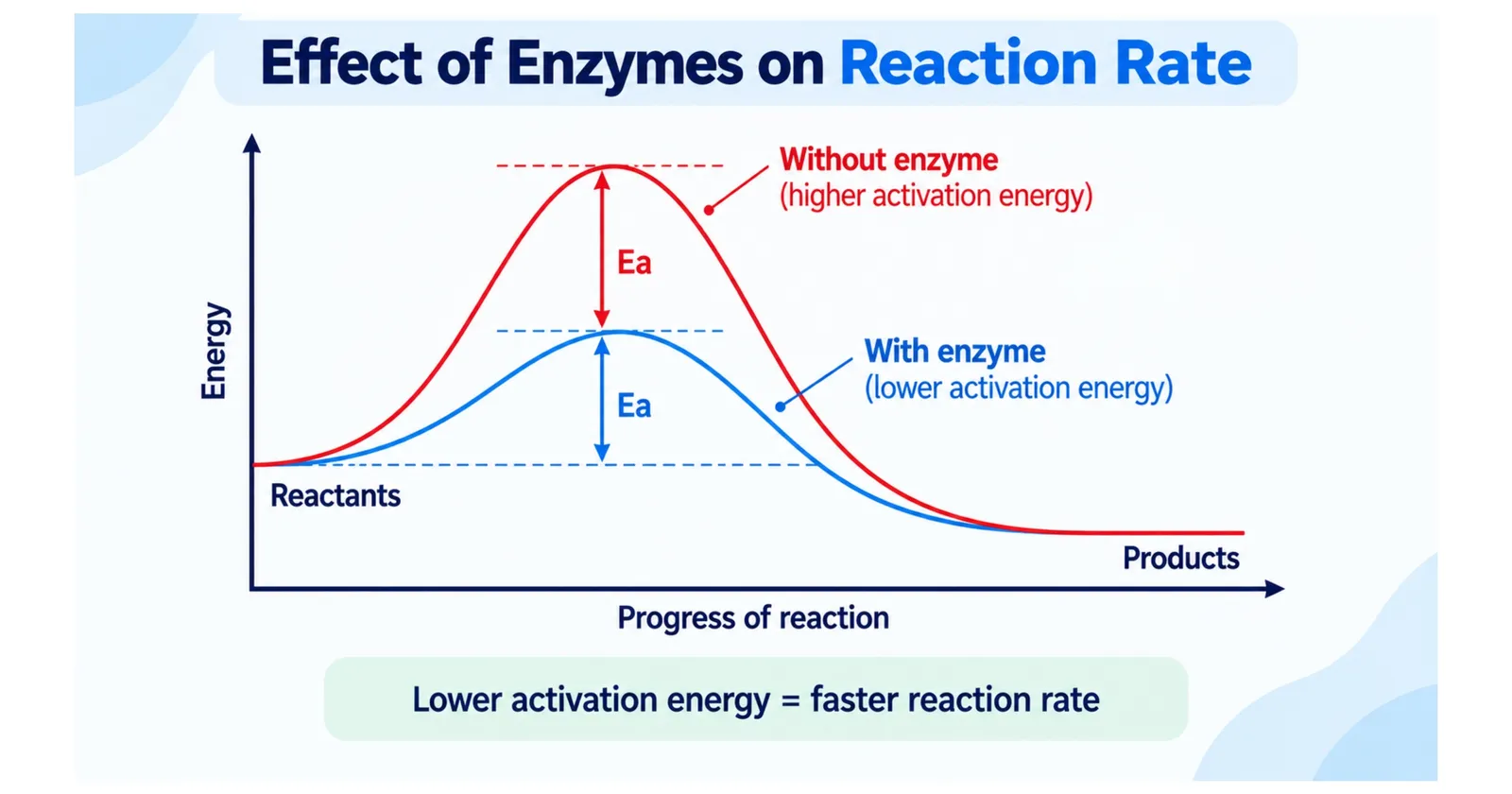
Every chemical reaction needs a certain amount of energy to get started. This is called the activation energy. Think of it as a hill that the reactants must climb before they can roll down the other side and become products.
Enzymes lower the activation energy. They do this by holding the substrate in exactly the right position, putting strain on its chemical bonds or bringing two substrates close together so that they react easily. With a lower hill to climb, many more molecules can react at body temperature, so the reaction becomes much faster. Some enzymes speed up reactions by a factor of more than a million.
Slide: Effect of enzymes on reaction rate
Lower activation energy, faster reaction
1/1
The Lock and Key Model
The lock and key model is the simplest way to explain how enzymes work, and it is the model you need for GCSE and IGCSE exams.
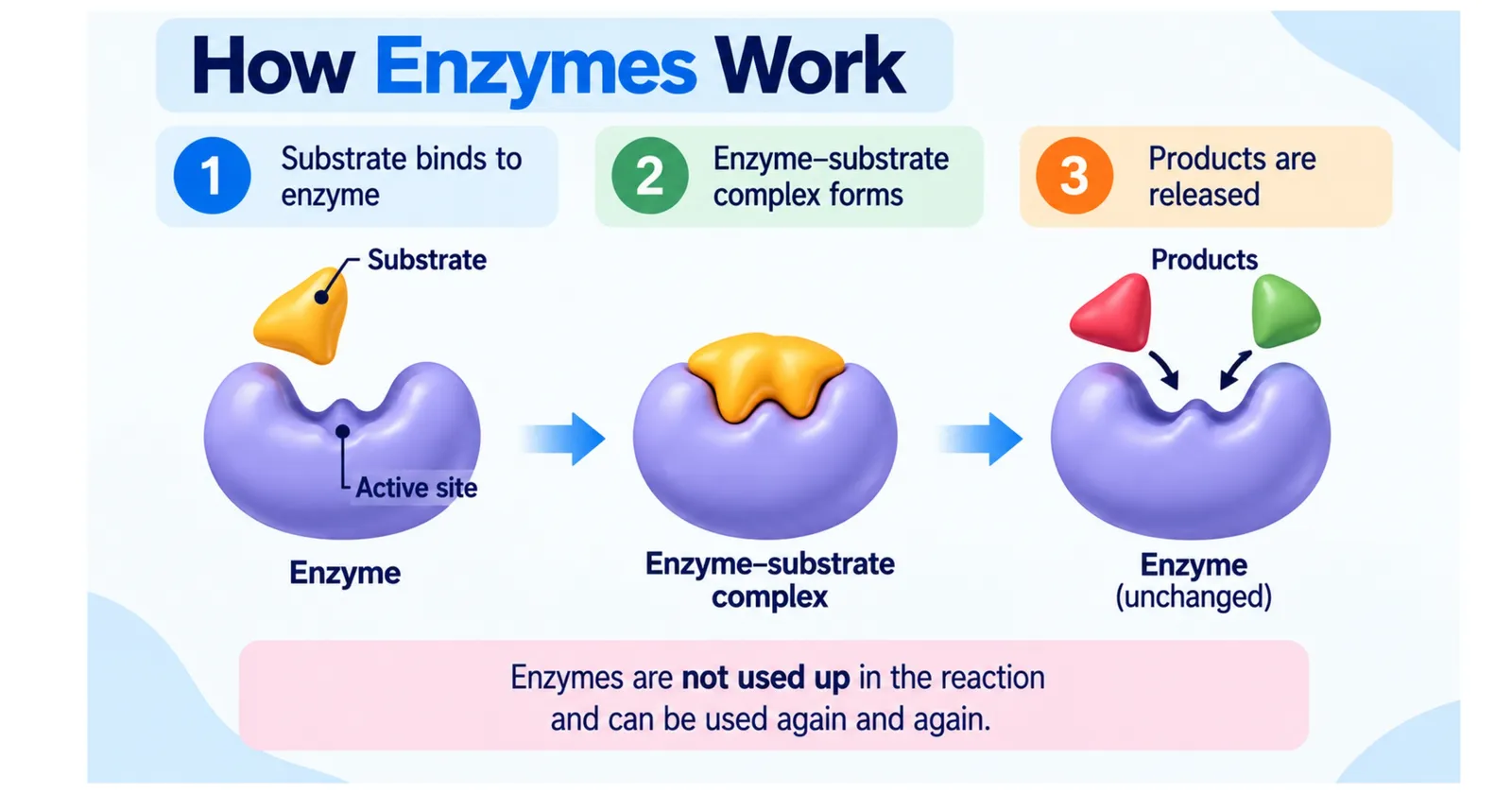
The enzyme is the lock and the substrate is the key.
The active site has a specific shape that is complementary to the shape of the substrate.
Only a substrate with the right shape can fit into the active site, just as only the correct key can open a lock.
The substrate binds to the active site, forming an enzyme-substrate complex.
The reaction takes place and the products are released.
The enzyme is unchanged and ready to bind to another substrate molecule.
This model explains why enzymes are specific: each enzyme catalyses only one reaction or one type of reaction. Amylase breaks down starch, but it cannot break down proteins or fats.
Slide: How enzymes work
Substrate binds, complex forms, products released
1/1
The Induced Fit Model: A More Accurate Picture
Scientists now know that the active site is not a rigid shape. The induced fit model, which is needed at A Level, says that the active site changes shape slightly when the substrate binds to it, moulding itself around the substrate like a glove around a hand. This tighter fit puts strain on the bonds in the substrate, which helps lower the activation energy. The induced fit model also explains why some enzymes can act on a small group of similar substrates.
Types of Enzymes: Digestive Enzymes You Must Know
Digestive enzymes are the most commonly examined enzymes. They break large insoluble food molecules into small soluble ones that can be absorbed into the blood.
| Enzyme | Substrate | Products | Where it is made |
|---|---|---|---|
| Amylase (a carbohydrase) | Starch | Maltose (a sugar) | Salivary glands, pancreas |
| Protease (for example pepsin, trypsin) | Proteins | Amino acids | Stomach, pancreas, small intestine |
| Lipase | Lipids (fats and oils) | Fatty acids and glycerol | Pancreas, small intestine |
| Maltase | Maltose | Glucose | Small intestine |
Bile, made in the liver, is not an enzyme. It emulsifies fats into small droplets to give lipase a bigger surface area to work on, and it neutralises stomach acid.
Other Important Enzymes in Your Body
Enzymes are not only involved in digestion. Some other examples include:
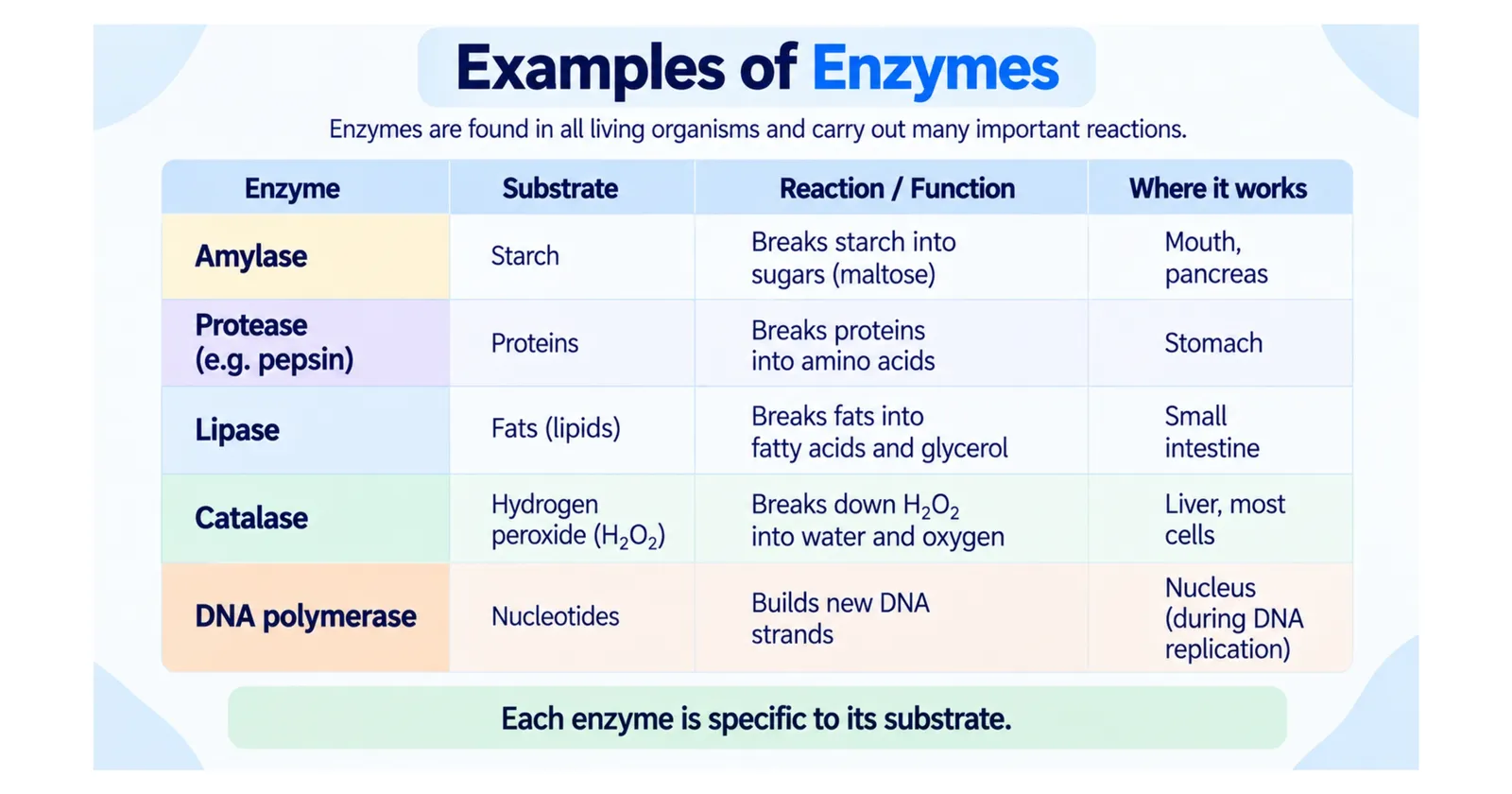
Catalase: found in nearly all living cells, especially liver cells. It breaks down toxic hydrogen peroxide (H2O2) into water and oxygen.
DNA polymerase: builds new strands of DNA when cells divide.
ATP synthase: makes ATP, the energy currency of the cell, during respiration.
Rubisco: the enzyme that fixes carbon dioxide in photosynthesis. It is thought to be the most abundant protein on Earth.
Lysozyme: found in tears and saliva, it breaks down bacterial cell walls and is part of your immune defences.
Slide: Examples of enzymes
Substrate, reaction and where each enzyme works
1/1
Factors Affecting Enzyme Activity
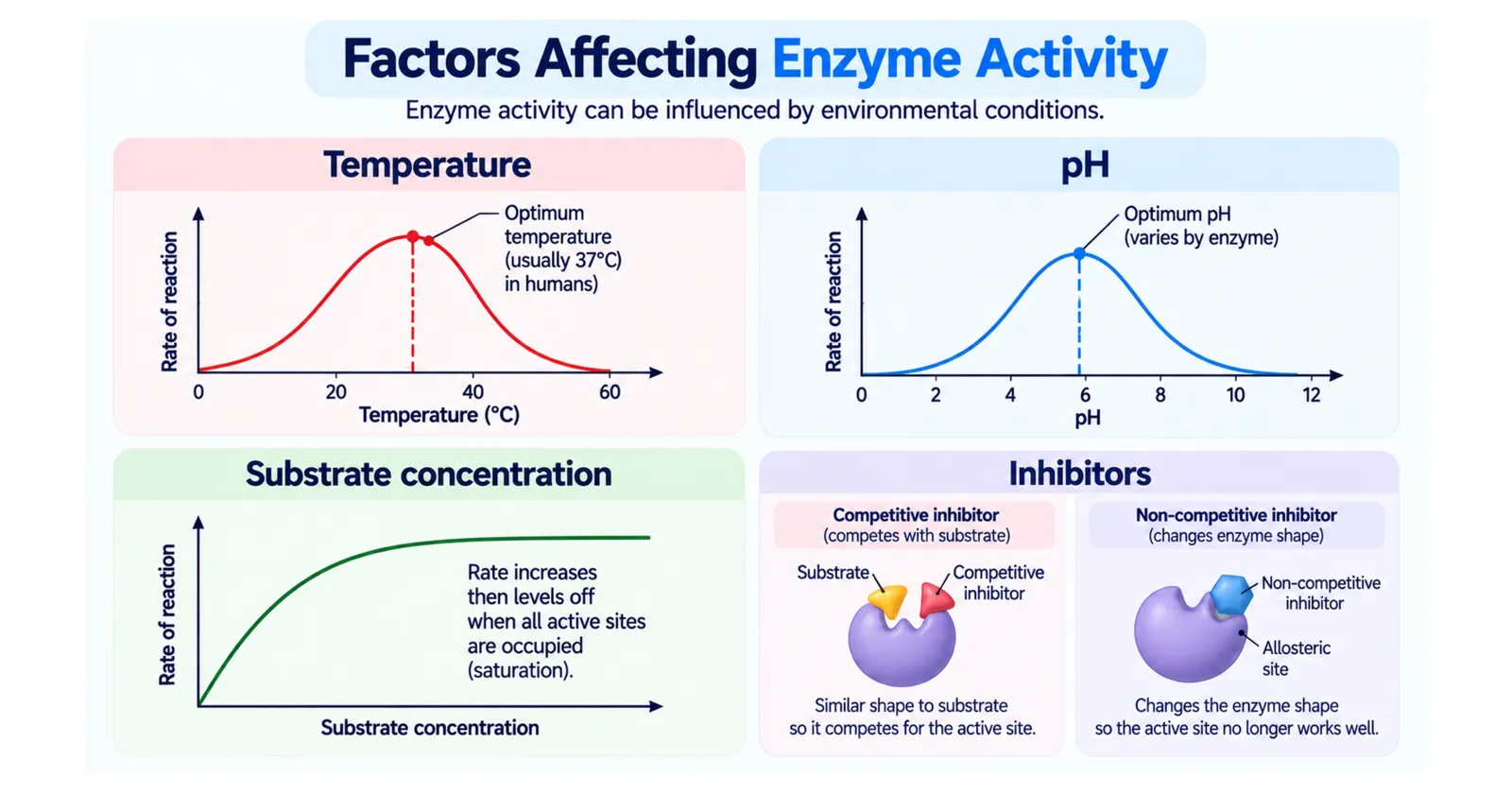
This section is essential for exam success. Enzyme activity depends on how often enzyme and substrate molecules collide successfully, and on whether the active site keeps its shape.
Temperature
As temperature increases, enzyme and substrate molecules gain kinetic energy and move faster. They collide more often, so more enzyme-substrate complexes form and the rate of reaction increases.
At the optimum temperature, the enzyme works fastest. For most human enzymes this is about 37 °C, which is body temperature.
Above the optimum, the rate drops sharply. The extra energy makes the enzyme molecule vibrate so much that the bonds holding its three-dimensional shape break. The active site changes shape and the substrate no longer fits. The enzyme is now denatured. Denaturation is usually permanent. Think about cooking an egg: once the proteins in the egg white have changed, they never turn back.
At low temperatures enzymes are not denatured. They simply work slowly because molecules move slowly and collide less often. That is why food keeps longer in a fridge.
pH
Every enzyme has an optimum pH. If the pH moves too far from the optimum, the charges on the amino acids in the active site change, the bonds holding the shape break and the enzyme denatures.
| Enzyme | Location | Optimum pH |
|---|---|---|
| Pepsin | Stomach | About 2 (acidic) |
| Salivary amylase | Mouth | About 7 (neutral) |
| Trypsin | Small intestine | About 8 (slightly alkaline) |
Pepsin is adapted to the hydrochloric acid in the stomach, which is also important for killing bacteria in food.
Substrate concentration
Increasing the substrate concentration increases the rate of reaction, because there are more collisions between substrate and enzyme molecules. Eventually all the active sites are occupied at any moment. The enzymes are saturated, and adding more substrate has no effect. Enzyme concentration is now the limiting factor.
Enzyme concentration
More enzyme molecules mean more active sites available, so the rate increases, provided there is plenty of substrate.
Slide: Factors affecting enzyme activity
Temperature, pH, substrate concentration and inhibitors
1/1
Enzyme Inhibitors
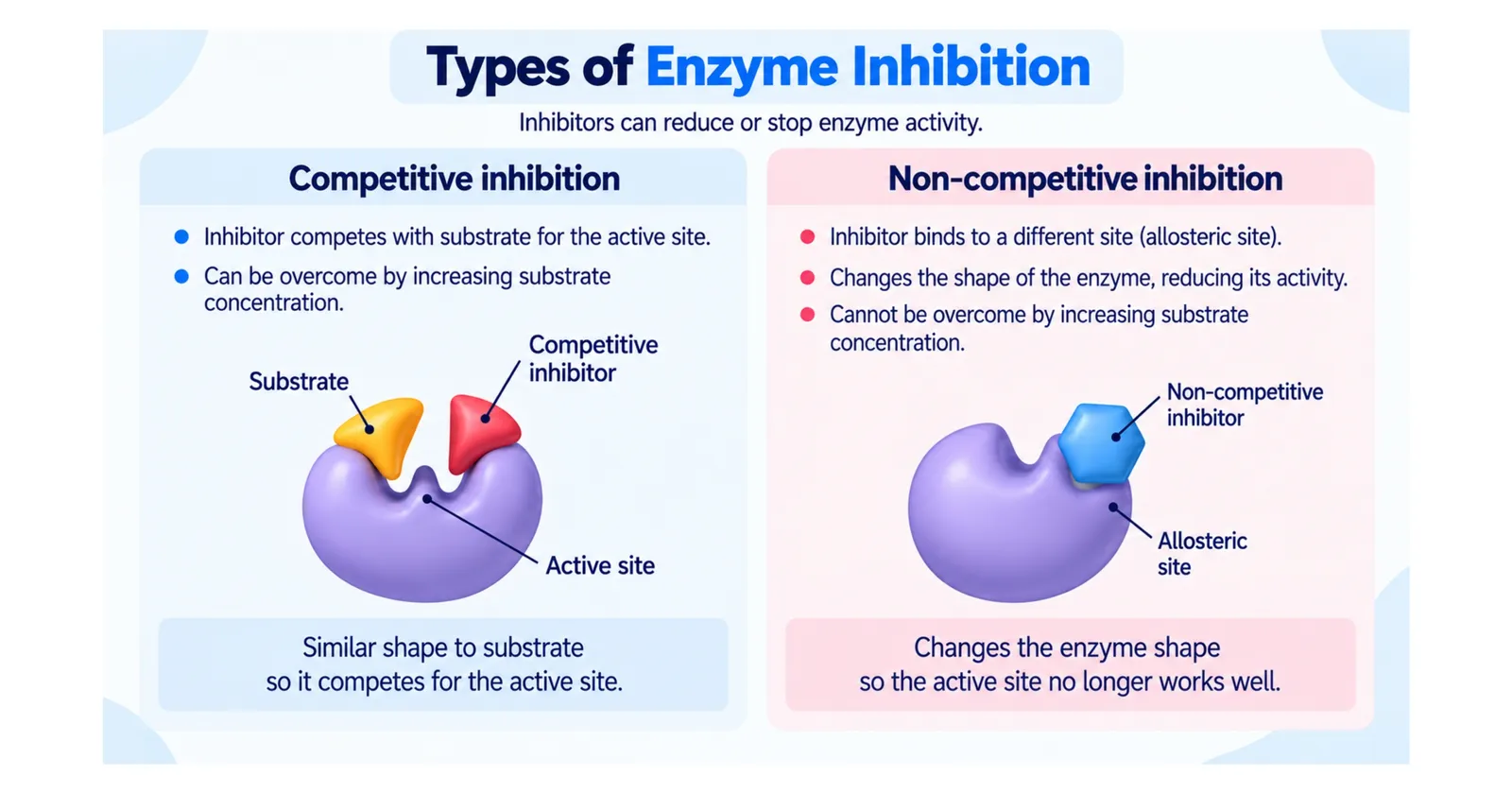
Inhibitors are molecules that reduce enzyme activity. There are two main types.
Competitive inhibitors have a shape similar to the substrate. They enter the active site and block it, so the real substrate cannot bind. Adding more substrate can overcome this type of inhibition.
Non-competitive inhibitors bind somewhere else on the enzyme, called an allosteric site. This changes the shape of the active site so the substrate no longer fits. Adding more substrate does not help.
Many medicines and poisons work as inhibitors. For example, some antibiotics such as penicillin block enzymes that bacteria need to build their cell walls, and cyanide is deadly because it inhibits an enzyme needed for respiration.
Slide: Types of enzyme inhibition
Competitive vs non-competitive
1/1
Enzyme Experiments You Should Know
Investigating the effect of pH on amylase
Place drops of iodine solution into the wells of a spotting tile. Iodine turns blue-black in the presence of starch.
Mix amylase, a buffer solution of known pH and starch solution in a test tube kept in a water bath at a fixed temperature.
Every 30 seconds, add a drop of the mixture to a fresh well of iodine.
Record the time taken for the iodine to stay orange-brown, which shows that all the starch has been broken down.
Repeat using buffers of different pH values.
The shortest time shows the optimum pH. You can calculate the rate using rate = 1000 ÷ time. Control variables include temperature, volume and concentration of amylase and starch.
Investigating catalase with hydrogen peroxide
Adding pieces of potato or liver to hydrogen peroxide produces bubbles of oxygen. Counting bubbles or collecting the gas in an upturned measuring cylinder shows how fast catalase works at different temperatures.
Everyday and Industrial Uses of Enzymes
Enzymes are big business. They are used because they work at normal temperatures, which saves energy, and they are specific, so they produce fewer unwanted by-products.
Biological washing powders contain proteases and lipases that break down food and grease stains at low wash temperatures.
Baby foods are pre-digested with proteases to make them easier to digest.
Carbohydrases convert starch into sugar syrup for soft drinks and sweets.
Isomerase converts glucose into fructose, which is sweeter, so less is needed in slimming foods.
Rennin (chymosin) is used to clot milk in cheese making.
Pectinase helps extract more juice from fruit.
Enzymes in medicine are used in blood glucose test strips for people with diabetes.
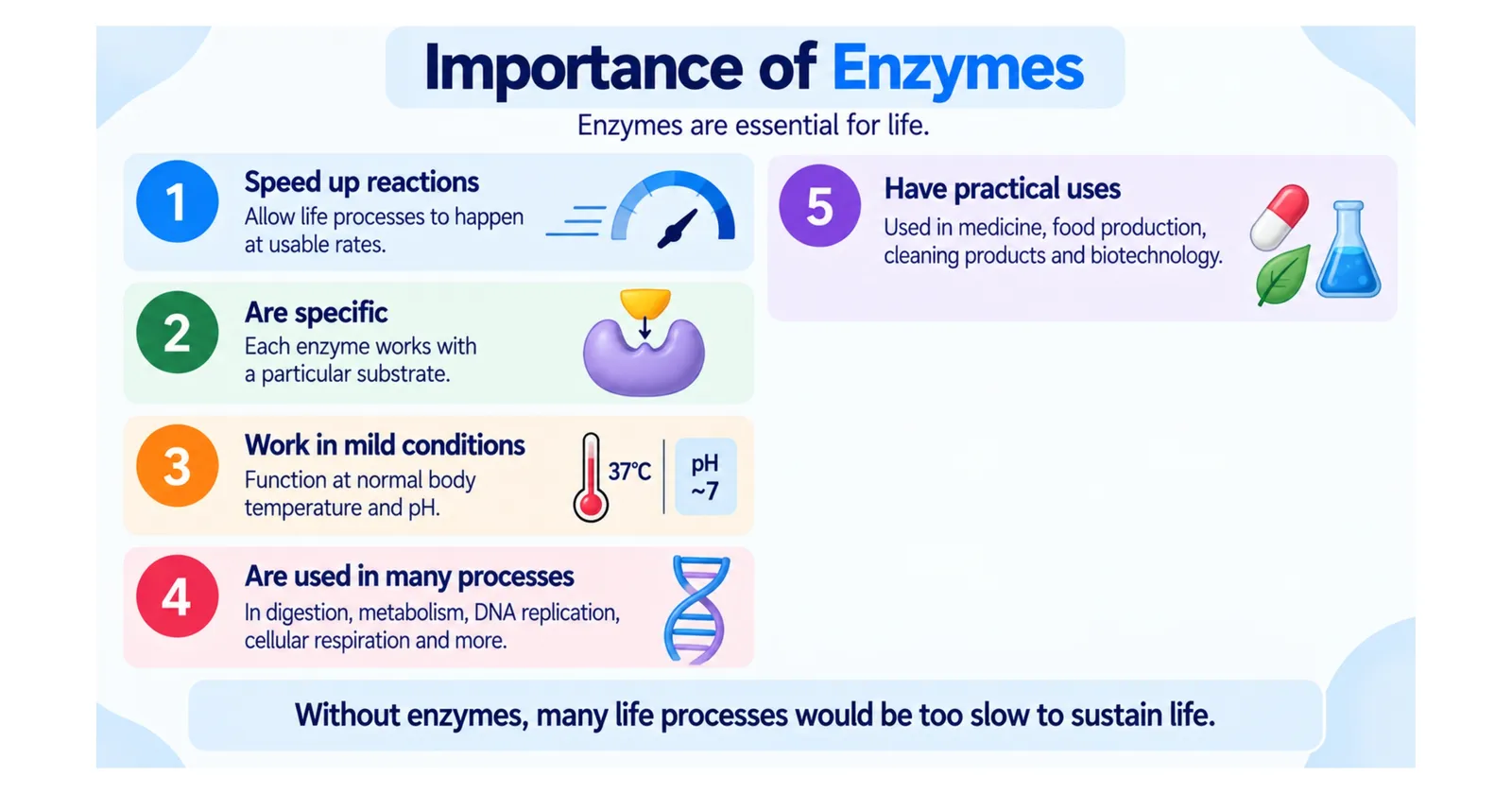
Slide: Importance of enzymes
Why life and industry depend on them
1/1
Enzymes and Health: When Enzymes Go Missing
Because every enzyme is made from the instructions in a gene, a faulty gene can mean a missing or faulty enzyme. Lactose intolerance is a common example: many adults make too little lactase, the enzyme that digests milk sugar, so undigested lactose causes bloating and stomach pain. Phenylketonuria (PKU) is an inherited condition in which the enzyme that breaks down the amino acid phenylalanine does not work, and babies are tested for it at birth. Doctors also measure enzymes in the blood; high levels of certain liver or heart enzymes can reveal damage to those organs.
Common Enzyme Exam Mistakes
Never say an enzyme is "killed" at high temperatures. Enzymes are not alive; they are denatured.
Do not say the enzyme's shape changes at low temperature. It just works more slowly.
Always mention that the active site changes shape and the substrate no longer fits when you explain denaturation.
Say "complementary" rather than "the same shape" when describing the active site and substrate.
Frequently Asked Questions About Enzymes
Are all enzymes proteins?
Almost all enzymes are proteins. A small number of RNA molecules, called ribozymes, can also act as catalysts. In fact, the part of the ribosome that joins amino acids together during protein synthesis is a ribozyme.
Why do enzyme names end in -ase?
Most enzymes are named after their substrate with -ase added, such as lipase for lipids and maltase for maltose. Some older names, like pepsin and trypsin, do not follow this rule.
Why is a high fever dangerous?
A body temperature above about 40 °C can start to denature important enzymes, especially in the brain, which disrupts vital reactions.
What are coenzymes?
Coenzymes are small non-protein molecules, often made from vitamins, that help certain enzymes work. This is one reason vitamins are essential in the diet.
Key Takeaways
Enzymes are protein biological catalysts that speed up reactions without being used up.
The active site is complementary in shape to one specific substrate.
The lock and key and induced fit models explain how enzymes work.
High temperatures and extreme pH denature enzymes by changing the shape of the active site.
Enzymes are widely used in food, medicine and household products.
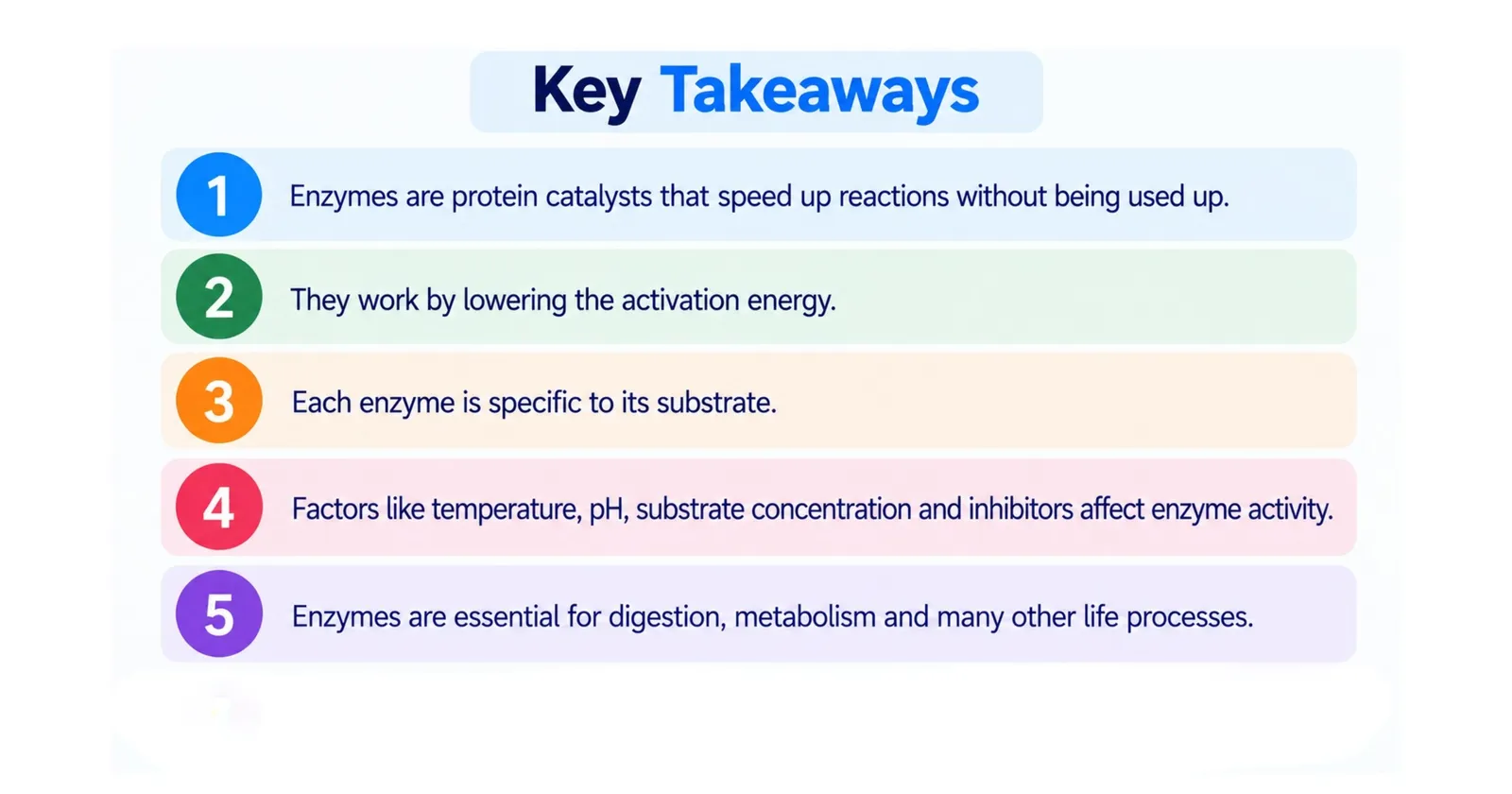
Slide: Key takeaways
1/1
Enzymes themselves are proteins, so they are made by protein synthesis. Read our next guide to discover how your cells read the genetic code to build every enzyme your body needs.
🗂️ Revision Flashcards
Tap a card to reveal the answer.
🎯 Quick Quiz
8 questions. Pick an answer to check it straight away.
1What is the product when amylase breaks down starch?
Amylase breaks starch down into the product maltose, a sugar.
2How do enzymes speed up reactions?
Enzymes lower the activation energy, so many more molecules can react at body temperature.
3Which word should you use to describe how the active site and substrate shapes relate?
Say "complementary" rather than "the same shape" when describing the active site and substrate.
4What happens to an enzyme at a low temperature?
At low temperatures enzymes are not denatured; they simply work slowly.
5What is the optimum pH of pepsin in the stomach?
Pepsin is adapted to the hydrochloric acid in the stomach and has an optimum pH of about 2.
6Where does a non-competitive inhibitor bind?
Non-competitive inhibitors bind to an allosteric site, which changes the shape of the active site.
7Which enzyme breaks down hydrogen peroxide into water and oxygen?
Catalase, found especially in liver cells, breaks down toxic hydrogen peroxide into water and oxygen.
8Bile is made in the liver. What does it do?
Bile is not an enzyme; it emulsifies fats to give lipase a bigger surface area and neutralises stomach acid.