The four layers of the Earth, mantle convection, the geodynamo and how P and S waves reveal the planet's interior.
Introduction: What Is Inside the Earth?
When you look at the ground, you see soil, rock, grass and water. It is easy to forget that this is only the very top of something enormous. The Earth is a sphere about 12,740 kilometers across, and nearly all of that distance lies hidden beneath our feet. The deepest hole humans have ever drilled reaches only about 12 kilometers down. That is less than one third of one percent of the way to the center.
So how do we know what is down there? The answer is a mix of clever detective work, physics and careful measurement. Earthquakes send vibrations through the planet, and by tracking those vibrations scientists can work out what the rock is like along the way. Meteorites, which are leftovers from the formation of the solar system, give clues about the chemicals that built our planet. Experiments in laboratories squeeze and heat minerals to copy conditions deep inside the Earth. Put together, these clues tell a consistent story.
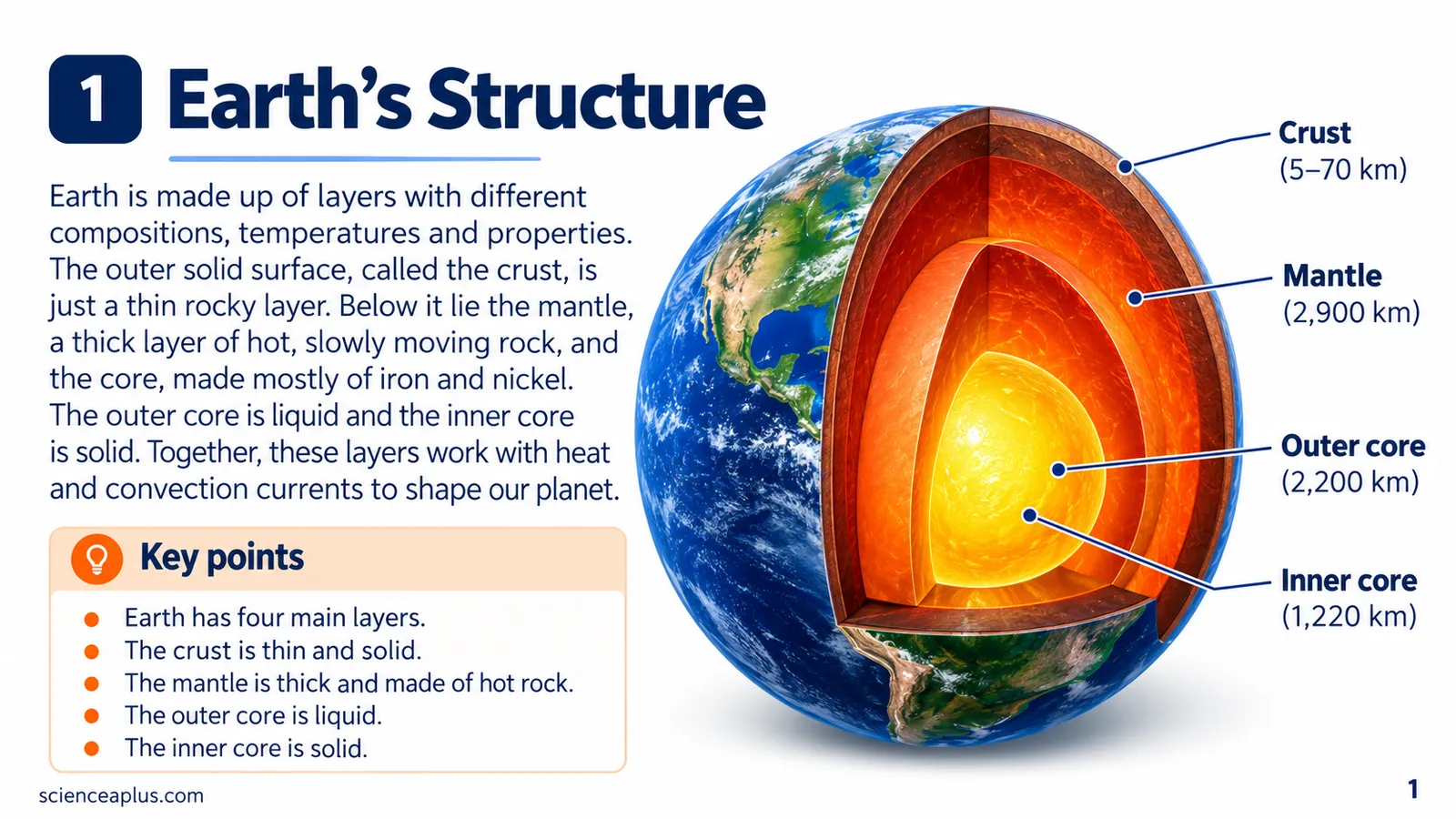
The story is this: the Earth is made up of layers with different compositions, temperatures and properties. The outer solid surface, called the crust, is just a thin rocky layer. Below it lies the mantle, a thick layer of hot, slowly moving rock. At the center is the core, made mostly of iron and nickel, which is divided into a liquid outer core and a solid inner core. Together, these layers work with heat and convection currents to shape our planet.
In this article we will explore each layer in turn, look at how heat drives motion inside the Earth, see how the liquid core creates a magnetic shield, and learn exactly how scientists use earthquake waves to peek inside. By the end you will be able to describe all four layers, compare their features and explain why they matter to life on the surface.
Key points
Earth has four main layers.
The crust is thin and solid.
The mantle is thick and made of hot rock.
The outer core is liquid.
The inner core is solid.
🌍
Slide: Earth's structure
Four layers, from crust to inner core
1/1
Why Does Earth Have Layers at All?
The layers did not appear by accident. About 4.5 billion years ago, the young Earth was a hot, partly molten ball formed from dust, rock and metal crashing together. In that molten state, materials were free to move. Heavy substances, especially iron and nickel, sank toward the center under the pull of gravity. Lighter materials, such as the silicate minerals that make up rock, floated upward. This sorting process is called differentiation, and it is the reason the Earth has a dense metal core and a lighter rocky shell.
You can see a small version of differentiation in a jar of salad dressing. Shake it up and everything is mixed. Leave it on the counter and the heavy vinegar settles to the bottom while the lighter oil rises to the top. On the early Earth the process took millions of years and involved rock and metal instead of oil and vinegar, but the principle is identical: density decides where things end up.
The Four Layers at a Glance
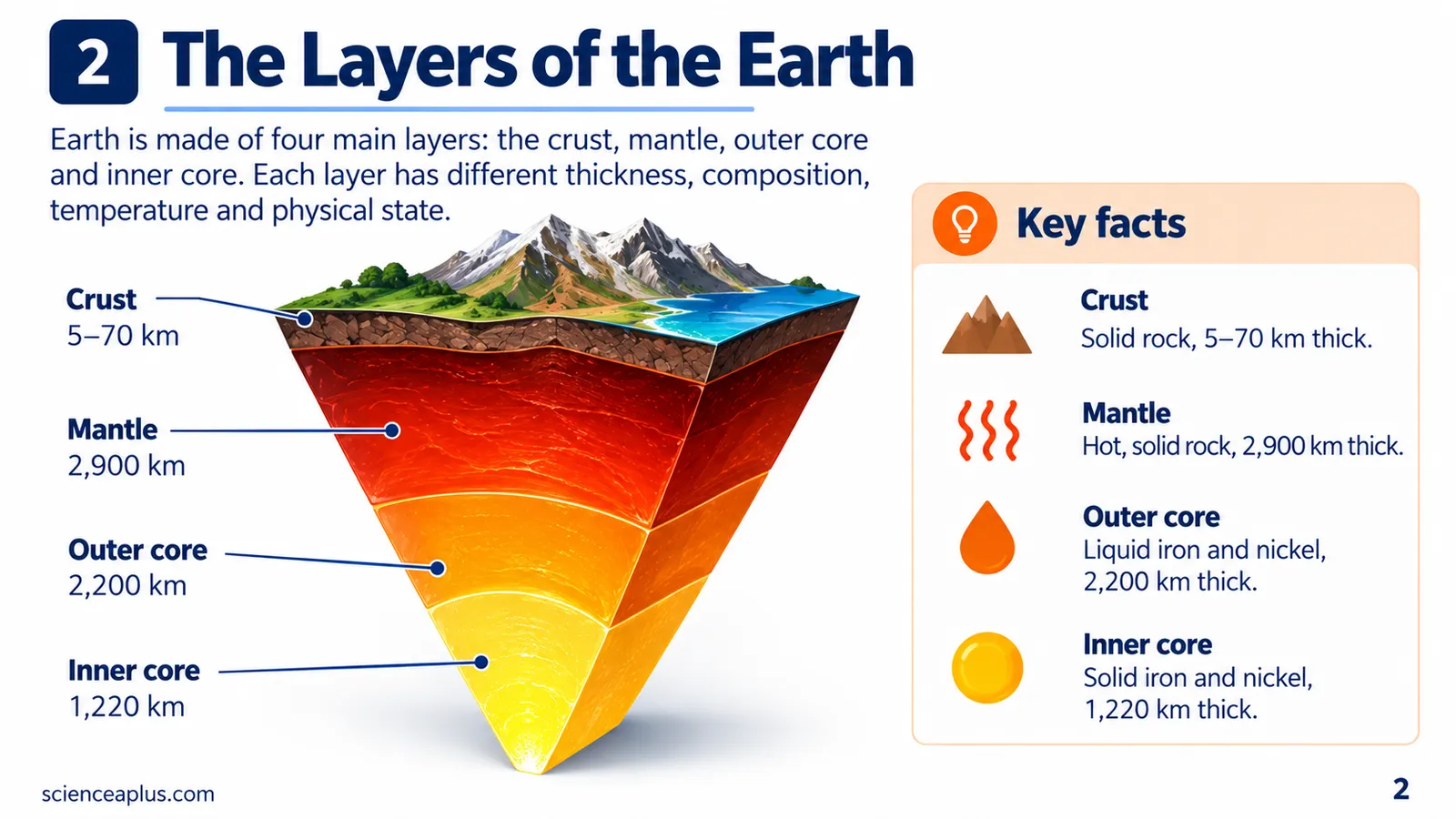
Earth is made of four main layers: the crust, mantle, outer core and inner core. Each layer has a different thickness, composition, temperature and physical state. Here is a quick comparison before we dive into each one.
Layer
Thickness
State
Main materials
Crust
5–70 km
Solid rock
Granite and basalt
Mantle
About 2,900 km
Hot, solid rock that can flow slowly
Silicate rock rich in magnesium and iron
Outer core
About 2,200 km
Liquid
Iron and nickel
Inner core
About 1,220 km (radius)
Solid
Iron and nickel
Notice something interesting in the table. The crust is the layer we know best, yet it is by far the thinnest. If the Earth were scaled down to the size of a basketball, the crust would be thinner than a sheet of paper. The mantle makes up about 84 percent of the planet's volume, so it is the true bulk of the Earth. The core, although smaller in volume, contains about one third of the planet's mass because iron and nickel are so dense.
📏
Slide: The layers of the Earth
Thickness and state of each layer
1/1
The Crust: Earth's Thin Outer Skin
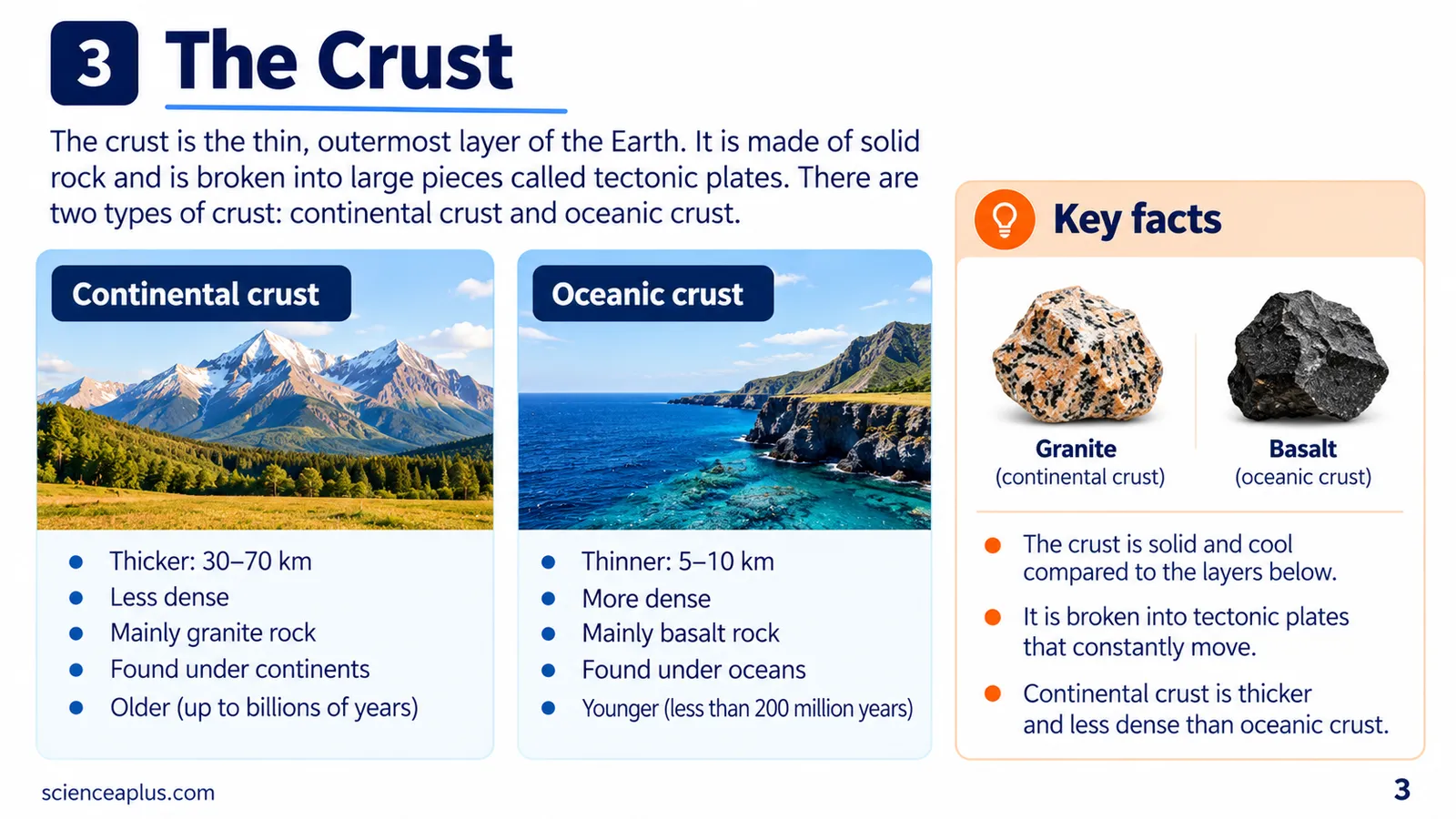
The crust is the thin, outermost layer of the Earth. It is made of solid rock and is broken into large pieces called tectonic plates. Every mountain, valley, ocean floor, desert and city sits on the crust. It is the only layer humans have walked on, mined and drilled into.
There are two types of crust, and they are surprisingly different from each other.
Continental crust
Continental crust forms the land. It is thicker, ranging from about 30 to 70 kilometers, and the thickest parts lie under tall mountain ranges such as the Himalayas. It is less dense than oceanic crust and is made mainly of granite, a light-colored rock rich in quartz and feldspar. Because it is found under the continents, it is what we stand on in daily life.
Continental crust is also very old. Some rocks in Canada, Greenland and Australia are up to several billion years old. This long lifespan exists because continental crust is light and buoyant. It floats high on the mantle and resists being pulled back down, so it survives for ages while other parts of the surface are recycled.
Oceanic crust
Oceanic crust lies beneath the oceans. It is thinner, about 5 to 10 kilometers thick, and more dense. It is made mainly of basalt, a dark, fine-grained volcanic rock that forms when lava cools. It is also much younger than continental crust, generally less than 200 million years old.
Why is oceanic crust so young? The answer is plate tectonics. New oceanic crust forms at mid-ocean ridges, where magma rises and hardens. As it ages it moves away from the ridge, cools and becomes even denser. Eventually, at places called subduction zones, it sinks back into the mantle and is recycled. This conveyor belt means the ocean floor never lasts long in geological terms.
Key facts: The crust
The crust is solid and cool compared to the layers below.
It is broken into tectonic plates that constantly move.
Continental crust is thicker and less dense than oceanic crust.
Granite is typical of continental crust; basalt is typical of oceanic crust.
🏔️
Slide: The crust
Continental vs oceanic crust
1/1
The Mantle: The Thick Layer of Hot, Slow-Moving Rock
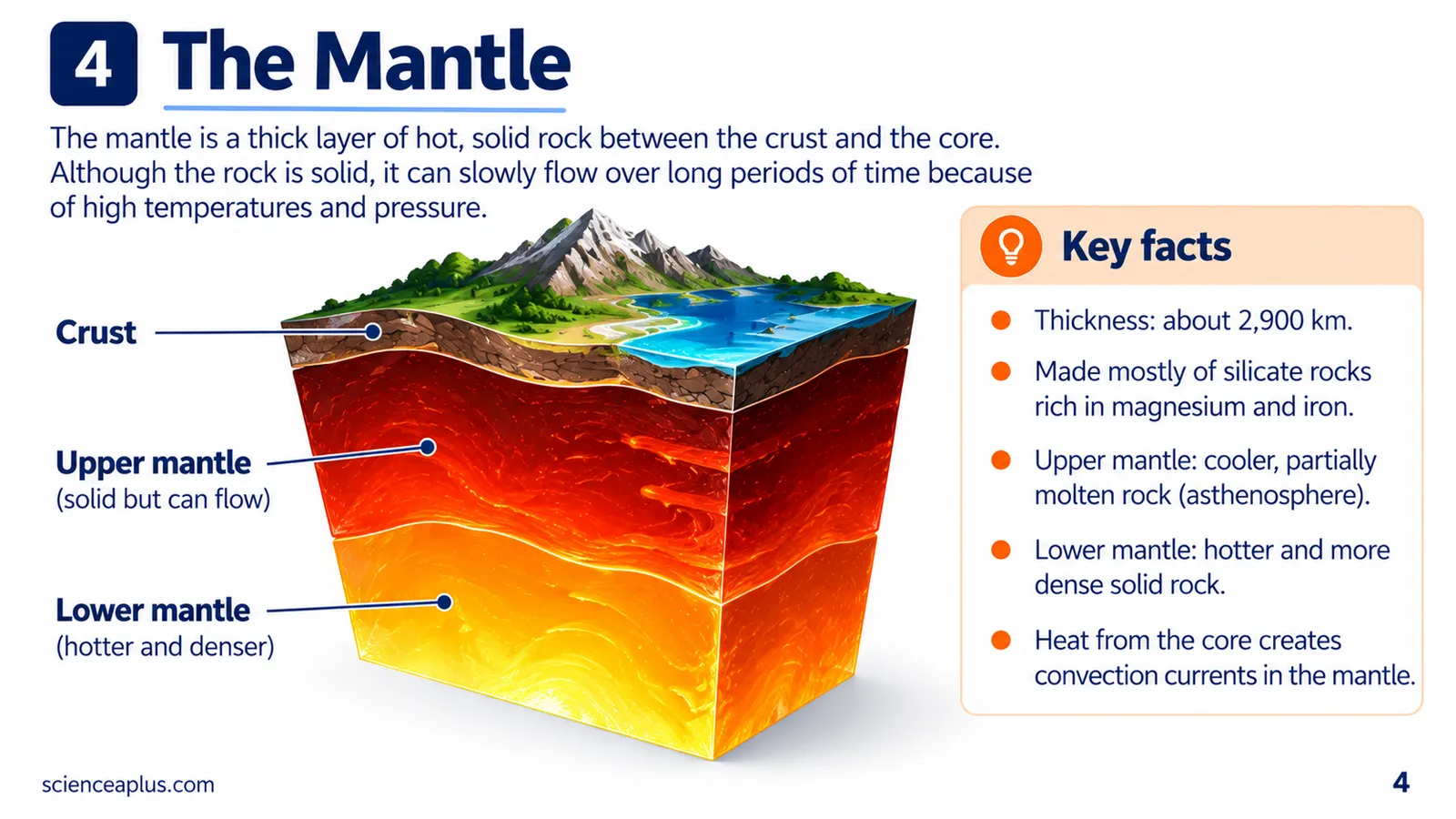
Beneath the crust lies the mantle, the largest layer by volume. The mantle is a thick layer of hot, solid rock between the crust and the core, and it is about 2,900 kilometers thick. It is made mostly of silicate rocks rich in magnesium and iron.
Here is a point that surprises many students: the mantle is solid, yet it flows. How can both things be true? The answer is time. Over a human lifetime the rock seems completely rigid, and earthquake waves pass through it as they would through a solid. But the mantle is so hot, and under such enormous pressure, that over millions of years it creeps like very thick putty or like glacier ice. The speed is about the same as the speed at which your fingernails grow, a few centimeters per year.
Upper mantle and lower mantle
Scientists divide the mantle into two main regions.
The upper mantle is cooler and, in places, partially molten. The very top of it is rigid and joins with the crust to form the lithosphere. Just below that lies the asthenosphere, a weak, partially molten zone sometimes called the soft layer. The tectonic plates can slide over this zone because it is able to flow.
The lower mantle is hotter and more dense. Because the pressure there is so large, the rock stays solid and stiff even at extremely high temperatures. Temperatures in the mantle range from roughly 1,000°C near the top to more than 3,500°C near the core.
Key facts: The mantle
Thickness: about 2,900 km.
Made mostly of silicate rocks rich in magnesium and iron.
Upper mantle: cooler, partially molten rock (asthenosphere).
Lower mantle: hotter and more dense solid rock.
Heat from the core creates convection currents in the mantle.
The mantle matters to us far more than its hidden location suggests. It is the source of the magma that feeds volcanoes. Its slow movements shift the continents, open and close oceans and lift mountain ranges. Diamonds are carried up from the mantle in rare volcanic eruptions. Without the mantle's heat engine, Earth would be a geologically dead world like the Moon.
🔥
Slide: The mantle
Hot rock that flows slowly
1/1
The Outer Core: A Sea of Liquid Metal
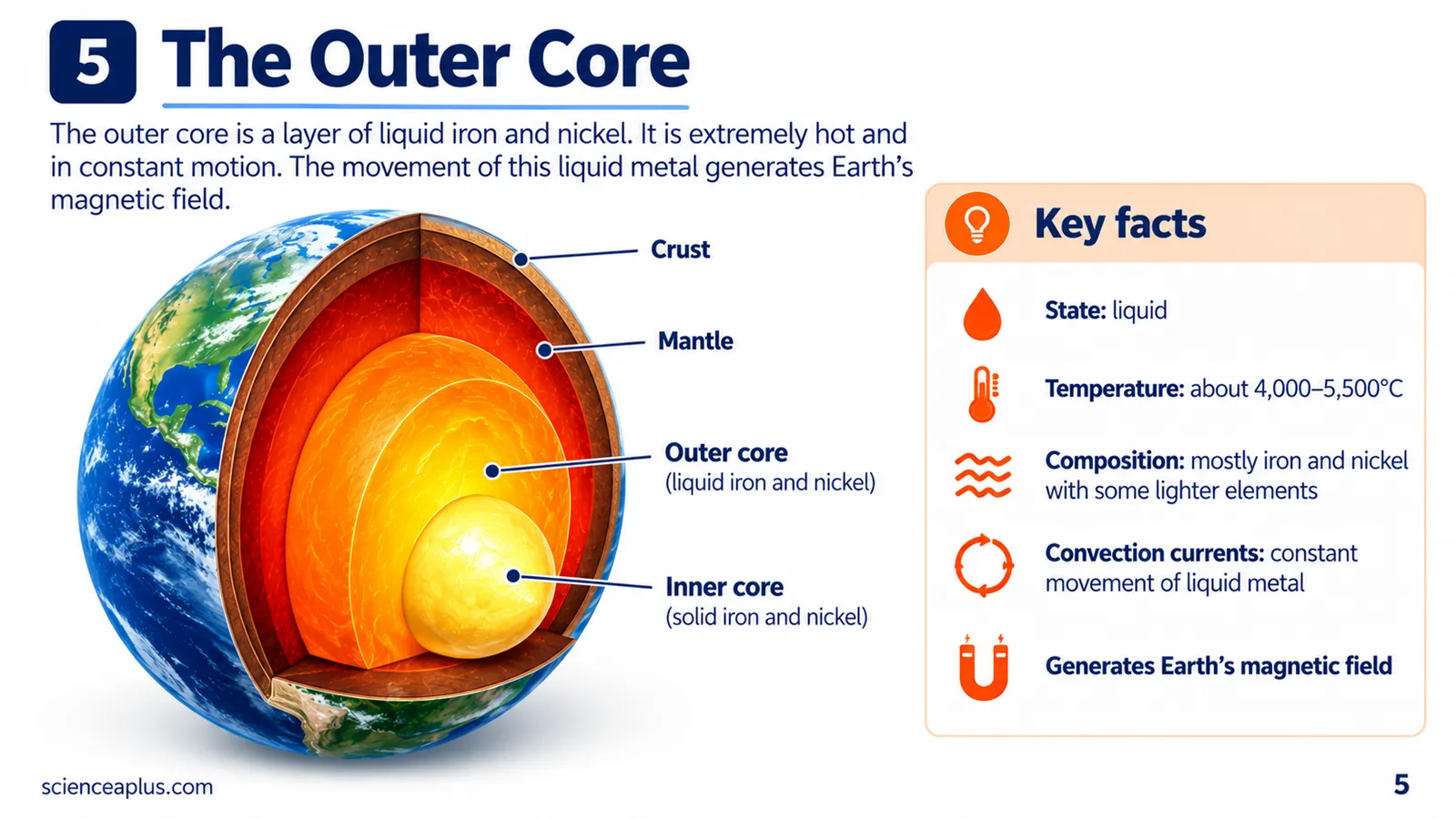
Below the mantle, at a depth of about 2,900 kilometers, we reach the core. The core is made mostly of iron and nickel, and it has two parts. The first is the outer core, a layer of liquid iron and nickel about 2,200 kilometers thick. It is extremely hot and in constant motion.
The temperature of the outer core is about 4,000 to 5,500°C. That is as hot as the surface of some stars. The outer core also contains some lighter elements, such as sulfur and oxygen, mixed with the iron and nickel. These lighter elements are part of the reason the outer core is liquid, because they lower the temperature at which the metal melts.
The most important thing about the outer core is that it moves. Liquid metal is constantly churning, driven by heat escaping from the inner core and by the planet's rotation. This movement is the engine behind Earth's magnetic field, which we will discuss shortly.
Key facts: The outer core
State: liquid.
Temperature: about 4,000–5,500°C.
Composition: mostly iron and nickel with some lighter elements.
Convection currents: constant movement of liquid metal.
Generates Earth's magnetic field.
🌀
Slide: The outer core
Liquid iron and nickel in constant motion
1/1
The Inner Core: A Solid Ball of Iron and Nickel
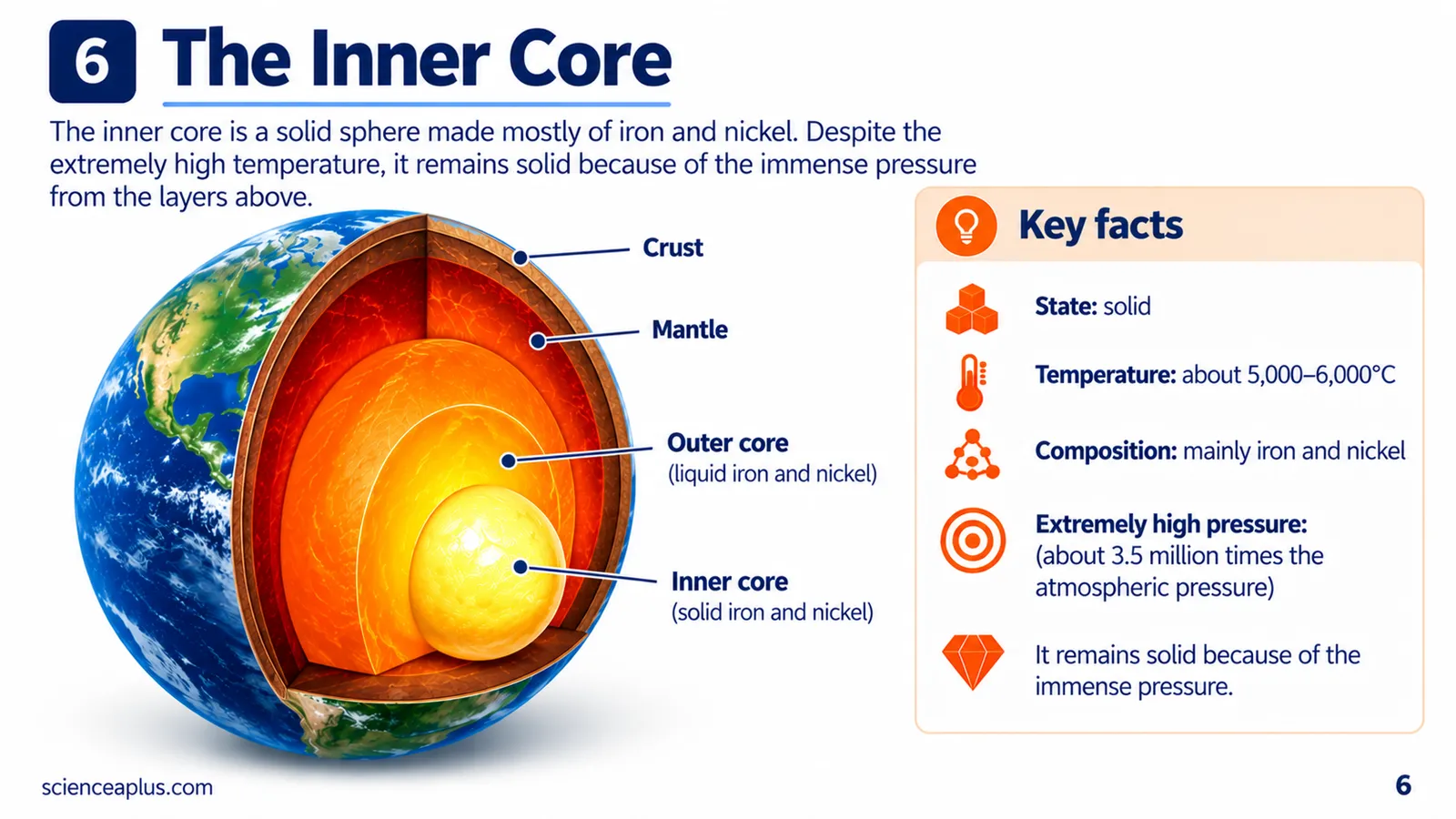
At the very center of the Earth lies the inner core, a solid sphere made mostly of iron and nickel. Its radius is about 1,220 kilometers, a little smaller than the Moon. Here is the puzzle: the inner core is hotter than the outer core, at about 5,000 to 6,000°C, yet it is solid while the outer core is liquid.
The explanation is pressure. At the center of the Earth, the weight of all the rock and metal above creates extreme pressure, about 3.5 million times the atmospheric pressure at sea level. Under such force, iron atoms are squeezed so tightly together that they cannot move around as a liquid. They lock into a solid crystal structure, even though the temperature is high enough to melt iron at the surface. Pressure wins over heat.
The inner core is not static. It slowly grows as the planet cools. Liquid iron at the boundary between the outer and inner core freezes onto the surface of the inner core, adding a bit more solid metal over time. This freezing releases heat and lighter elements that help stir the outer core, adding energy to the magnetic field. The inner core is thought to be growing by roughly a millimeter a year.
Key facts: The inner core
State: solid.
Temperature: about 5,000–6,000°C.
Composition: mainly iron and nickel.
Extremely high pressure, about 3.5 million times atmospheric pressure.
It remains solid because of the immense pressure.
💎
Slide: The inner core
Solid because of immense pressure
1/1
Convection Currents in the Mantle
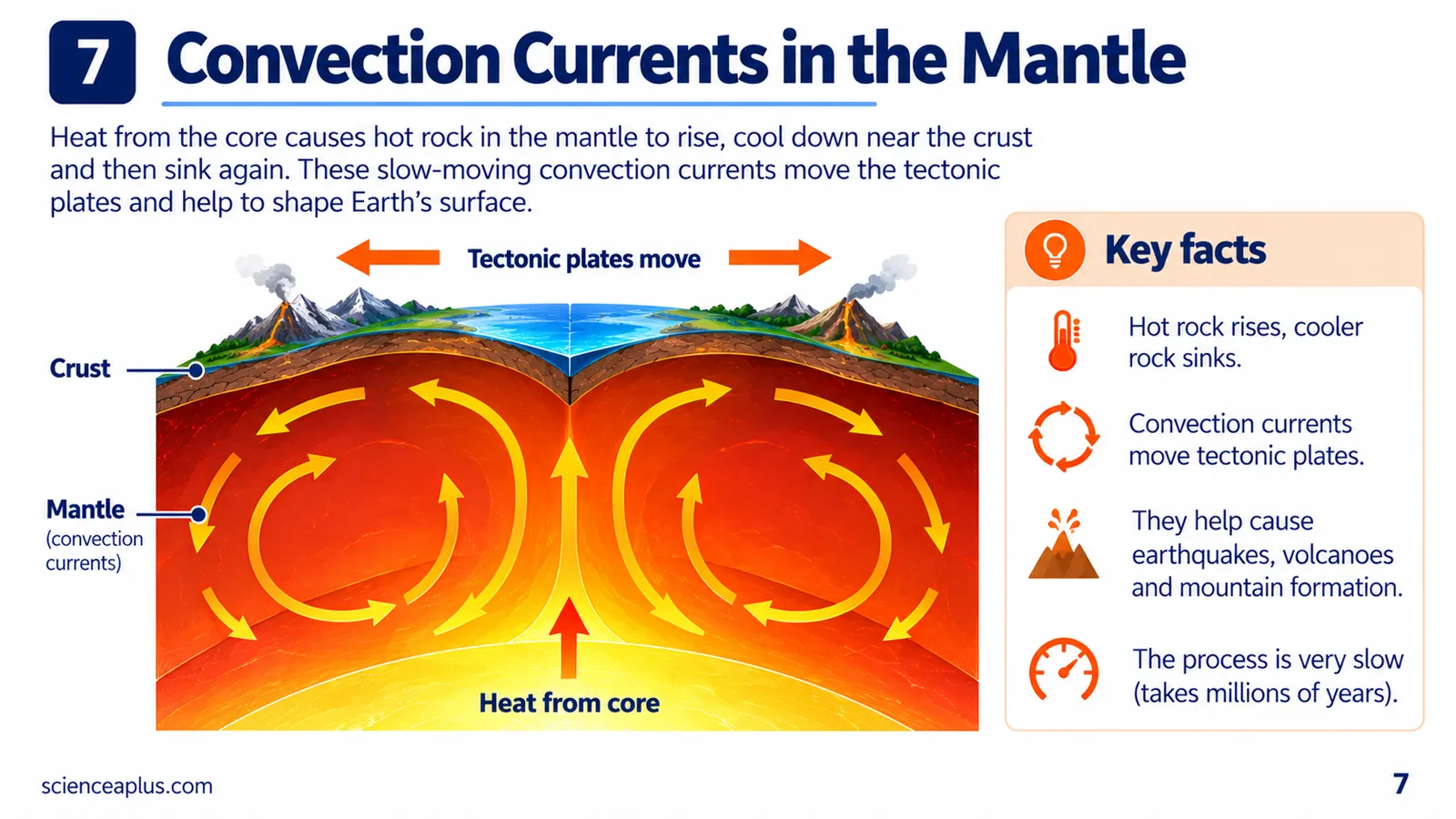
Heat is the great driver of change inside the Earth. The core is extremely hot, and that heat has to travel outward toward the cooler surface. In the mantle, much of it moves by convection. Heat from the core causes hot rock in the mantle to rise, cool down near the crust and then sink again. These slow-moving convection currents move the tectonic plates and help to shape Earth's surface.
You can watch convection in a pot of soup on the stove. The soup at the bottom gets hot, becomes less dense and rises. At the surface it cools, becomes denser and sinks back down along the edges. The result is a circular motion called a convection cell. In the mantle the same thing happens, but it is incredibly slow. A complete circuit can take tens to hundreds of millions of years.
The effects of this slow circulation are huge. Where hot rock rises beneath the crust, plates are pushed apart, forming mid-ocean ridges and rift valleys. Where cooler rock sinks, plates are pulled down, forming deep ocean trenches and fueling volcanoes and earthquakes. The collisions of plates create mountain ranges. Almost every large feature on the planet's surface, from the Andes to the Mid-Atlantic Ridge, can be linked to convection in some way.
Key facts: Convection
Hot rock rises, cooler rock sinks.
Convection currents move tectonic plates.
They help cause earthquakes, volcanoes and mountain formation.
The process is very slow and takes millions of years.
♨️
Slide: Convection currents in the mantle
Hot rock rises, cooler rock sinks
1/1
Earth's Magnetic Field
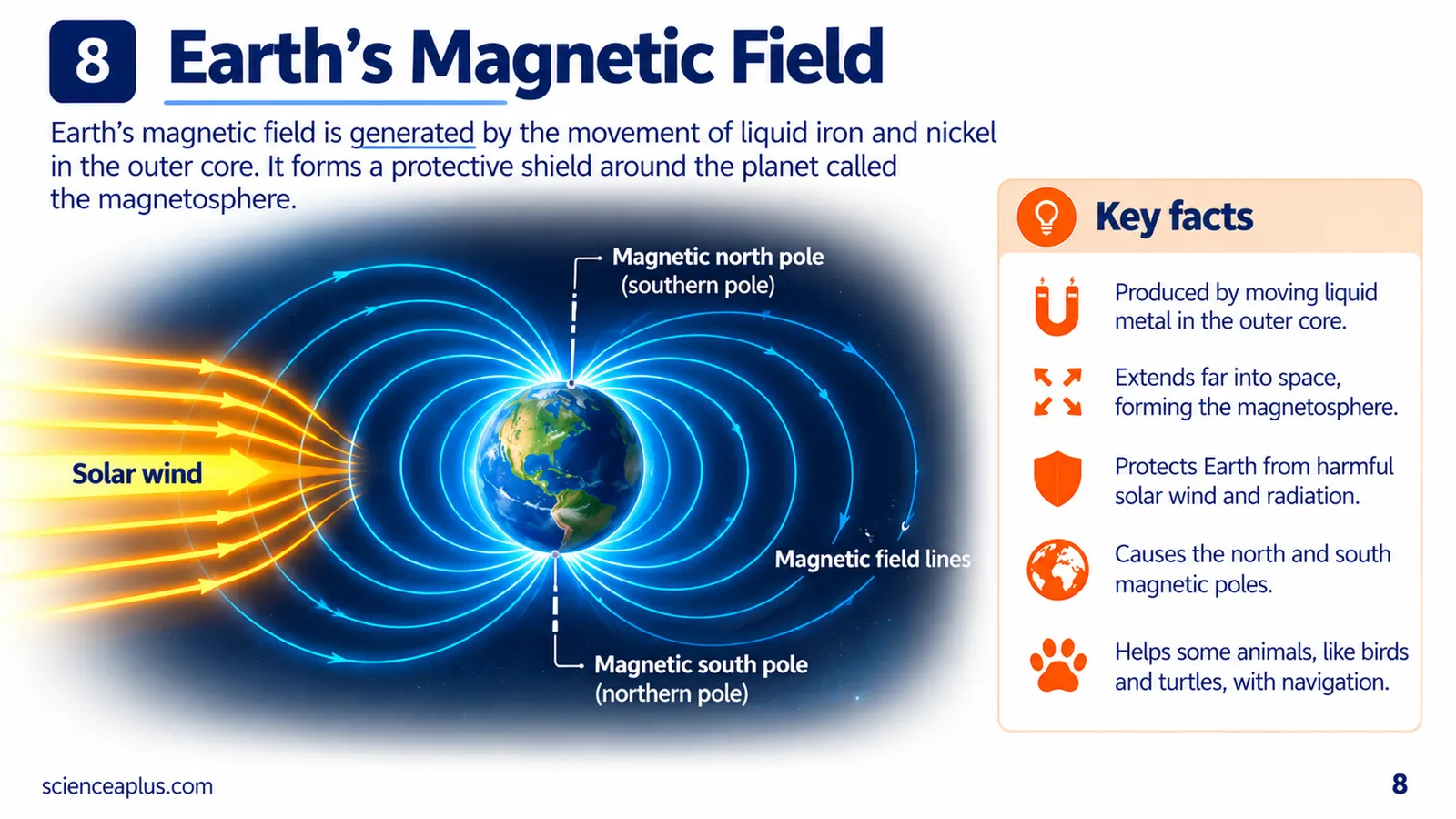
If you have ever used a compass, you have used a gift from the outer core. Earth's magnetic field is generated by the movement of liquid iron and nickel in the outer core. As the electrically conducting metal swirls and flows, helped by the planet's spin, it creates electric currents. These currents in turn create a magnetic field that extends far out into space. Scientists call this process the geodynamo.
The field forms a protective shield around the planet called the magnetosphere. It stretches tens of thousands of kilometers into space and is squeezed on the side facing the Sun and stretched into a long tail on the other side.
Protection from the Sun
The Sun constantly releases a stream of charged particles known as the solar wind. Without protection, these particles would slowly strip away our atmosphere and flood the surface with harmful radiation, as likely happened on Mars, which lost its global magnetic field billions of years ago. The magnetosphere deflects most of the solar wind around the Earth and keeps the atmosphere in place. In that sense, a liquid metal ocean 3,000 kilometers beneath your feet helps keep you alive.
When some charged particles do get channeled toward the poles along the magnetic field lines, they collide with gases in the upper atmosphere and produce glowing curtains of light. These are the aurora borealis in the north and the aurora australis in the south.
Key facts: The magnetic field
Produced by moving liquid metal in the outer core.
Extends far into space, forming the magnetosphere.
Protects Earth from harmful solar wind and radiation.
Causes the north and south magnetic poles.
Helps some animals, like birds and turtles, with navigation.
🧲
Slide: Earth's magnetic field
The magnetosphere and the solar wind
1/1
How Do We Know What Is Inside the Earth?
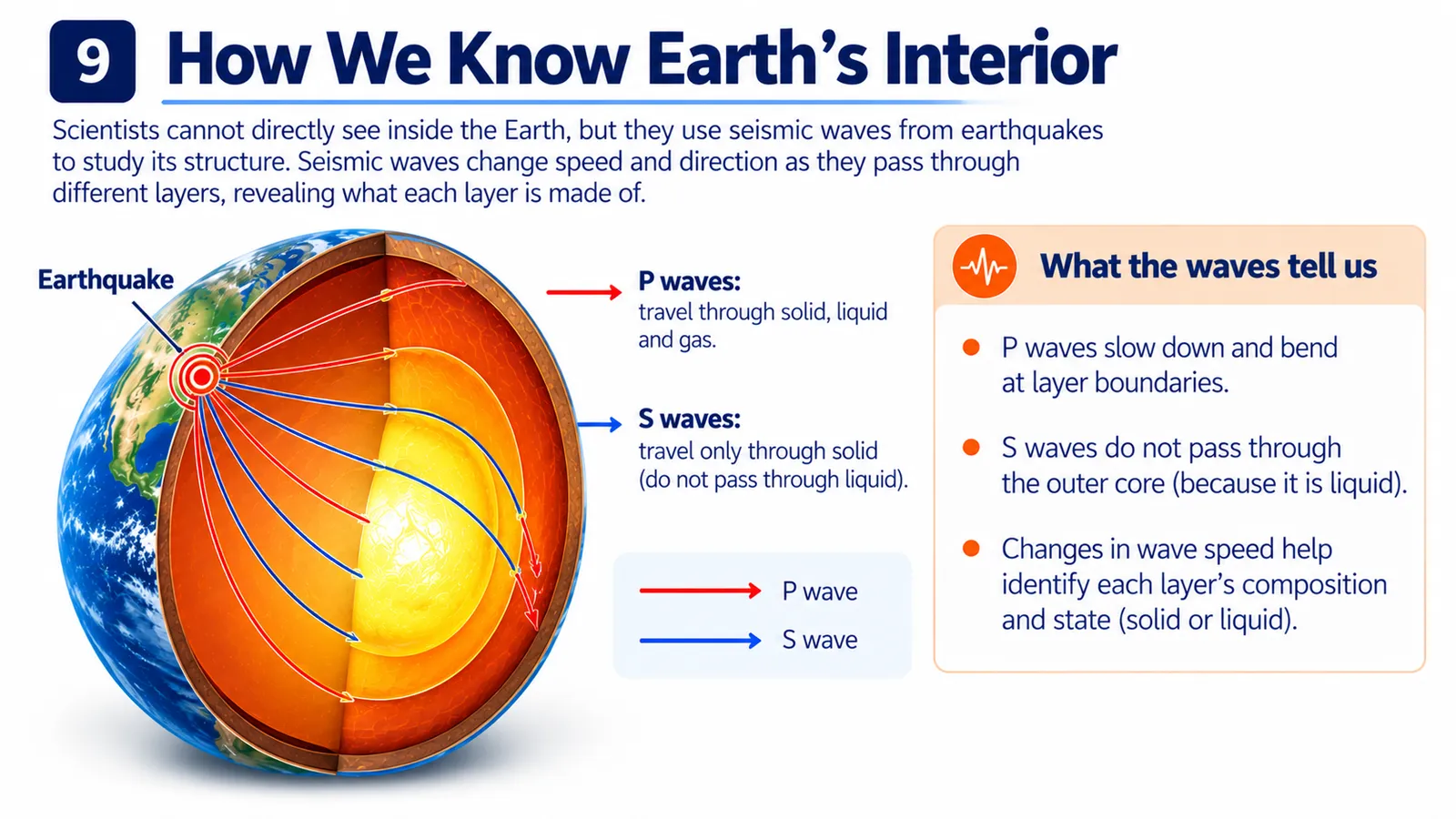
Scientists cannot directly see inside the Earth, but they use seismic waves from earthquakes to study its structure. Seismic waves change speed and direction as they pass through different layers, revealing what each layer is made of. This is the single most important tool in the study of Earth's interior.
When an earthquake happens, it releases energy that travels as waves in all directions. Seismometers, sensitive instruments placed all over the world, record when the waves arrive and how strong they are. Because the waves have traveled through the planet, they carry information about everything they passed through. It is a little like doctors using ultrasound to look inside a body without cutting it open.
P waves and S waves
There are two main kinds of seismic body waves, and the difference between them is the key to the whole method.
P waves, or primary waves, are the fastest. They are compression waves that push and pull the material they travel through, much like sound. P waves can travel through solids, liquids and gases.
S waves, or secondary waves, are slower and arrive second. They move material from side to side, perpendicular to the direction of travel. S waves can travel only through solids. They cannot pass through a liquid.
What the waves tell us
This difference gave scientists a powerful clue. In the early twentieth century, seismologists noticed that S waves from a big earthquake never appeared on the opposite side of the planet. A large "shadow zone" existed where they were missing. The only way to explain this was a layer of liquid in the Earth's interior, blocking the S waves. That was the first strong evidence for a liquid outer core.
P waves also behave in revealing ways. They slow down and bend when they cross the boundary between the mantle and the outer core, because the material changes. In 1936, the Danish seismologist Inge Lehmann discovered that some P waves were reflected from a deeper boundary inside the core. This showed there is a solid inner core within the liquid outer core, a discovery made without anyone ever leaving the surface.
In short, changes in wave speed help identify each layer's composition and state, whether solid or liquid.
What the waves tell us
P waves slow down and bend at layer boundaries.
S waves do not pass through the outer core because it is liquid.
Changes in wave speed help identify each layer's composition and state.
📈
Slide: How we know Earth's interior
P waves and S waves
1/1
Conclusion
Our planet is far more than a rocky ball. It is a layered, dynamic machine. A thin solid crust carries the oceans, mountains and living things. A thick mantle of hot rock creeps and circulates, moving plates and powering volcanoes. A liquid outer core of iron and nickel churns constantly and creates a magnetic shield. And a solid inner core, squeezed by crushing pressure, sits at the center, hotter than the surface of many stars.
All of this was worked out from the surface, using waves, rocks, magnets and imagination. That is the beauty of science: even when something is out of reach, careful observation and logical thinking can reveal its secrets. The next time you feel a gentle tremor, glance at a compass or watch a volcano on the news, remember that you are seeing the visible results of the layers deep below.
Frequently Asked Questions
How do we know the outer core is liquid?
S waves cannot travel through liquids. After a large earthquake, S waves vanish on the far side of the planet, which means a layer of liquid must lie in their path. That layer is the outer core.
Why is the inner core solid if it is the hottest layer?
The pressure at the center of the Earth is about 3.5 million times atmospheric pressure. It squeezes iron atoms so tightly that they lock into a solid crystal structure, even at 5,000 to 6,000 degrees Celsius. Pressure beats heat.
How deep have humans drilled into the Earth?
The deepest hole ever drilled is the Kola Superdeep Borehole in Russia, at about 12 kilometers. That is only a tiny fraction of the distance to the center, so scientists rely on seismic waves to study the deeper layers.
Could Earth's magnetic field disappear?
The field has weakened, wandered and even reversed many times in Earth's history, and life has survived these changes. Scientists still monitor it closely because it shields satellites, power grids and the atmosphere from the solar wind.
Key Takeaways
Earth has four main layers: the thin solid crust, the thick hot mantle, the liquid outer core and the solid inner core.
The crust is divided into thick, light continental crust and thin, dense oceanic crust.
Heat from the core drives convection currents in the mantle, which move the tectonic plates.
The moving liquid metal of the outer core generates the magnetic field that protects life from solar wind.
Seismic P waves and S waves reveal what each layer is made of and whether it is solid or liquid.
Want to keep learning? Explore more illustrated lessons, slides and study guides at scienceaplusedu.com.
🗂️ Revision Flashcards
Tap a card to reveal the answer.
🎯 Quick Quiz
8 questions. Pick an answer to check it straight away.
1Which layer of the Earth is liquid?
The outer core is a layer of liquid iron and nickel; the inner core is solid.
2What is oceanic crust mainly made of?
Oceanic crust is mainly basalt; granite is typical of continental crust.
3Why is oceanic crust much younger than continental crust?
New oceanic crust forms at mid-ocean ridges and is recycled at subduction zones, so it never lasts long.
4About how thick is the mantle?
The mantle is about 2,900 km thick and makes up about 84 percent of Earth's volume.
5The inner core is hotter than the outer core. Why is it solid?
At about 3.5 million times atmospheric pressure, pressure wins over heat.
6What drives convection currents in the mantle?
Heat from the core makes hot rock rise, cool near the crust and sink again.
7What generates Earth's magnetic field?
The swirling liquid metal of the outer core creates electric currents, which create the field (the geodynamo).
8Why do S waves not appear on the far side of the Earth after a big earthquake?
S waves cannot pass through a liquid, so the liquid outer core creates an S-wave shadow zone.