Imagine a metal so soft you can cut it with a butter knife, so light it floats on water and so reactive that it bursts into flames the moment it touches that water. That is the alkali metals. These elements are famous for the dramatic demonstrations in school science labs, and they are one of the most frequently examined groups in IGCSE and GCSE Chemistry. In this guide you will learn what makes Group 1 metals special, how and why their reactivity changes down the group, how they react with water, oxygen and chlorine, and how to identify them using flame tests.
📖 Lesson
Properties, trends, reactions with water, oxygen and chlorine, and flame tests for Group 1, in the words examiners look for.
What Are the Alkali Metals?
The alkali metals get their name because they react with water to form alkalis, which are soluble bases. The members of Group 1 are:
| Element | Symbol | Atomic number | Electronic configuration | Melting point |
|---|---|---|---|---|
| Lithium | Li | 3 | 2, 1 | 181 °C |
| Sodium | Na | 11 | 2, 8, 1 | 98 °C |
| Potassium | K | 19 | 2, 8, 8, 1 | 63 °C |
| Rubidium | Rb | 37 | 2, 8, 18, 8, 1 | 39 °C |
| Caesium | Cs | 55 | 2, 8, 18, 18, 8, 1 | 28 °C |
| Francium | Fr | 87 | ends in 1 | Radioactive, very rare |
Hydrogen sits above lithium in many Periodic Tables because it has one outer electron, but it is a non-metal gas and is not an alkali metal.
Why Are They in Group 1?
Every alkali metal atom has one electron in its outer shell. This single electron is easily lost, leaving a stable full outer shell. When the electron is lost, the atom forms an ion with a 1+ charge, such as Li+, Na+ and K+. Because they all have the same number of outer electrons, the alkali metals react in very similar ways, and their compounds have similar formulae: NaCl, KCl and LiCl, or Na2O, K2O and Li2O.
Physical Properties of the Alkali Metals
Alkali metals are unusual metals. They behave differently from the tough, dense metals like iron and copper that you probably picture.
Soft: they can be cut with a knife, and they get softer down the group. Lithium is the hardest; caesium is almost like putty.
Shiny when freshly cut: the cut surface is silvery, but it quickly tarnishes and goes dull as it reacts with oxygen in the air.
Low density: lithium, sodium and potassium are less dense than water, so they float on it.
Low melting points: compared with most metals. Caesium melts at 28 °C, so it would melt in your hand if it were safe to hold.
Good conductors of heat and electricity, like all metals.
Trends in physical properties down the group
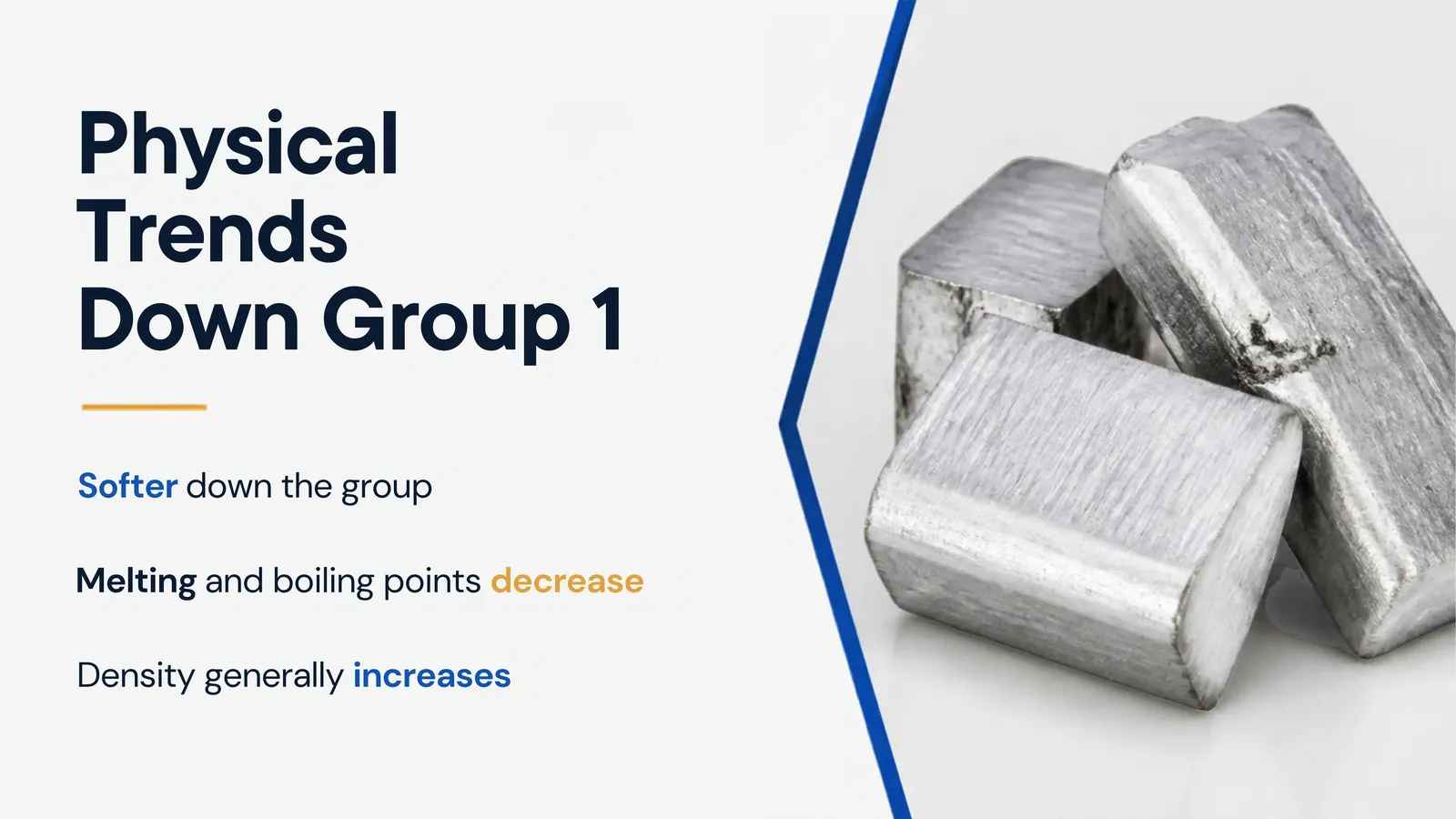
Melting and boiling points decrease.
Softness increases.
Density generally increases (potassium is a slight exception, being less dense than sodium).
Melting points decrease because the atoms get larger, so the metallic bonding between the positive ions and the sea of delocalised electrons becomes weaker.
Slide: Physical trends down Group 1
Softer, lower melting points, density generally rising
1/1
Why Are Alkali Metals Stored in Oil?
Alkali metals react quickly with oxygen and water vapour in the air. To stop this, they are stored under oil (usually paraffin oil), which keeps air and moisture away. Lithium is sometimes stored under petroleum jelly because it is so light that it floats on oil. Caesium and rubidium are so reactive that they are stored in sealed glass tubes filled with an unreactive gas such as argon.
Reactions of the Alkali Metals With Water
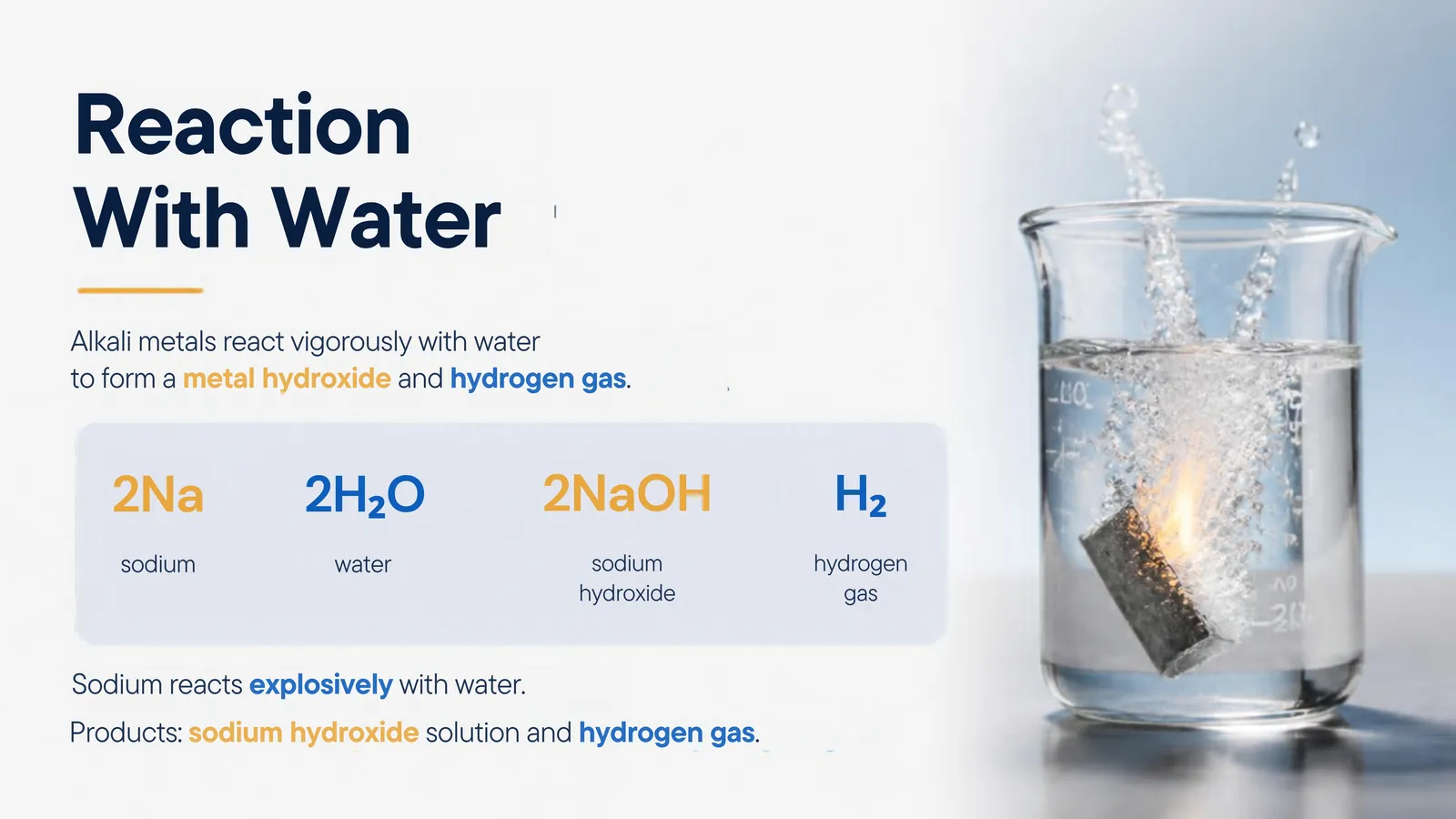
This is the reaction everyone remembers. Every alkali metal reacts with cold water to form a metal hydroxide and hydrogen gas:
metal + water → metal hydroxide + hydrogen
For sodium: 2Na + 2H2O → 2NaOH + H2
For potassium: 2K + 2H2O → 2KOH + H2
The metal hydroxide dissolves in the water to form an alkaline solution, which turns universal indicator purple and has a pH of around 13 to 14.
What you observe
| Metal | Observations when added to water |
|---|---|
| Lithium | Floats, fizzes steadily, moves slowly around the surface and gradually disappears |
| Sodium | Floats, melts into a shiny silver ball, fizzes rapidly, whizzes around the surface and disappears quickly; may produce a yellow-orange flame |
| Potassium | Floats, melts, fizzes very vigorously, whizzes around and bursts into a lilac flame; may spit and crackle |
| Rubidium and caesium | React explosively, even with ice; far too dangerous for school labs |
Slide: Reaction with water
Metal hydroxide plus hydrogen gas
1/1
Explaining each observation
Exam questions often ask you to explain the observations, not just describe them:
Floats: the metal is less dense than water.
Fizzes (effervescence): hydrogen gas is produced.
Melts into a ball: the reaction is exothermic and releases enough heat to melt the metal, which has a low melting point.
Moves around the surface: the hydrogen gas produced pushes the metal along.
Disappears: the metal reacts to form a hydroxide that dissolves in the water.
Flame with potassium: enough heat is released to ignite the hydrogen gas.
Why Does Reactivity Increase Down Group 1?
This explanation is essential and is worth several marks in almost every exam.
When alkali metals react, their atoms lose their single outer electron. The easier it is to lose that electron, the more reactive the metal.
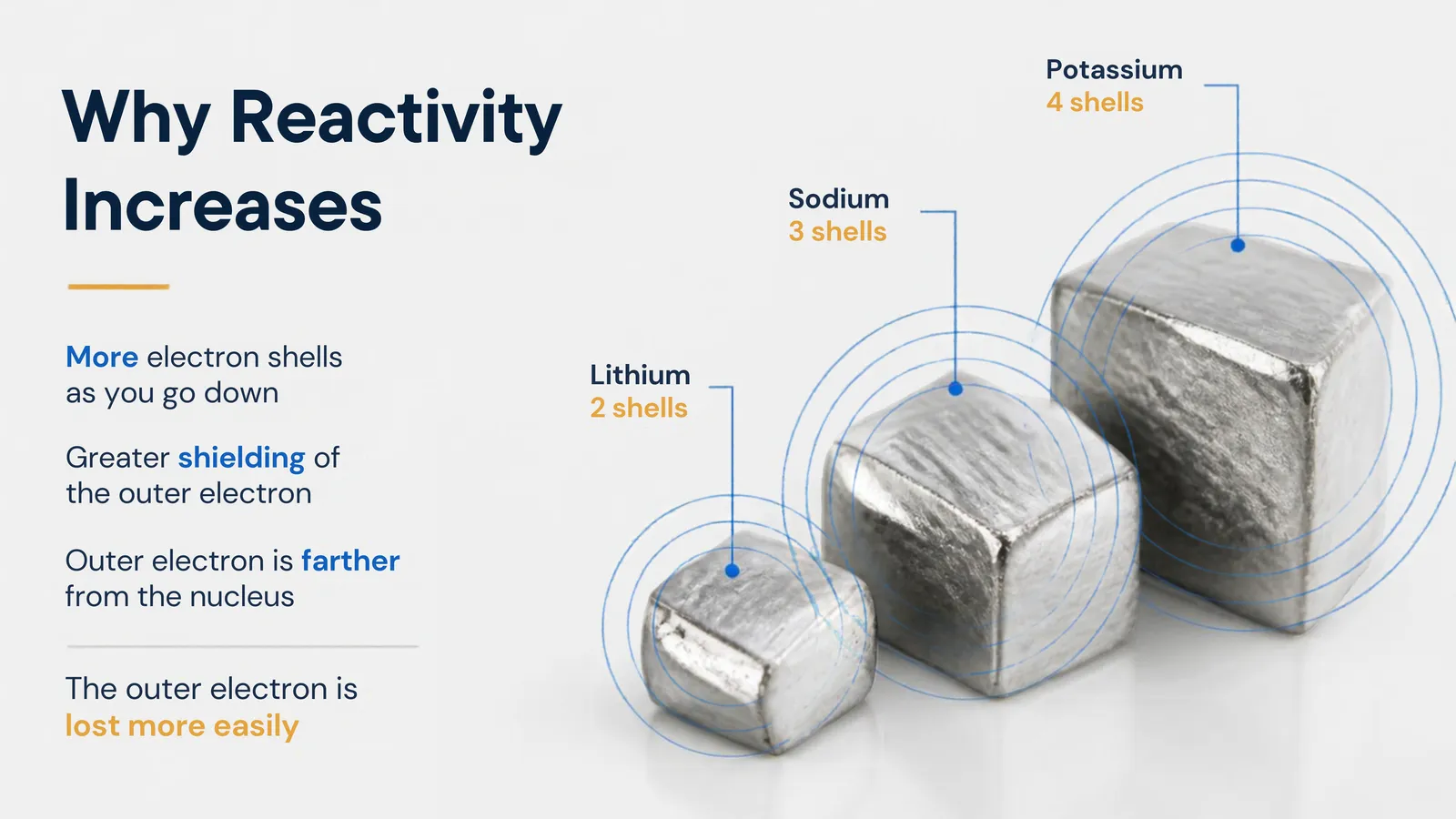
Going down the group, atoms have more electron shells, so the atoms are larger.
The outer electron is further from the nucleus.
There is more shielding from inner electrons.
So the attraction between the nucleus and the outer electron is weaker.
The outer electron is lost more easily, so reactivity increases down the group.
Caesium is therefore more reactive than potassium, which is more reactive than sodium, which is more reactive than lithium. This is the opposite of the halogens, which become less reactive down the group because they need to gain electrons.
Slide: Why reactivity increases
More shells, more shielding, outer electron lost more easily
1/1
Reactions With Oxygen
Alkali metals tarnish quickly in air because they react with oxygen to form metal oxides. When heated, they burn with brightly coloured flames:
4Li + O2 → 2Li2O
4Na + O2 → 2Na2O
The oxides are white solids that dissolve in water to form alkaline hydroxide solutions:
Na2O + H2O → 2NaOH
The speed of tarnishing is a simple demonstration of the reactivity trend. A freshly cut surface of lithium stays shiny for a while, sodium goes dull within seconds and potassium tarnishes almost immediately.
Reactions With Chlorine
Alkali metals react vigorously with chlorine to form white metal chlorides, which are ionic compounds:
2Na + Cl2 → 2NaCl
2K + Cl2 → 2KCl
Sodium burns in chlorine with a bright yellow flame, producing clouds of white sodium chloride. In this reaction, each sodium atom transfers its outer electron to a chlorine atom, forming Na+ and Cl− ions. The compounds formed are all white solids that dissolve in water to give colourless solutions.
Compounds of the Alkali Metals
Alkali metal compounds share several features:
They are ionic compounds containing 1+ metal ions.
They are usually white solids.
They are almost always soluble in water, which is why sodium, potassium and ammonium salts are described in solubility rules as "all soluble".
Their solutions are colourless.
Important compounds include sodium chloride (table salt), sodium hydroxide (used to make soap, paper and bleach), sodium carbonate (washing soda), sodium hydrogencarbonate (baking soda) and potassium nitrate (a fertiliser and an ingredient of gunpowder).
Flame Tests: Identifying Alkali Metal Ions
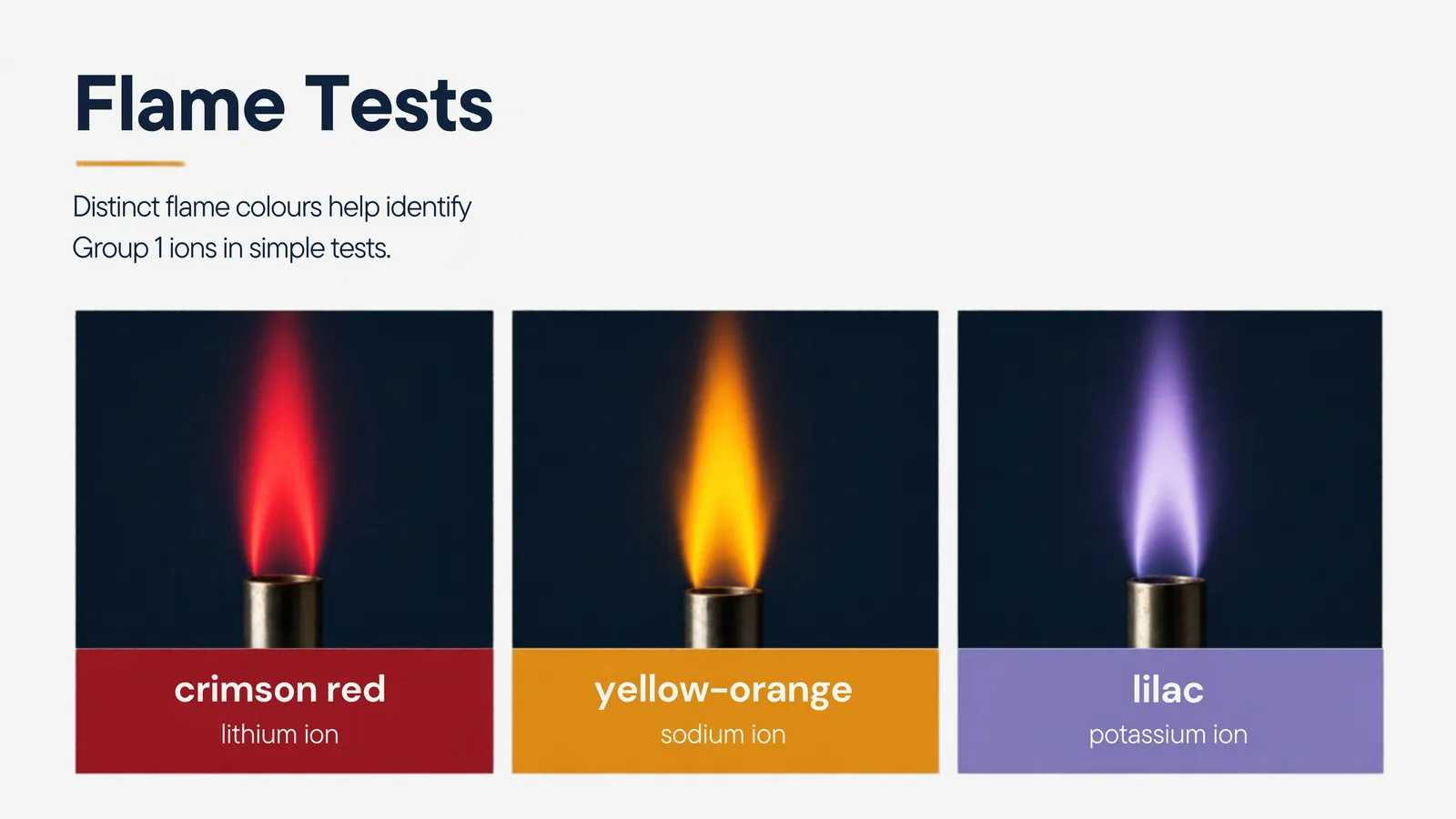
When compounds of alkali metals are heated in a flame, they give out distinctive colours. This allows chemists to identify the metal ion.
| Metal ion | Flame colour |
|---|---|
| Lithium, Li+ | Red (crimson) |
| Sodium, Na+ | Yellow-orange |
| Potassium, K+ | Lilac |
Slide: Flame test colours
Lithium, sodium and potassium ions
1/1
How to carry out a flame test
Clean a nichrome or platinum wire loop by dipping it in concentrated hydrochloric acid and holding it in a roaring blue Bunsen flame until it gives no colour.
Dip the loop in the acid again and then into the solid sample.
Hold the loop at the edge of a blue Bunsen flame and observe the colour.
Why do flames change colour? The heat excites electrons to higher energy levels. When the electrons fall back, they release energy as light of a particular colour. The same principle makes fireworks colourful: sodium compounds produce yellow, lithium and strontium compounds produce red.
Uses of the Alkali Metals
Lithium: used in rechargeable lithium-ion batteries for phones, laptops and electric cars. Lithium compounds are also used in medicine to treat bipolar disorder.
Sodium: liquid sodium has been used as a coolant in some nuclear reactors because it conducts heat so well. Sodium vapour lamps give the orange glow of older streetlights.
Potassium: potassium compounds are essential in fertilisers, because plants need potassium to grow healthily.
Caesium: caesium atomic clocks are the most accurate timekeepers in the world, and the official definition of the second is based on caesium atoms.
Predicting the Properties of Rubidium, Caesium and Francium
You can use trends to make predictions about elements further down the group. For example, rubidium:
Has a lower melting point than potassium, below 63 °C.
Reacts more violently with water than potassium, possibly explosively.
Forms rubidium hydroxide, RbOH, and hydrogen gas with water.
Forms Rb+ ions and the compound RbCl with chlorine.
Francium would be predicted to be the most reactive of all, but it is so radioactive that only tiny amounts have ever been made, and it decays within minutes.
Alkali Metals in Your Body
Sodium and potassium ions are essential for life. They carry electrical signals along nerve cells, control muscle contractions, including your heartbeat, and help to balance the water content of your cells. This is why sports drinks contain sodium and potassium salts to replace those lost in sweat, and why bananas, which are rich in potassium, are a popular snack for athletes.
Safety When Handling Alkali Metals
Use only small pieces, about the size of a grain of rice.
Handle them with tongs or tweezers, never with fingers, because they react with moisture on the skin.
Use a safety screen and wear eye protection.
Never let an alkali metal touch a large volume of water in a small container.
Common Exam Mistakes
Saying alkali metals form "alkalines". The product is a metal hydroxide, which forms an alkaline solution.
Forgetting hydrogen gas as a product of the reaction with water.
Saying reactivity increases because there are "more electrons". The key is that the outer electron is further from the nucleus and less strongly attracted.
Writing H instead of H2 for hydrogen gas in equations.
Writing the ion as Na1+. The charge is written simply as Na+.
Frequently Asked Questions About the Alkali Metals
Why are alkali metals so soft?
They have only one delocalised electron per atom and large atoms, so their metallic bonding is weak compared with other metals.
Is hydrogen an alkali metal?
No. Although it has one outer electron, hydrogen is a non-metal gas that forms diatomic H2 molecules.
Which alkali metal is the most reactive?
Francium is predicted to be the most reactive, but caesium is the most reactive alkali metal that can be studied in useful amounts.
Why does sodium react faster than lithium?
Sodium atoms are larger, so the outer electron is further from the nucleus, is more shielded and is lost more easily.
Key Takeaways
Alkali metals are Group 1 metals with one outer electron that form 1+ ions.
They are soft, shiny when cut, low in density and low in melting point.
They react with water to form a metal hydroxide and hydrogen gas.
Reactivity increases down the group because the outer electron is lost more easily.
Flame tests identify lithium (red), sodium (yellow-orange) and potassium (lilac).
The alkali metals react eagerly with the halogens to form salts. Read our guide to the halogens to understand the other side of these reactions, or explore the Periodic Table guide to see how both groups fit into the bigger picture.
🗂️ Revision Flashcards
Tap a card to reveal the answer.
🎯 Quick Quiz
8 questions. Pick an answer to check it straight away.
1How many electrons do alkali metal atoms have in their outer shell?
Every Group 1 atom has one outer electron, which is easily lost.
2What are the products when sodium reacts with cold water?
Alkali metal + water gives a metal hydroxide and hydrogen gas: 2Na + 2H₂O → 2NaOH + H₂.
3What colour does universal indicator turn in the solution formed when an alkali metal reacts with water?
The hydroxide solution is strongly alkaline, pH around 13 to 14, so universal indicator turns purple.
4Why does potassium burst into a lilac flame when added to water?
The reaction is exothermic enough to ignite the hydrogen produced.
5Why does reactivity increase going down Group 1?
More shells and shielding weaken the attraction to the outer electron, so it is lost more easily.
6What happens to the melting points of the alkali metals down the group?
Larger atoms give weaker metallic bonding, so melting and boiling points decrease.
7Which flame colour identifies sodium ions?
Lithium is red, sodium yellow-orange and potassium lilac.
8Which statement about alkali metal compounds is correct?
Alkali metal compounds are ionic, usually white solids, almost always soluble, with colourless solutions.