Why does a lit splint go out the moment you plunge it into a jar of "used up" air, yet relight instantly in a jar of pure oxygen? The answer lies in exactly what air is made of, and what happens when its most reactive ingredient, oxygen, reacts away. This guide walks through how chemists measure the percentage of oxygen in air, how elements burn in oxygen, how carbonates release carbon dioxide when heated, and why CO2 -- almost alone among the gases in air -- is able to trap heat as a greenhouse gas.
📖 Lesson
What air is made of, how chemists measure its oxygen, how elements burn, and why CO₂ traps heat.
What's Actually in the Air?
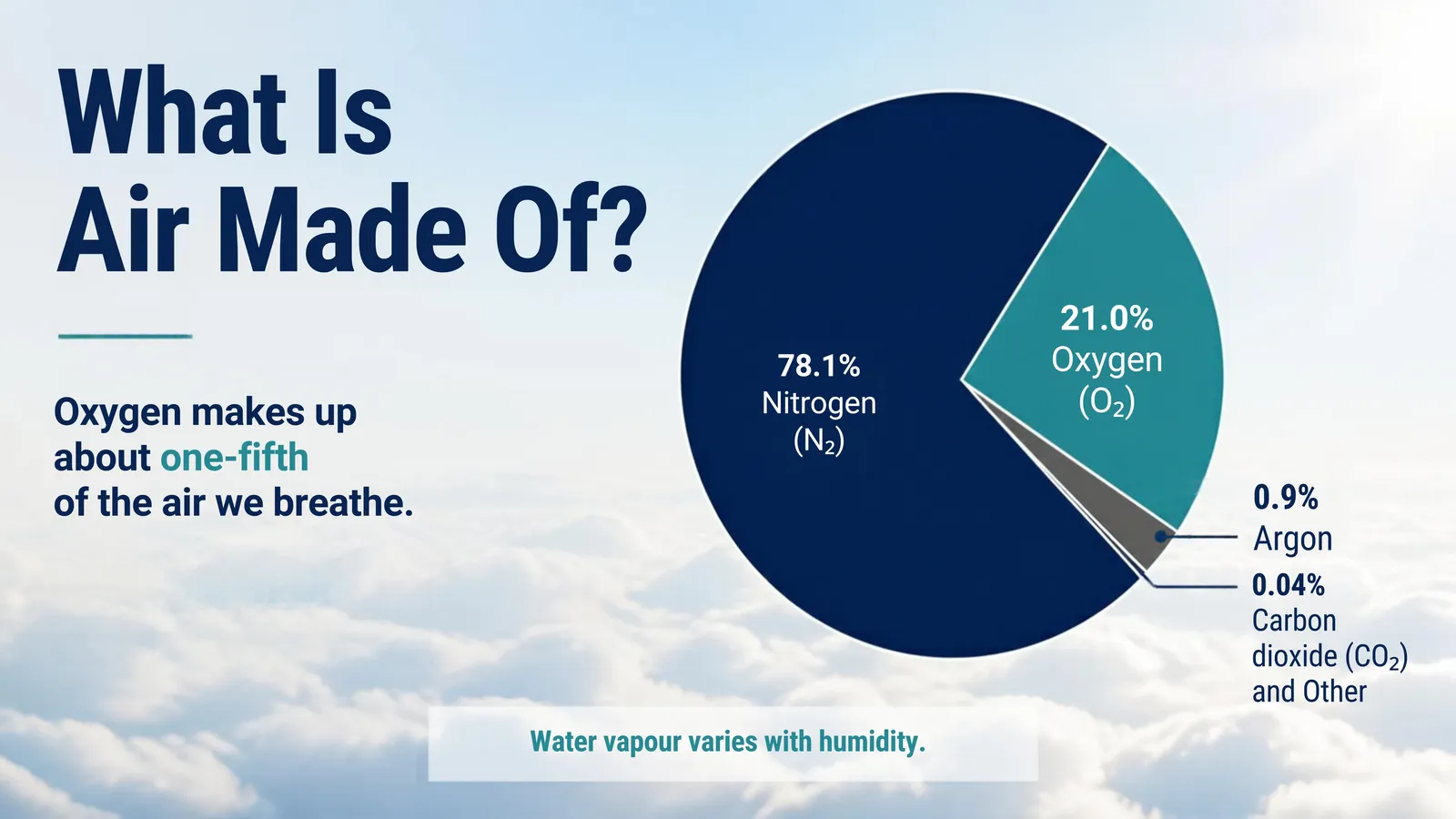
Air is not one substance; it is a mixture. Dry, unpolluted air is approximately 78.1% nitrogen (N2), 21.0% oxygen (O2), 0.9% argon, and 0.04% carbon dioxide (CO2), with tiny traces of other noble gases such as neon and krypton. Two figures matter most for this topic: oxygen makes up roughly one-fifth (1/5) of the air, and carbon dioxide, although tiny in percentage, is the gas whose level is rising steadily because of human activity.
Note: real air also contains water vapour (0-4%, depending on humidity) -- the 78/21/0.9/0.04 figures apply specifically to dry, unpolluted air.
Slide: What is air made of?
Composition of dry air
1/1
Three Ways to Measure the 1/5 of Oxygen
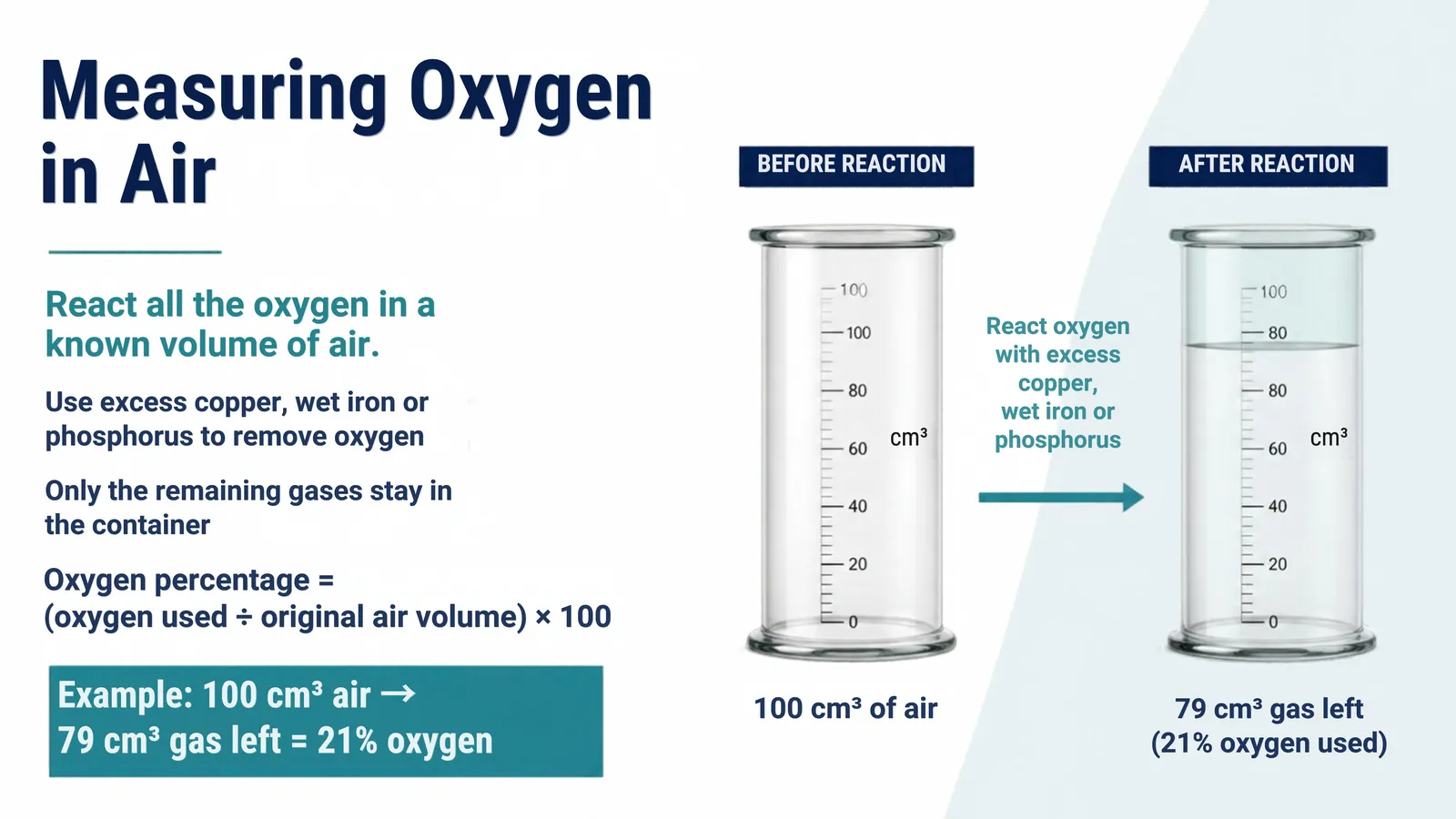
You cannot see oxygen disappearing, so every method used to measure its percentage in air relies on the same trick: react something with all the oxygen in a fixed volume of air, then measure how much the total gas volume shrinks.
Heated copper: air is passed back and forth over strongly heated copper filings in a silica tube using two connected gas syringes. Pink-brown copper turns black as copper(II) oxide forms (2Cu(s) + O2(g) → 2CuO(s)), and the gas volume stops falling once all the oxygen has reacted.
Rusting iron: wet iron filings are sealed in a flask connected to a gas syringe and left for about a week. Iron needs both oxygen and water to rust, so the trapped gas volume slowly falls as oxygen is used up, then levels off.
Burning phosphorus: phosphorus on a floating dish is ignited under a sealed bell jar standing in water. White phosphorus oxide smoke dissolves in the water, so the water level rises inside the jar as the oxygen is consumed.
In every case, percentage oxygen = (volume of oxygen used ÷ original volume of air) × 100, and the reacting substance -- copper, iron or phosphorus -- must be used in excess, so that every last trace of oxygen is guaranteed to react. A student measuring 100 cm3 of air with the copper method and ending with 79 cm3 has used 21 cm3 of oxygen: 21/100 × 100 = 21%, matching the accepted value almost exactly. A handy check at the end of any of these experiments: if a lit splint is lowered into the leftover gas, it goes out -- confirming what's left behind is mostly unreactive nitrogen.
Slide: Measuring oxygen in air
React all the oxygen, then measure the fall in volume
1/1
Combustion: How Elements Burn in Oxygen
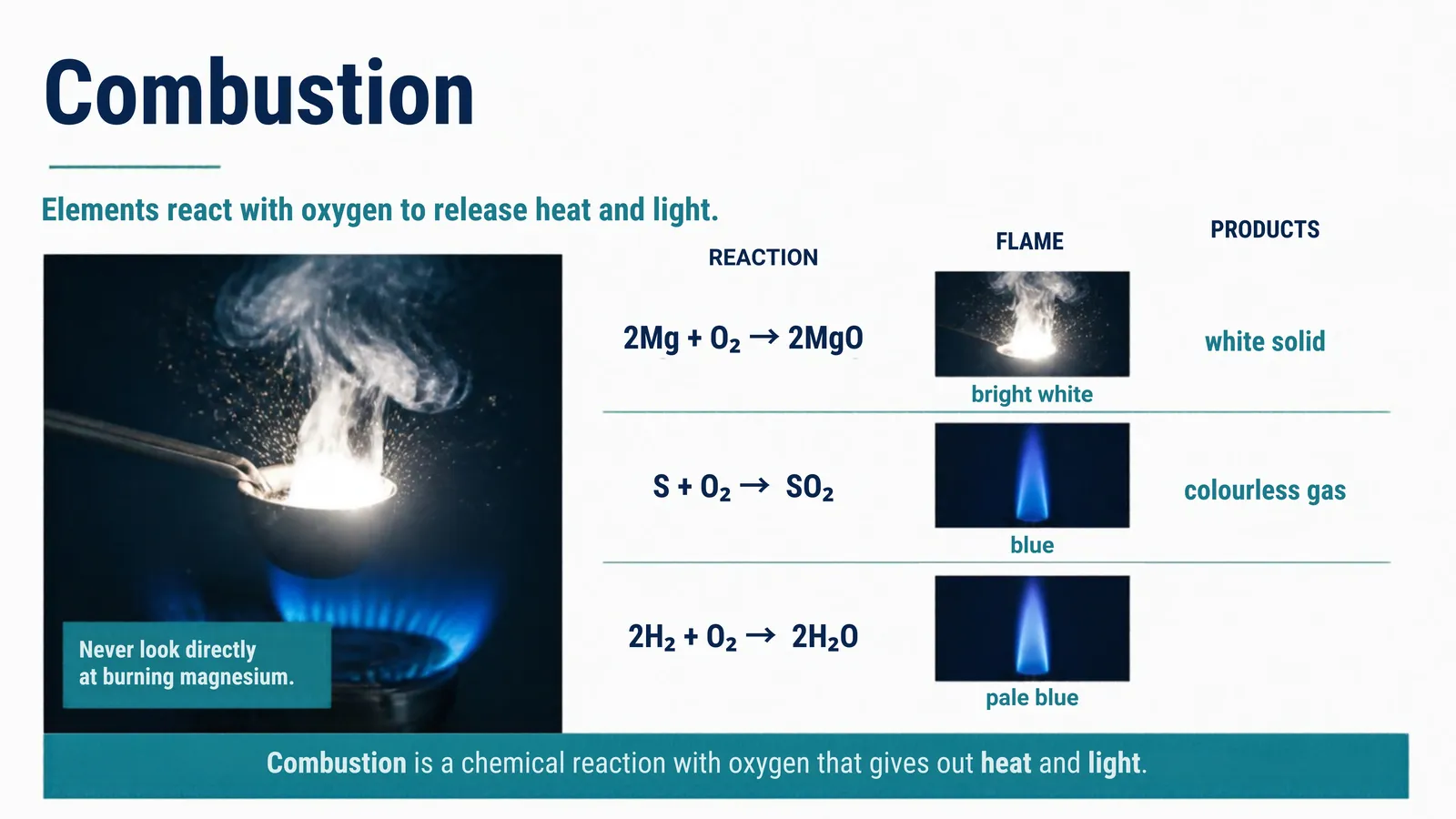
When an element burns in oxygen, it forms an oxide, following the general pattern element + oxygen → oxide. Because pure oxygen provides nearly five times as much oxygen as ordinary air, elements burn far more vigorously in a gas jar of pure oxygen than they do in the open air.
| Element | Flame colour | Product |
|---|---|---|
| Magnesium | Extremely bright white | White solid, MgO (2Mg(s) + O2(g) → 2MgO(s)) |
| Sulfur | Blue | Colourless gas, SO2 (S(s) + O2(g) → SO2(g)) |
| Hydrogen | Pale blue | Water, H2O (2H2(g) + O2(g) → 2H2O(l)) |
Two safety-flavoured facts are worth learning alongside the table. Never look directly at burning magnesium -- the intense white light can damage your eyes. And sulfur dioxide dissolves in water to form sulfurous acid, H2SO3 (not sulfuric acid, H2SO4, which is one of the most common exam mix-ups in this whole topic).
Slide: Combustion
Flame colours and products
1/1
Metal Oxides vs Non-Metal Oxides
The oxide formed depends heavily on whether the burning element is a metal or a non-metal. Metal oxides are ionic, generally basic, and usually insoluble (though the few that do dissolve, like MgO, give a weakly alkaline solution). Non-metal oxides are covalent, generally acidic, and often soluble, forming acidic solutions -- sulfur dioxide forming sulfurous acid, and carbon dioxide forming a weakly acidic solution, are both examples of exactly this pattern.
Thermal Decomposition of Carbonates
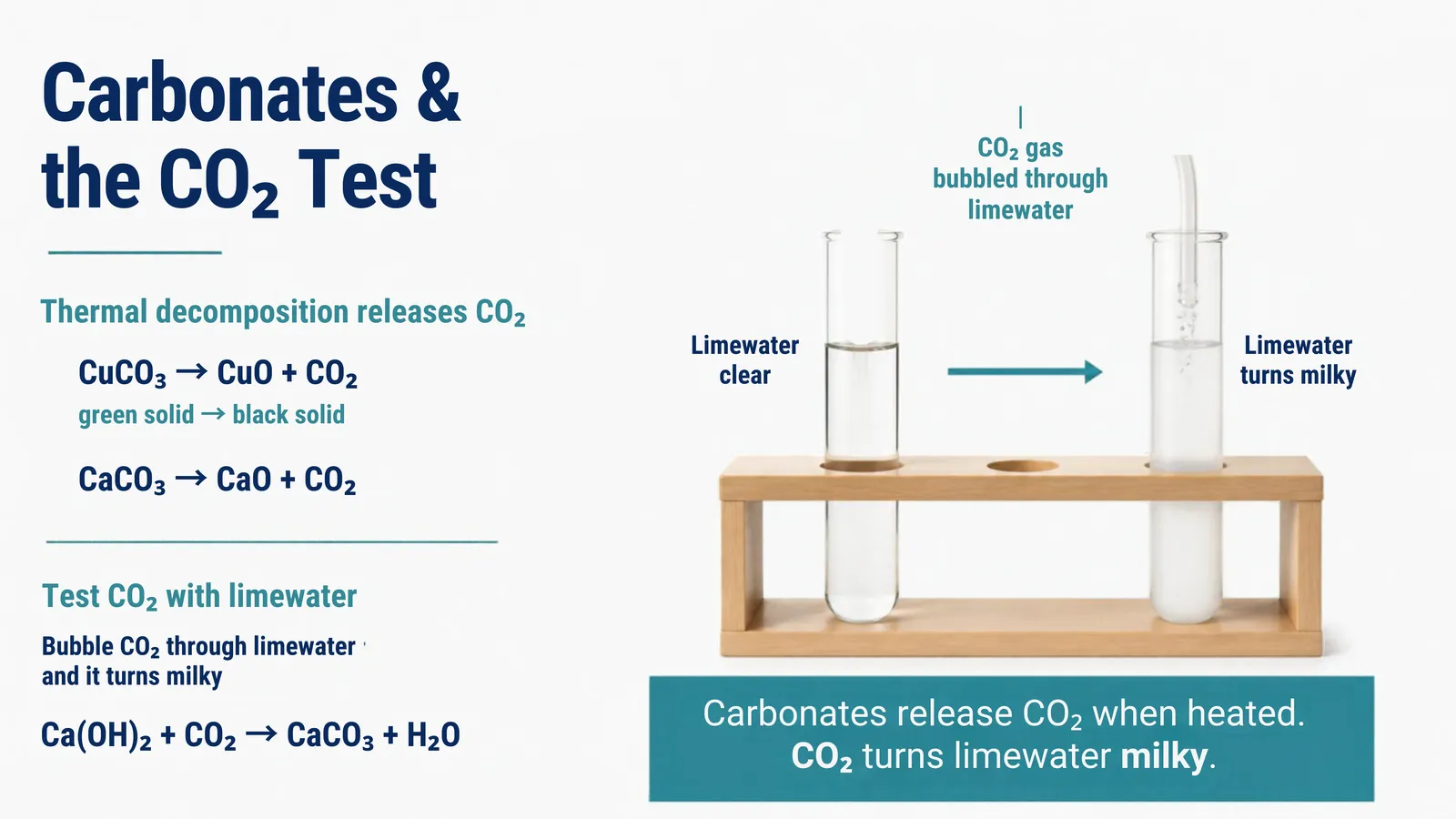
Thermal decomposition means breaking a substance apart using heat alone, and most metal carbonates decompose this way into a metal oxide and carbon dioxide: metal carbonate → metal oxide + carbon dioxide. Calcium carbonate (limestone) needs very high temperatures, but converting it into calcium oxide (quicklime) is a commercially important reaction: CaCO3(s) → CaO(s) + CO2(g).
A favourite exam example is copper(II) carbonate: a green powder that decomposes on heating into black copper(II) oxide and carbon dioxide -- CuCO3(s) → CuO(s) + CO2(g). Not every carbonate behaves the same way, though: sodium carbonate is so thermally stable that it barely decomposes at typical Bunsen burner temperatures, releasing almost no gas at all under the same conditions that fully decompose copper(II) carbonate.
Whatever the source, the gas released is confirmed using the standard test for carbon dioxide: bubble it through limewater (a solution of calcium hydroxide). If CO2 is present, the limewater turns from colourless to cloudy/milky, because the gas reacts with the dissolved calcium hydroxide to form insoluble calcium carbonate -- Ca(OH)2(aq) + CO2(g) → CaCO3(s) + H2O(l).
Slide: Carbonates and the CO2 test
Heat the carbonate, test the gas
1/1
Why CO2 Is a Greenhouse Gas (and N2 and O2 Are Not)
High-energy radiation from the Sun passes through the atmosphere and warms the Earth's surface. The warm surface then radiates energy back out as infrared (IR) radiation. A greenhouse gas is one that can absorb this IR radiation and re-emit it in all directions, including back down towards the surface -- warming the atmosphere. Without any greenhouse gases at all, the planet would be far too cold for liquid water to exist; the problem is having too much of them.
Whether a molecule can absorb IR radiation comes down to polarity. A molecule is polar if one end is slightly negative and the other slightly positive, and this can change as the molecule vibrates. Carbon dioxide is normally linear and symmetrical (O=C=O), so its two bond dipoles cancel out and the molecule is non-polar overall -- but as it vibrates, it briefly becomes asymmetrical and polar, which lets it absorb IR radiation. Nitrogen (N2) and oxygen (O2), by contrast, are each made of two identical atoms. Their bonding electrons are attracted equally by both atoms at every point in the vibration, so there is never a dipole and they cannot absorb IR at all -- which is exactly why N2 and O2, despite making up 99% of the air, are not greenhouse gases.
Slide: CO2 and the greenhouse effect
How infrared radiation is absorbed and re-emitted
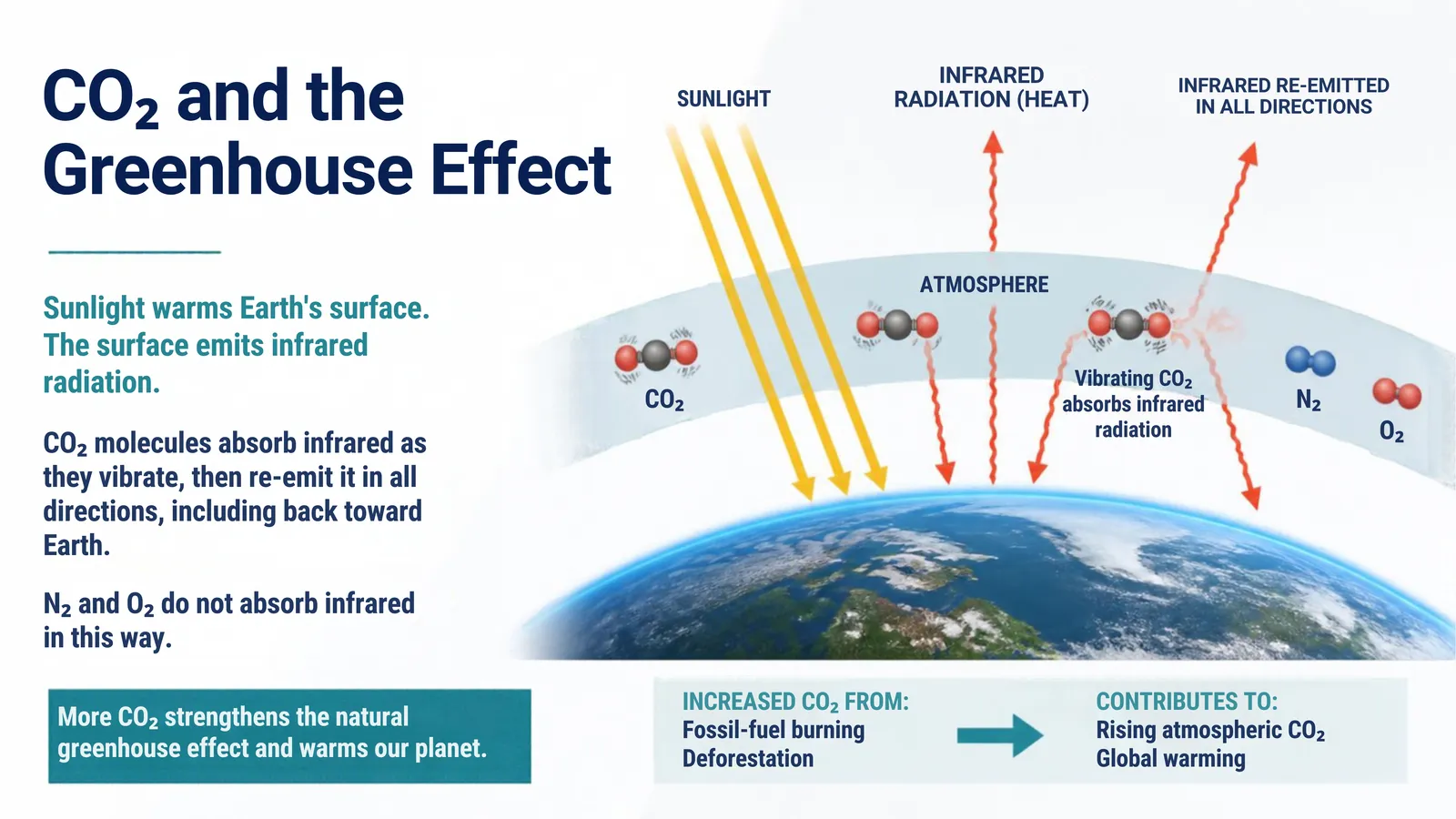
1/1
Climate Change and Rising CO2 Levels
For roughly the last 200 years -- since the industrial revolution -- the level of CO2 in the atmosphere has been rising, driven mainly by burning fossil fuels (coal, oil and gas) and by deforestation. Burning coal (mostly carbon) produces CO2 directly: C(s) + O2(g) → CO2(g); burning petrol, a mixture of hydrocarbons, does the same on a larger scale, for example 2C8H18(l) + 25O2(g) → 16CO2(g) + 18H2O(l). Many scientists believe the resulting rise in CO2 contributes to climate change, with possible effects including melting polar ice caps, rising sea levels, and more extreme weather. It is worth knowing, for a balanced exam answer, that some scientists argue part of 20th-century warming reflects natural cycles too -- but the consensus link between rising CO2 and a warming atmosphere is well established.
Gases in the Atmosphere: Frequently Asked Questions
What percentage of the air is oxygen?
About 21%, or roughly one-fifth. This can be confirmed experimentally by reacting all the oxygen in a known volume of air with excess copper, iron or phosphorus and measuring the fall in gas volume.
Why must the reactant be in excess when measuring oxygen in air?
Using an excess of copper, iron or phosphorus guarantees that every trace of oxygen in the sample has reacted. If the reactant ran out first, some oxygen would be left unreacted and the calculated percentage would come out too low.
Why is carbon dioxide a greenhouse gas but nitrogen and oxygen are not?
Carbon dioxide's shape briefly becomes asymmetrical and polar as it vibrates, which lets it absorb and re-emit infrared radiation. Nitrogen and oxygen molecules are each made of two identical atoms, so their bonds never become polar, and they cannot absorb infrared radiation at all.
Key Takeaways
Dry air is about 78% N2, 21% O2, 0.9% argon and 0.04% CO2; oxygen's ~1/5 share can be measured using copper, iron or phosphorus, each used in excess.
Elements burn in oxygen to form oxides: Mg gives a bright white flame and white MgO; S gives a blue flame and SO2; H2 gives a pale blue flame and water.
Metal oxides are ionic and basic; non-metal oxides are covalent and acidic.
Metal carbonates thermally decompose into a metal oxide and CO2; the gas is confirmed with limewater, which turns cloudy.
CO2 is a greenhouse gas because its polarity changes as it vibrates, letting it absorb infrared radiation; N2 and O2 cannot do this.
Want more practice? Download the Science A Plus Edu Gases in the Atmosphere Revision Notebook, with 25 pages of notes, diagrams and revision activities, and read our companion guide to the Reactivity Series to see how these same combustion and displacement ideas connect across the whole Inorganic Chemistry unit.
🗂️ Revision Flashcards
Tap a card to reveal the answer.
🎯 Quick Quiz
8 questions. Pick an answer to check it straight away.
1Approximately what percentage of dry air is oxygen?
Dry air is about 21.0% oxygen, roughly one-fifth.
2A student starts with 100 cm³ of air and ends with 79 cm³ after the copper method. What is the percentage of oxygen?
21 cm³ of oxygen was used: 21/100 × 100 = 21%.
3Why must the copper, iron or phosphorus be used in excess?
If the reactant ran out first, oxygen would be left and the percentage would come out too low.
4What is formed when sulfur burns in oxygen, and what does it form in water?
Sulfur gives colourless SO₂, which dissolves to form sulfurous acid, not sulfuric acid.
5Which statement about oxides is correct?
Metal oxides are ionic and generally basic; non-metal oxides are covalent and generally acidic.
6What are the products of heating copper(II) carbonate?
Green CuCO₃ decomposes to black CuO and CO₂.
7What happens to limewater when carbon dioxide is bubbled through it?
CO₂ reacts with calcium hydroxide to form insoluble calcium carbonate.
8Why can N₂ and O₂ not act as greenhouse gases?
Their bonding electrons are shared equally at every point in the vibration, so they cannot absorb IR.