This lesson is specially designed for international curricula, such as GCSE, CBSE, and AP Physics.
This blog includes interactive experiences to identify these ideas for better understanding, with activity sheets and easy-to-follow illustrations that you can turn into memory cards.
🌊 What is a Wave?
Understanding how energy travels without transferring matter
A wave is a disturbance that transfers energy (and sometimes information) from one place to another without transferring matter permanently. Waves appear in many forms — ripples on water, sound in air, and light across space.
Two broad categories are mechanical waves (which need a medium) and electromagnetic waves (which do not need a medium).
Important Ideas:
- Waves transport energy, not mass (the medium's particles only oscillate locally)
- Waves are described by properties such as amplitude, wavelength, frequency and speed
- The wave equation relates these properties: v = f × λ (speed = frequency × wavelength)
⚡ Types of Waves
Mechanical waves vs Electromagnetic waves
Mechanical vs Electromagnetic Waves
Mechanical Waves
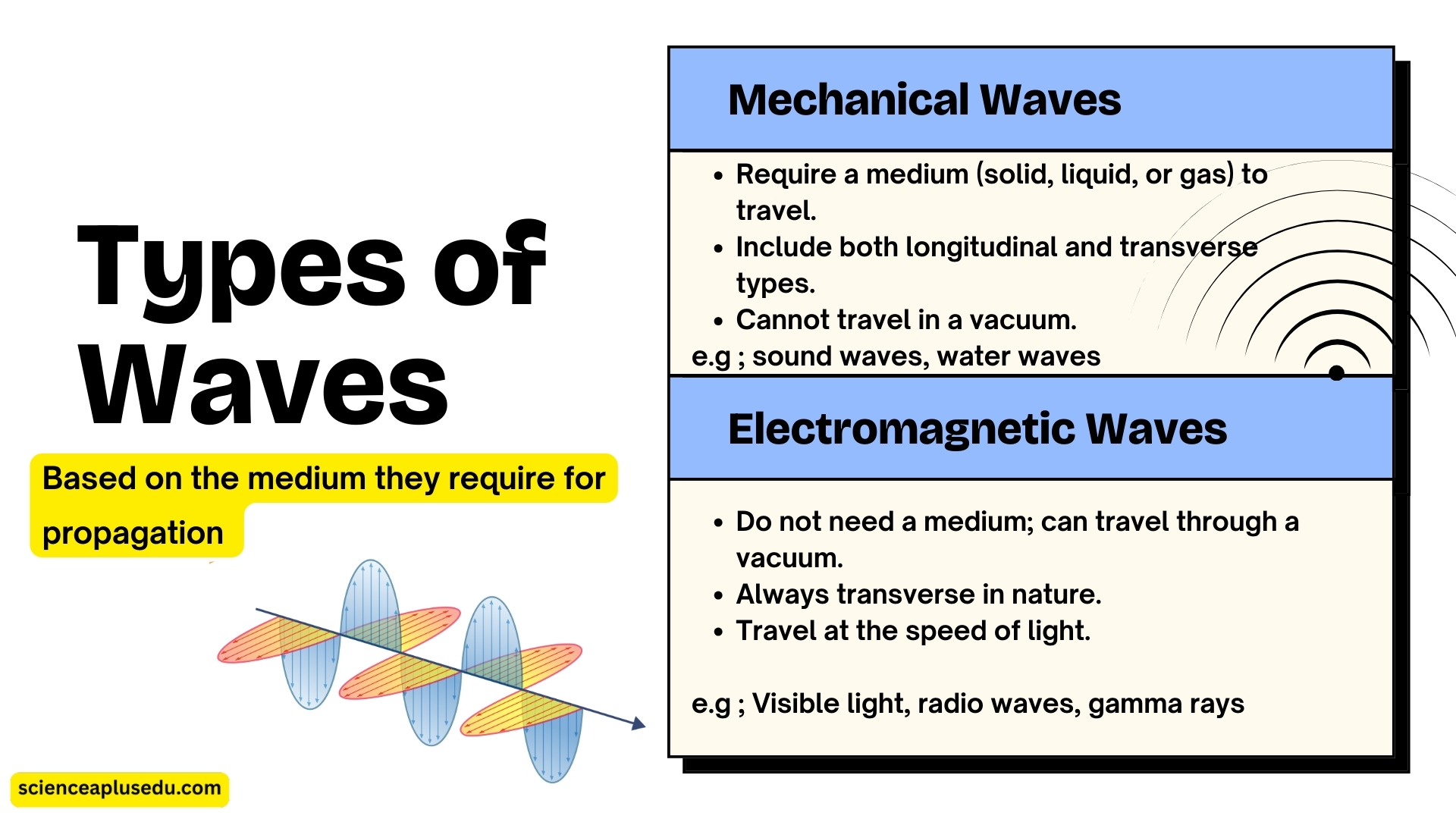
- Require a medium (solid, liquid or gas) to travel through
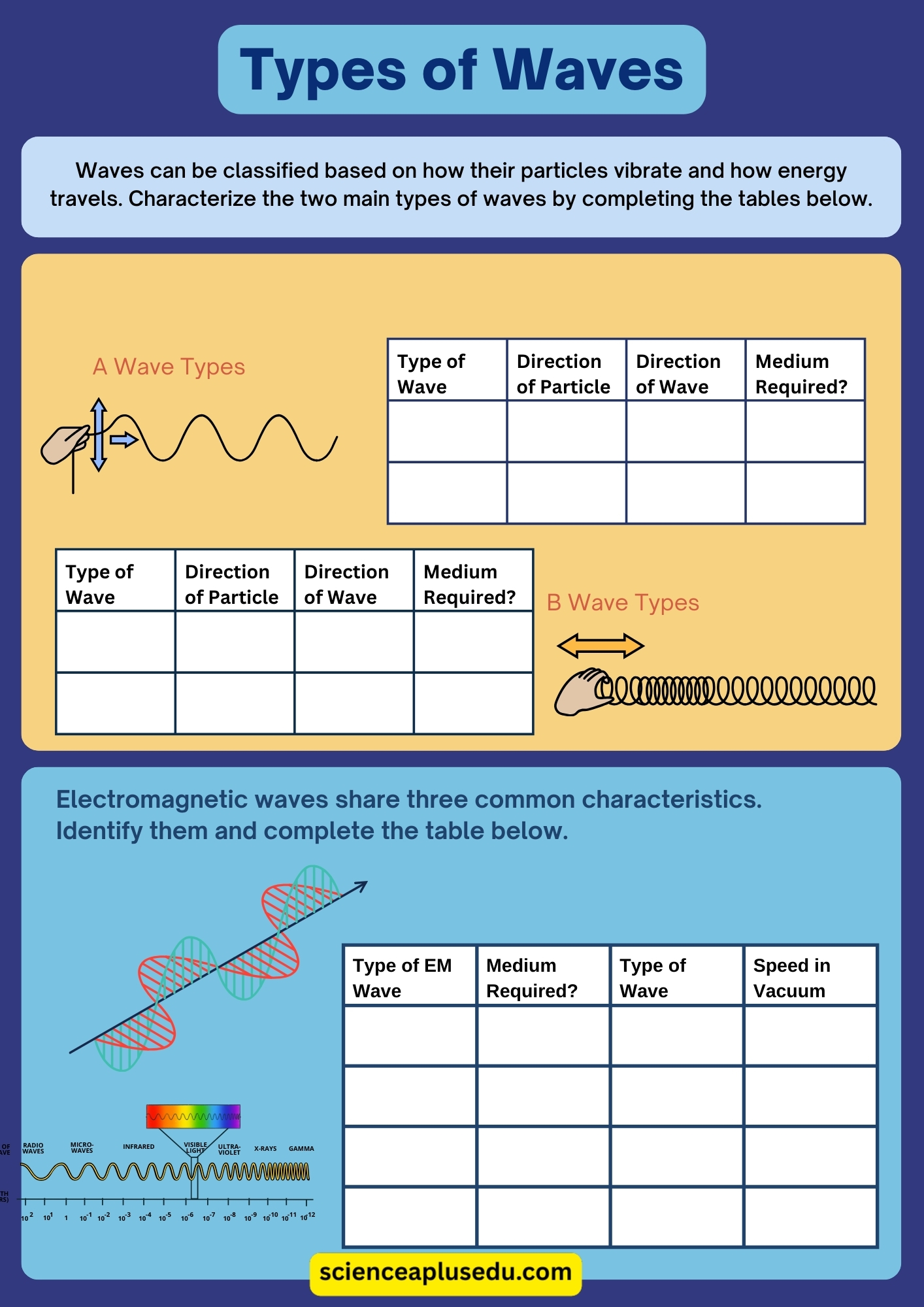
- Can be transverse (e.g., waves on a string) or longitudinal (e.g., sound waves in air)
- Cannot travel in a vacuum
- Examples: sound waves, water waves, seismic waves
Electromagnetic Waves
- Do not require a medium (can travel through a vacuum)
- Always transverse (electric and magnetic fields oscillate perpendicular to propagation)
- Travel at the speed of light (3 × 10⁸ m/s in vacuum)
- Examples: radio waves, microwaves, infrared, visible light, ultraviolet, X-rays, gamma rays
Comparison: Mechanical vs Electromagnetic Waves
| Property | Mechanical Waves | Electromagnetic Waves |
|---|---|---|
| Medium Required | Yes (solid, liquid, or gas) | No (can travel through vacuum) |
| Type | Transverse or Longitudinal | Always Transverse |
| Speed in Vacuum | Cannot travel in vacuum | 3 × 10⁸ m/s (speed of light) |
| Examples | Sound, water waves, seismic waves | Light, radio, X-rays, microwaves |
↔️ Transverse & Longitudinal Waves
Based on particle motion relative to wave direction
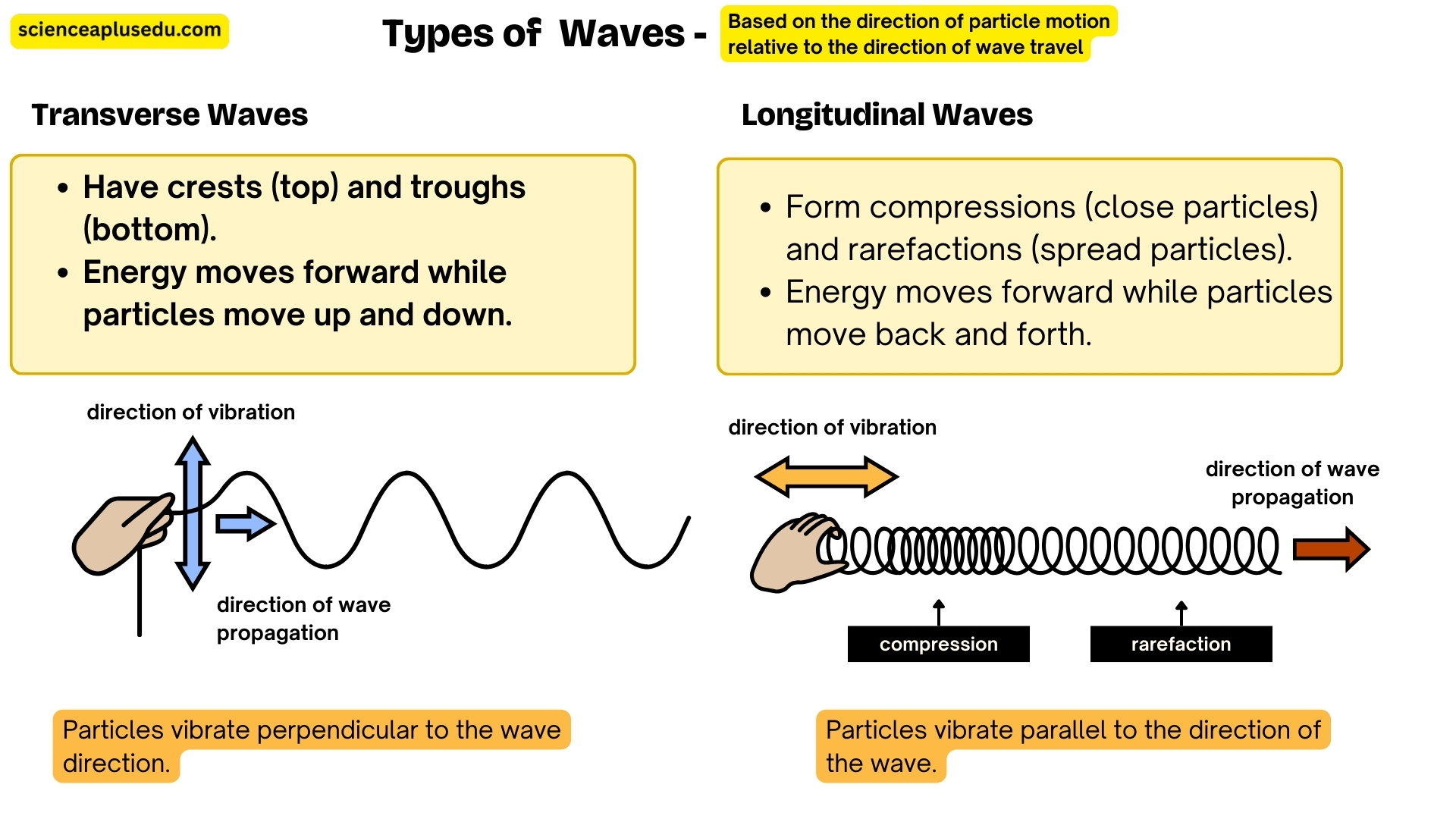
Transverse Waves
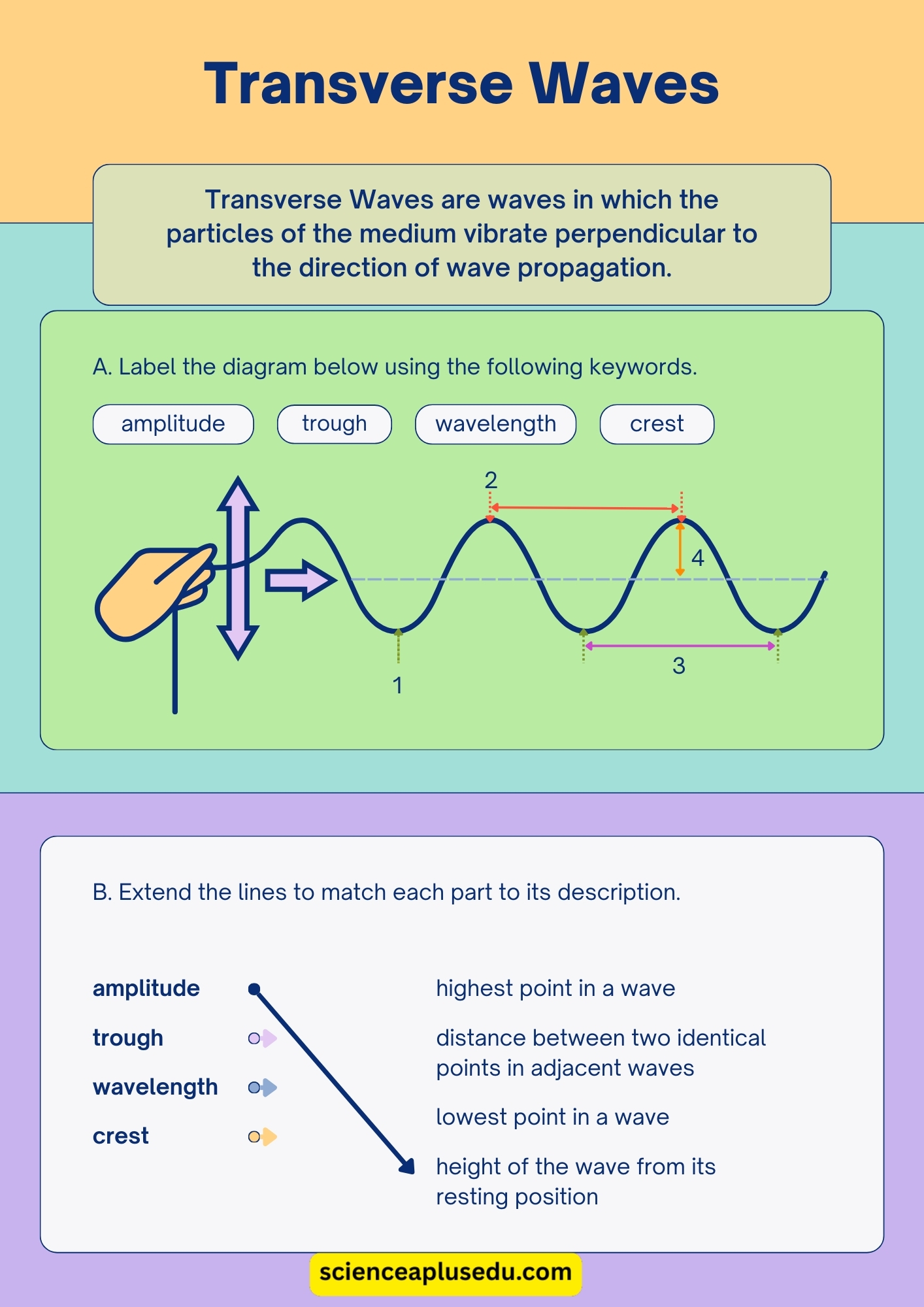
- Particles oscillate perpendicular to the direction the wave travels
- Have crests (highest points) and troughs (lowest points)
- Energy moves forward while particles move up and down
- Examples: water waves, light waves, waves on a string
Longitudinal Waves
- Particles oscillate parallel to the direction the wave travels
- Form compressions (close particles) and rarefactions (spread particles)
- Energy moves forward while particles move back and forth
- Examples: sound waves in air, pressure waves
📏 Wavelength & Frequency
Key properties for describing waves
Parts of a Wave
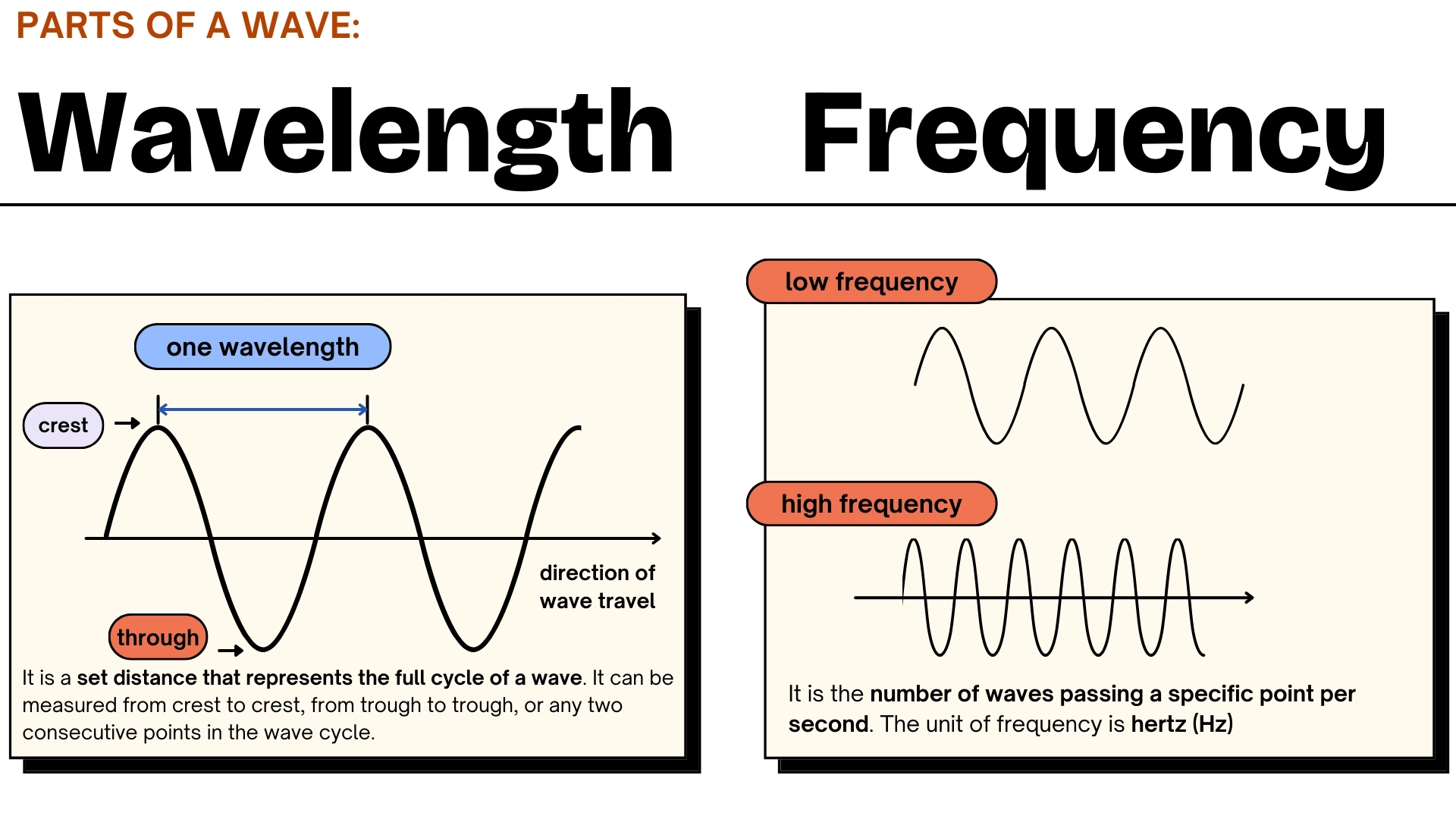
Wavelength (λ)
- The distance between two successive corresponding points on a wave
- Can be measured crest-to-crest or trough-to-trough
- Measured in metres (m)
- Represents one complete cycle of the wave
Frequency (f)
- The number of complete waves (cycles) passing a fixed point per second
- Measured in hertz (Hz) — 1 Hz = 1 wave per second
- Higher frequency = more waves per second = shorter wavelength
Other Wave Properties
- Amplitude: the height of the wave from its resting position (relates to energy)
- Crest: the highest point in a transverse wave
- Trough: the lowest point in a transverse wave
- Period (T): time for one complete wave cycle, T = 1/f
The Wave Equation
The relationship between wave speed, frequency and wavelength is given by:
v = f × λ
Wave Speed (m/s) = Frequency (Hz) × Wavelength (m)
Wave Equation Variables
| Symbol | Quantity | Unit | Description |
|---|---|---|---|
| v | Wave speed | m/s (metres per second) | How fast the wave travels |
| f | Frequency | Hz (hertz) | Number of waves per second |
| λ | Wavelength | m (metres) | Distance of one complete wave |
🌈 The Electromagnetic Spectrum
All types of electromagnetic radiation arranged by wavelength and frequency
What is the Electromagnetic Spectrum?
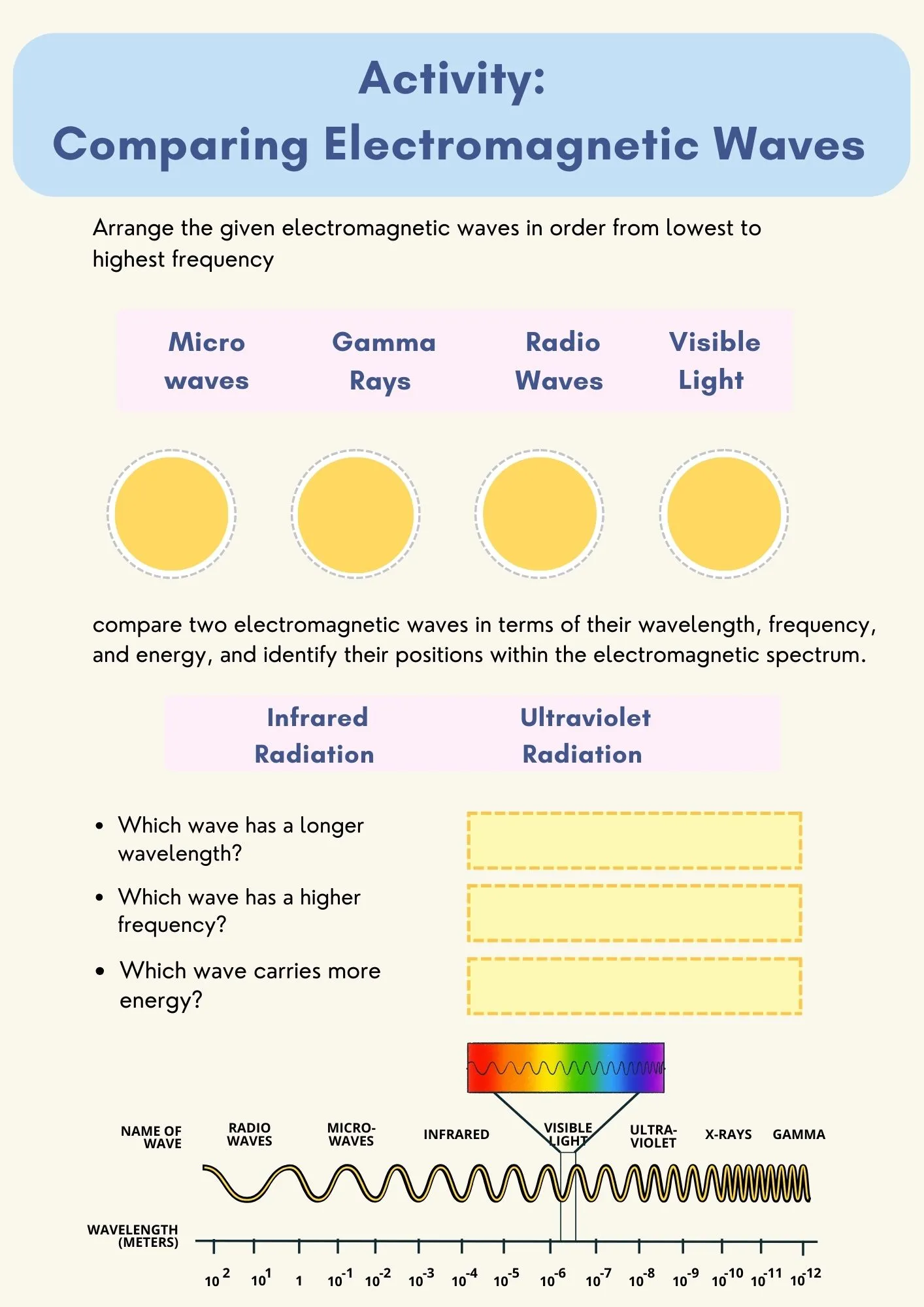
The electromagnetic spectrum is the range of all types of electromagnetic radiation, classified by wavelength, frequency, and energy. It arranges waves from longest wavelength / lowest frequency (radio) to shortest wavelength / highest frequency (gamma rays).
All electromagnetic waves travel at the speed of light (3 × 10⁸ m/s) in a vacuum. Each region has different applications and interactions with matter.
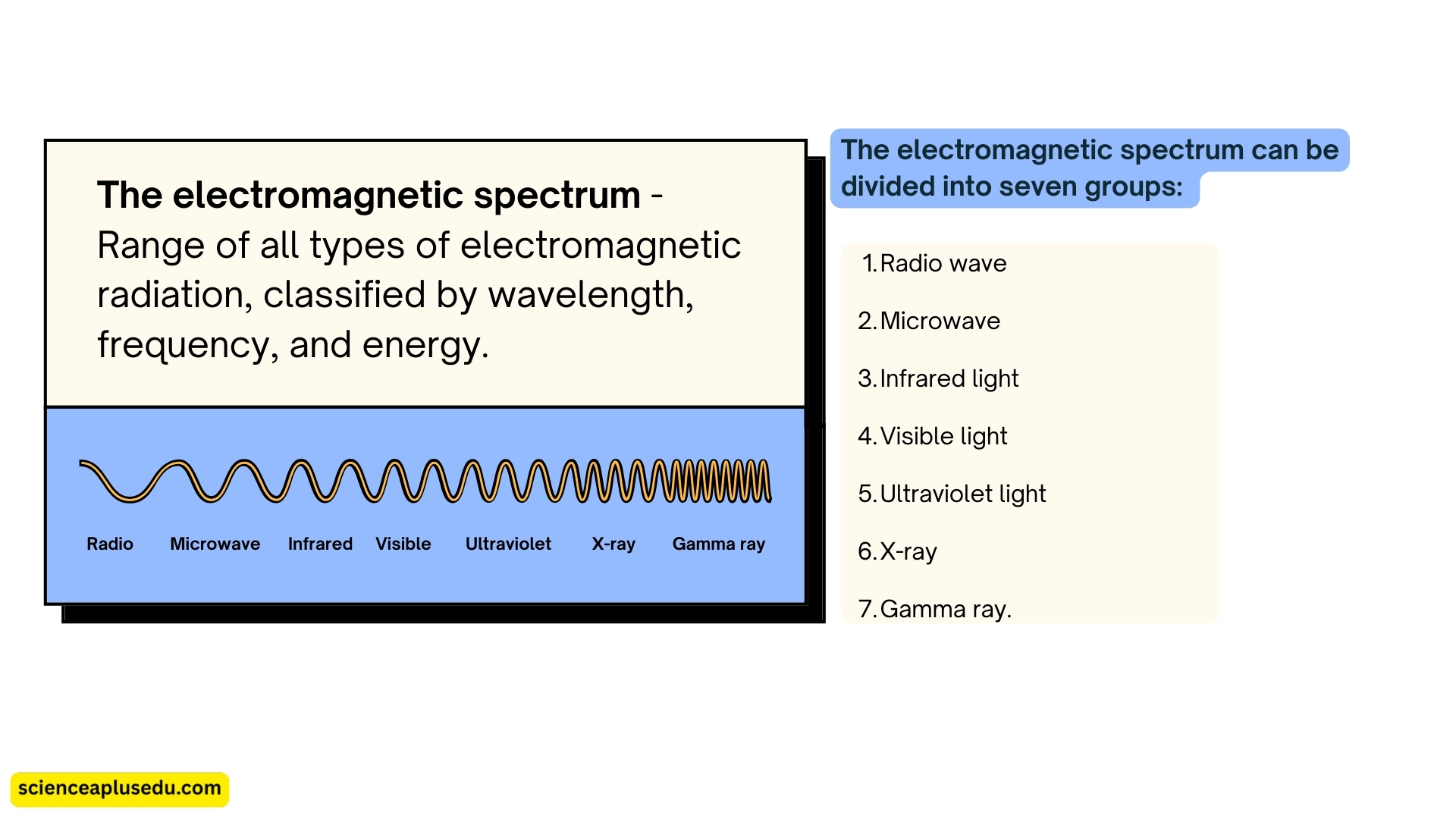
The Seven Types of Electromagnetic Waves
1. Radio Waves (Longest Wavelength)
- Have the longest wavelengths (can be several kilometres long)
- Used for broadcasting (radio and TV) and communications
- Widely used for long-distance transmission
- Low energy, low frequency
2. Microwaves
- Shorter than radio waves, wavelengths from millimetres to centimetres
- Used in cooking (microwave ovens) and radar communications
- Interact easily with water molecules, causing heating
- Used in satellite communications and mobile phones
3. Infrared
- Felt as heat — sits just beyond visible red light
- Used in remote controls and thermal imaging
- Night vision cameras detect infrared radiation
- Used in heating applications and fibre optic communications
4. Visible Light
- The only part of the spectrum we can see
- Different wavelengths produce different colours (Red → Violet)
- Red has the longest wavelength, violet has the shortest
- Essential for vision, photography, and plant photosynthesis
5. Ultraviolet (UV)
- Has shorter wavelengths than visible light
- Can cause chemical changes (sunburn, skin damage)
- Used in sterilisation and fluorescence applications
- Helps the body produce Vitamin D
6. X-rays
- High-energy waves that penetrate soft tissues
- Absorbed by denser materials like bone and metal
- Used in medical imaging and security scanning
- Can be harmful with prolonged exposure
7. Gamma Rays (Shortest Wavelength)
- Have the highest energies and shortest wavelengths
- Produced by nuclear processes and radioactive decay
- Used in cancer treatment (radiotherapy) and sterilisation
- Very penetrating and potentially harmful
The Electromagnetic Spectrum Summary
| Type of Wave | Wavelength Range | Main Uses | Produced By |
|---|---|---|---|
| Radio Waves | > 1 m (up to km) | TV, radio broadcasting, communications | Oscillating electric currents |
| Microwaves | 1 mm – 1 m | Cooking, radar, mobile phones, satellites | Electronic devices |
| Infrared | 700 nm – 1 mm | Heating, remote controls, thermal imaging | Warm objects |
| Visible Light | 400 – 700 nm | Vision, photography, photosynthesis | Very hot objects, LEDs |
| Ultraviolet | 10 – 400 nm | Sterilisation, tanning, fluorescent lamps | The Sun, UV lamps |
| X-rays | 0.01 – 10 nm | Medical imaging, security scanning | X-ray tubes |
| Gamma Rays | < 0.01 nm | Cancer treatment, sterilisation | Radioactive decay, nuclear reactions |
👁️ Visible Light
The narrow portion of the spectrum humans can see
Understanding Visible Light
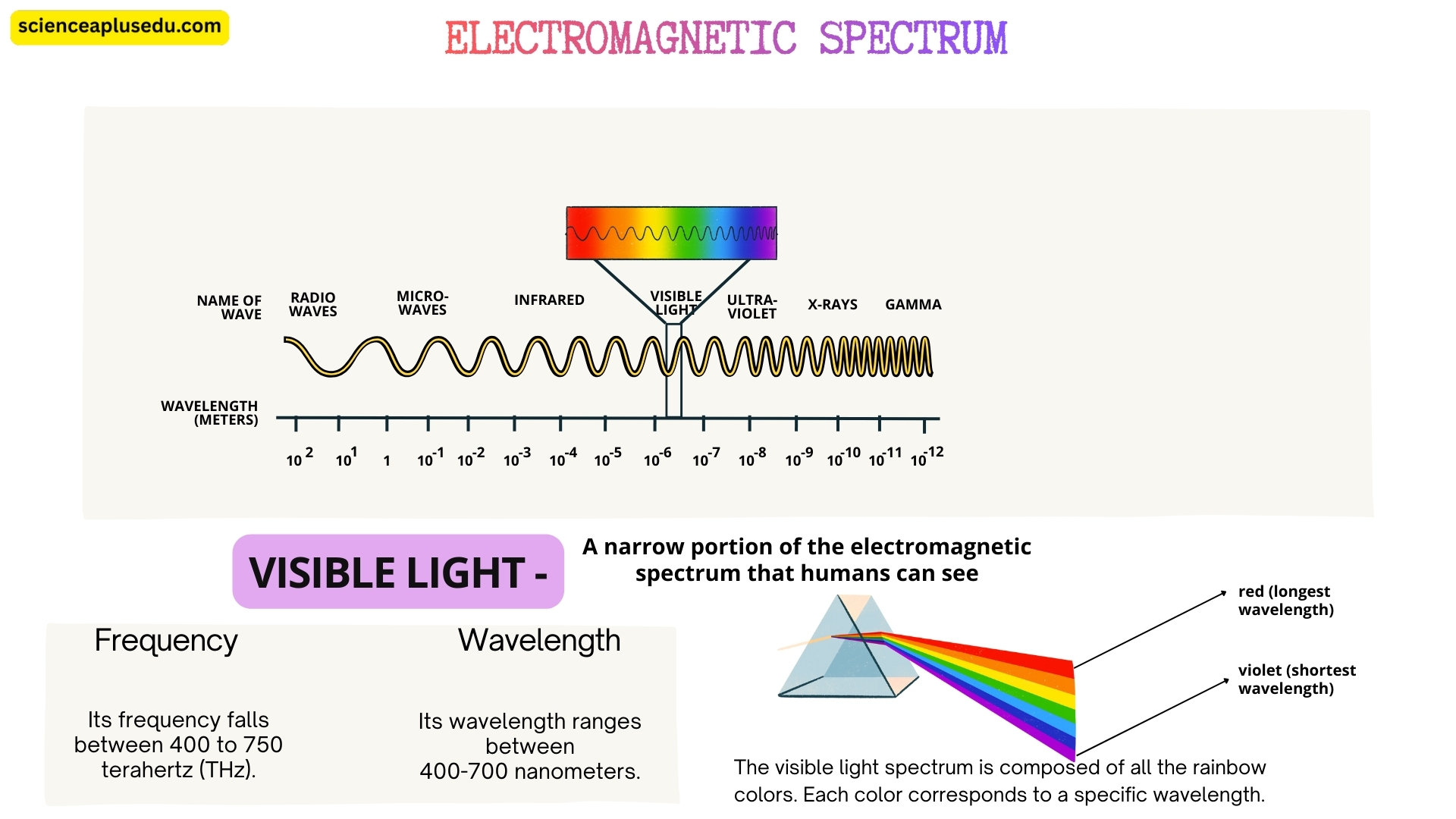
Visible light is a narrow portion of the electromagnetic spectrum that humans can see. It represents the colours of the rainbow, with each colour corresponding to a specific wavelength.
Key Facts About Visible Light
- Wavelength range: 400-700 nanometres (nm)
- Frequency range: 400-750 terahertz (THz)
- Red light has the longest wavelength (~700 nm) and lowest frequency
- Violet light has the shortest wavelength (~400 nm) and highest frequency
- White light is a mixture of all visible colours
- A prism separates white light into its component colours (dispersion)
The Colour Spectrum (ROYGBIV)
- Red – Longest wavelength (~700 nm)
- Orange – ~620 nm
- Yellow – ~580 nm
- Green – ~530 nm
- Blue – ~470 nm
- Indigo – ~450 nm
- Violet – Shortest wavelength (~400 nm)
Key Relationships in the EM Spectrum
Wavelength, Frequency and Energy
| As you move from Radio to Gamma... | What Happens? |
|---|---|
| Wavelength | Decreases (gets shorter) |
| Frequency | Increases (more waves per second) |
| Energy | Increases (more energetic) |
| Penetrating Power | Increases (passes through more materials) |
Remember: Wavelength and frequency are inversely proportional — as one increases, the other decreases. This is because all EM waves travel at the same speed (speed of light) in a vacuum.