A lemon (pH 2) and an oven cleaner (pH 13) sit at almost opposite ends of the same scale, and yet the chemistry that puts them there is exactly the same idea, viewed from two directions. This guide covers the pH scale, what makes a solution acidic or alkaline at the level of ions, the four indicators you need to know, and how neutralisation cancels an acid and an alkali out to leave nothing more exciting than salt and water.
📖 Lesson
The pH scale, hydrogen and hydroxide ions, four indicators and the ionic equation for neutralisation.
What Is the pH Scale?
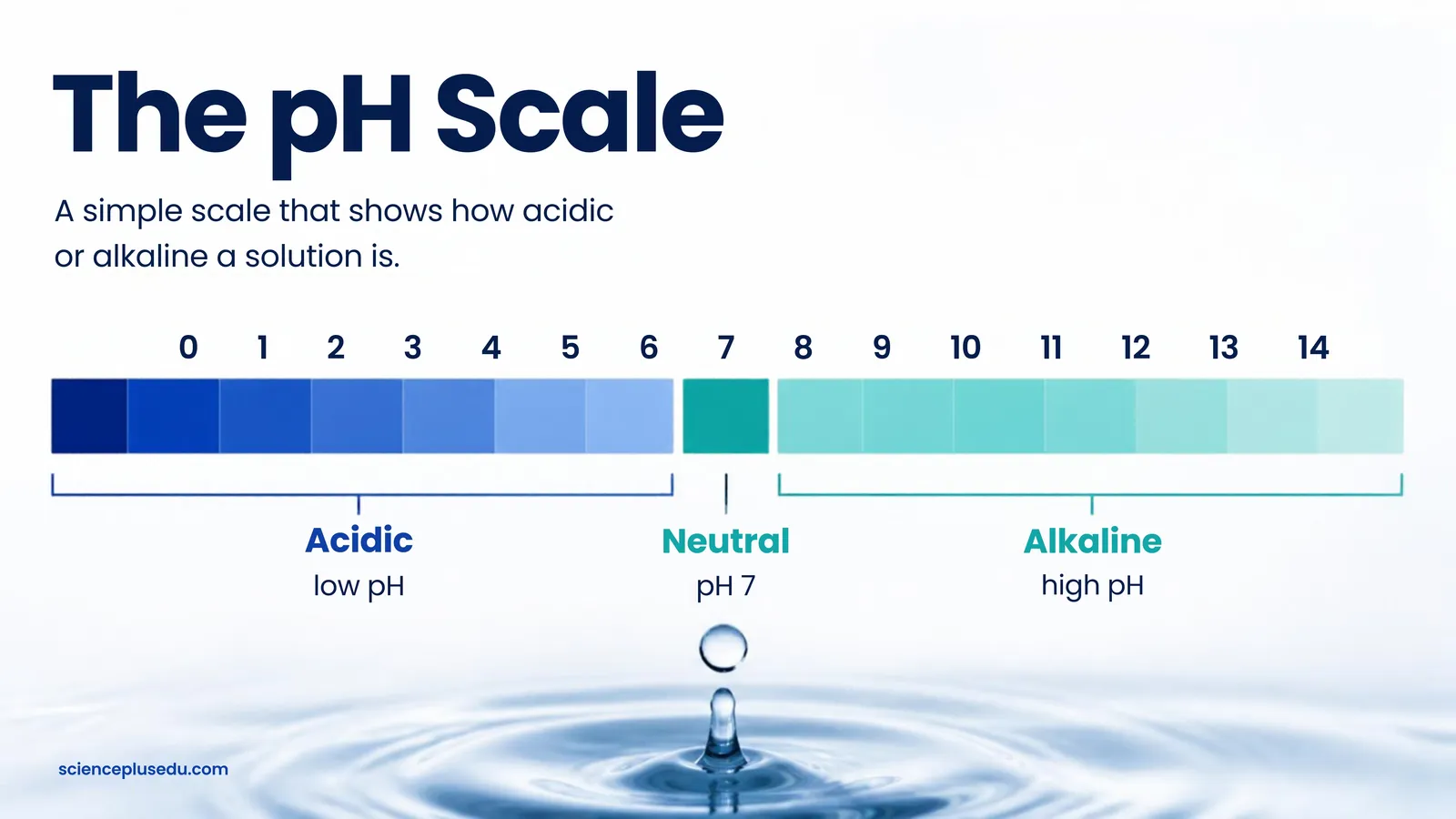
The pH scale runs from about 0 to 14 and tells you how acidic or how alkaline a solution is: the lower the pH, the more acidic; the higher the pH, the more alkaline. It splits neatly into five regions -- strongly acidic (0-3), weakly acidic (4-6), neutral (7), weakly alkaline (8-10), and strongly alkaline (11-14). What pH is really measuring is the concentration of hydrogen ions, H+, dissolved in the solution: a low pH means a high concentration of H+ ions, while a high pH means very few H+ ions (and, as you'll see below, far more OH- ions instead).
Slide: The pH scale
Acidic, neutral and alkaline regions
1/1
Acids: A Source of Hydrogen Ions
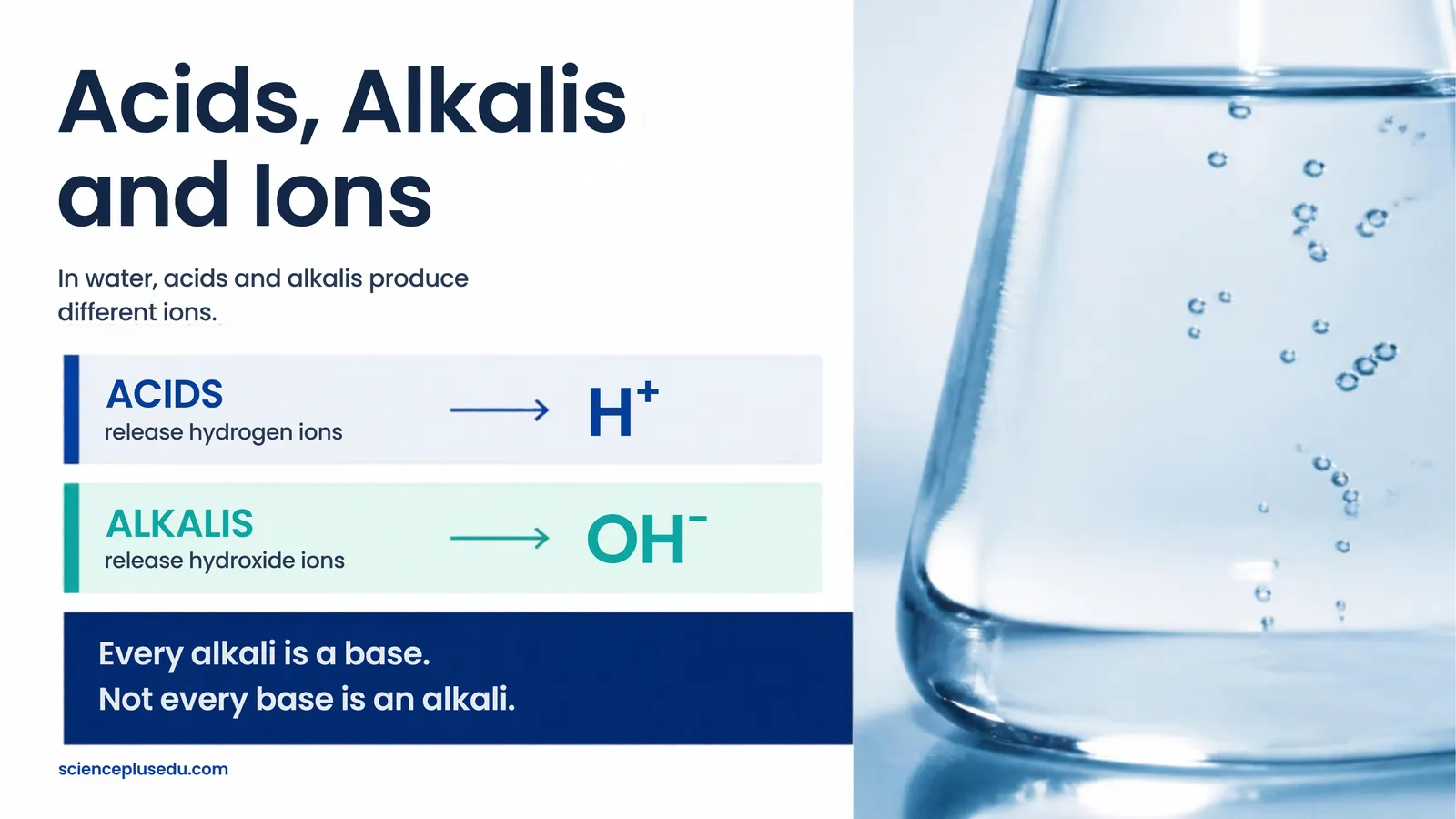
Every acid contains hydrogen, and when it dissolves in water it dissociates -- splits apart -- releasing hydrogen ions: HCl(aq) → H+(aq) + Cl-(aq). Sulfuric acid, H2SO4, has two replaceable hydrogens and releases two H+ ions per molecule: H2SO4(aq) → 2H+(aq) + SO42-(aq). The key definition to learn is that acids in aqueous solution are a source of hydrogen ions, H+ -- and the more H+ ions a solution contains, the lower its pH.
Slide: Acids and ions
Acids release H+, alkalis release OH-
1/1
Alkalis: A Source of Hydroxide Ions
Alkalis are the mirror image of acids: instead of releasing hydrogen ions, they release hydroxide ions, OH-, when dissolved in water. Sodium hydroxide splits apart completely: NaOH(aq) → Na+(aq) + OH-(aq). Ammonia, NH3, is slightly different -- it is a gas that reacts with water rather than simply dissociating, forming hydroxide ions this way: NH3(aq) + H2O(l) ⇌ NH4+(aq) + OH-(aq). Because only some of the ammonia reacts, ammonia solution is only weakly alkaline.
It is worth being precise about one distinction here: a base is any substance that can neutralise an acid (this includes metal oxides, metal hydroxides and ammonia), while an alkali is simply a base that is soluble and releases OH- ions when it dissolves. Every alkali is a base, but not every base is an alkali -- copper(II) oxide neutralises acids, so it is a base, but it does not dissolve in water, so it is not an alkali.
Four Indicators Compared
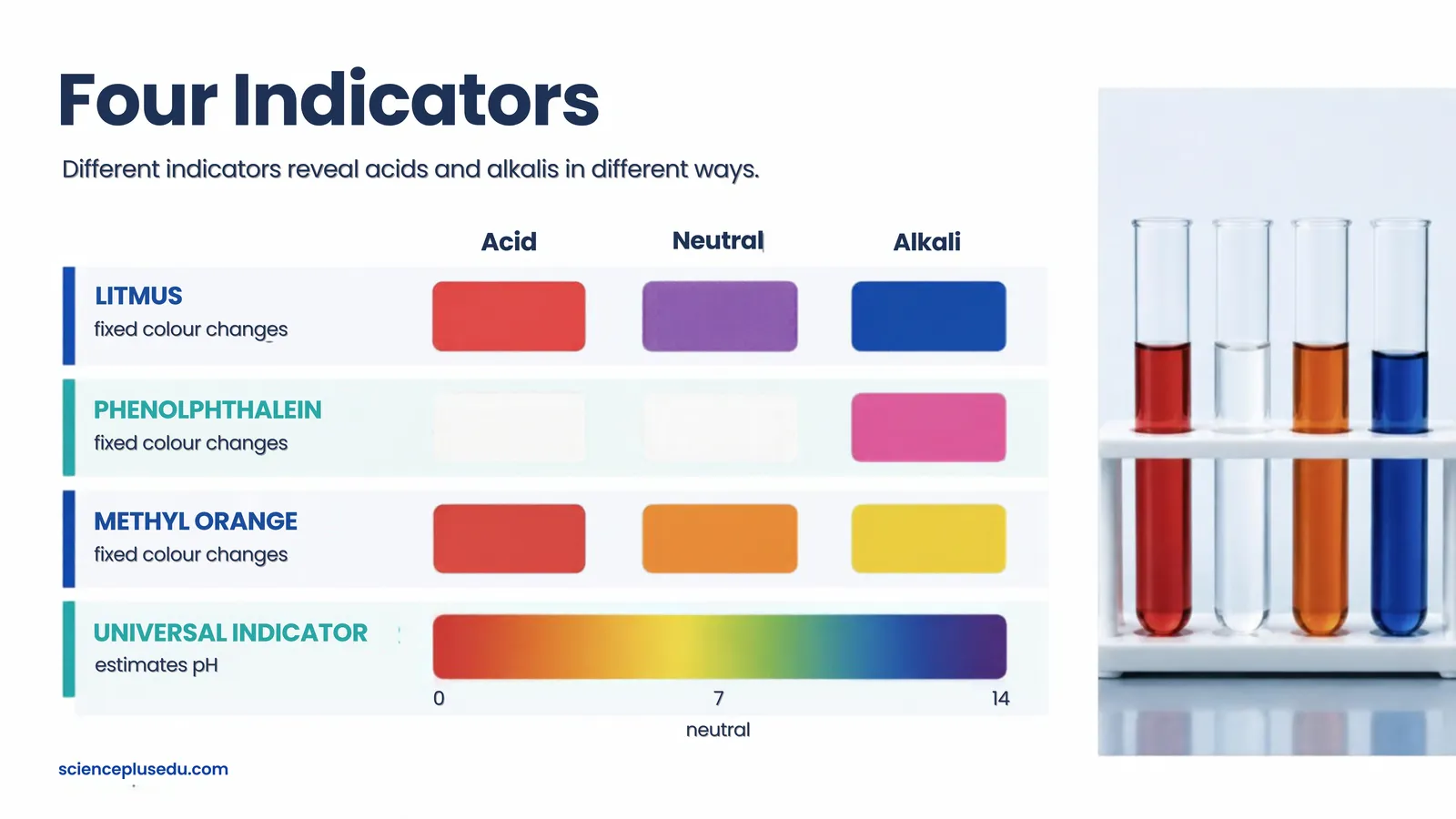
An indicator is a substance that changes colour depending on the pH of the solution it is added to. Three simple indicators each give a fixed colour on either side of neutral, while only universal indicator can estimate an actual pH value.
| Indicator | Acid | Neutral | Alkali | Gives a pH number? |
|---|---|---|---|---|
| Litmus | Red | Purple | Blue | No |
| Phenolphthalein | Colourless | Colourless | Pink | No |
| Methyl orange | Red | Orange | Yellow | No |
| Universal indicator | Red → yellow | Green | Blue → violet | Yes (approx.) |
Notice that phenolphthalein cannot tell an acid from a neutral solution -- both look colourless, and it only turns pink once a solution becomes alkaline. This makes it especially useful for spotting the exact moment a solution stops being acidic and starts being alkaline. Universal indicator is different from the other three: it is not a single dye but a carefully blended mixture that changes colour gradually across the whole 0-14 range, which is what lets it estimate an actual pH number rather than a simple acid/alkali verdict.
Slide: Four indicators
Litmus, phenolphthalein, methyl orange and universal indicator
1/1
Neutralisation: Acids and Alkalis Cancelling Each Other Out
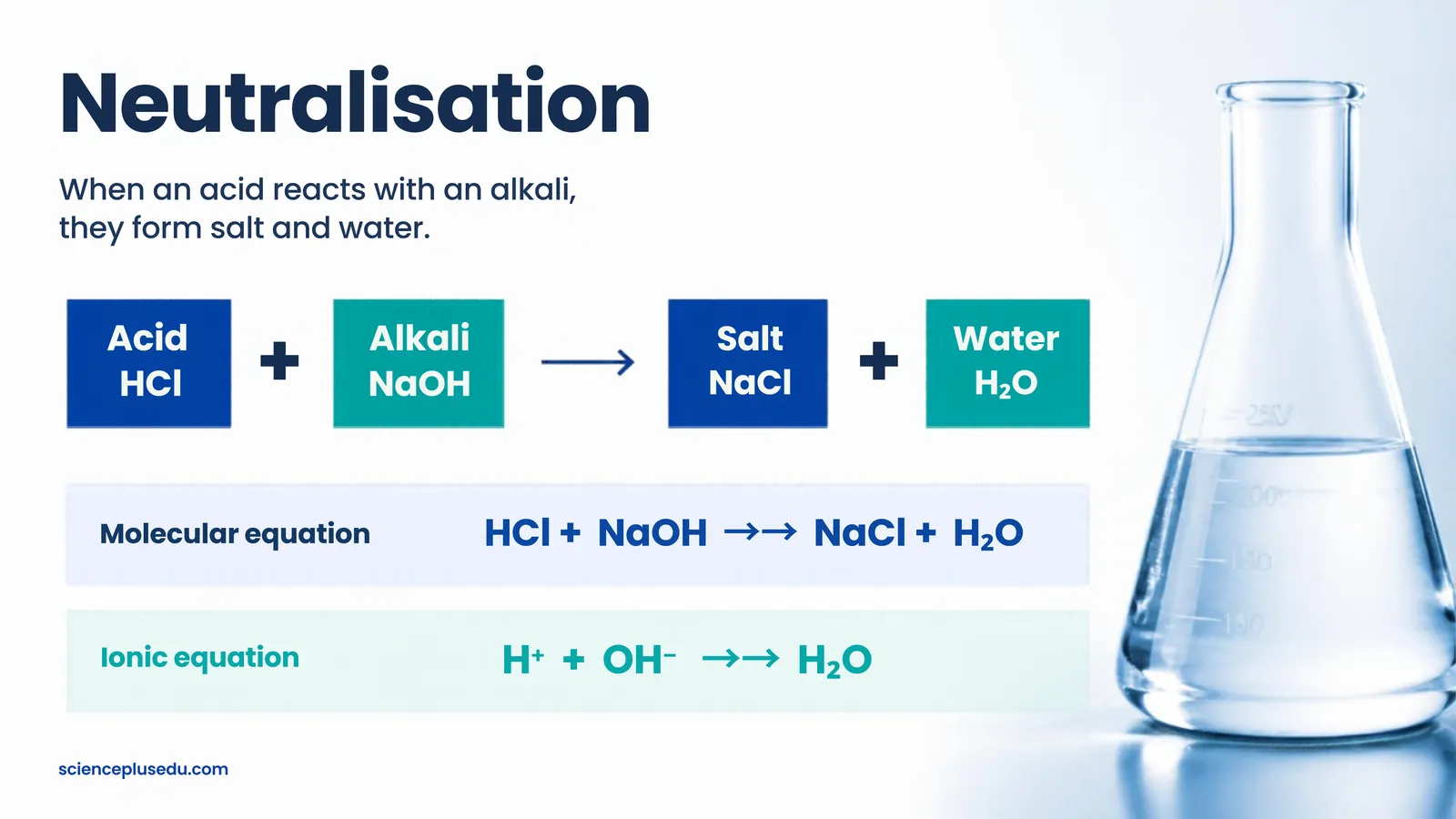
When an alkali neutralises an acid, the general pattern is acid + base → salt + water. Take sodium hydroxide reacting with hydrochloric acid: NaOH(aq) + HCl(aq) → NaCl(aq) + H2O(l). Both compounds are ionic and exist as separate ions in solution, so writing out every ion present gives Na+(aq) + OH-(aq) + H+(aq) + Cl-(aq) → Na+(aq) + Cl-(aq) + H2O(l). The sodium and chloride ions appear unchanged on both sides -- they are spectator ions that take no real part in the reaction. Removing them leaves the true ionic equation: OH-(aq) + H+(aq) → H2O(l). This exact ionic equation is the same for every acid-alkali neutralisation, whichever acid and whichever alkali are used, because it is always the H+ ions from the acid reacting directly with the OH- ions from the alkali.
Slide: Neutralisation
Acid + alkali gives salt + water
1/1
Acids and Alkalis in Everyday Life
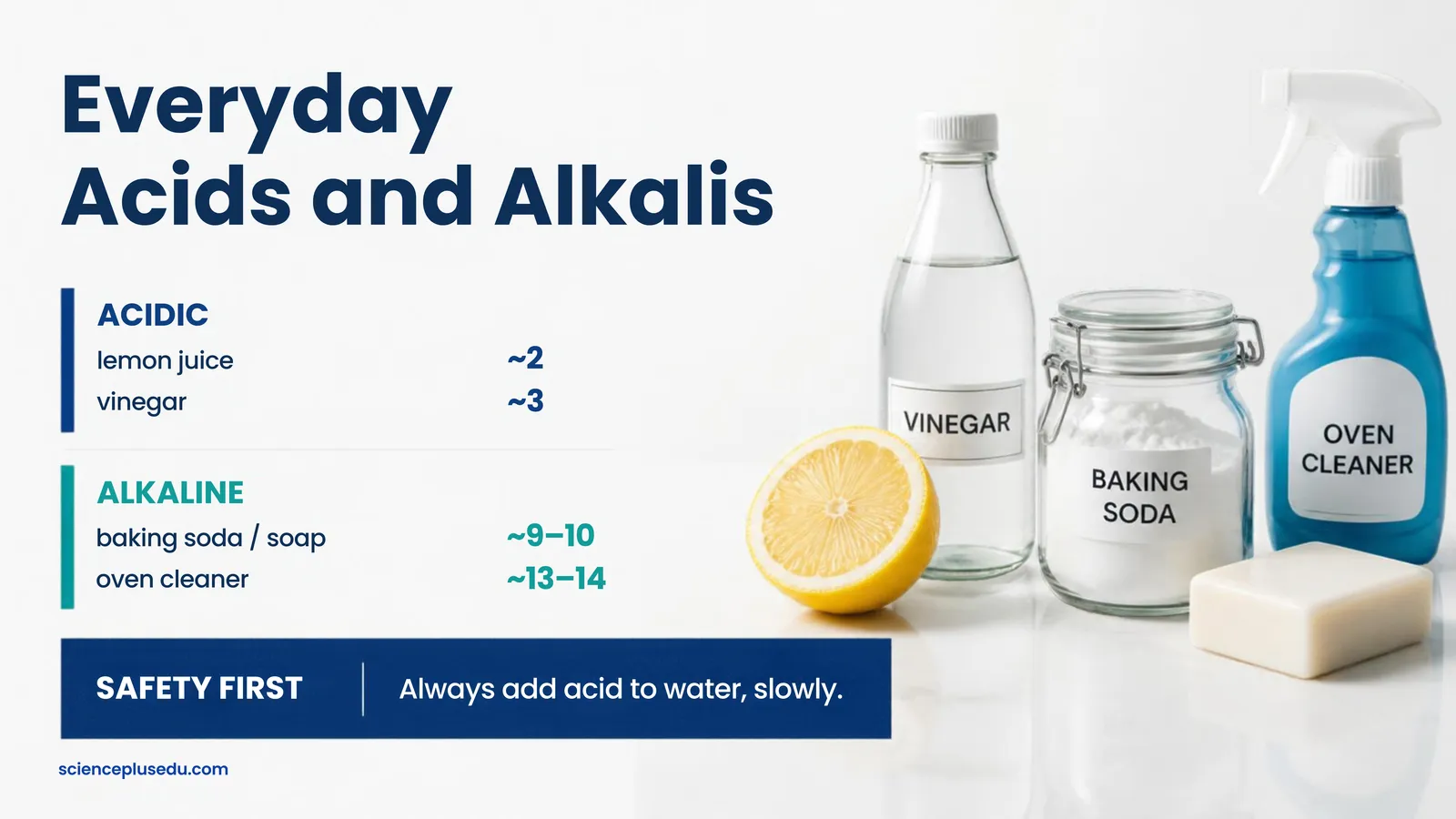
Acids and alkalis are all around you, not just in the lab. Lemon juice (pH ~2, citric acid), vinegar (pH ~3, ethanoic acid) and stomach acid (pH 1-2, hydrochloric acid) are all common acids; soap solution and baking soda (both around pH 9-10) and oven cleaner (pH 13-14) are common alkalis. Concentrated versions of these same substances used in industry are strongly corrosive and can cause serious burns, which is why the golden safety rule is always to add acid to water, slowly and with stirring, and never the other way round.
Slide: Everyday acids and alkalis
Lemon juice to oven cleaner, and the safety rule
1/1
Acids and Alkalis: Frequently Asked Questions
What ion do all acids release in water?
Hydrogen ions, H+. This is the defining feature of an acid in aqueous solution, and the concentration of H+ ions is directly what the pH scale measures.
What is the difference between a base and an alkali?
A base is any substance that neutralises an acid, including insoluble metal oxides. An alkali is specifically a base that is soluble in water and releases hydroxide (OH-) ions when it dissolves -- so every alkali is a base, but not every base is an alkali.
Which indicator should I use to find an exact pH value?
Universal indicator. Litmus, phenolphthalein and methyl orange each only show which side of neutral a solution is on; universal indicator is a blend that changes colour gradually across the whole 0-14 range, letting you estimate an actual pH number by matching the colour to a chart.
Key Takeaways
The pH scale runs 0-14: strongly acidic (0-3), weakly acidic (4-6), neutral (7), weakly alkaline (8-10), strongly alkaline (11-14).
Acids are a source of H+ ions in solution; alkalis are a source of OH- ions.
Litmus, phenolphthalein and methyl orange each give fixed acid/neutral/alkali colours; only universal indicator estimates an actual pH value.
A base neutralises an acid; an alkali is specifically a soluble base.
Neutralisation: acid + base → salt + water; the ionic equation H+(aq) + OH-(aq) → H2O(l) is the same for every acid-alkali reaction.
Want more practice? Download the Science A Plus Edu Acids and Alkalis Revision Notebook, with 25 pages of notes, diagrams and revision activities, and read our companion guide to Acids, Bases and Salt Preparations to see exactly how neutralisation is used to make pure, dry salt crystals.
🗂️ Revision Flashcards
Tap a card to reveal the answer.
🎯 Quick Quiz
8 questions. Pick an answer to check it straight away.
1Which ion do acids release in water?
Acids in aqueous solution are a source of hydrogen ions, H⁺.
2A solution has a pH of 13. How is it best described?
pH 11-14 is strongly alkaline.
3Which indicator is colourless in both an acid and a neutral solution?
Phenolphthalein is colourless in acid and neutral solutions and only turns pink in alkali.
4Which indicator can estimate an actual pH value?
Universal indicator is a blend that changes colour gradually across the whole 0-14 range.
5Why is copper(II) oxide a base but not an alkali?
An alkali is a soluble base; copper(II) oxide neutralises acids but is insoluble.
6What is the ionic equation for every acid-alkali neutralisation?
It is always H⁺ ions from the acid reacting with OH⁻ ions from the alkali to form water.
7In NaOH + HCl → NaCl + H₂O, which are the spectator ions?
Na⁺ and Cl⁻ appear unchanged on both sides, so they take no real part in the reaction.
8How many H⁺ ions does one molecule of sulfuric acid, H₂SO₄, release?
Sulfuric acid has two replaceable hydrogens, releasing two H⁺ ions per molecule.