Close your eyes and think of the smell of fresh bread, rain on dry soil or a favourite perfume. Instantly, a memory or feeling appears. That is the power of the human nose. We often think of the nose as just a way to breathe, but it is actually a sophisticated sense organ, an air conditioner, a filter and a key part of our immune defences all at once. In this guide we explore the structure of the nose, how smell works, why the nose runs when you have a cold and many surprising facts about this underrated organ.
📖 Lesson
The parts of the nose, how it cleans, warms and moistens air, and how about 400 receptor types let you smell.
The Structure of the Human Nose
The nose has two main parts: the external nose that you can see on your face and the nasal cavity hidden inside your skull.
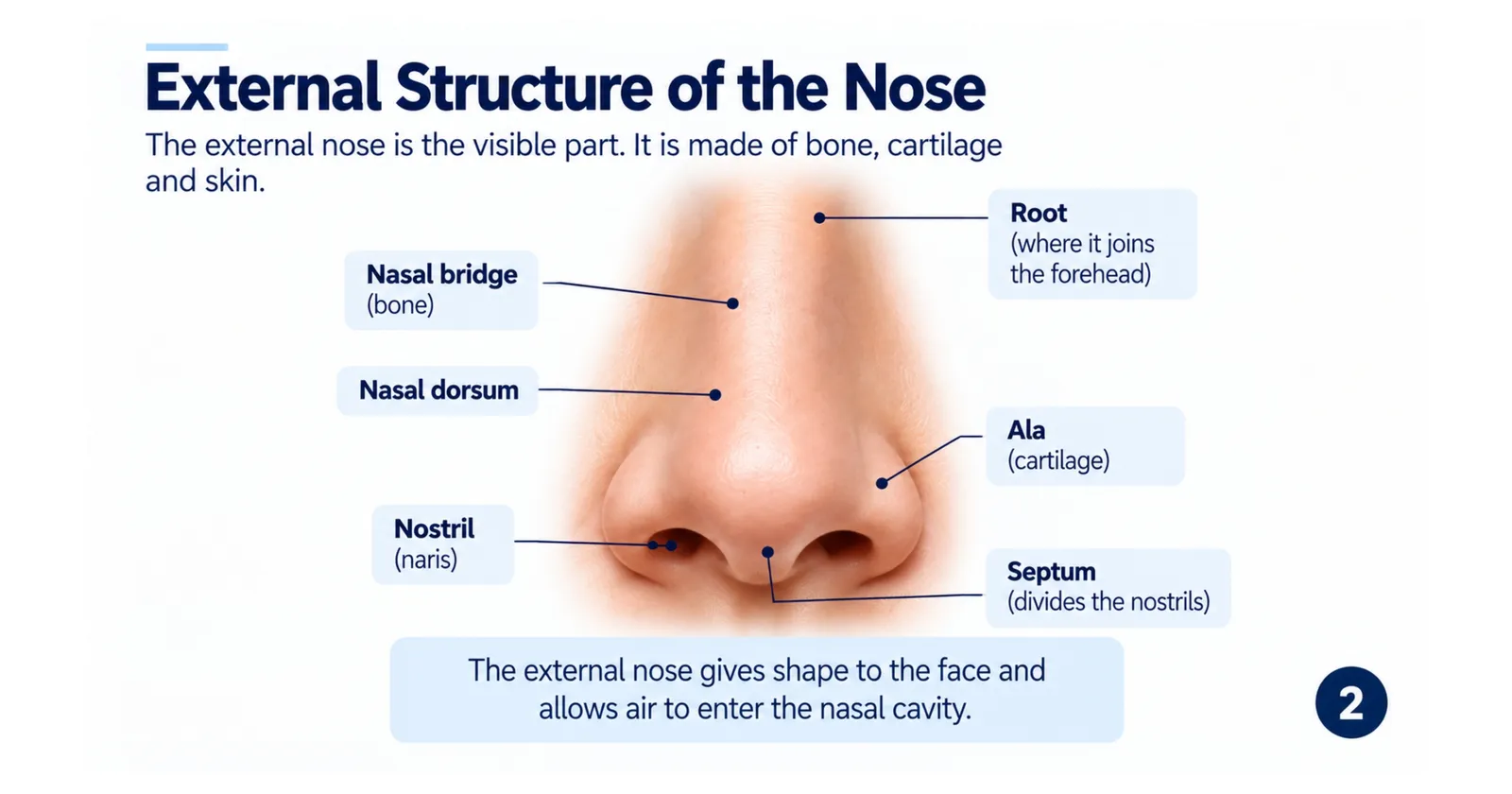
The external nose
The outer nose is shaped by bone at the top and flexible cartilage at the bottom.
Nasal bones: two small bones that form the bridge of the nose.
Cartilage: firm, flexible tissue that shapes the lower part of the nose and the tip. This is why the tip of your nose can bend.
Nostrils (nares): the two openings through which air enters.
Alae: the curved, fleshy sides of the nostrils, which flare during heavy breathing.
Nasal septum: a wall of cartilage and bone that divides the nose into left and right halves.
A slightly off-centre septum, called a deviated septum, is very common. Around 80 percent of people have some degree of deviation, although most never notice it.
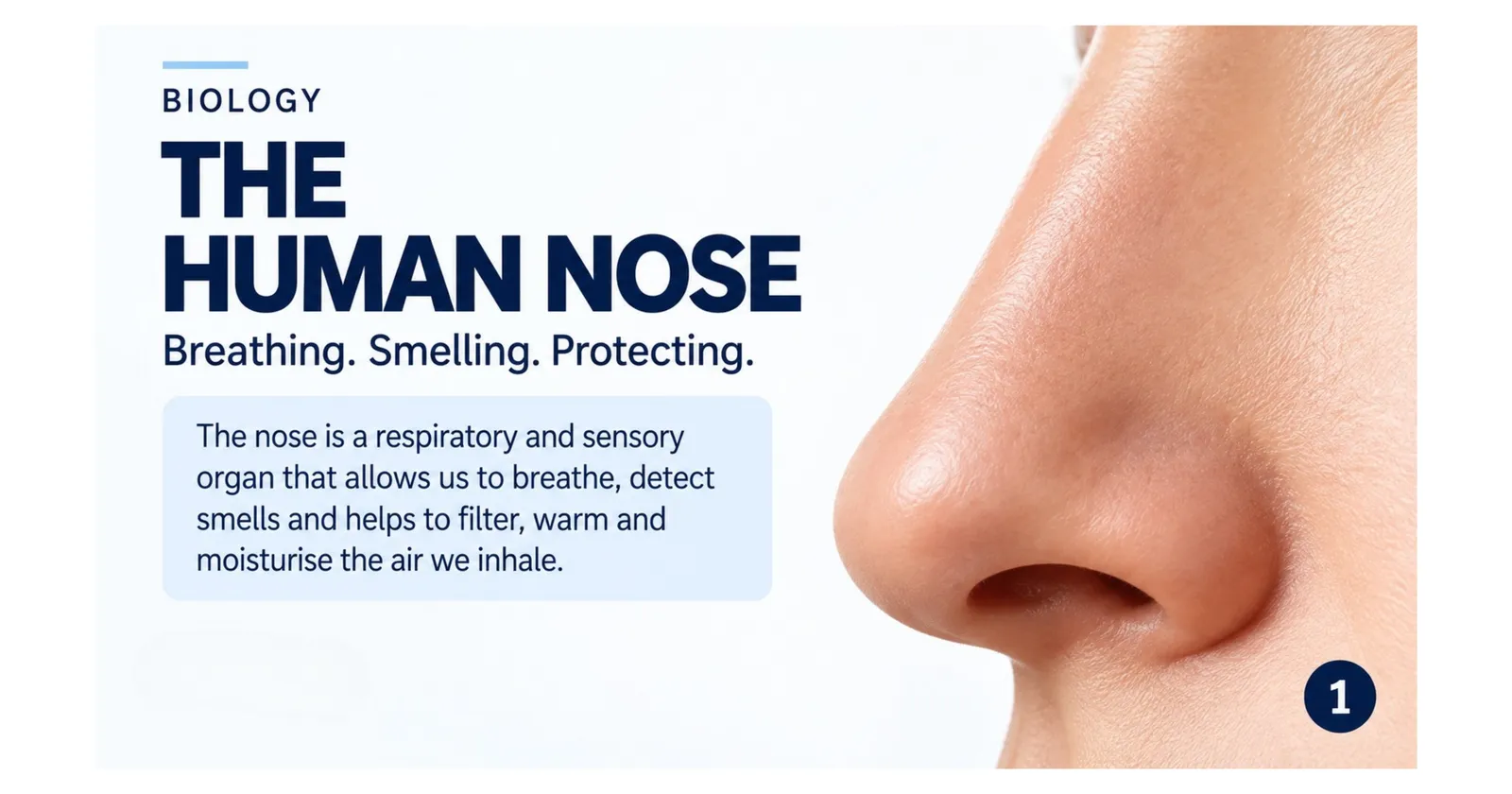
Slides: The human nose and its outer structure
Breathing, smelling, protecting
1/2
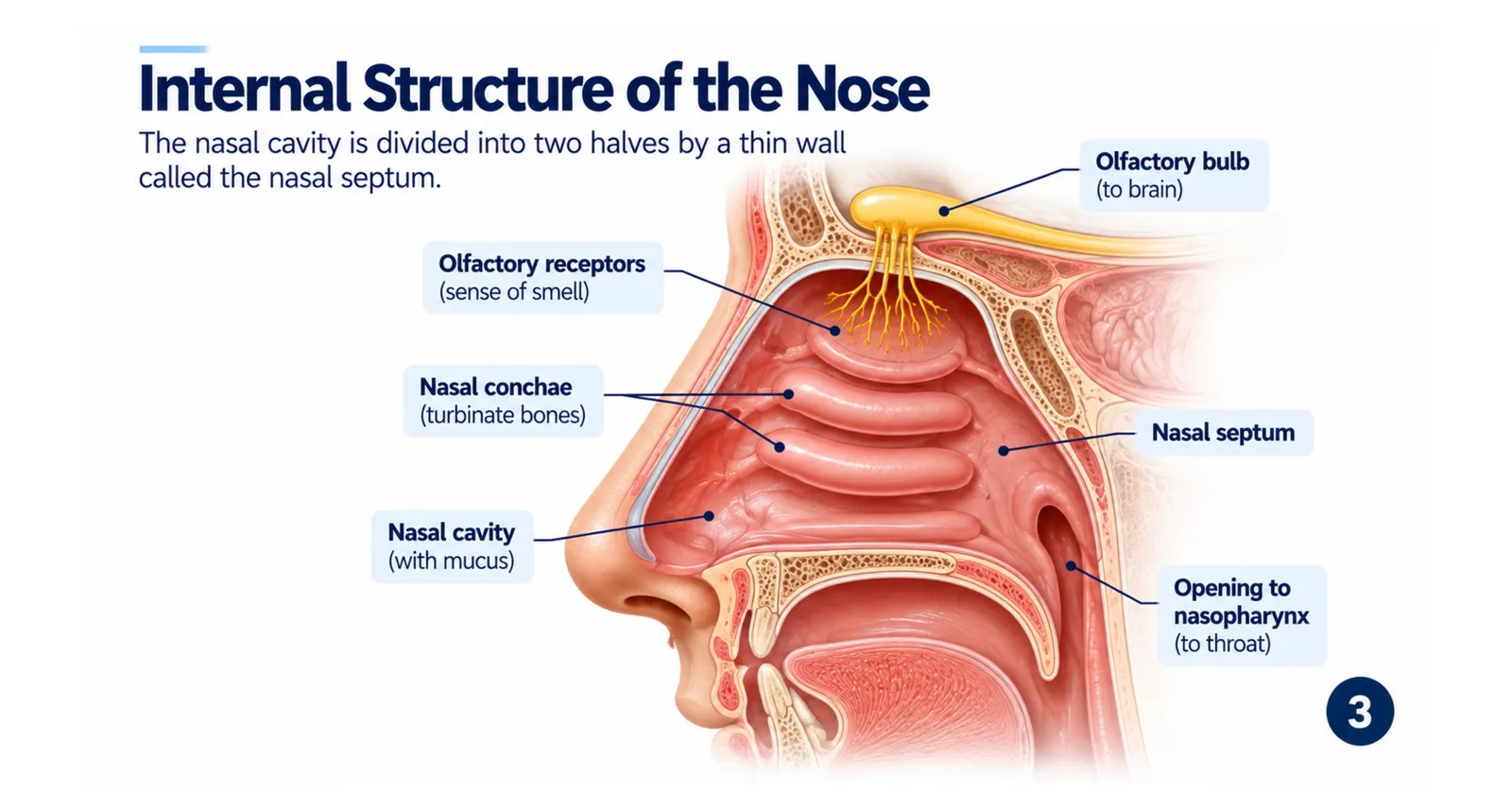
The nasal cavity
Behind the nostrils lies the nasal cavity, a large air-filled space that extends back to the throat.
Vestibule: the area just inside the nostrils, lined with skin and coarse hairs.
Nasal conchae (turbinates): three curled, shelf-like bones on each side wall, called the superior, middle and inferior conchae. They make the air swirl, which increases contact with the lining.
Nasal mucosa: the moist lining of the cavity, rich in blood vessels, mucus-producing goblet cells and hair-like cilia.
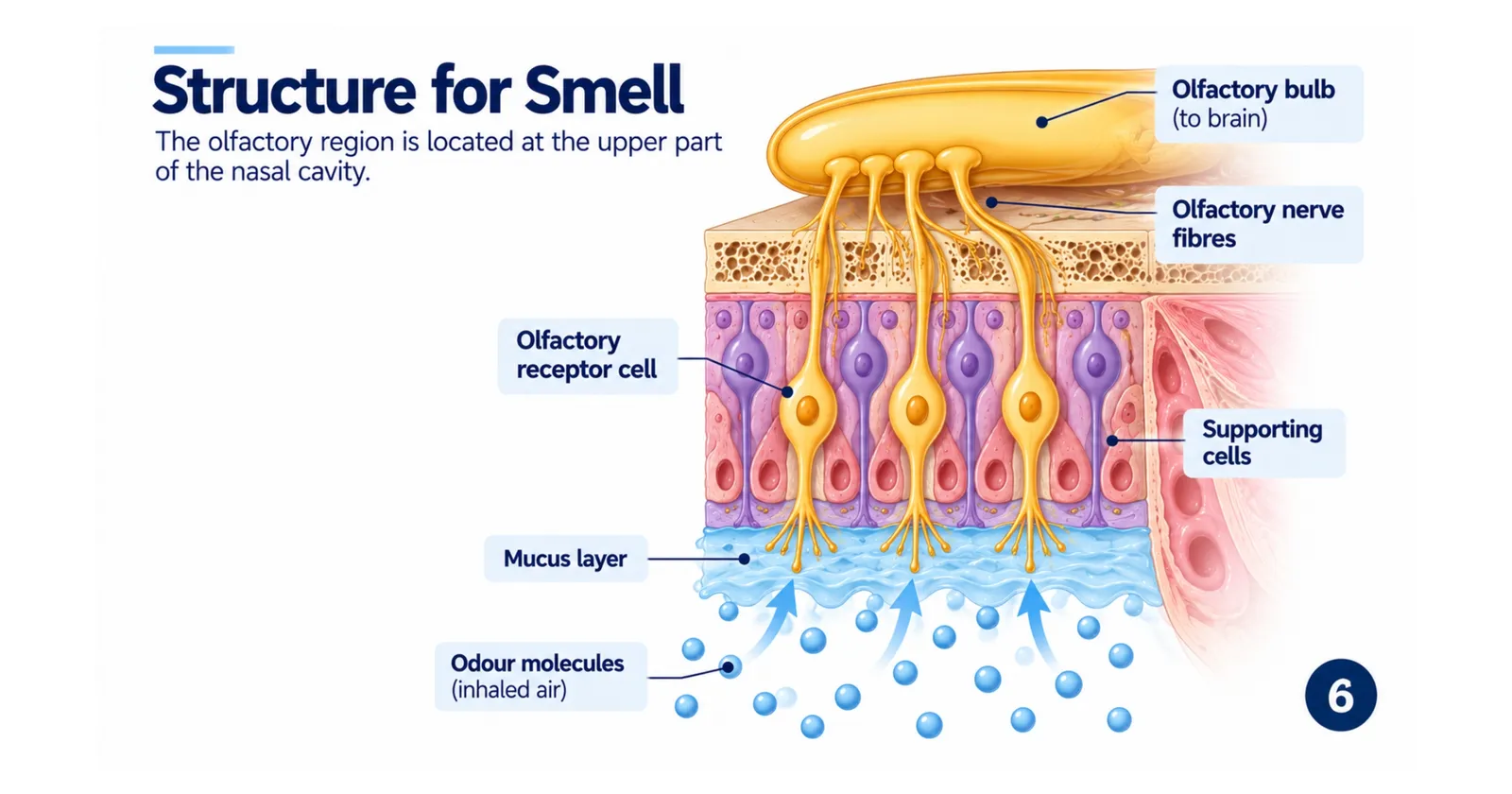
Olfactory region: a small patch of specialised tissue in the roof of the cavity that detects smells.
Nasopharynx: the back of the nasal cavity, which connects to the throat. The Eustachian tubes from the middle ears also open here.
The paranasal sinuses
The sinuses are air-filled spaces in the bones around the nose. There are four pairs: the frontal sinuses (forehead), maxillary sinuses (cheeks), ethmoid sinuses (between the eyes) and sphenoid sinuses (deep behind the nose). They make the skull lighter, help produce mucus and add resonance to the voice. When they become inflamed and blocked, the result is the painful pressure of sinusitis.
Slide: Inside the nose
The nasal cavity, conchae and olfactory region
1/1
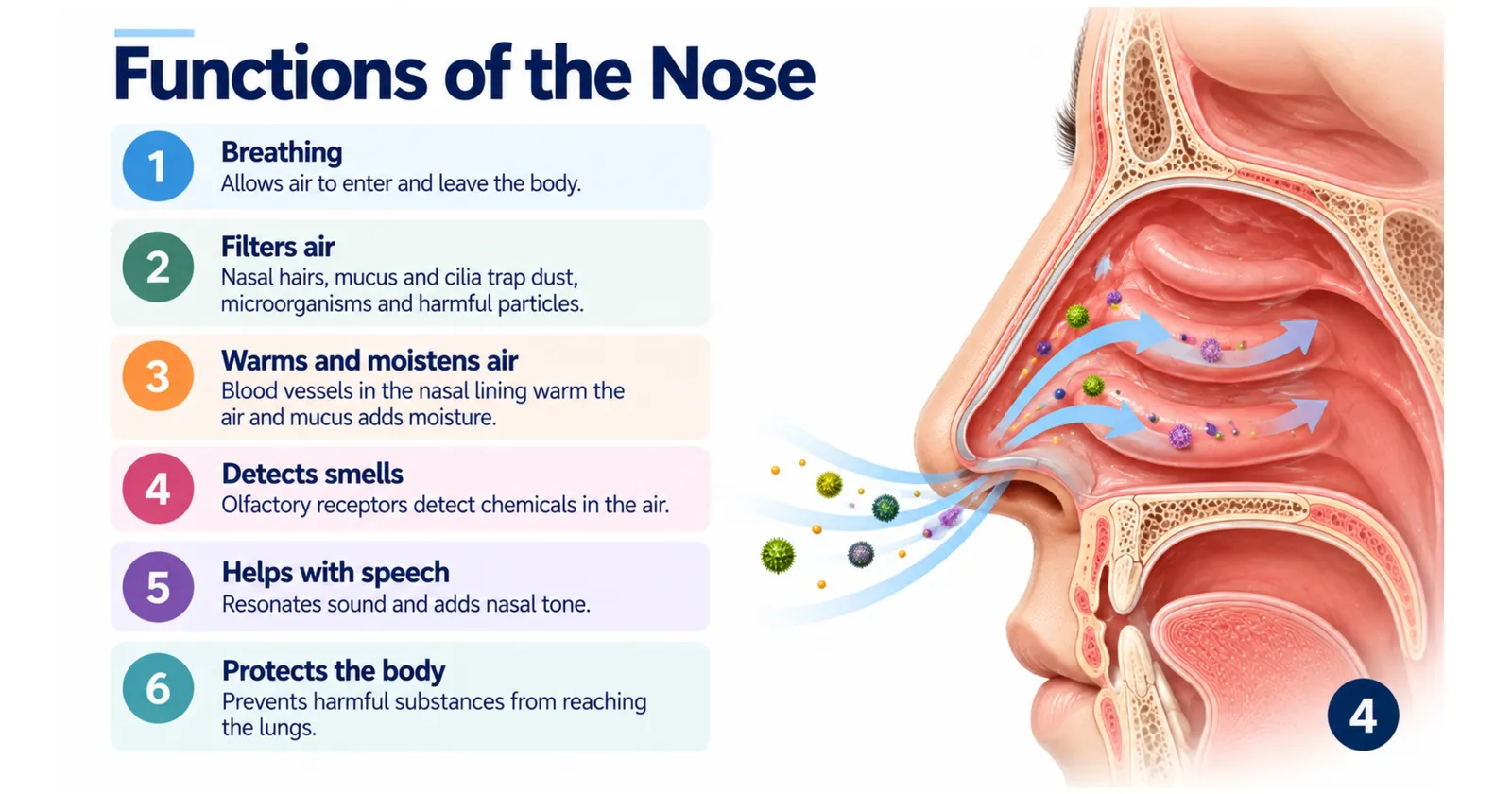
Main Functions of the Nose
| Function | How the nose does it |
|---|---|
| Breathing | Provides the main route for air to enter the respiratory system |
| Filtering | Nose hairs, mucus and cilia trap dust, pollen and microbes |
| Warming | A rich blood supply in the lining warms incoming air towards body temperature |
| Moistening | Mucus adds water vapour so air reaching the lungs is humid |
| Smelling | Olfactory receptors detect odour molecules |
| Tasting | Smell provides most of the flavour of food |
| Speech | The nasal cavity and sinuses shape the tone of the voice |
| Defence | Mucus contains antibodies and enzymes; sneezing expels irritants |
Slide: Functions of the nose
Six jobs the nose does every day
1/1
How the Nose Cleans, Warms and Moistens Air
Your lungs are delicate. The air they receive must be clean, warm and humid, and the nose acts as a natural air conditioner to make that happen.
Filtering the air
Coarse hairs in the nostrils catch large particles such as dust and insects. Deeper inside, the air swirls around the turbinates and smaller particles stick to the sticky mucus coating the lining. The nose produces roughly one litre of mucus per day in a healthy adult, most of which you swallow without noticing.
The mucociliary escalator
The lining of the nose is covered with millions of tiny hair-like cilia. They beat in coordinated waves, sweeping the mucus and the trapped particles backwards towards the throat, where they are swallowed and destroyed by stomach acid. This conveyor belt system is called the mucociliary escalator. Smoking damages cilia, which is one reason smokers are more prone to chest infections.
Warming and humidifying
The nasal lining contains a dense network of blood vessels close to the surface. As air passes over them, heat is transferred to the air. Water evaporates from the moist mucus into the air, making it humid. By the time air reaches the back of the throat, it is close to body temperature and almost fully saturated with water vapour. This is also why breathing through the mouth on a cold day can leave the throat feeling dry and sore.
The nasal cycle
Here is a surprising fact: you usually breathe mainly through one nostril at a time. The blood vessels in the turbinates of one side swell while the other side shrinks, and this switches every few hours. It is called the nasal cycle, and it gives each side of the nose time to rest and recover.
How Does the Sense of Smell Work?
The sense of smell is called olfaction. It is a chemical sense, because it detects chemicals rather than light or sound.
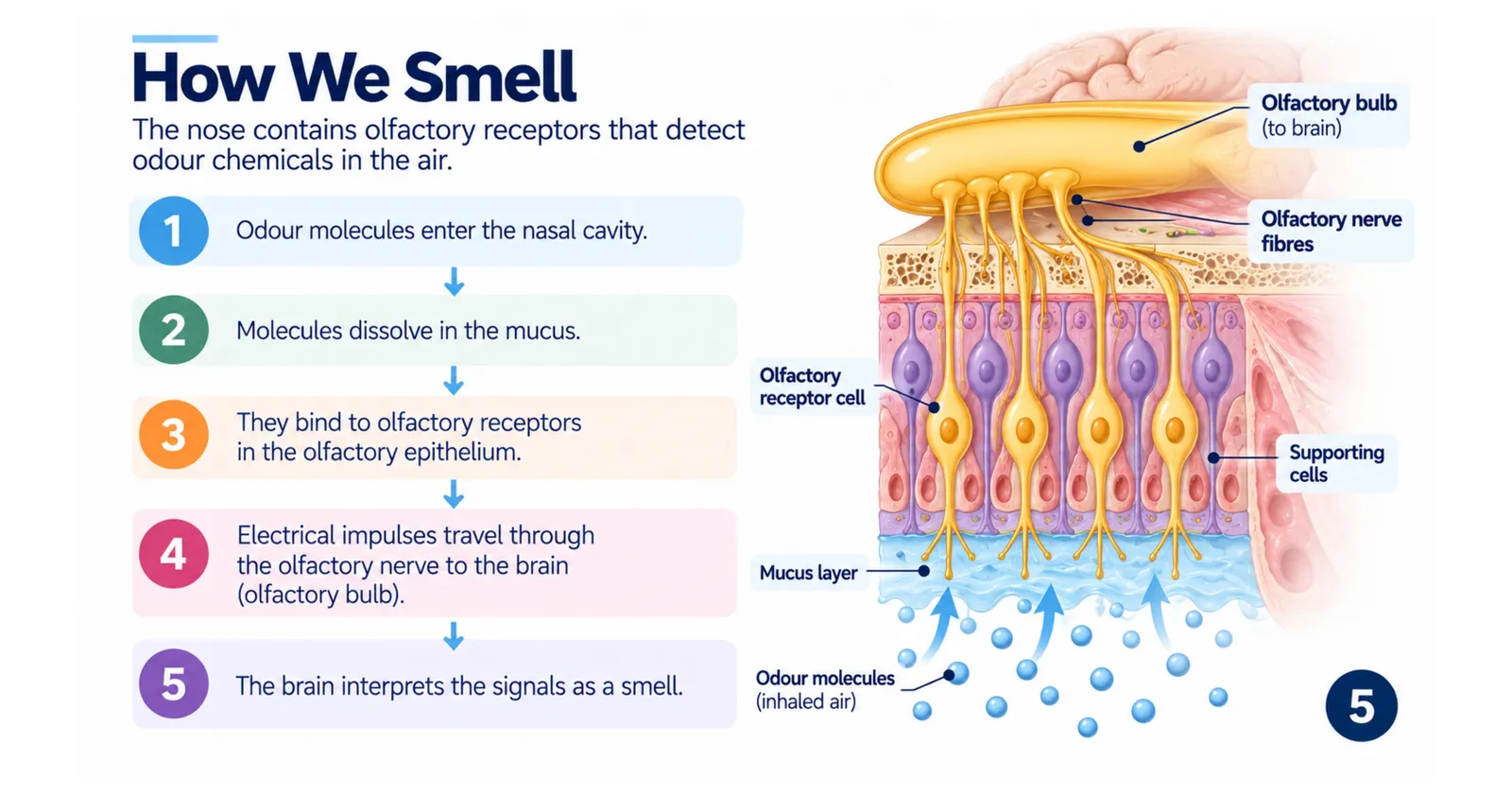
Step 1: Odour molecules enter the nose
Everything that smells releases tiny molecules into the air. When you breathe in or sniff, these odour molecules are carried up to the olfactory epithelium, a patch of tissue about the size of a postage stamp in the roof of each nasal cavity.
Step 2: Molecules dissolve in mucus
The odour molecules dissolve in the thin layer of mucus covering the olfactory epithelium.
Step 3: Receptors detect the molecules
The olfactory epithelium contains millions of olfactory receptor neurones. Each has tiny hair-like projections (olfactory cilia) covered in receptor proteins. Humans have around 400 different types of smell receptor, and each type binds to particular chemical features. When an odour molecule binds to a receptor, it triggers an electrical nerve impulse.
Step 4: Signals travel to the olfactory bulb
The nerve fibres pass up through tiny holes in a thin bone called the cribriform plate and reach the olfactory bulb at the base of the brain. Here, signals from receptors of the same type are grouped together.
Step 5: The brain identifies the smell
Most smells activate a unique combination of receptors, a bit like a chord on a piano. The brain reads this pattern and identifies the smell. Because 400 receptor types can combine in countless ways, scientists estimate that humans can distinguish many thousands, perhaps even billions, of different odours.
Why smells trigger memories and emotions
Unlike other senses, smell signals travel directly to parts of the brain involved in emotion and memory, called the amygdala and hippocampus, without first passing through the thalamus. This is why a particular smell can suddenly bring back a vivid childhood memory.
Slides: How we smell
From odour molecule to brain
1/2
The Nose and Taste: Why Food Is Bland With a Cold
Your tongue can detect only five basic tastes: sweet, sour, salty, bitter and umami. The rich flavours of food, such as strawberry, coffee or cinnamon, come mostly from smell. When you chew, odour molecules travel from the back of the mouth up into the nasal cavity. This is called retronasal smell. When your nose is blocked by a cold, these molecules cannot reach the receptors, so food tastes bland. Try holding your nose while eating a jelly bean, and you will notice that you can taste sweetness but not the flavour.
Smell and Safety: Why Your Nose Protects You
Smell is also an important warning system. It helps you detect smoke from a fire, gas leaks, spoiled food and toxic chemicals long before they can harm you. This is why gas companies add a strong-smelling chemical to natural gas, which is otherwise odourless. People who have lost their sense of smell are advised to fit smoke and gas alarms and to check food dates carefully.
Why Do We Sneeze?
Sneezing is a protective reflex. When irritants such as dust, pollen or pepper stimulate nerve endings in the nasal lining, the brain triggers a powerful blast of air through the nose and mouth. A sneeze can travel at speeds of around 30 to 50 metres per second and spread droplets several metres, which is why covering your sneeze helps to stop the spread of infections.
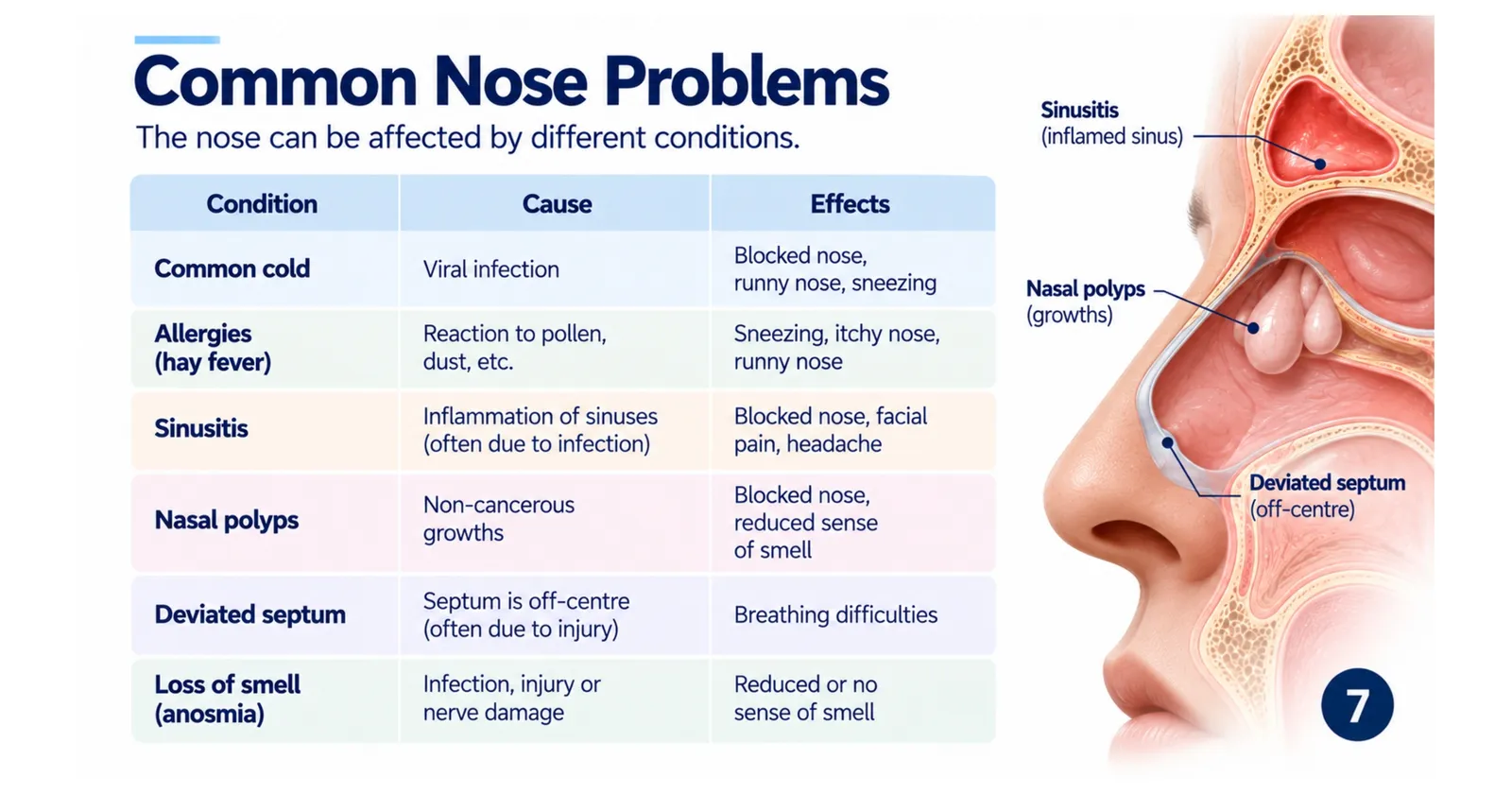
Common Nose Problems
Common cold: a viral infection that causes the lining to swell and produce extra mucus, leading to a runny or blocked nose.
Allergic rhinitis (hay fever): the immune system overreacts to pollen, dust mites or pet hair, releasing histamine that causes sneezing, itching and a runny nose.
Sinusitis: inflammation of the sinuses, causing facial pain, pressure and thick mucus.
Nosebleeds (epistaxis): usually caused by the delicate blood vessels at the front of the septum breaking, often due to dry air or nose picking. Lean forward and pinch the soft part of the nose for 10 to 15 minutes to stop the bleeding.
Nasal polyps: soft, painless growths in the lining that can block the nose and reduce the sense of smell.
Deviated septum: can cause blockage on one side and snoring; severe cases can be corrected by surgery.
Anosmia: loss of the sense of smell. It can be caused by colds, head injuries, polyps or viral infections such as COVID-19, and it can also be an early sign of some brain conditions.
Slide: Common nose problems
Conditions, causes and effects
1/1
How to Keep Your Nose Healthy
Breathe through your nose rather than your mouth whenever you can.
Keep the air in your home from getting too dry, especially in winter.
Use saline nasal sprays to clear mucus and allergens.
Avoid smoking and second-hand smoke, which damage the cilia.
Wash your hands often and avoid picking your nose, which can spread germs and cause nosebleeds.
Do not overuse decongestant sprays; using them for more than a few days can make congestion worse.
Amazing Facts About the Human Nose
Your sense of smell is strongest in your early twenties and gradually declines with age.
Women, on average, perform better than men in many smell tests.
Olfactory receptor neurones are replaced roughly every one to two months, one of the few types of nerve cell that the body regenerates.
Your nose can remember tens of thousands of different smells.
Dogs have about 50 times more olfactory receptor cells than humans, which is why they are used to sniff out drugs, explosives and even some diseases.
Everyone has a unique "odour fingerprint", and identical twins are the only people who smell almost the same.
Frequently Asked Questions About the Human Nose
Why does my nose run when it is cold outside?
Cold air stimulates the nose to produce more mucus to warm and humidify the air, and water vapour in your breath also condenses at the nostrils.
Is it better to breathe through the nose or the mouth?
Nose breathing is healthier because the nose filters, warms and humidifies the air before it reaches the lungs.
Can you lose your sense of smell permanently?
Most smell loss after a cold returns within weeks. Smell loss caused by head injuries or nerve damage can sometimes be permanent, but smell training may help.
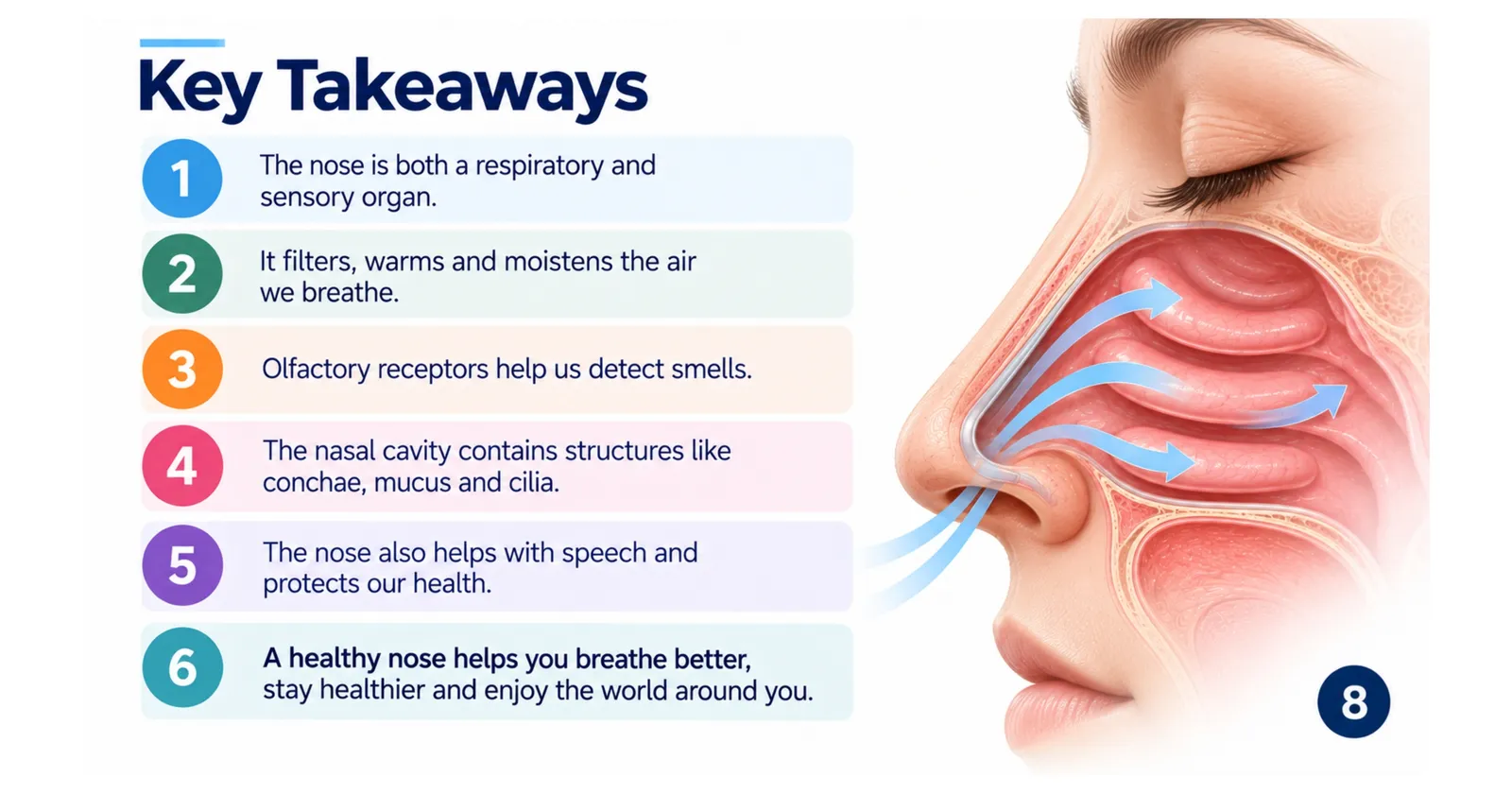
Key Takeaways
The nose is made of bone and cartilage outside and a large nasal cavity with turbinates and sinuses inside.
It filters, warms and moistens air before it reaches the lungs.
About 400 types of olfactory receptors work together to detect thousands of smells.
Smell is responsible for most of the flavour we experience in food.
Common nose problems include colds, allergies, sinusitis and nosebleeds.
Slide: Key takeaways
1/1
The nose is just one of your amazing sense organs. Explore our guides to the human ear and the human eye to discover how you hear and see the world around you.
🗂️ Revision Flashcards
Tap a card to reveal the answer.
🎯 Quick Quiz
8 questions. Pick an answer to check it straight away.
1Which part of the nose divides it into left and right halves?
The nasal septum is a wall of cartilage and bone that divides the nose into left and right halves.
2What is the job of the nasal conchae (turbinates)?
The curled, shelf-like turbinates make the air swirl so more of it touches the lining.
3Roughly how much mucus does a healthy adult nose produce each day?
The nose produces roughly one litre of mucus per day, most of which you swallow without noticing.
4Where does the mucociliary escalator sweep mucus and trapped particles?
Cilia sweep mucus back to the throat, where it is swallowed and destroyed by stomach acid.
5About how many different types of smell receptor do humans have?
Humans have around 400 different types of smell receptor.
6Through which thin bone do olfactory nerve fibres pass to reach the olfactory bulb?
The nerve fibres pass up through tiny holes in the cribriform plate.
7Why does food taste bland when you have a cold?
A blocked nose stops retronasal odour molecules reaching the receptors, and smell gives most of the flavour.
8Why can a smell bring back a vivid memory?
Smell signals travel directly to the amygdala and hippocampus, involved in emotion and memory, without passing through the thalamus.