Everything you can see, touch or smell is made of atoms. They are so small that about 100 million of them lined up side by side would stretch just 1 centimetre. Yet inside each atom is an even tinier world of particles, and the way those particles are arranged explains why gold is shiny, why sodium explodes in water and why helium balloons float. Atomic structure is the foundation of the whole of chemistry. In this guide you will learn what atoms are made of, how to work out the numbers of each particle, what isotopes are, how to calculate relative atomic mass and how electrons are arranged in shells.
📖 Lesson
What atoms are made of, how to work out the particles in any atom, what isotopes are, how to calculate relative atomic mass and how electrons fill shells.
What Is an Atom?
An atom is the smallest part of an element that can exist and still have the chemical properties of that element. All atoms of one element have the same number of protons, and atoms of different elements have different numbers of protons.
Atoms have no overall charge, because the number of positive protons is always equal to the number of negative electrons.
The Three Subatomic Particles
| Particle | Relative mass | Relative charge | Location |
|---|---|---|---|
| Proton | 1 | +1 | In the nucleus |
| Neutron | 1 | 0 (neutral) | In the nucleus |
| Electron | 1/1836 (almost zero) | −1 | In shells around the nucleus |
The nucleus
The nucleus is at the centre of the atom. It contains the protons and neutrons, which together are called nucleons. The nucleus holds almost all of the atom's mass, yet it is incredibly small. If an atom were the size of a football stadium, the nucleus would be about the size of a pea on the centre spot. The rest of the atom is mostly empty space.
Electrons
Electrons move around the nucleus in energy levels called shells. They have almost no mass, but they are extremely important, because electrons are the particles involved in chemical reactions and bonding. The arrangement of electrons decides how an atom reacts.
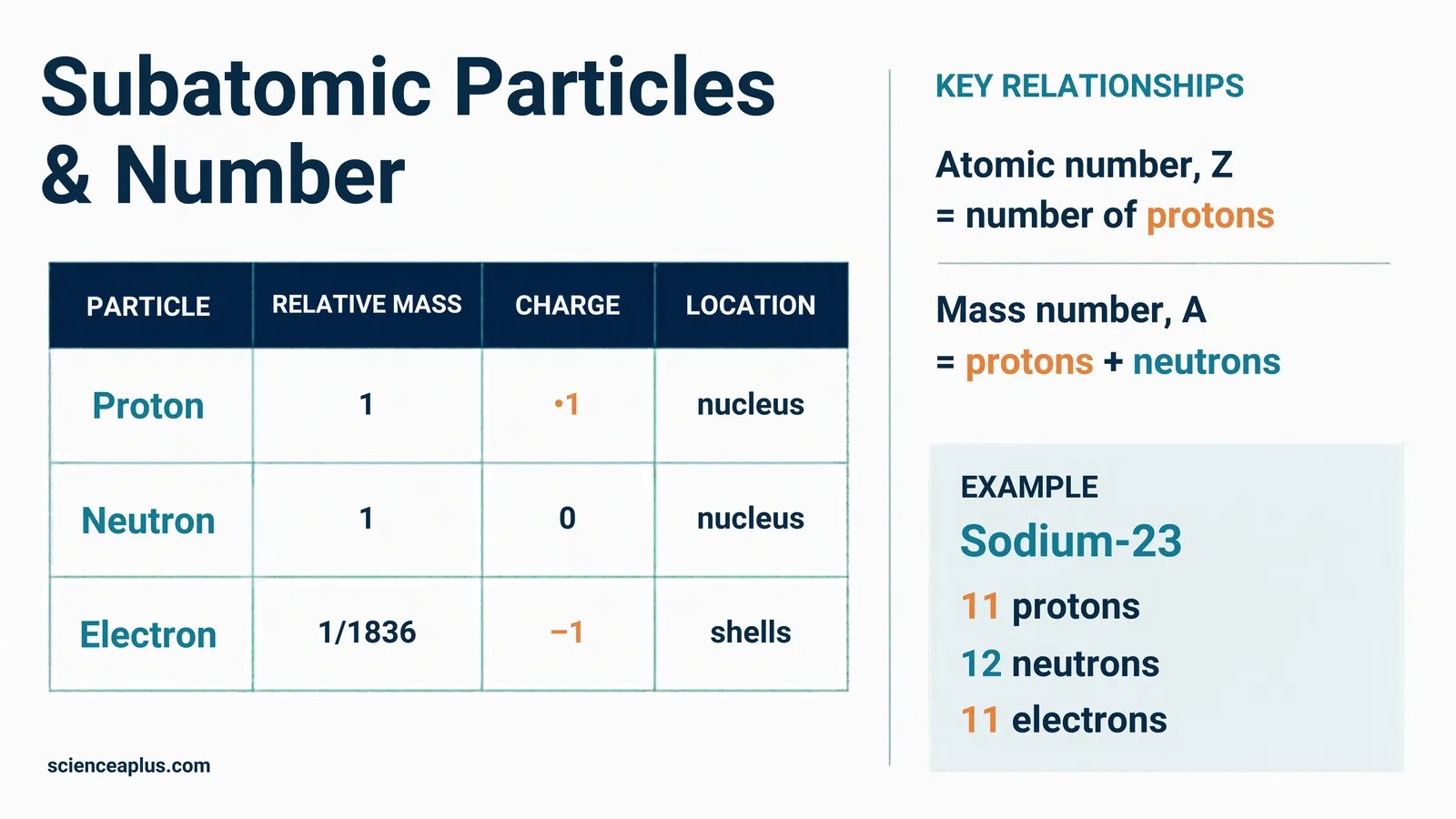
Slide: Subatomic particles and numbers
Protons, neutrons and electrons at a glance
1/1
Atomic Number and Mass Number
Each element in the Periodic Table has two important numbers.
Atomic number (proton number), Z: the number of protons in the nucleus of an atom. Every element has its own unique atomic number. Carbon always has 6 protons; if an atom has 7 protons, it is nitrogen.
Mass number (nucleon number), A: the total number of protons and neutrons in the nucleus.
In nuclear notation, the mass number is written at the top left of the symbol and the atomic number at the bottom left. For sodium it is written as 2311Na.
How to calculate the number of each particle
Number of protons = atomic number
Number of electrons = atomic number (for a neutral atom)
Number of neutrons = mass number − atomic number
Worked examples
| Atom | Atomic number | Mass number | Protons | Neutrons | Electrons |
|---|---|---|---|---|---|
| 2311Na | 11 | 23 | 11 | 12 | 11 |
| 3517Cl | 17 | 35 | 17 | 18 | 17 |
| 5626Fe | 26 | 56 | 26 | 30 | 26 |
| 126C | 6 | 12 | 6 | 6 | 6 |
What about ions?
An ion is an atom or group of atoms that has gained or lost electrons, so it has a charge. The number of protons and neutrons does not change.
A sodium ion, Na+, has lost one electron: 11 protons, 12 neutrons and 10 electrons.
An oxide ion, O2−, has gained two electrons: 8 protons, 8 neutrons and 10 electrons.
Positive ions have lost electrons; negative ions have gained electrons.
What Are Isotopes?
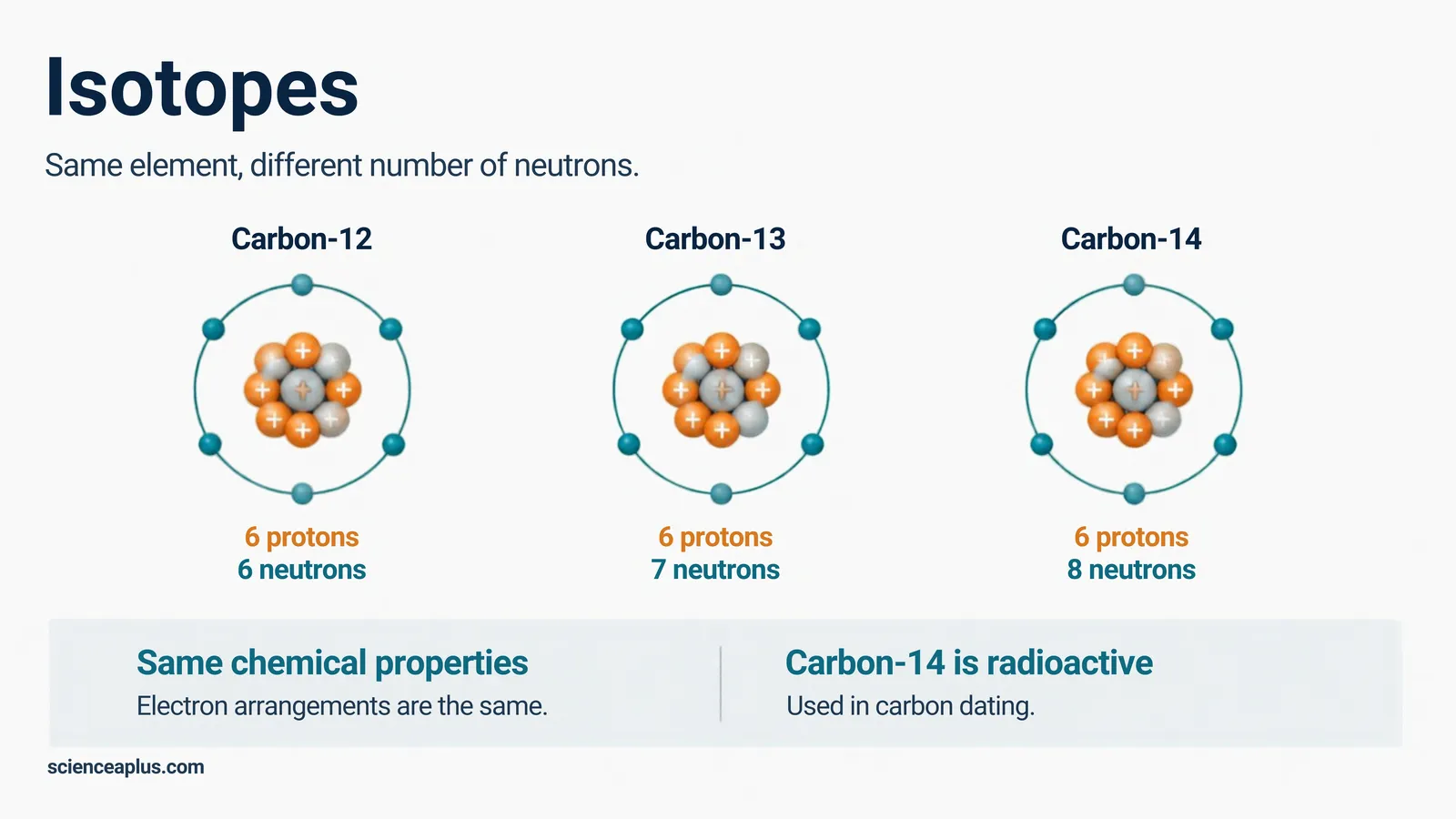
Isotopes are atoms of the same element with the same number of protons but different numbers of neutrons. This means they have the same atomic number but different mass numbers.
For example, carbon has three naturally occurring isotopes:
| Isotope | Protons | Neutrons | Electrons | Notes |
|---|---|---|---|---|
| Carbon-12 | 6 | 6 | 6 | About 99 percent of carbon atoms |
| Carbon-13 | 6 | 7 | 6 | About 1 percent |
| Carbon-14 | 6 | 8 | 6 | Radioactive; used in carbon dating |
Other important examples include chlorine-35 and chlorine-37, and the three isotopes of hydrogen: hydrogen-1 (protium, no neutrons), hydrogen-2 (deuterium) and hydrogen-3 (tritium).
Do isotopes have the same chemical properties?
Yes. Isotopes of the same element have the same chemical properties because they have the same number of electrons, and electrons decide how an atom reacts. They have slightly different physical properties, such as density and mass, because they contain different numbers of neutrons.
Uses of isotopes
Carbon-14 dating measures the age of ancient bones, wood and fabrics.
Medical tracers, such as technetium-99m, help doctors take images of organs.
Radiotherapy uses isotopes such as cobalt-60 to destroy cancer cells.
Uranium-235 is the fuel in nuclear power stations.
Slide: Isotopes
Same element, different neutrons
1/1
Relative Atomic Mass
Because most elements are a mixture of isotopes, the mass shown in the Periodic Table is an average called the relative atomic mass, Ar.
The relative atomic mass is the weighted average mass of the isotopes of an element, compared with 1/12 of the mass of a carbon-12 atom. It takes into account how common each isotope is, which is called its abundance.
How to calculate relative atomic mass
Ar = (mass of isotope 1 × % abundance + mass of isotope 2 × % abundance) ÷ 100
Worked example: chlorine
Chlorine contains 75 percent chlorine-35 and 25 percent chlorine-37.
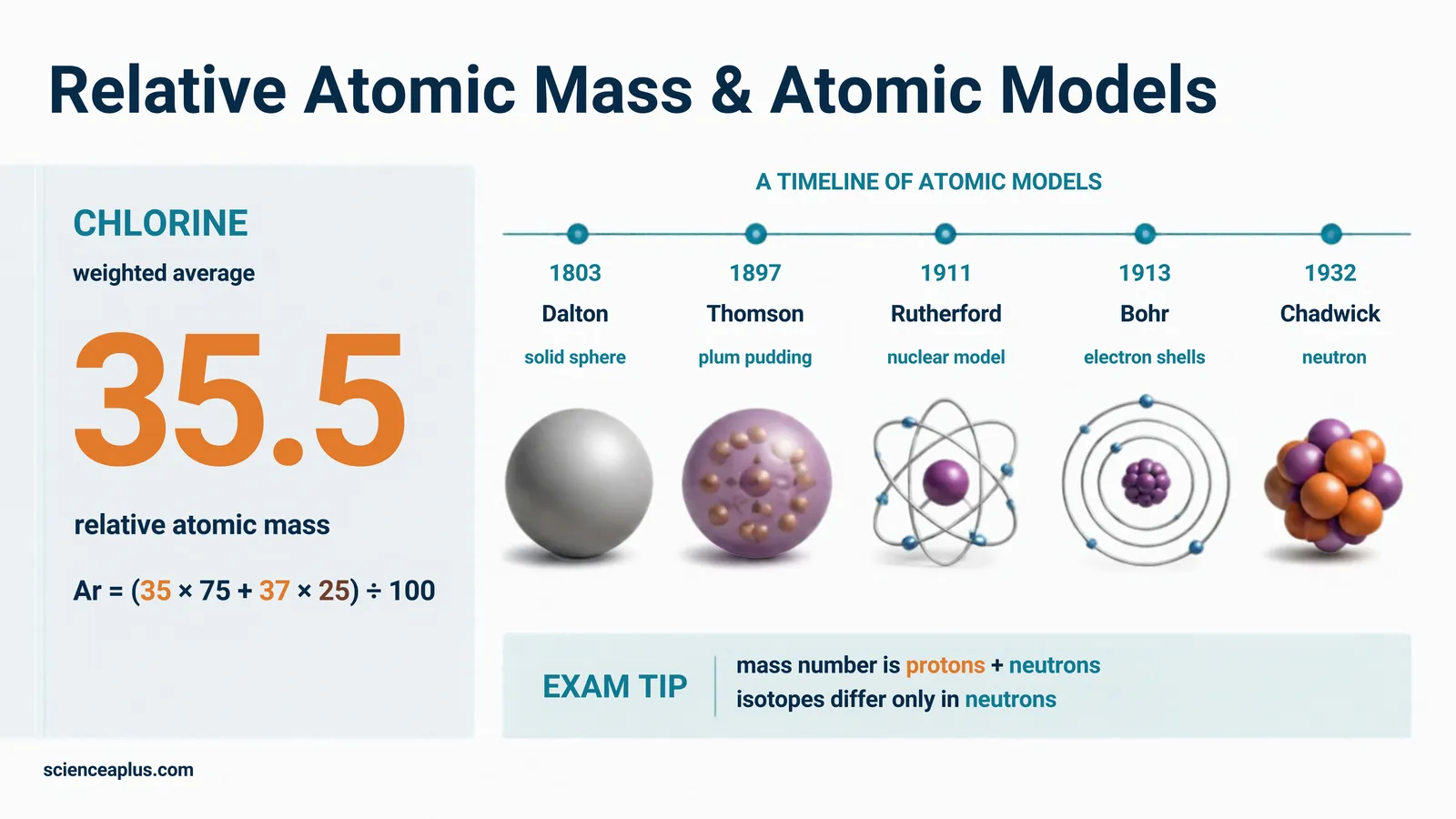
Ar = (35 × 75 + 37 × 25) ÷ 100 = (2625 + 925) ÷ 100 = 3550 ÷ 100 = 35.5
This is why the Periodic Table gives chlorine a relative atomic mass of 35.5, even though no single chlorine atom has that mass. The answer is closer to 35 because chlorine-35 is much more abundant.
Worked example: copper
Copper is 69 percent copper-63 and 31 percent copper-65.
Ar = (63 × 69 + 65 × 31) ÷ 100 = (4347 + 2015) ÷ 100 = 63.6
A quick check: your answer must lie between the masses of the lightest and heaviest isotopes, and it should be closer to the most abundant one.
Electronic Configuration: How Electrons Are Arranged
Electrons occupy shells, also called energy levels, around the nucleus. Shells closest to the nucleus have the lowest energy and fill up first. For the first 20 elements:
The first shell holds up to 2 electrons.
The second shell holds up to 8 electrons.
The third shell holds up to 8 electrons (for the first 20 elements).
The fourth shell then begins to fill with potassium and calcium.
Examples of electronic configurations
| Element | Atomic number | Electronic configuration |
|---|---|---|
| Hydrogen | 1 | 1 |
| Carbon | 6 | 2, 4 |
| Oxygen | 8 | 2, 6 |
| Neon | 10 | 2, 8 |
| Sodium | 11 | 2, 8, 1 |
| Chlorine | 17 | 2, 8, 7 |
| Argon | 18 | 2, 8, 8 |
| Calcium | 20 | 2, 8, 8, 2 |
Why electronic configuration matters
The electronic configuration links directly to the Periodic Table:
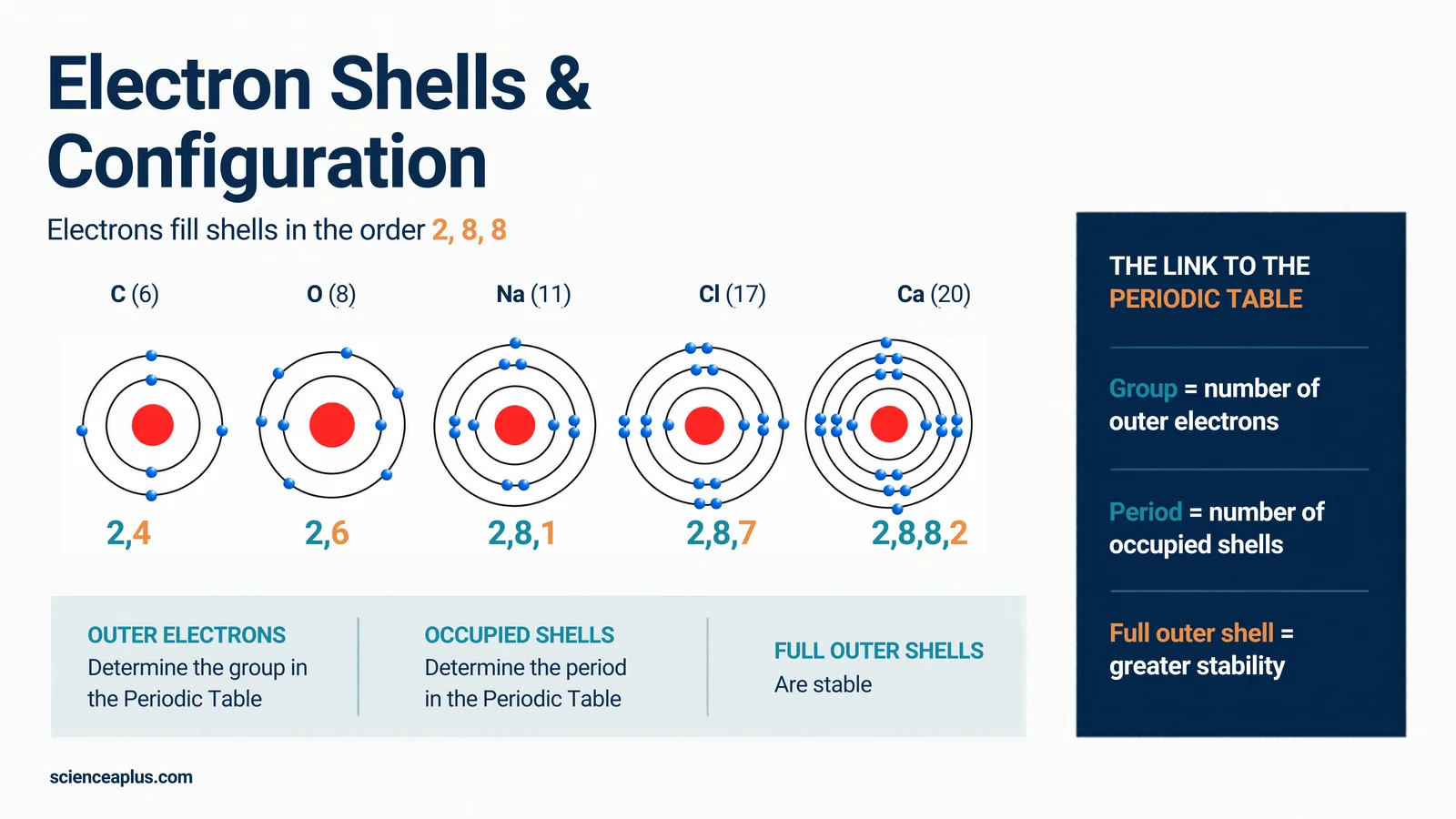
The number of outer electrons equals the group number (for Groups 1 to 7). Sodium, 2, 8, 1, is in Group 1; chlorine, 2, 8, 7, is in Group 7.
The number of occupied shells equals the period number. Sodium has three shells, so it is in Period 3.
Atoms with a full outer shell, the noble gases, are very stable and unreactive.
Atoms react by losing, gaining or sharing electrons to achieve a full outer shell, which is the basis of ionic and covalent bonding.
Slide: Electron shells and configuration
How electrons fill shells and link to the Periodic Table
1/1
Drawing Electron Shell Diagrams
Exams often ask you to draw the arrangement of electrons in an atom. Follow these steps:
Find the atomic number from the Periodic Table; this tells you the number of electrons.
Draw a small circle for the nucleus. You can write the number of protons and neutrons inside it, such as 11p and 12n for sodium.
Draw concentric circles around the nucleus for each occupied shell.
Add electrons as dots or crosses, filling the inner shell first: 2 in the first shell, then up to 8 in the second, then up to 8 in the third.
Place electrons in pairs around each shell to keep your diagram clear.
For an ion, draw the new arrangement after electrons are lost or gained, put the whole diagram in square brackets and write the charge at the top right. A sodium ion, Na+, has the arrangement 2, 8, which is the same as the noble gas neon.
Atoms, Electrons and Light
When atoms are heated, electrons can absorb energy and jump to a higher shell. When they fall back, they release that energy as light of a specific colour. Each element produces its own unique pattern of colours, called an emission spectrum. This is why lithium compounds give a red flame and sodium compounds a yellow-orange flame, and it is how astronomers work out which elements are present in distant stars.
The History of the Atomic Model
Our understanding of the atom developed over more than 2,000 years, and this story is often examined.
Democritus (about 400 BCE): the ancient Greek philosopher suggested that matter is made of tiny, indivisible particles he called "atomos", meaning uncuttable.
John Dalton (1803): proposed that atoms are tiny solid spheres, that all atoms of an element are identical and that atoms combine in fixed ratios to form compounds.
J. J. Thomson (1897): discovered the electron and proposed the plum pudding model, in which negative electrons are scattered through a ball of positive charge.
Ernest Rutherford (1911): in the famous gold foil experiment, Hans Geiger and Ernest Marsden fired positively charged alpha particles at a very thin sheet of gold. Most passed straight through, showing that atoms are mostly empty space. A few were deflected, and about 1 in 8,000 bounced back, showing that there is a tiny, dense, positively charged nucleus. This produced the nuclear model.
Niels Bohr (1913): suggested that electrons orbit the nucleus in fixed energy levels, or shells, explaining why atoms give out light of particular colours.
James Chadwick (1932): discovered the neutron, explaining why the mass of atoms was greater than the mass of their protons alone.
Today, scientists use the quantum mechanical model, in which electrons are found in regions of probability called orbitals, but the shell model is still perfect for GCSE and IGCSE Chemistry.
Slide: Relative atomic mass and atomic models
Chlorine 35.5 and the timeline from Dalton to Chadwick
1/1
Common Exam Mistakes
Saying the mass number is the number of neutrons. It is protons plus neutrons.
Saying isotopes have different numbers of protons or electrons. Only the neutrons differ.
Forgetting that atoms are neutral because protons equal electrons.
Rounding relative atomic mass answers too early. Keep one decimal place unless asked otherwise.
Putting more than two electrons in the first shell.
Frequently Asked Questions About Atomic Structure
Why don't electrons fall into the nucleus?
Electrons exist in fixed energy levels. According to quantum theory, they cannot lose energy continuously and spiral inwards, so the atom is stable.
What holds the nucleus together?
The strong nuclear force, a powerful attraction between nucleons that acts over very short distances, overcomes the repulsion between the positively charged protons.
Can atoms be split?
Yes. In nuclear fission, heavy nuclei such as uranium-235 split into smaller nuclei, releasing huge amounts of energy. However, this is a nuclear change, not a chemical reaction.
Key Takeaways
Atoms contain protons and neutrons in a tiny nucleus, with electrons in shells around it.
Atomic number is the number of protons; mass number is protons plus neutrons.
Isotopes have the same number of protons but different numbers of neutrons.
Relative atomic mass is the weighted average mass of an element's isotopes.
Electronic configuration determines an element's group, period and chemical behaviour.
Atomic structure explains the pattern of the Periodic Table. Read our guide to the Periodic Table next to see how elements are organised using their atomic numbers and electron arrangements.
🗂️ Revision Flashcards
Tap a card to reveal the answer.
🎯 Quick Quiz
8 questions. Pick an answer to check it straight away.
1Which particle has a relative charge of −1 and a relative mass of 1/1836?
Electrons have a relative charge of −1 and almost no mass, and move in shells around the nucleus.
2How many neutrons are in an atom of 35Cl with atomic number 17 and mass number 35?
Neutrons = mass number − atomic number = 35 − 17 = 18.
3A sodium ion, Na+, has 11 protons and 12 neutrons. How many electrons does it have?
Na+ has lost one electron from the neutral atom's 11, leaving 10 electrons.
4What do isotopes of the same element always have in common?
Isotopes have the same number of protons but different numbers of neutrons, so the mass number differs.
5Chlorine is 75 percent chlorine-35 and 25 percent chlorine-37. What is its relative atomic mass?
(35 × 75 + 37 × 25) ÷ 100 = 3550 ÷ 100 = 35.5.
6What is the electronic configuration of sodium (atomic number 11)?
Fill 2 in the first shell, 8 in the second, leaving 1 in the third: 2, 8, 1.
7Why does the sodium atom belong in Group 1 and Period 3 of the Periodic Table?
Outer electrons equal the group number and occupied shells equal the period number.
8What did Rutherford's gold foil experiment show?
A few alpha particles were deflected and about 1 in 8,000 bounced back, showing a tiny, dense, positive nucleus.