📖 Lesson: Types of Muscles
Navigate through the grouped slides to learn about muscles and their types
Introduction to Muscles Slides 1-3
Three Types of Muscles Slides 4-7
Muscle Function & Health Slides 8-10
🎴 Flashcards for Revision
Click each card to reveal the answer - perfect for quick revision!
Skeletal Muscle
What type of control?
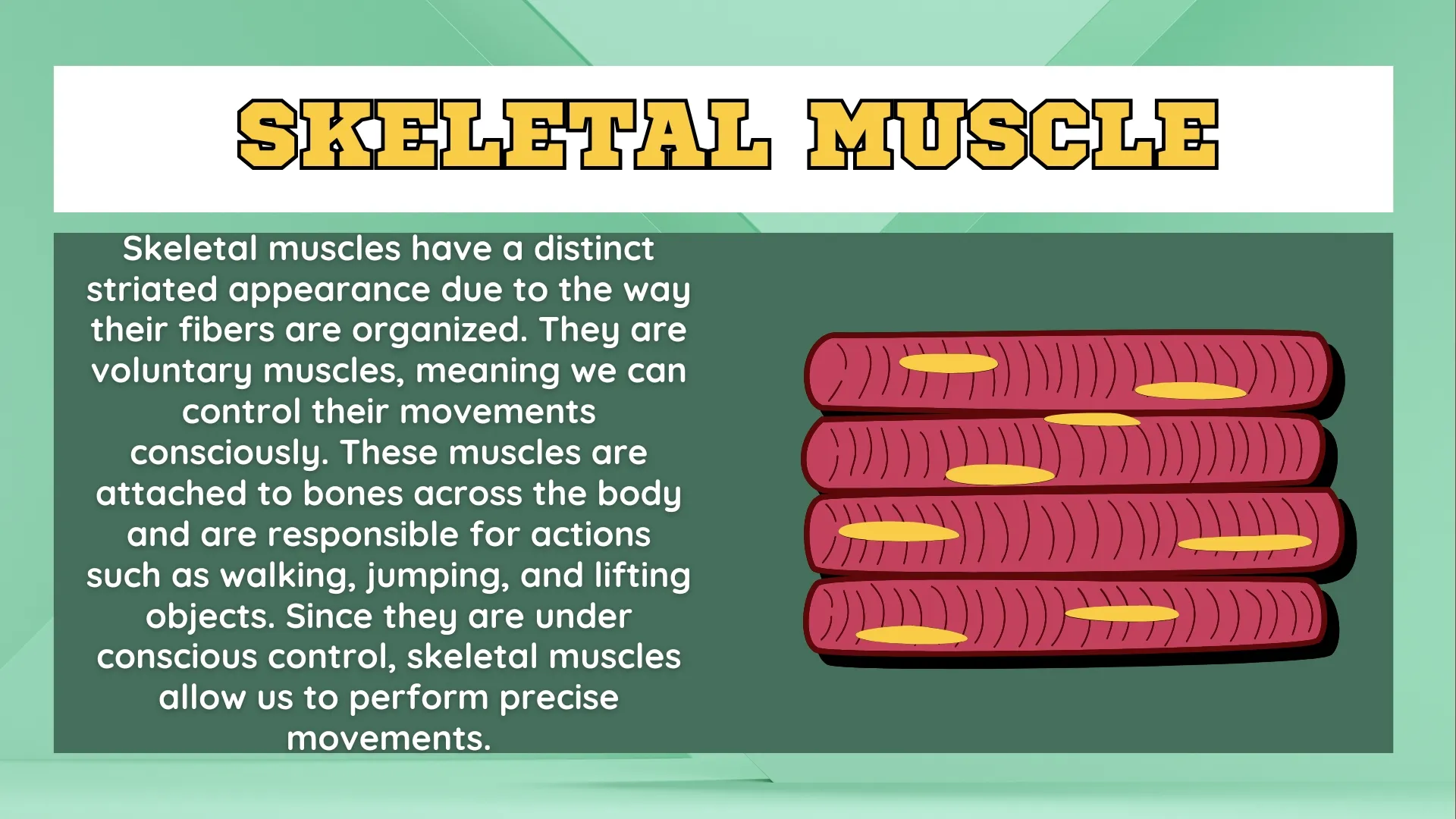
Skeletal muscles are attached to bones and controlled consciously by the brain. They have a striated (striped) appearance and are responsible for movements like walking, running, and lifting.
Cardiac Muscle
Where is it found?
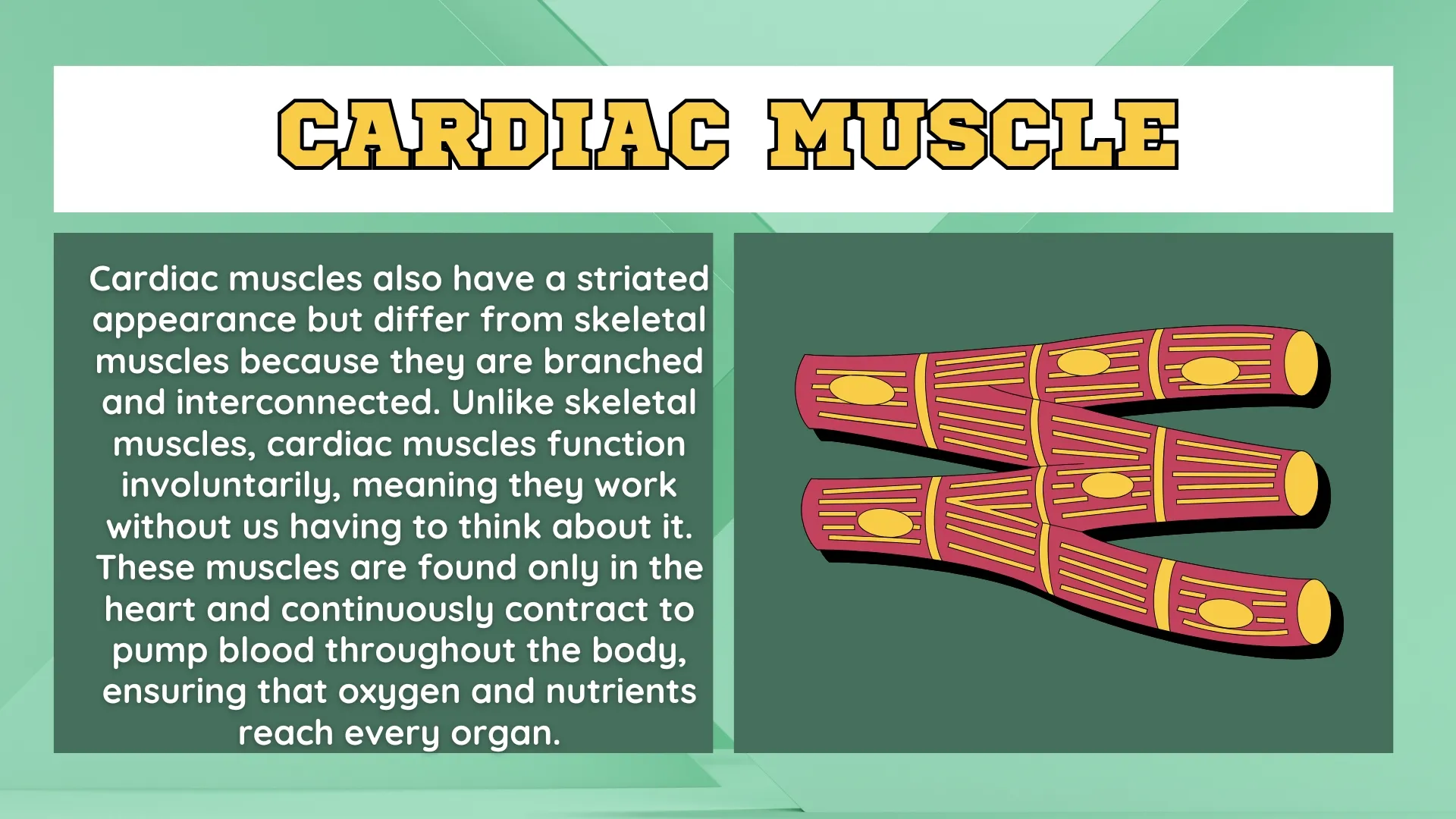
Cardiac muscles are involuntary, striated, and branched. They contract continuously without fatigue to pump blood throughout the body. They are interconnected for coordinated contractions.
Smooth Muscle
What is its appearance?
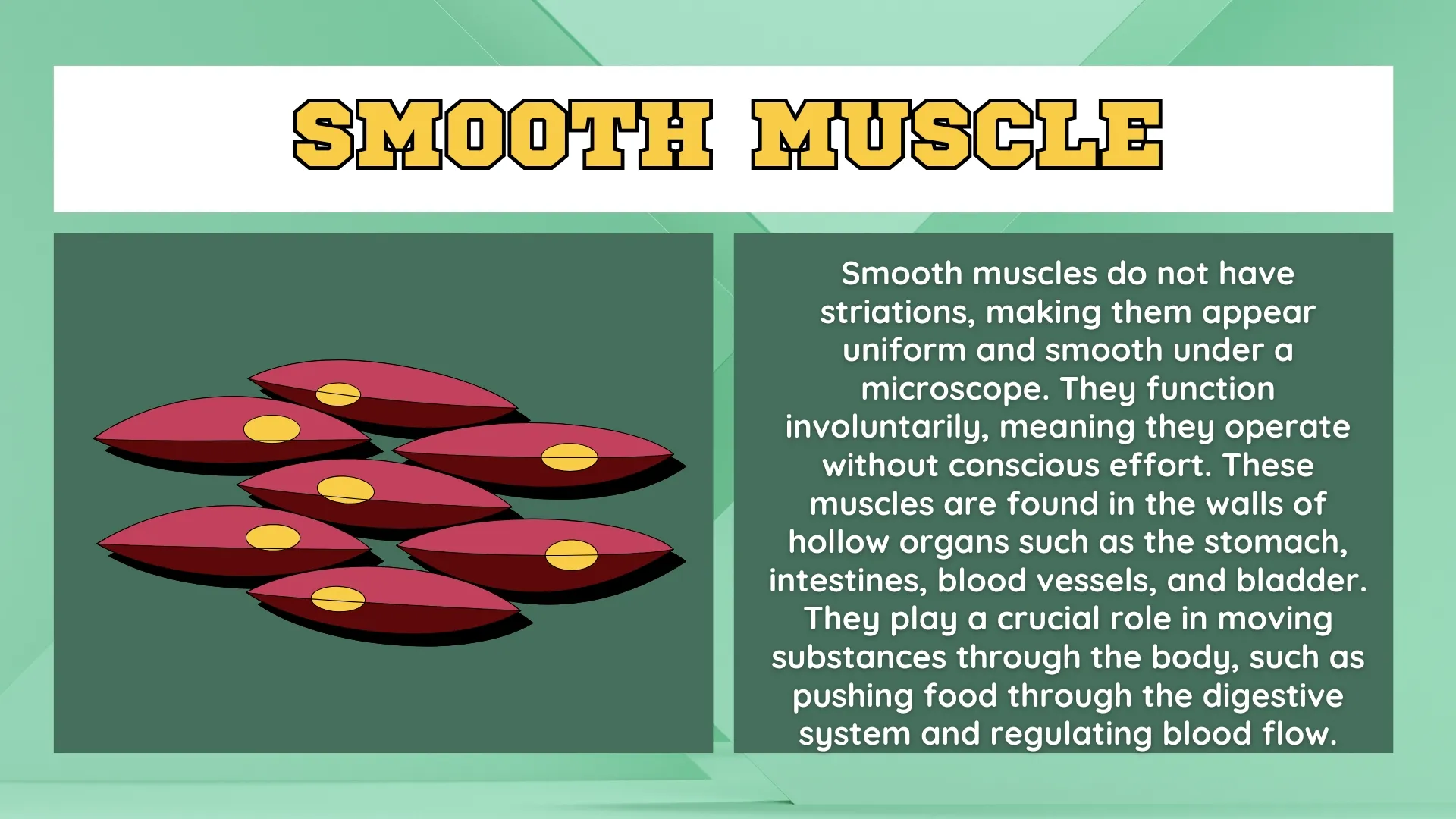
Smooth muscles are involuntary and found in the walls of hollow organs like the stomach, intestines, blood vessels, and bladder. They help move substances through the body.
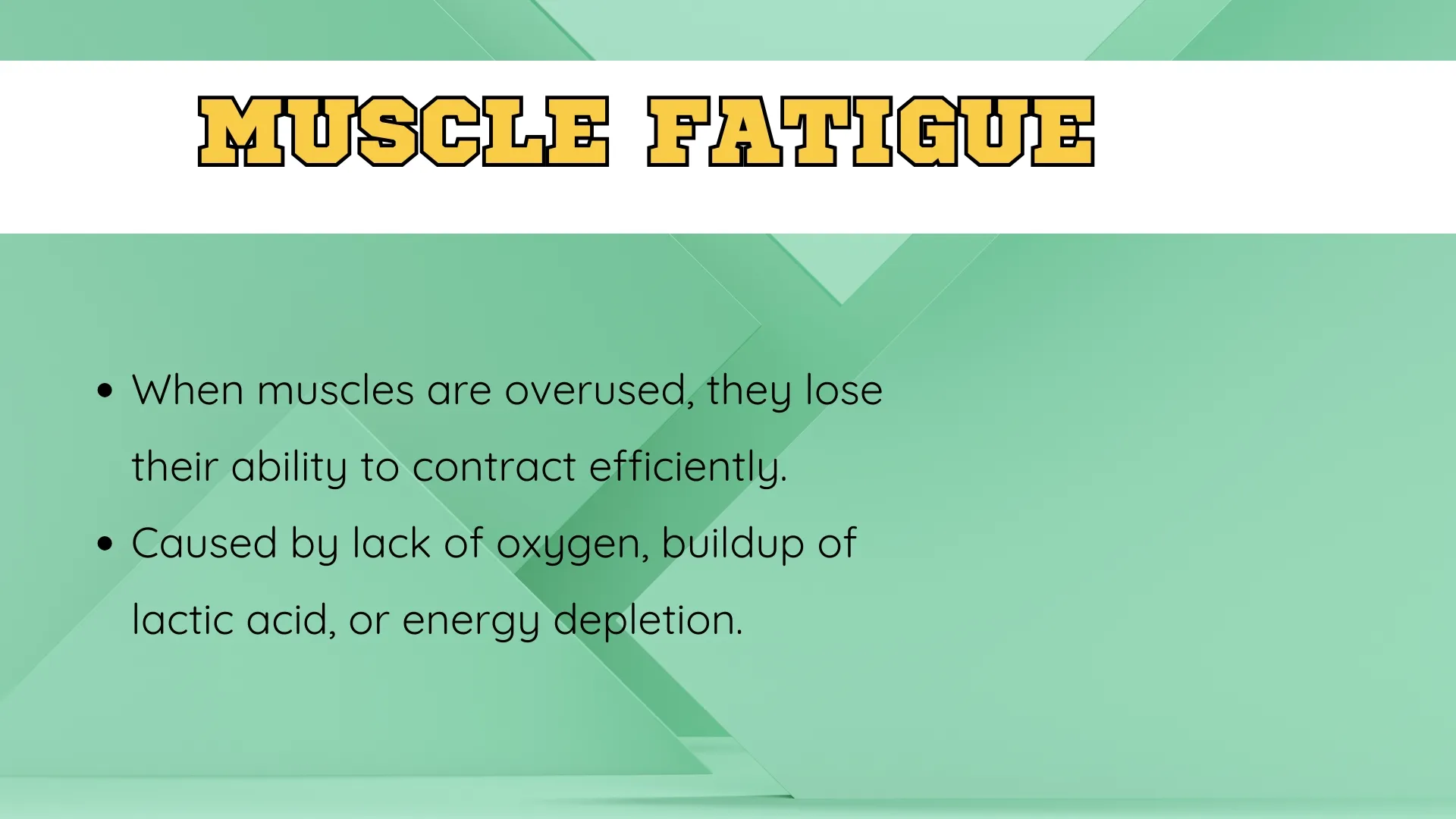
Muscle Fatigue
What causes it?
Muscle fatigue occurs when muscles lose their ability to contract efficiently due to lack of oxygen, buildup of lactic acid, or depletion of energy stores (ATP).
Muscle Pairs
How do muscles work together?
Muscles work in pairs - when one contracts, the other relaxes. For example, the biceps and triceps work together to bend and straighten the arm.
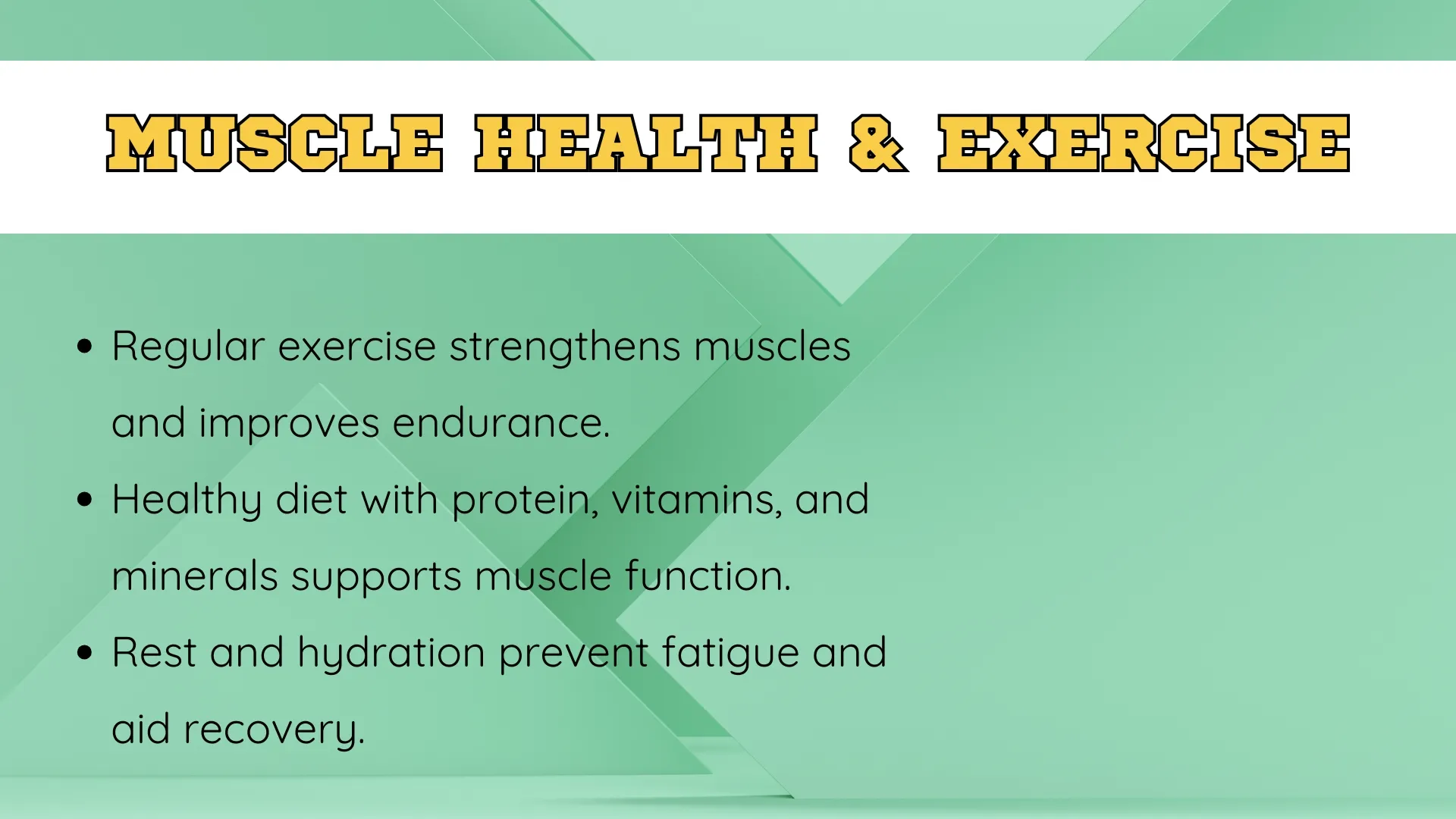
Muscle Health
How to maintain healthy muscles?
Regular exercise strengthens muscles. A healthy diet with protein, vitamins, and minerals supports muscle function. Rest and hydration prevent fatigue and aid recovery.
📝 Test Your Knowledge
Complete the quizzes to check your understanding of muscle types
✏️ Fill in the Blanks
Complete each sentence with the correct word. Use hints if you need help!
☑️ Multiple Answer Questions
Select ALL correct answers for each question (2-3 correct answers per question)
💪 Types of Muscles: The Three Kinds of Muscle Tissue Explained
How many types of muscle are there?
Ask a biology teacher and the answer is three. Every muscle in the human body is built from one of three kinds of muscle tissue: skeletal muscle, smooth muscle and cardiac muscle. They differ in what their cells look like under the microscope, in whether you can control them deliberately, and in where they are found.
You will also meet other numbers, and it helps to know why. "Two types of muscle" usually means the two functional groups: voluntary muscle, which you control consciously, and involuntary muscle, which works without you thinking about it. Skeletal muscle is the only voluntary type; smooth and cardiac muscle are both involuntary, so the three tissue types fold neatly into two groups. "Six types of muscle" is not a tissue classification at all. It normally comes from fitness and exercise guides that divide the body's skeletal muscles into major muscle groups, such as the chest, back, shoulders, arms, abdomen and legs, and those lists vary from one source to another. For a biology exam, the answer is three tissue types, which can be grouped as voluntary or involuntary.
What all muscles have in common
Muscle tissue is made of cells that can contract, which means they shorten and pull. Muscles can only pull; they never push. Contraction needs energy, which the muscle cells release by respiration, so muscle cells contain many mitochondria. Together the three types make up roughly 40 per cent of a person's body mass, and they are responsible for every movement the body makes, from running to the beating of the heart to the passage of food along the gut.
Skeletal muscle
Skeletal muscle is attached to the bones of the skeleton by tough cords called tendons, and when it contracts it moves the bones at a joint. It is voluntary: you decide to lift your arm and motor nerves carry the instruction to the muscle. Under the microscope its long, cylindrical cells, called fibres, show a pattern of light and dark bands, so it is described as striated or striped. Each fibre has many nuclei. Skeletal muscle contracts quickly and powerfully, but it also tires quickly, which is why you cannot hold a heavy bag at arm's length for long. The biceps, triceps, quadriceps and the muscles of the face and tongue are all skeletal muscle.
Smooth muscle
Smooth muscle is found in the walls of hollow organs and tubes: the stomach and intestines, the bladder, the uterus, the airways and the blood vessels, as well as in the iris of the eye. It is involuntary, controlled by the autonomic nervous system and by hormones rather than by conscious thought. Its cells are short, spindle-shaped, with a single nucleus and no striations, which is why it is called smooth. Smooth muscle contracts slowly and can stay contracted for a long time without tiring. The wave of contraction that squeezes food along the gut, called peristalsis, is smooth muscle at work, and so is the narrowing of blood vessels that raises blood pressure.
Cardiac muscle
Cardiac muscle is found in only one place: the wall of the heart. Its cells are striated like skeletal muscle, but they are shorter, branched, usually have one nucleus, and are joined end to end by special junctions called intercalated discs that let an electrical signal pass rapidly from cell to cell, so the whole heart wall contracts together. Cardiac muscle is involuntary and myogenic: it generates its own rhythm without any nerve impulse, which is why a heart keeps beating even when removed from the body for transplant. Nerves and the hormone adrenaline only speed the rhythm up or slow it down. Most remarkably, cardiac muscle never tires; it contracts around 100,000 times a day for a whole lifetime.
Comparing the three types of muscle
| Feature | Skeletal | Smooth | Cardiac |
|---|---|---|---|
| Control | Voluntary | Involuntary | Involuntary |
| Striations | Yes (striped) | No | Yes (striped) |
| Cell shape | Long, cylindrical fibres, many nuclei | Short, spindle-shaped, one nucleus | Branched, joined by intercalated discs, usually one nucleus |
| Where found | Attached to bones by tendons | Walls of gut, bladder, uterus, airways, blood vessels; iris | Wall of the heart only |
| Speed of contraction | Fast | Slow and sustained | Rhythmic, moderate speed |
| Tires? | Yes, quickly | Very slowly | Never |
| Job | Movement, posture, heat | Moving substances through organs, controlling tube width | Pumping blood |
How skeletal muscles move the body: antagonistic pairs
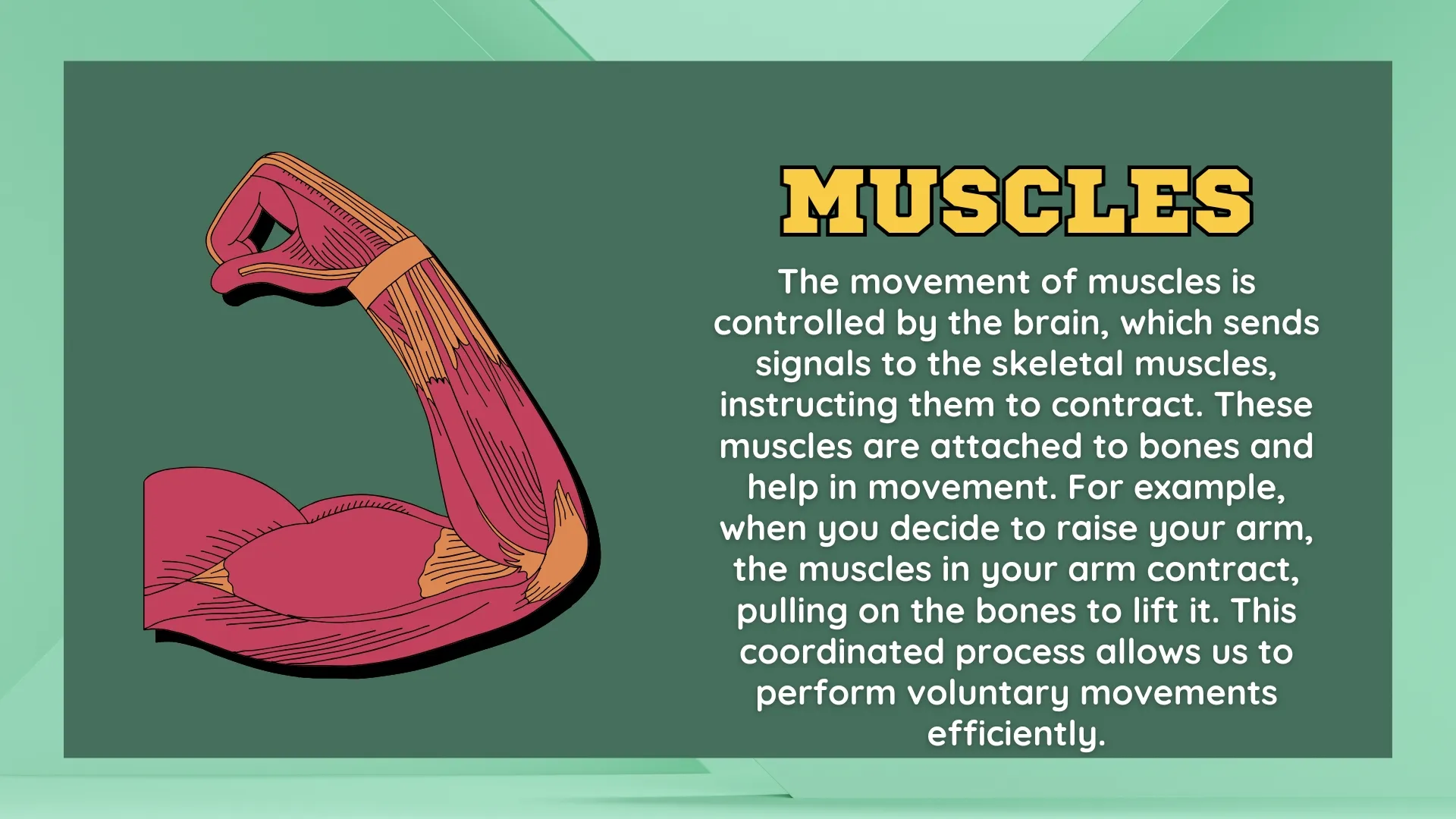
Because a muscle can only pull, one muscle cannot both bend and straighten a joint. Skeletal muscles therefore work in antagonistic pairs: when one contracts, the other relaxes and is stretched. In the upper arm the biceps contracts to bend the elbow while the triceps relaxes; to straighten the arm the triceps contracts and the biceps relaxes. The same arrangement moves the knee, the ankle and the fingers. Tendons attach the muscle to bone; do not confuse them with ligaments, which join bone to bone at a joint.
Why muscles get tired
During hard exercise the blood cannot deliver oxygen to skeletal muscle as fast as the muscle is using it. The muscle cells then switch partly to anaerobic respiration, which releases less energy from each glucose molecule and produces lactic acid. As lactic acid builds up the muscle contracts less efficiently and feels heavy and sore, a state called muscle fatigue. After exercise you keep breathing hard for a while because extra oxygen is needed to break the lactic acid down; this is the oxygen debt. Regular exercise, a diet with enough protein, and adequate rest all help skeletal muscle grow stronger and recover.
Key terms
- Striated
- Striped in appearance under the microscope; true of skeletal and cardiac muscle but not smooth muscle.
- Voluntary muscle
- Muscle under conscious control; skeletal muscle is the only voluntary type.
- Involuntary muscle
- Muscle that works without conscious control; smooth and cardiac muscle.
- Myogenic
- Able to contract rhythmically on its own without a nerve impulse; a property of cardiac muscle.
- Tendon
- A tough cord of connective tissue that attaches a skeletal muscle to a bone.
- Antagonistic pair
- Two muscles that produce opposite movements at a joint, such as the biceps and triceps.
- Peristalsis
- Waves of smooth-muscle contraction that push food along the gut.
- Muscle fatigue
- The loss of contracting power in a muscle after prolonged activity, linked to a build-up of lactic acid.