📖 Lesson: Calculating Electric Current
Learn how to calculate current, charge, and time in electrical circuits
🃏 Flashcards
Click each card to reveal the definition
🎮 Interactive Games
Test your knowledge about electric current calculations
⚡ The I = Q/t Formula Explained
What I = Q/t means
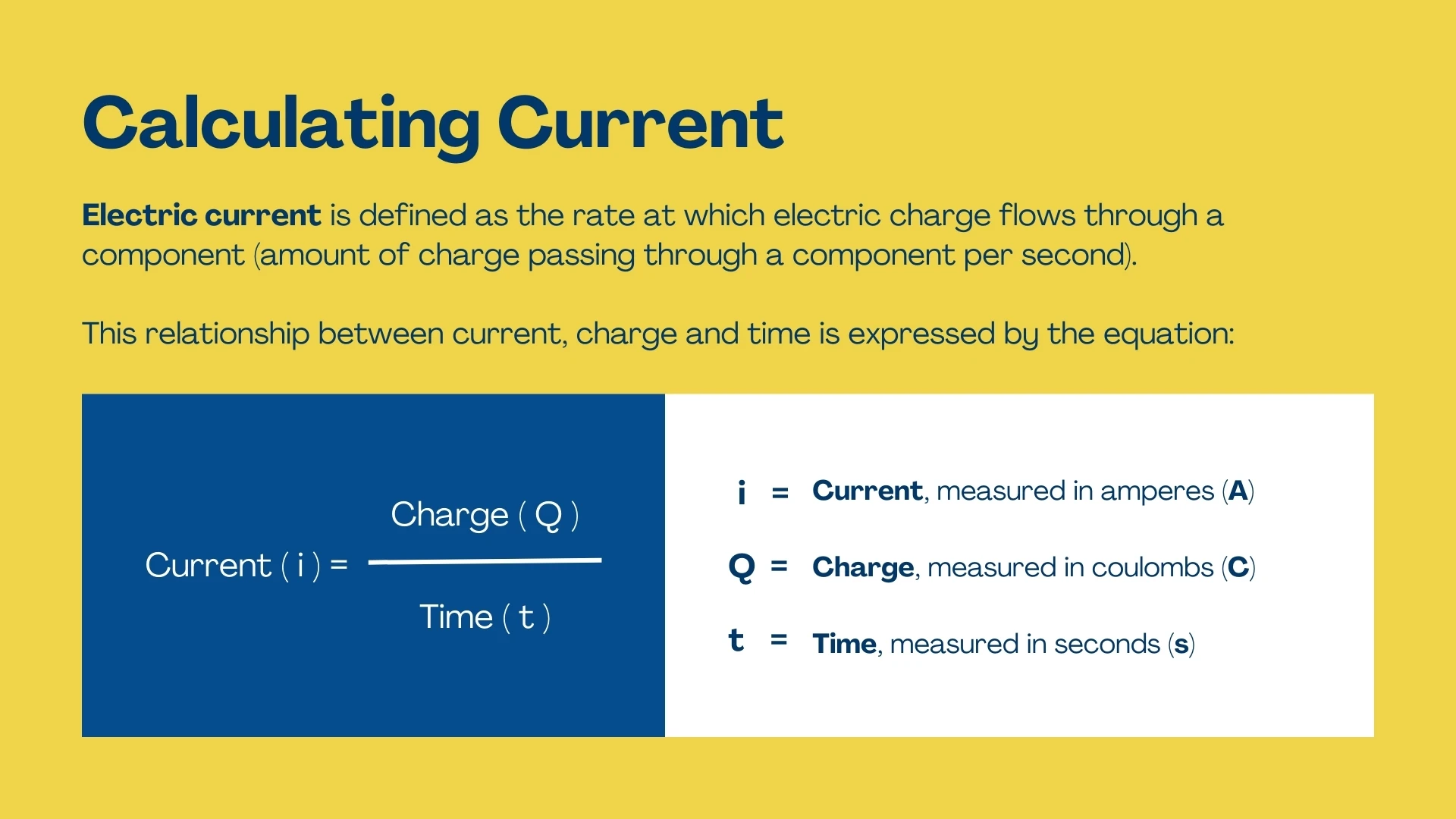
Electric current is not a thing in its own right — it is a rate. It measures how much electric charge flows past a point in a circuit each second. That is the whole idea behind the formula:
I = Q / t
Read it as "current equals charge divided by time". Each symbol stands for one quantity, and each quantity has its own unit:
- I — current
- How fast charge is flowing. Measured in amperes (A), often shortened to amps.
- Q — charge
- The amount of electric charge that has flowed. Measured in coulombs (C).
- t — time
- How long the charge took to flow. Measured in seconds (s).
This gives the definition of the ampere: a current of 1 ampere means 1 coulomb of charge passes a point every second. So an amp is really just a coulomb per second, and you will sometimes see the unit written that way, as C/s.
Rearranging the formula
Most exam questions do not hand you current, charge and time and ask for the one you already have. They give you two and ask for the third, so you need all three versions:
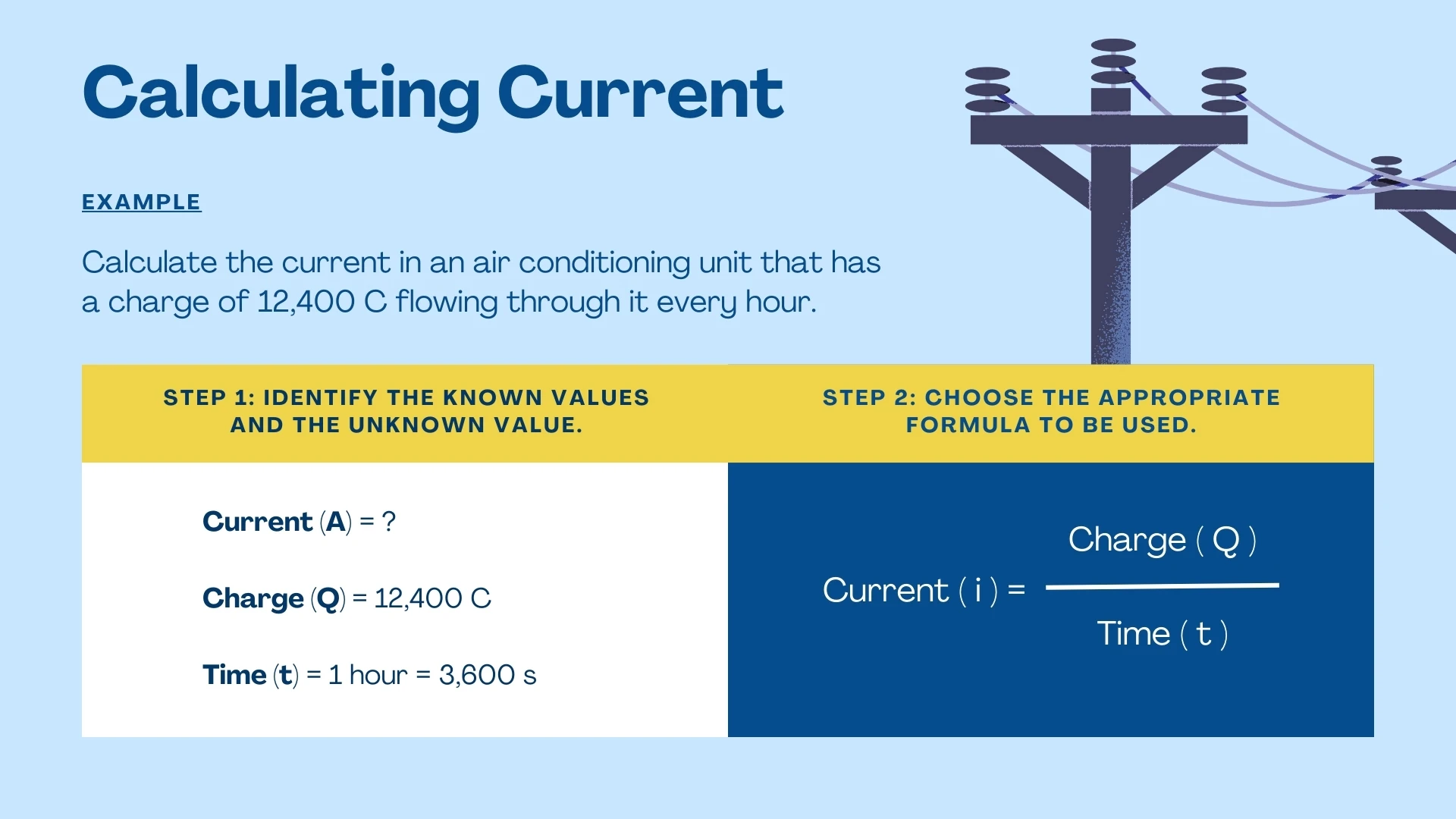
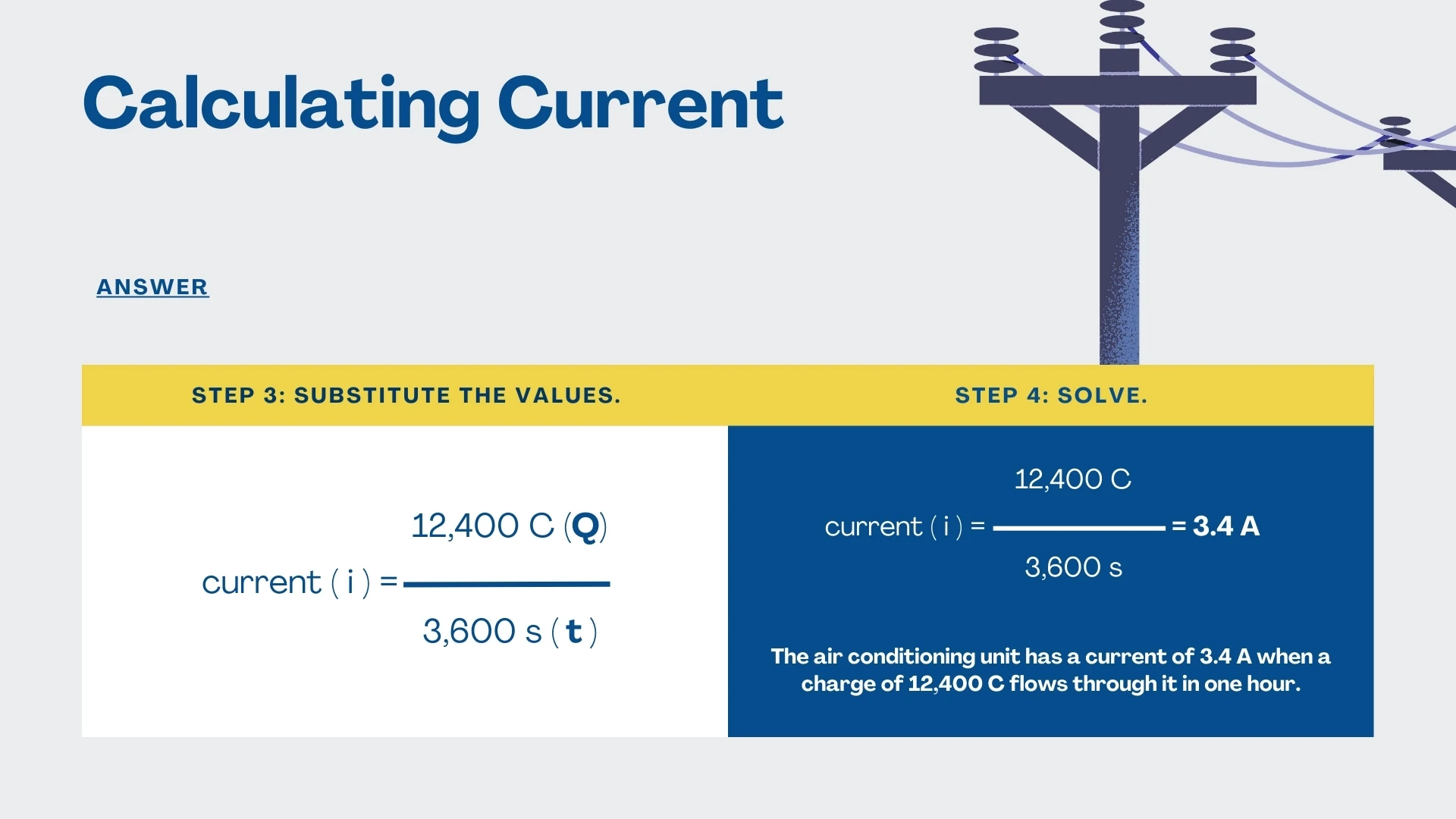
- To find current: I = Q / t — charge divided by time.
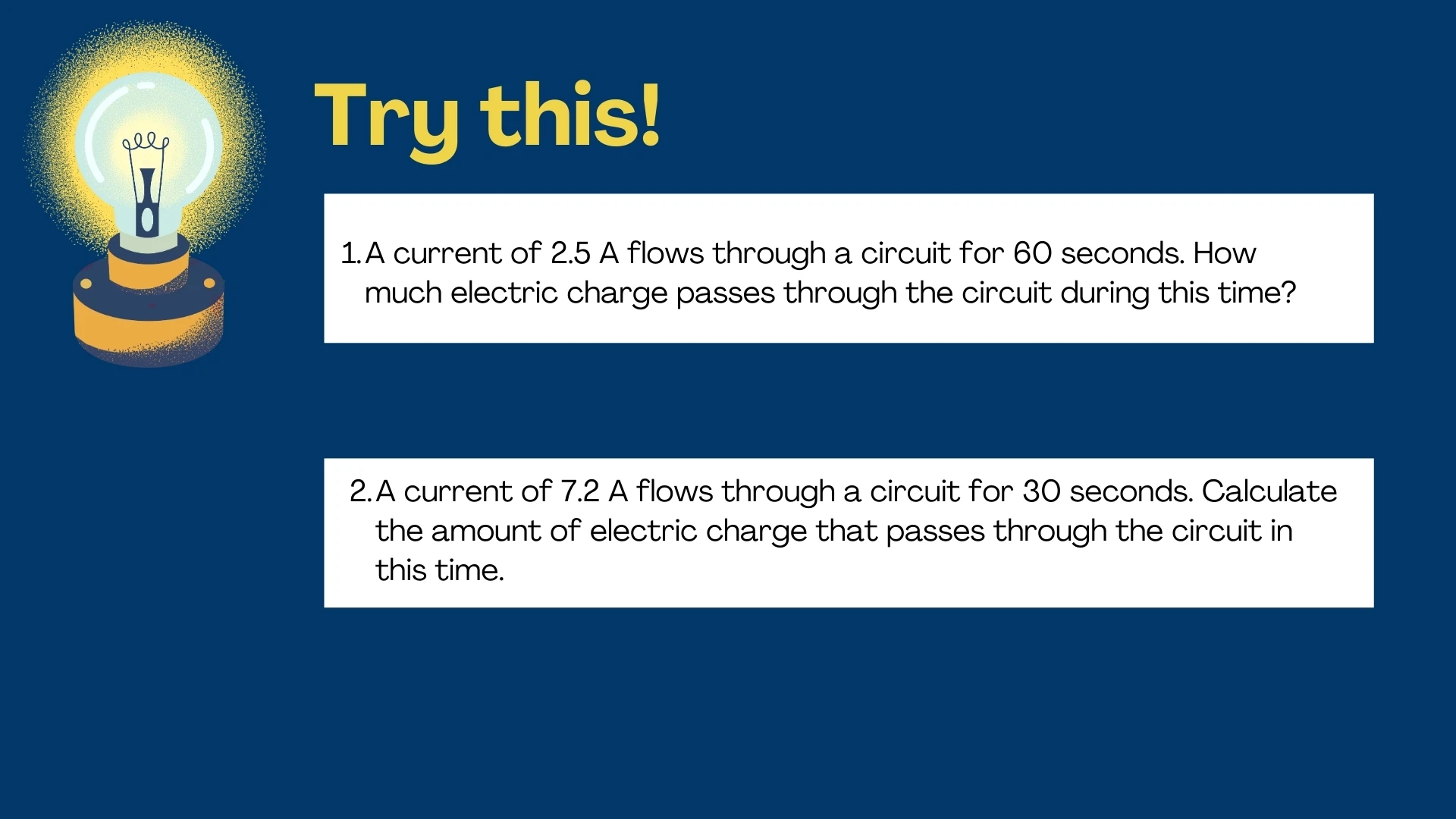
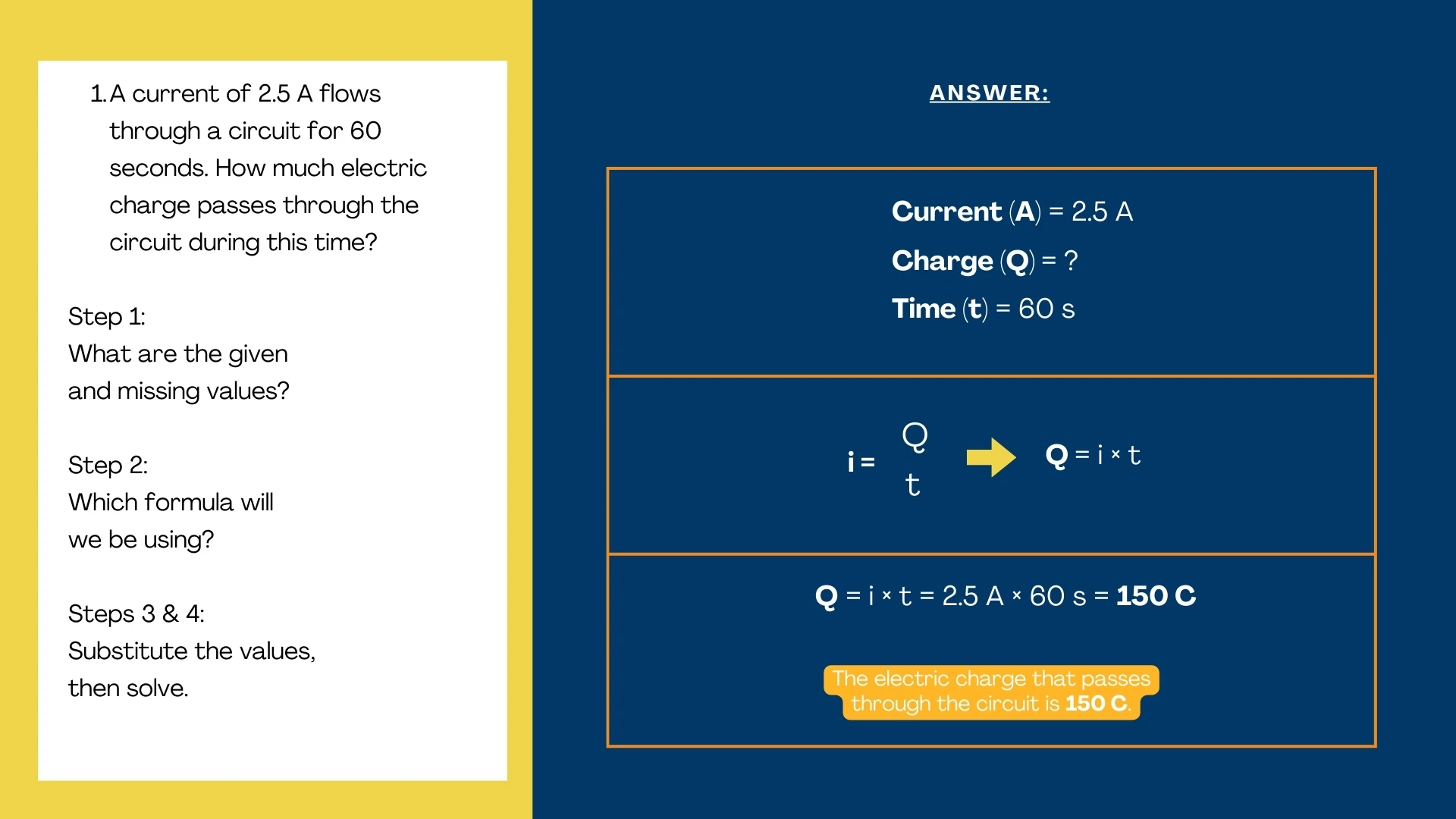
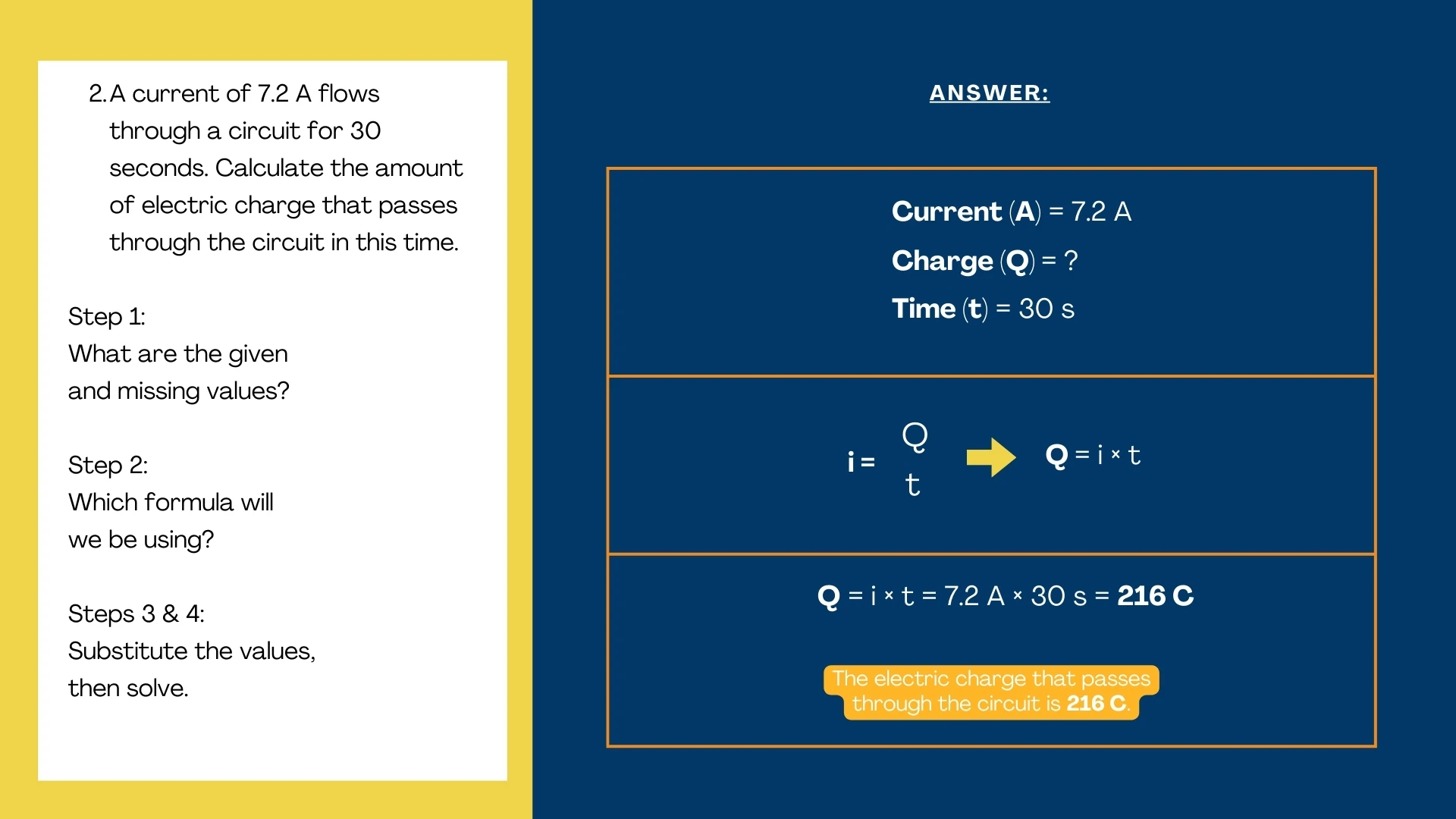
- To find charge: Q = I × t — current multiplied by time.
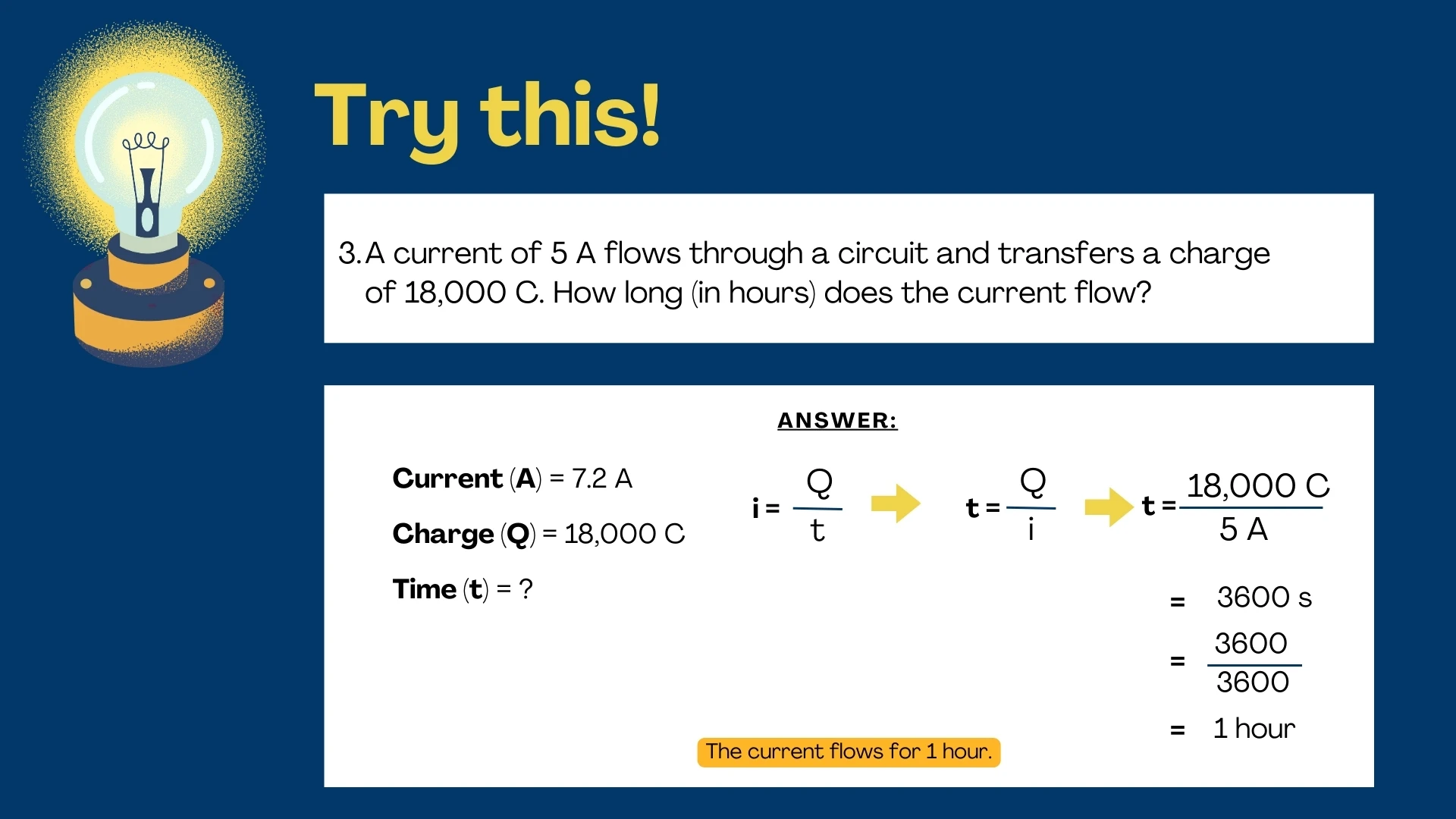
- To find time: t = Q / I — charge divided by current.
A useful check: if you are asked for charge, you multiply. If you are asked for current or time, you divide. Getting this the wrong way round is the single most common mistake in this topic.
Worked example 1 — finding charge
An electric welding machine takes a current of 15 amperes for 30 seconds. What quantity of electric charge is transported to the welder?
You are given current and time and asked for charge, so use Q = I × t:
Q = 15 A × 30 s = 450 C
450 coulombs of charge flow through the welder. Notice that the time was already in seconds — if a question gives you minutes or hours you must convert to seconds first, or every answer after that will be wrong.
Worked example 2 — finding current
120 coulombs of charge flow through a lamp in 60 seconds. What is the current?
I = Q / t = 120 C ÷ 60 s = 2 A
Two coulombs arrive every second, so the current is 2 amperes.
Worked example 3 — finding time
How long does it take for 90 coulombs of charge to flow through a motor carrying a current of 3 A?
t = Q / I = 90 C ÷ 3 A = 30 s
Worked example 4 — converting the time first
A torch bulb carries a current of 0.4 A for 5 minutes. How much charge passes through it?
First convert: 5 minutes × 60 = 300 seconds. Then apply Q = I × t:
Q = 0.4 A × 300 s = 120 C
How many electrons is that?
Charge is carried by electrons, and each electron carries a tiny fixed charge of about 1.6 × 10⁻¹⁹ coulombs. To find how many electrons make up a given charge, divide:
number of electrons = Q ÷ 1.6 × 10⁻¹⁹ C
So the 450 C in the welding example above is carried by roughly 2.8 × 10²¹ electrons. The number is enormous because a single electron's charge is so extremely small — which is exactly why we measure charge in coulombs rather than counting electrons.
Common mistakes to avoid
- Leaving time in minutes or hours. The formula only works with seconds. Convert first.
- Dividing when you should multiply. Charge is current × time, not current ÷ time.
- Mixing up the units. Amperes measure current, coulombs measure charge. They are not interchangeable.
- Forgetting the unit in the answer. A bare number scores no marks — write 450 C, not 450.
Key terms
- Current (I)
- The rate of flow of electric charge, measured in amperes (A).
- Charge (Q)
- A quantity of electricity, measured in coulombs (C).
- Ampere (A)
- The unit of current. One ampere is one coulomb per second.
- Coulomb (C)
- The unit of charge. The charge carried past a point by a current of 1 A in 1 second.
- Elementary charge
- The charge on a single electron, about 1.6 × 10⁻¹⁹ C.