Everything in the universe, from the air you breathe to the phone in your hand, can be classified as an element, a compound or a mixture. Knowing the difference is one of the first big ideas in chemistry, and it unlocks everything that comes after: formulae, equations, bonding and reactions. In this guide you will learn clear definitions, see plenty of real examples, understand what "pure" really means to a chemist, and master the separation techniques that appear in every IGCSE and GCSE exam.
📖 Lesson
Definitions, examples, the iron and sulfur experiment and every separation technique, with the exam mistakes to avoid.
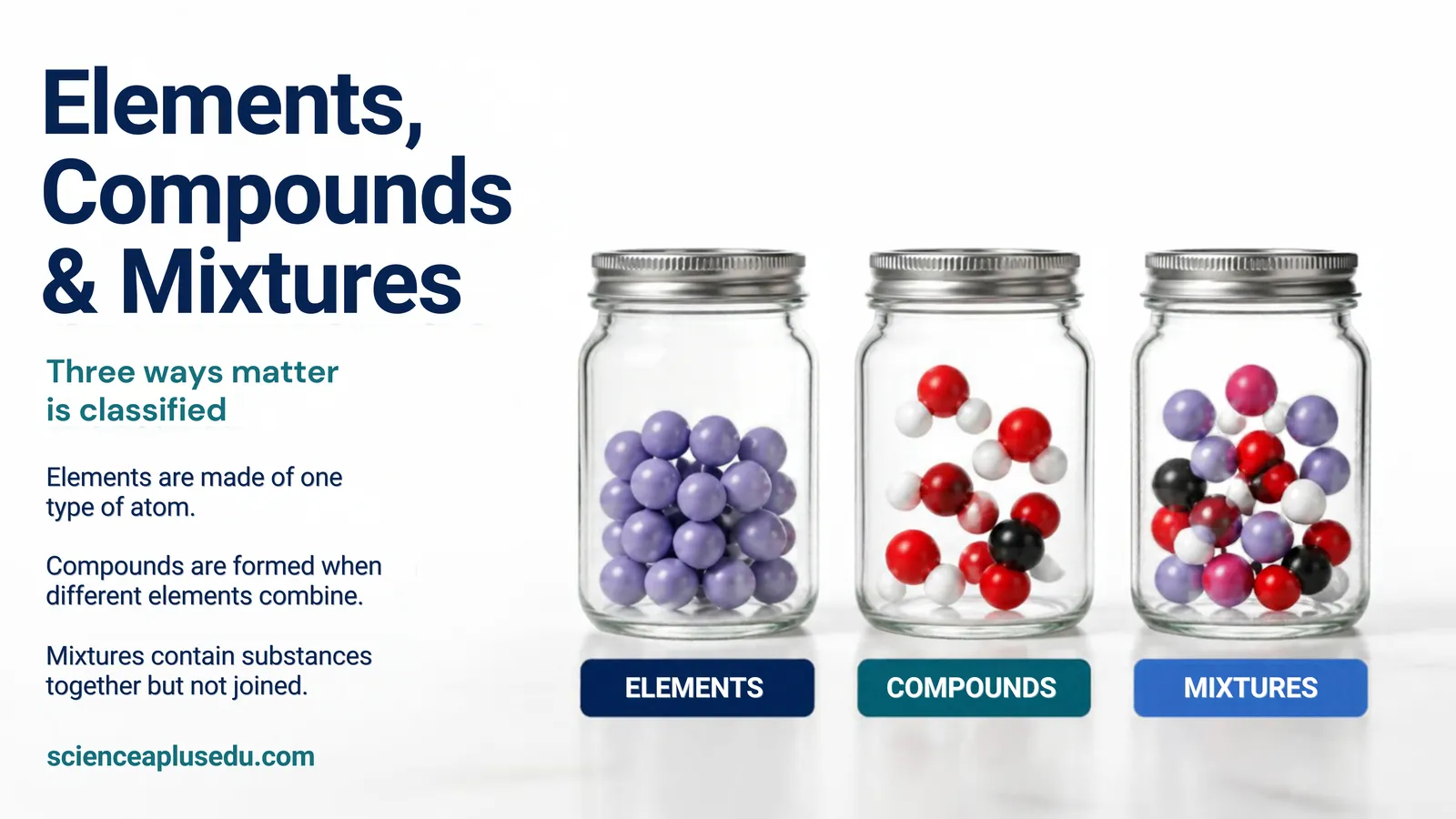
Slide: Three ways matter is classified
Elements, compounds and mixtures at a glance
1/1
What Is an Element?
An element is a substance made of only one type of atom. It cannot be broken down into anything simpler by chemical reactions.
There are 118 known elements, and they are all arranged in the Periodic Table. Each element has a symbol of one or two letters: O for oxygen, Fe for iron (from the Latin ferrum), Na for sodium (from natrium) and Au for gold (from aurum). The first letter is always a capital and the second is always lower case, so Co is cobalt but CO is carbon monoxide, a compound.
Elements can exist as:
Single atoms: for example, the noble gases helium (He) and neon (Ne).
Molecules: two or more atoms of the same element bonded together, such as oxygen (O2), nitrogen (N2), chlorine (Cl2) and sulfur (S8).
Giant structures: such as metals like copper, or carbon in the form of diamond and graphite.
About three-quarters of the elements are metals. Most of the rest are non-metals, and a few, such as silicon, are metalloids with properties in between.
What Is a Compound?
A compound is a substance made of two or more different elements chemically bonded together in fixed proportions.
Examples include:
Water, H2O: always two hydrogen atoms bonded to one oxygen atom.
Carbon dioxide, CO2: one carbon atom and two oxygen atoms.
Sodium chloride, NaCl: sodium and chloride ions in a 1:1 ratio.
Glucose, C6H12O6.
Calcium carbonate, CaCO3: the main compound in limestone, chalk and marble.
Key features of compounds
They have a fixed composition, shown by a chemical formula.
They can only be separated into their elements by chemical reactions, such as electrolysis or thermal decomposition, not by physical methods.
Their properties are completely different from the elements they are made from.
That last point is remarkable. Sodium is a soft metal that explodes in water, and chlorine is a poisonous green gas, yet together they form sodium chloride, the harmless salt you sprinkle on food. Hydrogen is a flammable gas and oxygen helps things burn, but water puts out fires.
Naming simple compounds
A compound of a metal and a non-metal is named with the metal first and the non-metal ending in -ide: magnesium oxide, sodium chloride, iron sulfide.
A compound ending in -ate contains oxygen as well: copper sulfate (CuSO4) contains copper, sulfur and oxygen; calcium carbonate contains calcium, carbon and oxygen.
Prefixes show the number of atoms in some compounds: mono (one), di (two), tri (three), as in carbon monoxide (CO) and carbon dioxide (CO2).
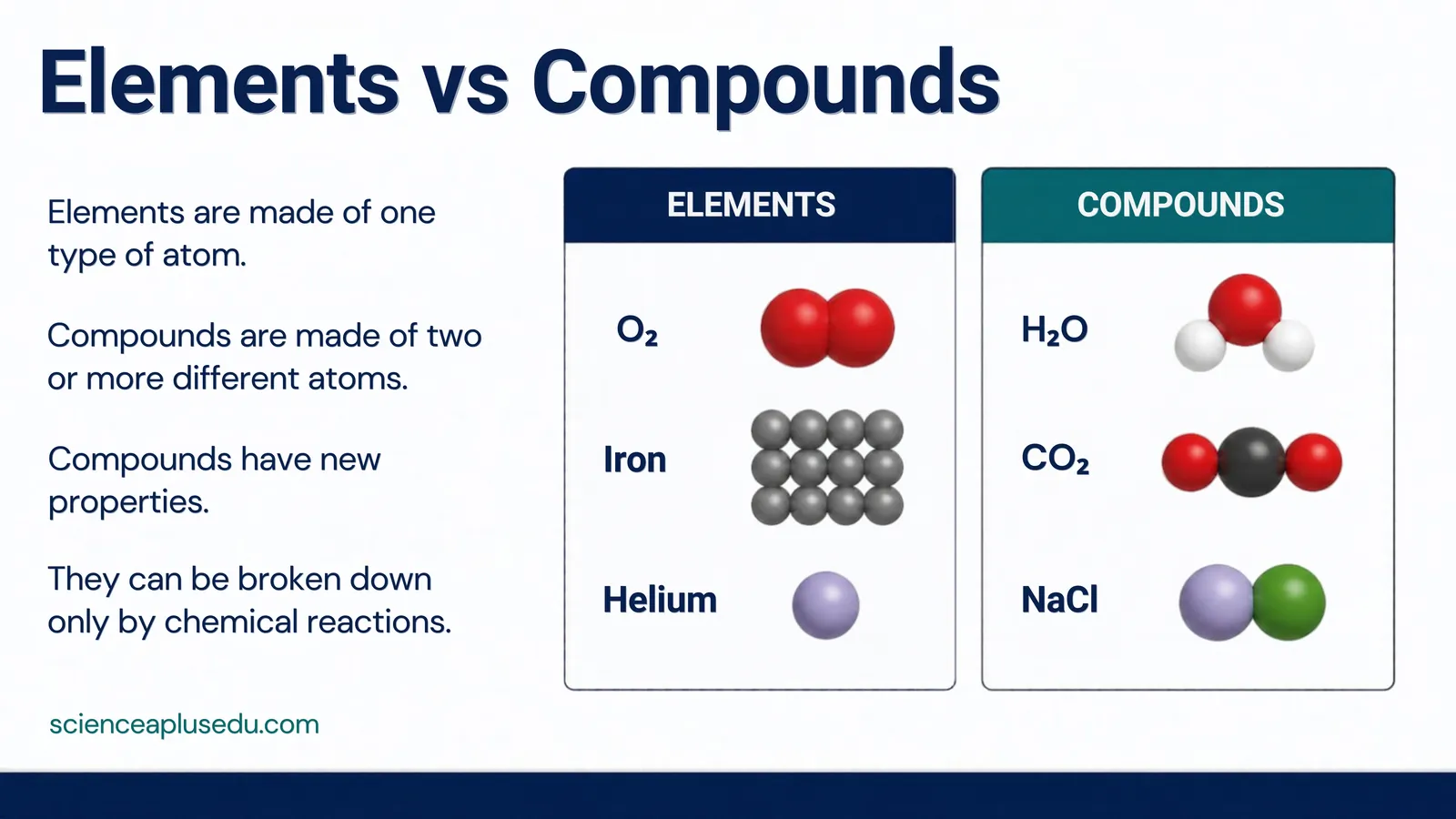
Slide: Elements vs compounds
Atoms of one kind, or different atoms bonded together
1/1
What Is a Mixture?
A mixture contains two or more substances (elements or compounds) that are not chemically joined together.
Examples include:
Air: a mixture of nitrogen (about 78 percent), oxygen (about 21 percent), argon, carbon dioxide and water vapour.
Sea water: water with dissolved salts.
Crude oil: a mixture of many hydrocarbons.
Alloys such as brass (copper and zinc) and steel (iron with carbon and other elements).
Ink, which contains several different dyes.
Soil, sand and salt, and fruit juice.
Key features of mixtures
The substances keep their own properties. A mixture of iron filings and sulfur still contains magnetic iron and yellow sulfur.
The composition can vary. You can make salt water weak or strong.
They can be separated by physical methods such as filtration and distillation.
They usually melt and boil over a range of temperatures.
Elements vs Compounds vs Mixtures: The Comparison Table
| Feature | Element | Compound | Mixture |
|---|---|---|---|
| Made of | One type of atom | Two or more elements chemically bonded | Two or more substances not chemically bonded |
| Composition | Fixed | Fixed ratio (has a formula) | Variable |
| Properties | Its own properties | Different from its elements | Components keep their own properties |
| Separation | Cannot be broken down | Only by chemical reactions | By physical methods |
| Melting and boiling point | Sharp, fixed | Sharp, fixed | Over a range |
| Examples | Oxygen, iron, carbon | Water, carbon dioxide, salt | Air, sea water, brass |
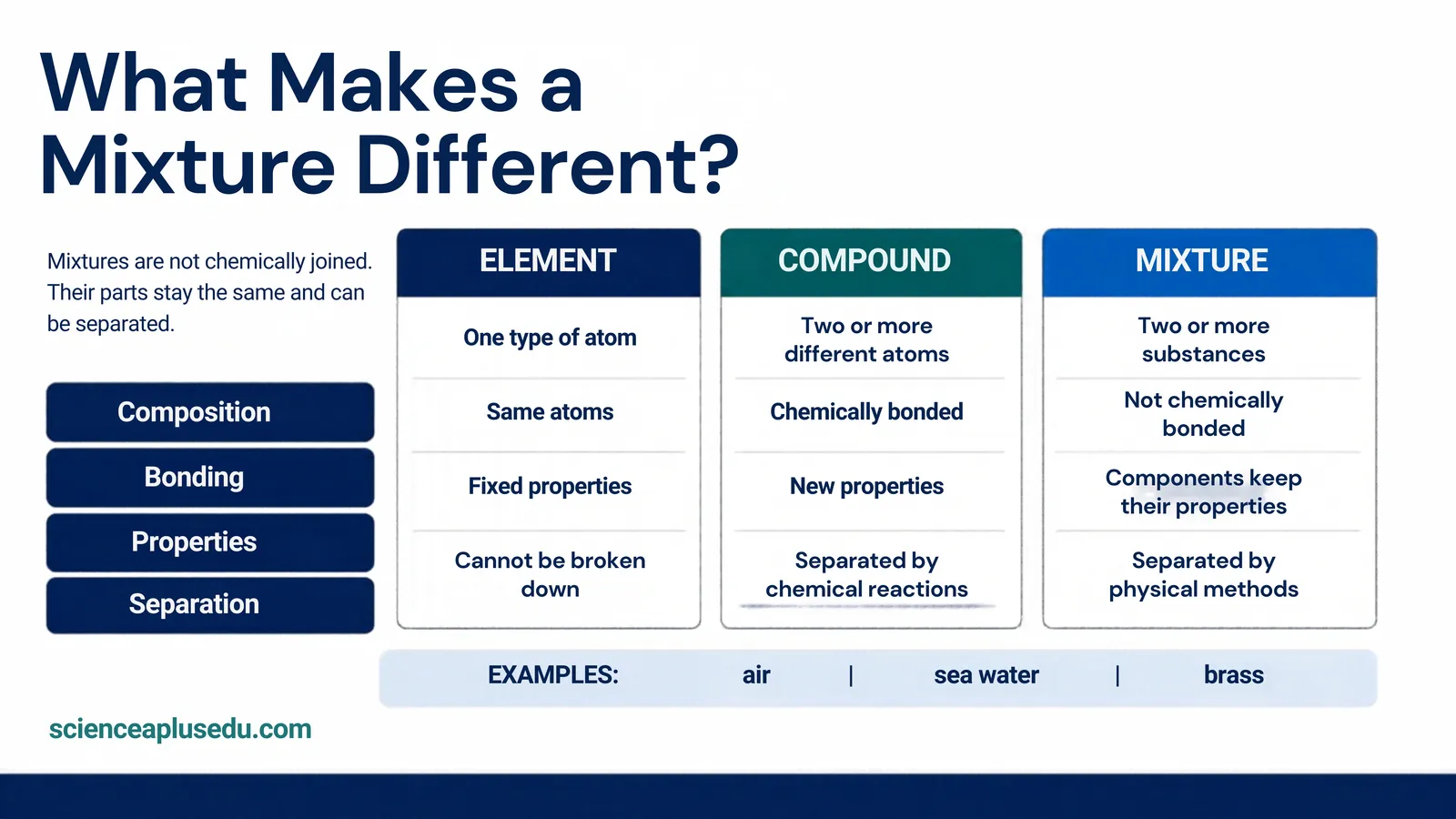
Slide: What makes a mixture different?
Composition, bonding, properties and separation compared
1/1
The Iron and Sulfur Experiment
This classic experiment clearly shows the difference between a mixture and a compound.
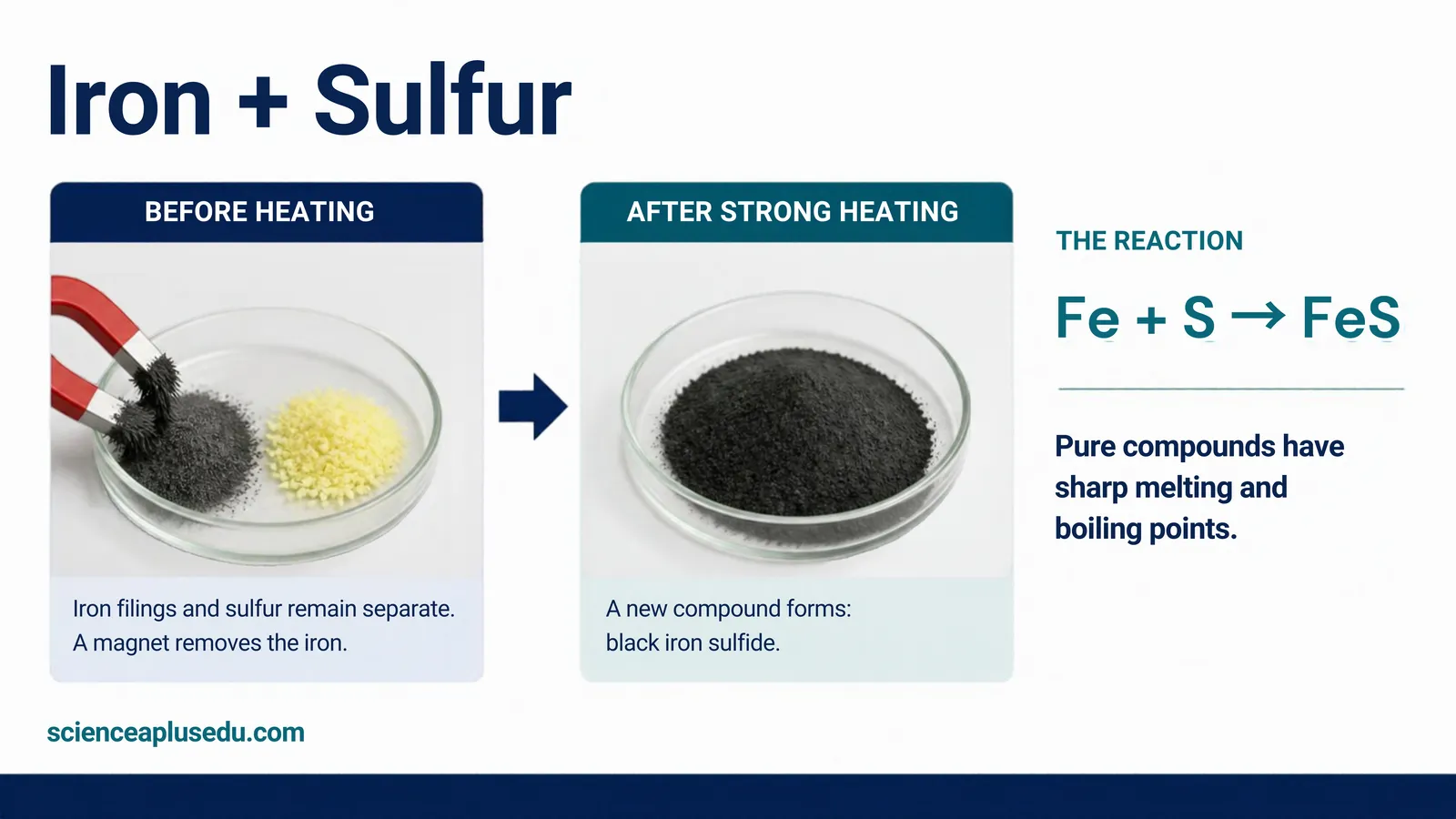
Mix iron filings and powdered sulfur. You can still see yellow and grey particles, and a magnet pulls the iron out. This is a mixture.
Heat the mixture strongly. It glows red hot and keeps glowing even after the Bunsen burner is removed, because the reaction is exothermic.
A black solid forms: iron sulfide, FeS. This is a new compound. It is not attracted to a magnet and does not look like either element.
Fe + S → FeS
Slide: Iron + sulfur
Before and after strong heating
1/1
Pure and Impure Substances
In everyday language, "pure" means natural or with nothing added. Pure orange juice, for example, is actually a mixture of water, sugars, acids and many other chemicals. In chemistry, a pure substance is a single element or a single compound that contains nothing else.
The best way to test purity is to measure the melting point or boiling point:
A pure substance melts and boils at a sharp, fixed temperature. Pure water melts at exactly 0 °C and boils at 100 °C.
An impure substance melts over a range of temperatures, usually lower than the pure substance, and boils at a higher temperature.
Formulations
A formulation is a mixture that has been carefully designed for a particular purpose, with each ingredient in a measured amount. Medicines, paints, fertilisers, cleaning products, cosmetics and fuels are all formulations.
How to Separate Mixtures
Choosing the right separation technique depends on the properties of the substances in the mixture.
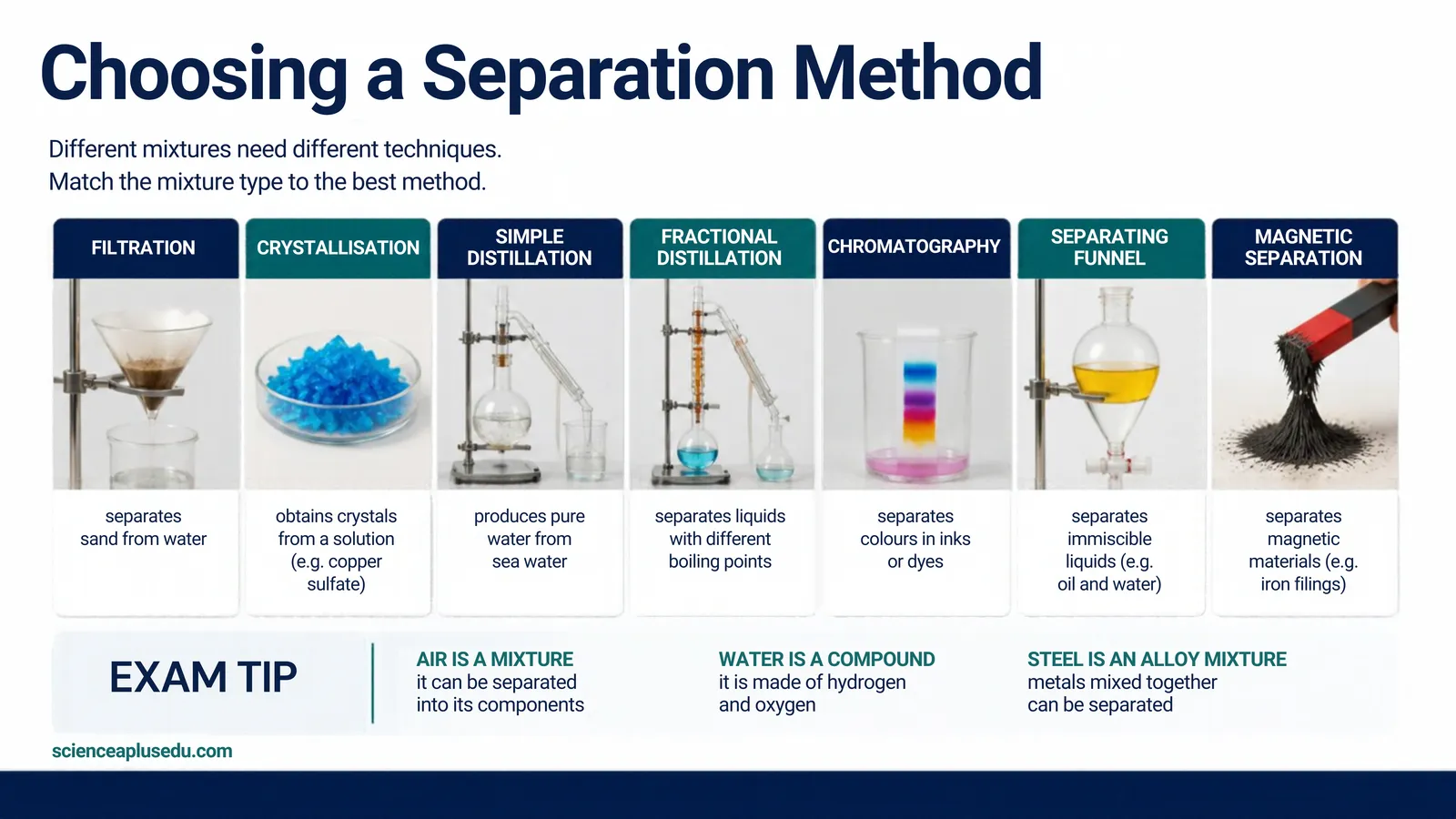
| Technique | Used to separate | Example |
|---|---|---|
| Filtration | An insoluble solid from a liquid | Sand from water |
| Evaporation | A soluble solid from a solution (when crystals are not needed) | Salt from sea water |
| Crystallisation | A soluble solid from a solution, forming pure crystals | Copper sulfate crystals from its solution |
| Simple distillation | A solvent from a solution | Pure water from sea water |
| Fractional distillation | Miscible liquids with different boiling points | Ethanol from water; crude oil fractions |
| Paper chromatography | Soluble substances such as dyes | Dyes in ink or food colourings |
| Separating funnel | Immiscible liquids | Oil from water |
| Magnet | Magnetic from non-magnetic solids | Iron filings from sulfur |
Filtration
Filtration separates an insoluble solid from a liquid. The mixture is poured through filter paper in a funnel. The solid particles are too large to pass through the tiny holes in the paper and stay behind as the residue. The liquid passes through as the filtrate. Water treatment works use filtration through beds of sand and gravel to clean drinking water.
Crystallisation
Crystallisation obtains pure crystals of a soluble solid from a solution.
Heat the solution in an evaporating basin to evaporate some of the water.
Stop heating when the solution is saturated. To check, dip in a cold glass rod: if crystals form on it, the solution is ready.
Leave the solution to cool slowly. Crystals form because the solid is less soluble in cold water.
Filter off the crystals, wash them with a little cold distilled water and dry them between filter papers.
Crystallisation is better than evaporating to dryness for salts such as hydrated copper sulfate, which would decompose if heated too strongly.
Simple distillation
Simple distillation separates a liquid from a solution, keeping the liquid.
The solution is heated in a flask, and the solvent boils and turns to vapour.
The vapour passes into a Liebig condenser, where cold water flowing through the outer jacket cools it back into a liquid.
The pure liquid, called the distillate, drips into a beaker.
The dissolved solid stays behind in the flask.
Cold water enters the condenser at the bottom and leaves at the top so that the jacket stays completely full and cooling is most efficient. A thermometer bulb is placed level with the side arm to measure the temperature of the vapour being collected.
Fractional distillation
Fractional distillation separates miscible liquids (liquids that mix completely) with different boiling points, such as ethanol (78 °C) and water (100 °C). A fractionating column, packed with glass beads, is placed between the flask and the condenser. The column is hotter at the bottom and cooler at the top. Vapours condense and re-evaporate many times on the beads. The liquid with the lower boiling point reaches the top first and is collected, and the temperature on the thermometer stays constant while each fraction distils. On a huge scale, fractional distillation separates crude oil into useful fractions such as petrol, diesel and kerosene, and separates liquefied air into oxygen and nitrogen.
Paper chromatography
Chromatography separates mixtures of soluble substances, such as the dyes in ink.
Draw a baseline in pencil near the bottom of the chromatography paper. Pencil is used because it is insoluble and will not run.
Place small spots of the samples on the line.
Stand the paper in a beaker containing a shallow layer of solvent. The solvent level must be below the baseline, or the spots would dissolve into the solvent.
As the solvent moves up the paper, it carries the dyes with it. Each dye travels a different distance depending on how soluble it is in the solvent and how strongly it is attracted to the paper.
Remove the paper before the solvent reaches the top and mark the solvent front.
A pure substance produces one spot; a mixture produces several spots. Spots that match in height and colour show the same substance.
Calculating Rf values
The Rf value (retention factor) is used to identify substances:
Rf = distance travelled by the substance ÷ distance travelled by the solvent
For example, if a dye moves 3.2 cm and the solvent front moves 8.0 cm, Rf = 3.2 ÷ 8.0 = 0.40. The Rf value is always less than 1 and has no units. It is constant for a given substance in the same solvent, so scientists compare Rf values with known references. Colourless substances, such as amino acids, can be made visible by spraying the paper with a locating agent.
Slide: Choosing a separation method
Match the technique to the mixture
1/1
Common Exam Mistakes
Saying a compound is "a mixture of elements". Compounds are chemically bonded; mixtures are not.
Using a pen instead of a pencil for the chromatography baseline.
Placing the solvent above the baseline.
Forgetting that the thermometer in distillation should be at the side arm.
Describing pure orange juice as a pure substance.
Frequently Asked Questions
Is water an element or a compound?
Water is a compound, because it contains hydrogen and oxygen chemically bonded in a fixed 2:1 ratio.
Is air a compound?
No, air is a mixture. Its gases are not chemically bonded, and its composition can vary slightly.
Is steel an element, compound or mixture?
Steel is an alloy, which is a mixture of iron with carbon and often other elements.
Key Takeaways
Elements contain only one type of atom and are listed in the Periodic Table.
Compounds contain different elements chemically bonded in fixed proportions and have new properties.
Mixtures contain substances that are not chemically joined and can be separated by physical methods.
Pure substances have sharp melting and boiling points.
Filtration, crystallisation, distillation and chromatography each separate different types of mixture.
To understand why elements behave so differently, you need to look inside the atom. Continue with our guide to atomic structure.
🗂️ Revision Flashcards
Tap a card to reveal the answer.
🎯 Quick Quiz
8 questions. Pick an answer to check it straight away.
1What is an element?
An element is made of one type of atom and cannot be broken down by chemical reactions.
2Which of these is a compound?
Carbon dioxide has one carbon atom and two oxygen atoms chemically bonded; oxygen and helium are elements and air is a mixture.
3Which statement about a mixture is correct?
In a mixture such as iron filings and sulfur, each substance keeps its own properties.
4After iron and sulfur are heated strongly, what forms?
A black solid, iron sulfide, forms. It does not look like either element and is not attracted to a magnet.
5How does an impure substance melt?
Pure substances have sharp melting points; impure ones melt over a range.
6Which technique separates pure water from sea water?
Simple distillation separates a solvent from a solution; the solid stays behind in the flask.
7A dye moves 3.2 cm and the solvent front moves 8.0 cm. What is its Rf value?
Rf = 3.2 ÷ 8.0 = 0.40.
8Why is the chromatography baseline drawn in pencil?
Pencil is insoluble, so the line does not run up the paper with the solvent.