⚡ Nerve impulses🧠 Brain regions🔗 Synapses🔁 Reflex arc👁️ Sense organs
📖 Lesson
Neurons, synapses, the CNS and PNS, the brain's main regions and the reflex arc, built up one layer at a time.
Introduction: The Fastest Network You Own
Touch something unexpectedly hot and your hand pulls back before you have finished thinking the word hot. You did not decide to move. The decision was made somewhere inside you, acted upon, and completed while your conscious mind was still catching up.
That is the nervous system at work. It is the fastest communication network in your body, capable of sending signals at speeds above one hundred metres per second. It controls your heartbeat, your breathing, your balance, your memory of last week's lesson, and the small decision you just made to keep reading this line.
This guide breaks the nervous system down into pieces that make sense, starting with its single building block and working up to the brain itself.
What Is the Nervous System?
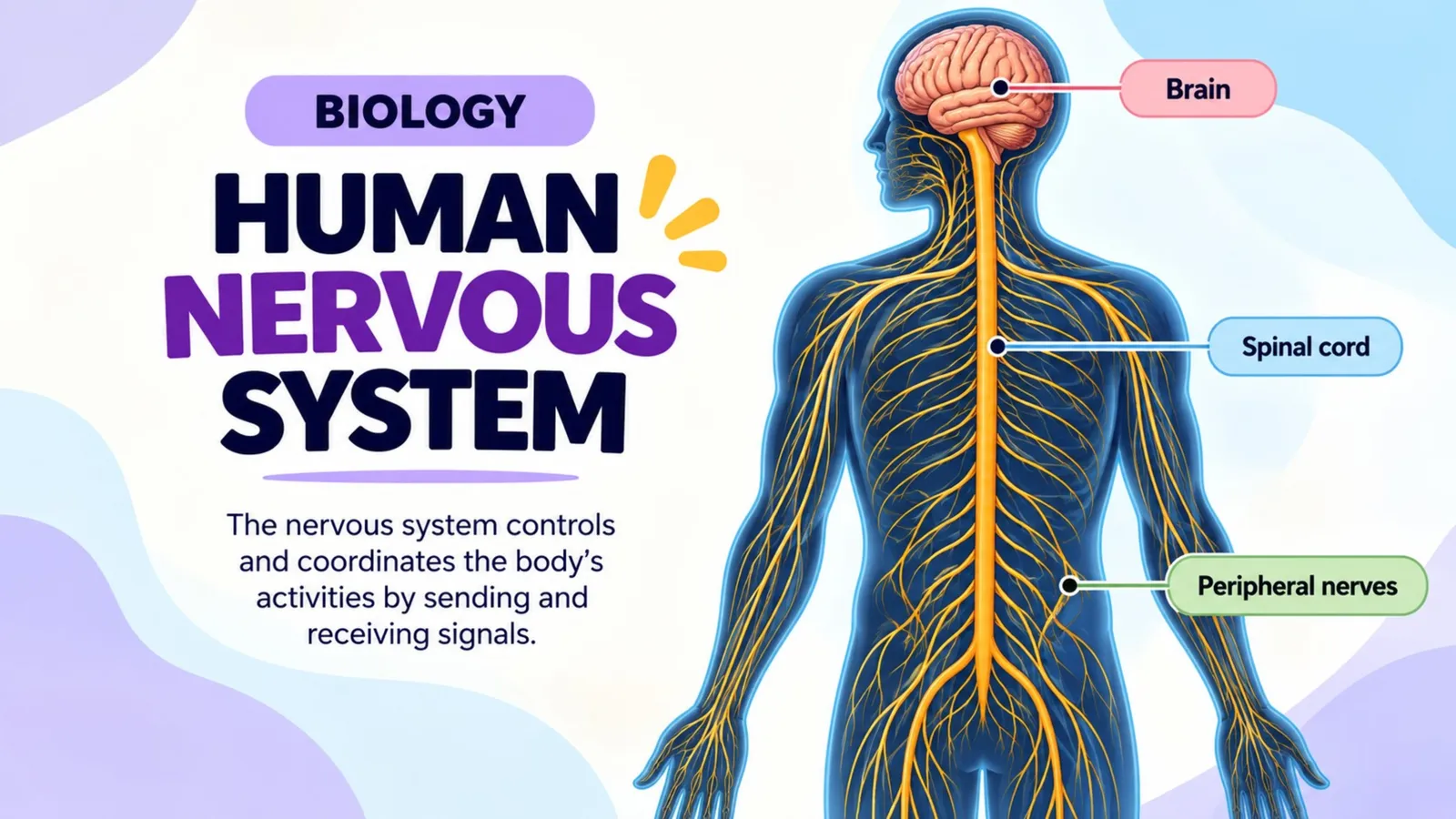
The nervous system is the network of specialised cells that collects information from inside and outside the body, processes that information, and sends out instructions telling the body how to respond.
Everything it does can be summarised in three jobs.
First, sensory input. Receptors detect changes in the environment, such as light, sound, temperature, pressure and chemicals. Any change that a receptor can detect is called a stimulus.
Second, integration. The brain and spinal cord receive that information, compare it with stored memories and current needs, and decide what should happen.
Third, motor output. Instructions travel out to muscles and glands, which are called effectors because they carry out the effect.
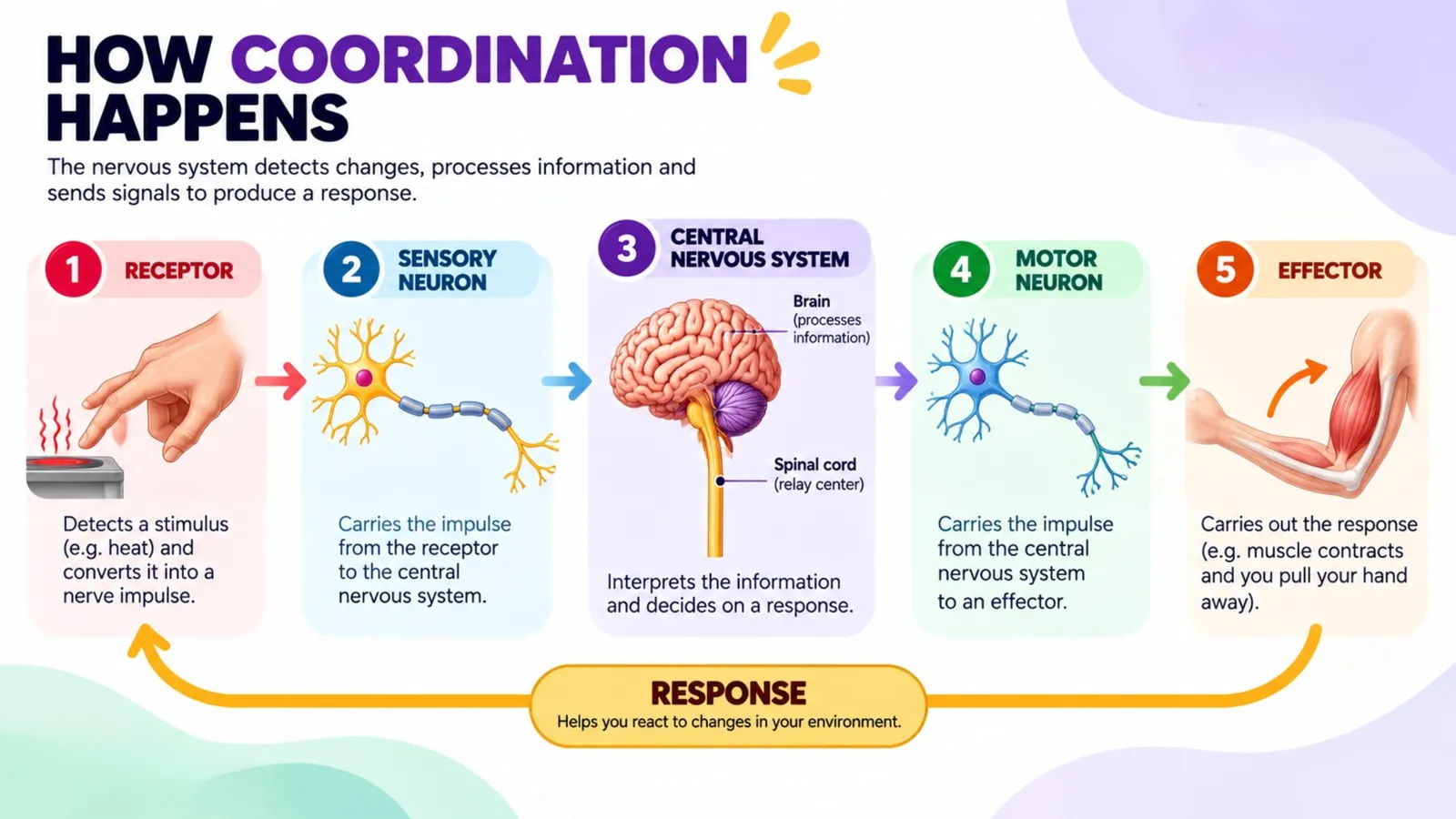
The whole path can be written as a simple chain. Stimulus, receptor, sensory neuron, central nervous system, motor neuron, effector, response. If you can recite that chain confidently, a surprising number of examination questions become straightforward.
🧠
Slides: What the nervous system does
From stimulus to response
1/3
The Neuron: The Building Block of the Nervous System
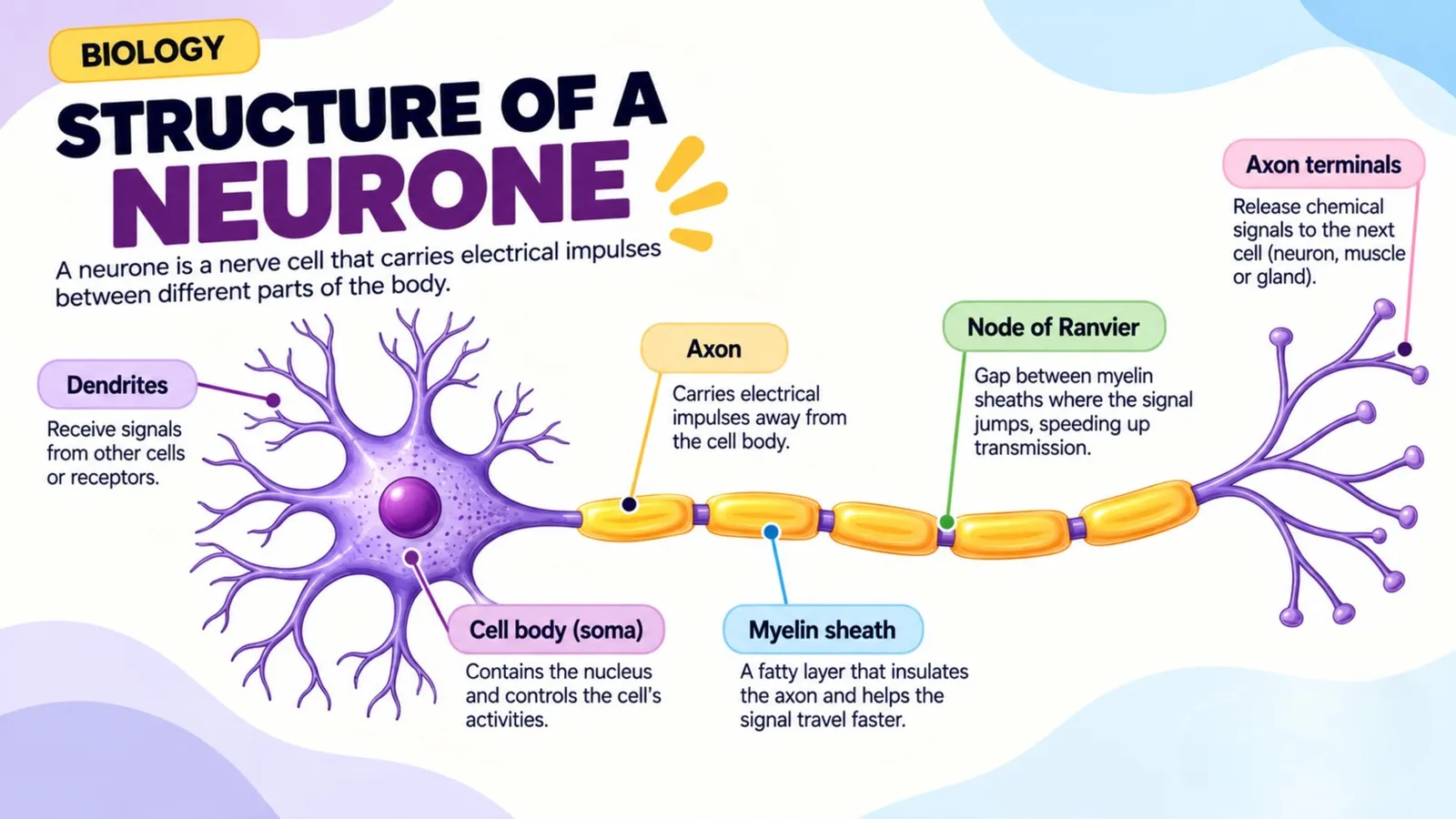
A neuron, or nerve cell, is the basic unit of the nervous system. It is one of the strangest looking cells in the body, and its shape is entirely built around one purpose, which is carrying an electrical signal over a long distance.
Parts of a Neuron
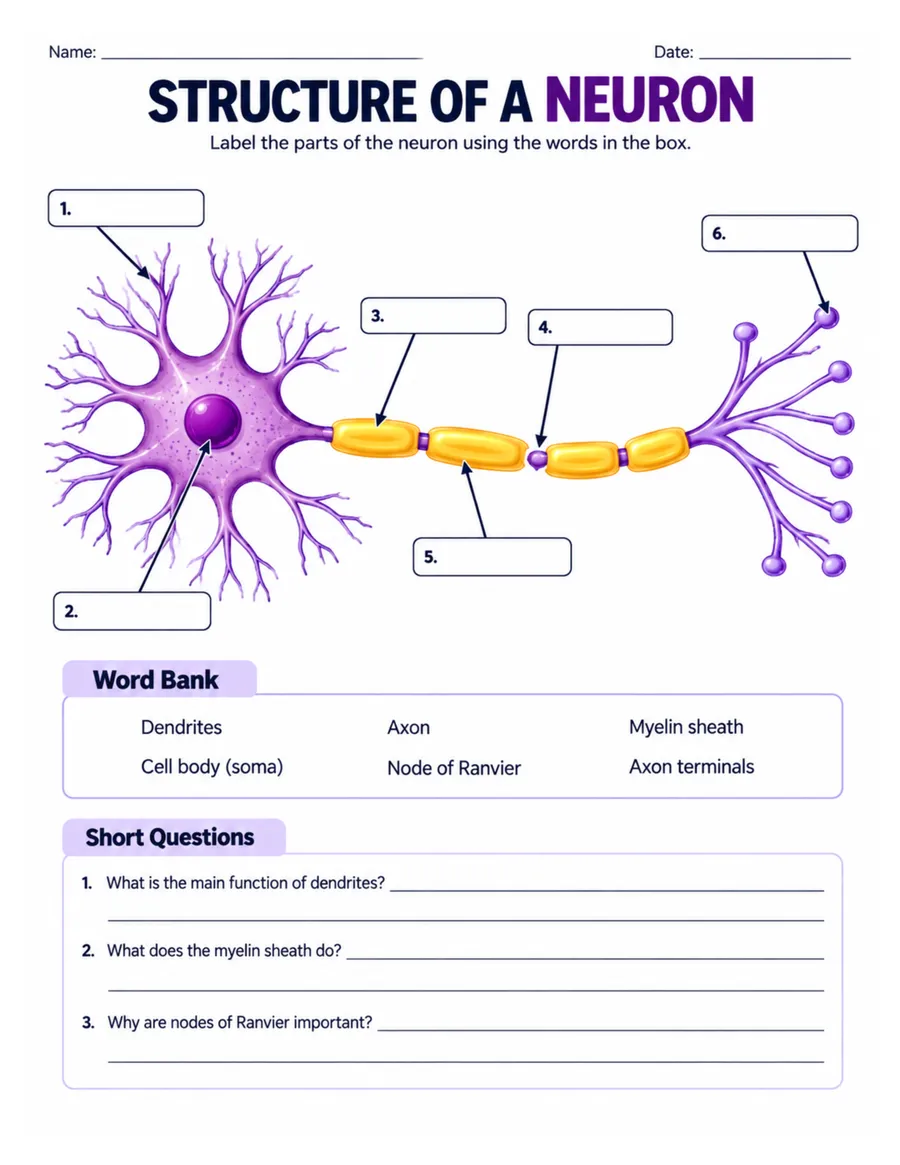
The cell body, sometimes called the cyton, contains the nucleus and most of the cell machinery. It keeps the neuron alive.
The dendrites are short branched fibres extending from the cell body. They receive signals from other neurons and carry them towards the cell body. Their branching shape lets a single neuron collect information from thousands of others.
The axon is a single long fibre that carries the signal away from the cell body. Some axons are microscopic, while others running from the spinal cord to the toes can be around one metre long, making them the longest cells in the human body.
The myelin sheath is a fatty insulating layer wrapped around many axons. It works like the plastic coating on an electrical wire, but it does something extra as well. Gaps in the sheath, called nodes of Ranvier, allow the impulse to jump from gap to gap rather than travelling smoothly along the whole length. This jumping makes the signal dramatically faster. A myelinated fibre can conduct impulses many times faster than an unmyelinated one.
The axon terminals at the far end release chemicals that pass the message on to the next cell.
Types of Neurons
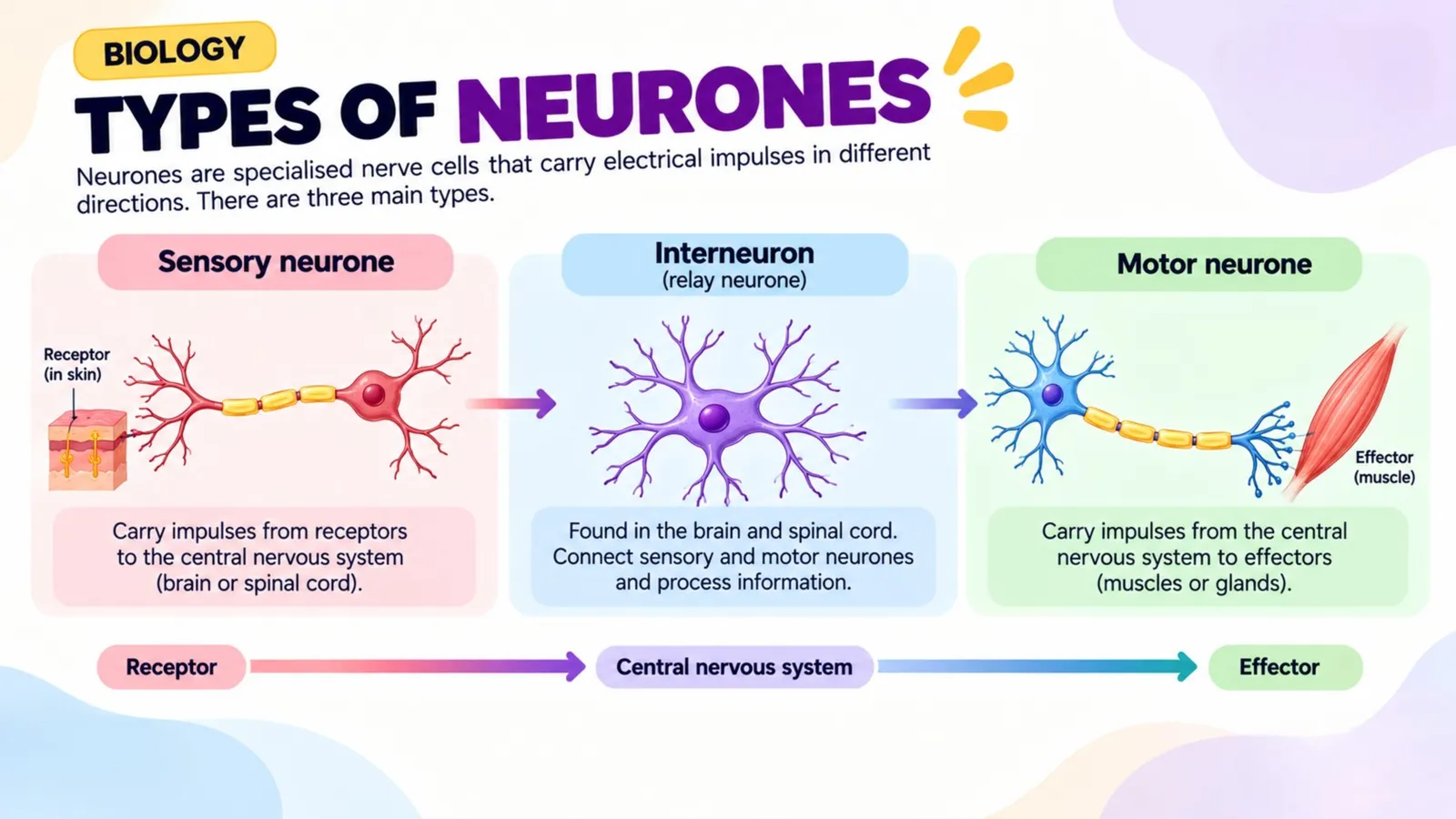
Sensory neurons carry impulses from receptors towards the central nervous system.
Motor neurons carry impulses from the central nervous system out to muscles and glands.
Relay neurons, also called interneurons, sit inside the brain and spinal cord and connect sensory neurons to motor neurons.
🌿
Slides: Neurons
Structure of a neurone and the three types
1/2
The Nerve Impulse and the Synapse
A nerve impulse is not electricity flowing through a wire in the way current flows through a copper cable. It is a moving wave of electrical change across the membrane of the neuron, produced by charged particles such as sodium and potassium ions rushing in and out.
At rest, the inside of a neuron is slightly negative compared with the outside. When a strong enough stimulus arrives, sodium ions rush in and briefly flip the charge, creating a spike that travels along the axon. Behind it, the neuron quickly restores its resting state, ready to fire again.
Impulses obey the all or none principle. A stimulus either reaches the threshold and produces a full impulse, or it does not and produces nothing at all. There is no such thing as half an impulse. Your body signals a stronger stimulus not by making bigger impulses but by sending more of them per second and by involving more neurons.
What Happens at a Synapse
Neurons do not physically touch each other. Between the axon terminal of one neuron and the dendrite of the next lies a microscopic gap called the synapse.
An electrical impulse cannot jump this gap on its own, so the message is converted into a chemical one. When the impulse reaches the axon terminal, tiny sacs release chemicals called neurotransmitters into the gap. These chemicals drift across, bind to receptors on the next neuron, and trigger a new electrical impulse there. Enzymes then clear the neurotransmitter away so the synapse is ready for the next signal.
Synapses matter for two reasons. They make the signal travel in one direction only, because only one side releases the chemical and only the other side has the receptors. They also act as decision points, since a neuron may need signals from several sources before it fires. Many medicines and many drugs work by altering what happens at synapses.
Organisation of the Nervous System
The nervous system is divided into two main parts.
The Central Nervous System
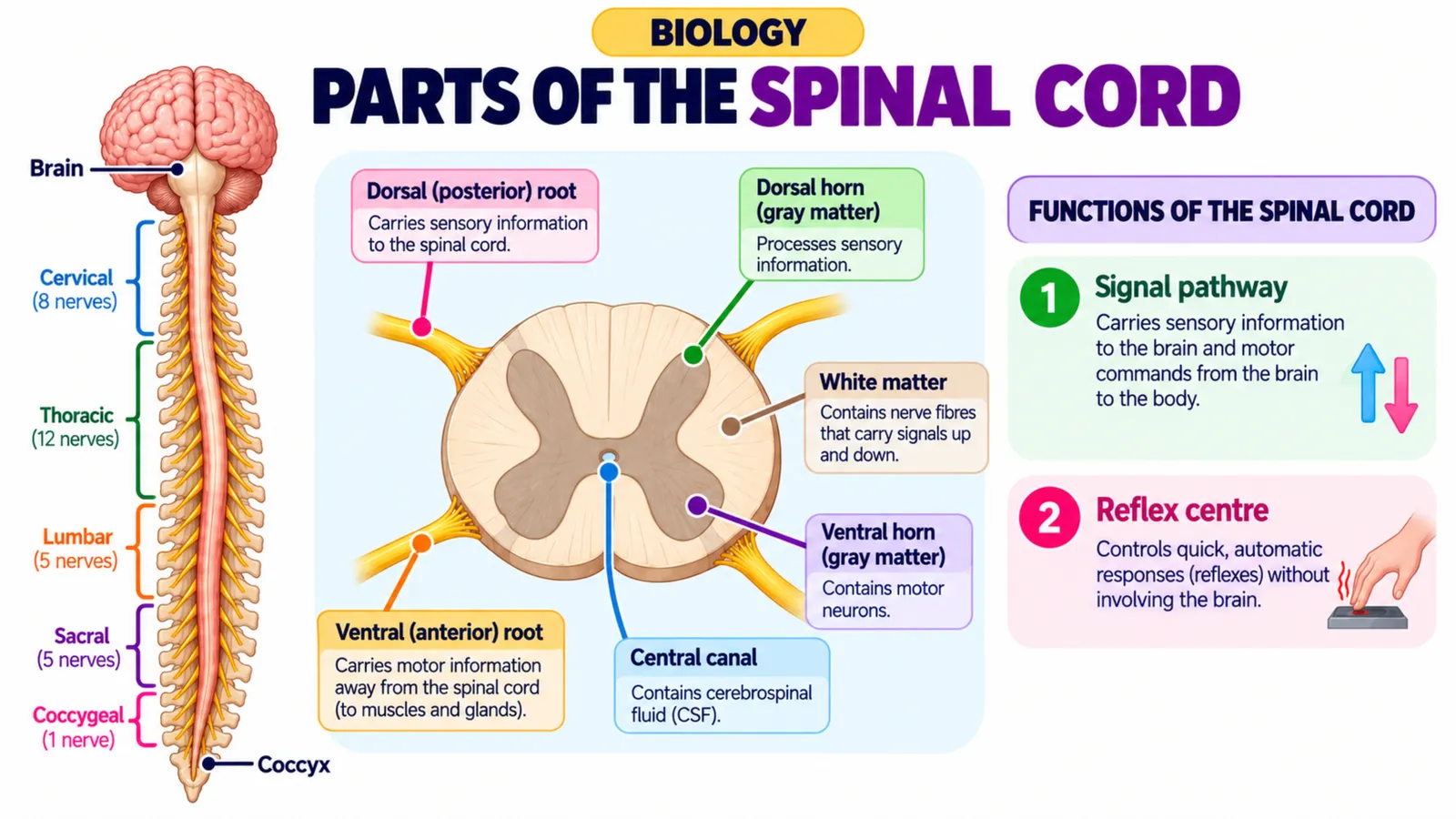
The central nervous system, or CNS, consists of the brain and the spinal cord. It is the processing and decision making centre. Because it is so important, it is heavily protected. The brain sits inside the skull, the spinal cord runs inside the backbone, and both are wrapped in three protective membranes called meninges with cerebrospinal fluid cushioning them against shock.
The Peripheral Nervous System
The peripheral nervous system, or PNS, is everything else, which means all the nerves branching out from the brain and spinal cord to the rest of the body. There are twelve pairs of cranial nerves emerging from the brain and thirty one pairs of spinal nerves emerging from the spinal cord.
The peripheral nervous system splits further into two divisions.
The somatic nervous system controls voluntary actions, such as deciding to raise your hand or walk across a room. You are aware of these actions and you choose them.
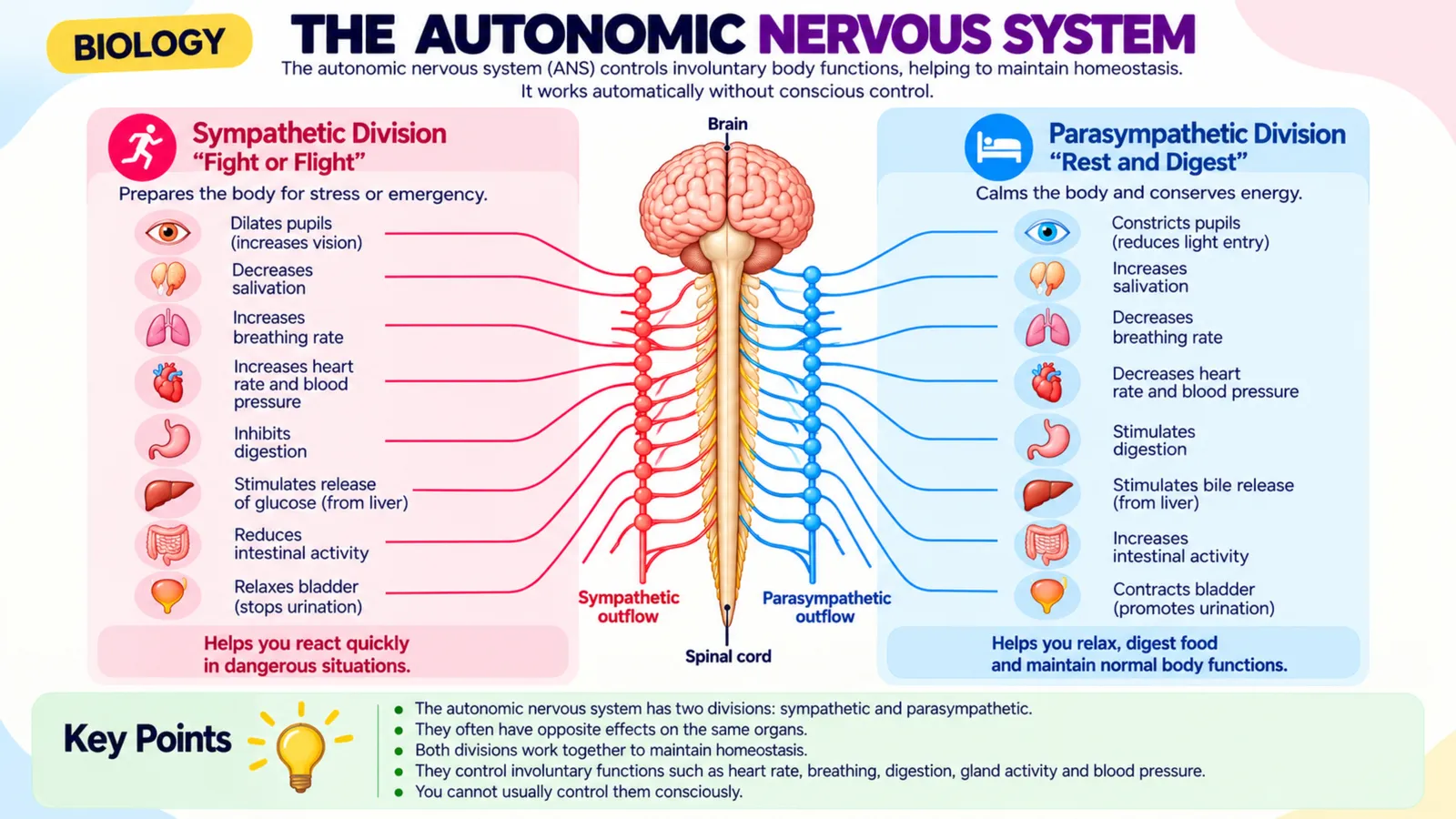
The autonomic nervous system controls involuntary actions such as heartbeat, digestion, breathing rate and pupil size. You do not consciously manage these, which is fortunate, because remembering to beat your own heart would be exhausting.
The autonomic system itself has two opposing branches. The sympathetic branch prepares the body for action, speeding the heart, widening the pupils and slowing digestion. The parasympathetic branch calms the body afterwards, slowing the heart and restarting digestion. One is often described as the accelerator and the other as the brake, and healthy functioning depends on both working in balance.
⚖️
Slide: The autonomic nervous system
Sympathetic and parasympathetic divisions
1/1
The Human Brain and Its Parts
The brain weighs roughly one point four kilograms and contains tens of billions of neurons. Despite being a small fraction of your body weight, it consumes about a fifth of the oxygen and glucose you use.
The Cerebrum
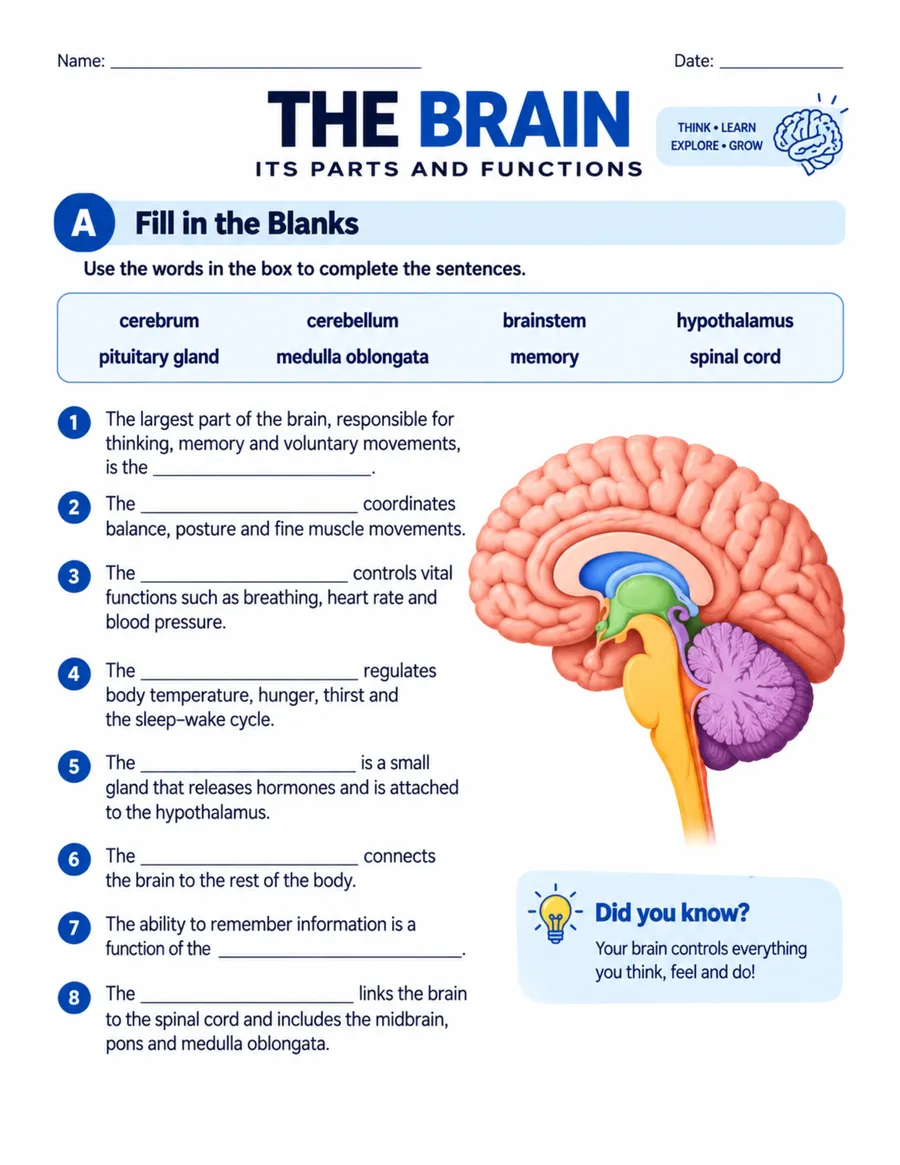
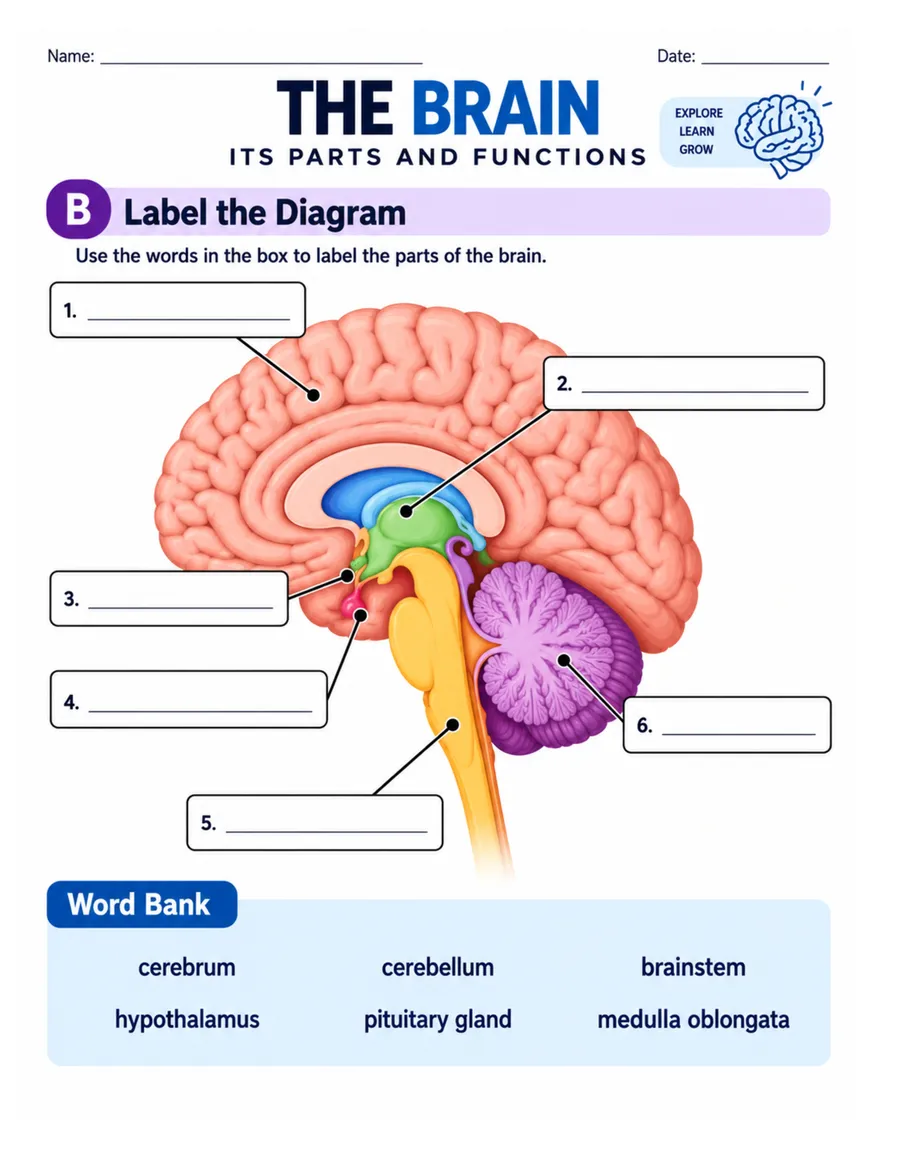
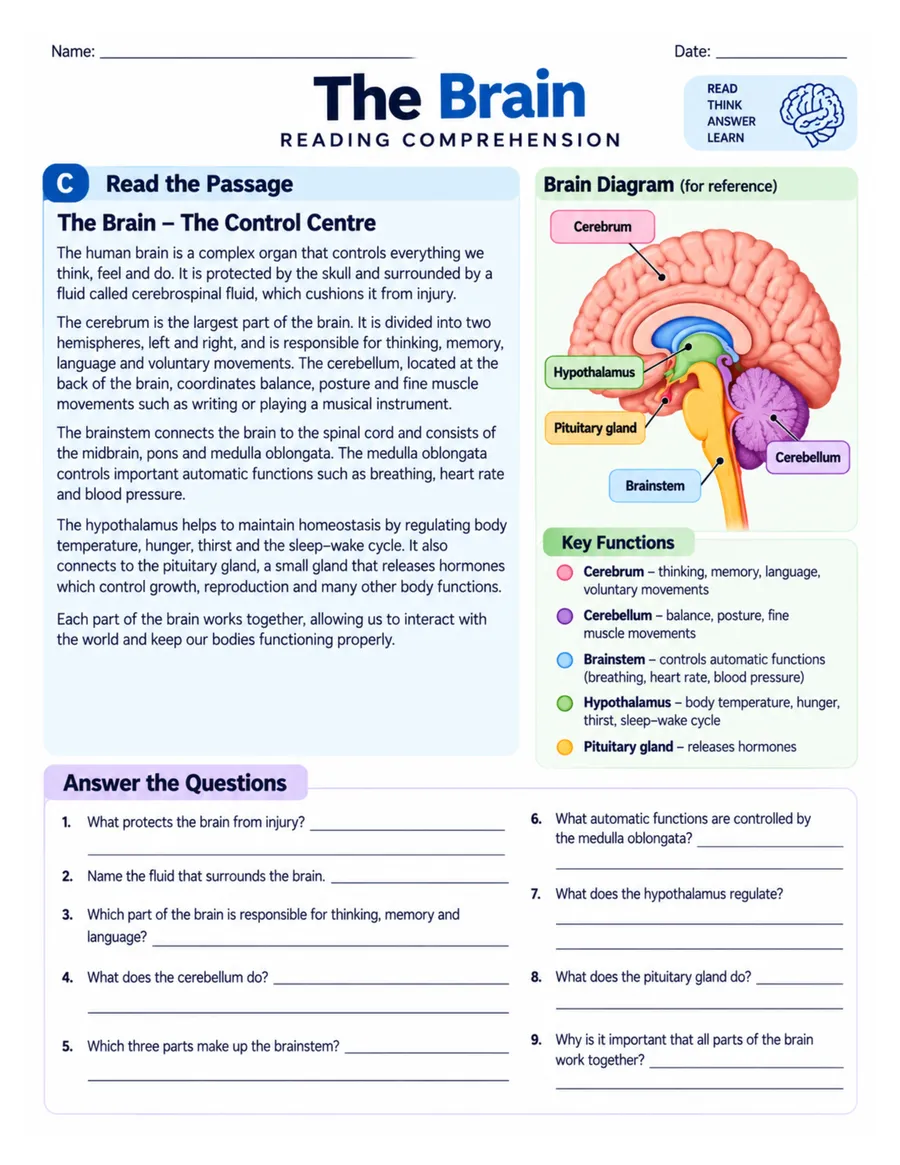
The cerebrum is the largest part of the brain and the part most people picture when they imagine a brain. Its surface is deeply folded, and those folds exist to pack an enormous surface area into a limited skull.
The cerebrum is responsible for everything we think of as conscious thought. Memory, reasoning, language, imagination, personality, voluntary movement and the conscious interpretation of what you see, hear and feel all happen here.
It is divided into two halves called hemispheres, joined by a thick bundle of fibres. Each hemisphere controls the opposite side of the body, so the left hemisphere controls the right hand and the right hemisphere controls the left hand.
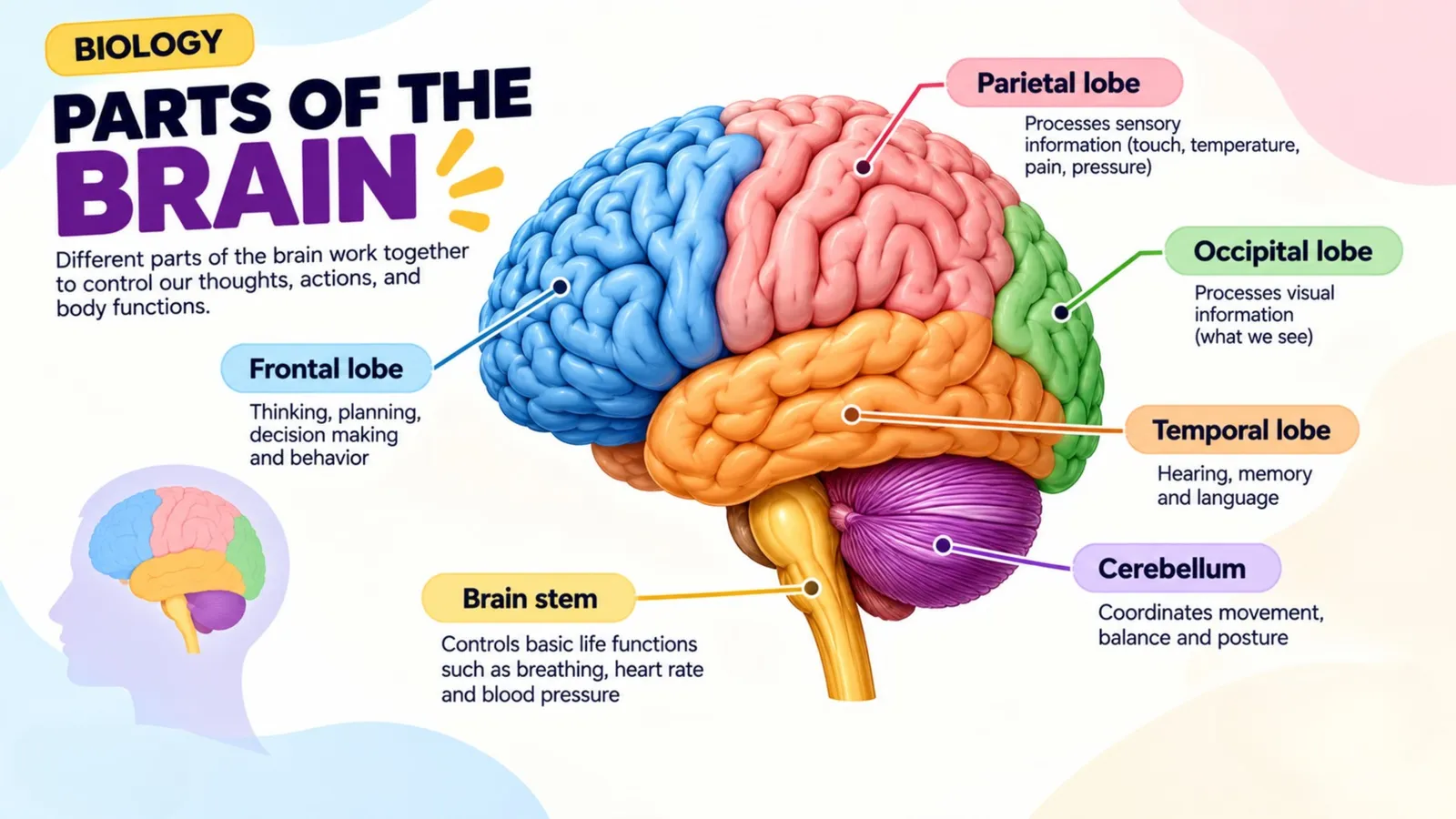
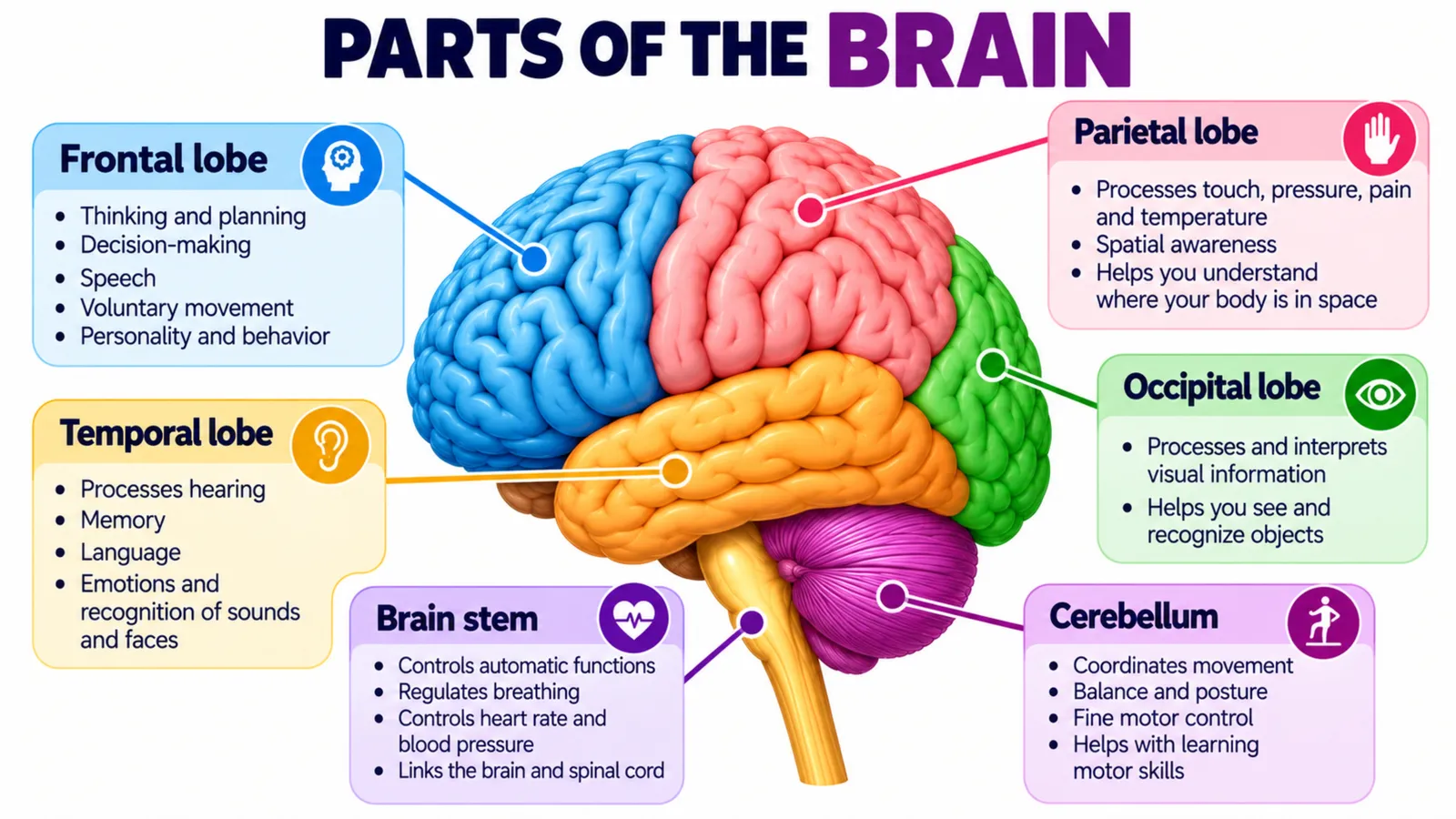
Different regions handle different jobs. The frontal region deals with planning, decision making and voluntary movement. The region behind it handles touch and body sensation. The region at the back of the head processes vision, and the regions at the sides handle hearing and language.
The Cerebellum
The cerebellum sits below and behind the cerebrum. It coordinates muscular activity, maintains posture and controls balance.
The cerebellum is the reason a skilled action becomes smooth with practice. When you first learned to ride a bicycle, every movement was clumsy and conscious. After enough practice, the cerebellum took over the fine coordination and the action became automatic. Damage to the cerebellum does not cause paralysis, but it makes movements jerky and unbalanced.
The Medulla Oblongata
The medulla oblongata sits at the base of the brain where it joins the spinal cord. It controls the involuntary processes you cannot afford to forget, including heartbeat, breathing rate, blood pressure, swallowing, coughing, sneezing and vomiting.
Because it governs these life sustaining functions, injury to the medulla is extremely dangerous.
Other Important Regions
The hypothalamus regulates body temperature, hunger, thirst and sleep, and links the nervous system to the endocrine system by controlling the pituitary gland.
The thalamus acts as a relay station, sorting incoming sensory information and directing it to the correct part of the cerebrum.
The pons connects different parts of the brain and assists in controlling breathing rhythm.
🧠
Slides: Parts of the brain
Lobes, cerebellum and brain stem
1/2
The Spinal Cord and Reflex Actions
The spinal cord is a thick cable of nervous tissue running from the medulla down through the backbone. It carries messages between the brain and the body, and it also produces reflexes on its own.
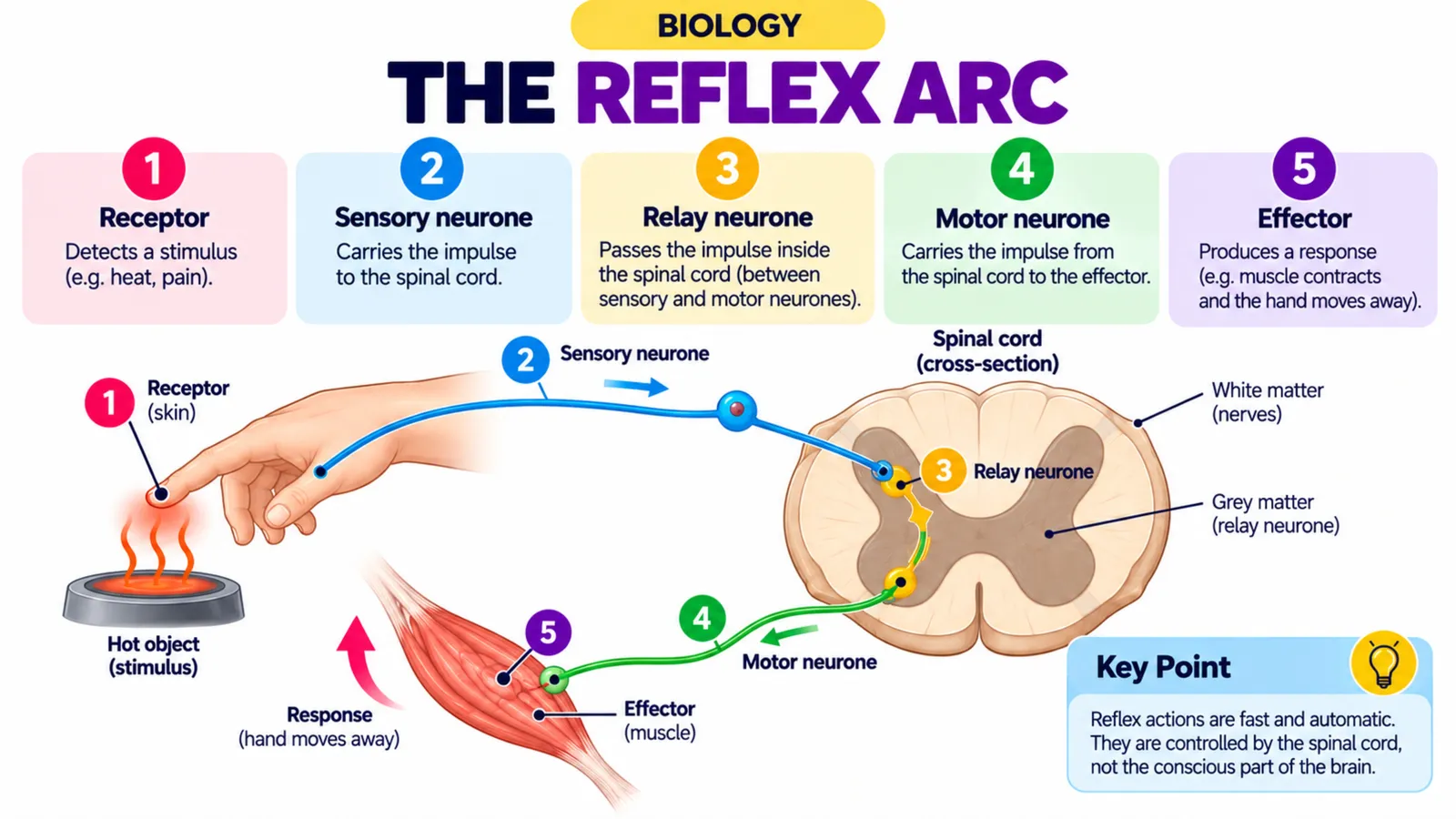
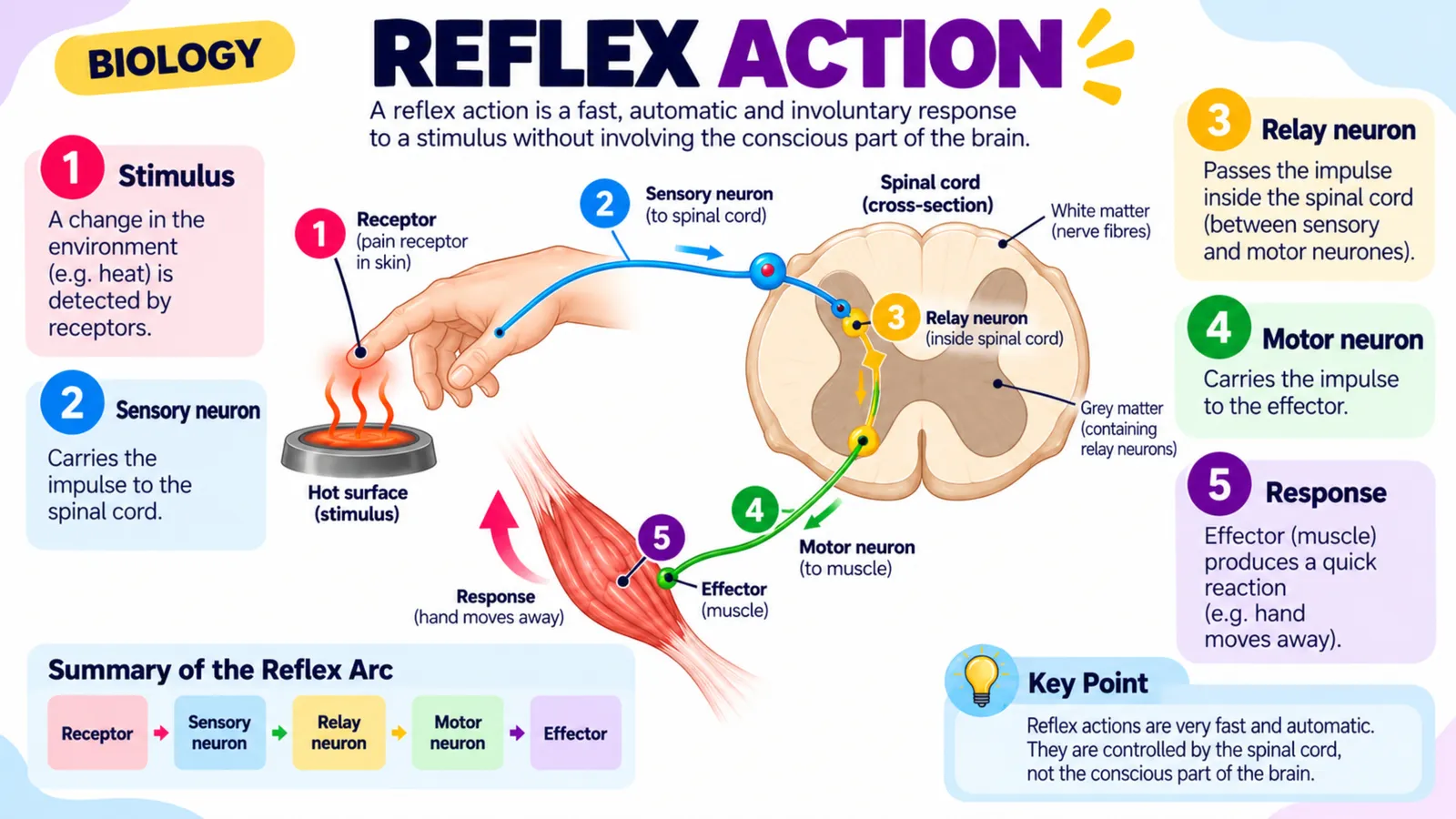
A reflex action is a rapid, automatic response to a stimulus that does not require a decision from the brain. The pathway it follows is called a reflex arc.
Suppose you accidentally touch a hot pan. Pain receptors in your skin detect the heat. A sensory neuron carries the impulse to the spinal cord. Inside the spinal cord a relay neuron passes it directly to a motor neuron. The motor neuron instructs your arm muscle to contract and your hand pulls away.
The critical point is that this entire path bypasses the brain. The brain is informed a fraction of a second later, which is why you feel the pain only after your hand has already moved. That delay is not a flaw. It is the whole advantage. By handling the response locally in the spinal cord, the body saves precious time and reduces the injury.
Other familiar reflexes include blinking when something approaches your eye, the knee jerk when the tendon below the kneecap is tapped, pupils narrowing in bright light, and salivating at the smell of food.
🔁
Slides: Spinal cord and the reflex arc
How a reflex bypasses the brain
1/3
The Sense Organs in Brief
The eyes contain light receptors in the retina that convert light into nerve impulses sent to the brain along the optic nerve.
The ears detect sound vibrations and also contain fluid filled canals that provide the sense of balance.
The nose contains chemical receptors that detect substances carried in the air, producing the sense of smell.
The tongue carries taste buds that detect sweet, sour, salty, bitter and savoury tastes.
The skin contains receptors for touch, pressure, pain and temperature, making it the largest sense organ of all.
Common Nervous System Disorders
Epilepsy involves bursts of abnormal electrical activity in the brain that cause seizures.
Parkinson disease results from the loss of certain brain cells that produce dopamine, leading to tremors and stiff, slow movement.
Alzheimer disease causes the progressive loss of memory and reasoning as brain cells are damaged and lost.
Multiple sclerosis involves damage to the myelin sheath, which slows or blocks nerve impulses.
Stroke occurs when the blood supply to part of the brain is interrupted, so brain cells are starved of oxygen and die.
Meningitis is inflammation of the protective membranes around the brain and spinal cord.
How to Take Care of Your Nervous System
Sleep properly, because the brain consolidates memory and clears waste during sleep, which is why studying without sleep rarely works.
Eat a balanced diet, since the brain needs a steady glucose supply along with vitamins and minerals.
Exercise regularly, because good blood flow delivers more oxygen to brain tissue.
Wear a helmet when cycling or riding, since the skull alone cannot absorb every impact.
Manage stress, because long term stress hormones can harm memory related regions of the brain.
Avoid alcohol and recreational drugs, which interfere directly with synaptic transmission.
Frequently Asked Questions About the Nervous System
What is the difference between a reflex action and a voluntary action?
A reflex action is automatic, extremely fast, and controlled by the spinal cord without needing a conscious decision. A voluntary action is chosen consciously and controlled by the cerebrum, so it takes longer.
Why is the myelin sheath important?
It insulates the axon and allows the impulse to jump between gaps, which greatly increases conduction speed. When myelin is damaged, as in multiple sclerosis, signals slow down or fail.
Why do nerve impulses travel in only one direction?
Because of the synapse. Neurotransmitters are released only from the axon terminal and receptors are present only on the receiving neuron, so the chemical step can only work one way.
What is the difference between a neuron and a nerve?
A neuron is a single nerve cell. A nerve is a bundle of many neuron fibres held together by connective tissue, rather like a cable containing many wires.
Which part of the brain controls heartbeat and breathing?
The medulla oblongata, located at the base of the brain where it meets the spinal cord.
Final Thoughts
The nervous system is the reason you experience anything at all. Every sight, sound, taste, thought and memory exists because electrical impulses are travelling along neurons and jumping chemical gaps millions of times each second.
For revision, build the topic in layers. Start with one neuron and know its parts and their functions. Then learn how two neurons communicate across a synapse. Then place those neurons into the reflex arc and trace the path of a hand pulling away from heat. Finally, zoom out to the brain and give each major region one clear job. Learning it in this order turns a huge topic into a short logical story, and a story is always easier to recall in an examination hall than a list.
📝 Worksheets
Print-ready practice sheets for this lesson. Sign in to download the PDF.
Label the structure of a neuron
Label the parts of a neuron using the word bank, then answer short questions about how it works.