Water, the air you breathe, the sugar in your tea, plastics, proteins and DNA all have one thing in common: their atoms are joined by covalent bonds. There are far more covalent compounds than ionic ones, so understanding covalent bonding is essential for IGCSE and GCSE Chemistry. This guide explains what a covalent bond is, how to draw dot-and-cross diagrams, why some covalent substances are gases while diamond is the hardest material known, and how to phrase your exam answers.
📖 Lesson
Shared pairs, the octet rule, dot-and-cross diagrams and why diamond and water behave so differently, in exam-ready words.
What Is a Covalent Bond?
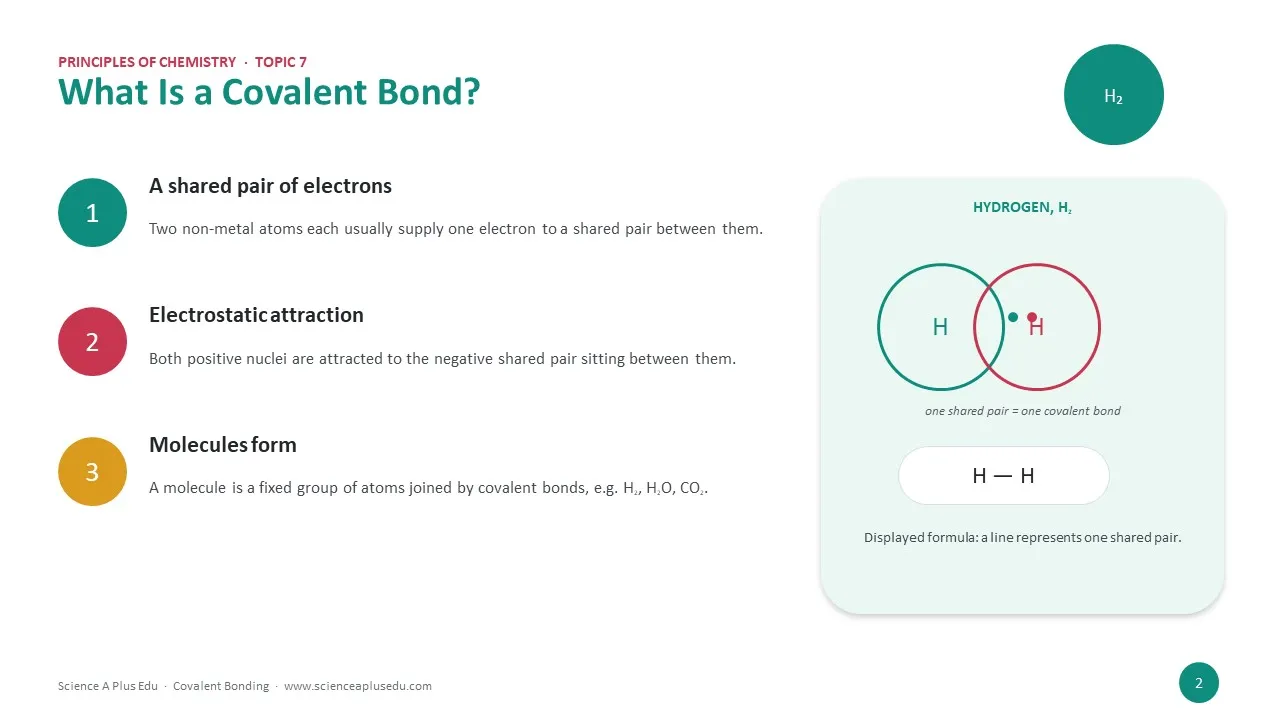
Ionic bonding happens when a metal transfers electrons to a non-metal. But when two non-metal atoms meet, neither wants to give electrons away; both need to gain electrons to fill their outer shells. The solution is to share. In a covalent bond, a pair of electrons is shared between two atoms, and usually each atom supplies one electron to the pair.
What actually holds the atoms together? In every kind of bond, particles are held by electrostatic attraction between something positive and something negative. In a covalent bond the positive nuclei of both atoms are attracted to the negative shared pair of electrons sitting between them. The exam definition is: a covalent bond is the strong electrostatic attraction between the nuclei of the two atoms and the shared pair of electrons.
The simplest example is hydrogen. Each hydrogen atom has one electron. Two atoms share their electrons to make one shared pair, so hydrogen exists as diatomic molecules, H2. A molecule is a group of atoms joined by covalent bonds, and it always contains a fixed number of atoms. Why do atoms bond at all? Whenever a bond forms, energy is released, and the molecule ends up with less energy, which makes it more stable than the separate atoms.
Slides: What is a covalent bond?
A shared pair, held by electrostatic attraction
1/2
Noble Gas Structures and How Many Bonds an Atom Forms
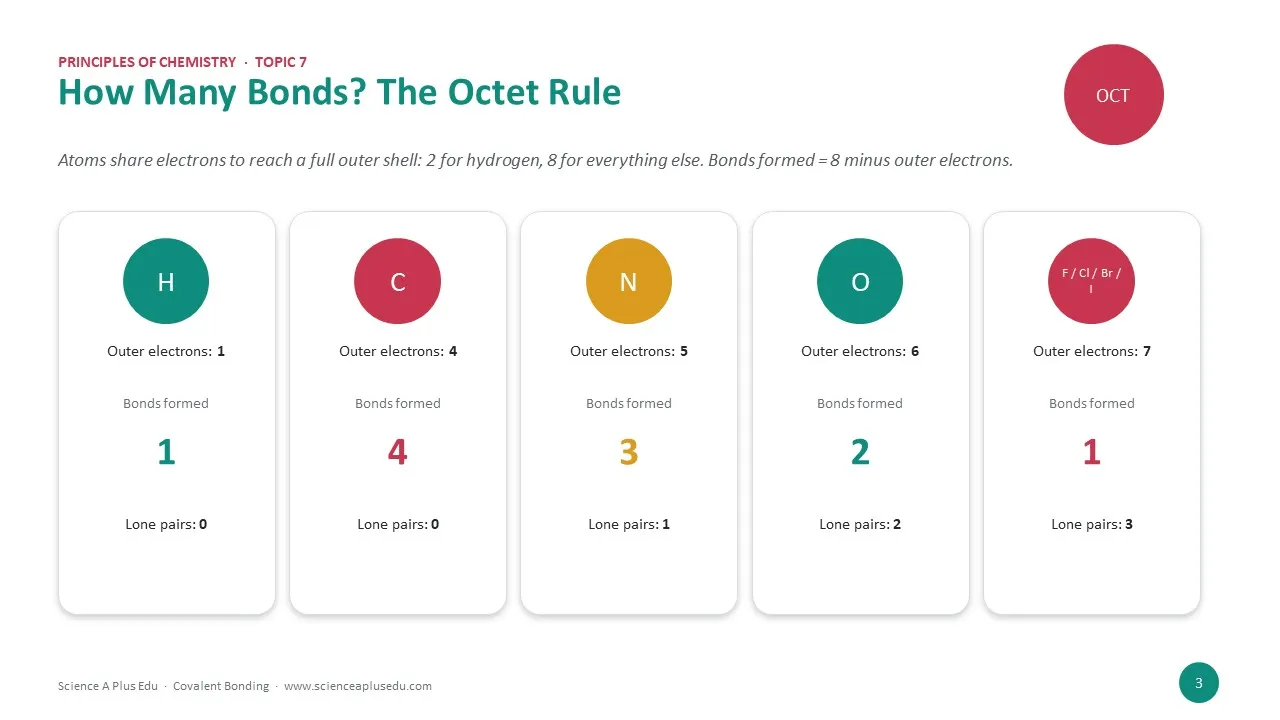
Atoms share electrons so that they end up with the same number of outer electrons as a noble gas: two for hydrogen (like helium) and eight for everything else (the octet). The shared electrons count for both atoms at once. A hydrogen atom in H2 has the same number of electrons as helium, but it has not turned into helium, because the number of protons has not changed.
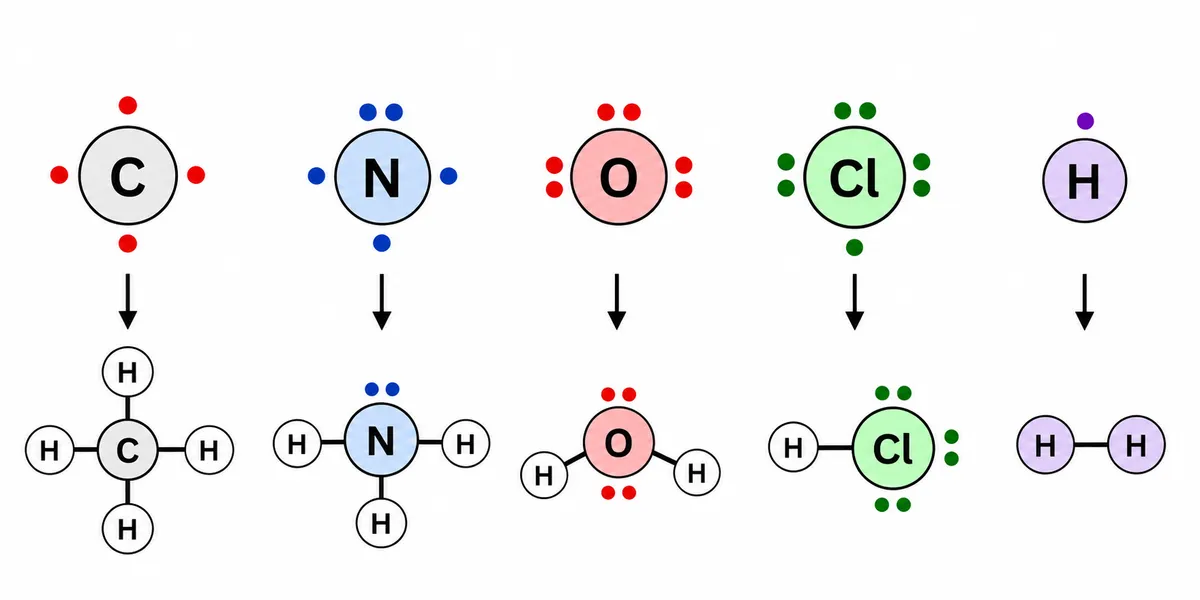
This gives a very useful rule: the number of bonds an atom forms is 8 minus its number of outer electrons.
Carbon (4 outer electrons) forms 4 bonds.
Nitrogen (5) forms 3 bonds and keeps one lone pair.
Oxygen (6) forms 2 bonds and keeps two lone pairs.
Fluorine, chlorine, bromine and iodine (7) form 1 bond and keep three lone pairs.
Hydrogen forms 1 bond and is always on the outside of a molecule.
Slide: How many bonds? The octet rule
Bonds = 8 minus outer electrons
1/1
How to Draw Dot-and-Cross Diagrams for Covalent Molecules
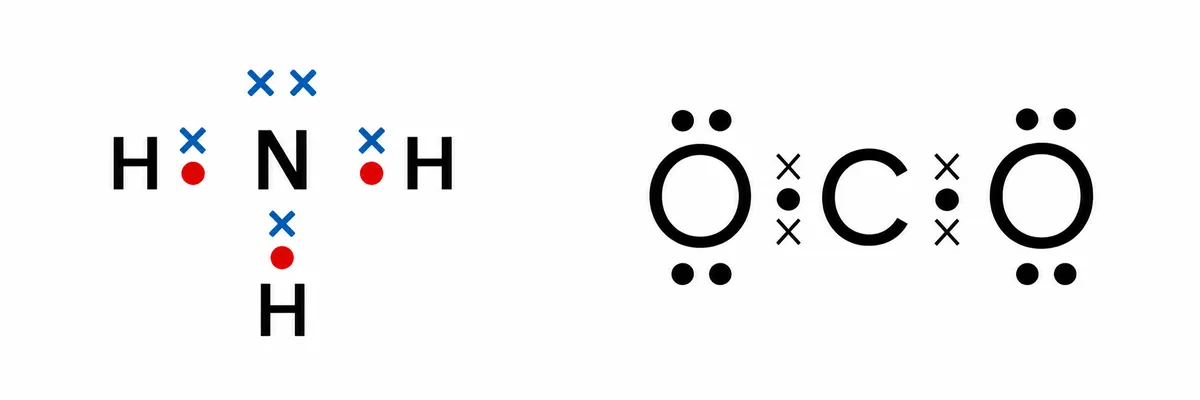
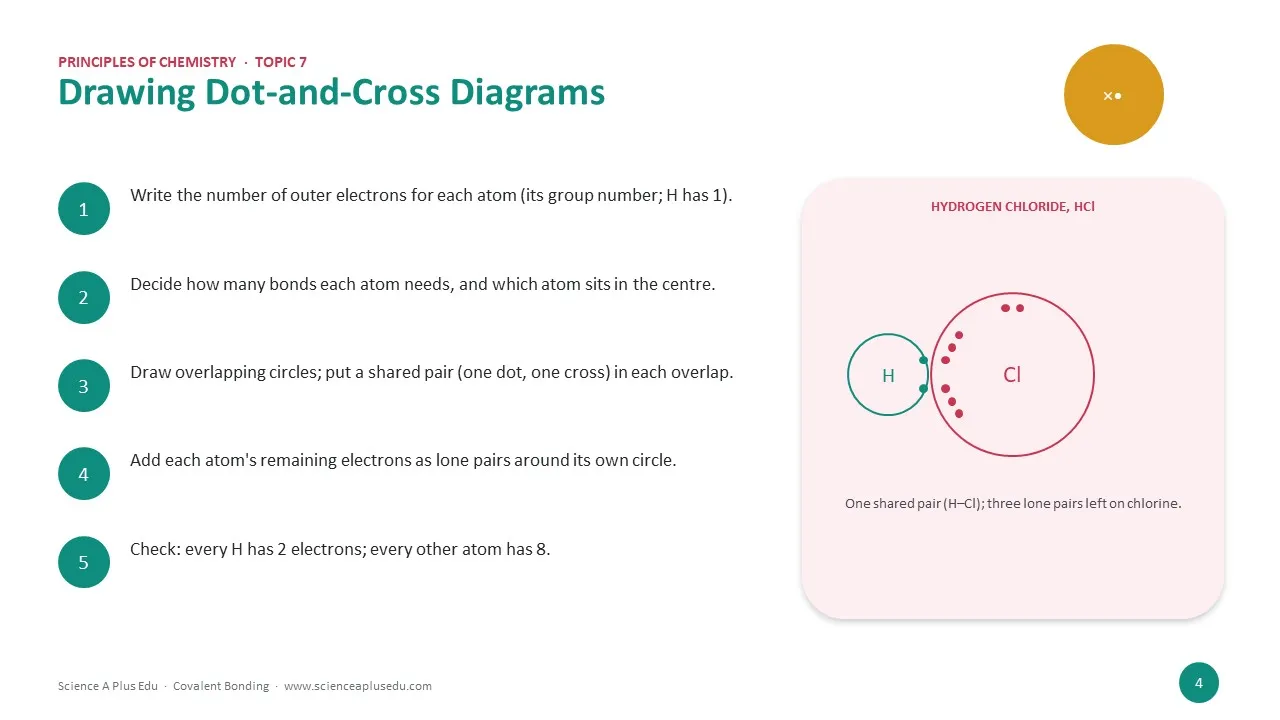
Dot-and-cross diagrams show the outer electrons of each atom. Dots and crosses are the same kind of electron; the two symbols simply show which atom each electron came from. Draw overlapping circles for the outer shells, put one dot and one cross in each overlap to show a shared pair, then add the remaining electrons as lone pairs. Finally check that every hydrogen has two electrons and every other atom has eight.
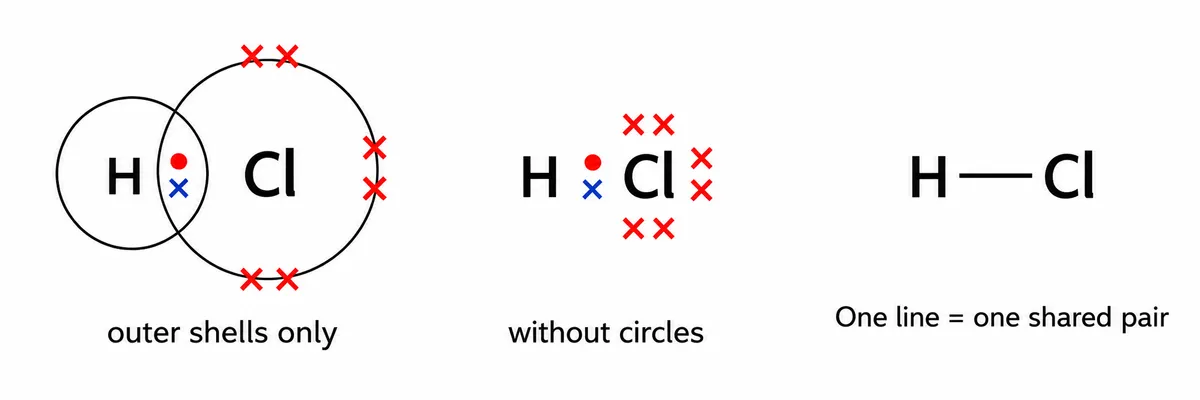
Bonds can also be drawn as lines, such as H-Cl or O=C=O. This is a displayed formula and is not a dot-and-cross diagram, so if the question asks for dot-and-cross you must draw the electrons.
Here are the molecules you must be able to draw:
Hydrogen chloride, HCl: one shared pair between H and Cl, plus three lone pairs on chlorine. The hydrogen halides HF, HBr and HI are identical apart from the symbol.
Chlorine, Cl2: one shared pair and three lone pairs on each chlorine. All the halogens bond this way.
Methane, CH4: carbon in the centre with four single bonds to four hydrogens and no lone pairs.
Ammonia, NH3: nitrogen with three bonds to hydrogen and one lone pair.
Water, H2O: oxygen with two bonds to hydrogen and two lone pairs. Because of the lone pairs the molecule is bent, which makes water polar.
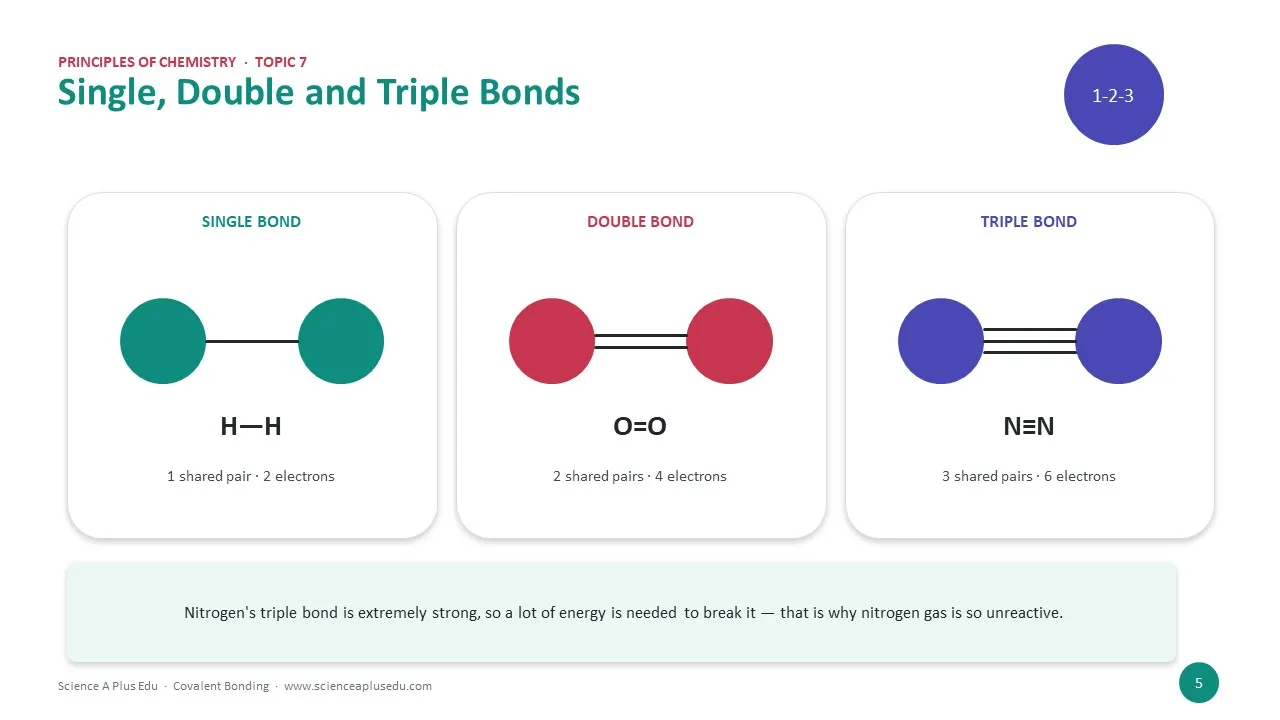
Oxygen, O2: two shared pairs between the atoms, a double bond, with two lone pairs on each oxygen.
Nitrogen, N2: three shared pairs, a triple bond, with one lone pair on each nitrogen. The triple bond is extremely strong, which is why nitrogen gas is so unreactive.
Carbon dioxide, CO2: carbon in the centre with a double bond to each oxygen, O=C=O.
Ethane, C2H6, and ethene, C2H4: ethane has a carbon-carbon single bond and six C-H bonds; ethene has a carbon-carbon double bond and four C-H bonds.
Molecules with halogen atoms, such as bromomethane, CH3Br: the halogen forms one bond and keeps three lone pairs.
Slides: Drawing dot-and-cross diagrams
Shared pairs, lone pairs, double and triple bonds
1/2
Simple Molecular Structures: Strong Bonds, Weak Forces
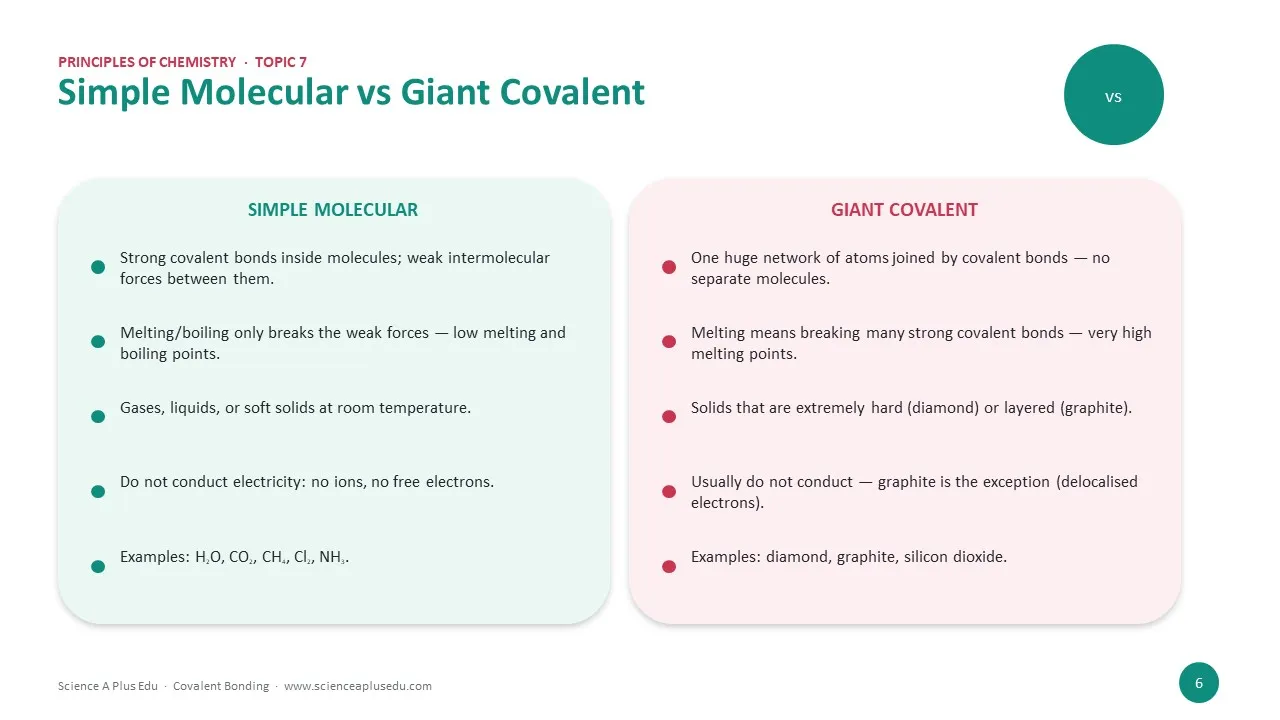
Inside a water molecule the H and O atoms are joined by strong covalent bonds. But there must also be forces between the molecules, otherwise water could never be a liquid. These are called intermolecular forces, and they are much weaker than covalent bonds. A substance made of molecules held together by intermolecular forces has a simple molecular structure.
This one idea explains the properties of almost every covalent compound you will meet:
Low melting and boiling points. When water boils, only the weak intermolecular forces are broken; the covalent bonds inside each molecule stay intact. Little energy is needed, so simple molecular substances are usually gases or liquids at room temperature, or soft solids with low melting points such as iodine and wax. Never write that "the bonds are weak": the covalent bonds are strong, it is the forces between molecules that are weak.
Boiling points rise with relative molecular mass. Going down Group 7, fluorine and chlorine are gases, bromine is a liquid and iodine is a solid. As the molecules get bigger the intermolecular forces get stronger, so more energy is needed to separate them.
No electrical conductivity. Molecules have no overall charge and all the electrons are held tightly in atoms or bonds, so there are no ions and no free electrons to carry the charge.
Solubility. Covalent molecular substances tend to be insoluble in water but soluble in organic solvents such as hexane, the opposite of ionic compounds.
Slide: Simple molecular vs giant covalent
Strong bonds, weak intermolecular forces
1/1
Giant Covalent Structures: Diamond, Graphite and Fullerenes
Not every covalent substance is made of molecules. In a giant covalent structure, atoms are joined by covalent bonds in a huge network with no separate molecules. Diamond, graphite and silicon dioxide are the examples you need.
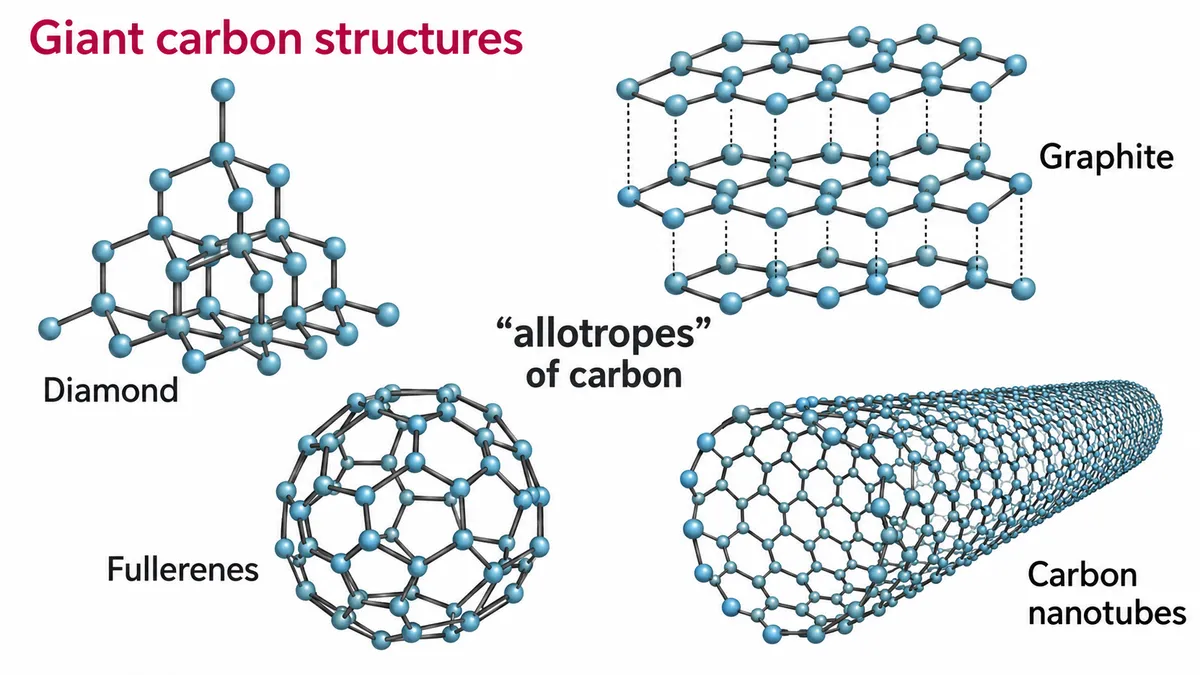
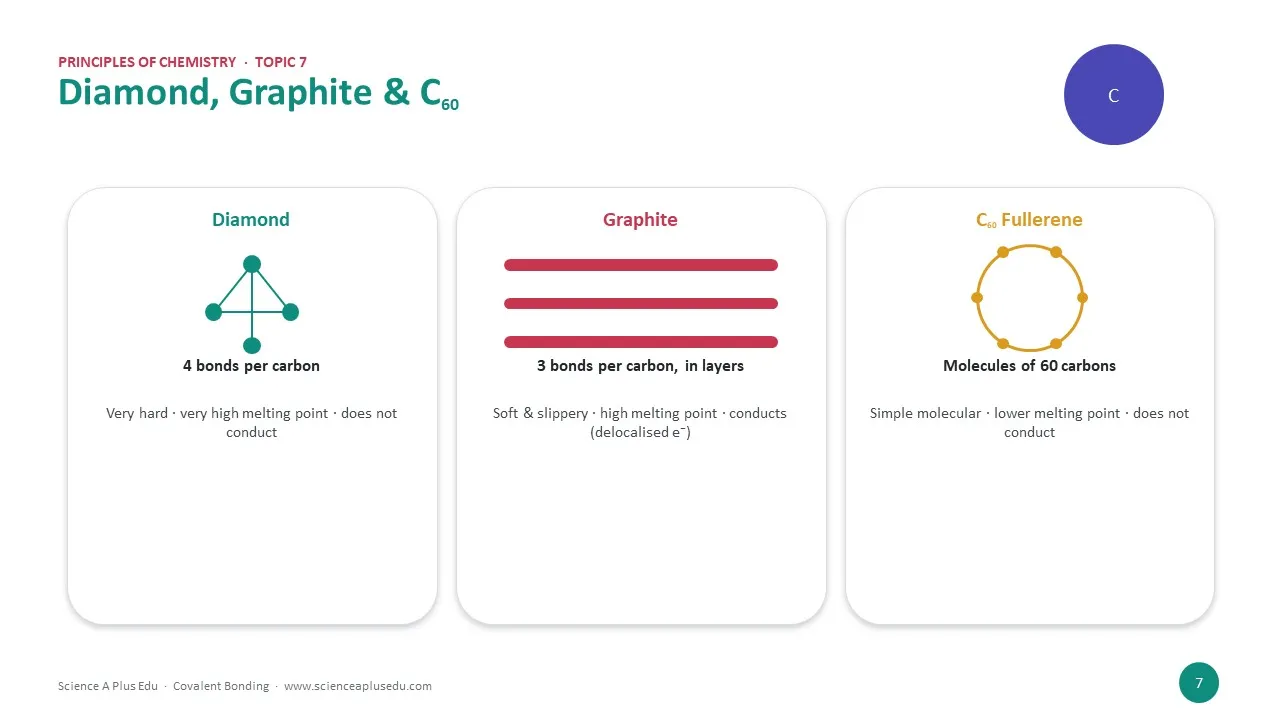
Diamond is pure carbon in which every carbon atom forms four strong covalent bonds to four other carbons in a tetrahedral arrangement. The network continues in three dimensions. Diamond has a very high melting point and is extremely hard, because a huge amount of energy is needed to break the many strong covalent bonds. It does not conduct electricity because all four outer electrons of each carbon are locked in bonds.
Graphite is also pure carbon, but each atom is bonded to only three others, forming flat layers of hexagons stacked like a pack of playing cards. Within a layer the covalent bonds are strong, but between the layers there are only weak forces, so the layers slide over each other. This makes graphite soft and slippery, ideal for pencils and lubricants. The fourth outer electron of each carbon is delocalised and free to move along the layer, which is why graphite conducts electricity and is used for electrodes. Graphite still has a high melting point, because melting it breaks the strong covalent bonds within the layers.
C60 fullerene is a third allotrope of carbon (allotropes are different forms of the same element). Each C60 molecule is a hollow ball of exactly sixty carbon atoms, so fullerene has a simple molecular structure with weak intermolecular forces between the balls. It therefore melts more easily than diamond or graphite, is not as hard, and does not conduct electricity, because the spare electron on each carbon cannot jump from one molecule to the next.
Slide: Diamond, graphite and C₆₀
Three allotropes of carbon
1/1
Ionic vs Covalent: The Comparison Examiners Love
Particles: ionic compounds are made of ions in a giant lattice; simple molecular substances are made of molecules.
Melting and boiling points: high for ionic compounds (strong electrostatic attraction between ions); low for simple molecular substances (weak intermolecular forces).
Conductivity: ionic compounds conduct only when molten or dissolved, because the ions are free to move; simple molecular substances never conduct, because there are no ions or free electrons.
Solubility: ionic compounds are usually soluble in water; covalent molecular substances are usually insoluble in water but soluble in organic solvents.
Covalent Bonding: Frequently Asked Questions
What is the difference between a covalent bond and an intermolecular force?
A covalent bond is the strong attraction that holds atoms together inside a molecule. An intermolecular force is the much weaker attraction between separate molecules. Melting and boiling break intermolecular forces, not covalent bonds.
Why does carbon dioxide have a low boiling point but diamond a very high one?
Carbon dioxide has a simple molecular structure, so only weak intermolecular forces need to be overcome. Diamond has a giant covalent structure, so many strong covalent bonds must be broken, which needs a very large amount of energy.
Why does graphite conduct electricity but diamond does not?
Each carbon in graphite uses only three electrons in bonds; the fourth is delocalised and free to move along the layers. In diamond all four outer electrons are in covalent bonds, so none are free.
Key Takeaways
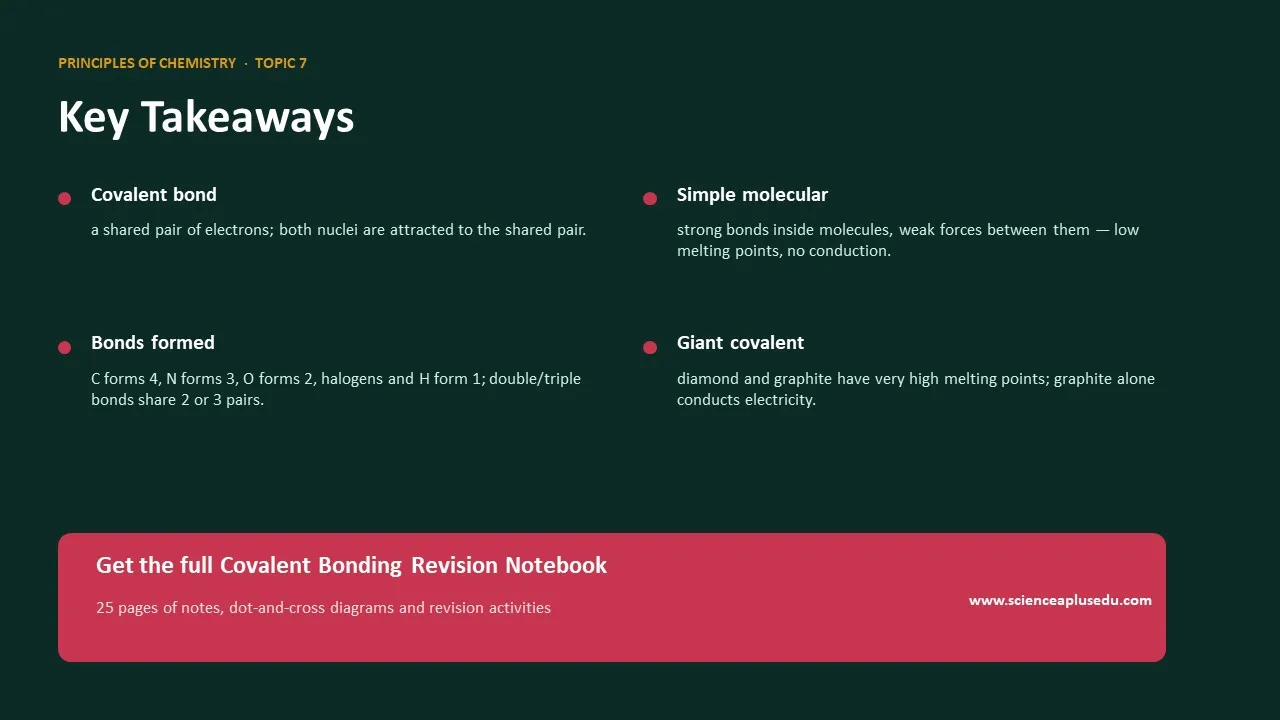
A covalent bond is a shared pair of electrons; the nuclei of both atoms are attracted to the shared pair.
Atoms share to reach a noble gas structure: C forms 4 bonds, N 3, O 2, halogens and hydrogen 1.
Double and triple bonds are two and three shared pairs (O=O, N≡N, O=C=O, C=C).
Simple molecular substances have low melting points and do not conduct; giant covalent structures such as diamond have very high melting points, and graphite conducts because of delocalised electrons.
Slide: Key takeaways
1/1
For more help, download the Science A Plus Edu Covalent Bonding Revision Notebook with 25 pages of clear notes, dot-and-cross diagrams and revision activities, and read our companion guide to ionic bonding to compare the two types of bonding side by side.
🗂️ Revision Flashcards
Tap a card to reveal the answer.
🎯 Quick Quiz
8 questions. Pick an answer to check it straight away.
1What is a covalent bond?
The positive nuclei of both atoms are attracted to the negative shared pair.
2How many covalent bonds does a nitrogen atom (5 outer electrons) form?
8 − 5 = 3 bonds, and nitrogen keeps one lone pair.
3How many shared pairs of electrons are in a nitrogen molecule, N₂?
N₂ has a triple bond: three shared pairs.
4Why does water have a low boiling point?
Boiling breaks the weak intermolecular forces; the covalent bonds stay intact.
5Why do simple molecular substances not conduct electricity?
Molecules have no overall charge and all electrons are held in atoms or bonds.
6Why does graphite conduct electricity but diamond does not?
Graphite uses three electrons in bonds; the fourth is free to move along the layers.
7Which of these has a simple molecular structure?
Each C₆₀ is a separate molecule with weak intermolecular forces between the balls.
8Going down Group 7, what happens to the boiling points of the halogens?
Bigger molecules have stronger intermolecular forces, so more energy is needed to separate them.