How plants make their own food, how the leaf is built to do it, what they do with the glucose and how to test it in practicals.
Sit a student in the sunshine with a glass of water and a packet of crisps, and the crisps will be gone long before the student has made a single molecule of food from light. A plant sitting in the same spot does something remarkable. It takes in water through its roots, takes in carbon dioxide from the air, captures light energy from the Sun and builds sugar from those simple ingredients. Every food chain on Earth begins with this process, and the oxygen in every breath you take was released by a plant, an alga or a photosynthetic microbe.
This guide covers the whole of the plant nutrition section of GCSE plant physiology in clear, full sentences. By the end you will understand plant cells, photosynthesis, leaf structure, gas exchange, what plants do with the glucose they make, the mineral ions they need, the rate of photosynthesis and the key practicals. Use the headings to jump to the part you need, and use the exam tips to turn understanding into marks.
What Is Plant Physiology?
Physiology is the study of how the parts of a living thing work. Anatomy tells you what the parts are and where they sit. Physiology tells you what they do. Plant physiology therefore asks how plants take in light, water, carbon dioxide and minerals, how they turn these into food and new cells, how they move substances around their bodies, how they reproduce and how they respond to their surroundings.
Plants carry out all seven life processes: movement, respiration, sensitivity, growth, reproduction, excretion and nutrition. Plants do move, but slowly, by growing towards light or away from gravity. They respire all day and all night. They respond to their surroundings using hormones instead of nerves. They excrete waste oxygen and water vapour. Their special feature is nutrition, because they are the producers that start almost every food chain.
The Plant Cell
Every part of a plant is built from cells. A plant cell is a eukaryotic cell, which means its genetic material is enclosed inside a nucleus. It shares many structures with an animal cell, and it has three extra ones.
Parts found in plant and animal cells
The nucleus contains DNA, which controls the activities of the cell.
The cytoplasm is the jelly-like liquid where most chemical reactions happen, controlled by enzymes.
The cell membrane is partially permeable and controls which substances enter and leave the cell.
Mitochondria are the site of aerobic respiration, which releases energy from glucose.
Ribosomes are the site of protein synthesis, where amino acids are joined together.
Parts found only in plant cells
The cell wall is a strong layer made of cellulose outside the membrane. It supports the cell and stops it bursting when it takes in water.
Chloroplasts are green oval structures that contain chlorophyll and carry out photosynthesis.
The permanent vacuole is a large sac of cell sap in the centre of the cell. It stores water, sugars and salts and keeps the cell firm.
Not every plant cell is green. Root cells grow underground in the dark, so they contain no chloroplasts. They still have mitochondria, because they still need to respire. A common exam mistake is to confuse the cell wall with the cell membrane. The wall is fully permeable and gives strength. The membrane is partially permeable and controls what goes in and out.
Specialised Plant Cells
As a plant grows, its cells differentiate, which means they develop special features that suit one job. Learn the job and the feature that helps the cell do it.
Cell
Job
Adaptation
Root hair cell
Absorb water and mineral ions
Long hair gives a large surface area, thin wall, many mitochondria for active transport
Palisade cell
Photosynthesis
Tall, packed with chloroplasts, placed near the upper surface where light is brightest
Guard cell
Open and close the stomata
Kidney shaped with a thicker inner wall, and contains chloroplasts
Xylem vessel
Carry water and mineral ions
Dead, hollow tube with no end walls and lignin in the wall
Autotrophs and Heterotrophs
Organisms get their food in two ways. Autotrophs make their own food from simple inorganic substances. Green plants, algae and some bacteria are autotrophs, and they are the producers in a food chain. Heterotrophs cannot make their own food. They must eat other organisms, and they are the consumers and decomposers.
In a food chain such as carrot, rabbit, fox, the arrows show the flow of energy. The carrot captured that energy from sunlight, so every other organism in the chain receives energy that a plant first trapped. At each step a large amount of energy is lost as heat from respiration, which is why food chains are short. Plants are also vital because they release the oxygen that organisms use in respiration, remove carbon dioxide from the air and provide habitats.
A frequent misunderstanding is that plants get their food from the soil. They do not. The soil supplies water and mineral ions only. The food, glucose, is made in the leaves.
Photosynthesis: The Process That Feeds the World
Photosynthesis is the process in which green plants use light energy, absorbed by chlorophyll, to convert carbon dioxide and water into glucose, releasing oxygen as a by-product.
The word equation is: carbon dioxide + water → glucose + oxygen, with light energy and chlorophyll written above the arrow. The balanced symbol equation is 6CO₂ + 6H₂O → C₆H₁₂O₆ + 6O₂. Light and chlorophyll are not reactants, so never write them as part of the equation itself.
Photosynthesis is an endothermic reaction, because it takes in energy from the surroundings. Light energy is transferred to chemical energy stored in the bonds of glucose. This is the opposite of respiration, which releases that energy again.
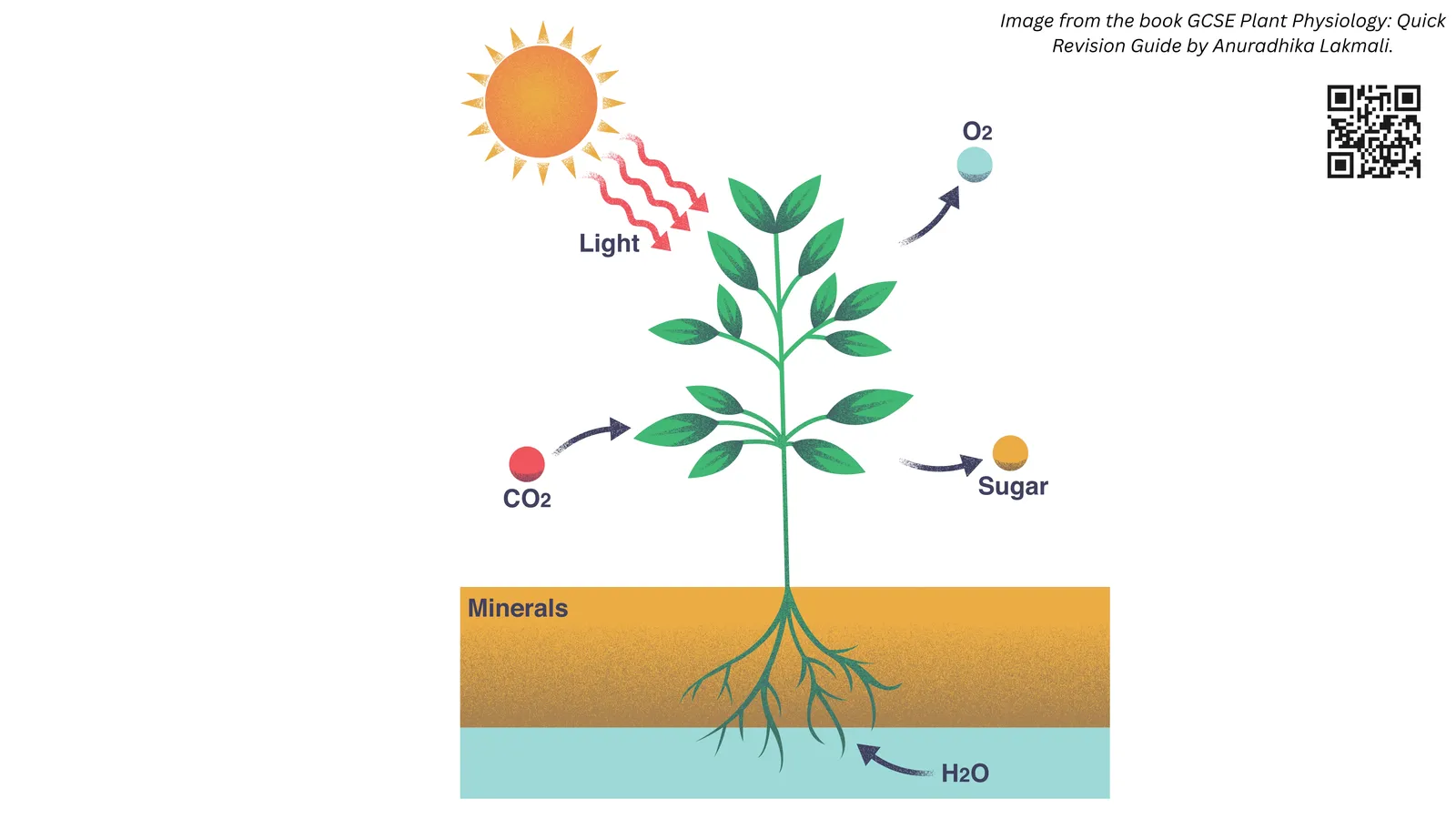
Where does each ingredient come from?
Light comes from the Sun and is absorbed by chlorophyll.
Carbon dioxide diffuses from the air into the leaf through the stomata.
Water is absorbed from the soil by root hair cells and carried up the xylem to the leaf.
Glucose is made in the chloroplasts and is then used, stored or moved to other parts of the plant.
Oxygen is released through the stomata, or used by the plant in respiration.
Every oxygen molecule a plant releases comes from the splitting of water, not from carbon dioxide. That is a point that surprises many students and it makes a good talking point in an exam.
🌱
Slide: Photosynthesis in a whole plant
Light, carbon dioxide and water in; sugar and oxygen out
1/1
Photosynthesis and respiration compared
Feature
Photosynthesis
Aerobic respiration
Where
Chloroplasts of green cells
Mitochondria of all living cells
When
Only in the light
All the time, day and night
Takes in
Carbon dioxide and water
Glucose and oxygen
Gives out
Glucose and oxygen
Carbon dioxide and water
Energy
Absorbed (endothermic)
Released (exothermic)
Inside the Chloroplast
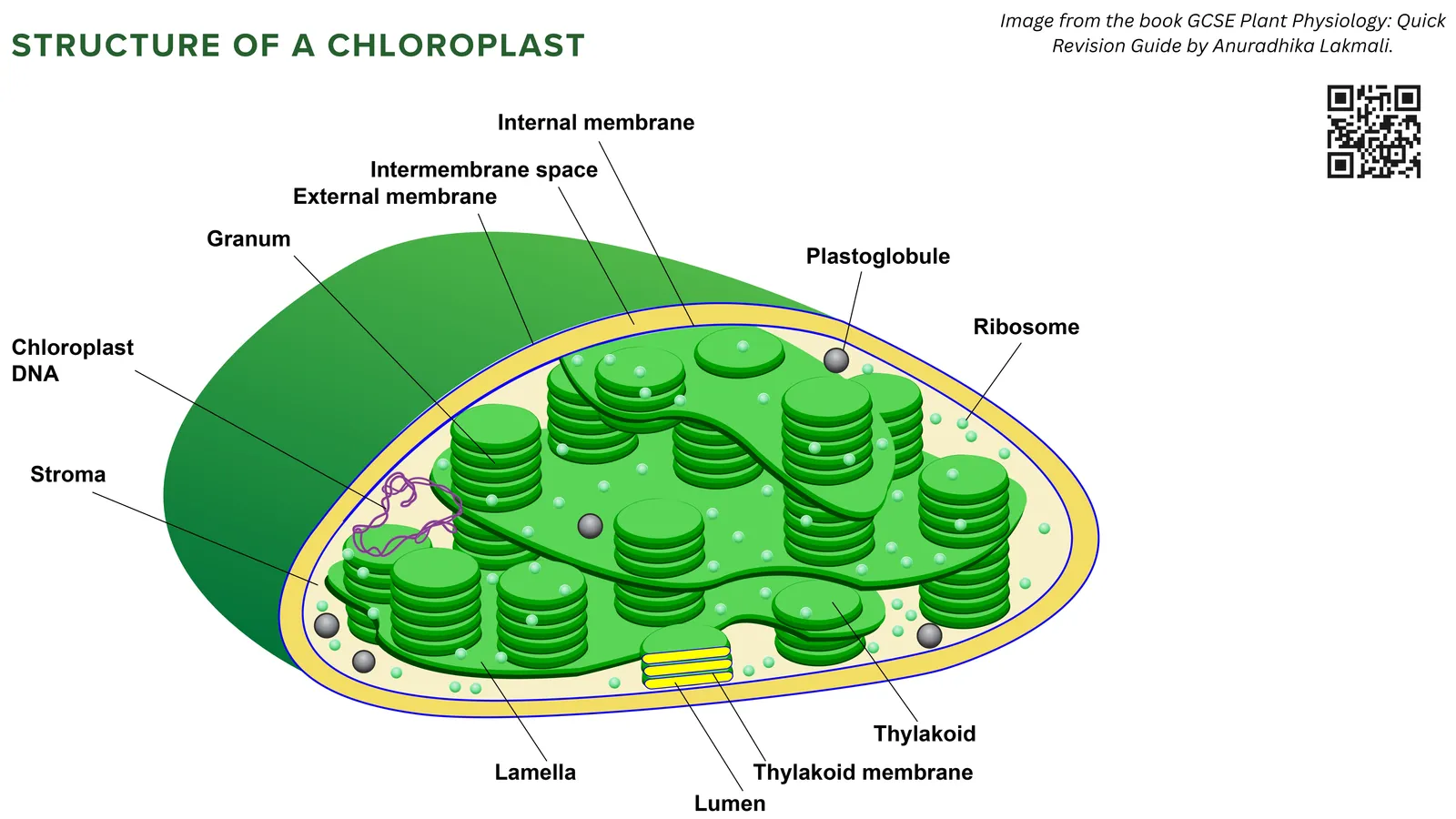
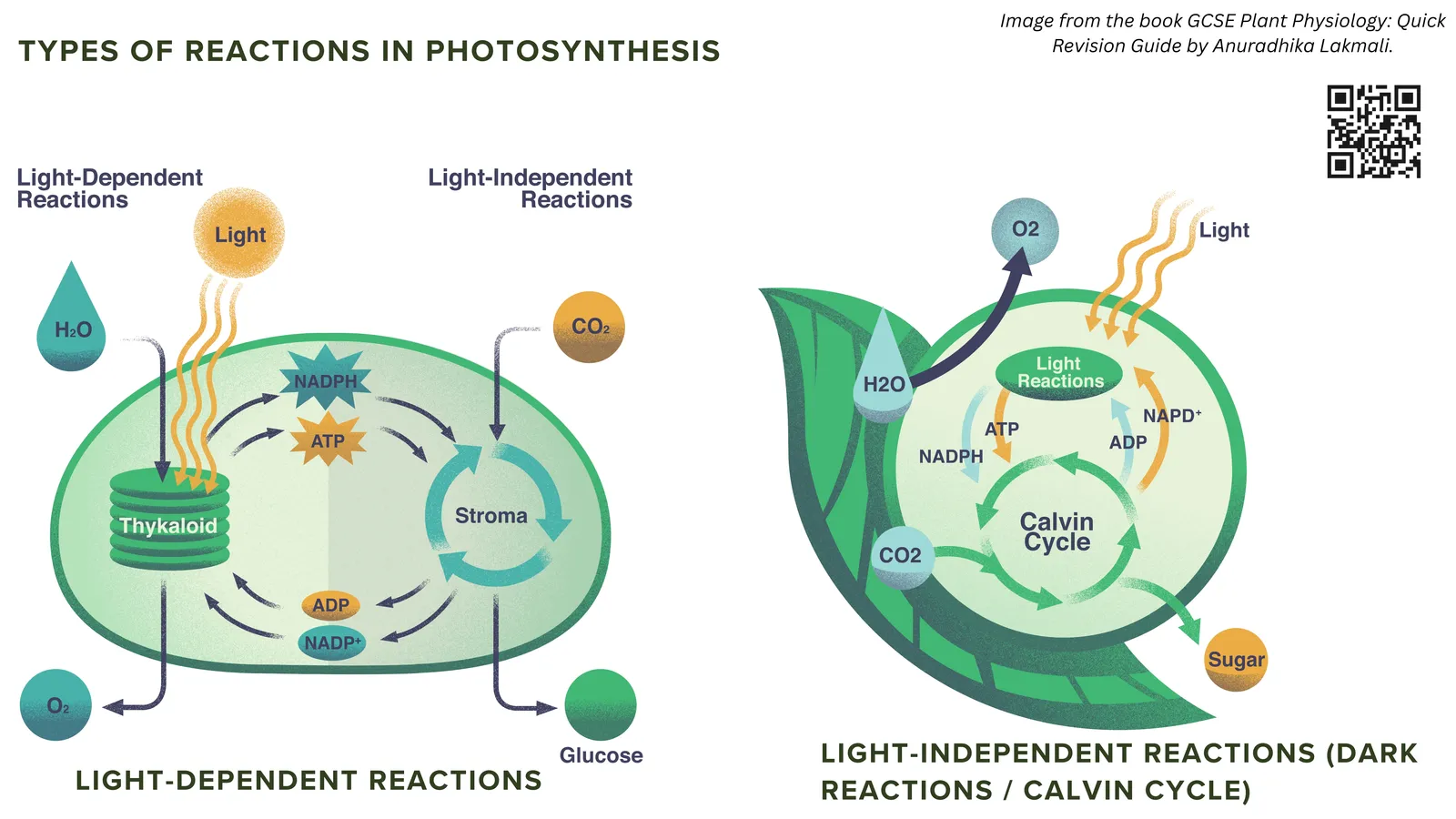
A chloroplast is a small, oval, membrane-bound structure in the green cells of plants and algae. Inside it there are stacks of flattened discs called thylakoids, and each stack is called a granum. The thylakoid membranes hold the green pigment chlorophyll, so the stacking gives a very large surface area for absorbing light. The fluid around the stacks, the stroma, contains the enzymes that build glucose from carbon dioxide. Chloroplasts even have their own small loop of DNA and their own ribosomes.
Why are leaves green? Chlorophyll absorbs mostly red and blue light and uses that energy. It absorbs very little green light, so green light is reflected into our eyes. In autumn many trees break down their chlorophyll, and the yellow and orange pigments that were hidden all summer show through. Remember that chlorophyll is the pigment, while the chloroplast is the structure that contains it.
🟢
Slides: Chloroplast and its reactions
Grana, stroma and the two stages of photosynthesis
1/2
Leaf Structure: A Perfect Design for Photosynthesis
The leaf is the plant's food-making organ. To photosynthesise quickly it must catch as much light as possible, take in carbon dioxide, receive water and send glucose away. Its structure is adapted for every one of those jobs.
Outside the leaf
The broad, flat blade (lamina) gives a large surface area to absorb light.
The leaf is thin, so carbon dioxide has a short distance to diffuse and light reaches the inner cells.
A network of veins brings water in the xylem and takes sugar away in the phloem. The veins also support the blade.
The petiole holds the leaf out and turns it to face the light.
Leaves are arranged so that they do not shade each other.
Inside the leaf
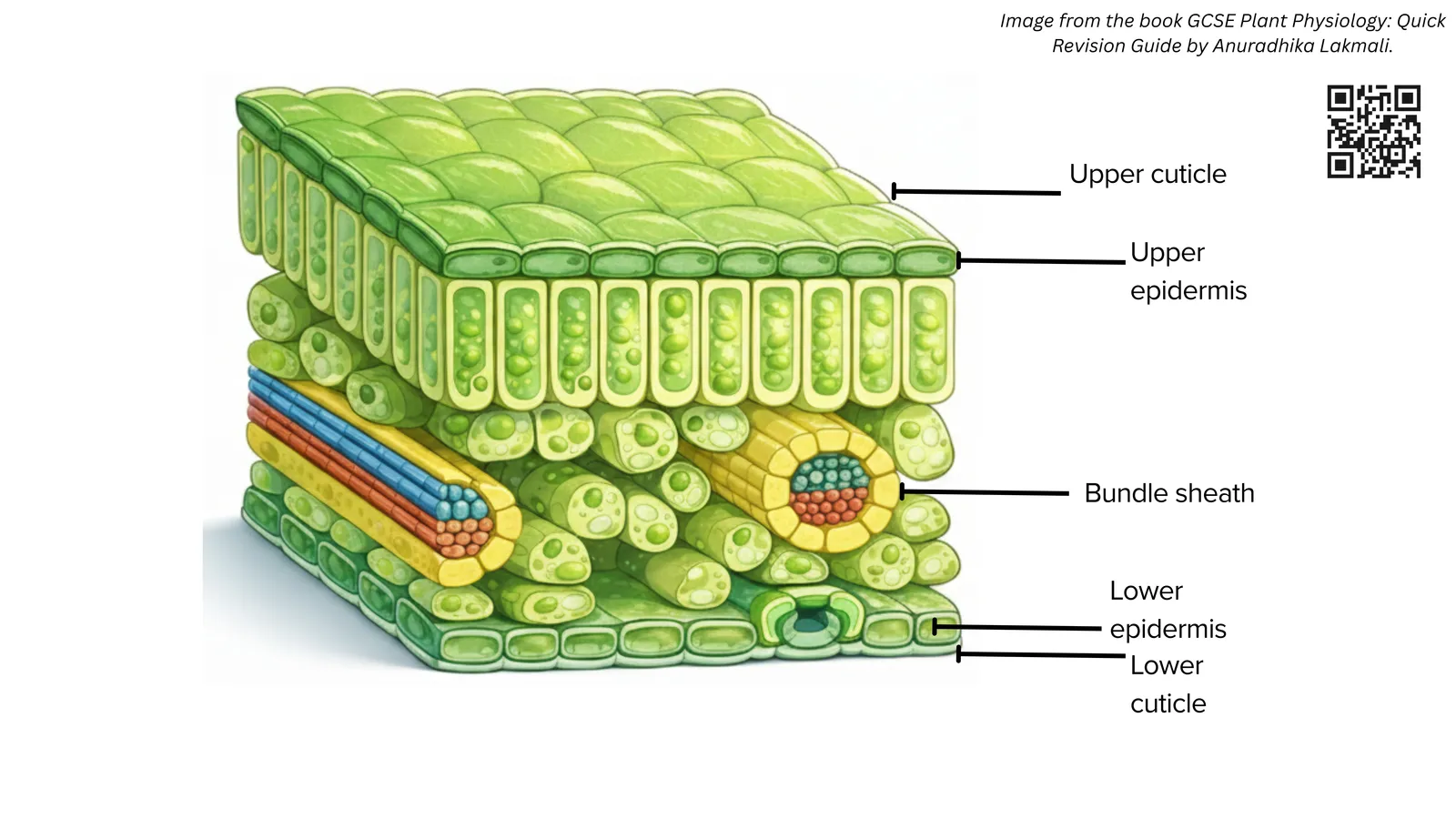
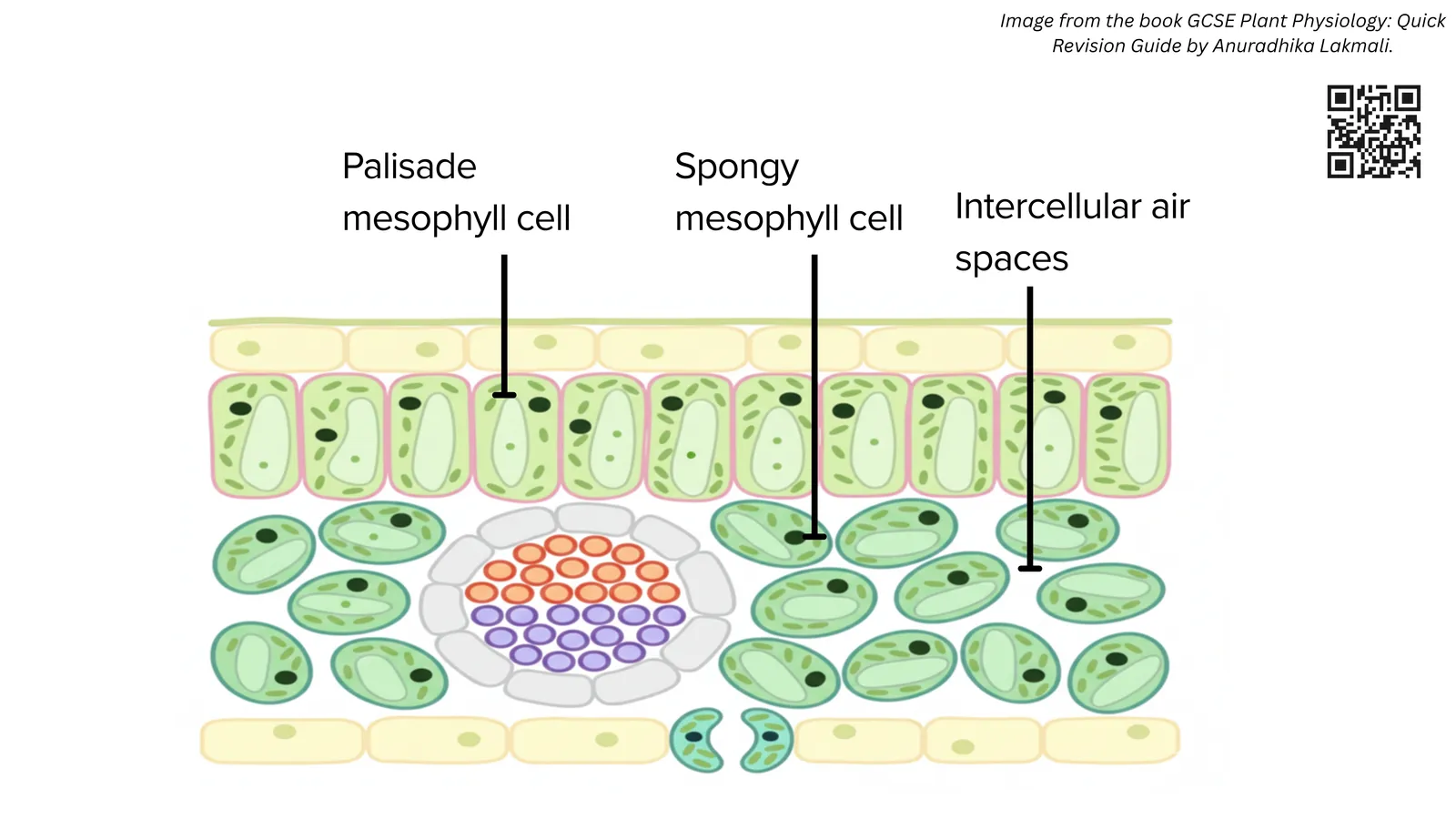
If you cut across a leaf and look at it with a microscope, you can see several layers of tissue.
Layer
Features and job
Waxy cuticle
Thin, waterproof, transparent layer that reduces water loss
Upper epidermis
One layer of clear cells with no chloroplasts, so light passes through
Palisade mesophyll
Tall, tightly packed cells full of chloroplasts, the main site of photosynthesis
Spongy mesophyll
Round, loosely packed cells with large air spaces so gases can diffuse
Vascular bundle
The vein, containing xylem and phloem
Lower epidermis
Contains many stomata, each between two guard cells
The palisade layer sits at the top because that is where light is strongest. The spongy layer sits at the bottom, next to the stomata, where gases enter and leave.
🍃
Slides: Inside the leaf
Layers of tissue from cuticle to lower epidermis
1/2
Stomata, Guard Cells and Gas Exchange
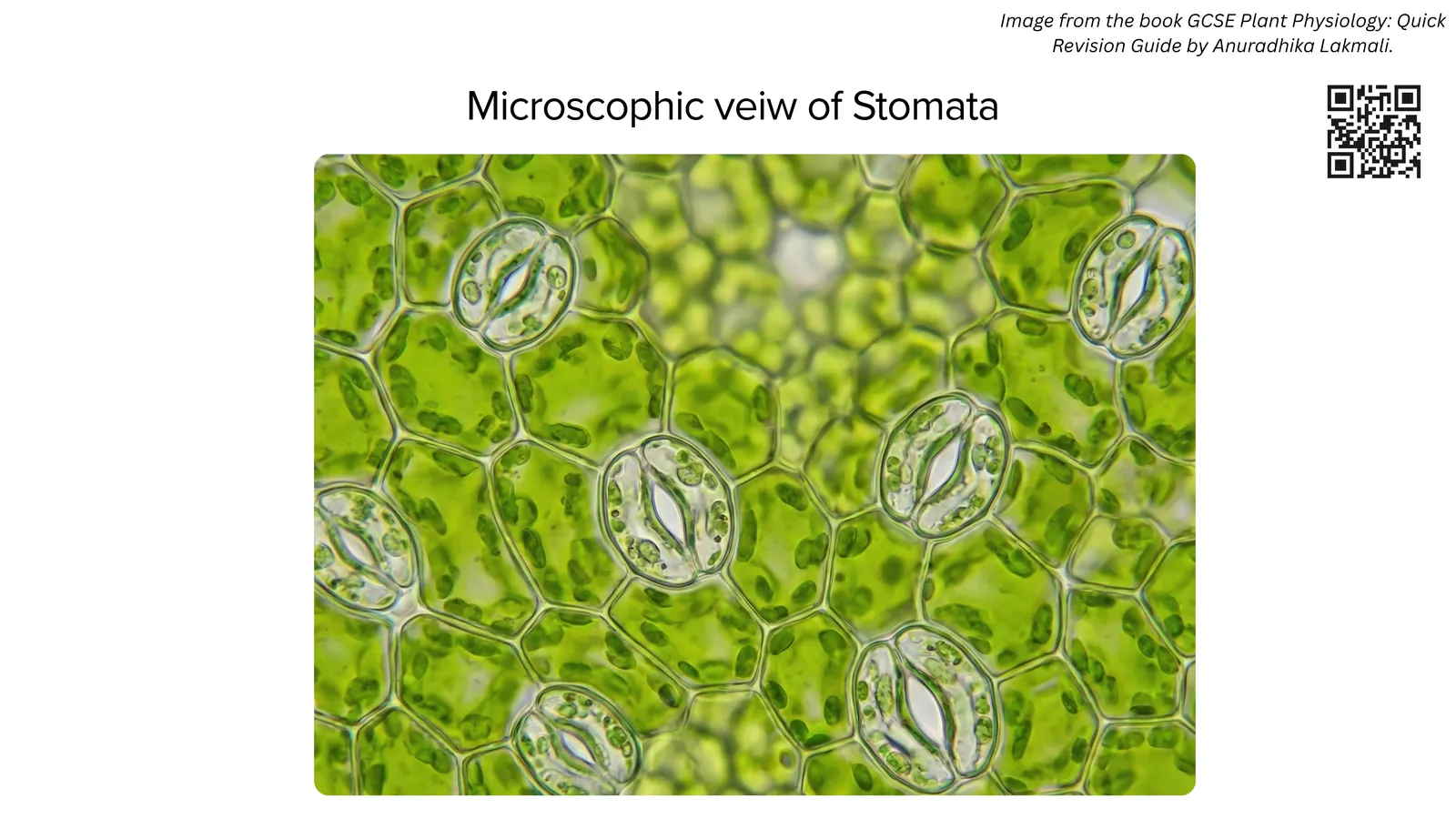
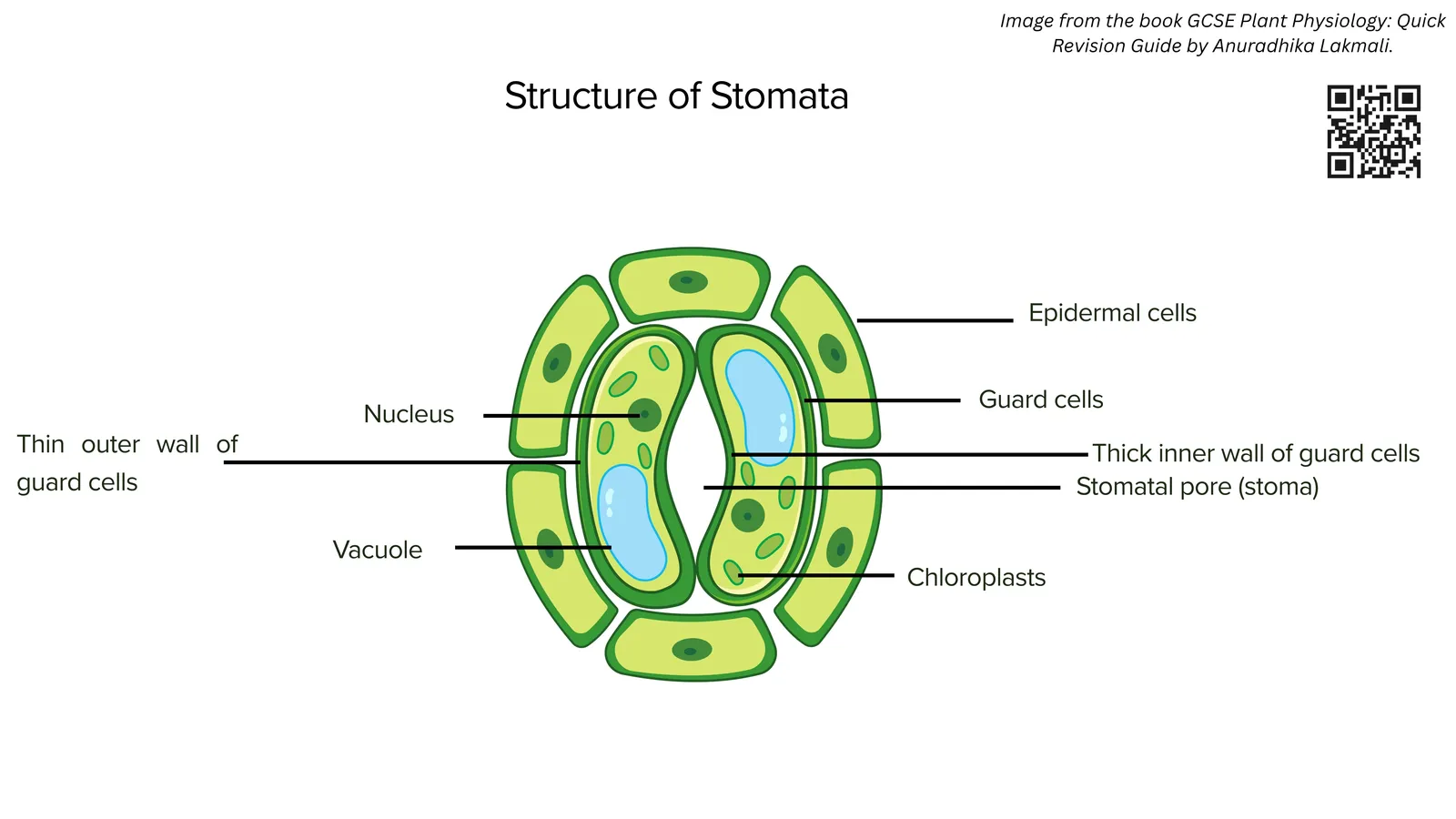
Stomata (singular: stoma) are tiny pores in the leaf, mostly in the lower epidermis. Each is surrounded by two guard cells that open and close it. Stomata control two things at once: the movement of carbon dioxide and oxygen, and the loss of water vapour.
In the light, guard cells take in potassium ions. Water follows by osmosis, so the guard cells become turgid. Because their inner wall is thicker, they curve apart and the pore opens. In the dark or in dry conditions, potassium ions leave, water leaves, the guard cells become flaccid and the pore closes.
The leaf faces a balancing act. It needs its stomata open to let carbon dioxide in, but every open stoma also lets water vapour escape. On a hot dry day the plant may close its stomata to save water, even though this slows photosynthesis. Most stomata are on the shaded lower surface, which helps to reduce water loss. Plants that float on water, such as water lilies, have their stomata on the upper surface instead.
🚪
Slides: Stomata
Guard cells, pores and the structure of a stoma
1/2
Gas exchange by day and by night
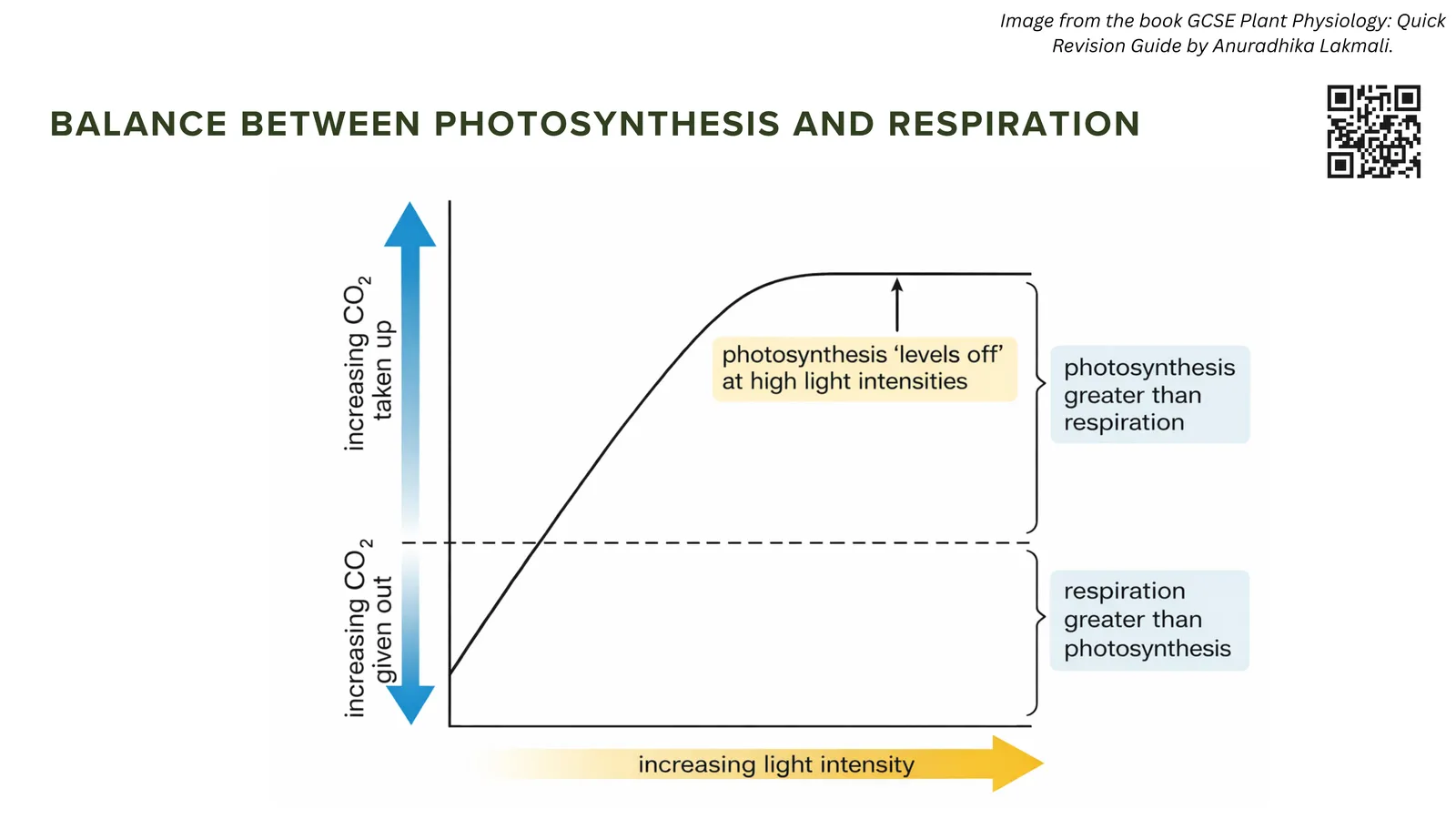
In bright light photosynthesis is faster than respiration, so the leaf takes in carbon dioxide and gives out oxygen overall. At the compensation point the two rates are equal and there is no net gas exchange. In the dark only respiration takes place, so the leaf takes in oxygen and gives out carbon dioxide. A popular mistake is to say that plants only respire at night. They respire all the time. In the light the effect is hidden by faster photosynthesis.
⚖️
Slide: Photosynthesis and respiration balance
Net gas exchange as light intensity rises
1/1
What Do Plants Do With Glucose?
Glucose is soluble and is the main product of photosynthesis. Some is used straight away and the rest is changed into other substances.
1. Respiration. Glucose is broken down in the mitochondria to release energy for active transport, growth and building large molecules.
2. Starch for storage. Spare glucose is joined into long chains of starch. Starch is insoluble, so it does not affect the movement of water by osmosis, and it is compact. It is stored in leaves, roots, stems, tubers and seeds.
3. Cellulose. Glucose is joined into cellulose fibres to build the cell wall.
4. Sucrose for transport. Glucose is changed into sucrose, which is carried in the phloem to parts of the plant that cannot photosynthesise.
5. Lipids. Fats and oils form part of cell membranes and store energy in seeds such as sunflower seeds and peanuts.
6. Amino acids and proteins. Glucose contains only carbon, hydrogen and oxygen. To make amino acids, the plant combines sugars with nitrogen from nitrate ions in the soil.
Plants store carbohydrate as starch but transport it as sucrose. Animals store carbohydrate as glycogen, never as starch.
Mineral Ions From the Soil
Plants make their own food, but they also need small amounts of mineral ions. These are absorbed by root hair cells, often by active transport, and carried up the xylem.
Ion
Why it is needed
Symptom if missing
Nitrate
To make amino acids and proteins for growth
Stunted growth and yellow older leaves
Magnesium
To make chlorophyll
Chlorosis, with leaves yellow between the veins
Phosphate
For DNA, cell membranes and respiration
Poor root growth and purple young leaves
Potassium
Helps enzymes of photosynthesis and respiration work
Yellow leaf edges with dead patches
Fertilisers put mineral ions back into the soil. Farmers add them because every harvest removes minerals that the crop took up. A simple way to remember the links is nitrate gives protein gives growth, and magnesium gives chlorophyll gives green colour.
The Starch Test Practical
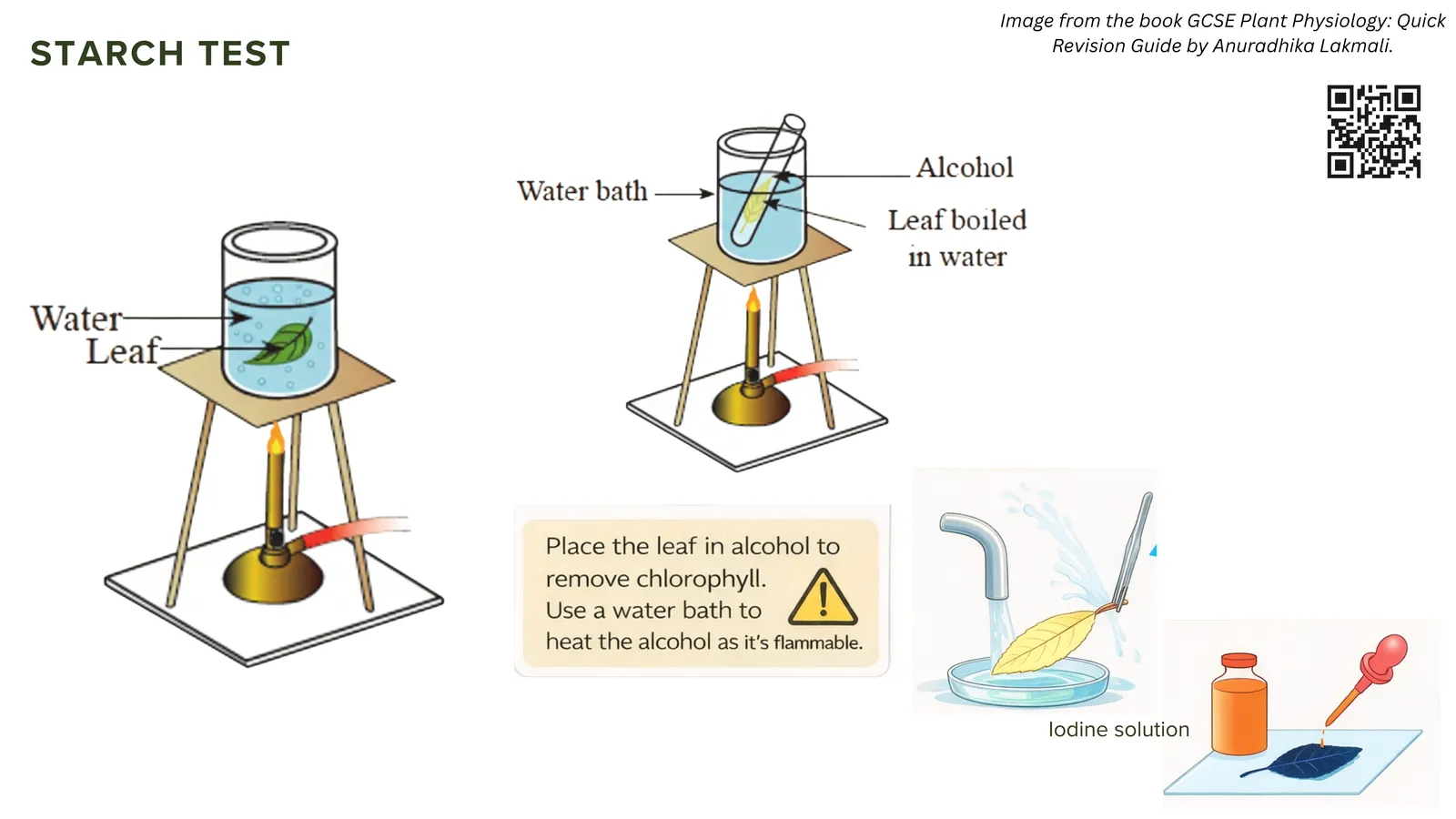
Glucose is soluble and is quickly used or moved, so it is hard to detect. Plants turn extra glucose into starch, which stays in the leaf. If a leaf contains starch, we know it has been photosynthesising. Iodine solution is used to test for starch.
1. Boil the leaf in water for about one minute. This kills the leaf and breaks down the membranes so iodine can get in.
2. Put the leaf in warm ethanol in a water bath. Ethanol removes the chlorophyll so that the colour change is easy to see. Ethanol is highly flammable, so switch off any Bunsen burner first.
3. Rinse the leaf in warm water to soften it, spread it on a white tile and add iodine solution.
A blue-black colour means starch is present. An orange-brown colour means there is no starch. Before the experiment the plant is kept in the dark for 48 hours, which is called destarching. This uses up stored starch, so any starch found later must have been made during the experiment.
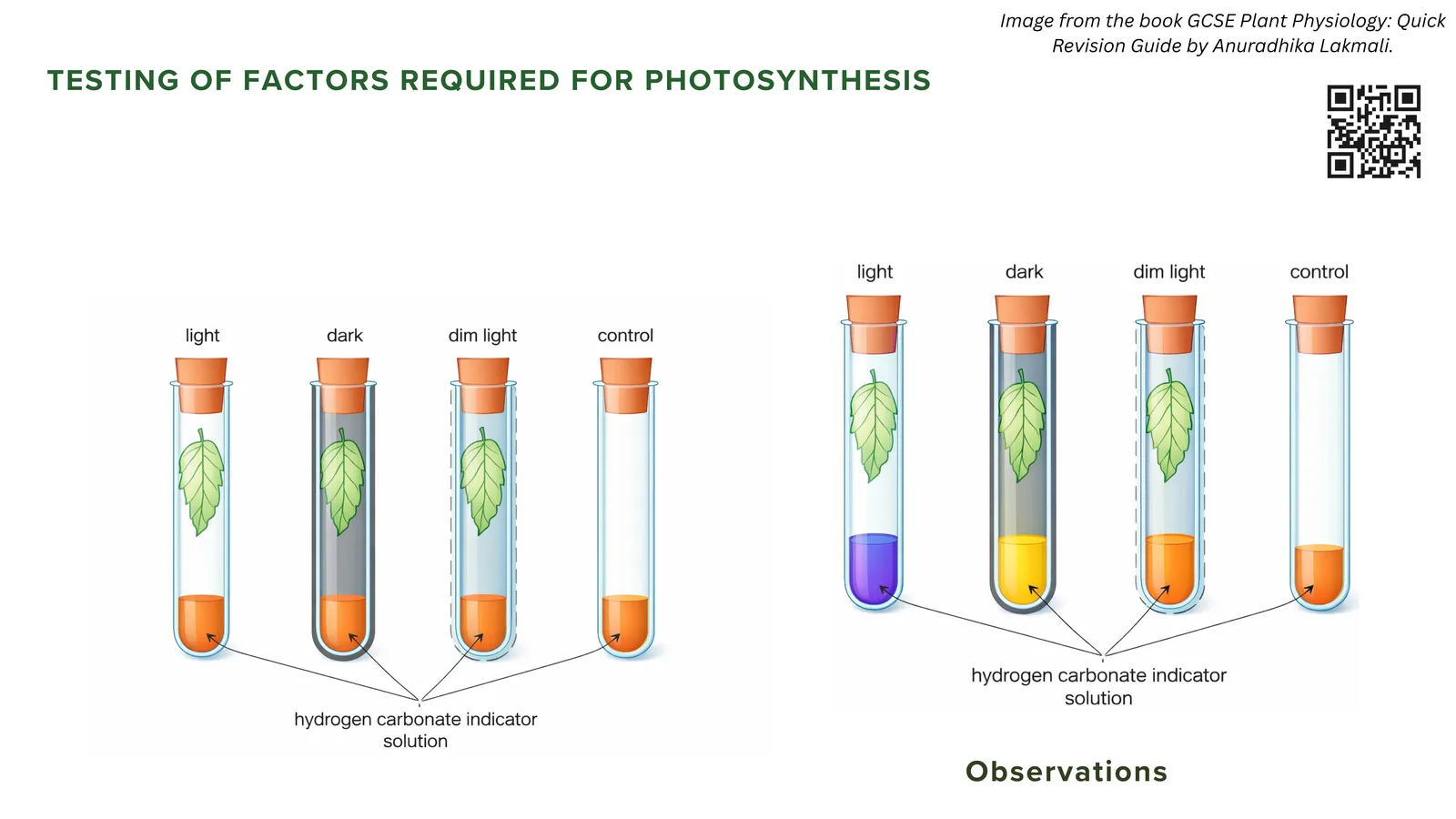
The same method shows that a leaf needs light, chlorophyll and carbon dioxide. Cover part of a leaf with foil and only the uncovered part turns blue-black. Use a variegated leaf and only the green parts turn blue-black. Place a leaf in a bag with sodium hydroxide, which absorbs carbon dioxide, and that leaf stays orange-brown. In every case the experiment needs a control that is identical except for the one factor being tested.
🧪
Slides: The starch test and testing factors
Boiling, ethanol, iodine and controlled test tubes
1/2
The Rate of Photosynthesis and Limiting Factors
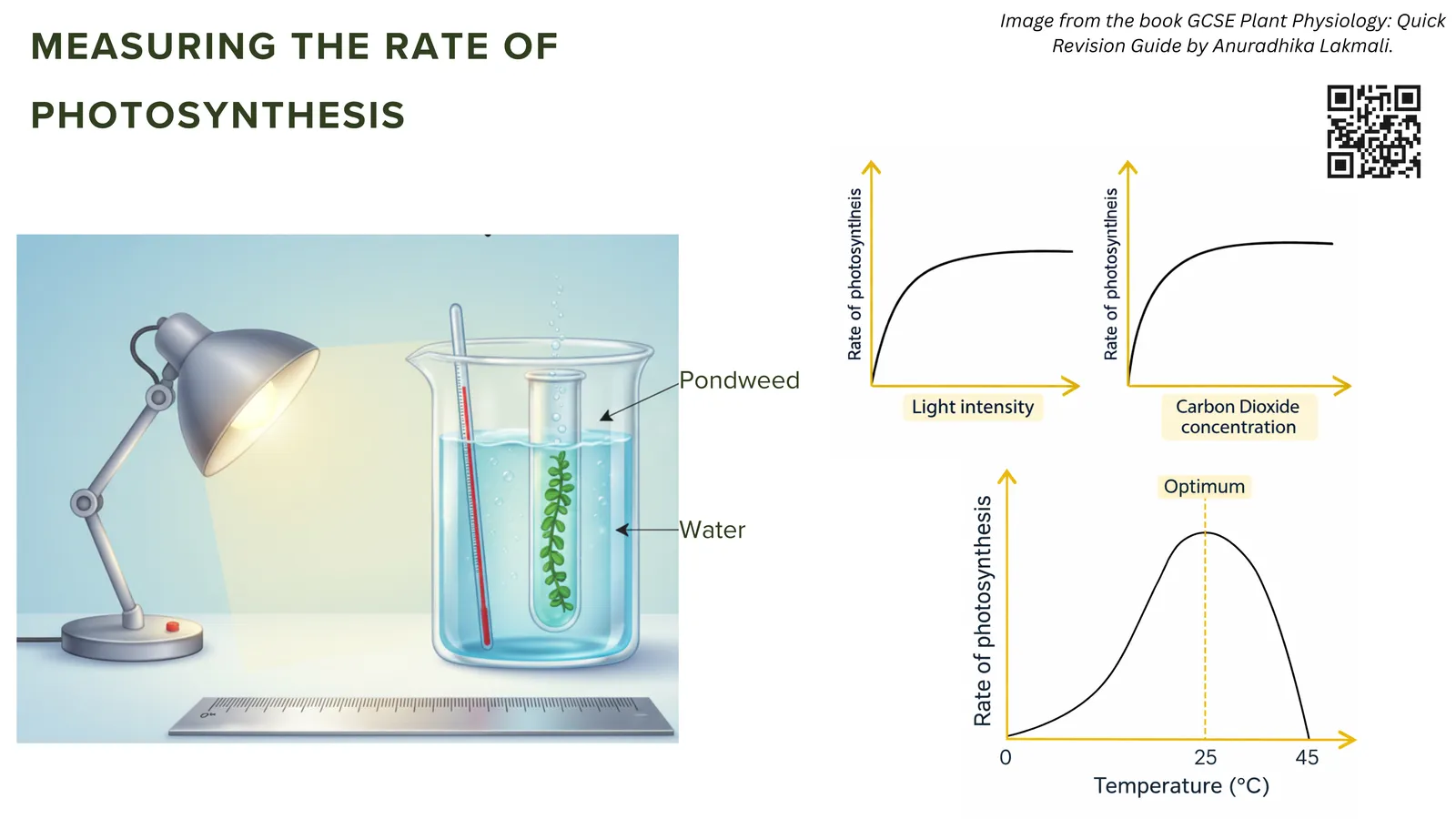
The rate of photosynthesis is how quickly a plant makes glucose. It can be measured by how fast oxygen is released. Three main factors change the rate.
Light intensity. Light provides the energy. As light increases the rate rises steadily, then levels off when another factor becomes limiting.
Carbon dioxide concentration. Carbon dioxide is a raw material. Air contains only about 0.04 percent, so it often limits the rate on bright days.
Temperature. Photosynthesis is controlled by enzymes. Warming speeds up the reactions, but above the optimum temperature the enzymes are denatured and the rate falls sharply.
A limiting factor is the factor in shortest supply, which stops the rate from going any higher. On a graph, where a line slopes upwards the factor on the x-axis is limiting. Where the line is flat, a different factor is limiting. Farmers use this idea in greenhouses. Lamps give light at night, heaters keep the temperature near the optimum, and paraffin heaters release carbon dioxide as well as heat. A grower only adds more of a factor when the extra crop sells for more than the cost.
The pondweed practical
Pondweed releases oxygen as bubbles, so counting bubbles measures the rate of photosynthesis. Place a piece of pondweed in water with a little sodium hydrogencarbonate, which provides carbon dioxide. Put a lamp at a set distance, leave the plant for a few minutes to adjust, then count the bubbles in one minute. Repeat at different distances and plot the rate. The distance is the independent variable, bubbles per minute is the dependent variable, and temperature and carbon dioxide are controlled. A clear heat shield stops the lamp warming the water. For higher tier, light intensity is proportional to one over distance squared, so halving the distance makes the light four times as intense.
📈
Slide: Measuring the rate of photosynthesis
Pondweed, lamp and the graphs of limiting factors
1/1
Exam Tips That Earn Marks
Write the word equation or the balanced symbol equation, and keep light and chlorophyll above the arrow.
Link every adaptation to a job. Say that the leaf is thin to give a short diffusion distance, and broad to give a large surface area.
Name the process. Water enters root hairs by osmosis, and minerals enter by active transport.
In a limiting factor question, name the factor and give evidence from the graph.
Say that high temperatures denature enzymes. Never say the enzymes are killed, because enzymes are not alive.
In practical questions, explain why the plant is destarched and why the leaf is boiled in ethanol.
Frequently Asked Questions
Do plants respire?
Yes. Plants respire all the time, day and night, because every living cell needs energy. In bright light they photosynthesise faster than they respire, so overall they release oxygen.
Where does the food a plant makes come from?
It is made in the leaves by photosynthesis. The soil provides water and mineral ions only, not food.
Why are leaves thin and flat?
A large flat blade absorbs more light, and a thin leaf gives carbon dioxide a very short distance to travel to the cells that need it.
What is the difference between a chloroplast and chlorophyll?
Chlorophyll is the green pigment that absorbs light. The chloroplast is the structure that contains the chlorophyll.
Why is starch stored instead of glucose?
Starch is insoluble, so it does not draw water into cells by osmosis, and it is compact, so a lot of energy can be stored in a small space.
Why do stomata close?
In the dark or in dry conditions the guard cells lose water and become flaccid, so the pore closes. This saves water but slows the entry of carbon dioxide.
Key Takeaways
Plants are producers that make glucose by photosynthesis using light, carbon dioxide and water.
The leaf is adapted by being broad, thin, veined, full of chloroplasts and covered in stomata.
Glucose is used in respiration, stored as starch, built into cellulose, lipids and proteins and carried as sucrose.
Mineral ions such as nitrate and magnesium are taken from the soil to make proteins and chlorophyll.
The rate of photosynthesis depends on light, carbon dioxide and temperature, and the factor in shortest supply is the limiting factor.
The starch test and the pondweed practical turn these ideas into evidence.
Conclusion
Plant nutrition is one of the most satisfying topics in GCSE biology because every fact connects to the next. Light is absorbed by chlorophyll, carbon dioxide arrives through stomata, water arrives in the xylem, glucose is made in the chloroplasts and then used, stored or moved. Once you can tell that story from start to finish, and explain how the leaf is built to make it happen, most exam questions on this topic become a matter of applying what you already know. Keep practising with the diagrams and the practical, and the marks will follow.
🗂️ Revision Flashcards
Tap a card to reveal the answer.
🎯 Quick Quiz
8 questions. Pick an answer to check it straight away.
1Where does a plant get the food it uses for growth?
The soil supplies water and mineral ions only. Food, glucose, is made in the leaves.
2Where do the oxygen molecules released in photosynthesis come from?
Every oxygen molecule a plant releases comes from the splitting of water, not from carbon dioxide.
3Which layer of the leaf is the main site of photosynthesis?
Palisade mesophyll cells are tall, tightly packed and full of chloroplasts.
4Why are leaves green?
Chlorophyll absorbs very little green light, so green light is reflected into our eyes.
5What is the purpose of boiling a leaf in ethanol in the starch test?
Ethanol removes the chlorophyll so the iodine colour change is easy to see.
6A leaf is tested with iodine and stays orange-brown. What does this show?
Blue-black means starch is present. Orange-brown means there is no starch.
7Which mineral ion is needed to make chlorophyll?
Magnesium is needed to make chlorophyll. Without it leaves show chlorosis, yellow between the veins.
8On a graph of rate of photosynthesis, the line slopes upwards. What does this show?
Where the line slopes upwards the factor on the x-axis is limiting. Where it is flat, a different factor is limiting.