A large oak tree can lose more than 400 litres of water on a hot summer day. A field of maize can release enough water vapour to change the local weather. Yet plants have no heart and no pump. So how does water climb from the soil all the way to leaves 100 metres above the ground in the tallest redwood trees? The answer is transpiration, one of the most fascinating processes in plant biology. In this guide we explain what transpiration is, how it works step by step, what affects its rate and how to measure it with a potometer.
📖 Lesson
How water climbs from the soil to the leaves, what speeds transpiration up and how to measure it with a potometer.
What Is Transpiration? A Simple Definition
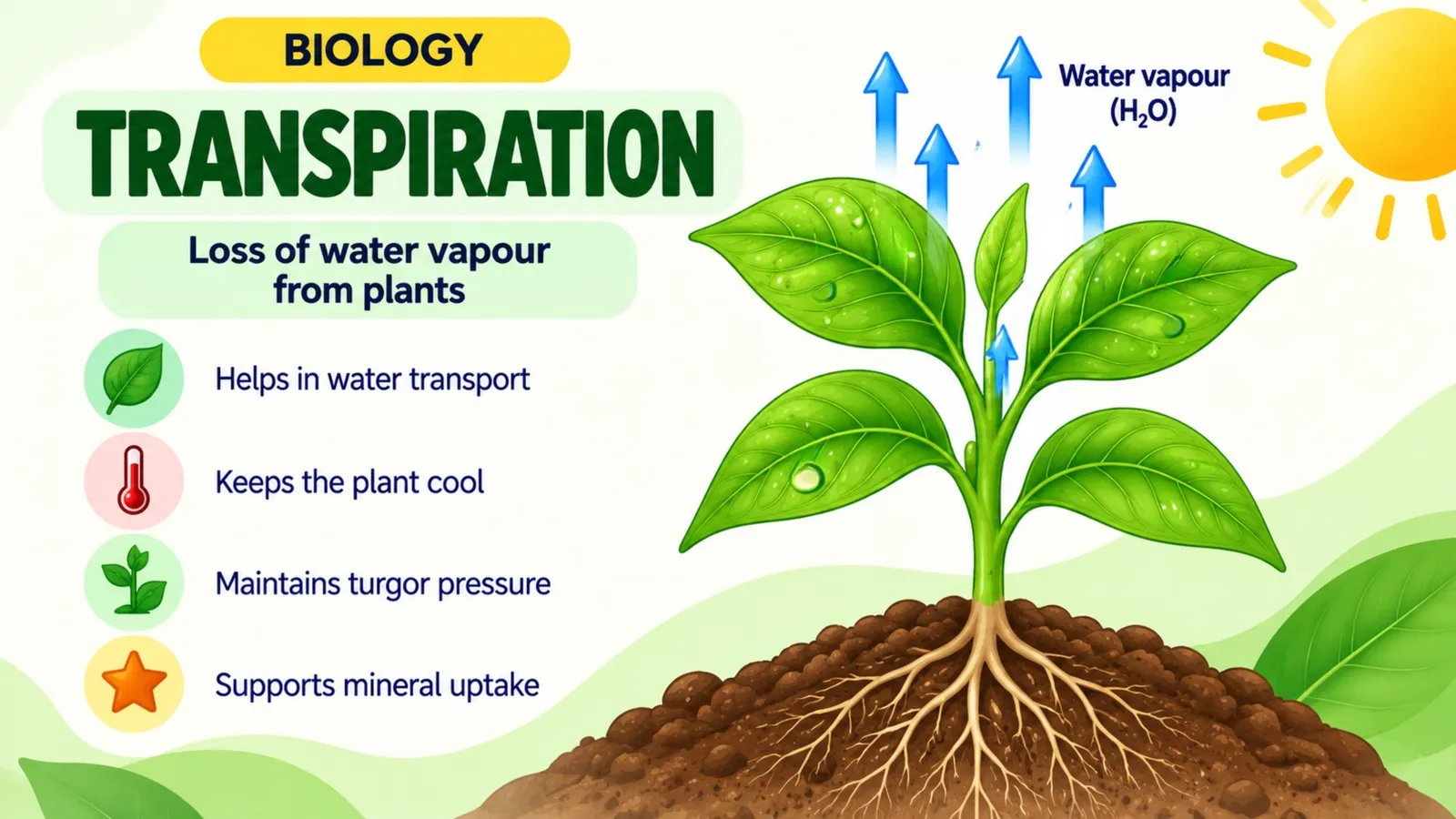
Transpiration is the evaporation of water from the inner cells of a leaf followed by the diffusion of water vapour out of the leaf, mostly through the stomata. It is similar to the way sweat evaporates from your skin, except that plants lose far more water in relation to their size.
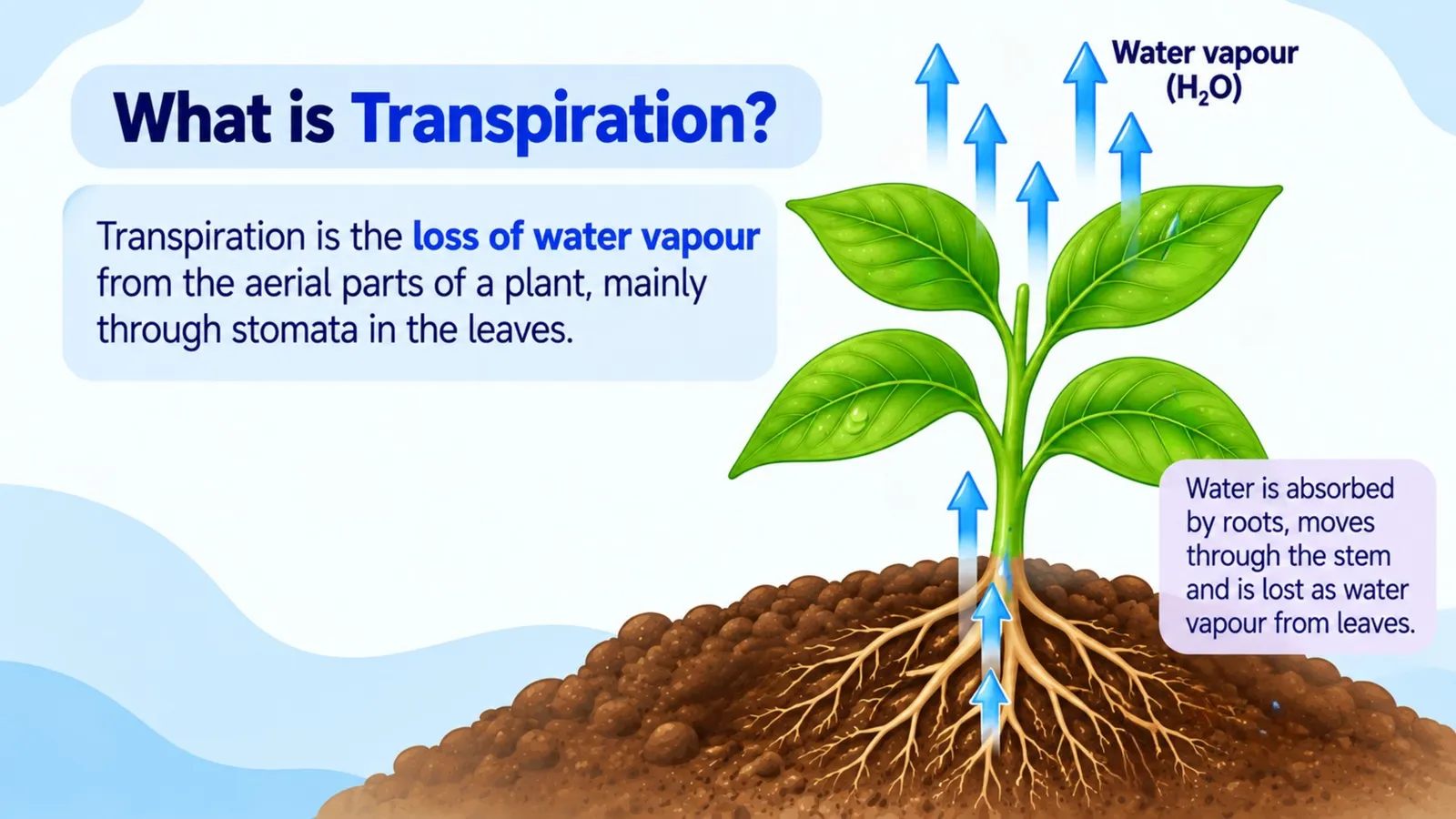
The exam-ready definition is: transpiration is the loss of water vapour from the aerial parts of a plant, especially the leaves, by evaporation from mesophyll cell surfaces and diffusion through the stomata.
About 99 percent of the water a plant absorbs through its roots is lost by transpiration. Only around 1 percent is actually used in photosynthesis and other reactions. That might sound wasteful, but transpiration does several essential jobs, as we will see later.
Slides: What is transpiration?
Loss of water vapour from plants
1/2
Parts of the Plant Involved in Transpiration
To understand transpiration you need to know the key structures that water passes through.
Root hair cells: long, thin extensions of root epidermis cells that give a huge surface area for absorbing water from the soil.
Root cortex: layers of cells that water crosses to reach the centre of the root.
Xylem vessels: long, hollow tubes made of dead cells joined end to end. Their walls are strengthened with lignin, which stops them collapsing under tension.
Mesophyll cells: the cells inside the leaf. The spongy mesophyll has many air spaces where water evaporates.
Stomata: tiny pores, mostly on the lower surface of the leaf, through which water vapour escapes.
Guard cells: pairs of bean-shaped cells that surround each stoma and control its opening and closing.
The Transpiration Stream Step by Step
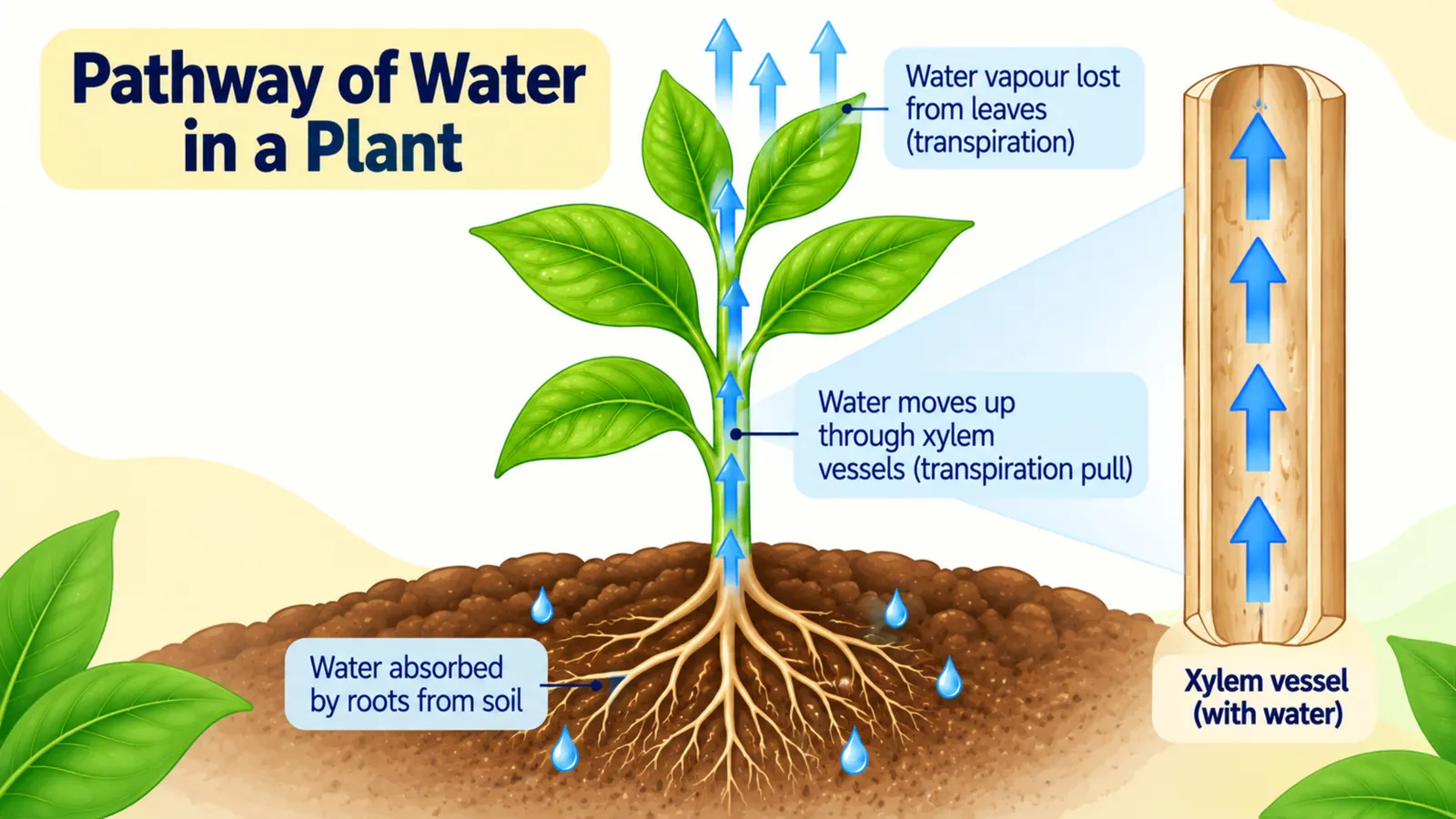
The movement of water from the soil, through the plant and out into the atmosphere is called the transpiration stream. Here is how it works.
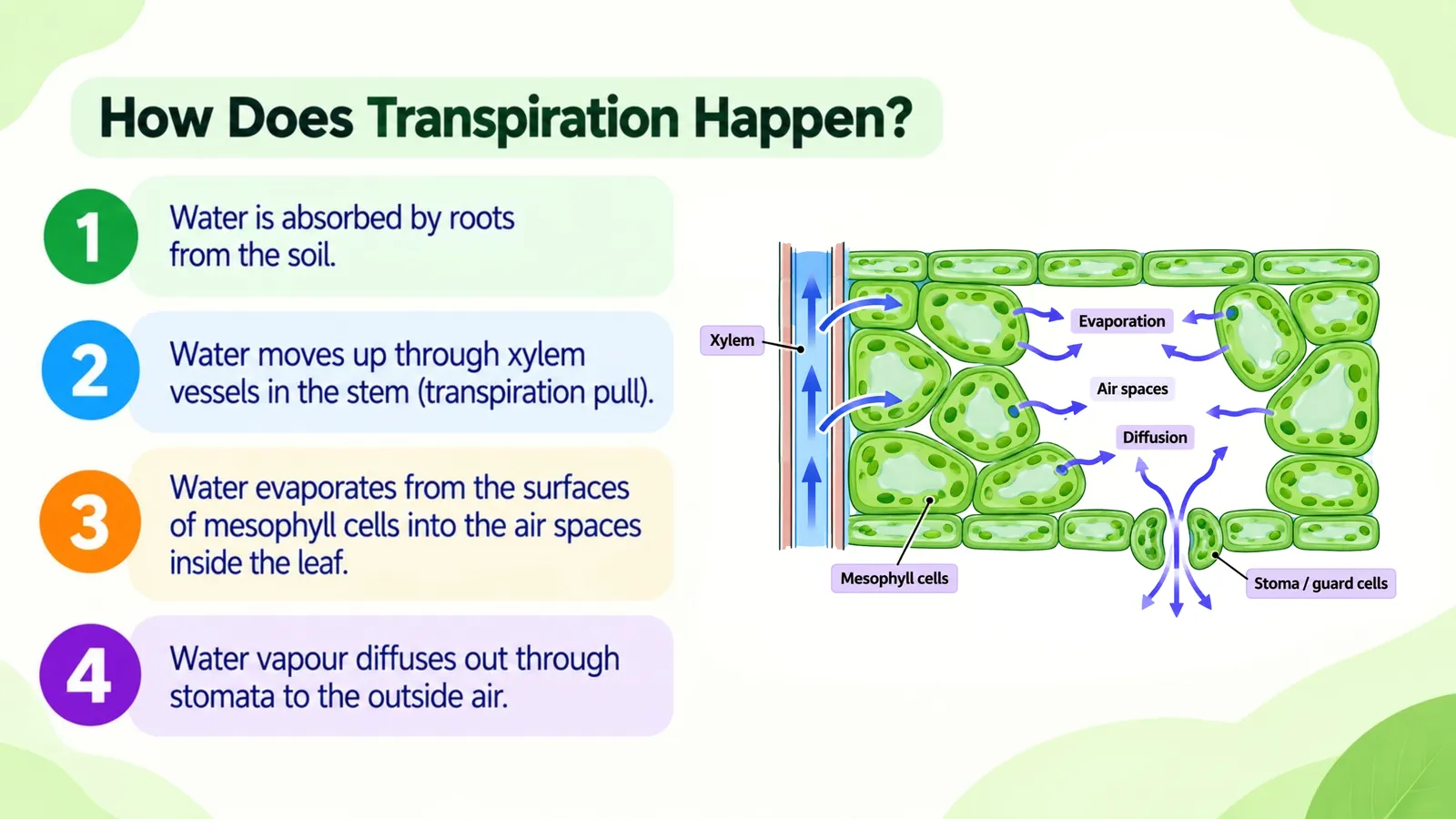
Step 1: Water enters the root hair cells by osmosis
Soil water contains only a few dissolved mineral ions, so it has a higher water potential than the cell sap inside root hair cells. Water therefore moves into the root hairs by osmosis. Mineral ions such as nitrates are absorbed separately, usually by active transport.
Step 2: Water crosses the root to the xylem
Water moves from cell to cell across the root cortex, either through the cells themselves or along the cell walls. It eventually reaches the xylem vessels in the centre of the root.
Step 3: Water moves up the xylem
Water travels up the stem in the xylem as a continuous column. This column stretches unbroken from the roots to the leaves.
Step 4: Water evaporates inside the leaf
In the leaf, water leaves the xylem and moves into the mesophyll cells. It then evaporates from the moist surfaces of these cells into the air spaces, turning into water vapour.
Step 5: Water vapour diffuses out through the stomata
The air spaces inside the leaf are almost saturated with water vapour, while the air outside is usually drier. Water vapour therefore diffuses out through the open stomata, down a concentration gradient.
Slides: The transpiration stream
From root hairs to stomata
1/2
How Does Water Climb So High? Cohesion-Tension Theory
The best explanation for how water rises in plants is the cohesion-tension theory.
Tension (transpiration pull): as water evaporates from the leaves, it creates a pulling force on the water in the xylem, a bit like sucking water up a straw.
Cohesion: water molecules stick to each other because of hydrogen bonds. This means that when water molecules at the top are pulled, the whole column is dragged upwards together.
Adhesion: water molecules also stick to the walls of the xylem vessels, which helps to support the column and stop it falling back.
Because the column is under tension, the xylem vessels are actually pulled slightly inwards. Scientists have measured tiny decreases in tree trunk diameter during the day, when transpiration is fastest. Lignin in the xylem walls prevents the vessels from collapsing. Root pressure, caused by roots actively pumping ions into the xylem, also gives water a small push from below, but it is far less important than transpiration pull.
Stomata and Guard Cells: The Gatekeepers
Stomata are essential for gas exchange. They let carbon dioxide in for photosynthesis and let oxygen out. The unavoidable cost of having open stomata is water loss.
How stomata open
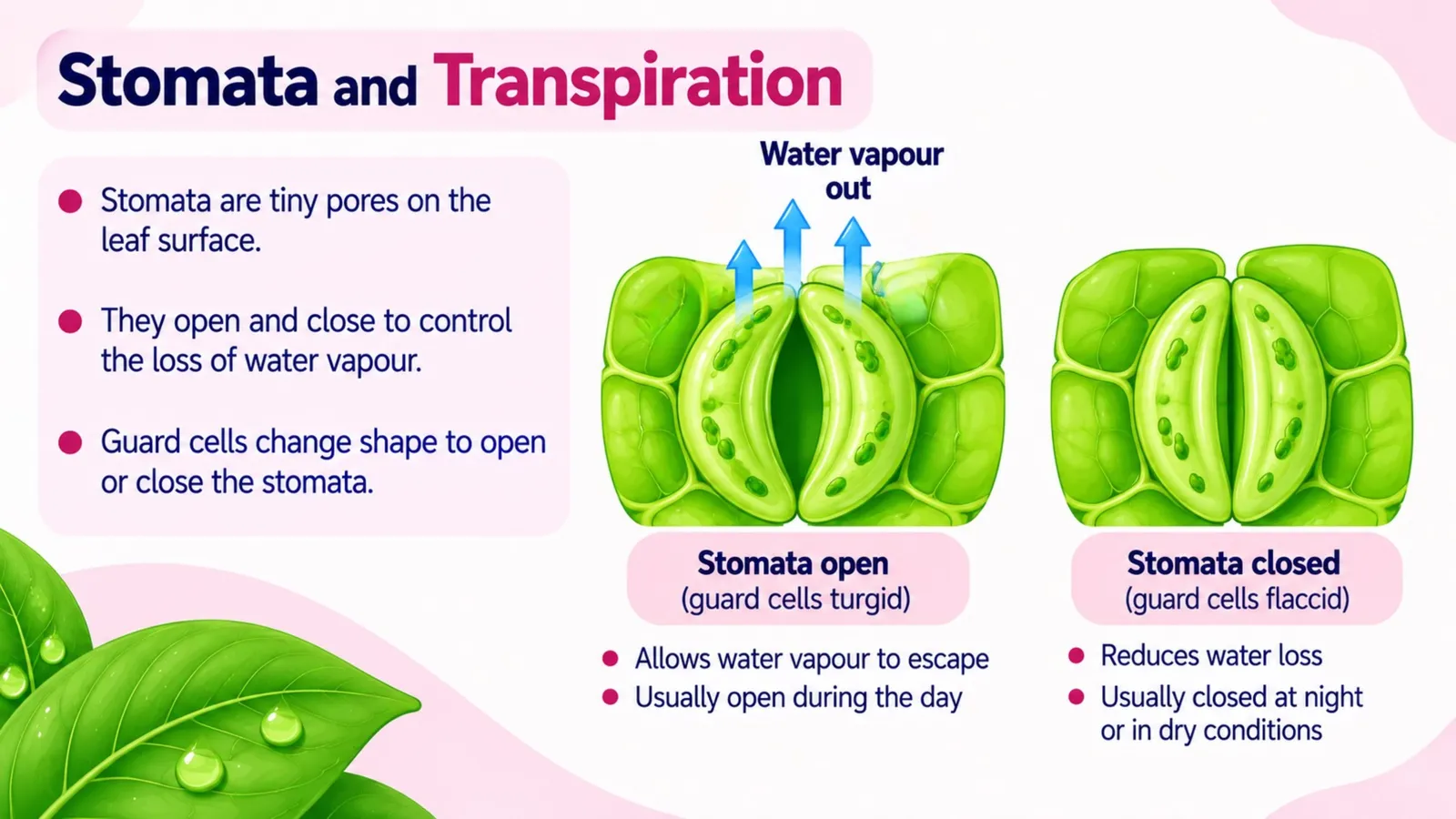
In the light, guard cells actively take in potassium ions (K+). This lowers their water potential, so water enters them by osmosis. The guard cells become turgid. Because their inner walls are thicker than their outer walls, they bend outwards as they swell, and the pore between them opens.
How stomata close
In the dark, or when the plant is short of water, potassium ions leave the guard cells, water follows by osmosis and the guard cells become flaccid. The pore closes. When a plant is badly dehydrated, it releases a hormone called abscisic acid (ABA), which triggers stomatal closure to save water.
Most plants have more stomata on the lower surface of their leaves. The lower surface is shaded and cooler, which reduces evaporation. Floating water lily leaves are an exception: their stomata are on the upper surface, because the lower surface rests on the water.
Slide: Stomata and guard cells
Open when turgid, closed when flaccid
1/1
Types of Transpiration
Plants lose water in three ways, and this is a popular short-answer question.
| Type | Where water is lost | Share of total water loss |
|---|---|---|
| Stomatal transpiration | Through open stomata | About 90 to 95 percent |
| Cuticular transpiration | Through the waxy cuticle covering the leaf | About 5 to 10 percent |
| Lenticular transpiration | Through lenticels, small pores in woody stems and fruits | Very small, less than 1 percent |
Factors Affecting the Rate of Transpiration
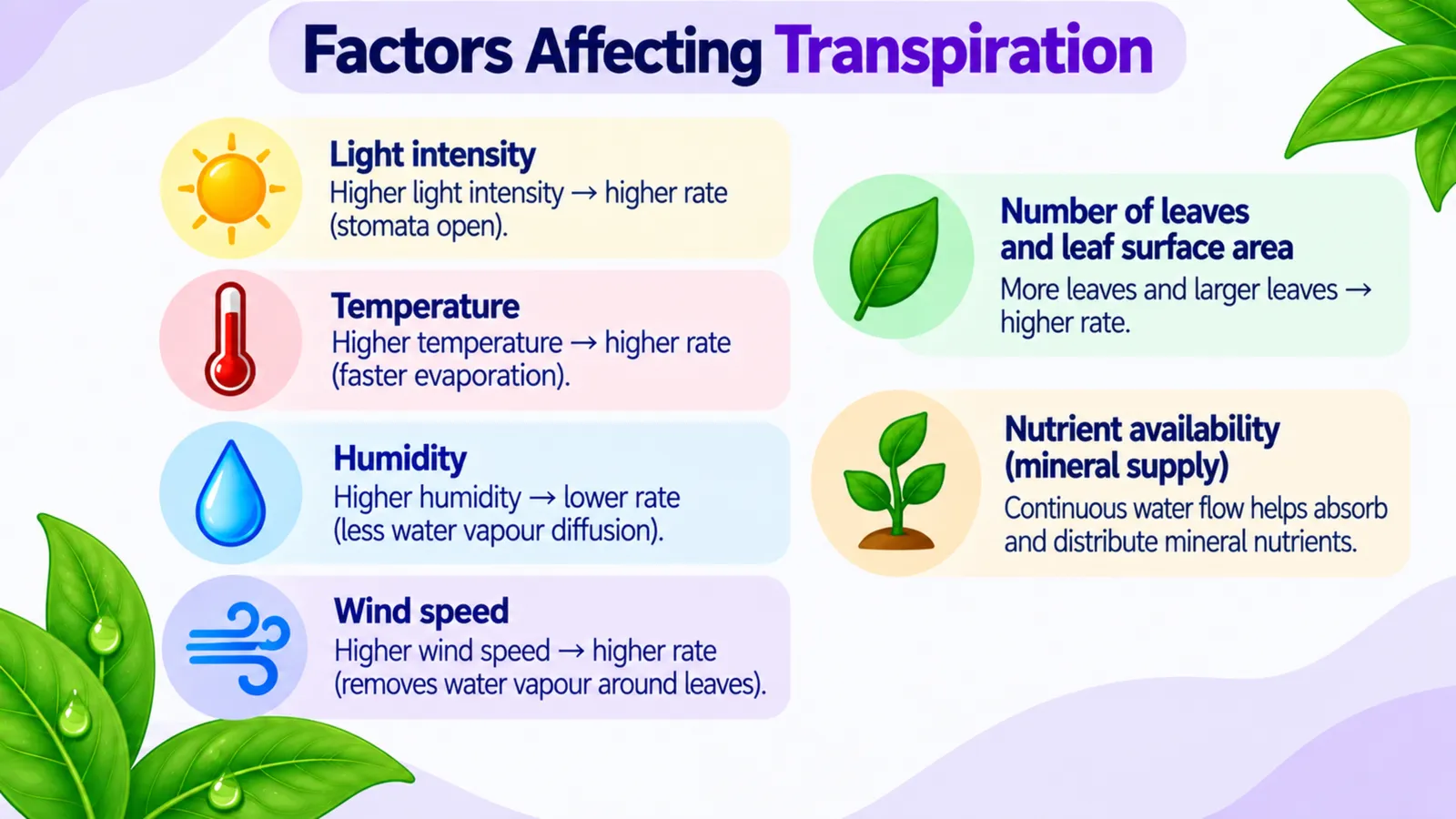
This is the most commonly examined part of the topic. Each factor changes either the rate of evaporation or the concentration gradient of water vapour between the leaf and the air.
Light intensity
Brighter light makes stomata open wider so the leaf can take in more carbon dioxide for photosynthesis. More open stomata mean more water vapour escapes, so the rate of transpiration increases. In darkness the stomata close and transpiration is very slow.
Temperature
At higher temperatures, water molecules have more kinetic energy, so water evaporates and diffuses faster. Warm air can also hold more water vapour, which keeps the concentration gradient steep. Transpiration therefore increases as temperature rises, up to the point where the plant closes its stomata to prevent wilting.
Humidity
Humidity is the amount of water vapour in the air. In humid air, the concentration gradient between the inside of the leaf and the outside is small, so water vapour diffuses out slowly. Dry air gives a steep gradient and fast transpiration. This is why plants lose water quickly on dry days.
Wind speed (air movement)
Still air lets a layer of humid air build up around the leaf, which reduces the concentration gradient. Wind blows this humid layer away and replaces it with drier air, keeping the gradient steep. Windy conditions therefore increase the rate of transpiration.
Water availability in the soil
If the soil is dry, roots cannot absorb enough water, the plant starts to wilt and the stomata close. Transpiration then slows down.
Plant features
Leaf surface area, the number and position of stomata, and the thickness of the waxy cuticle all affect how much water a plant loses.
Slide: Factors affecting transpiration
Light, temperature, humidity, wind and more
1/1
Measuring Transpiration: The Potometer Experiment
A potometer measures how fast a leafy shoot takes up water. Because almost all the water taken up is lost by transpiration, the rate of uptake is used as an estimate of the rate of transpiration.
Setting up a bubble potometer
Cut a leafy shoot under water to stop air entering the xylem and blocking it.
Fit the shoot into the potometer under water, and make sure all joints are airtight, using petroleum jelly if needed.
Dry the leaves gently, then introduce a single air bubble into the capillary tube.
Record how far the bubble moves in a set time, for example 5 minutes.
Use the reservoir to push the bubble back to the start and repeat to get a mean.
To compare conditions, change one factor at a time: move a lamp closer to test light intensity, use a fan to test wind, or place a clear plastic bag over the shoot to test humidity. Keep everything else the same.
To calculate the volume of water taken up, use the formula volume = πr² × distance moved, where r is the radius of the capillary tube.
Why the potometer is not perfectly accurate
A potometer measures water uptake, not water loss. A small amount of water is used by the plant in photosynthesis and to keep cells turgid, so the real rate of transpiration is slightly lower than the measured rate of uptake.
Why Is Transpiration Important for Plants?
Transpiration is sometimes described as a "necessary evil", but it brings real benefits:
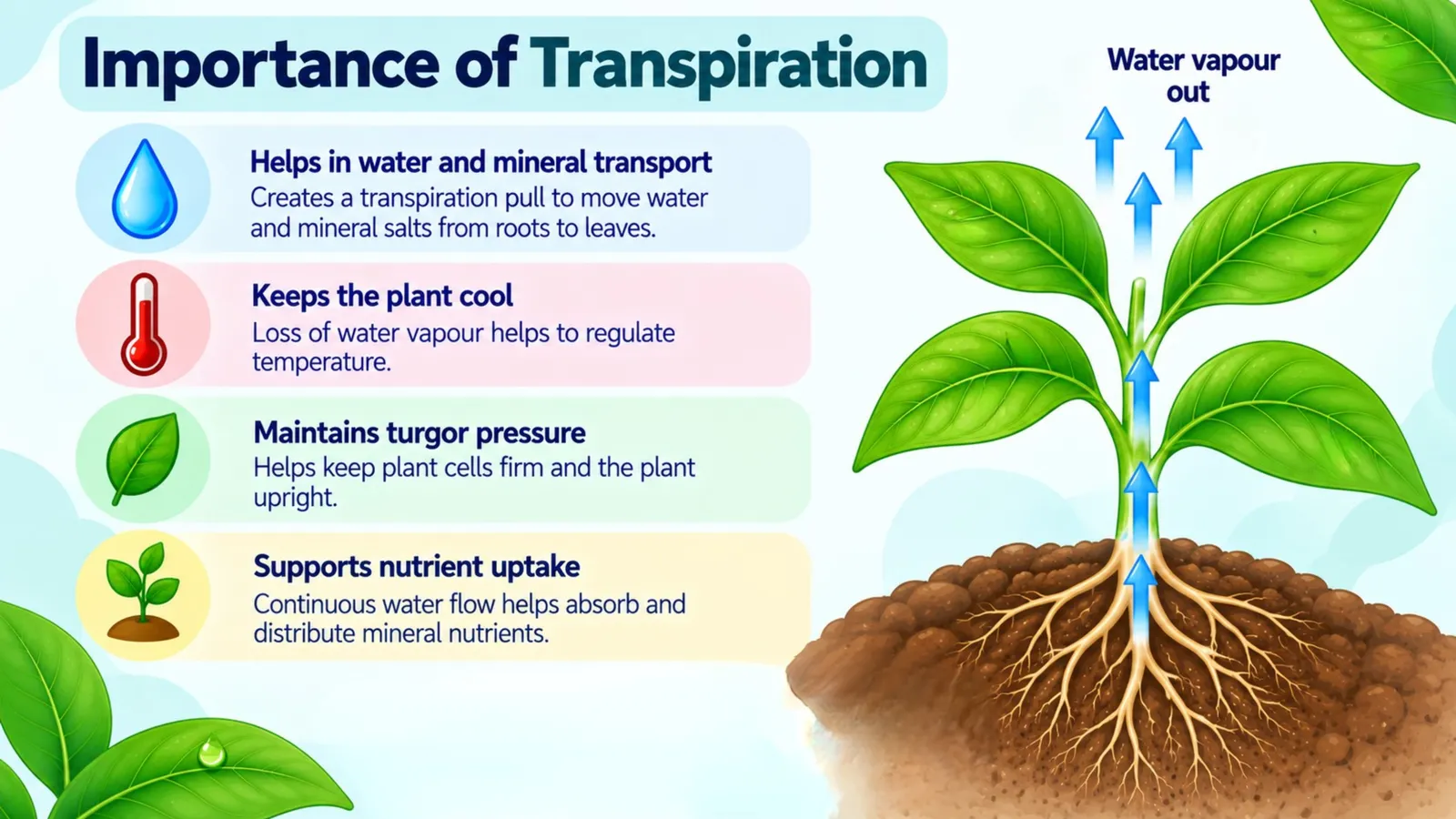
Transports mineral ions: dissolved minerals such as nitrates and magnesium are carried up from the roots in the transpiration stream.
Supplies water for photosynthesis: leaves need a constant supply of water to make glucose.
Keeps cells turgid: water keeps plant cells firm, supporting leaves and stems.
Cools the plant: evaporation of water takes heat energy from the leaf, which helps prevent overheating, just like sweating cools us down.
Affects the water cycle: transpiration returns huge volumes of water vapour to the atmosphere. Rainforests produce so much that they create their own rainfall.
Slide: Importance of transpiration
Why plants need it
1/1
How Plants Reduce Water Loss: Xerophyte Adaptations
Plants that live in dry places, such as cacti and marram grass, are called xerophytes. They have clever adaptations to reduce transpiration.
Thick waxy cuticle that is waterproof.
Leaves reduced to spines, as in cacti, which massively lowers the surface area.
Sunken stomata in pits, which trap humid air and reduce the concentration gradient.
Hairs on leaves that trap a layer of moist air.
Rolled leaves, as in marram grass, with stomata on the inside of the roll.
Fewer stomata, or stomata that open only at night, as in many desert plants.
Swollen stems that store water, as in cacti.
Transpiration vs Evaporation vs Guttation
People often confuse these terms. Evaporation is a physical process that happens from any wet surface. Transpiration is evaporation that takes place from living plant tissues and is controlled by the plant through its stomata. Guttation is different again: it is the loss of liquid water droplets from the edges of leaves, usually early in the morning when root pressure is high and transpiration is low. The droplets you see on grass at dawn are sometimes guttation, not dew.
Common Exam Mistakes About Transpiration
Do not say water evaporates from the stomata. Water evaporates from the surfaces of mesophyll cells, and water vapour then diffuses out through the stomata.
Do not say xylem is made of living cells. Mature xylem vessels are dead and hollow.
Do not confuse xylem with phloem. Xylem carries water and minerals upwards; phloem carries sugars in both directions.
Always link a factor to the concentration gradient or the rate of evaporation in your explanation.
Frequently Asked Questions About Transpiration
Does transpiration happen at night?
Very little, because most stomata close in the dark. A small amount of cuticular transpiration continues.
Why does a plant wilt on a hot day?
It loses water by transpiration faster than its roots can absorb it. Its cells become flaccid and the leaves droop.
What is the difference between transpiration and translocation?
Transpiration moves water and minerals upwards through the xylem. Translocation moves sugars such as sucrose through the phloem to wherever they are needed.
Key Takeaways
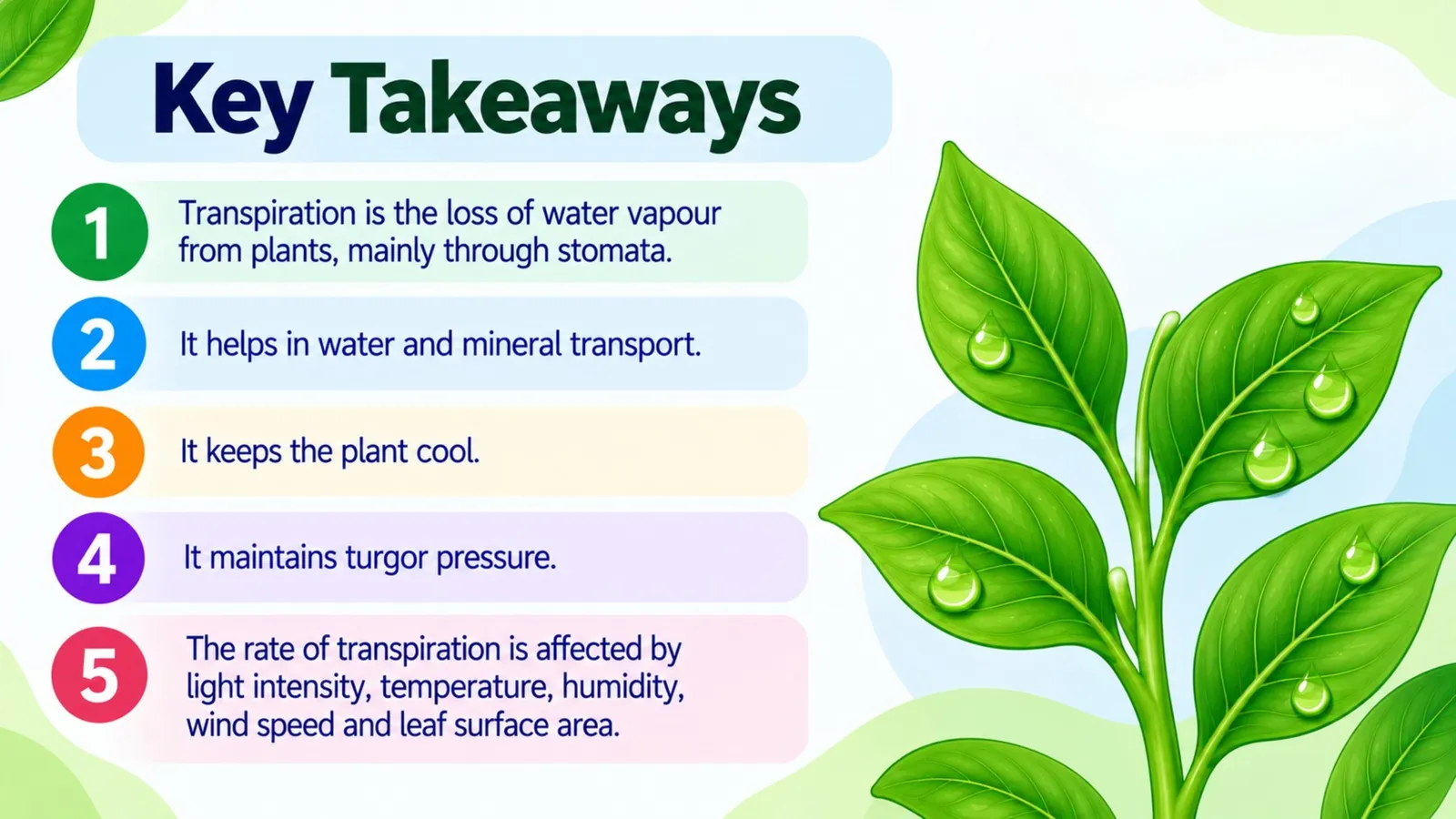
Transpiration is the loss of water vapour from leaves, mainly through stomata.
The transpiration stream carries water from roots, through the xylem, to the leaves.
Cohesion between water molecules and transpiration pull explain how water rises.
Light, temperature, wind and low humidity increase the rate; high humidity decreases it.
A potometer estimates transpiration rate by measuring water uptake.
Slide: Key takeaways
1/1
Now that you understand how water leaves a plant, read our guide to osmosis to see exactly how the roots take water in to begin with.
🗂️ Revision Flashcards
Tap a card to reveal the answer.
🎯 Quick Quiz
8 questions. Pick an answer to check it straight away.
1Where does water actually evaporate in a leaf?
Water evaporates from mesophyll cell surfaces; the vapour then diffuses out through the stomata.
2About what share of the water a plant absorbs is lost by transpiration?
About 99 percent is lost; only around 1 percent is used in photosynthesis and other reactions.
3How does water enter root hair cells?
Soil water has a higher water potential than root hair cell sap, so water enters by osmosis.
4Which force makes the whole water column move up together when molecules at the top are pulled?
Hydrogen bonds make water molecules stick to each other (cohesion), so the column is dragged up together.
5What happens to guard cells when the stomata close?
Potassium ions leave, water follows by osmosis and the flaccid guard cells close the pore.
6Which change would DECREASE the rate of transpiration?
Humid air reduces the concentration gradient of water vapour, so diffusion out of the leaf slows.
7Which type of transpiration accounts for about 90 to 95 percent of water loss?
Stomatal transpiration, through open stomata, is about 90 to 95 percent of the total.
8Why is a potometer not perfectly accurate?
Some water taken up is used in photosynthesis and to keep cells turgid, so true transpiration is slightly lower.