📖 Lesson: How Electricity is Generated
Learn about electricity generation, distribution, and responsible usage
🃏 Flashcards
Click each card to reveal the definition
🎮 Interactive Games
Test your knowledge about electricity generation
⚡ How Is Electricity Generated? The Full Answer
What "generating electricity" really means
Electricity is not dug up, grown or invented. It is converted. Every power station on Earth does the same basic job: it takes energy that is already stored in something else — in coal, in moving air, in falling water, in the nucleus of an atom — and turns it into electrical energy that can be sent down a wire. That is why scientists call electricity an energy carrier rather than an energy source. The energy has to come from somewhere first.
It also helps to know that the electrons are already inside the copper wires of your house. A generator does not create them and does not send them to you. It supplies the push — the potential difference, measured in volts — that makes the electrons already in the wire drift along and deliver energy to your lamp, kettle or phone charger.
The one idea behind almost all of it: electromagnetic induction
Michael Faraday discovered in 1831 that when a conductor and a magnetic field move relative to each other, a voltage appears across that conductor. This is electromagnetic induction, and it is the heart of practically every power station in the world.
A generator is that discovery built into a machine. It contains coils of wire and powerful magnets, and one is spun relative to the other. As the coils cut through the magnetic field, the magnetic field through them keeps changing, and a voltage is induced. Connect that coil to a circuit and a current flows. The faster the spinning, the stronger the magnets and the more turns of wire on the coil, the larger the induced voltage. Because the coil reverses its direction of motion through the field twice per turn, the voltage it produces reverses direction too — this is alternating current (AC), and in most countries it reverses 50 or 60 times a second.
How is electricity produced in a power station, step by step
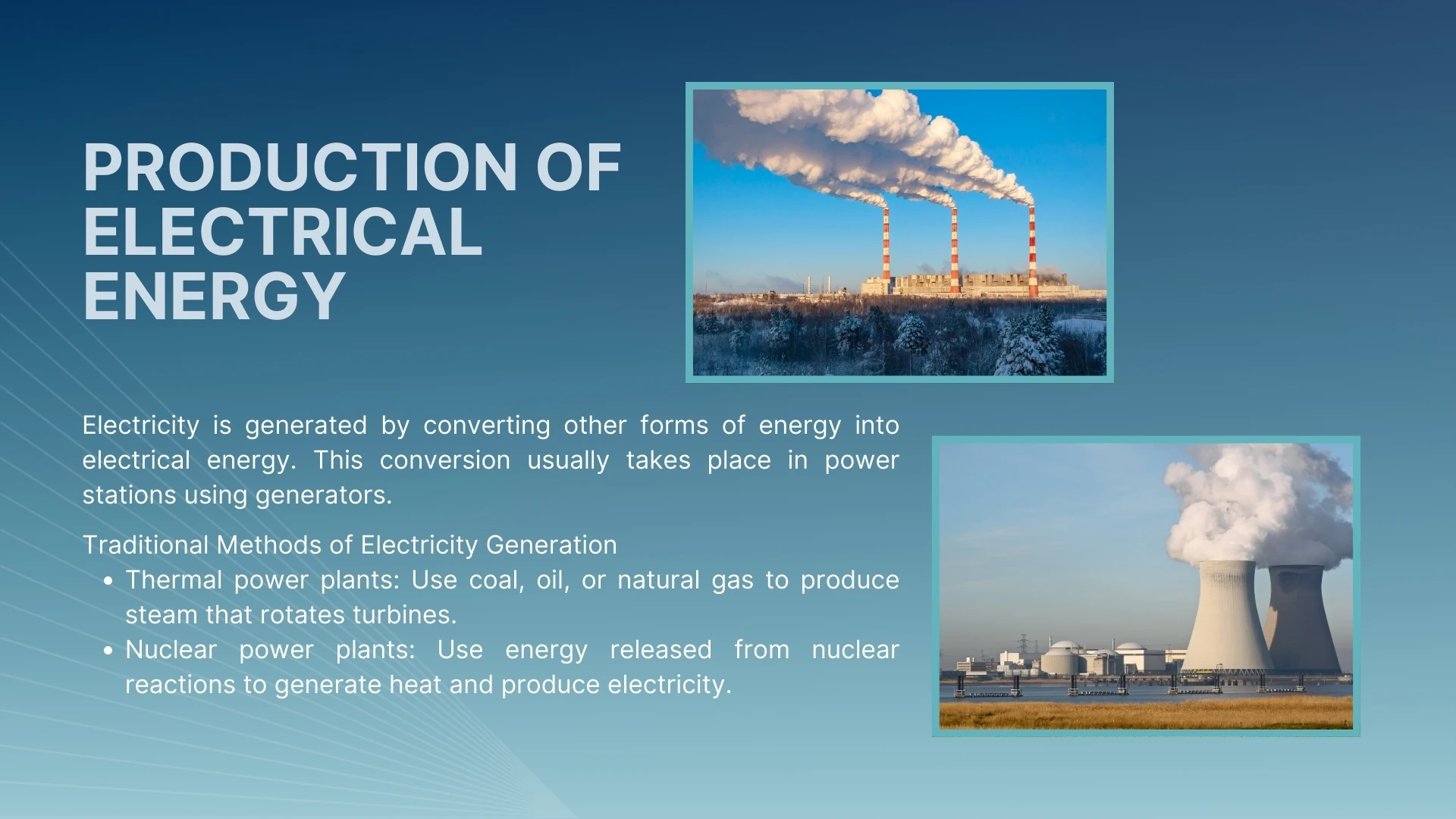
A thermal power station — coal, gas, oil, nuclear, geothermal or biomass — follows one chain of energy changes:
- Release heat. Fuel is burned, or in a nuclear plant uranium nuclei are split by fission. Either way the result is a large amount of heat.
- Boil water. The heat turns water into high-pressure steam inside a boiler.
- Spin a turbine. The steam is forced against the angled blades of a turbine, which is simply a very well-made windmill for steam. The steam's kinetic energy makes the shaft rotate at high speed.
- Turn the generator. The turbine shaft is coupled directly to the generator, so the coils and magnets inside it spin. Induction does the rest, and electrical energy comes out.
- Cool and reuse. The used steam is condensed back into water in a condenser — that is what the plumes from cooling towers are — and pumped back to the boiler.
Written as an energy chain, a coal station goes: chemical energy → thermal energy → kinetic energy → electrical energy. Not all of it survives the journey. A conventional coal station typically delivers only about 35 to 40 per cent of the fuel's energy as electricity, the rest escaping mostly as waste heat.
How do we generate electricity from different energy sources?
Change the first step of that chain and you change the type of power station. The generator at the end is nearly always the same.
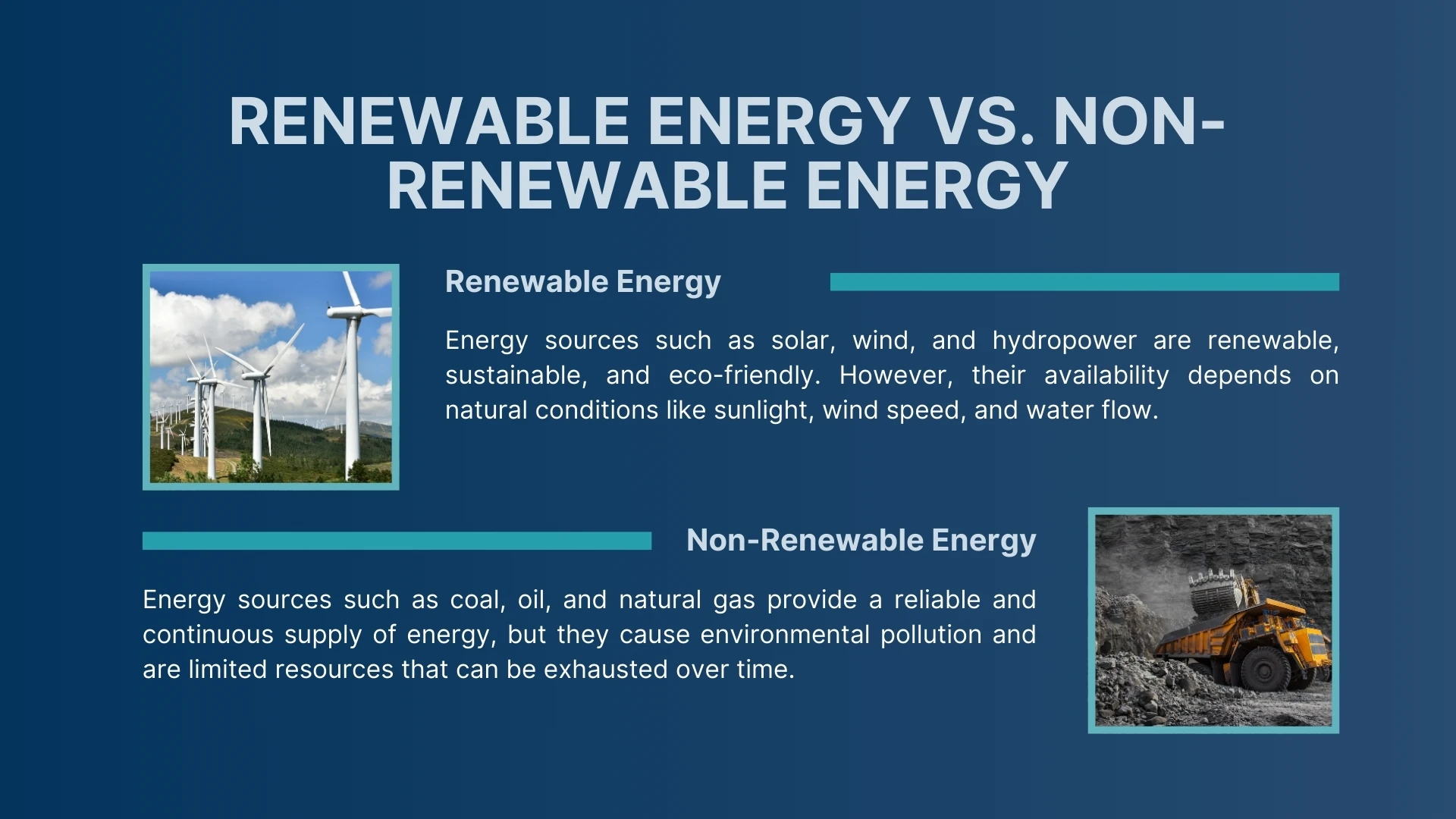
- Coal, oil and natural gas. Fossil fuels are burned to make heat. They are reliable and easy to store, but they are non-renewable and release carbon dioxide, the main gas driving climate change.
- Nuclear. Uranium nuclei are split in a controlled chain reaction, releasing heat with no carbon dioxide from the reaction itself. The difficulty is radioactive waste, which stays dangerous for a very long time.
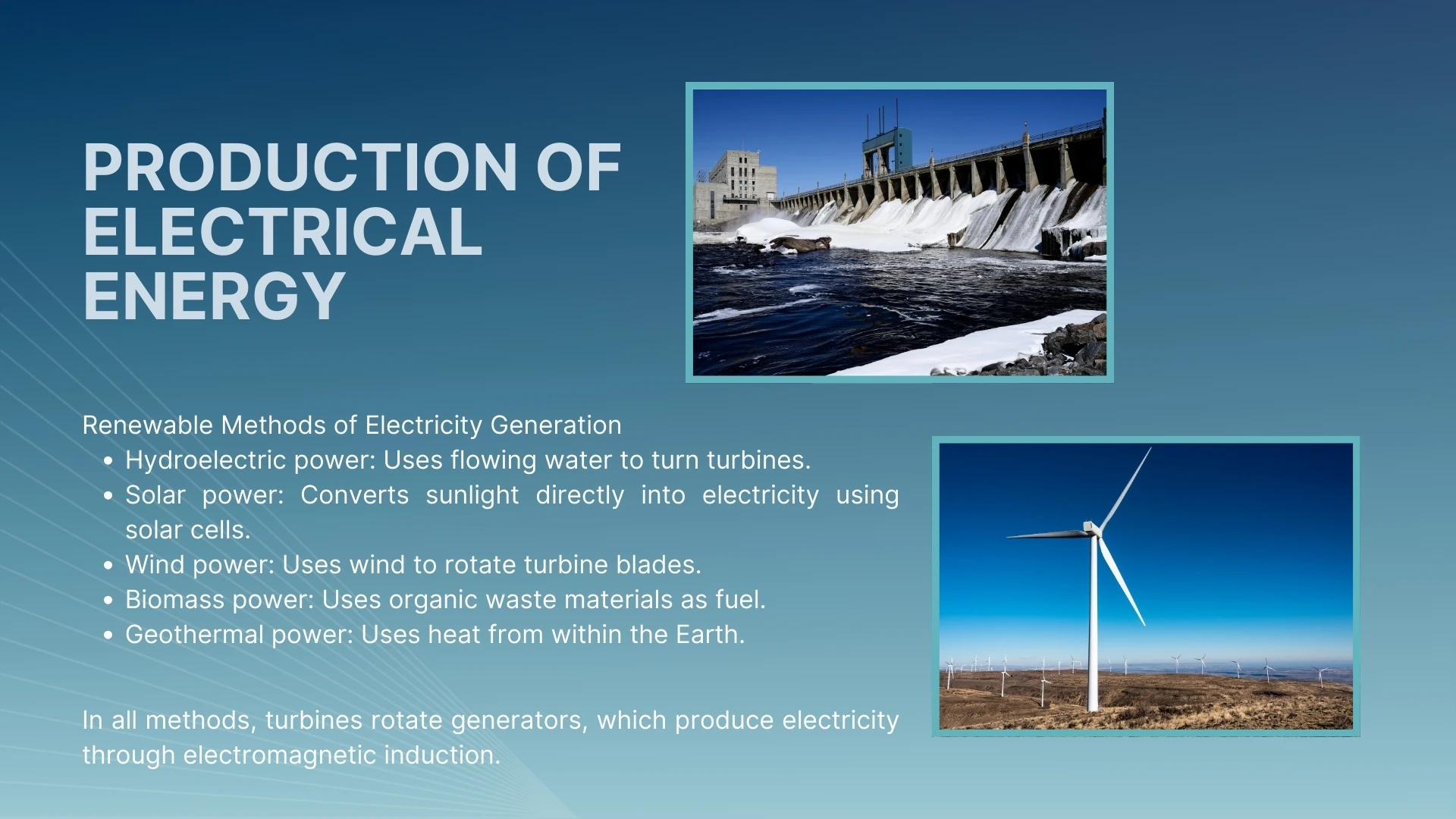
- Hydroelectric. Water held behind a dam is allowed to fall through pipes onto a turbine. Gravitational potential energy becomes kinetic energy, and no boiler is needed at all.
- Wind. Moving air pushes the long aerofoil blades of a wind turbine, which drives a generator in the nacelle at the top of the tower.
- Geothermal. In volcanic regions, heat from deep underground produces steam directly, which is piped to a turbine.
- Biomass. Wood, crop waste or biogas is burned like a fossil fuel, but the plants that made it absorbed carbon dioxide as they grew.
- Tidal and wave power. The rise and fall of the sea, or the motion of waves, is used to drive turbines. These are predictable but only work in the right coastal places.
Solar panels: making electricity without a turbine
Solar photovoltaic panels are the important exception. They contain no moving parts, no steam and no induction. A photovoltaic cell is a sandwich of specially treated silicon, and when light lands on it the energy of the light knocks electrons loose and the structure of the cell pushes them in one direction. That produces direct current (DC), so an inverter is used to change it into AC before it joins the grid. Batteries and fuel cells also make electricity directly, from chemical reactions rather than light, and they too give DC.
How do we get electricity from the power station to a house?
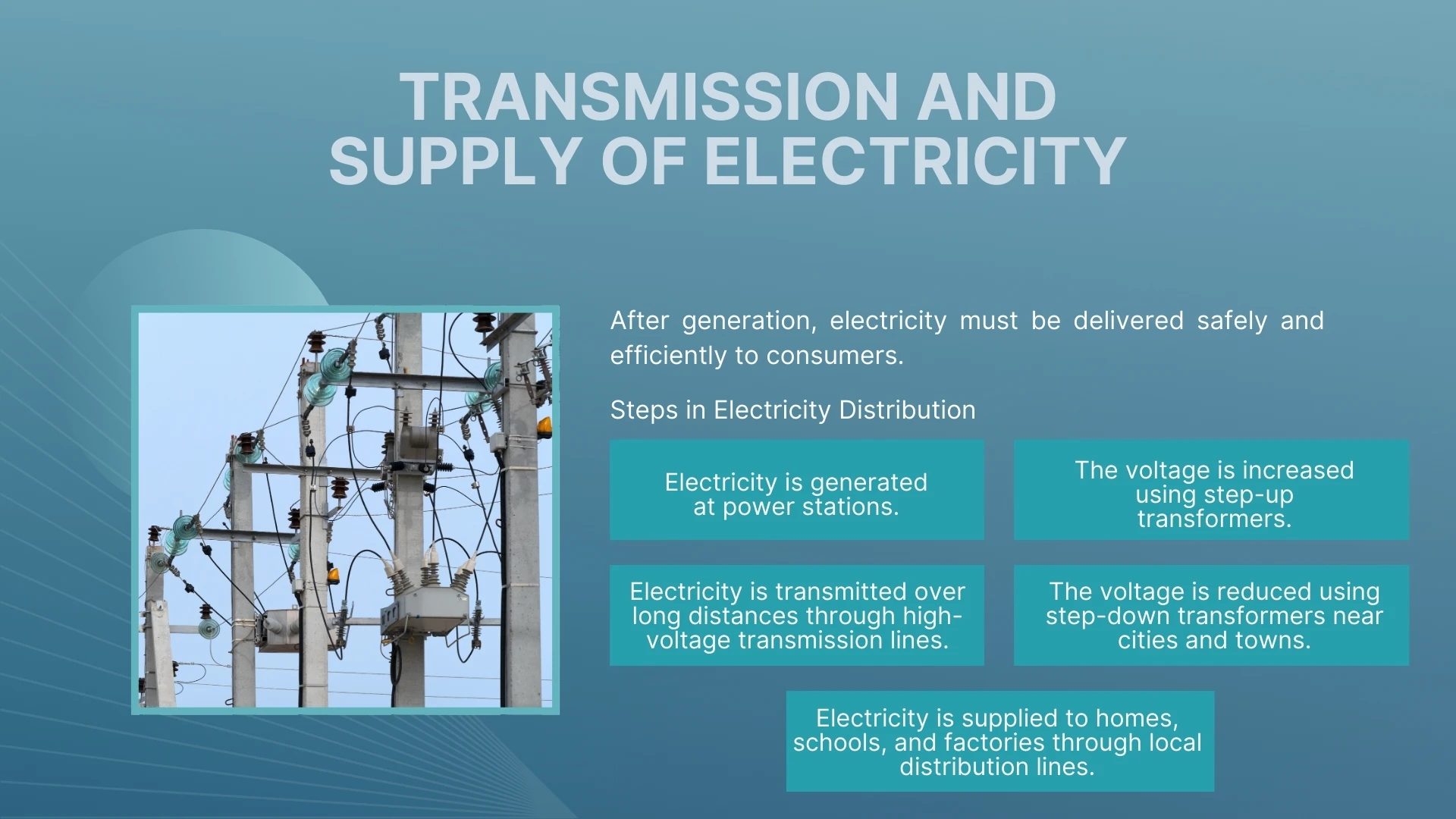
Generating the electricity is only half the story. Power stations are usually far from towns, and the network that closes that gap is called the grid.
Electricity leaves the generator at several thousand volts. Before it travels, a step-up transformer raises it to a very high voltage — commonly in the range of 100,000 to 400,000 volts — for the overhead transmission lines carried on pylons. Near towns, step-down transformers in substations lower it again in stages, until a final local transformer brings it to the mains voltage used in homes: about 230 volts in much of the world, about 120 volts in North America.
Why is electricity sent at such a high voltage?
Because of heat loss in the cables. Any wire has some resistance, and the power wasted heating it depends on the square of the current flowing through it. The power delivered depends on voltage multiplied by current, so the same amount of power can be sent either as a big current at a low voltage or a small current at a high voltage. Choosing the high voltage makes the current small, and because the loss depends on the current squared, halving the current cuts the wasted heat to a quarter. That single trick is why long-distance transmission is possible at all — and it is also why grids use alternating current, since transformers only work with a changing current.
Is electricity created, or just changed?
Strictly, electricity is never created and never destroyed. The law of conservation of energy says energy can only be transferred from one form into another. So when people ask how electricity is made, the honest answer is that some other store of energy is being emptied to fill it: a pile of coal, a reservoir behind a dam, the wind crossing a hillside, or sunlight falling on a roof.
Key terms
- Electromagnetic induction
- The production of a voltage in a conductor when it moves relative to a magnetic field, or when the magnetic field through it changes.
- Generator
- A machine that converts kinetic energy into electrical energy by spinning coils and magnets relative to each other.
- Turbine
- A bladed wheel spun by steam, water, wind or hot gas, used to drive a generator.
- Alternating current (AC)
- Current that reverses direction regularly, typically 50 or 60 times per second; the form supplied by the grid.
- Direct current (DC)
- Current that flows in one direction only, as supplied by batteries and solar cells.
- Transformer
- A device that steps an alternating voltage up or down; it cannot work on direct current.
- The grid
- The network of transmission lines, substations and cables that carries electricity from power stations to users.
- Renewable source
- An energy source that is replaced naturally as fast as it is used, such as wind, sunlight, flowing water or geothermal heat.
- Non-renewable source
- An energy source with a limited supply that is not replaced on a human timescale, such as coal, oil, natural gas and uranium.
- Energy carrier
- Something that moves energy from where it is released to where it is used. Electricity is a carrier, not an original source.