Have you ever wondered how a dangerously reactive metal like sodium and a poisonous green gas like chlorine can combine to make something as harmless as table salt? The answer is ionic bonding, one of the most important ideas in IGCSE and GCSE Chemistry. This student-friendly guide explains how ions form, how to draw dot-and-cross diagrams, how to write ionic formulae, and why ionic compounds behave the way they do, using the exact phrases examiners look for.
📖 Lesson
Ions, charges, dot-and-cross diagrams, formulae and the giant ionic lattice, in the words examiners look for.
What Is Ionic Bonding?
Ionic bonding is the type of chemical bonding that happens between a metal and a non-metal. A compound forms when two or more elements chemically combine, and in an ionic compound the elements combine by transferring electrons.
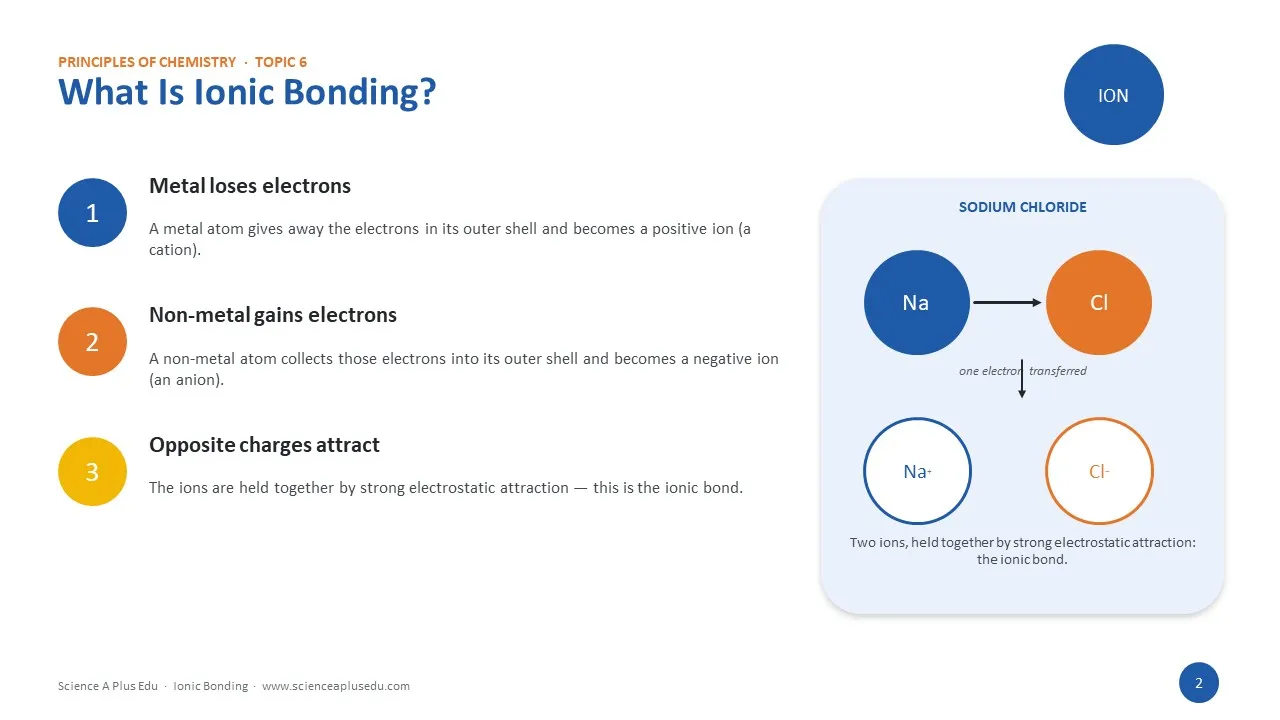
Here is the whole idea in three steps:
The metal atom loses its outer-shell electrons and becomes a positive ion (a cation).
The non-metal atom gains those electrons and becomes a negative ion (an anion).
Opposite charges attract, so the positive and negative ions are held together by strong electrostatic attraction. This attraction is the ionic bond.
The definition you should learn for the exam is: an ionic bond is the strong electrostatic attraction between oppositely charged ions, formed when electrons are transferred from a metal atom to a non-metal atom.
You can usually spot an ionic compound because it contains a metal combined with a non-metal: sodium chloride (NaCl), magnesium oxide (MgO), calcium fluoride (CaF2) and zinc bromide (ZnBr2) are all ionic. The one exception you need to know is ammonium compounds such as ammonium chloride (NH4Cl), which contain no metal but are still ionic because of the ammonium ion, NH4+.
How Are Ions Formed? Sodium and Chlorine Step by Step
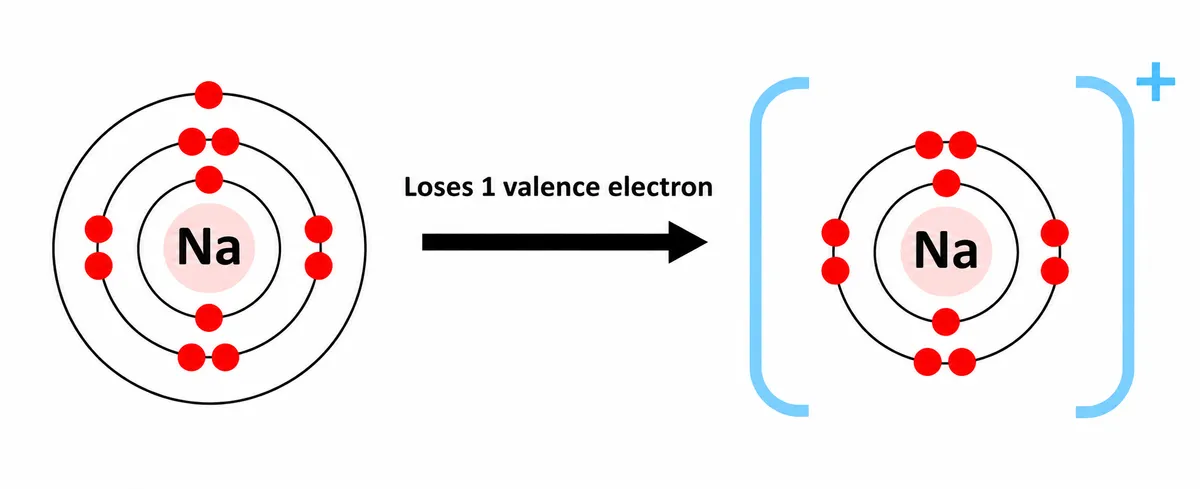
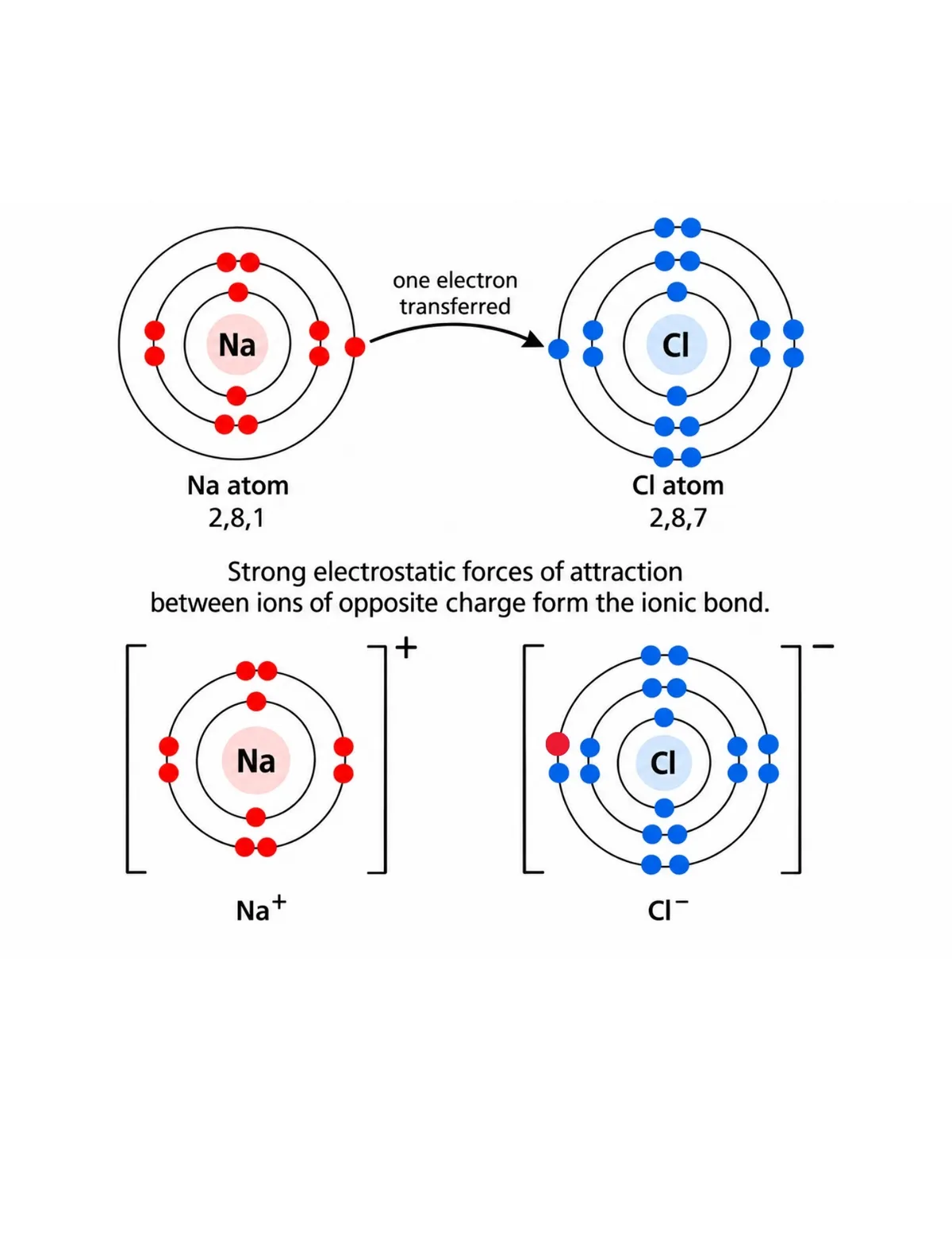
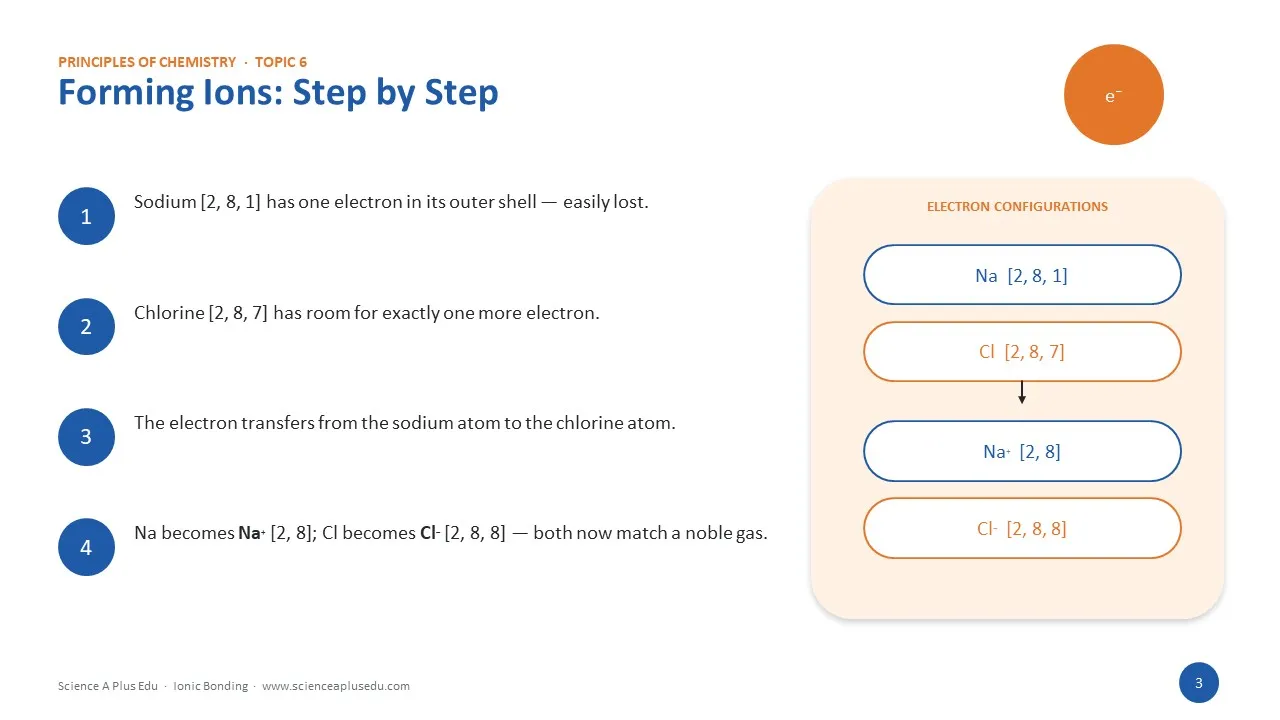
Let us look closely at sodium chloride. A sodium atom has the electronic configuration 2, 8, 1 and a chlorine atom has 2, 8, 7. Chlorine has a much stronger attraction for electrons than sodium, so when the two atoms meet, the single outer electron of sodium is transferred to the outer shell of chlorine.
Why does the sodium ion end up with a 1+ charge? Sodium has 11 protons (11+) and, as an atom, 11 electrons (11−), so the charges cancel. After losing one electron it has only 10 electrons: 11+ and 10− leave an overall charge of 1+. The nucleus never changes; only the number of electrons changes. Chlorine gains one electron, so it now has 18 electrons and 17 protons, giving a 1− charge.
Notice what the ions look like afterwards. Na+ has the configuration 2, 8, which is the same as the noble gas neon. Cl− has 2, 8, 8, the same as argon. Atoms of the first 20 elements lose or gain electrons so that they end up with a full outer shell, a noble gas electronic configuration. Chemists say that Na+ and Ne are isoelectronic, meaning they have the same number of electrons.
Slides: What is ionic bonding?
Electron transfer, step by step
1/3
Working Out the Charge on an Ion
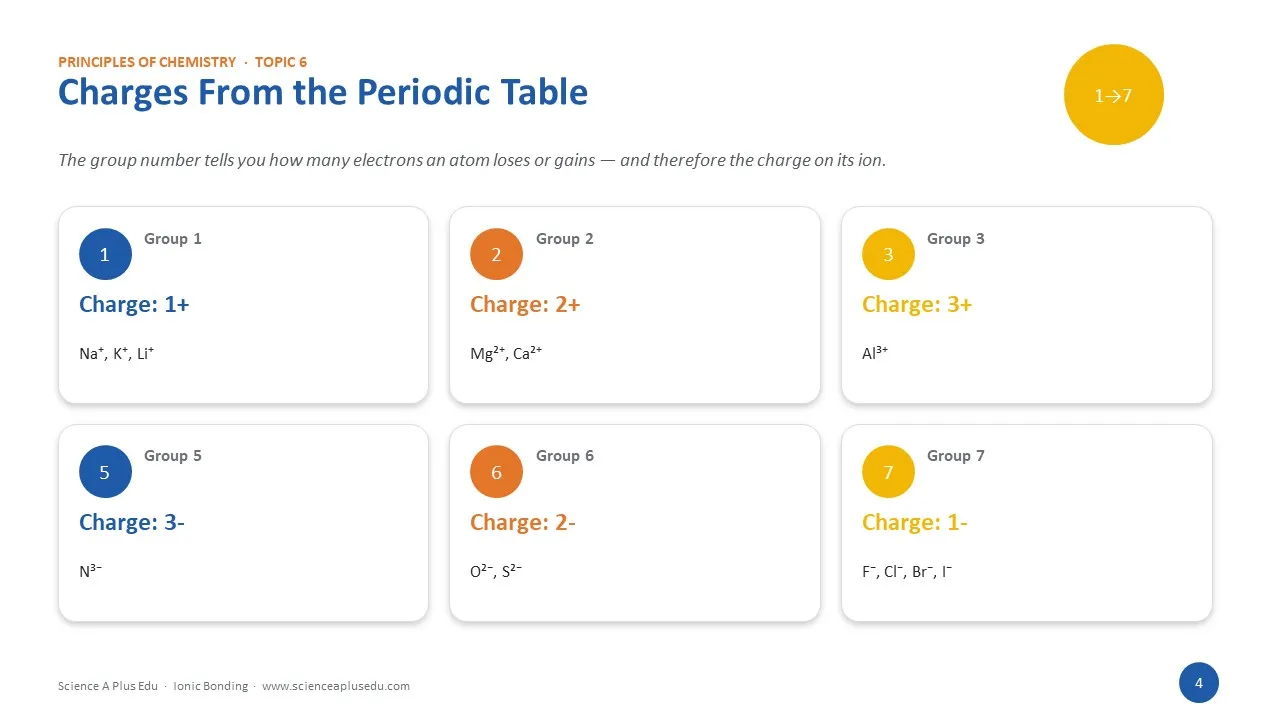
The Periodic Table tells you the charge on most ions, because the group number tells you how many outer electrons an atom has:
Group 1 elements lose 1 electron and form 1+ ions (Na+, K+, Li+).
Group 2 elements lose 2 electrons and form 2+ ions (Mg2+, Ca2+).
Group 3 elements lose 3 electrons and form 3+ ions (Al3+).
Group 5 elements gain 3 electrons and form 3− ions (N3−).
Group 6 elements gain 2 electrons and form 2− ions (O2−, S2−).
Group 7 elements gain 1 electron and form 1− ions (F−, Cl−, Br−, I−).
The rule is simple: the number of charges equals the number of electrons lost or gained. Metals always form positive ions and non-metals form negative ions. When a non-metal atom becomes a negative ion its name ends in -ide: chloride, oxide, sulfide, nitride.
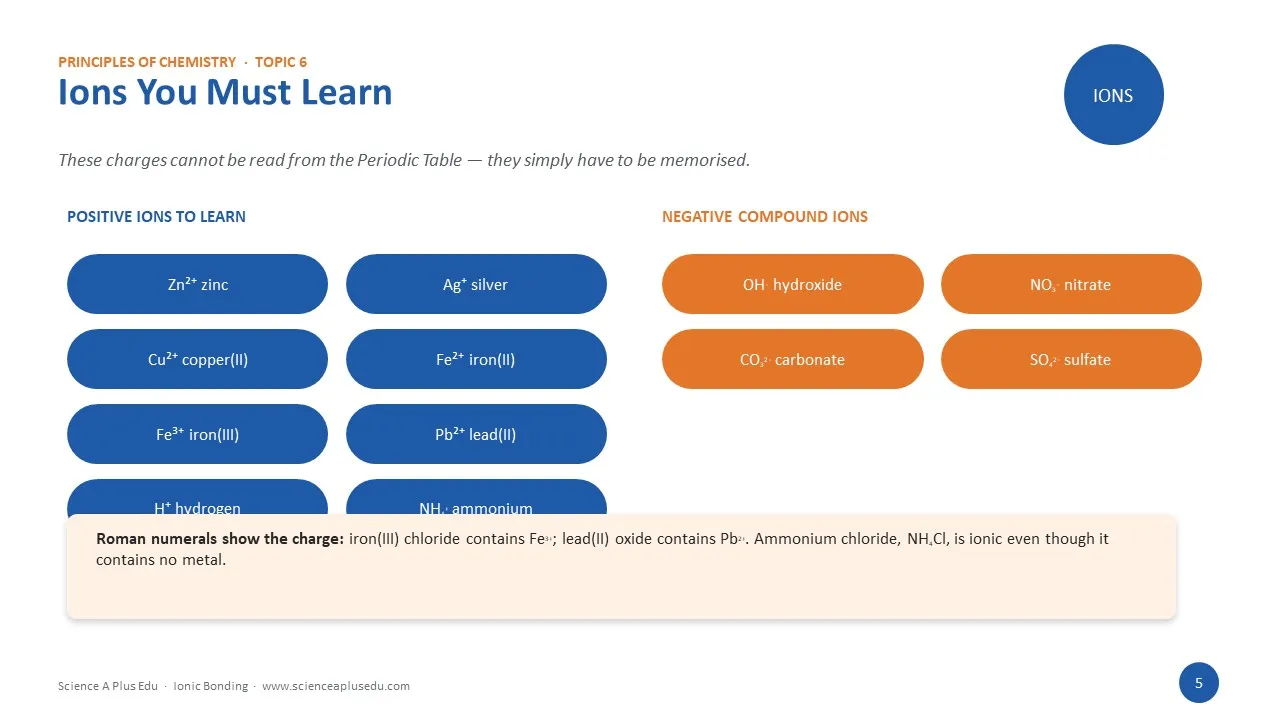
Some ions must simply be learned: zinc Zn2+, silver Ag+, copper(II) Cu2+, iron(II) Fe2+, iron(III) Fe3+, lead(II) Pb2+, hydrogen H+ and ammonium NH4+, together with the negative compound ions hydroxide OH−, nitrate NO3−, carbonate CO32− and sulfate SO42−. When a metal name has a Roman numeral, the numeral is the charge: iron(III) chloride contains Fe3+ ions.
Slides: Charges from the Periodic Table
Group number gives the charge, plus the ions you must learn
1/2
Drawing Dot-and-Cross Diagrams for Ionic Compounds
A dot-and-cross diagram shows where the electrons go during ionic bonding. Dots are used for the metal's electrons and crosses for the non-metal's electrons. In reality there is no difference between a "dot" electron and a "cross" electron; the two symbols only show which atom each electron came from. Usually you only need to draw the outer shell.
To draw one:
Write the electronic configuration of each atom and decide how many electrons must be transferred.
Draw the atoms with their outer electrons and add an arrow from each transferred electron to the non-metal.
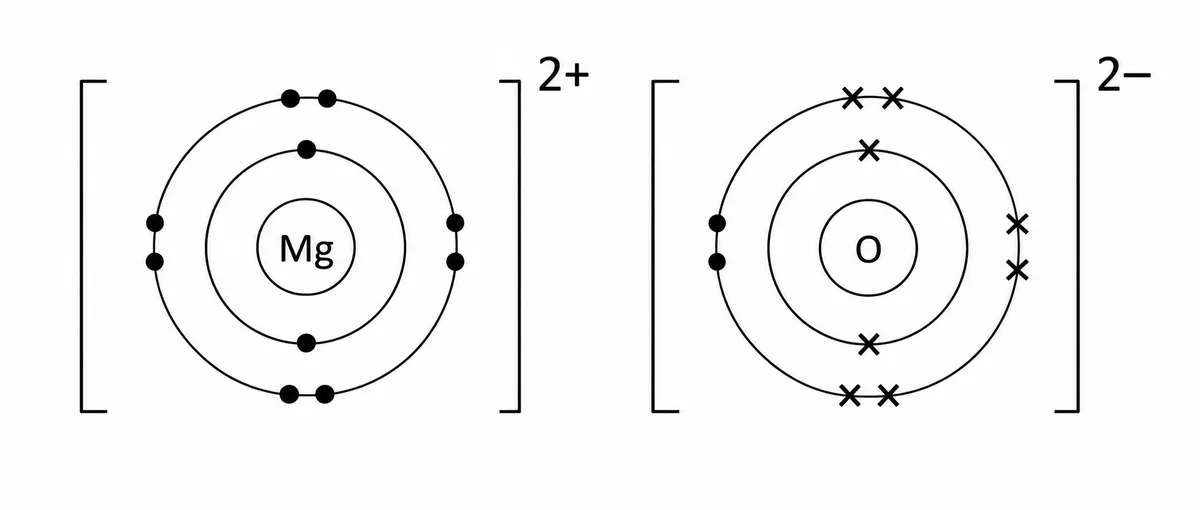
Draw the ions afterwards, put square brackets around each one and write the charge at the top right.
Check that the total positive charge equals the total negative charge.
Magnesium oxide is a good second example. Magnesium (2, 8, 2) loses two electrons to form Mg2+ and oxygen (2, 6) gains both of them to form O2−. Because one 2+ ion balances one 2− ion, the formula is MgO, not Mg2O2. Calcium chloride is different: calcium (2, 8, 8, 2) has two electrons to give away, but each chlorine atom only has room for one, so one calcium atom gives one electron to each of two chlorine atoms. The formula is CaCl2. Keep adding atoms until the number of electrons lost equals the number gained.
How to Write the Formula of an Ionic Compound
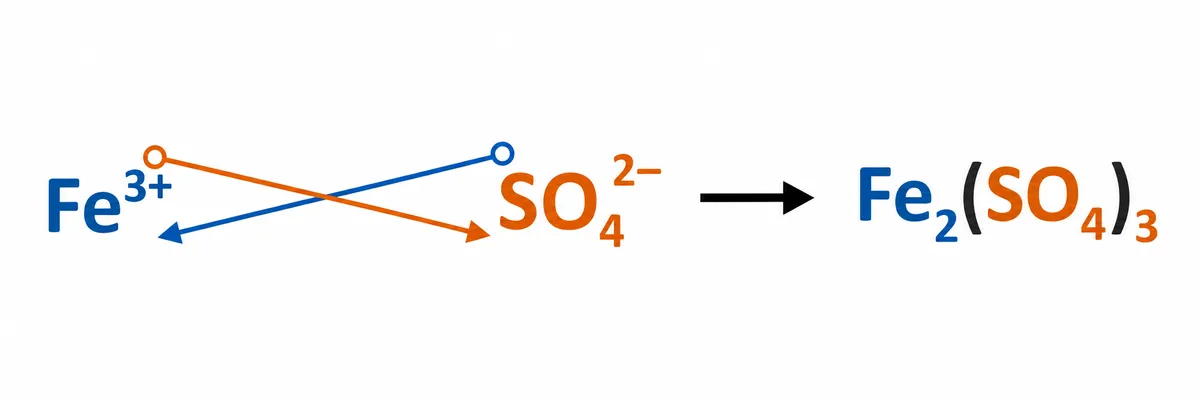
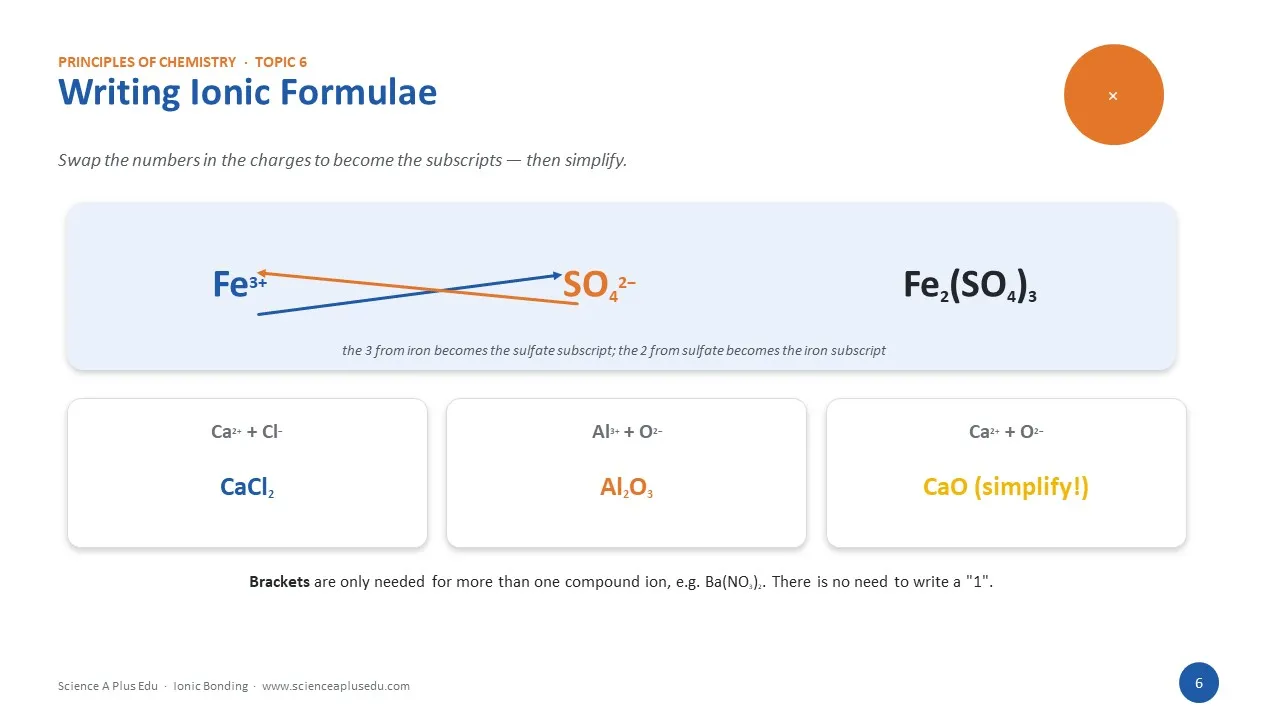
Ionic compounds are electrically neutral, so the total positive charge must cancel the total negative charge. The quickest method is to swap the numbers in the charges to become the subscripts:
Fe3+ and SO42− give Fe2(SO4)3 (iron(III) sulfate).
Ca2+ and Cl− give CaCl2 (calcium chloride).
Al3+ and O2− give Al2O3 (aluminium oxide).
Be careful when the charges are the same size. Ca2+ and O2− give calcium oxide, CaO, not Ca2O2, because you always write the simplest whole-number ratio. Brackets are needed only when you have more than one compound ion: barium nitrate is Ba(NO3)2, because writing BaNO32 would mean one barium, one nitrogen and thirty-two oxygens. Finally, read the word endings carefully. Copper(II) sulfide is CuS, containing only copper and sulfur, but copper(II) sulfate is CuSO4, because an -ate ending tells you that oxygen is present as well.
Slide: Writing ionic formulae
Swap the charges, then simplify
1/1
The Giant Ionic Lattice
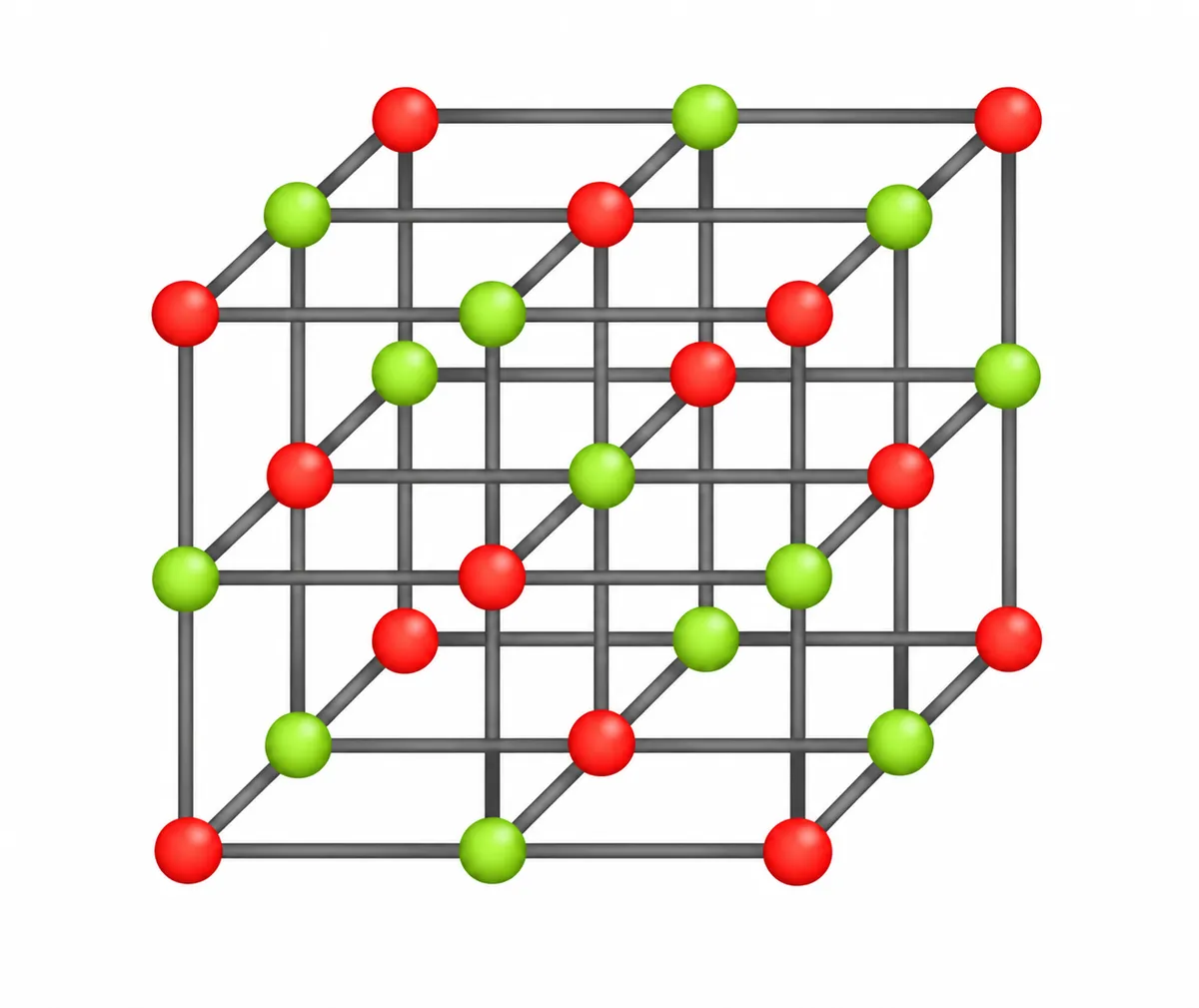
Ionic compounds do not form molecules. Instead the ions pack together in a regular, repeating pattern called a giant ionic lattice. In sodium chloride every Na+ ion is surrounded by six Cl− ions and every Cl− ion is surrounded by six Na+ ions, and this pattern continues throughout the whole crystal. The word "giant" does not mean big; it means there are no individual molecules and the bonding extends in all directions. Never write "sodium chloride molecules" in an exam, because it will be marked wrong.
Magnesium oxide has exactly the same structure as sodium chloride, but the attraction between 2+ and 2− ions is much stronger than between 1+ and 1− ions. That is why magnesium oxide melts at 2852 °C while sodium chloride melts at 801 °C.
Properties of Ionic Compounds and Why They Have Them
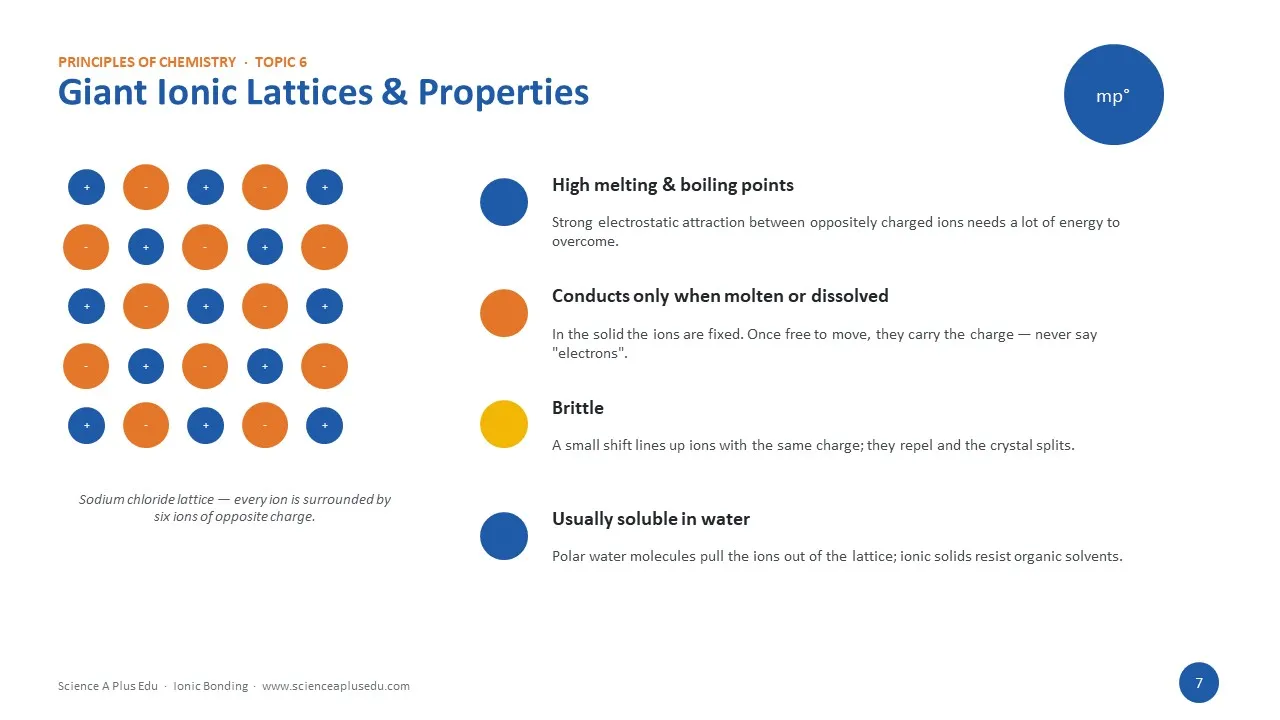
High melting and boiling points. To melt an ionic compound you must overcome the strong electrostatic forces of attraction between oppositely charged ions in the giant lattice. That needs a lot of energy, so the melting point is high. The three-part exam answer is: giant ionic lattice; strong electrostatic attraction between oppositely charged ions; a lot of energy is needed to overcome the attraction.
Electrical conductivity. Solid ionic compounds do not conduct electricity because the ions are fixed in position and cannot move. When the compound is molten (melted) or dissolved in water, the lattice breaks down, the ions are free to move and they carry the charge. Always say ions are free to move, never electrons.
Crystalline and brittle. The regular lattice produces crystals with flat faces. If a crystal is hit, one layer of ions slides so that ions with the same charge line up next to each other, they repel and the crystal splits apart.
Solubility. Ionic compounds tend to be soluble in water but insoluble in organic solvents such as hexane. Water molecules are polar and can pull the ions out of the lattice; hexane cannot.
Slide: Giant ionic lattices and properties
Why ionic compounds behave the way they do
1/1
Ionic Bonding: Frequently Asked Questions
What is the difference between ionic and covalent bonding?
Ionic bonding involves the transfer of electrons from a metal to a non-metal, forming ions. Covalent bonding involves the sharing of pairs of electrons between two non-metal atoms, forming molecules.
Why do ionic compounds have high melting points?
Because a lot of energy is needed to overcome the strong electrostatic forces of attraction between the oppositely charged ions throughout the giant ionic lattice.
Why does sodium chloride conduct electricity when molten but not when solid?
In the solid the ions are held in fixed positions and cannot move. When molten the lattice breaks down, so the ions are free to move and carry the charge.
Key Takeaways
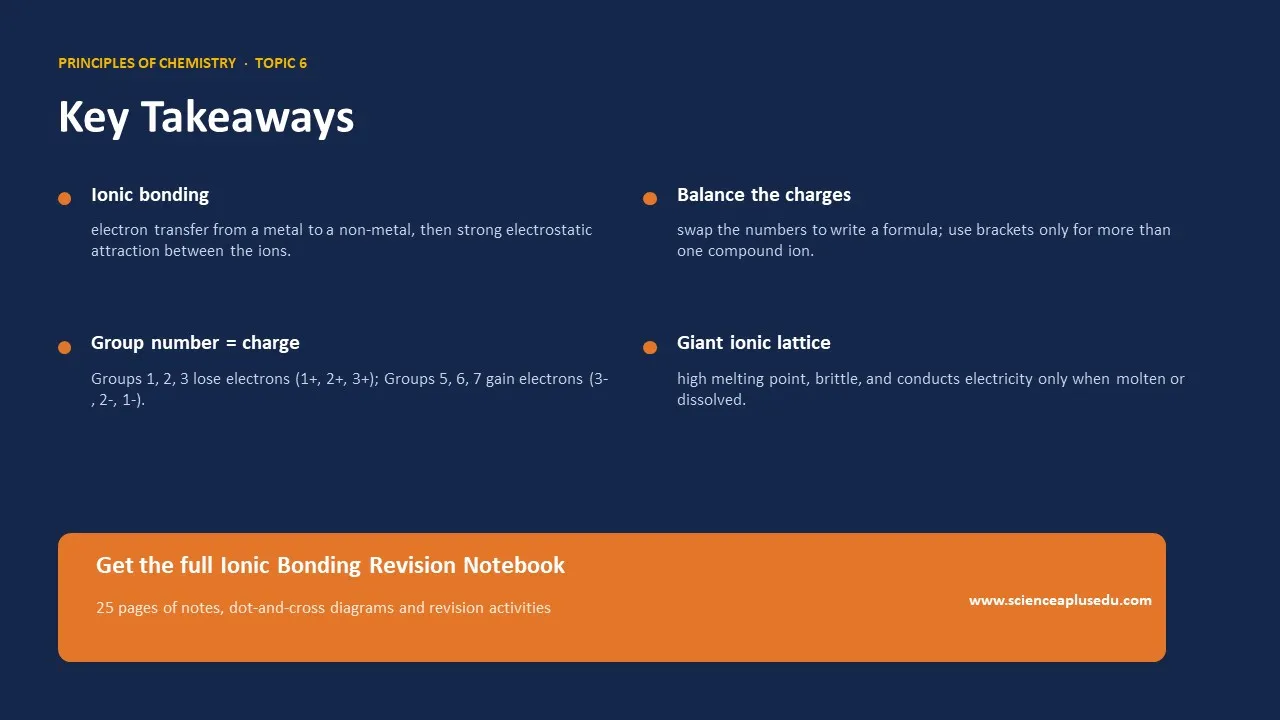
Ionic bonding = electron transfer from a metal to a non-metal, followed by strong electrostatic attraction between the ions.
Group number gives the charge: Groups 1, 2, 3 form 1+, 2+, 3+; Groups 5, 6, 7 form 3−, 2−, 1−.
Balance the charges to write a formula, use brackets for more than one compound ion, and simplify.
Ionic compounds form giant lattices with high melting points, conduct only when molten or dissolved, and are usually soluble in water.
Slide: Key takeaways
1/1
Want more practice? Download the Science A Plus Edu Ionic Bonding Revision Notebook, with 25 pages of notes, dot-and-cross diagrams and revision activities, and read our companion guide to covalent bonding to see how the two types of bonding compare.
🗂️ Revision Flashcards
Tap a card to reveal the answer.
🎯 Quick Quiz
6 questions. Pick an answer to check it straight away.
1What is an ionic bond?
Learn it word for word: strong electrostatic attraction between oppositely charged ions.
2Sodium (2, 8, 1) forms an ion. What is its charge?
It loses its one outer electron: 11 protons and 10 electrons leave a 1+ charge.
3Which ion forms from a Group 6 element?
Group 6 atoms gain 2 electrons, forming 2− ions.
4What is the formula of aluminium oxide (Al³⁺ and O²⁻)?
Swap the charge numbers: 2 × 3+ = 6+ balances 3 × 2− = 6−.
5Why is solid sodium chloride a poor conductor?
Ions must be free to move to carry charge, which happens only when molten or dissolved.
6Why does MgO melt at 2852 °C but NaCl at 801 °C?
Same lattice structure, but doubly charged ions attract much more strongly.