The 20 most commonly confused biology pairs side by side, with comparison tables and memory tricks
Biology · Grade 9-11 · 20 min read
🧬 DNA vs RNA🔬 Mitosis vs meiosis💧 Diffusion vs osmosis🌿 Xylem vs phloem❤️ Arteries vs veins🧠 Memory tricks
📖 Lesson
Twenty of the most commonly confused biology pairs, each with a short explanation, a comparison table and a memory trick for exam day.
Is it osmosis or diffusion? Xylem or phloem? Genotype or phenotype? Many of the marks students lose in biology do not come from missing knowledge. They come from mixing up two terms that sound similar or do similar jobs. Examiners know this, which is why comparison questions appear in almost every GCSE, IGCSE and A Level paper.
This guide puts 20 of the most commonly confused pairs side by side. Each one has a short explanation, a clear comparison table you can copy into your revision notes, and a memory trick to help you remember the difference on exam day.
How to Answer "Compare" and "Describe the Difference" Questions
Before the content, a quick word on exam technique, because it can win you easy marks.
Name both things in every point. Writing "xylem has thick walls" earns nothing in a difference question. Write "xylem has thick, lignified walls but phloem has no lignin."
Use comparison words such as "whereas", "but", "while" and "in contrast".
Compare the same feature in both columns, for example the direction of movement, the energy needed or where it happens.
Use the command word. "Compare" asks for similarities and differences. "State the difference" needs only differences.
Quick Cheat Sheet: 20 Biology Differences at a Glance
Comparison
The key difference in one line
DNA vs RNA
DNA is double-stranded with deoxyribose and thymine; RNA is single-stranded with ribose and uracil
Gene vs allele
A gene is a section of DNA for a characteristic; an allele is one version of that gene
Genotype vs phenotype
Genotype is the alleles you have; phenotype is the characteristic you can observe
Mitosis vs meiosis
Mitosis makes 2 identical cells for growth; meiosis makes 4 different gametes
Diffusion vs osmosis
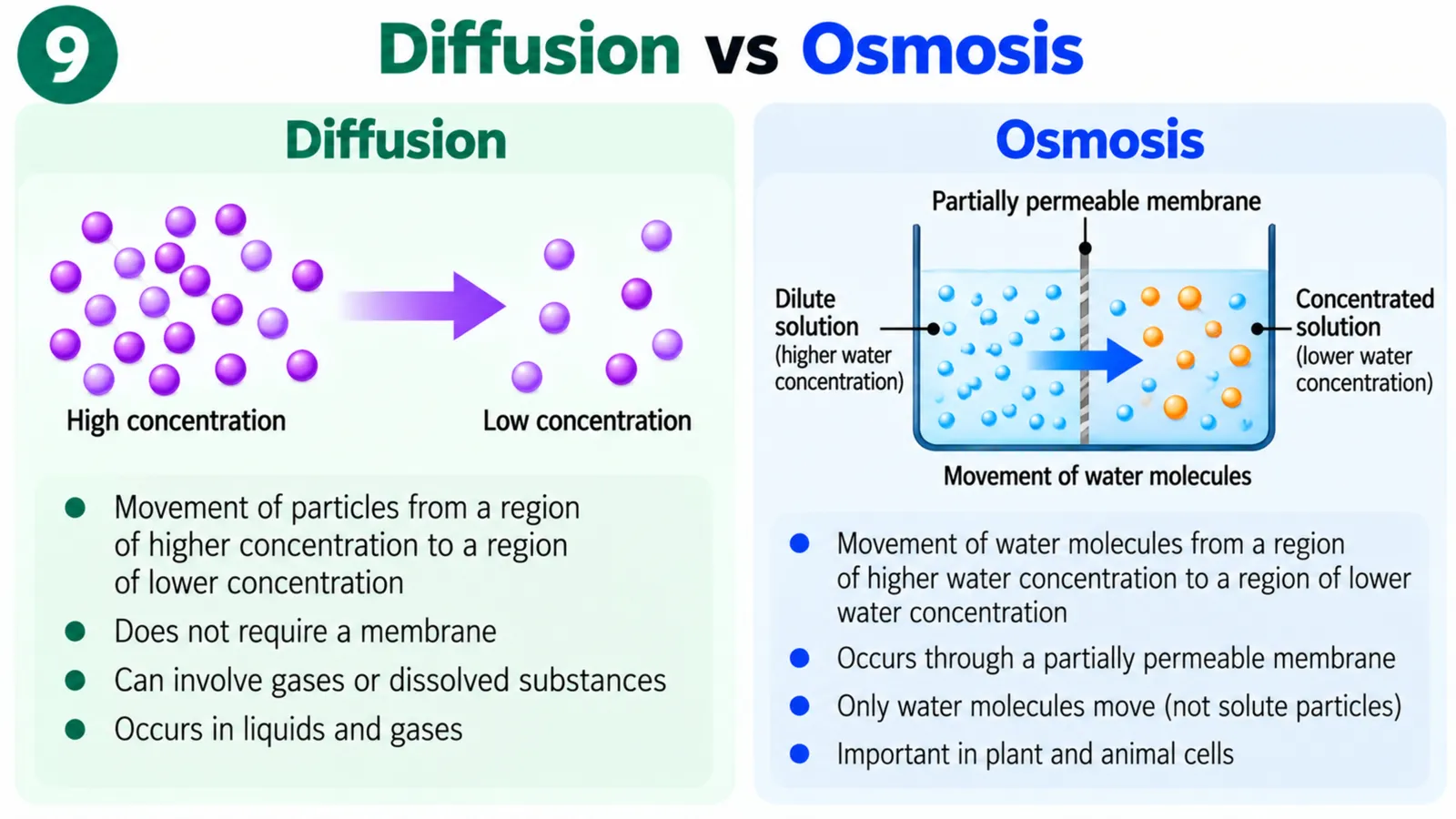
Diffusion moves any particles down a gradient; osmosis moves only water across a partially permeable membrane
Active transport vs diffusion
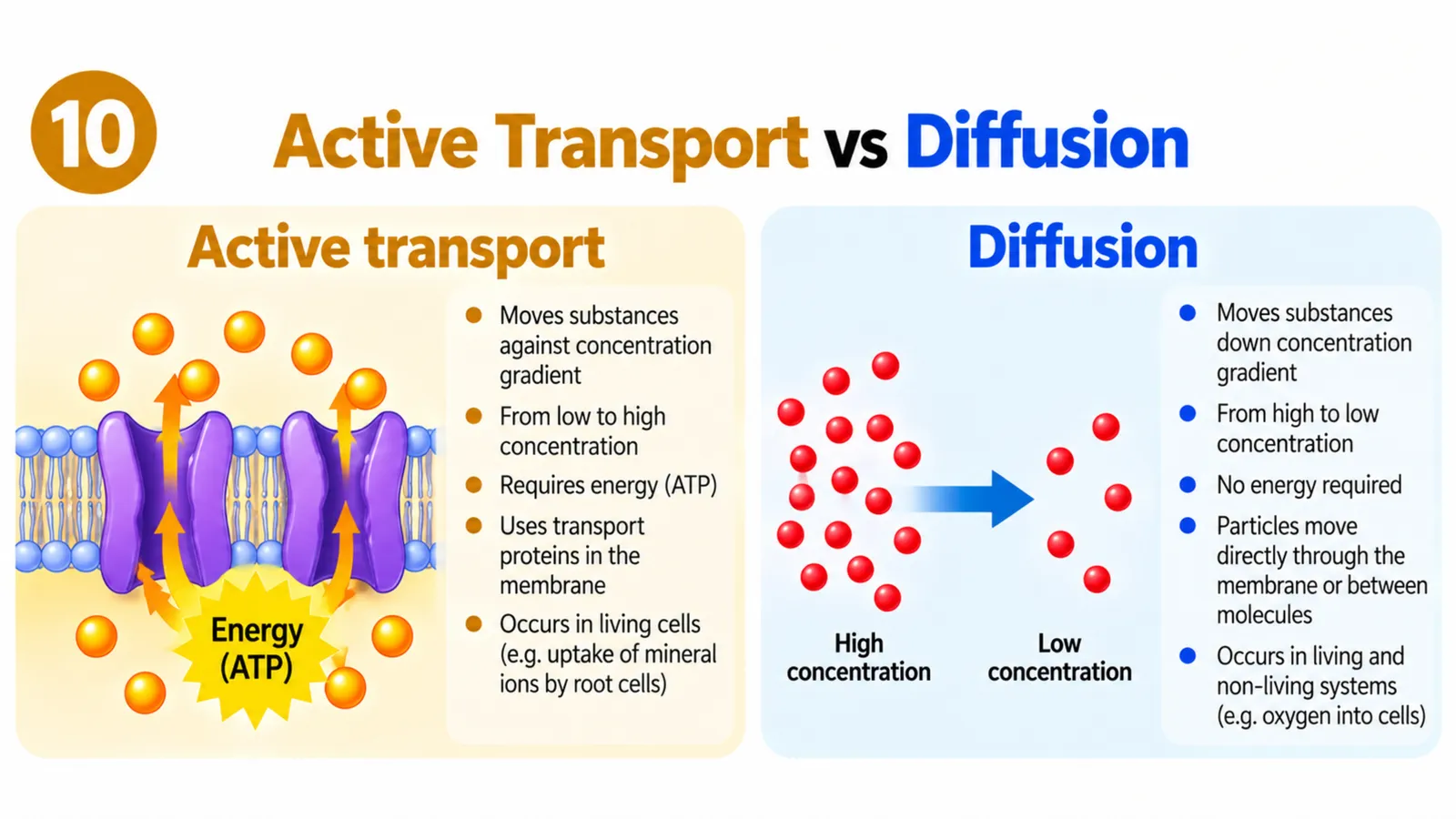
Active transport goes against the gradient using energy; diffusion goes down it for free
Competitive vs non-competitive inhibition
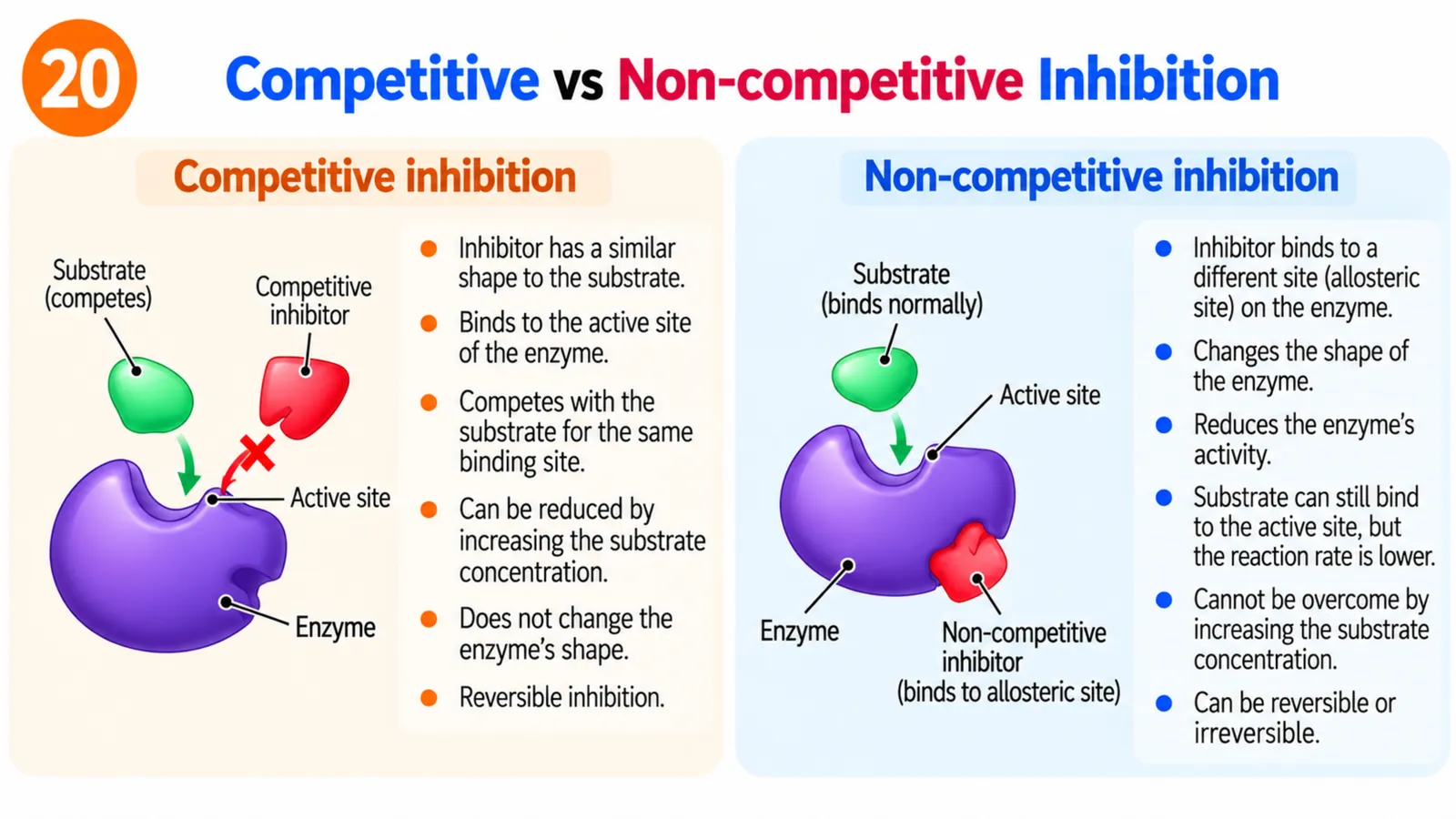
Competitive inhibitors block the active site; non-competitive ones bind elsewhere and change its shape
Xylem vs phloem
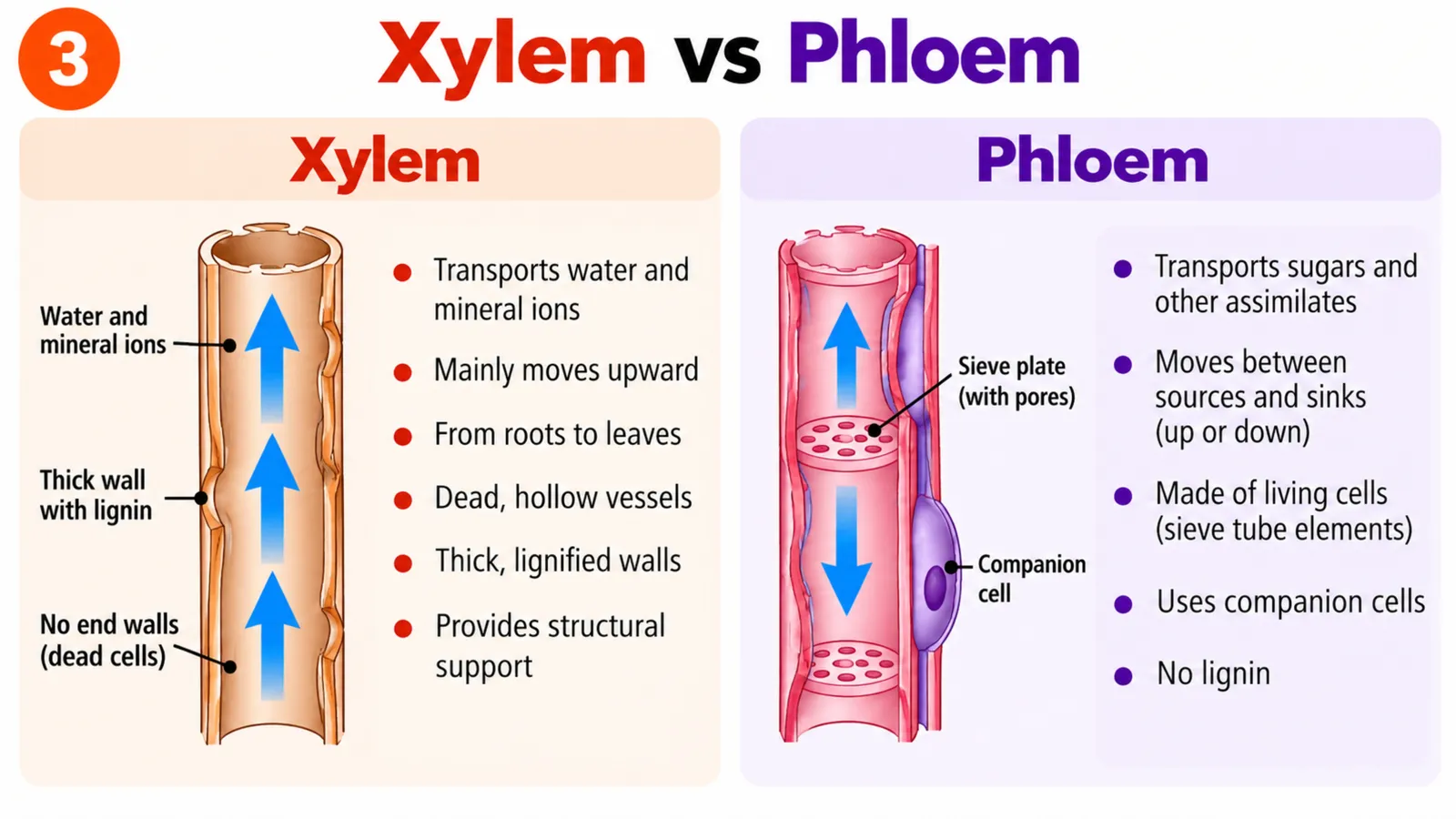
Xylem carries water and minerals up; phloem carries sugars up and down
Transpiration vs guttation
Transpiration loses water vapour through stomata; guttation loses liquid water through hydathodes
Stoma open vs closed
Open when guard cells are turgid; closed when they are flaccid
Photosynthesis vs respiration
Photosynthesis stores energy in glucose; respiration releases it
Aerobic vs anaerobic respiration
Aerobic uses oxygen and releases much more energy
Arteries vs veins
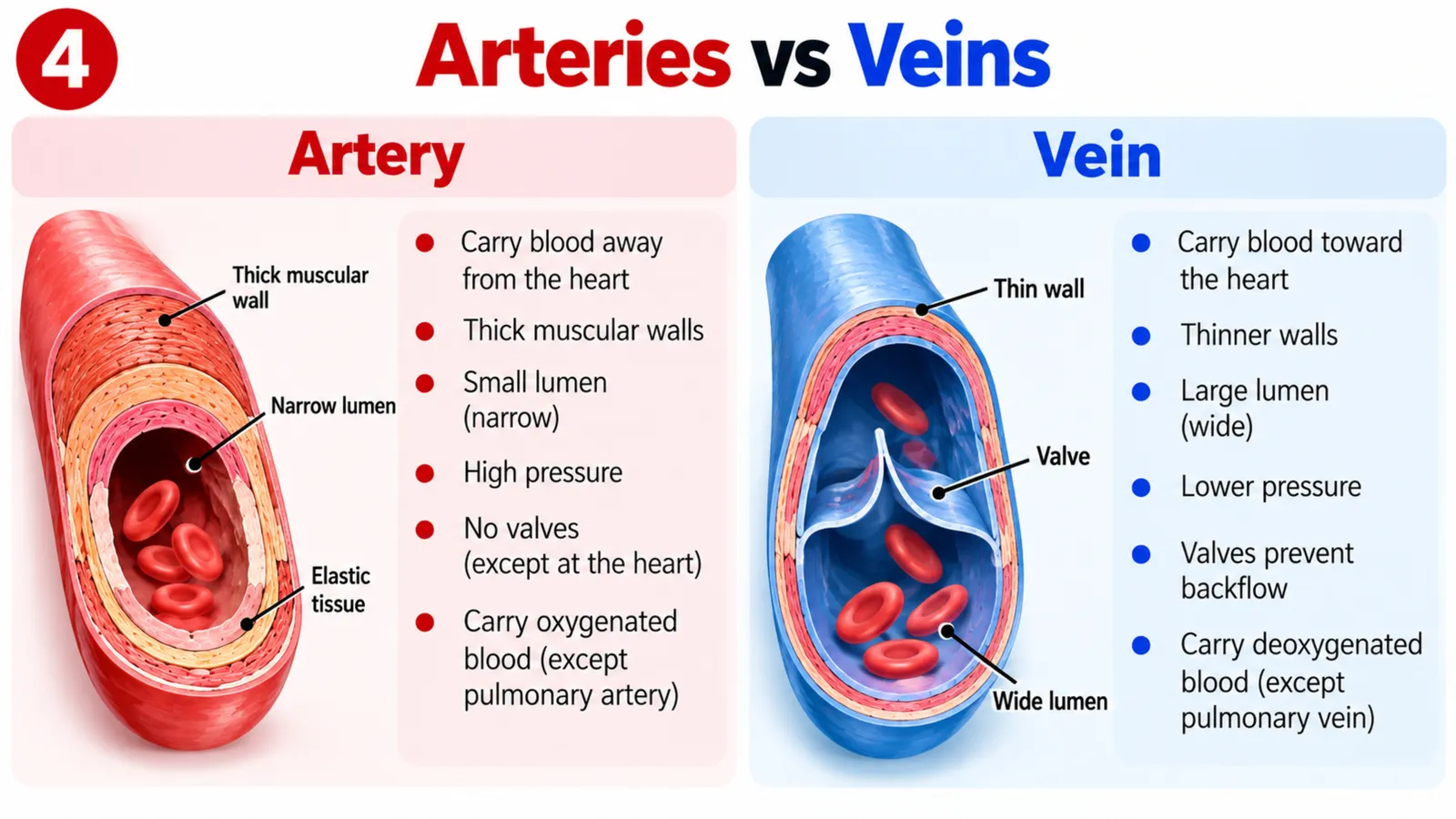
Arteries carry blood away from the heart at high pressure; veins carry it back at low pressure with valves
Red vs white blood cells
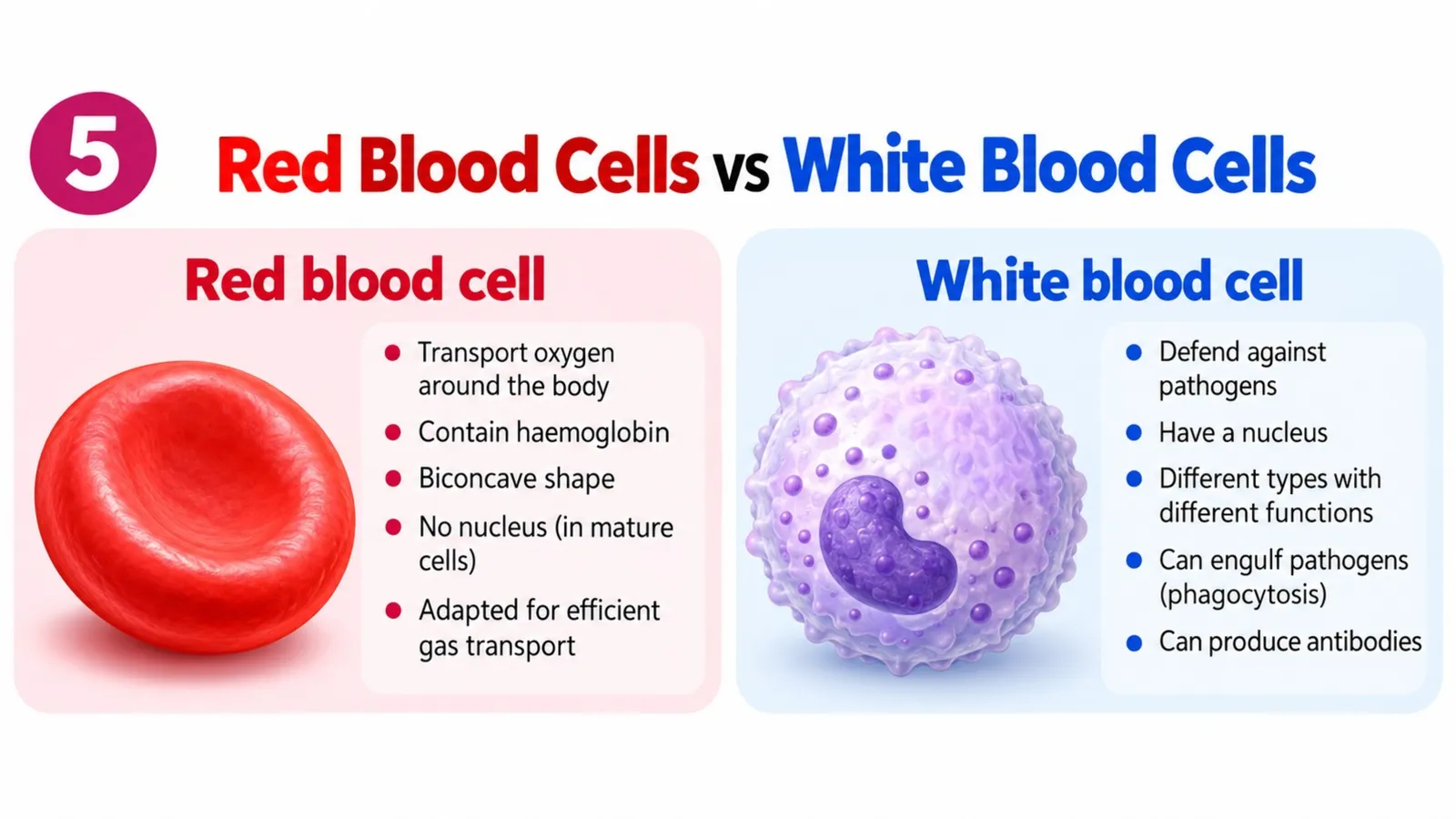
Red cells carry oxygen; white cells defend against disease
Inhalation vs exhalation
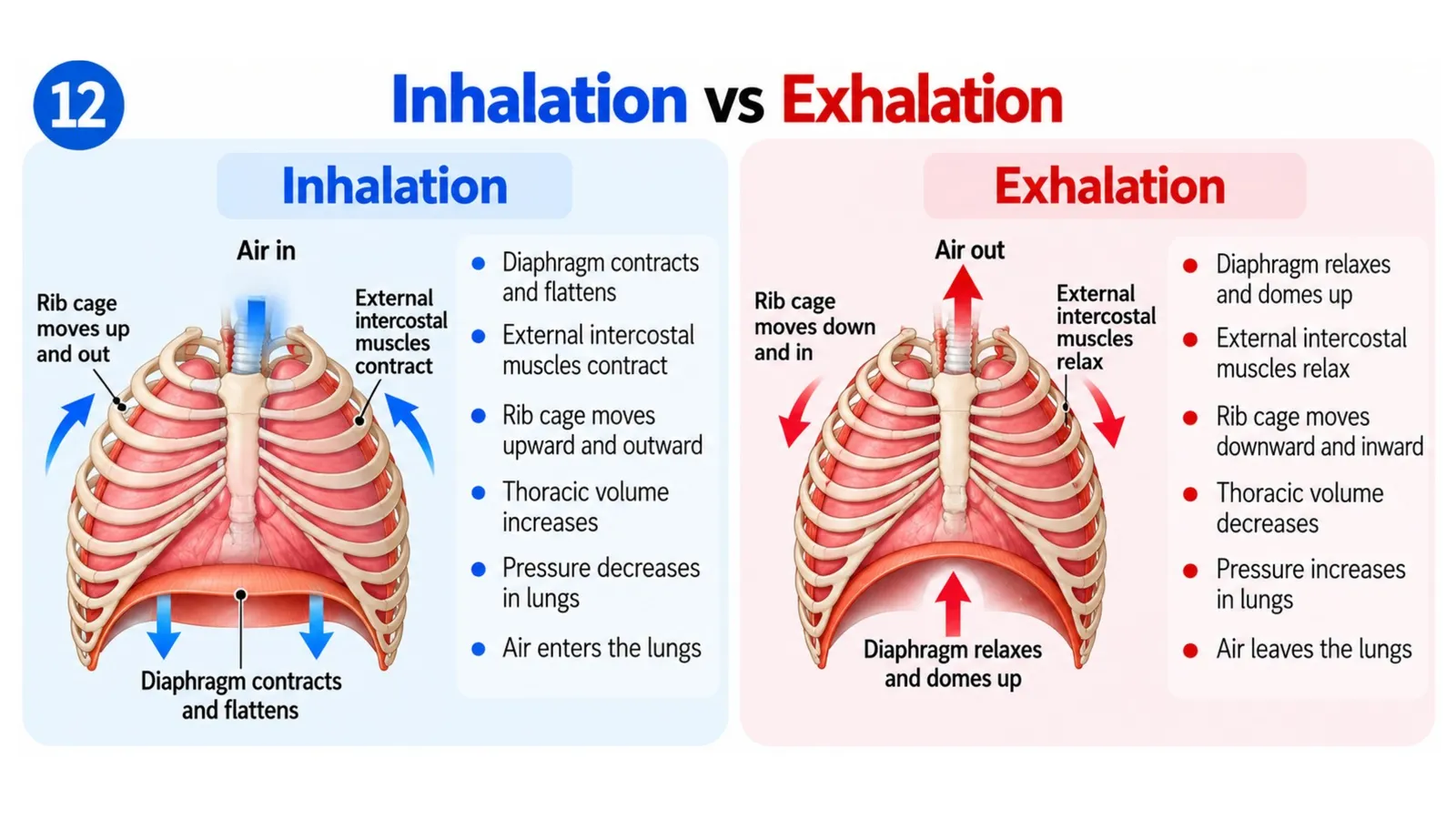
Inhalation: diaphragm contracts and pressure falls; exhalation: diaphragm relaxes and pressure rises
Antigen vs antibody
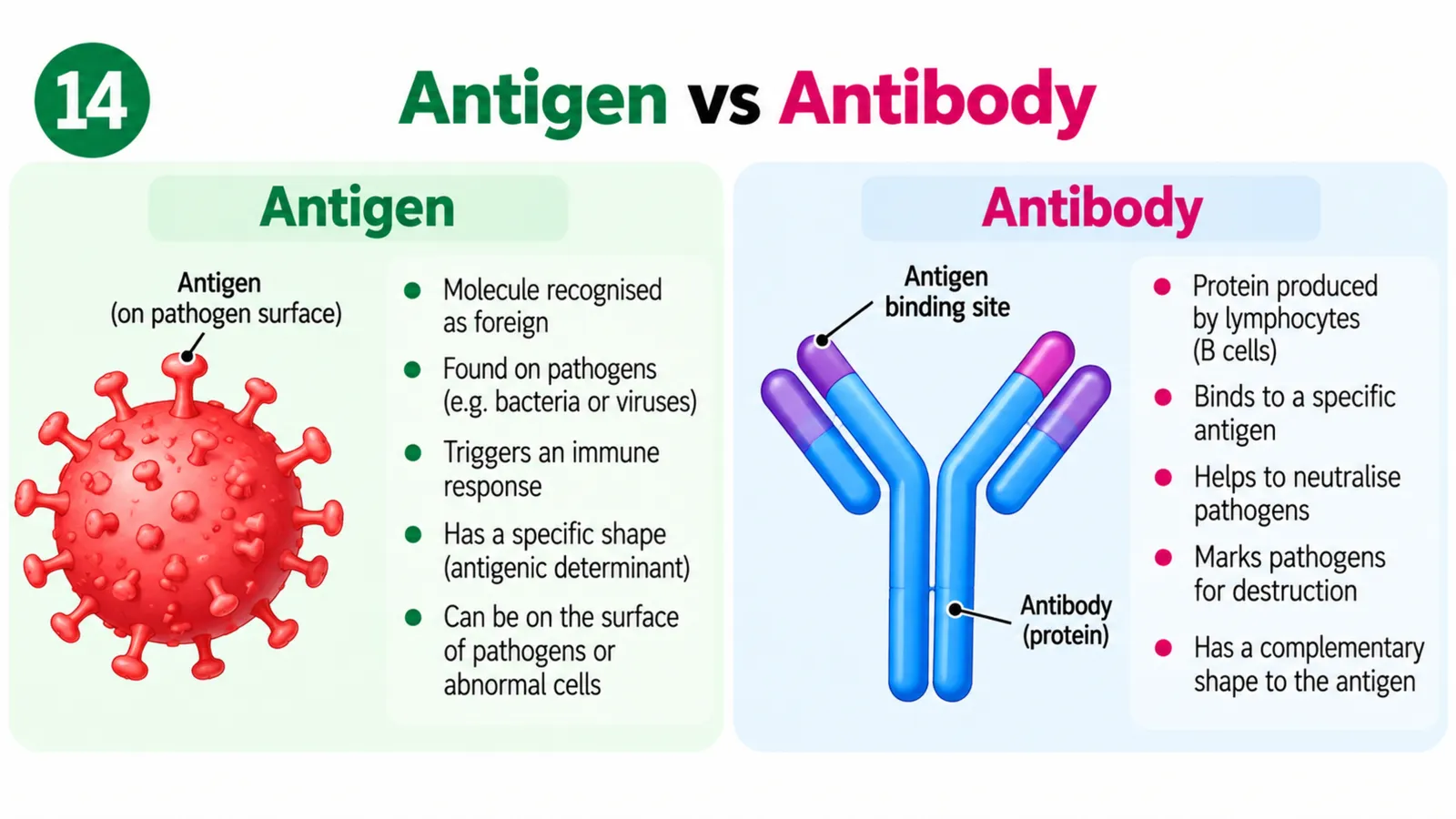
An antigen is the foreign marker; an antibody is the protein that binds to it
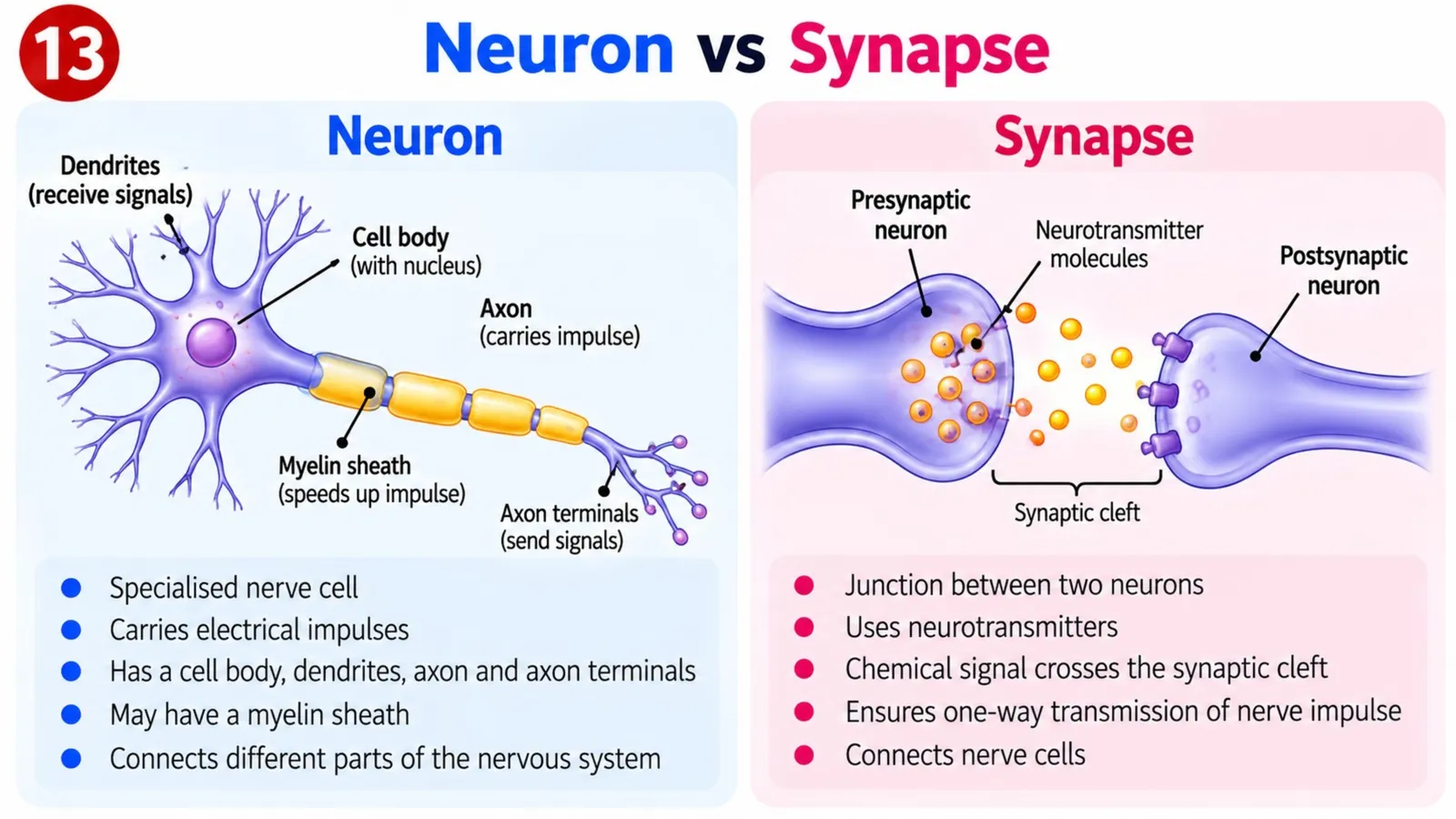
Neuron vs synapse
A neuron is the nerve cell; a synapse is the gap between two neurons
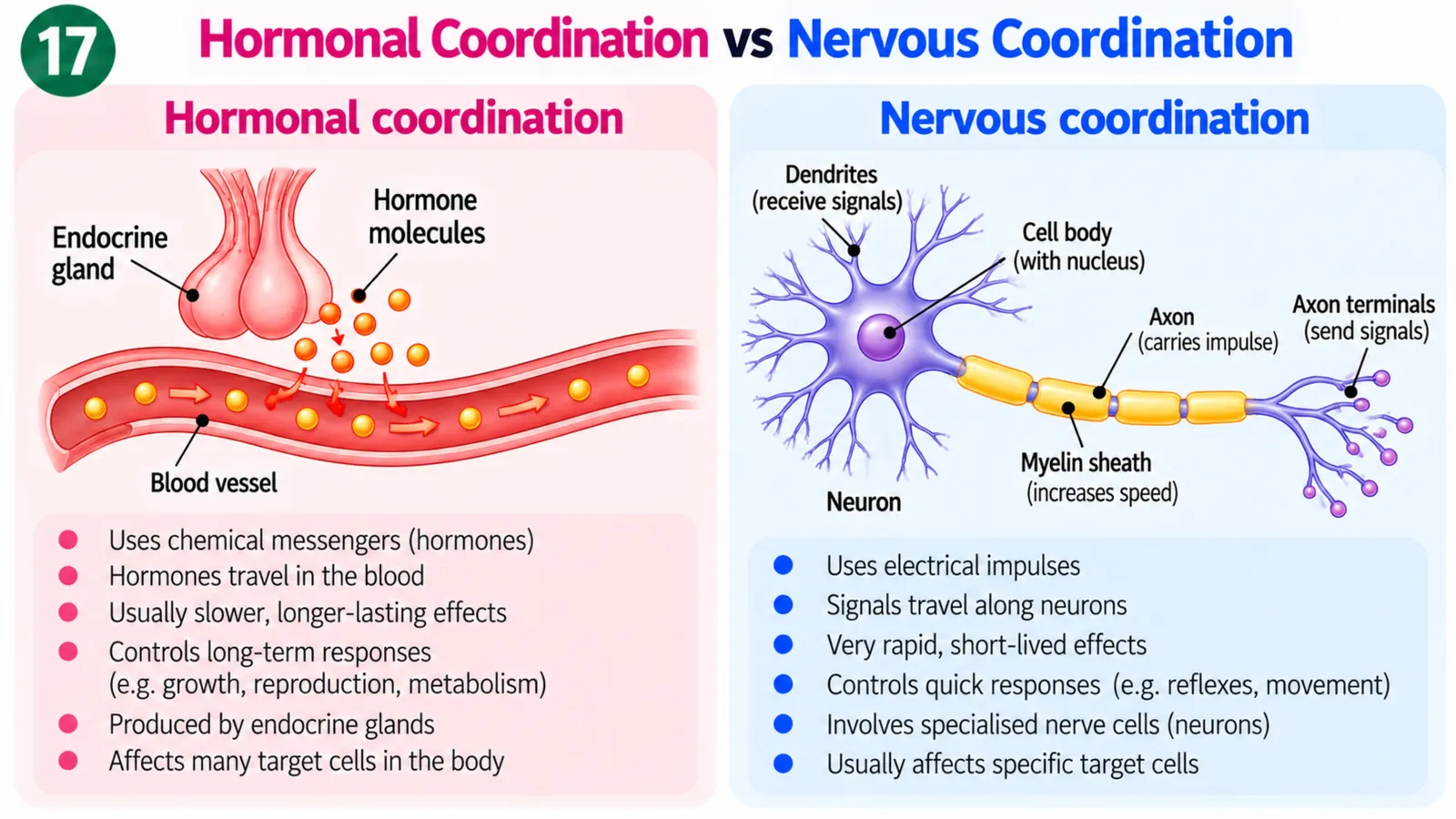
Hormonal vs nervous coordination
Hormones are slow chemical signals in the blood; nerves are fast electrical impulses
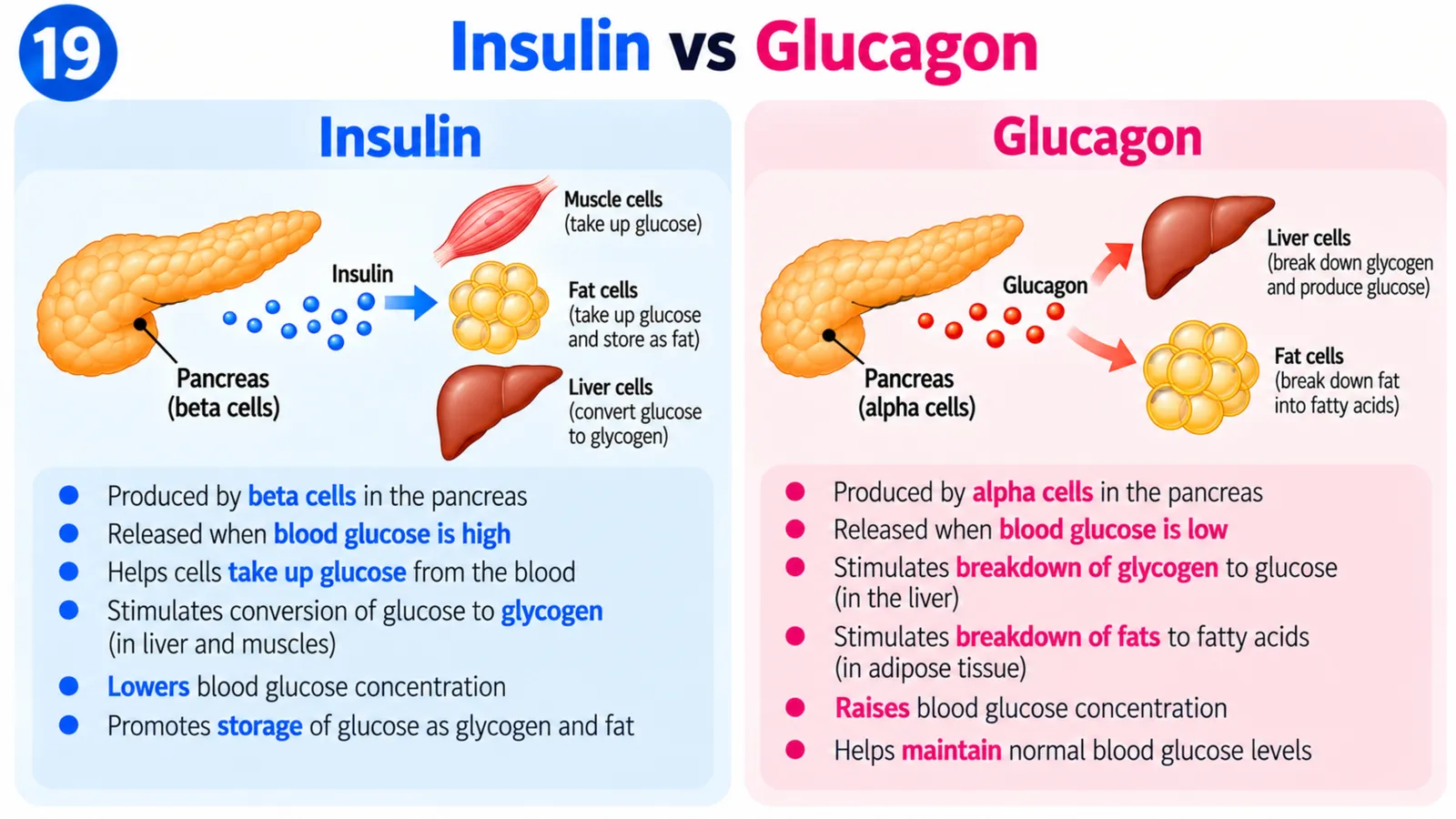
Insulin vs glucagon
Insulin lowers blood glucose; glucagon raises it
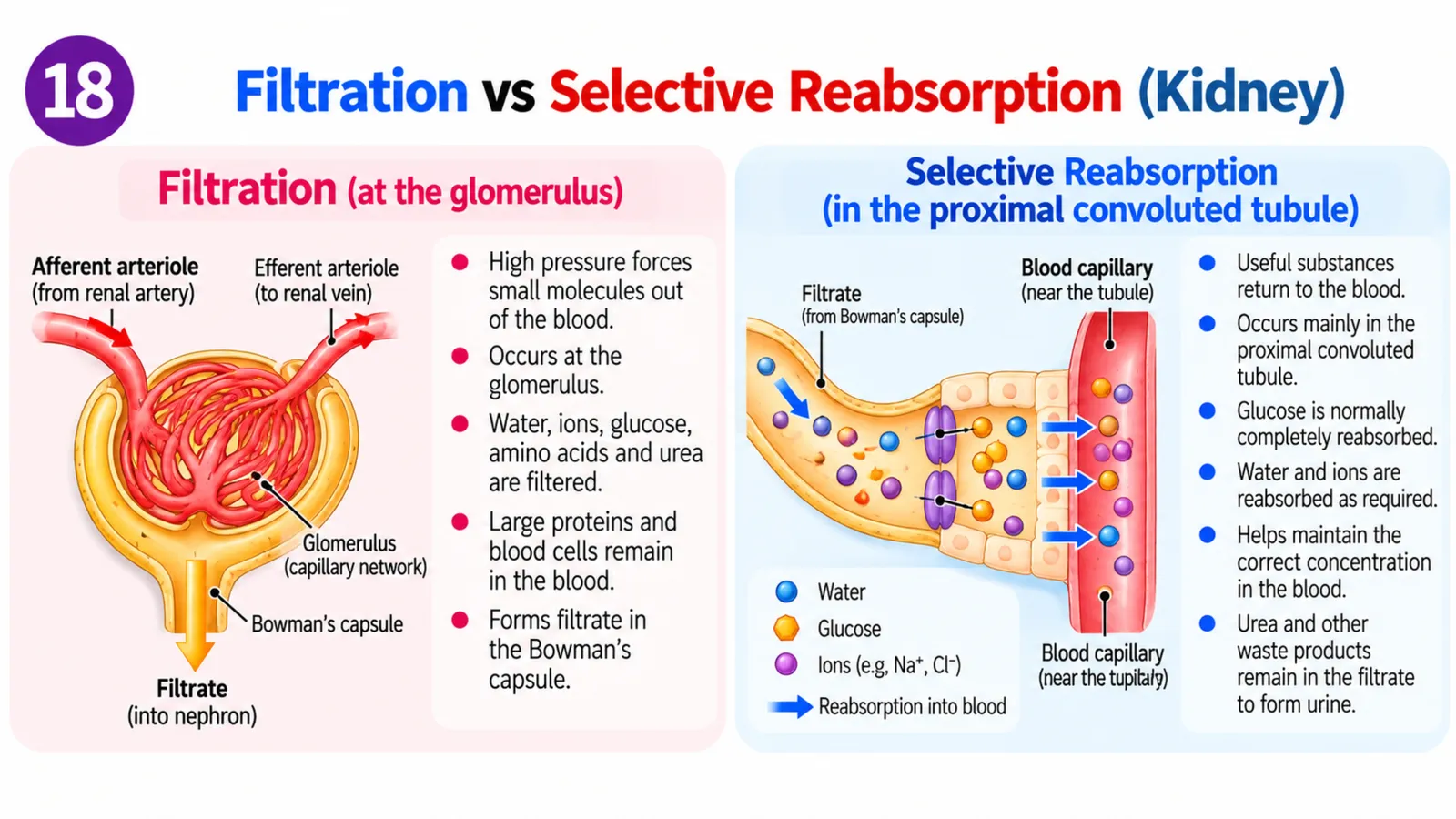
Filtration vs selective reabsorption
Filtration removes small molecules from blood; reabsorption takes the useful ones back
Genetics and Cell Division Comparisons
These four pairs form the backbone of genetics. If you can explain them clearly, you can tackle inheritance, protein synthesis and cell division questions with confidence.
1. DNA vs RNA
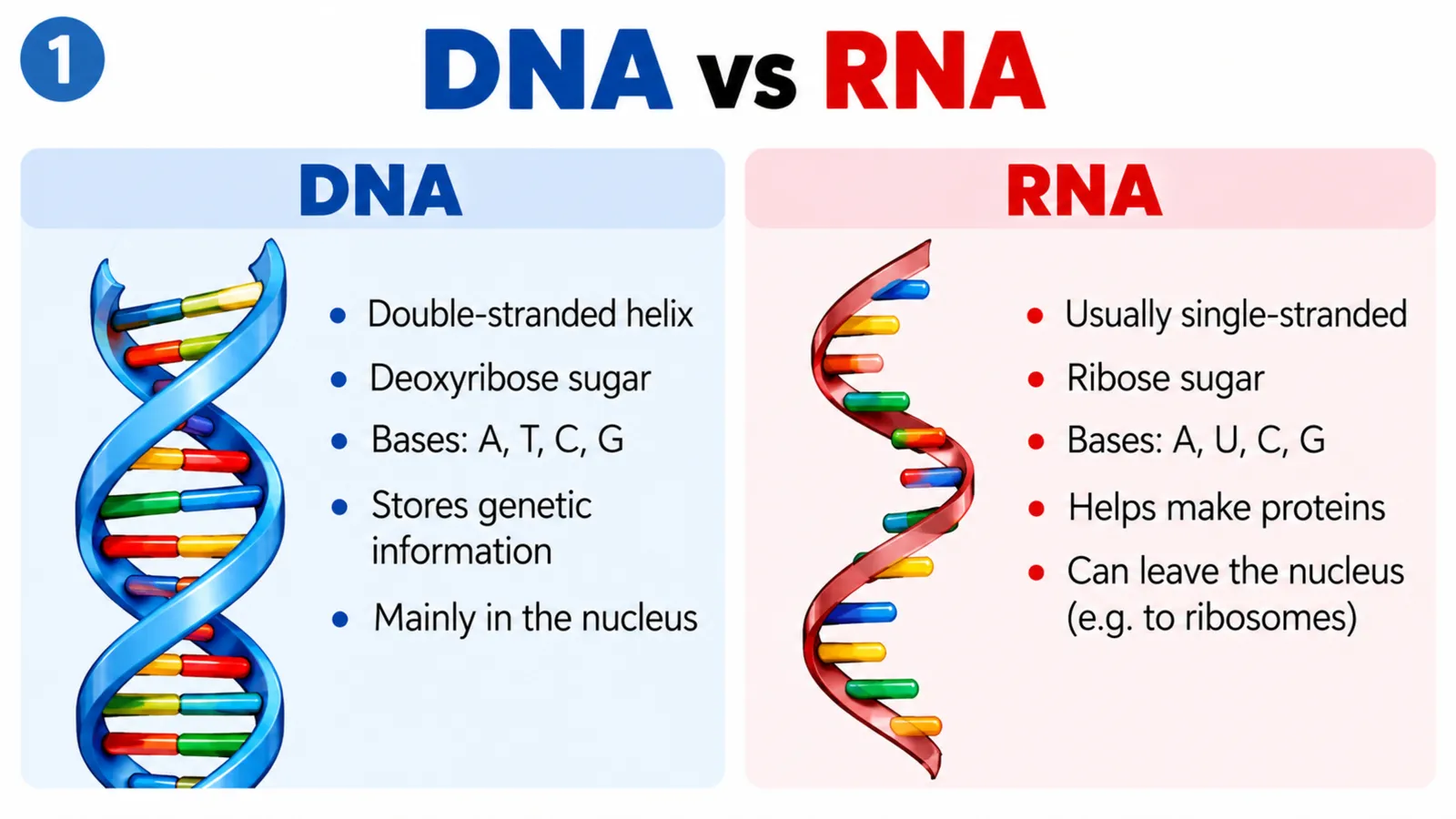
DNA and RNA are both nucleic acids made from repeating units called nucleotides. DNA stores the genetic instructions permanently, while RNA is a working copy that carries those instructions to the ribosomes so that proteins can be made.
Feature
DNA
RNA
Full name
Deoxyribonucleic acid
Ribonucleic acid
Structure
Double-stranded helix
Usually single-stranded
Sugar
Deoxyribose
Ribose
Bases
A, T, C, G
A, U, C, G
Job
Stores genetic information
Helps make proteins
Location
Mainly in the nucleus
Nucleus, cytoplasm and ribosomes
Can leave the nucleus?
No
Yes, for example mRNA travels to ribosomes
Memory trick: RNA has Uracil, and it is a single strand, so think "RNA is a single-stranded message sent to the ribosome". Learn more in our guide to protein synthesis.
🧬
Slide: DNA vs RNA
1/1
2. Gene vs Allele
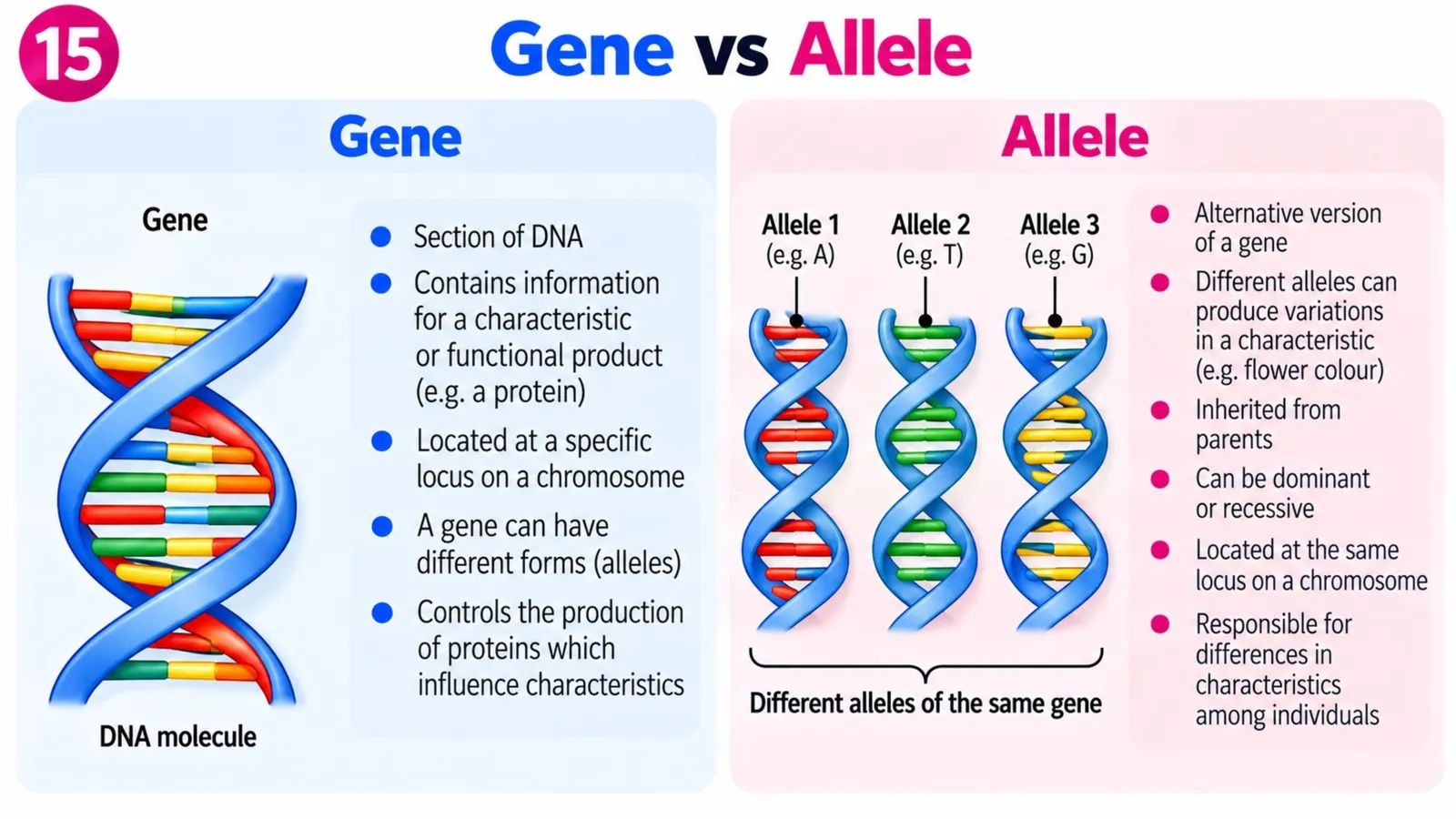
A gene is a section of DNA that holds the instructions for a characteristic, such as eye colour or flower colour. An allele is a particular version of that gene. You inherit one allele of each gene from each parent.
Feature
Gene
Allele
Definition
A section of DNA that codes for a protein
A different version of the same gene
Controls
The production of a protein linked to a characteristic
Which variation of the characteristic you show
Location
At a specific position (locus) on a chromosome
At the same locus as the other alleles of that gene
Number in a body cell
Two copies of each gene (one on each chromosome of a pair)
Two alleles, which may be the same or different
Example
The gene for flower colour
Purple allele or white allele
Dominance
Not applicable
Can be dominant or recessive
Memory trick: a gene is the recipe; alleles are the different versions of the recipe, such as a sweet or a spicy sauce.
🧩
Slide: Gene vs allele
1/1
3. Genotype vs Phenotype
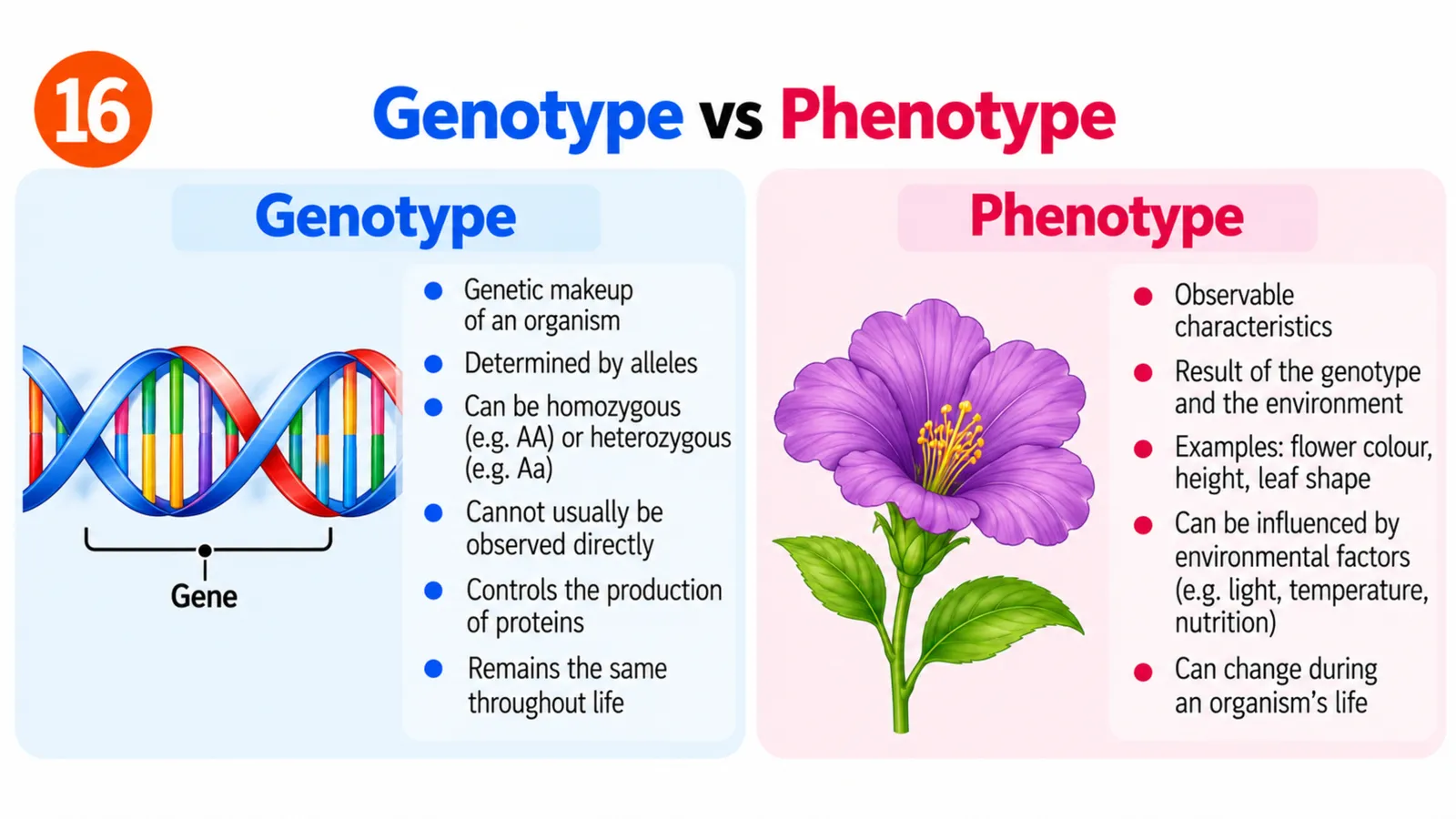
Your genotype is the combination of alleles you carry. Your phenotype is the physical characteristic that results. The phenotype depends on the genotype, but the environment can also have an effect.
Feature
Genotype
Phenotype
Meaning
The genetic makeup of an organism
The observable characteristics
Written as
Letters, for example AA, Aa or aa
Words, for example tall or purple flowers
Can you see it?
Not directly
Yes
Influenced by
Alleles inherited from the parents
Genotype and the environment
Changes during life?
No, apart from mutations
Yes, it can change, for example with diet or sunlight
Examples
Homozygous (AA, aa) or heterozygous (Aa)
Flower colour, height, leaf shape
Memory trick:Genotype = Genes (letters); Phenotype = Physical appearance. Two plants with different genotypes (AA and Aa) can still have the same phenotype if A is dominant.
🌸
Slide: Genotype vs phenotype
1/1
4. Mitosis vs Meiosis
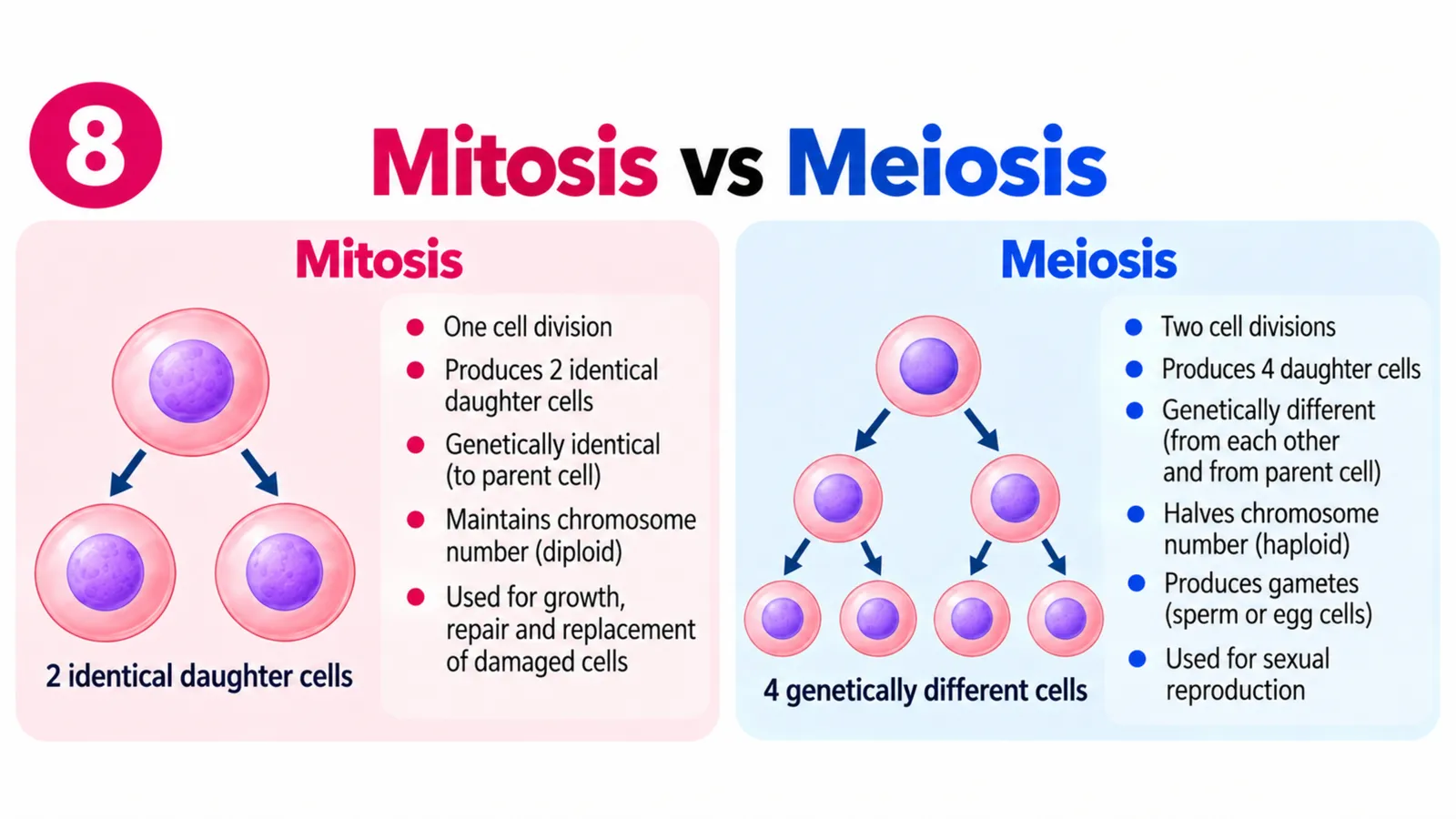
Both are types of cell division, but they have completely different jobs. Mitosis makes new body cells, while meiosis makes sex cells (gametes).
Feature
Mitosis
Meiosis
Number of divisions
One
Two
Daughter cells produced
2
4
Genetic makeup
Identical to the parent cell
Genetically different from each other and the parent
Chromosome number
Stays the same (diploid, 46 in humans)
Halved (haploid, 23 in humans)
Where it happens
Most body cells
Ovaries and testes
Purpose
Growth, repair, replacing cells and asexual reproduction
Making gametes for sexual reproduction
Variation
None, apart from mutations
Creates variation by crossing over and independent assortment
Memory trick:Mitosis = mirror image copies. Meiosis = means gametes (and halves the chromosome number).
🔬
Slide: Mitosis vs meiosis
1/1
Transport In and Out of Cells, and Enzyme Inhibition
Cells must constantly exchange substances with their surroundings. These three comparisons explain how substances move and how enzymes can be slowed down.
5. Diffusion vs Osmosis
Osmosis is really a special type of diffusion. Both are passive, which means they need no energy from the cell, but osmosis only describes the movement of water across a partially permeable membrane.
Feature
Diffusion
Osmosis
What moves
Any particles, such as gases or dissolved substances
Water molecules only
Direction
From high to low concentration of the particles
From high to low water potential (dilute to concentrated solution)
Membrane needed?
No
Yes, a partially permeable membrane
Energy needed?
No
No
Where it happens
Liquids and gases
Solutions separated by a membrane
Example
Oxygen moving from the alveoli into the blood
Water entering a root hair cell
Memory trick:Osmosis = Only water. See our full guide to osmosis, including the potato experiment.
💧
Slide: Diffusion vs osmosis
1/1
6. Active Transport vs Diffusion
Diffusion is like rolling a ball downhill. Active transport is like pushing it back uphill, so it needs energy from respiration.
Feature
Active transport
Diffusion
Direction
Against the concentration gradient (low to high)
Down the concentration gradient (high to low)
Energy needed?
Yes, from respiration (ATP)
No
Carrier proteins?
Yes, always
Not for simple diffusion
Where it happens
Living cells only
Living and non-living systems
Affected by oxygen and temperature?
Yes, because respiration supplies the energy
Temperature affects the rate, but oxygen supply does not
Examples
Root hair cells taking up mineral ions; glucose absorption in the small intestine
Memory trick:Active = ATP. If a question says a cell took up ions even though the concentration was higher outside, the answer is active transport.
⚡
Slide: Active transport vs diffusion
1/1
7. Competitive vs Non-competitive Inhibition
Enzyme inhibitors reduce enzyme activity. They do so in two different ways, and the difference is a favourite exam question. Our enzymes guide explains the active site in more detail.
Feature
Competitive inhibition
Non-competitive inhibition
Where it binds
The active site
A different site (allosteric site)
Shape of the inhibitor
Similar to the substrate
Does not need to resemble the substrate
Effect on the enzyme
Blocks the active site; the enzyme's shape is not changed
Changes the shape of the enzyme and its active site
Effect of more substrate
Can overcome the inhibition
Cannot overcome the inhibition
Reversible?
Yes
Can be reversible or irreversible
Memory trick: competitive inhibitors compete with the substrate for the same spot.
🧪
Slide: Competitive vs non-competitive inhibition
1/1
Plant Biology Comparisons
Plants have their own transport systems and ways of controlling water loss. These three pairs are very common in plant physiology questions.
8. Xylem vs Phloem
Xylem and phloem are the two transport tissues in a plant, together forming the vascular bundles. They carry different substances in different directions.
Feature
Xylem
Phloem
Transports
Water and mineral ions
Sugars (mainly sucrose) and amino acids, called assimilates
Direction
Upward only, from roots to leaves
Up and down, from sources to sinks
Cell type
Dead, hollow vessels with no end walls
Living sieve tube elements with sieve plates
Walls
Thick and strengthened with lignin
No lignin
Companion cells?
No
Yes, they supply energy to the sieve tubes
Extra job
Gives structural support to the plant
None
Process
Transpiration pull
Translocation
Memory trick: xylem carries water, and X marks the spot on a dead cell. Phloem carries products of photosynthesis.
🌿
Slide: Xylem vs phloem
1/1
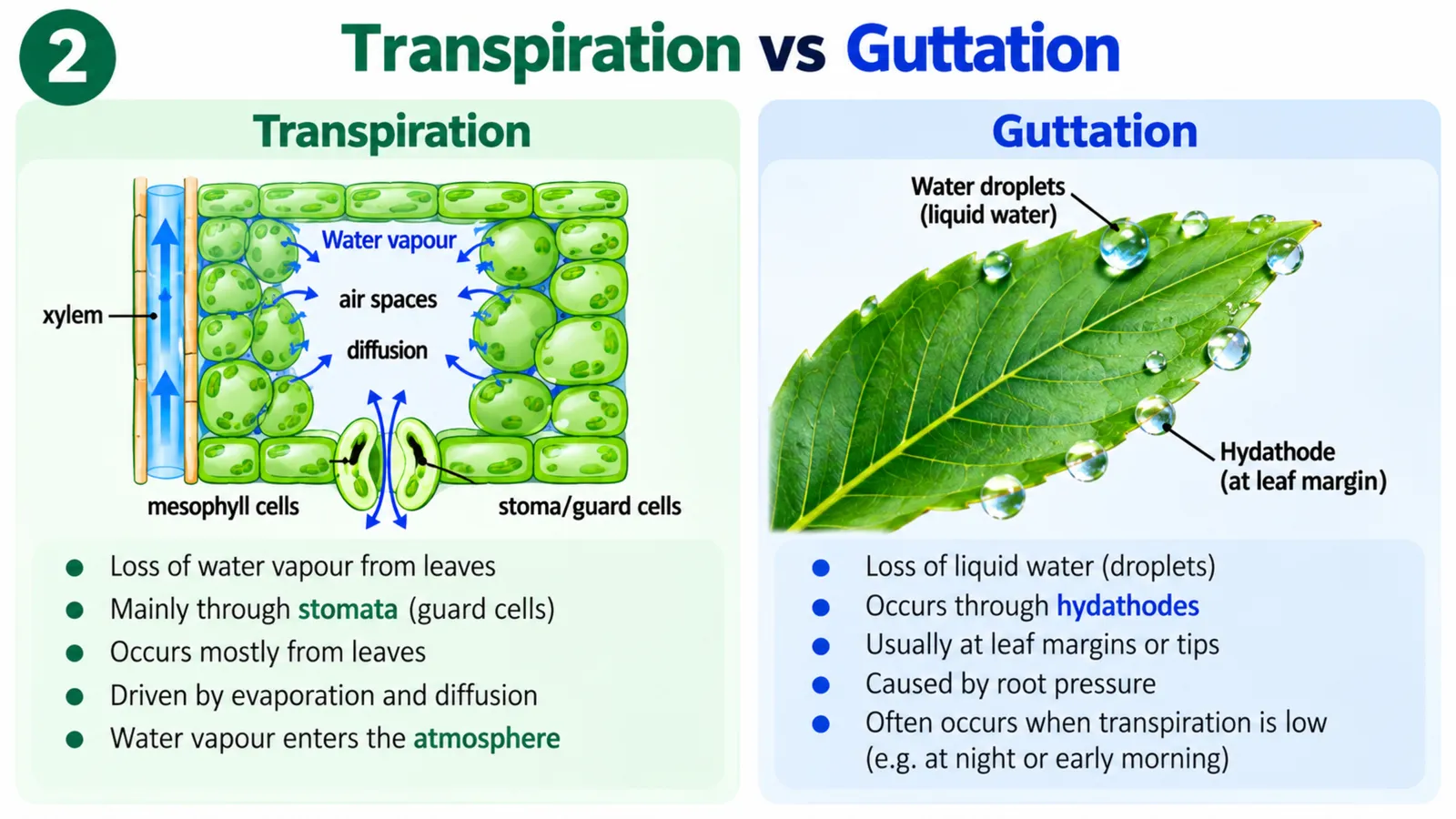
9. Transpiration vs Guttation
Both processes lose water from a plant, but they are very different. Transpiration is the loss of water vapour, mostly through stomata. Guttation is the loss of liquid water droplets from special pores.
Feature
Transpiration
Guttation
What is lost
Water vapour
Liquid water (droplets)
Where it happens
Mainly stomata on the leaves
Hydathodes at leaf edges and tips
Driven by
Evaporation and diffusion
Root pressure
When it happens
Mostly in the day, when stomata are open
Often at night or early morning, when transpiration is low and the air is humid
Effect on the plant
Pulls water up the xylem and cools the leaf
Pushes water out when the soil is wet and humid
Memory trick: guttation droplets look like dew on the edge of a leaf, but they come from inside the plant. Read more in our transpiration article.
🍃
Slide: Transpiration vs guttation
1/1
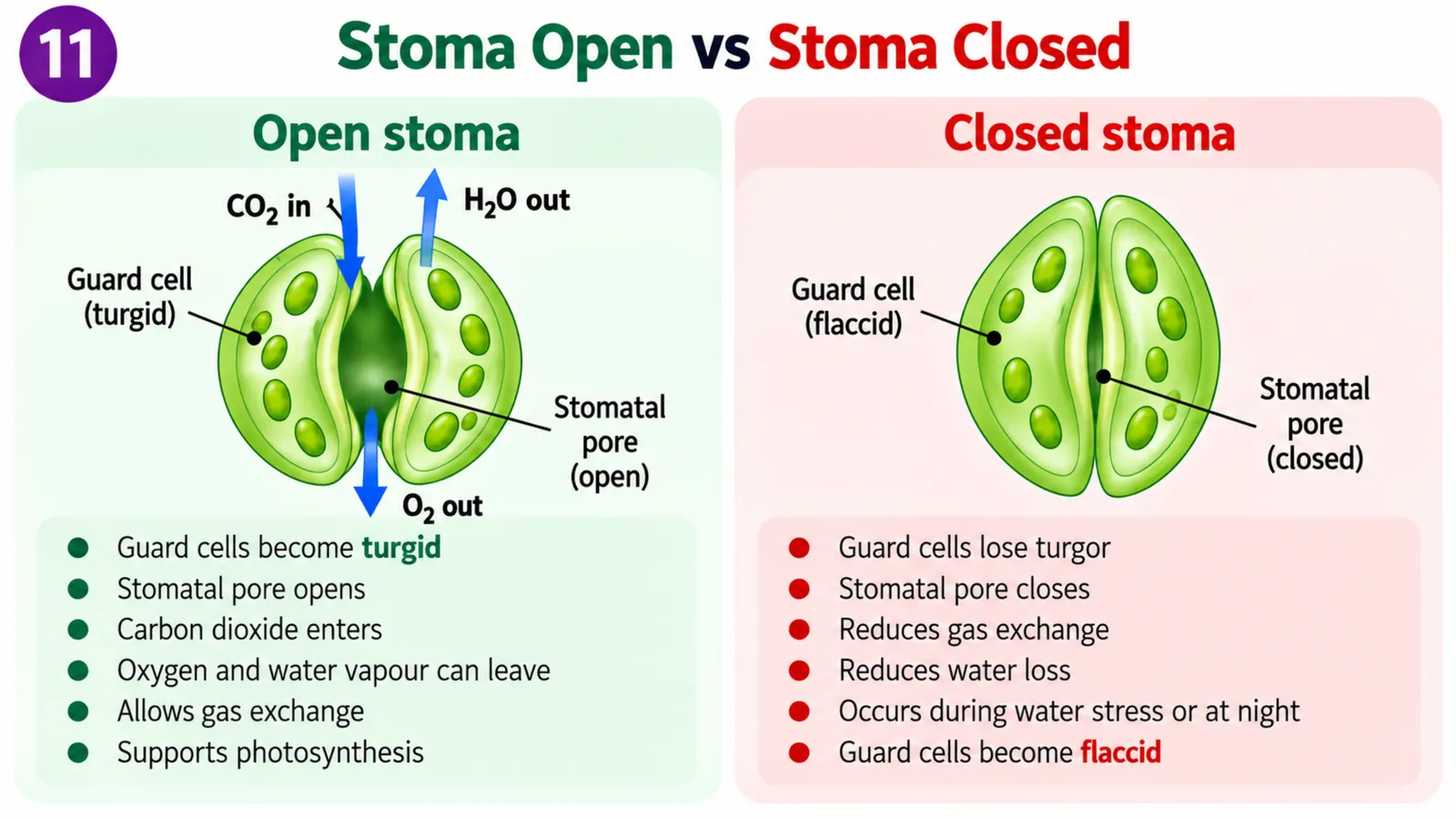
10. Stoma Open vs Stoma Closed
Stomata are tiny pores in the leaf surface, each surrounded by two guard cells. The guard cells control whether the pore is open or closed.
Feature
Stoma open
Stoma closed
Guard cells
Turgid (full of water)
Flaccid (lost turgor)
Pore
Open
Closed
Gas exchange
Carbon dioxide enters; oxygen and water vapour leave
Greatly reduced
Water loss
High
Low
When it happens
Usually in the light, with plenty of water
At night or during water stress, such as drought
Link to photosynthesis
Supports photosynthesis by letting CO2 in
Photosynthesis slows because little CO2 enters
Memory trick:Turgid = Two cells bulge open. Flaccid = Flat and shut.
🌱
Slide: Stoma open vs stoma closed
1/1
Energy and Respiration Comparisons
Every living thing needs energy. These two pairs are among the most commonly muddled in exams, so take extra care with them.
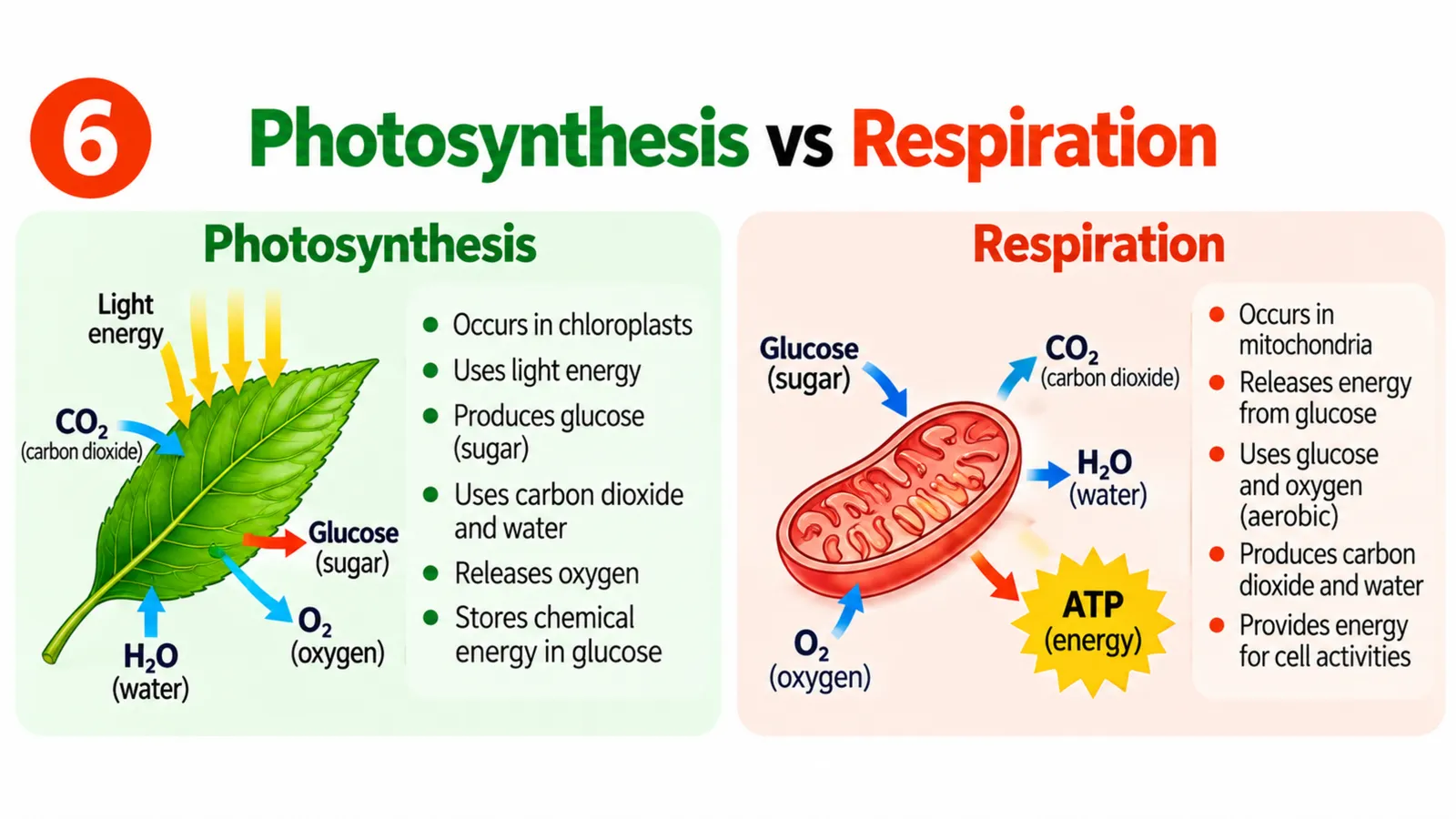
11. Photosynthesis vs Respiration
Photosynthesis and respiration are almost opposite processes. Photosynthesis captures light energy and stores it in glucose. Respiration releases that energy so that cells can use it.
Feature
Photosynthesis
Respiration
Where
Chloroplasts (in green plant cells)
Mitochondria and cytoplasm (in all living cells)
Energy
Takes in light energy (endothermic)
Releases energy (exothermic)
Reactants
Carbon dioxide and water
Glucose and oxygen (aerobic)
Products
Glucose and oxygen
Carbon dioxide, water and energy
Who does it?
Plants, algae and some bacteria
All living organisms
When
Only when there is light
All the time, day and night
Word equation
carbon dioxide + water → glucose + oxygen
glucose + oxygen → carbon dioxide + water
For the formulae, photosynthesis is 6CO2 + 6H2O → C6H12O6 + 6O2, and aerobic respiration is C6H12O6 + 6O2 → 6CO2 + 6H2O. Plants respire all the time, but in bright light photosynthesis happens faster, so they release more oxygen than they use.
Memory trick: the two equations are mirror images of each other.
☀️
Slide: Photosynthesis vs respiration
1/1
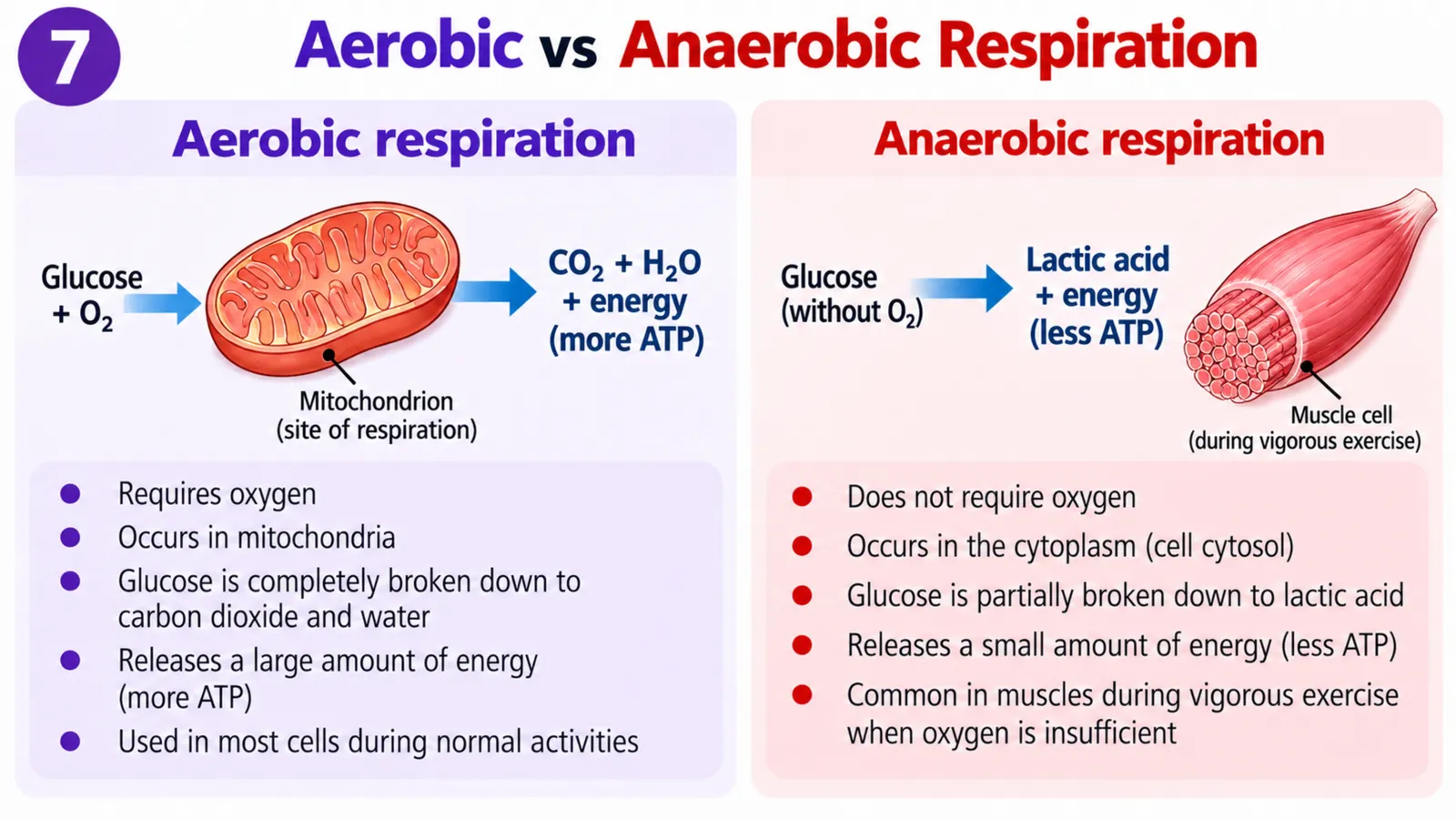
12. Aerobic vs Anaerobic Respiration
Aerobic respiration uses oxygen. Anaerobic respiration happens without oxygen and releases much less energy.
Feature
Aerobic respiration
Anaerobic respiration
Oxygen needed?
Yes
No
Where it happens
Mostly in mitochondria
In the cytoplasm
Glucose breakdown
Complete
Partial
Products in animals
Carbon dioxide and water
Lactic acid
Products in yeast and plants
Carbon dioxide and water
Ethanol and carbon dioxide
Energy released
Large amount (about 30 ATP per glucose molecule)
Small amount (2 ATP per glucose molecule)
When it happens
Normal activity
Vigorous exercise when oxygen is short
During hard exercise, lactic acid builds up in muscles. Afterwards you keep breathing heavily to repay the oxygen debt, breaking the lactic acid down in the liver.
Memory trick:anaerobic = an absence of oxygen.
🏃
Slide: Aerobic vs anaerobic respiration
1/1
Blood, Circulation and Breathing Comparisons
These three comparisons cover the heart, blood and lungs, the transport and gas exchange systems of the human body.
13. Arteries vs Veins
Arteries carry blood away from the heart, and veins carry it back. Their structures match their different jobs.
Feature
Arteries
Veins
Direction of blood
Away from the heart
Towards the heart
Wall
Thick, muscular and elastic
Thinner
Lumen (the space inside)
Narrow
Wide
Blood pressure
High, with a pulse
Low, with no pulse
Valves
No (except at the start, in the heart)
Yes, to prevent backflow
Oxygen in the blood
Oxygenated (except the pulmonary artery)
Deoxygenated (except the pulmonary vein)
Between them lie the capillaries, tiny vessels with walls only one cell thick, where substances are exchanged with the body cells.
Memory trick:Arteries carry blood away. Veins have valves.
❤️
Slide: Arteries vs veins
1/1
14. Red Blood Cells vs White Blood Cells
Blood contains four main components: red cells, white cells, platelets and plasma. Red and white cells could hardly be more different in structure and function.
Feature
Red blood cells
White blood cells
Main job
Carry oxygen around the body
Defend against pathogens
Contains
Haemoglobin
A nucleus and different cell contents
Shape
Biconcave disc
Irregular or round, depending on type
Nucleus
None in mature cells
Yes
Number
Very many (about 5 million per cubic millimetre)
Far fewer
Types
One
Several, such as phagocytes and lymphocytes
Key action
Haemoglobin binds oxygen to form oxyhaemoglobin
Phagocytosis, antibody and antitoxin production
Memory trick: red cells have no nucleus because that makes room for more haemoglobin. White cells are the body's defenders, like an army. See our human immunity guide.
🩸
Slide: Red vs white blood cells
1/1
15. Inhalation vs Exhalation
Breathing in and out depends on changes in the volume and pressure inside the chest (thorax). Air always moves from a region of high pressure to a region of lower pressure.
Feature
Inhalation (breathing in)
Exhalation (breathing out)
Diaphragm
Contracts and flattens
Relaxes and moves up into a dome shape
External intercostal muscles
Contract
Relax
Rib cage
Moves up and out
Moves down and in
Volume of the thorax
Increases
Decreases
Pressure in the lungs
Falls below atmospheric pressure
Rises above atmospheric pressure
Air movement
Air moves into the lungs
Air moves out of the lungs
Quiet exhalation is passive. During forceful breathing, such as exercise, the internal intercostal muscles contract to push air out faster.
Memory trick:inhalation = muscles contract and volume goes up, so pressure goes down.
🫁
Slide: Inhalation vs exhalation
1/1
Immunity Comparison
16. Antigen vs Antibody
These two words sound alike, but they are on opposite sides of an immune response. An antigen is the foreign marker, and an antibody is the protein your body builds to match it.
Feature
Antigen
Antibody
What is it?
A molecule recognised as foreign
A protein made by lymphocytes (B cells)
Found on
The surface of pathogens or abnormal cells
Released into the blood and body fluids
Role
Triggers an immune response
Binds to a specific antigen to neutralise or mark the pathogen
Shape
Has a specific shape
Has a binding site complementary to one antigen
Produced by
The pathogen
The immune system
When antibodies bind to antigens, they cause pathogens to clump together and make it easier for phagocytes to destroy them. Memory cells remain after infection, which is the principle behind vaccination.
Memory trick:antigens anticipate trouble (they generate antibodies); antibodies are the body's response.
🛡️
Slide: Antigen vs antibody
1/1
Coordination, Homeostasis and Excretion Comparisons
The final four comparisons look at how the body senses, responds, controls its internal environment and gets rid of waste.
17. Neuron vs Synapse
A neuron is a complete nerve cell. A synapse is not a cell at all: it is the tiny gap and connection between two neurons.
Slightly slower, because chemicals must diffuse across
Direction
Impulse can travel along the axon
Allows the impulse to pass one way only
At a synapse, the electrical impulse arrives and triggers the release of neurotransmitter molecules. These diffuse across the gap and bind to receptors on the next neuron, which starts a new impulse. Because only the presynaptic neuron releases neurotransmitters, messages travel in one direction only.
Memory trick: the neuron is the wire, and the synapse is the gap between two wires.
🧠
Slide: Neuron vs synapse
1/1
18. Hormonal vs Nervous Coordination
Your body uses two communication systems. The nervous system sends fast electrical messages, whereas the endocrine system sends chemical hormones through the blood.
Feature
Hormonal coordination
Nervous coordination
Message carried by
Hormones (chemicals)
Electrical impulses
Travels in
The blood
Neurons
Speed
Slower
Very fast
Length of effect
Longer-lasting
Short-lived
Target
Many target cells in the body
Specific target cells
Produced or sent by
Endocrine glands
Neurons and the brain
Examples
Growth, puberty, metabolism, blood sugar
Reflexes, movement, touch
Some responses use both. Adrenaline is a hormone that prepares the body for "fight or flight" within seconds, while the nervous system controls the immediate reflex.
Memory trick:Nervous = Now (fast). Hormones = hang around (slower and longer).
📡
Slide: Hormonal vs nervous coordination
1/1
19. Insulin vs Glucagon
Insulin and glucagon are two hormones made in the pancreas that work as a team to keep blood glucose steady. This is an example of negative feedback.
Feature
Insulin
Glucagon
Made by
Beta cells in the pancreas
Alpha cells in the pancreas
Released when
Blood glucose is high
Blood glucose is low
Main target
Liver, muscle and fat cells
Mainly the liver
Effect
Cells take up glucose; glucose is converted to glycogen and stored
Glycogen is broken down into glucose in the liver
Effect on blood glucose
Lowers it
Raises it
Linked condition
Type 1 diabetes (not enough insulin made)
Used in emergency treatment of very low blood sugar
Memory trick:Glucagon helps you "get" glucose back into the blood. Insulin takes glucose in to cells.
🍬
Slide: Insulin vs glucagon
1/1
20. Filtration vs Selective Reabsorption (Kidney)
The kidney makes urine in two key stages. First it filters the blood under high pressure, taking out almost everything small. Then it reclaims the useful substances.
Feature
Filtration
Selective reabsorption
Where
Glomerulus and Bowman's capsule
Mainly the proximal convoluted tubule
What happens
High pressure forces small molecules out of the blood
Useful substances return to the blood
Substances involved
Water, ions, glucose, amino acids and urea leave the blood
All glucose, and the amount of water and ions the body needs, are taken back
What stays behind
Large proteins and blood cells stay in the blood
Urea and other waste stay in the filtrate to form urine
Energy needed?
No, the pressure does the work
Yes, active transport is used for glucose
If glucose appears in the urine, selective reabsorption is not working properly, which is one way doctors can detect diabetes.
Memory trick: filtration is not selective and takes everything small; reabsorption is selective and takes back only what the body needs.
🫘
Slide: Filtration vs selective reabsorption
1/1
Common Mistakes When Comparing Biology Terms
Mixing up diffusion and osmosis. Osmosis is only about water, and it needs a partially permeable membrane.
Saying plants only respire at night. Plants respire all the time and photosynthesise only in the light.
Writing "the cell is full of oxygen" for aerobic respiration. The cell uses oxygen to break glucose down, and it releases carbon dioxide and water.
Forgetting the exceptions. Say "arteries carry oxygenated blood, except the pulmonary artery", and the reverse for veins.
Saying genotype can be seen. Genotype is the alleles; phenotype is what you observe.
Saying enzymes are "killed". Enzymes are denatured, not killed.
Describing only one side. In a "compare" question, always write both sides in the same sentence.
Frequently Asked Questions About Biology Comparisons
What is the easiest way to remember biology differences?
Make a two-column table for each pair, like those in this guide, then add one memory trick. Test yourself by covering one column and writing it from memory. Flashcards also work very well for this.
What is the difference between a gene and an allele?
A gene is a section of DNA that codes for a characteristic. An allele is one of the different versions of that gene. For example, the gene for flower colour may have a purple allele and a white allele.
Is osmosis a type of diffusion?
Yes. Osmosis is the diffusion of water molecules across a partially permeable membrane, from a dilute solution to a more concentrated one.
What is the difference between mitosis and meiosis in one sentence?
Mitosis makes two genetically identical cells for growth and repair, whereas meiosis makes four genetically different gametes with half the chromosome number.
What is the difference between hormonal and nervous coordination?
Nervous coordination uses fast electrical impulses along neurons for short-lived responses. Hormonal coordination uses chemicals carried in the blood for slower but longer-lasting effects.
Which of these comparisons come up most often in exams?
DNA vs RNA, mitosis vs meiosis, diffusion vs osmosis, xylem vs phloem, arteries vs veins, photosynthesis vs respiration, genotype vs phenotype, and the nervous vs hormonal systems are the most popular. Always check your exam board's specification, as some topics (such as competitive and non-competitive inhibition) are mainly A Level content.
Key Takeaways
Learn biology pairs side by side, and always compare the same feature in both columns.
Osmosis, diffusion and active transport differ in direction, energy use and the substances involved.
Xylem carries water up through dead, lignified vessels; phloem carries sugars both ways through living cells.
Photosynthesis and respiration are opposite processes, and aerobic respiration releases far more energy than anaerobic.
Genotype is the alleles; phenotype is the observable result of genotype plus the environment.
Nervous responses are fast and short-lived, while hormonal responses are slower and last longer.
Keep this page open as a revision checklist, then test yourself with our GCSE Cell Biology, Plant Physiology and Animal Physiology flashcards. Next, dive deeper into one of the topics above with our guides to osmosis, enzymes and protein synthesis.
🗂️ Revision Flashcards
Tap a card to reveal the answer.
🎯 Quick Quiz
8 questions. Pick an answer to check it straight away.
1Which base is found in RNA but not in DNA?
DNA has A, T, C, G; RNA has A, U, C, G, so uracil replaces thymine.
2How many daughter cells does meiosis produce?
Meiosis has two divisions and makes 4 genetically different gametes.
3A cell takes up ions even though their concentration is higher outside the cell. Which process is this?
Moving substances against the concentration gradient needs energy, so it is active transport.
4Where does a non-competitive inhibitor bind?
Non-competitive inhibitors bind elsewhere and change the shape of the enzyme and its active site.
5What drives guttation?
Guttation pushes liquid water out of hydathodes by root pressure.
6When are guard cells turgid?
Turgid guard cells bulge and open the pore; flaccid ones close it.
7During inhalation, what happens to the diaphragm and the pressure in the lungs?
The diaphragm contracts and flattens, the thorax volume increases and pressure falls below atmospheric pressure.
8Which is the correct description of an antibody?
Antibodies are proteins made by lymphocytes (B cells) with a binding site complementary to one antigen.