For many students, chemistry calculations are the most feared part of the course. But here is the good news: almost every calculation question uses the same small set of ideas, applied in the same logical order. Once you can write formulae, balance equations and use the mole, you can answer questions on reacting masses, yields, gas volumes and concentrations with confidence. This guide takes you from the very beginning to exam level, with clear worked examples at every step.
📖 Lesson
From writing formulae and balancing equations to moles, reacting masses, yields, gas volumes and concentrations, with worked examples.
Part 1: Chemical Formulae
A chemical formula uses element symbols and numbers to show the composition of a substance.
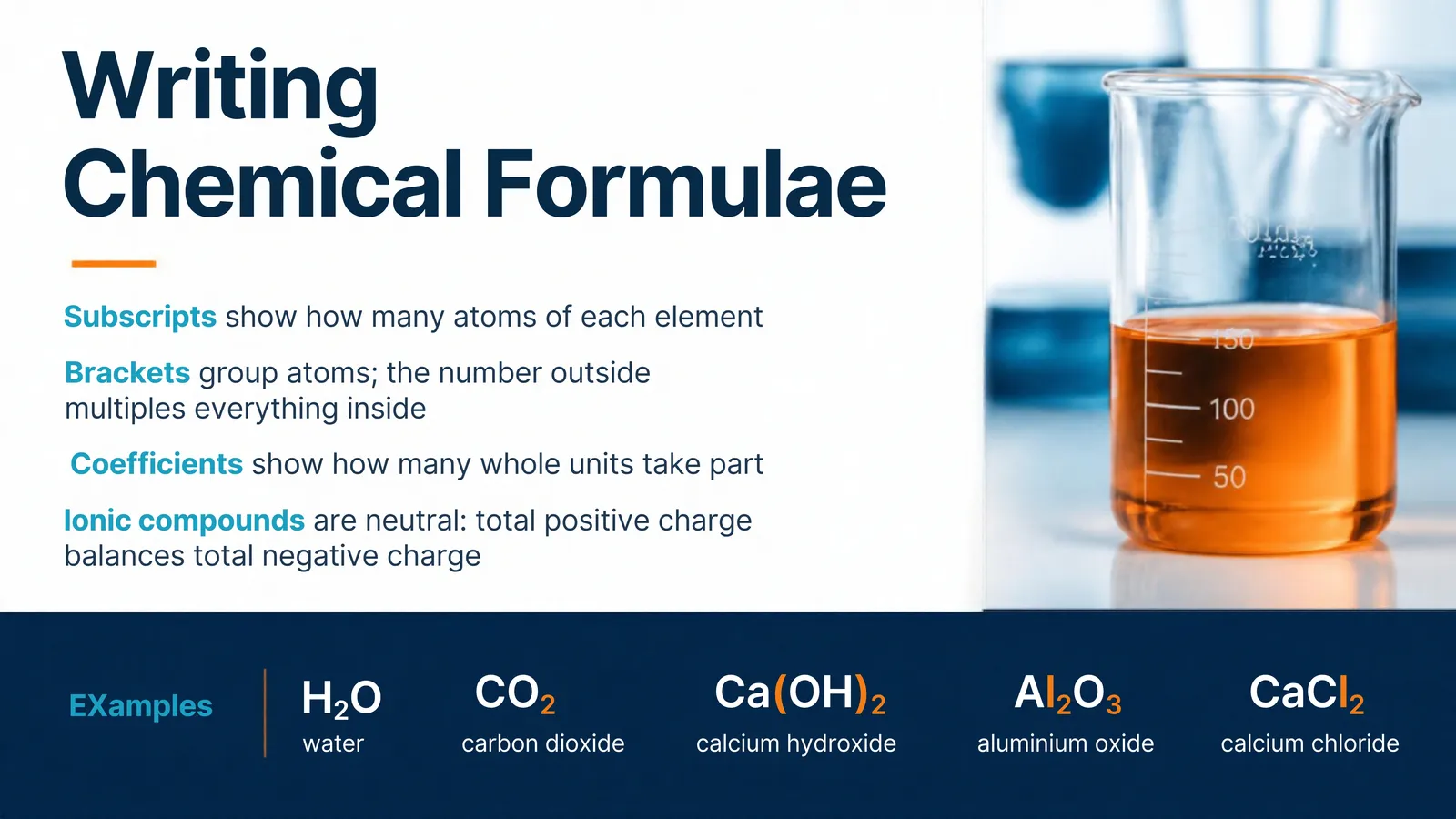
H2O contains 2 hydrogen atoms and 1 oxygen atom. The small number after a symbol, called a subscript, applies only to the element directly before it.
CO2 contains 1 carbon atom and 2 oxygen atoms.
In Ca(OH)2, the 2 after the bracket multiplies everything inside it, so there are 1 calcium, 2 oxygen and 2 hydrogen atoms.
A large number in front, called a coefficient, multiplies the whole formula: 3H2O means three water molecules, containing 6 hydrogen and 3 oxygen atoms in total.
Formulae of elements to remember
Most elements are written simply as their symbol, such as Fe, Mg and C. But seven elements exist as diatomic molecules and must be written with a 2: H2, N2, O2, F2, Cl2, Br2 and I2. A useful memory aid is "Have No Fear Of Ice Cold Beer".
Writing formulae of ionic compounds
Ionic compounds are neutral, so the total positive charge must equal the total negative charge. You need to know the charges on common ions:
| Positive ions | Negative ions |
|---|---|
| Na+, K+, Ag+, H+, NH4+ | Cl−, Br−, I−, OH−, NO3− |
| Mg2+, Ca2+, Cu2+, Zn2+, Fe2+ | O2−, S2−, SO42−, CO32− |
| Al3+, Fe3+ | N3−, PO43− |
The fastest method is to swap and drop the charge numbers:
Aluminium oxide: Al3+ and O2−. Swap the numbers to get Al2O3.
Calcium chloride: Ca2+ and Cl−. Swap to get CaCl2.
Magnesium oxide: Mg2+ and O2−. Swapping gives Mg2O2, which simplifies to MgO.
Calcium hydroxide: Ca2+ and OH−. You need two hydroxide ions, so use brackets: Ca(OH)2.
Ammonium sulfate: NH4+ and SO42− gives (NH4)2SO4.
Brackets are needed only when there is more than one of a compound ion.
Slides: Writing chemical formulae
Subscripts, brackets, coefficients and ionic formulae
1/2
Part 2: Chemical Equations
Word equations
A word equation names the reactants and products:
magnesium + oxygen → magnesium oxide
Reactants are on the left of the arrow and products on the right. The arrow means "reacts to form".
Symbol equations and the law of conservation of mass
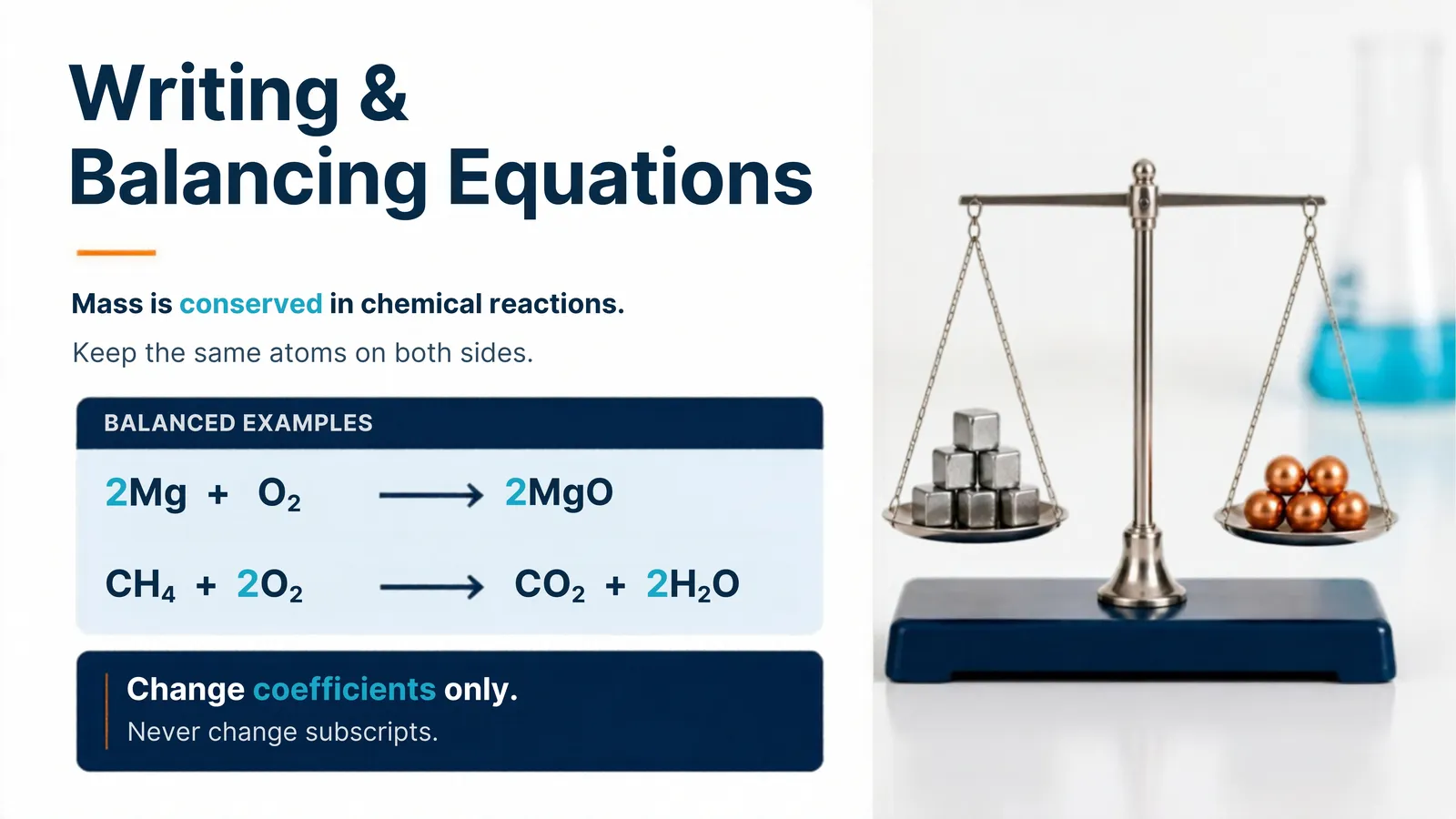
In a chemical reaction, atoms are not created or destroyed; they are simply rearranged. This is the law of conservation of mass: the total mass of the products equals the total mass of the reactants. A balanced symbol equation must therefore have the same number of each type of atom on both sides.
How to balance an equation step by step
Example 1: magnesium burning in oxygen
Write the correct formulae: Mg + O2 → MgO
Count the atoms. Left: 1 Mg, 2 O. Right: 1 Mg, 1 O. The oxygen does not balance.
Put a 2 in front of MgO: Mg + O2 → 2MgO. Now there are 2 Mg on the right.
Put a 2 in front of Mg: 2Mg + O2 → 2MgO. Balanced.
Example 2: methane burning
CH4 + O2 → CO2 + H2O
Carbon balances. Hydrogen: 4 on the left, 2 on the right, so write 2H2O.
Oxygen: now 2 + 2 = 4 on the right, so write 2O2 on the left.
CH4 + 2O2 → CO2 + 2H2O. Balanced.
Golden rule: never change the small numbers inside a formula. Changing H2O to H2O2 turns water into hydrogen peroxide, a completely different substance. Only change the large numbers in front.
Tips for balancing tricky equations
Balance elements that appear in only one compound on each side first.
Leave elements that appear on their own, such as O2 or Fe, until last.
Treat compound ions such as SO4 as a single unit if they appear unchanged on both sides.
Check every element at the end.
Slide: Balancing equations
Mass is conserved, so keep the same atoms on both sides
1/1
State symbols
State symbols show the physical state of each substance:
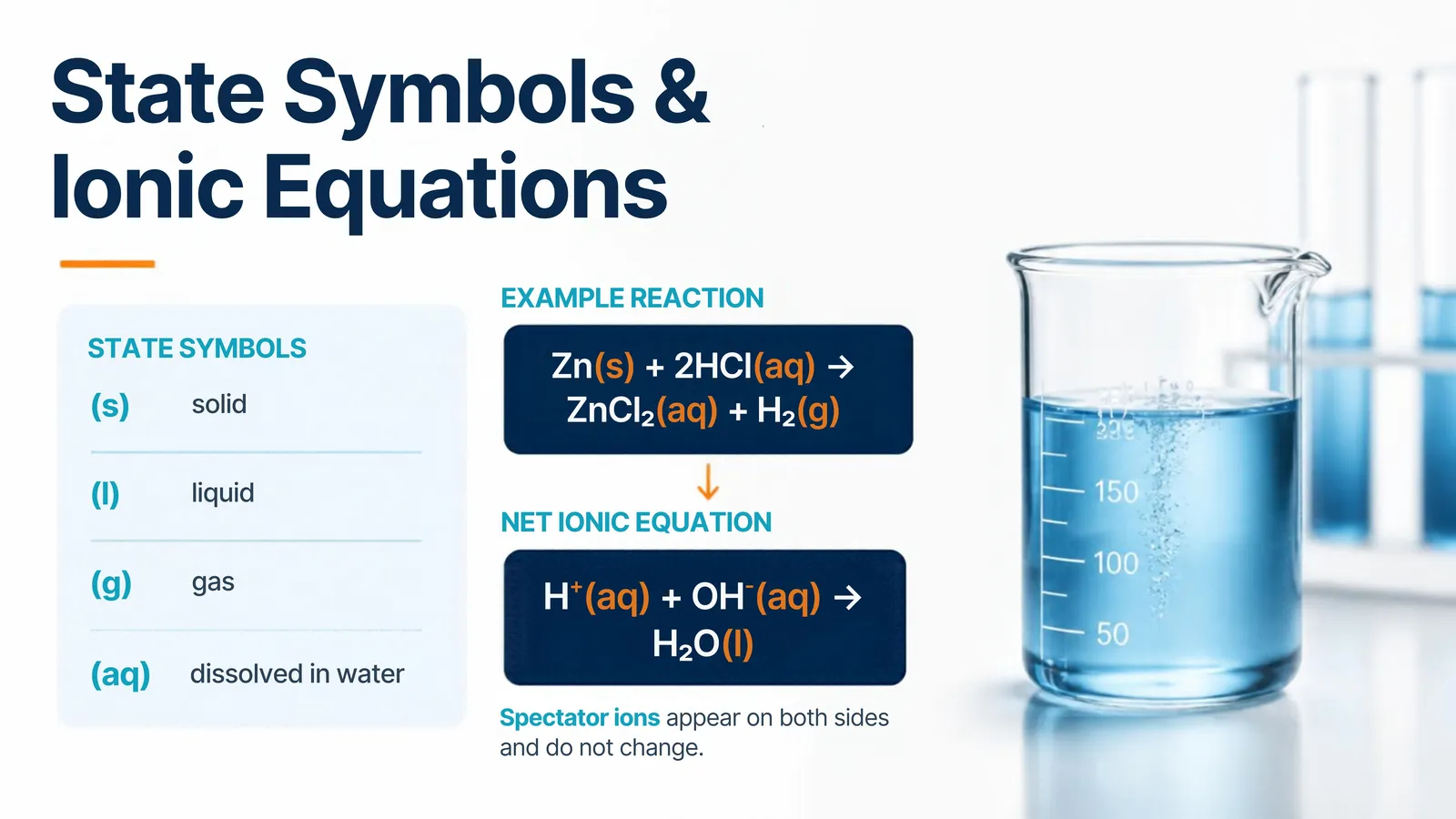
(s) solid
(l) liquid
(g) gas
(aq) aqueous, meaning dissolved in water
For example: Zn(s) + 2HCl(aq) → ZnCl2(aq) + H2(g)
Ionic equations
An ionic equation shows only the particles that actually change. For every neutralisation between an acid and an alkali:
H+(aq) + OH−(aq) → H2O(l)
The ions that do not change, such as Na+ and Cl−, are spectator ions and are left out.
Slide: State symbols and ionic equations
(s), (l), (g), (aq) and spectator ions
1/1
Part 3: Relative Formula Mass (Mr)
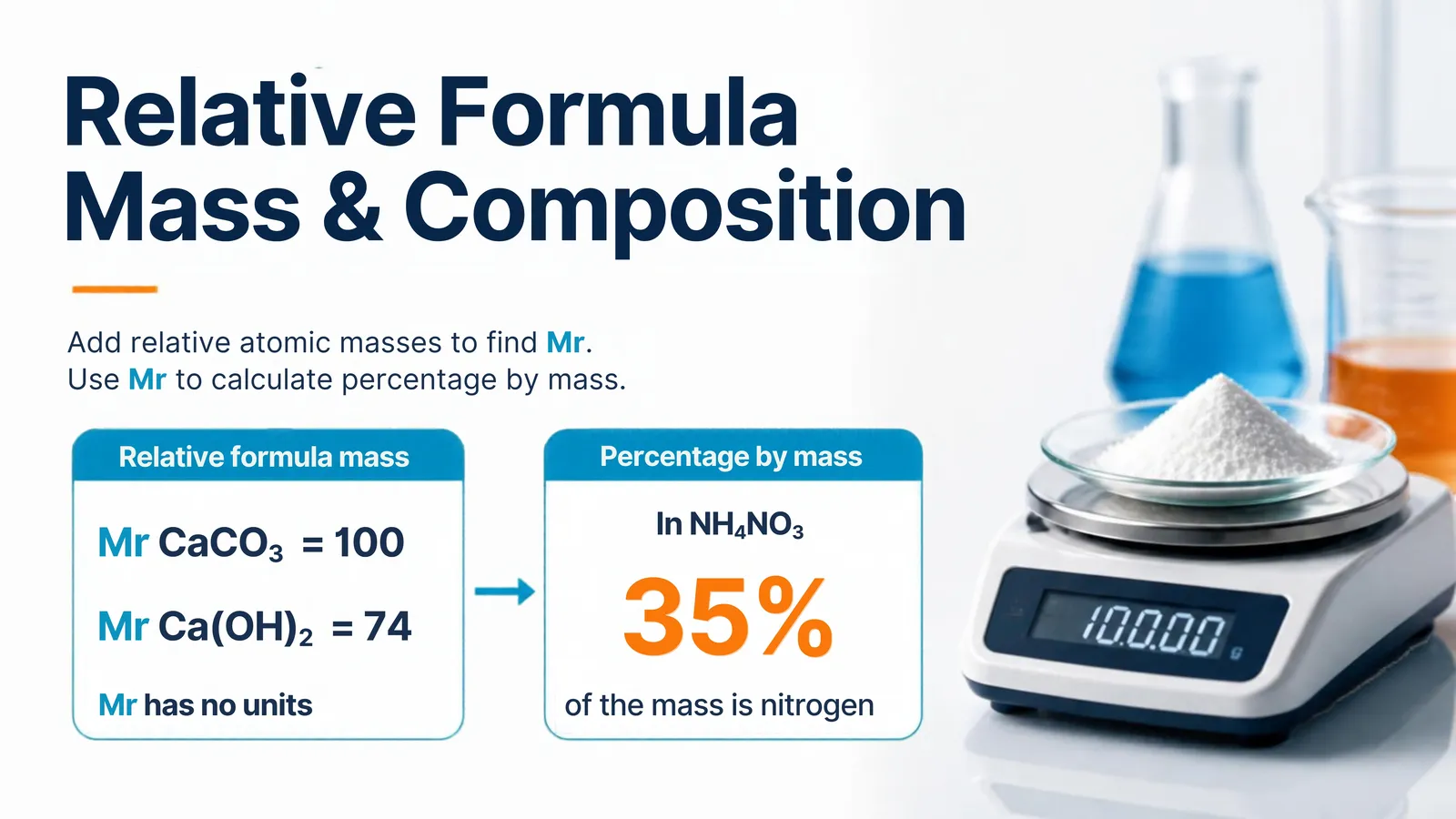
The relative atomic mass (Ar) of each element is found in the Periodic Table. The relative formula mass (Mr) of a compound is the sum of the relative atomic masses of all the atoms in its formula.
Worked example: find the Mr of calcium carbonate, CaCO3 (Ar: Ca = 40, C = 12, O = 16).
Mr = 40 + 12 + (3 × 16) = 100
Worked example: find the Mr of Ca(OH)2 (H = 1).
Mr = 40 + 2 × (16 + 1) = 74
Mr has no units, because it is a relative value.
Percentage by mass of an element
% of element = (Ar × number of atoms of that element ÷ Mr) × 100
Example: percentage of nitrogen in ammonium nitrate, NH4NO3 (Mr = 80).
% N = (14 × 2 ÷ 80) × 100 = 35%
Farmers compare fertilisers using calculations like this.
Slide: Relative formula mass
Mr and percentage by mass
1/1
Part 4: The Mole
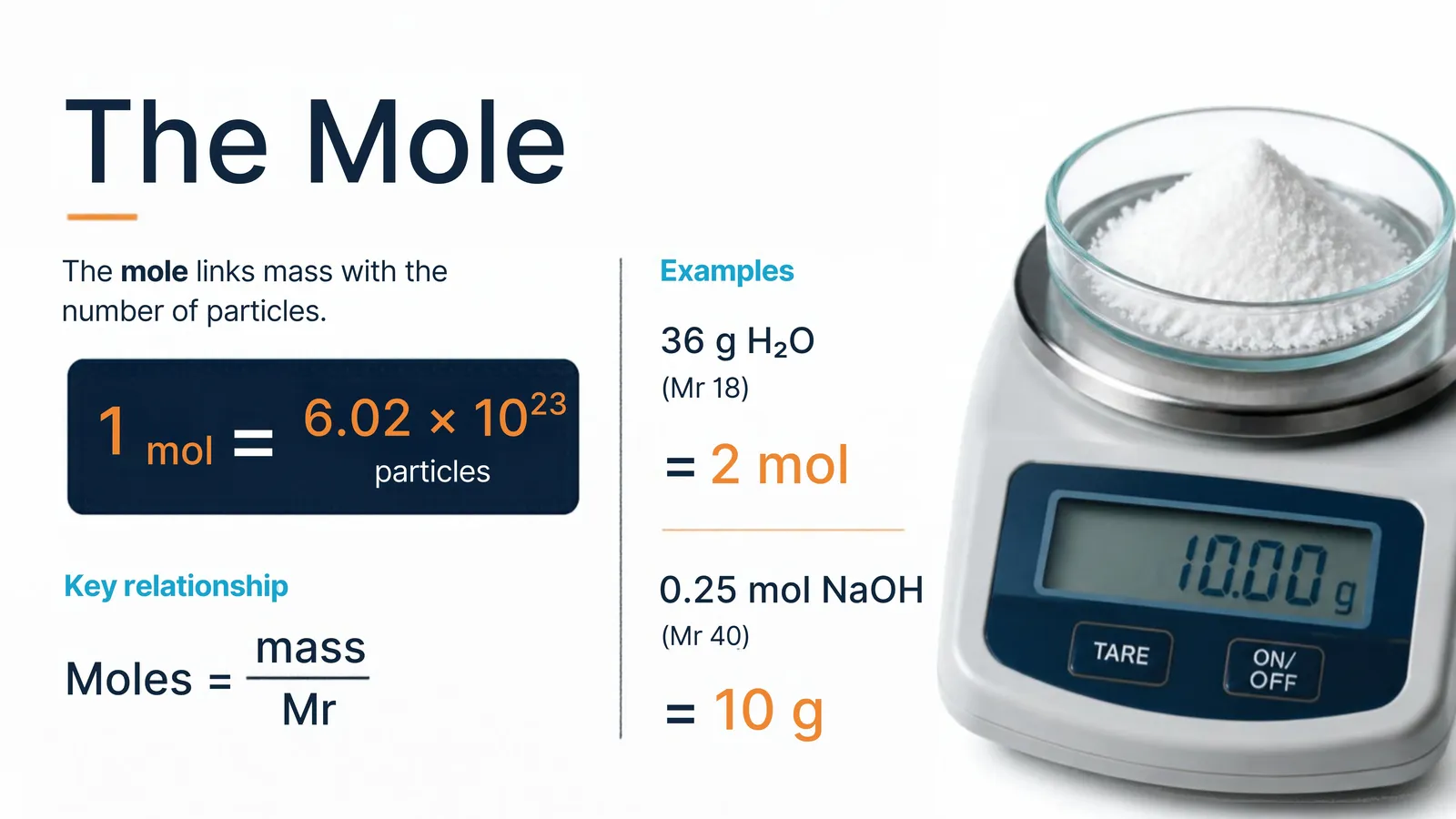
Atoms are far too small to count individually, so chemists count them in huge batches called moles. One mole of any substance contains 6.02 × 10²³ particles, a number called the Avogadro constant.
The key idea: one mole of a substance has a mass in grams equal to its Mr. One mole of carbon has a mass of 12 g; one mole of water has a mass of 18 g; one mole of calcium carbonate has a mass of 100 g.
The most important formula in chemistry
moles = mass (g) ÷ Mr
Rearranged: mass = moles × Mr, and Mr = mass ÷ moles.
Example: how many moles are in 36 g of water (Mr = 18)? Moles = 36 ÷ 18 = 2 mol.
Example: what is the mass of 0.25 mol of sodium hydroxide, NaOH (Mr = 40)? Mass = 0.25 × 40 = 10 g.
Slide: The mole
6.02 × 10²³ particles and moles = mass ÷ Mr
1/1
Part 5: Reacting Mass Calculations
Balanced equations tell you the ratio of moles that react. You can use this to calculate the mass of product formed or reactant needed.
The three-step method
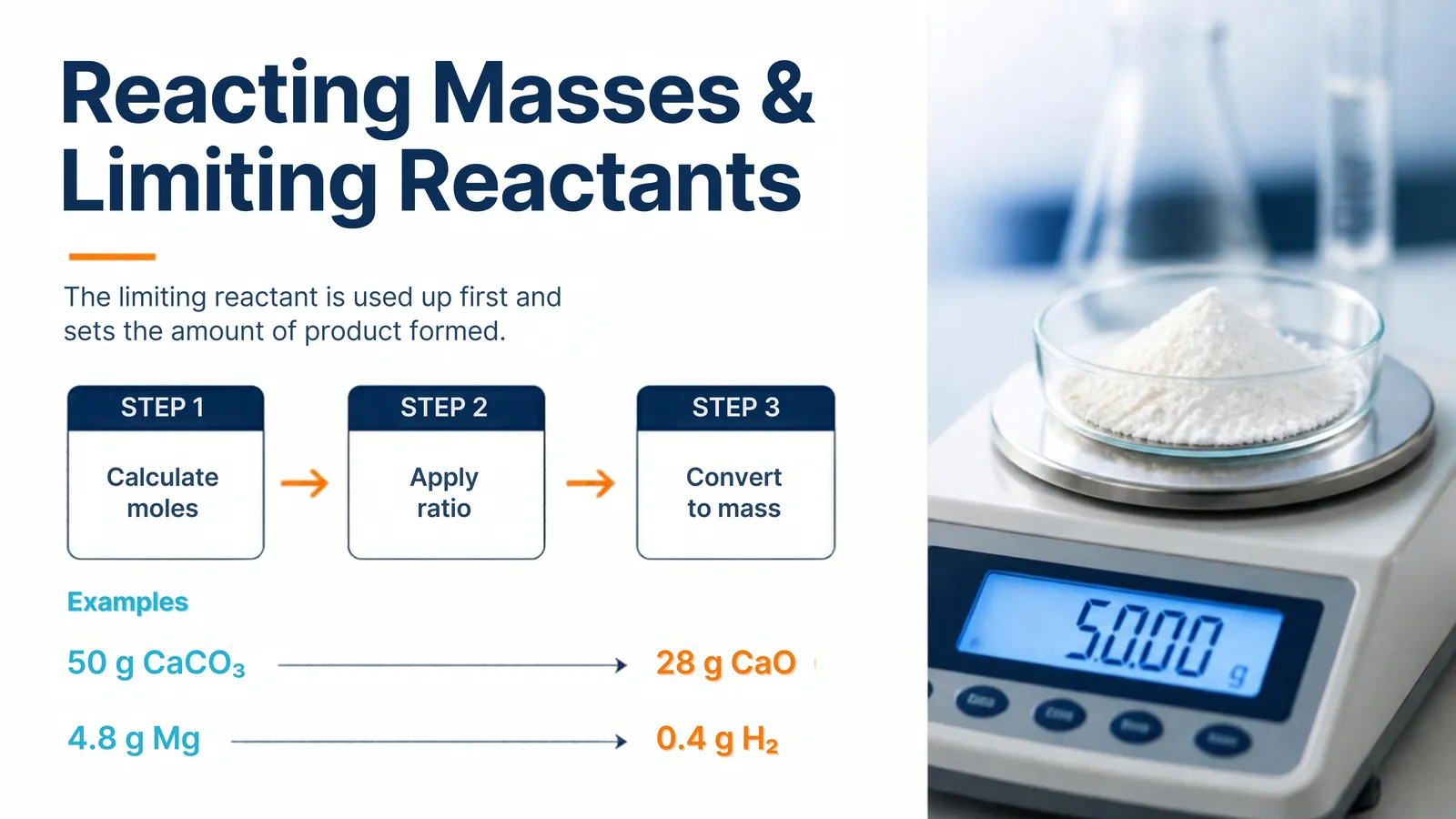
Step 1: Calculate the moles of the substance you know, using moles = mass ÷ Mr.
Step 2: Use the balanced equation to find the moles of the substance you want (the mole ratio).
Step 3: Convert moles back to mass, using mass = moles × Mr.
Worked example: What mass of calcium oxide is produced when 50 g of calcium carbonate is heated?
CaCO3 → CaO + CO2
Moles of CaCO3 = 50 ÷ 100 = 0.5 mol.
The ratio of CaCO3 to CaO is 1 : 1, so 0.5 mol of CaO forms.
Mass of CaO = 0.5 × 56 = 28 g.
Worked example with a different ratio: What mass of hydrogen is produced when 4.8 g of magnesium reacts with excess hydrochloric acid?
Mg + 2HCl → MgCl2 + H2
Moles of Mg = 4.8 ÷ 24 = 0.2 mol.
The ratio of Mg to H2 is 1 : 1, so 0.2 mol of H2 forms.
Mass of H2 = 0.2 × 2 = 0.4 g.
Limiting reactants
When two reactants are mixed, the one that is completely used up is the limiting reactant; it controls how much product forms. The other is in excess. To find the limiting reactant, calculate the moles of each and compare them with the ratio in the equation.
Slide: Reacting masses and limiting reactants
Calculate moles, apply the ratio, convert to mass
1/1
Part 6: Empirical and Molecular Formulae
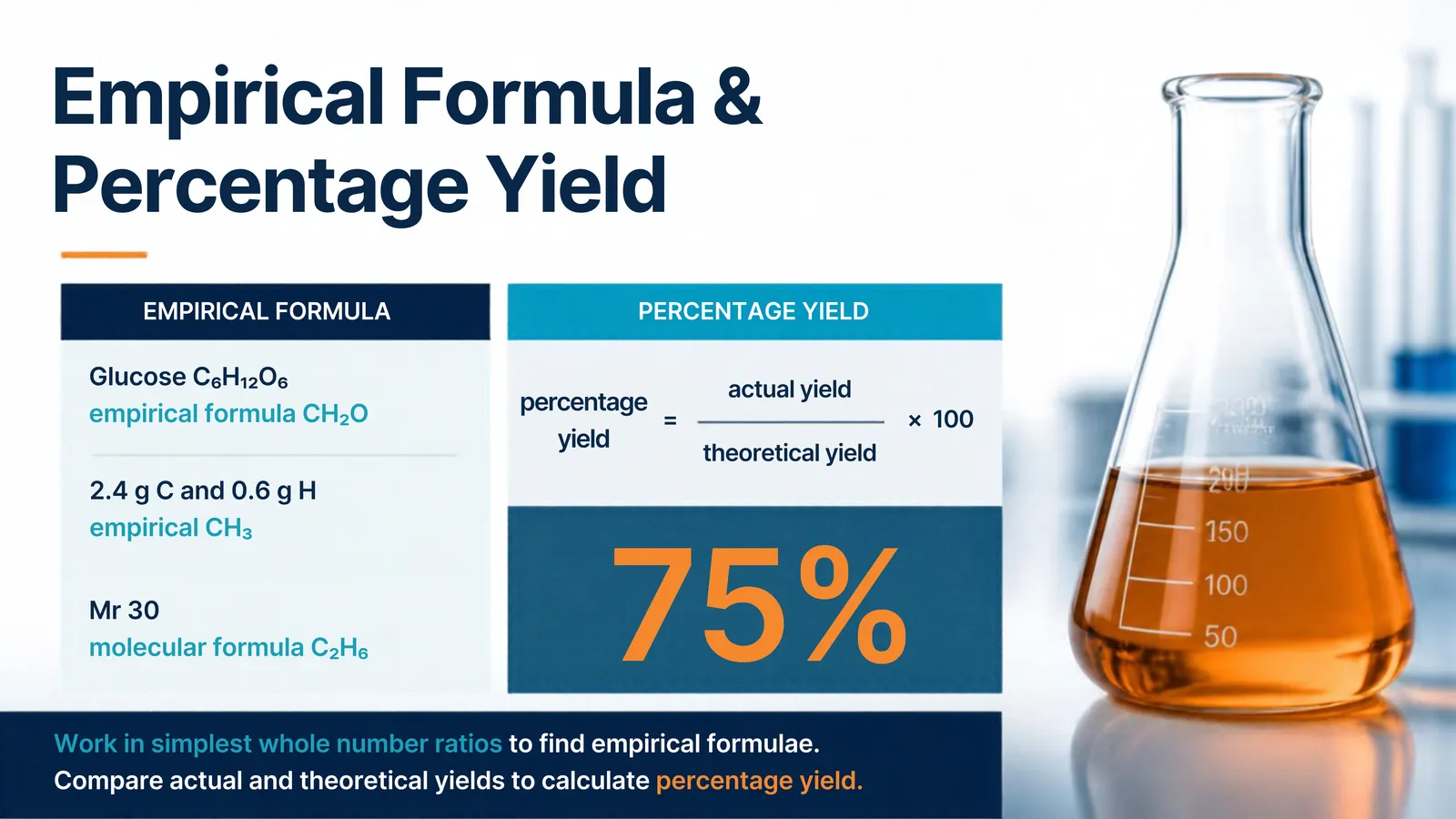
The empirical formula is the simplest whole-number ratio of atoms in a compound. The molecular formula shows the actual number of atoms in one molecule. For example, glucose has the molecular formula C6H12O6 and the empirical formula CH2O.
Worked example: a compound contains 2.4 g of carbon and 0.6 g of hydrogen. Find its empirical formula.
| Carbon | Hydrogen | |
|---|---|---|
| Mass (g) | 2.4 | 0.6 |
| Divide by Ar | 2.4 ÷ 12 = 0.2 | 0.6 ÷ 1 = 0.6 |
| Divide by smallest | 0.2 ÷ 0.2 = 1 | 0.6 ÷ 0.2 = 3 |
| Ratio | 1 | 3 |
The empirical formula is CH3. If the Mr of the compound is 30, the empirical formula mass is 15, so the molecular formula is twice that: C2H6 (ethane).
Part 7: Percentage Yield
The theoretical yield is the maximum mass of product you could get, calculated from the equation. The actual yield is what you really obtain. In practice it is always lower because some product is lost during filtering and transferring, the reaction may be reversible, or side reactions may occur.
percentage yield = (actual yield ÷ theoretical yield) × 100
Example: the theoretical yield of calcium oxide is 28 g, but only 21 g is collected. Percentage yield = (21 ÷ 28) × 100 = 75%.
Slide: Empirical formula and percentage yield
Simplest whole-number ratios and actual vs theoretical yield
1/1
Part 8: Gas Volumes
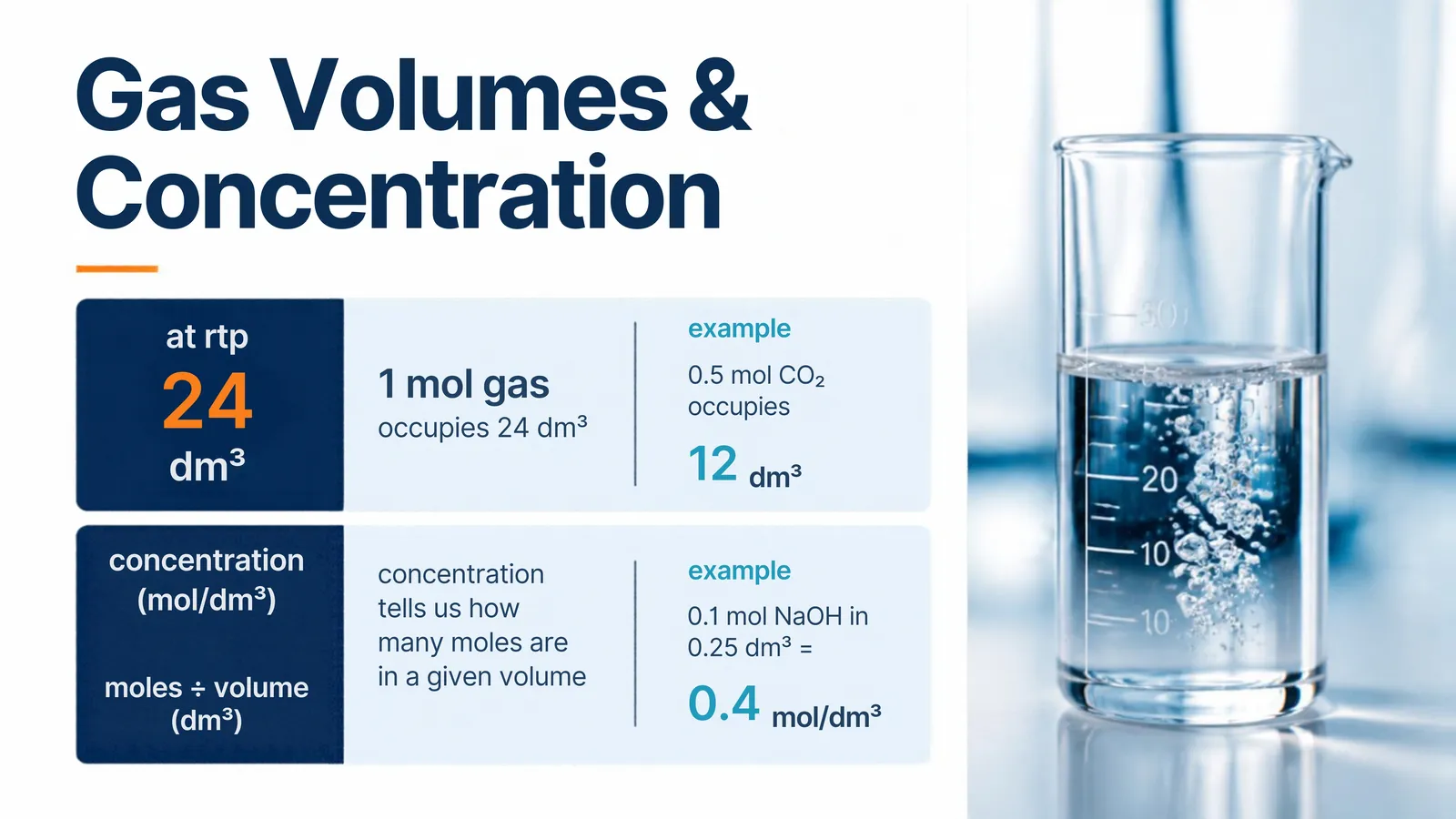
At room temperature and pressure (rtp), one mole of any gas occupies 24 dm³ (24,000 cm³).
volume of gas (dm³) = moles × 24
Example: what volume of carbon dioxide is produced when 0.5 mol of calcium carbonate decomposes? The ratio is 1 : 1, so 0.5 mol of CO2 forms. Volume = 0.5 × 24 = 12 dm³.
Part 9: Concentration of Solutions
Concentration tells you how much solute is dissolved in a volume of solution.
concentration (mol/dm³) = moles ÷ volume (dm³)
concentration (g/dm³) = mass (g) ÷ volume (dm³)
Remember to convert cm³ to dm³ by dividing by 1000.
Example: 0.1 mol of sodium hydroxide is dissolved to make 250 cm³ of solution. Volume = 250 ÷ 1000 = 0.25 dm³. Concentration = 0.1 ÷ 0.25 = 0.4 mol/dm³.
Slide: Gas volumes and concentration
24 dm³ per mole at rtp, and moles ÷ volume
1/1
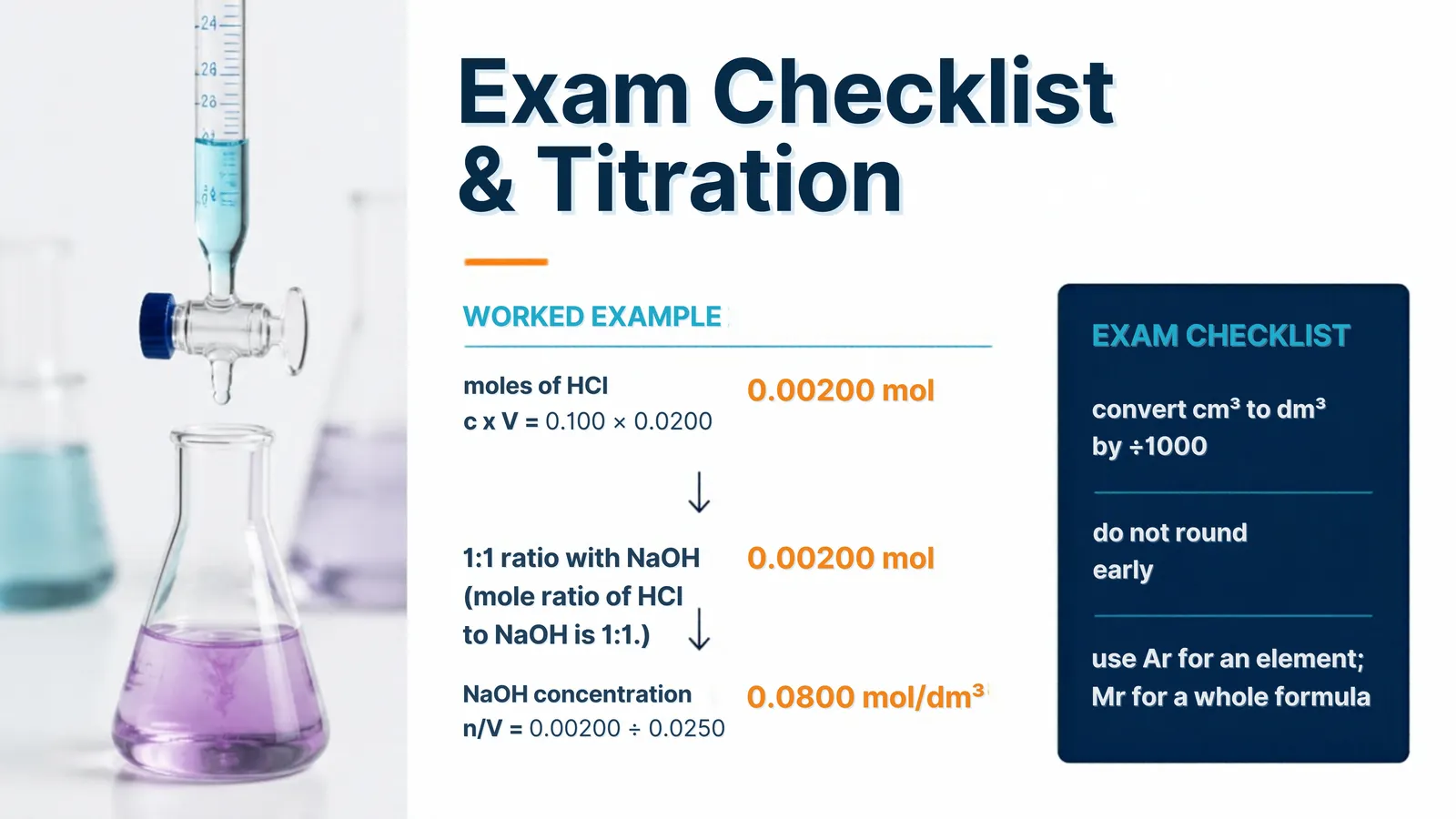
These formulae are used in titrations to find the unknown concentration of an acid or alkali. For example, if 25.0 cm³ of sodium hydroxide solution is exactly neutralised by 20.0 cm³ of 0.100 mol/dm³ hydrochloric acid, the moles of acid are 0.100 × 0.0200 = 0.00200 mol. The equation NaOH + HCl → NaCl + H2O has a 1 : 1 ratio, so the concentration of the alkali is 0.00200 ÷ 0.0250 = 0.0800 mol/dm³.
Slide: Titration and exam checklist
A worked titration plus three exam habits
1/1
Common Calculation Mistakes
Changing subscripts instead of coefficients when balancing.
Forgetting that the bracket number multiplies everything inside.
Using the mass of an element instead of the Mr of the whole compound.
Ignoring the mole ratio in the balanced equation.
Forgetting to convert cm³ to dm³.
Rounding too early. Keep full numbers until the final answer.
Frequently Asked Questions
Why do we use moles instead of grams?
Reactions happen between particles, not grams. Moles let chemists count particles by weighing, so they can mix reactants in exactly the right ratios.
Can a percentage yield be over 100%?
Not genuinely. A result over 100% usually means the product is still wet or contains impurities.
What is the difference between Ar and Mr?
Ar refers to a single element's atoms; Mr is the total for all the atoms in a formula.
Key Takeaways
Formulae show the elements and number of atoms; ionic formulae balance the charges.
Balanced equations have equal numbers of each atom on both sides; only change coefficients.
Mr is the sum of the Ar values of all atoms in a formula.
Moles = mass ÷ Mr is the key to every calculation.
Use the mole ratio from the equation for reacting masses, gas volumes and yields.
Practice is the secret to mastering calculations. Try our Chemistry Calculations Practice Book for hundreds of exam-style questions with full worked answers.
🗂️ Revision Flashcards
Tap a card to reveal the answer.
🎯 Quick Quiz
8 questions. Pick an answer to check it straight away.
1What is the correct formula of aluminium oxide (Al³⁺ and O²⁻)?
Swap and drop the charge numbers: Al³⁺ and O²⁻ give Al₂O₃.
2Which is the balanced equation for methane burning?
4 H needs 2H₂O; then 2 + 2 = 4 O on the right needs 2O₂ on the left.
3What is the Mr of calcium carbonate, CaCO₃ (Ca = 40, C = 12, O = 16)?
40 + 12 + (3 × 16) = 100.
4How many moles are in 36 g of water (Mr = 18)?
moles = mass ÷ Mr = 36 ÷ 18 = 2 mol.
5What mass of calcium oxide (Mr 56) forms when 50 g of CaCO₃ (Mr 100) is heated? CaCO₃ → CaO + CO₂
50 ÷ 100 = 0.5 mol CaCO₃; 1 : 1 ratio gives 0.5 mol CaO; 0.5 × 56 = 28 g.
6A compound contains 2.4 g of carbon and 0.6 g of hydrogen. What is its empirical formula?
2.4 ÷ 12 = 0.2 and 0.6 ÷ 1 = 0.6; divide by 0.2 to get 1 : 3, so CH₃.
7The theoretical yield is 28 g but only 21 g is collected. What is the percentage yield?
(21 ÷ 28) × 100 = 75%.
80.1 mol of NaOH is dissolved to make 250 cm³ of solution. What is the concentration?
250 cm³ = 0.25 dm³; 0.1 ÷ 0.25 = 0.4 mol/dm³.