Hanging on the wall of almost every science classroom in the world is one remarkable chart. The Periodic Table is far more than a list of elements. It is a map that lets chemists predict how an element will behave before they have even seen it. Once you understand how it is arranged, you can work out an element's electron arrangement, whether it is a metal or non-metal, what ions it forms and how reactive it will be. In this guide we explain how to read the Periodic Table, how it was invented, the key groups you must know and the trends that make it so powerful.
📖 Lesson
How the Periodic Table is arranged, how it was invented, the key groups you must know and the trends that make it so powerful.
What Is the Periodic Table?
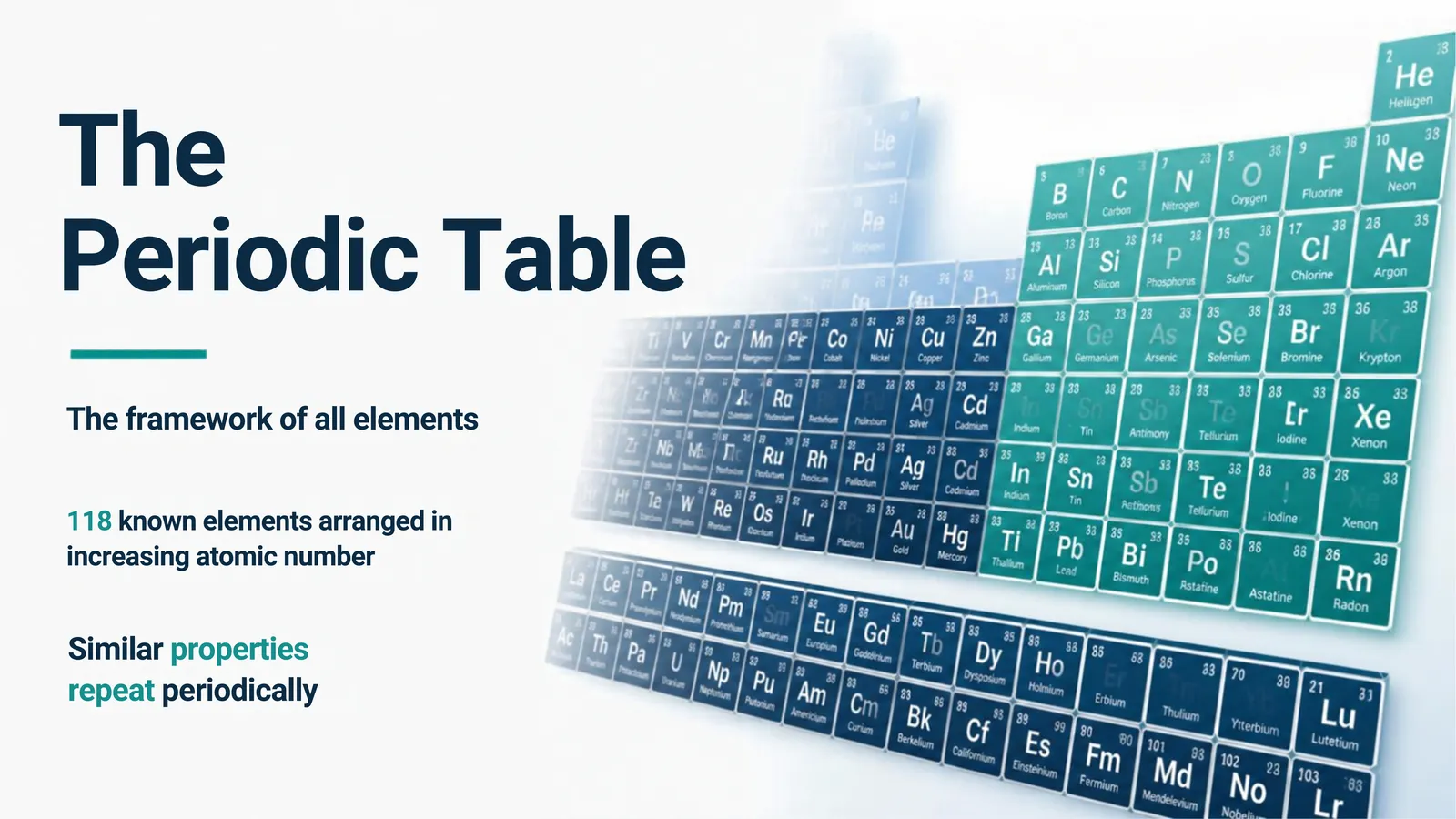
The Periodic Table is a chart of all the chemical elements, arranged in order of increasing atomic number so that elements with similar properties fall into the same vertical columns. The word "periodic" means repeating: similar properties appear again and again at regular intervals as the atomic number increases.
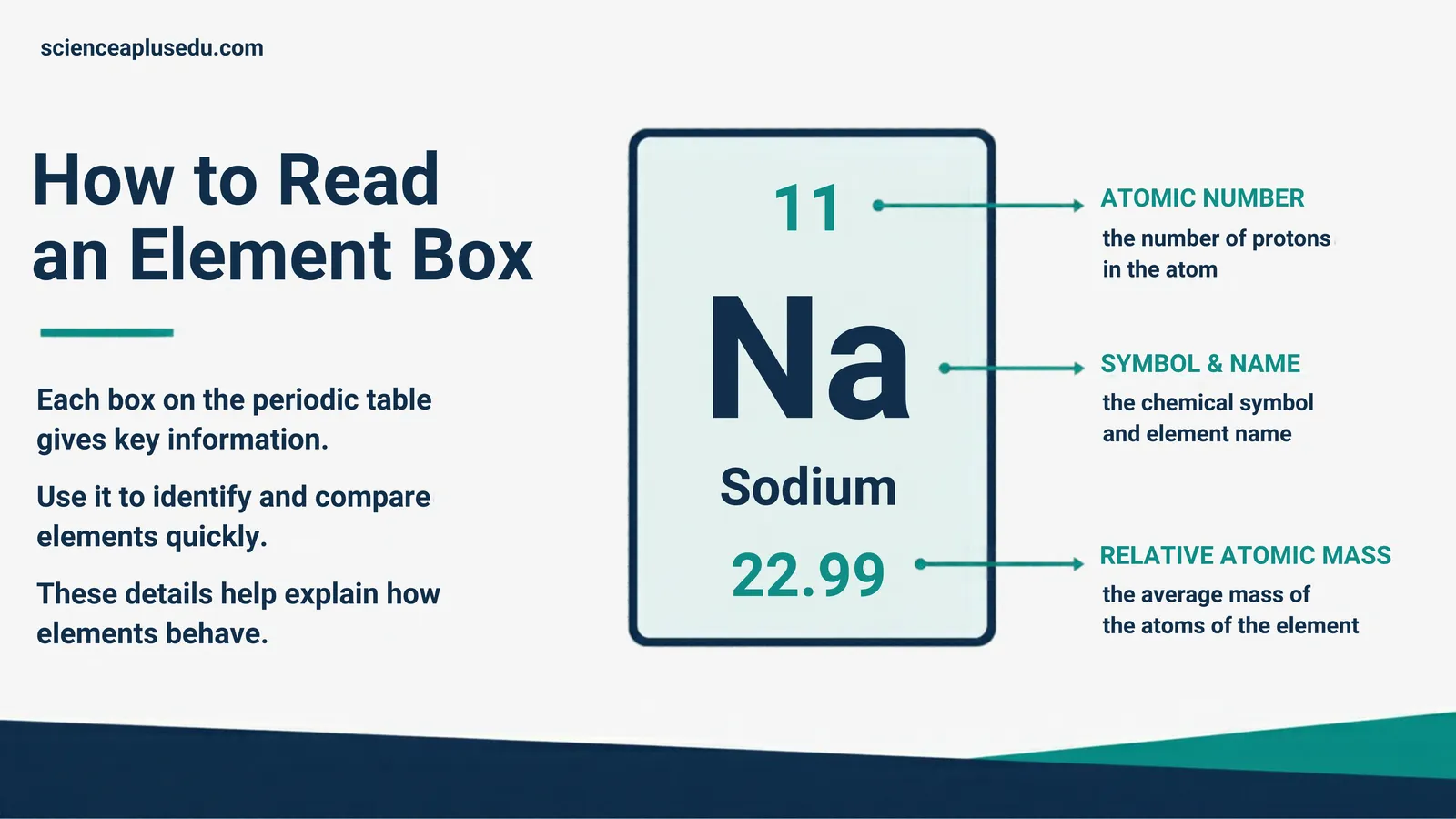
Each box in the table usually shows:
The chemical symbol, such as C, Na or Fe.
The name of the element.
The atomic number (proton number), usually the smaller number.
The relative atomic mass, usually the larger number.
Slides: The Periodic Table and the element box
What each box tells you
1/2
Groups: The Vertical Columns
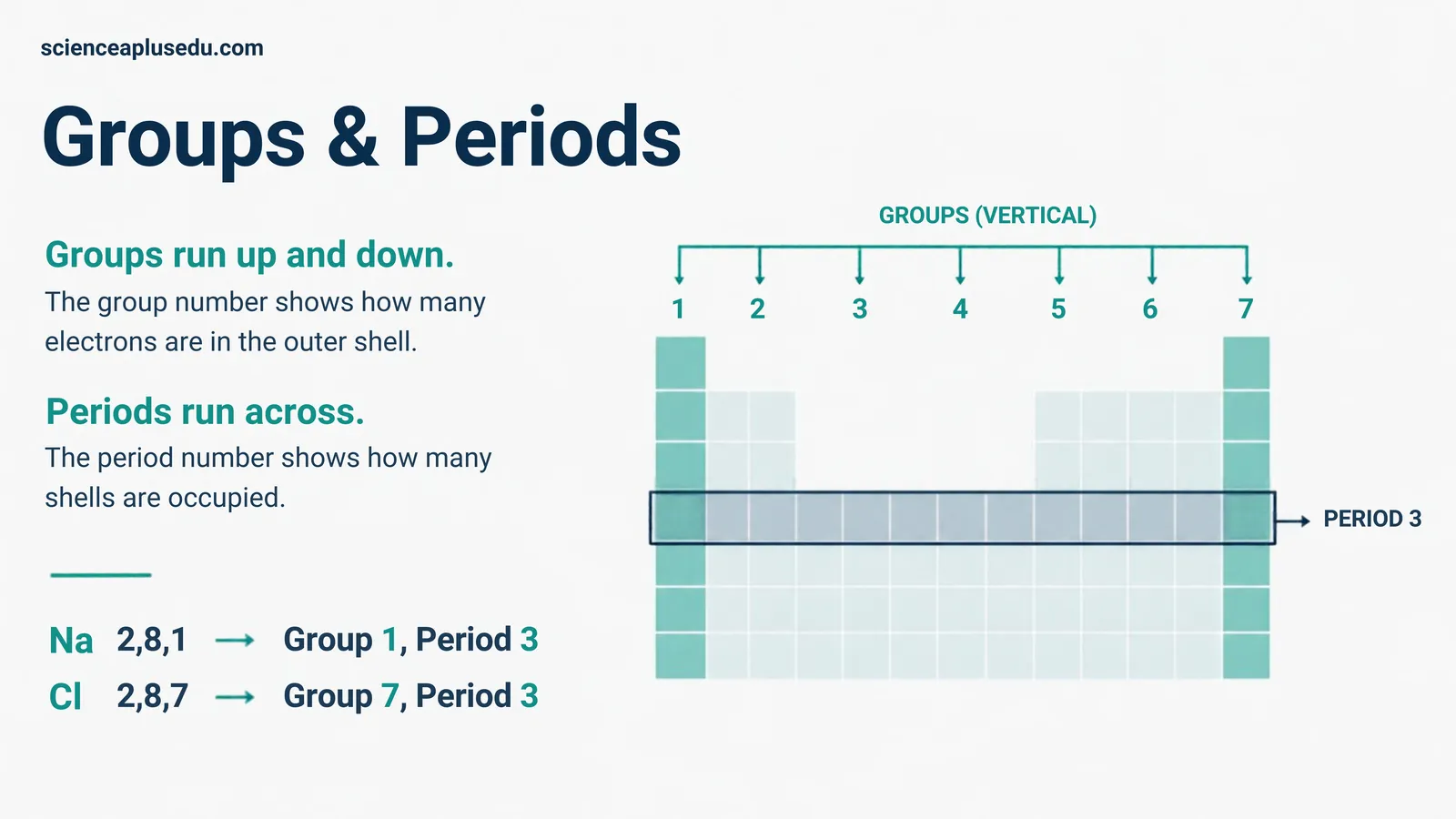
A group is a vertical column. There are 18 groups in the modern table. In IGCSE and GCSE Chemistry, the main groups are often numbered 1 to 7, with the noble gases as Group 0 (or Group 8), while the modern IUPAC system numbers them 1 to 18.
The most important rule is:
The group number equals the number of electrons in the outer shell (for Groups 1 to 7).
Sodium (2, 8, 1) has one outer electron, so it is in Group 1. Oxygen (2, 6) has six outer electrons, so it is in Group 6. Because chemical reactions involve outer electrons, elements in the same group have similar chemical properties. That is why lithium, sodium and potassium all react with water in the same way.
Periods: The Horizontal Rows
A period is a horizontal row. There are seven periods.
The period number equals the number of occupied electron shells.
Sodium has three occupied shells (2, 8, 1), so it is in Period 3. As you move across a period from left to right, the atomic number increases by one each time, so one extra proton and one extra electron are added.
| Element | Electronic configuration | Group | Period |
|---|---|---|---|
| Lithium | 2, 1 | 1 | 2 |
| Carbon | 2, 4 | 4 | 2 |
| Magnesium | 2, 8, 2 | 2 | 3 |
| Chlorine | 2, 8, 7 | 7 | 3 |
| Potassium | 2, 8, 8, 1 | 1 | 4 |
Using this link, you can work out the position of any of the first 20 elements from its electron arrangement, or its electron arrangement from its position.
Slide: Groups and periods
Columns give outer electrons, rows give shells
1/1
Metals and Non-Metals
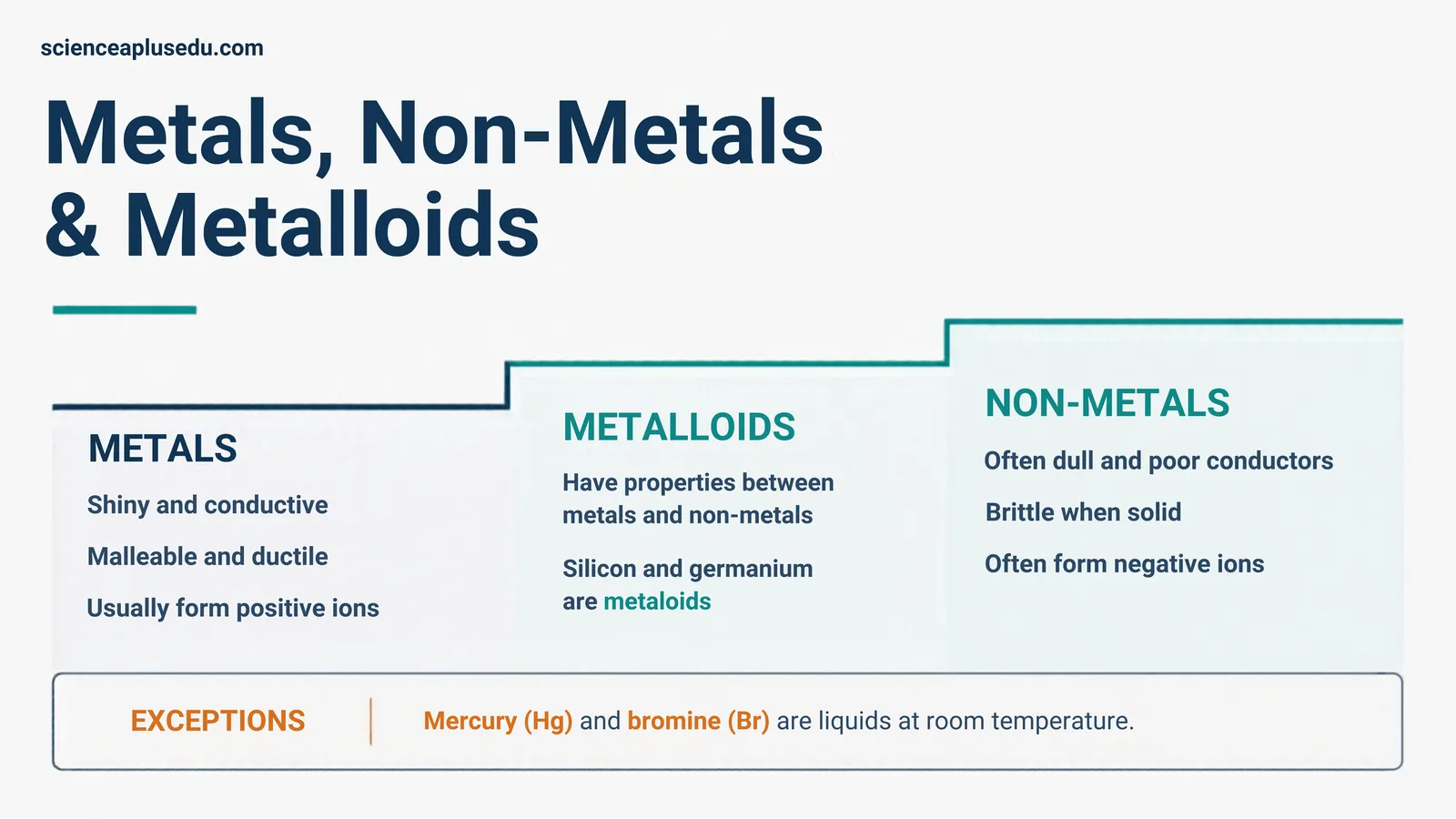
A zig-zag staircase line running from boron down to astatine separates the metals from the non-metals. Metals are on the left and in the centre; they make up about three-quarters of all elements. Non-metals are on the right. Elements close to the line, such as silicon and germanium, are metalloids with some properties of each.
| Property | Metals | Non-metals |
|---|---|---|
| Appearance | Shiny (lustrous) | Usually dull |
| State at room temperature | Solids (except mercury, a liquid) | Many are gases; bromine is a liquid |
| Melting and boiling points | Usually high | Usually low |
| Electrical conductivity | Good conductors | Poor conductors (except graphite) |
| Malleability | Malleable and ductile | Brittle when solid |
| Ions formed | Positive ions (cations) | Negative ions (anions) |
| Oxides | Basic oxides | Acidic oxides |
Why do metals form positive ions? Metal atoms usually have 1, 2 or 3 outer electrons, which they lose to gain a full outer shell. Non-metal atoms usually have 5, 6 or 7 outer electrons, so they gain electrons to fill their outer shell and form negative ions.
Slide: Metals, non-metals and metalloids
1/1
The History of the Periodic Table
The Periodic Table was not invented overnight. It took decades of work by many scientists.
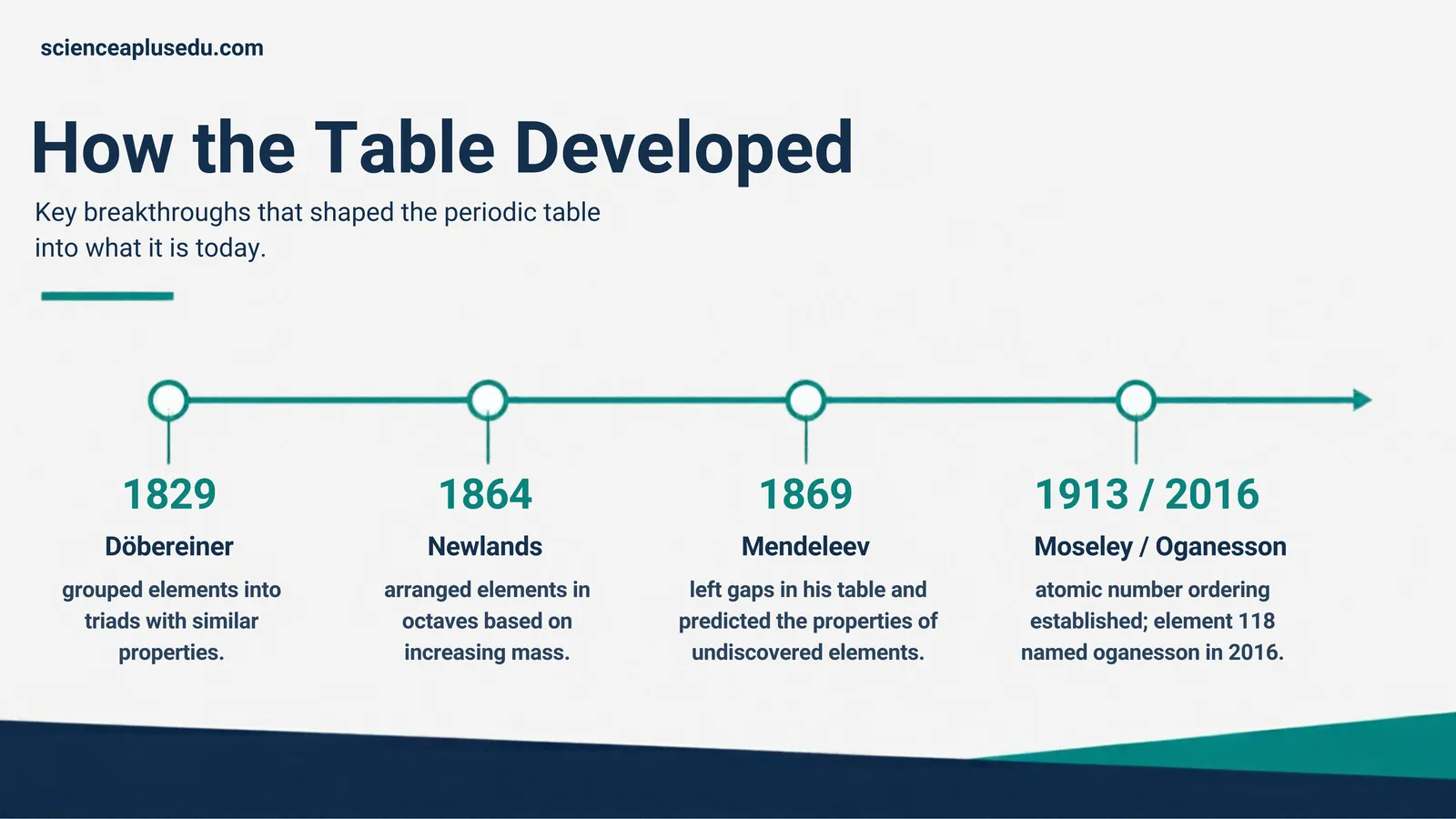
Döbereiner's triads (1829)
Johann Döbereiner noticed that some elements formed groups of three with similar properties, such as lithium, sodium and potassium, where the middle element's atomic mass was about the average of the other two.
Newlands' law of octaves (1864)
John Newlands arranged the known elements in order of atomic mass and noticed that every eighth element had similar properties, like the notes in a musical scale. His idea worked for the lighter elements but broke down later, as he forced unrelated elements into the same groups, and other scientists laughed at it.
Mendeleev's breakthrough (1869)
The Russian chemist Dmitri Mendeleev created the table that became the basis of today's version. His genius lay in three decisions:
He arranged elements mainly by atomic mass but grouped elements by their properties.
He swapped the order of some elements, such as tellurium and iodine, where atomic mass order would have put them in the wrong group.
He left gaps for elements that had not yet been discovered and predicted their properties.
When gallium (1875), scandium (1879) and germanium (1886) were discovered and matched his predictions closely, scientists were convinced that Mendeleev's table was correct. His prediction for "eka-silicon", later named germanium, was remarkably accurate.
The modern Periodic Table
When protons and isotopes were discovered in the early twentieth century, scientists realised that elements should be ordered by atomic number, not atomic mass. This explained why Mendeleev had needed to swap some pairs of elements: tellurium has a higher relative atomic mass than iodine because of its isotopes, but it has fewer protons. Henry Moseley confirmed atomic numbers experimentally in 1913. The noble gases, unknown in Mendeleev's time, were added as a new group. The table was completed up to element 118, oganesson, in 2016.
Slide: How the table developed
From triads to element 118
1/1
Key Groups of the Periodic Table
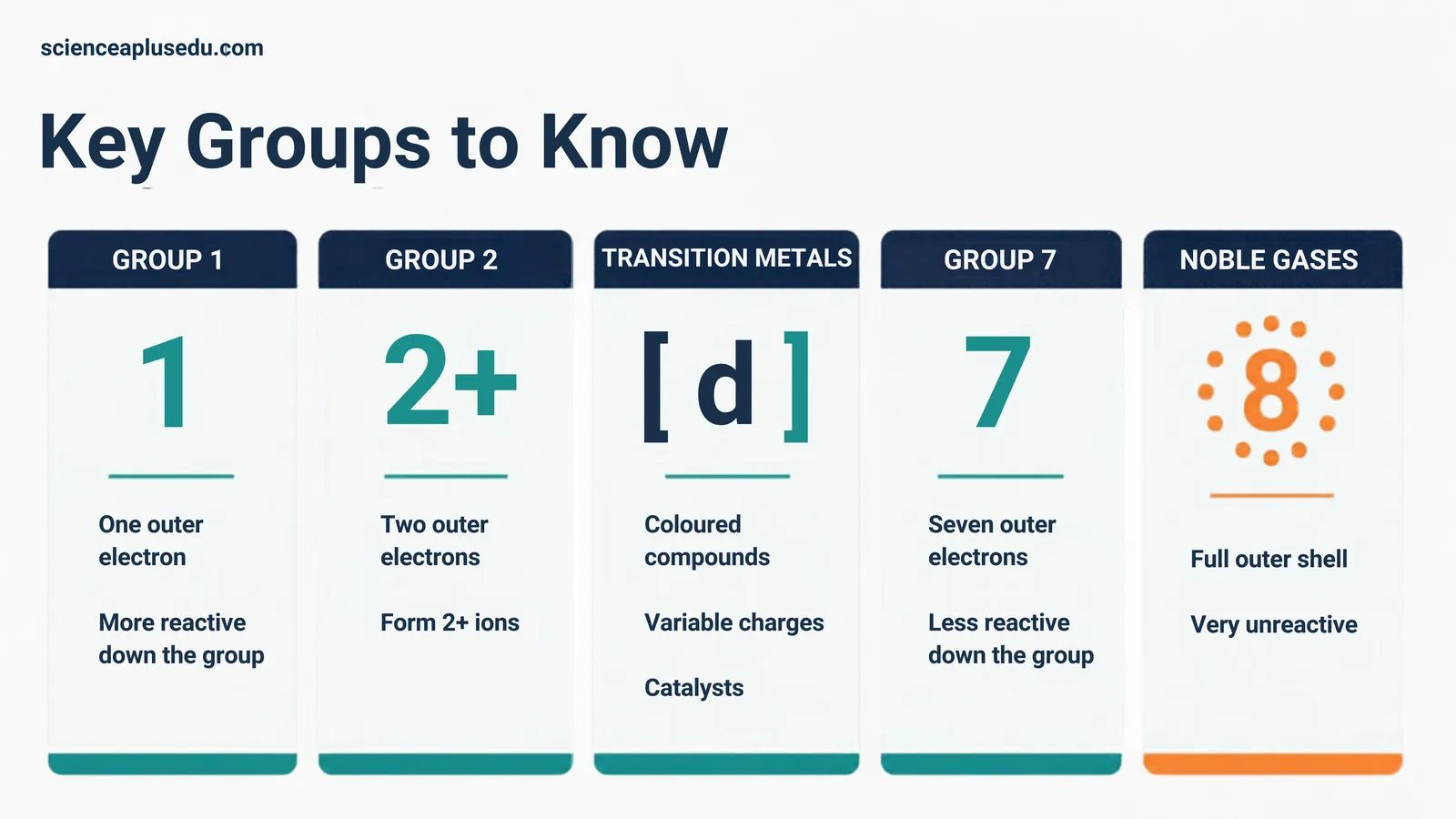
Group 1: the alkali metals
Lithium, sodium, potassium, rubidium, caesium and francium are soft, highly reactive metals with one outer electron. They react with water to form alkaline hydroxides and hydrogen, and they become more reactive down the group.
Group 2: the alkaline earth metals
Beryllium, magnesium, calcium, strontium, barium and radium have two outer electrons and form 2+ ions. They are reactive, but less so than Group 1. Calcium and magnesium are important in bones, teeth and chlorophyll.
Transition metals: the central block
The transition metals, such as iron, copper, nickel, chromium and zinc, sit between Groups 2 and 3. Compared with Group 1 metals they:
Have higher melting points and higher densities.
Are harder and stronger.
Are less reactive.
Often form coloured compounds, for example blue copper(II) sulfate and green iron(II) salts.
Can form ions with different charges, such as Fe2+ and Fe3+, which is why Roman numerals are used in their names.
Are often useful catalysts, such as iron in the Haber process and nickel in making margarine.
Group 7: the halogens
Fluorine, chlorine, bromine and iodine are reactive non-metals that exist as diatomic molecules. They have seven outer electrons and form 1− ions. Unlike Group 1, they become less reactive down the group.
Group 0 (Group 8 or 18): the noble gases
Helium, neon, argon, krypton, xenon and radon have a full outer shell of electrons (helium has 2, the others have 8). This makes them very unreactive (inert). They exist as single atoms and are colourless gases. Their boiling points increase down the group.
Their unreactivity makes them useful: helium fills balloons and airships because it is less dense than air and not flammable; argon provides an unreactive atmosphere in light bulbs and for welding; and neon glows red in advertising signs.
Slide: Key groups to know
1/1
Periodic Trends You Should Know
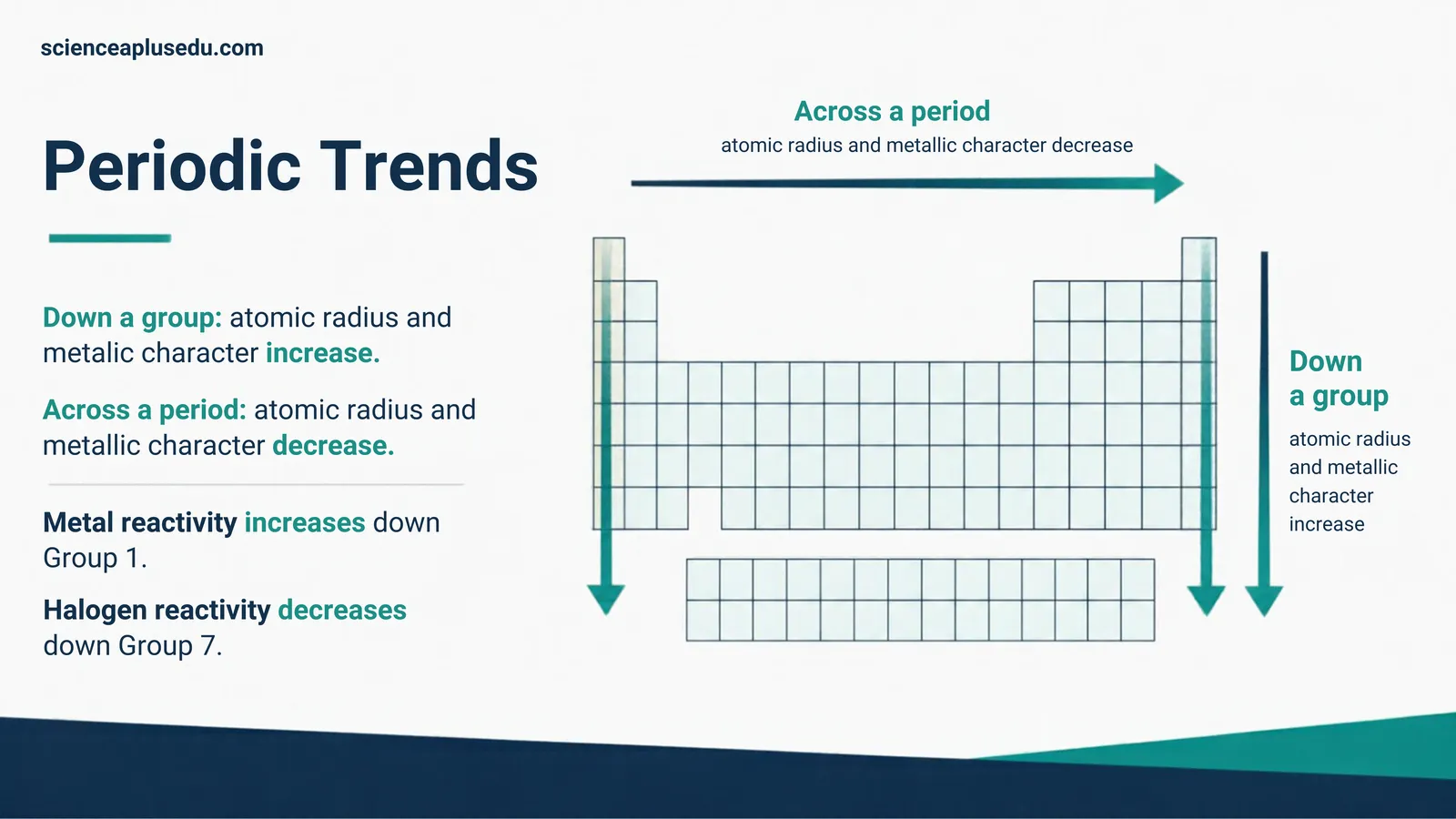
| Trend | Down a group | Across a period (left to right) |
|---|---|---|
| Atomic radius | Increases (more shells) | Decreases (more protons pull electrons closer) |
| Metallic character | Increases | Decreases (metals to non-metals) |
| Reactivity of metals | Increases | Decreases |
| Reactivity of non-metals | Decreases | Increases (up to Group 7) |
Why does atomic radius decrease across a period?
Across a period, electrons are added to the same shell while the number of protons increases. The greater positive charge of the nucleus pulls the electrons closer, so atoms become smaller.
Why are trends in Groups 1 and 7 opposite?
Metals react by losing electrons, which becomes easier down a group because the outer electrons are further from the nucleus. Non-metals react by gaining electrons, which becomes harder down a group for the same reason.
Slide: Periodic trends
Down a group and across a period
1/1
Trends Across Period 3
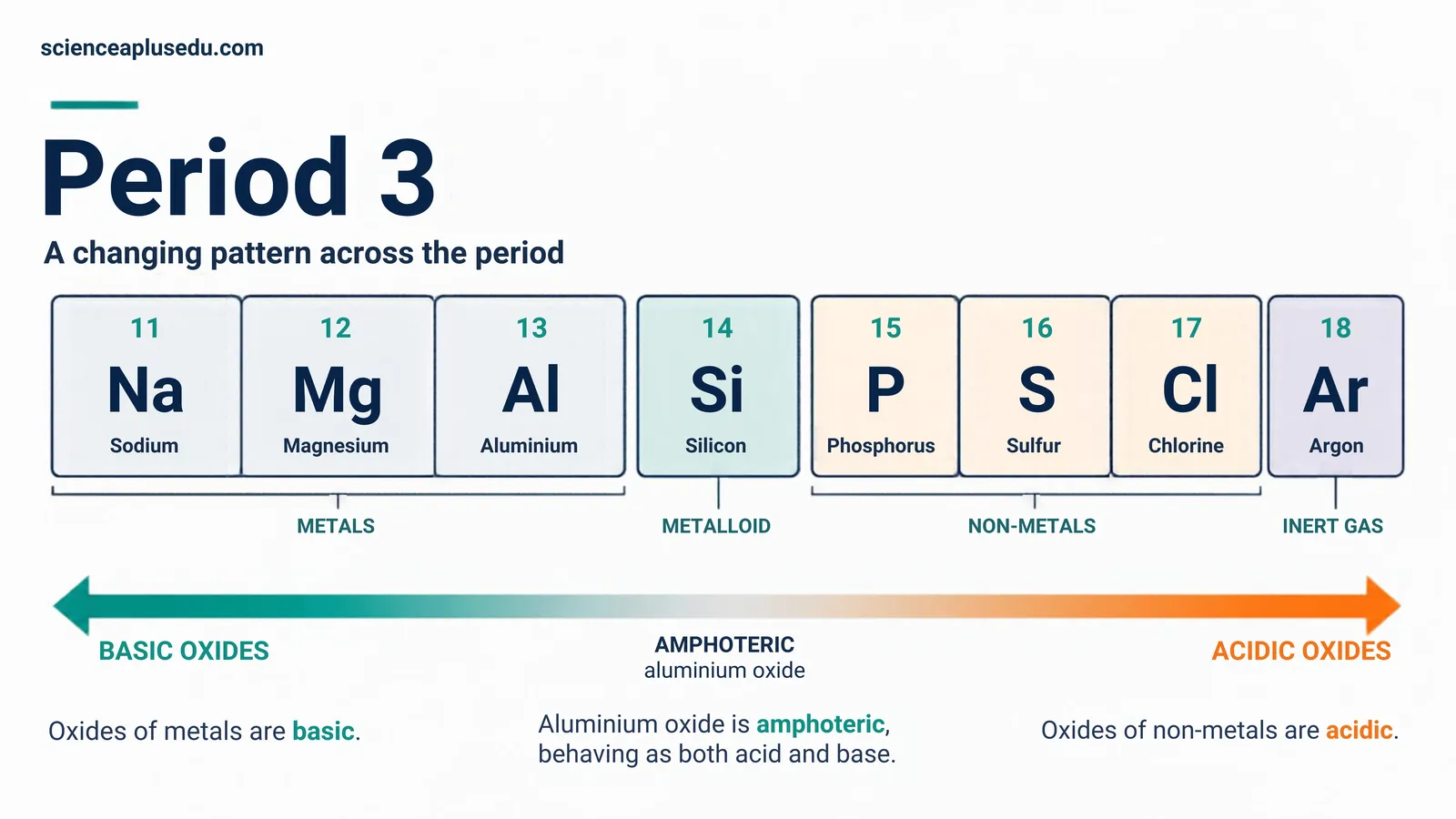
Period 3 shows the change from metals to non-metals very clearly. Moving from left to right: sodium, magnesium and aluminium are shiny metals that conduct electricity; silicon is a metalloid with a giant covalent structure and a very high melting point; phosphorus, sulfur and chlorine are non-metals made of small molecules with low melting points; and argon is an unreactive noble gas made of single atoms. The oxides change in the same way. Sodium oxide and magnesium oxide are basic and form alkaline solutions, aluminium oxide is amphoteric (it reacts with both acids and bases), and the oxides of phosphorus and sulfur are acidic. This pattern is a perfect example of periodicity: the same change from metal to non-metal repeats across Period 2 and Period 4 as well.
Slide: Period 3
From metals to non-metals
1/1
Blocks of the Periodic Table
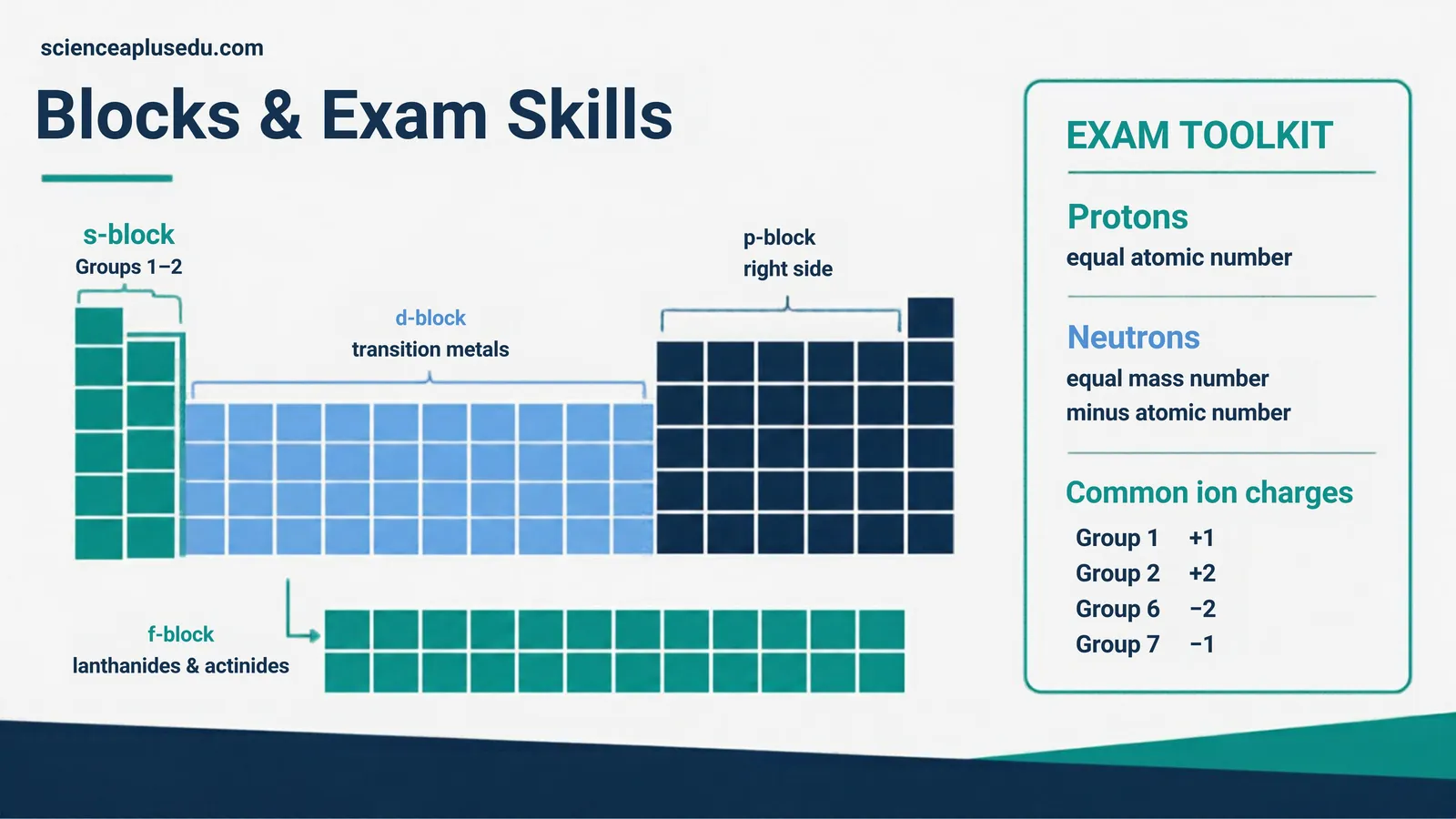
At a more advanced level, the table is divided into four blocks according to which type of electron orbital is being filled: the s-block (Groups 1 and 2), the p-block (Groups 3 to 0), the d-block (the transition metals) and the f-block (the lanthanides and actinides, usually shown as two separate rows at the bottom of the table). The f-block elements are placed at the bottom only to stop the table from becoming too wide to print.
How to Use the Periodic Table in Exams
Find the number of protons and electrons from the atomic number.
Work out neutrons using mass number minus atomic number.
Predict ion charges: Group 1 forms 1+, Group 2 forms 2+, Group 3 forms 3+, Group 5 forms 3−, Group 6 forms 2− and Group 7 forms 1−.
Predict properties of unfamiliar elements using group trends.
Find relative atomic masses for calculations of relative formula mass and moles.
Slide: Blocks and exam skills
1/1
Amazing Facts About the Periodic Table
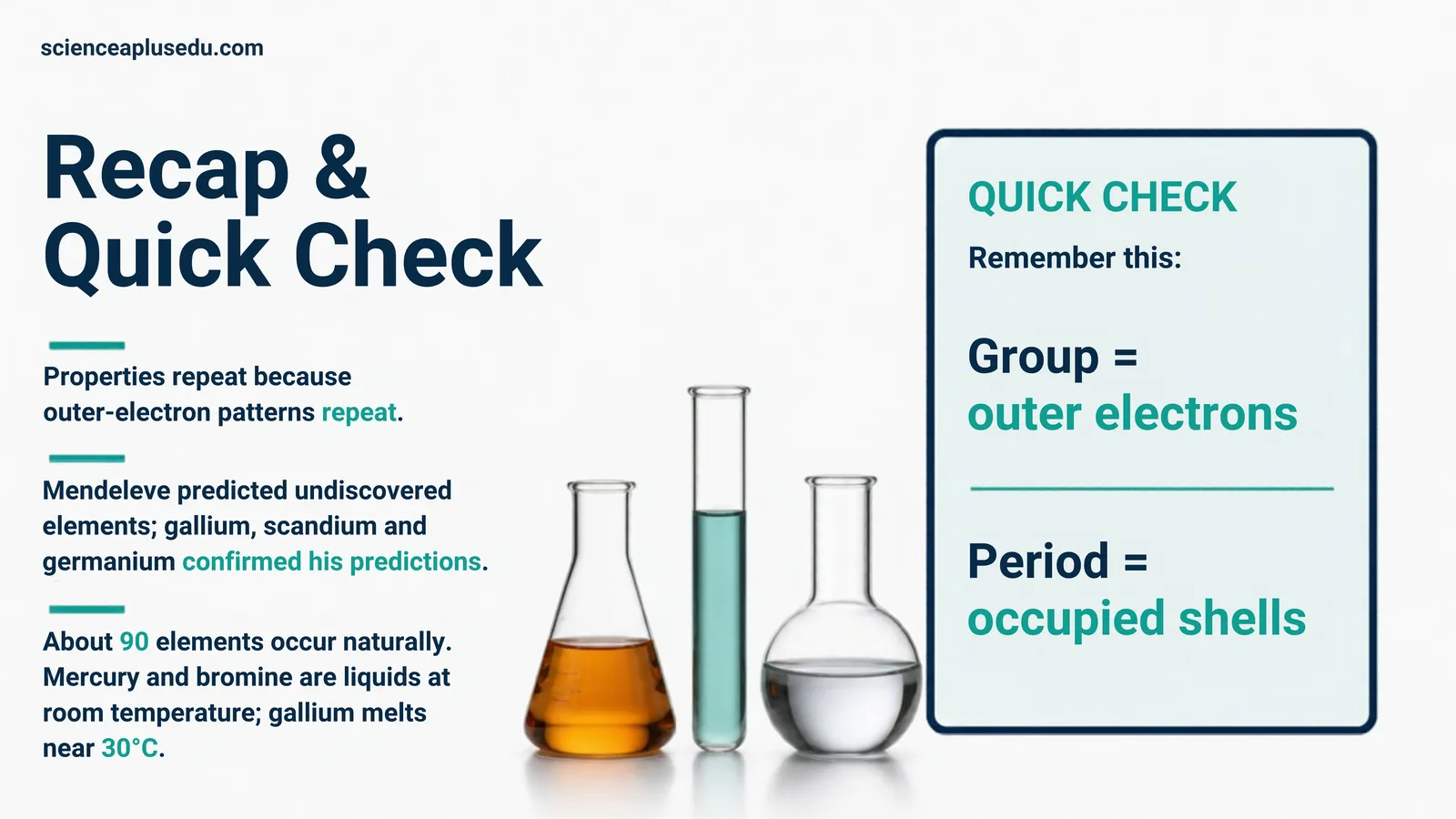
Only about 90 elements occur naturally; the rest have been made in laboratories.
Hydrogen makes up about 75 percent of the ordinary matter in the universe by mass.
Mercury and bromine are the only two elements that are liquids at room temperature.
Element 101, mendelevium, was named in honour of Mendeleev.
Gallium melts at about 30 °C, so it can melt in your hand.
Frequently Asked Questions About the Periodic Table
Why is hydrogen placed on its own?
Hydrogen has one outer electron like Group 1 metals, but it is a non-metal gas and can also gain an electron like Group 7. Its properties do not fit neatly into any group.
Why is it called the Periodic Table?
Because the properties of elements repeat periodically, in a regular pattern, as the atomic number increases.
Will more elements be discovered?
Scientists are trying to make elements 119 and 120 using particle accelerators, which would start an eighth period.
Key Takeaways
Elements are arranged in order of increasing atomic number.
Group number equals the number of outer electrons; period number equals the number of shells.
Elements in the same group have similar chemical properties.
Mendeleev left gaps and predicted undiscovered elements, proving his table's value.
Metals are on the left, non-metals on the right, and trends allow reliable predictions.
Slide: Recap and quick check
1/1
The Periodic Table is also your toolkit for chemical calculations. Continue with our guide to formulae, equations and calculations to put it to work.
🗂️ Revision Flashcards
Tap a card to reveal the answer.
🎯 Quick Quiz
8 questions. Pick an answer to check it straight away.
1Chlorine has the electronic configuration 2, 8, 7. Where is it in the Periodic Table?
Seven outer electrons gives Group 7; three occupied shells gives Period 3.
2Potassium is 2, 8, 8, 1. Which period is it in?
The period number equals the number of occupied shells, and potassium has four.
3Who left gaps in his table and predicted the properties of undiscovered elements?
Mendeleev's predictions were confirmed when gallium, scandium and germanium were discovered.
4What happens to atomic radius across a period from left to right?
More protons pull electrons in the same shell closer to the nucleus.
5What charge do Group 6 elements form when they make ions?
Group 6 forms 2− ions.
6Which group becomes LESS reactive down the group?
Halogens react by gaining electrons, which gets harder as the outer shell moves further from the nucleus.
7Aluminium oxide reacts with both acids and bases. It is described as:
Amphoteric means it reacts with both acids and bases.
8Which two elements are liquids at room temperature?
Mercury and bromine are the only two elements that are liquids at room temperature.